

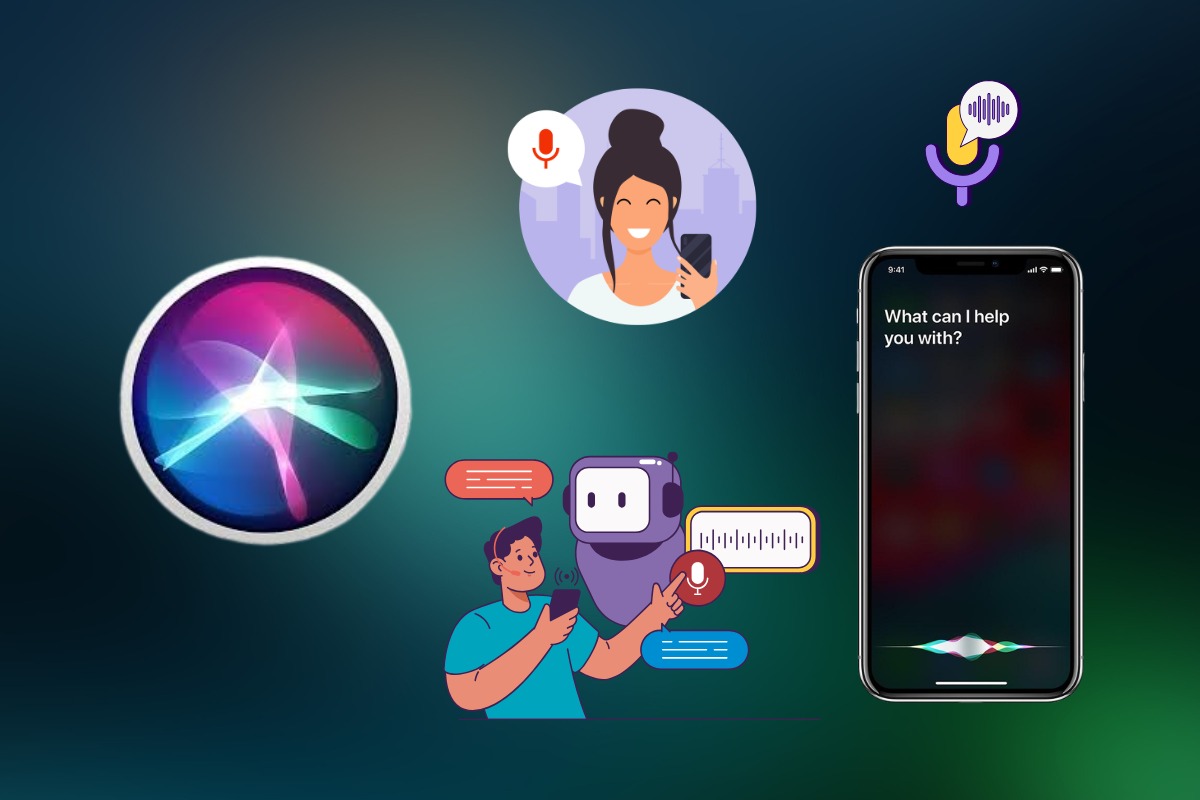
Siri enters the year at a significant turning point as Apple develops the assistant beyond traditional voice commands and toward a more conversational, context-aware AI experience. Apple’s ecosystem now spans more than 2.5 billion active devices, while nearly one in four active smartphones worldwide is an iPhone, giving Siri access to an exceptionally large potential audience across mobile, wearable, desktop, and connected-device categories.
For users, Siri remains particularly relevant for practical, hands-free tasks such as messaging, navigation, calls, reminders, timers, music, accessibility and quick information searches. Newer AI capabilities are expanding those scenarios through personal-context understanding, onscreen awareness, conversational follow-ups, and integration with Apple Intelligence and ChatGPT. The following Siri statistics examine its users, adoption, usage frequency, market position, common commands, voice commerce trends, accuracy, satisfaction, privacy, and evolving role in the competitive AI-assistant market.
Editor’s Choice
- Apple’s active hardware base surpassed 2.5 billion devices by the end of 2025, up from about 2.35 billion around a year earlier.
- Apple accounted for about 25% of the global active smartphone installed base in 2025, placing Siri on roughly one-quarter of smartphones currently in use worldwide. This percentage measures iPhones, not active Siri users.
- Only Apple and Samsung had surpassed 1 billion active smartphones each by 2025.
- Apple added more net new active smartphones during 2025 than the next seven leading smartphone brands combined, strengthening the potential reach of Siri.
- Apple captured 21% of global smartphone shipments in Q2 2026, compared with 17% in Q2 2025, providing another source of new Siri-capable devices.
- In a U.S. clinical survey published in 2025, 67.8% of participants who had used a digital voice assistant had used Siri, compared with 46.7% for Google Assistant and 46.1% for Alexa. The study used a small Michigan-based convenience sample, so it should not be treated as a national market-share estimate.
- Siri processed about 2 billion requests per week as far back as 2016. Apple has not published a comparable current request-volume figure, so using that historical total as a 2026 usage statistic would overstate what public data can support.
Recent Developments
- In June 2026, Apple introduced Siri AI, a new version of Siri designed around Apple Intelligence and a more conversational interaction model.
- New Siri AI capabilities entered developer testing on June 8, 2026, across iOS 27, iPadOS 27, macOS 27, and visionOS 27.
- Siri AI is scheduled to reach users as a beta later in 2026, initially on supported devices configured for English.
- The redesigned Siri can use personal context across Messages, Mail, Photos, and other apps to find information such as confirmations, recommendations, or past conversations.
- Siri AI also adds on-screen awareness, allowing users to ask questions about content already displayed on their device.
- The 2026 version can access current information from the web and continue answers through follow-up questions, shifting Siri closer to a conversational AI assistant rather than a one-command-at-a-time interface.
- Hardware requirements could constrain early adoption. One June 2026 analysis estimated that more than 1.3 billion existing iPhones would not support the advanced Siri capabilities because of hardware requirements.
- The same analysis estimated that more than 850 million iPhones could not handle even basic Apple Intelligence queries, showing a substantial gap between classic Siri availability and next-generation Siri AI availability.
- Siri AI will initially face geographic limits; the 2026 rollout excludes iPhone and iPad users in the EU at launch, while the new features are also unavailable in China pending regulatory resolution.
Siri Users Worldwide
- Apple had more than 2.5 billion active devices worldwide entering 2026. Siri is available across multiple Apple product families, but one person can own several devices, so this figure cannot be interpreted as 2.5 billion Siri users.
- Published industry estimates place the active iPhone base at roughly 1.6 billion units in 2025, making iPhone the largest single-device channel for Siri.
- Independent installed-base tracking found that nearly 25% of all active smartphones worldwide were iPhones in 2025.
- Apple and Samsung together represented about 44% of the global active smartphone base in 2025, illustrating how concentrated assistant distribution has become around the two largest mobile ecosystems.
- The worldwide active smartphone base expanded by only 2% during 2025, while replacement cycles approached four years. Longer device life means older Siri-capable iPhones remain active longer, but it also slows migration to newer AI-capable hardware.
- Apple added more net new active smartphones in 2025 than the seven next-largest smartphone vendors combined, indicating that the addressable Siri population continued expanding even in a mature smartphone market.
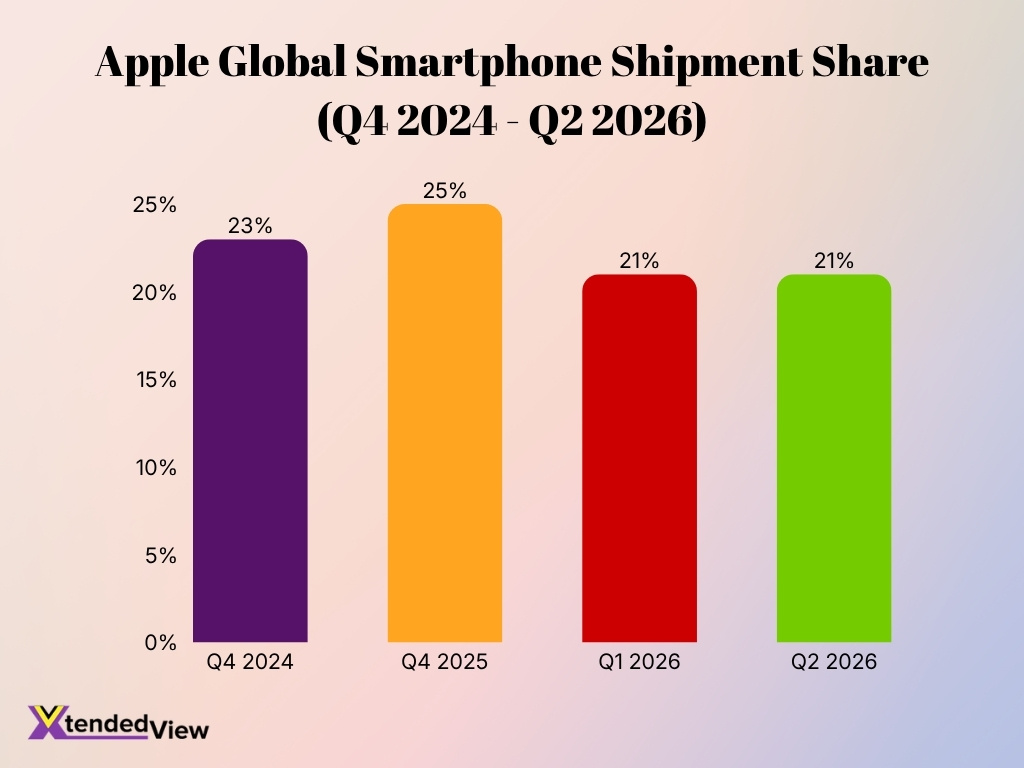
- Apple’s global smartphone shipment share reached 25% in Q4 2025, up from 23% in Q4 2024, before settling at 21% in both Q1 and Q2 2026.
- Apple’s iPhone shipments grew 13% year over year in Q2 2026, providing a fresh pipeline of devices capable of using Siri and, for supported models, Apple Intelligence features.
- Despite the enormous installed base, Siri AI’s early worldwide audience will remain materially smaller because advanced features require newer hardware and face regional availability restrictions in the EU and China.
Siri Users in the United States
- 91% of U.S. women and 90% of U.S. men reported owning a smartphone in a 2025 national survey, creating near-universal access to mobile voice-assistant technology among adults.
- Smartphone ownership reached 97% among Americans ages 18-29 in 2025, making younger adults one of the largest addressable groups for smartphone-based assistants such as Siri.
- Ownership remained high at 96% among adults ages 30-49 and 90% among those ages 50-64.
- Even among Americans ages 65 and older, 78% owned a smartphone in 2025, extending Siri’s potential reach well beyond younger technology users.
- Apple captured approximately 67% of U.S. smartphone shipments in Q4 2025, compared with 65% in Q4 2024. Another sales-based tracker placed its Q4 share at 69%, reflecting methodological differences between shipments and sell-through measurements.
- U.S. Apple smartphone sales increased 7% year over year in Q4 2025, while the overall U.S. smartphone market grew only 1%.
- In a Michigan health-system study published in 2025, 103 of 152 previous voice-assistant users, or 67.8%, had used Siri. The sample was not nationally representative, but it provides a useful niche measure of real-world U.S. usage.
- The same research noted that roughly 62% of U.S. adults had used a digital voice assistant according to previous national estimates cited by the researchers, showing that voice-assistant experience extends beyond smart-speaker ownership.
- Among parents of U.S. children ages 12 or younger surveyed in May 2025, older children were more likely than younger children to interact with a voice-activated assistant such as Siri or Alexa, indicating that assistant exposure starts before adulthood.
Siri User Growth and Active Users
- Apple’s active device base climbed from roughly 2.35 billion devices in early 2025 to more than 2.5 billion entering 2026, equivalent to growth of about 150 million devices.
- That rise represents approximately 6.4% year-over-year growth in Apple’s active installed device base based on the reported 2.35 billion and 2.5 billion totals.
- The wider global active smartphone base increased just 2% in 2025, meaning Apple’s device ecosystem expanded faster than the overall pool of smartphones in use.
- Apple was one of only two smartphone brands with more than 1 billion active handsets worldwide in 2025.
- Apple gained more net new active smartphones in 2025 than the next seven largest brands combined, suggesting that Siri’s potential mobile footprint grew faster than those of many competing assistants.
- Worldwide iPhone shipment share moved from 17% in Q2 2025 to 21% in Q2 2026, a gain of four percentage points year over year.
- iPhone shipments grew 13% year over year in Q2 2026, providing a continuing source of users who can access Siri on newly activated hardware.
- In the U.S., Apple’s Q4 smartphone shipment share increased from 65% in 2024 to 67% in 2025, while sales-based tracking put the corresponding increase at 65% to 69%. Both datasets point to stronger domestic distribution entering 2026.
- Siri AI adoption will not initially match classic Siri’s reach. An analysis published after the June 2026 announcement estimated that over 1.3 billion existing iPhones lack the hardware required for the most advanced Siri features.
- Consequently, no credible public dataset currently supports claims that Siri has a specific number of monthly active users in 2026. Device totals should be presented as potential reach, not direct user counts.
Siri Requests and Usage Frequency
- Apple reported that Siri handled 2 billion requests per week in 2016 across 36 countries. That equals roughly 286 million requests per day at the time, but it should not be presented as a current 2026 volume.
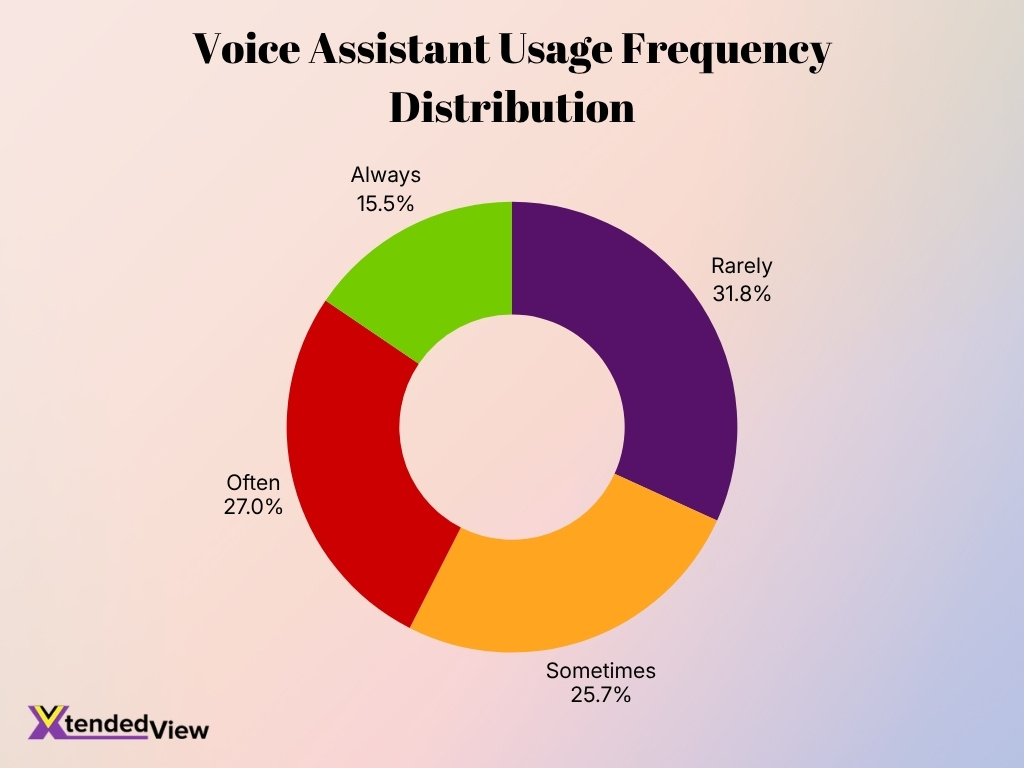
- In a U.S. study published in 2025, 42.6% of previous voice-assistant users said they used a digital voice assistant “often” or “always.”
- Another 57.4% reported using voice assistants only “rarely” or “sometimes,” showing that access does not automatically translate into high-frequency engagement.
- 31.8% of respondents who had used a voice assistant classified their usage frequency specifically as “rarely.”
- 25.7% said they used a voice assistant “sometimes,” while 27.0% said “often” and 15.5% said “always.”
- Only 27.5% said they relied on a voice assistant for everyday needs, while another 15.4% said they did so sometimes.
- A majority, 57.0%, said they did not rely on a digital voice assistant for everyday needs, highlighting the difference between trying Siri and making it part of a daily routine.
- Smartphones dominated voice-assistant access in the study; 88.8% of users accessed a digital voice assistant through a personal cellphone.
- Answering questions ranked as the most common task at 75.0%, followed by entertainment at 57.2%, online information access at 55.9%, and setting timers at 51.3%.
- The introduction of conversational follow-ups, broader web knowledge, and personal-context search in Siri AI could increase request depth in late 2026 because a single interaction can now develop into multiple related queries instead of ending after one command. This is a product-capability inference, not a published usage forecast.
Siri Market Share by Country and Region
- In August 2026, Apple represented 60.68% of mobile device usage in the United States, compared with 21.97% for Samsung and 2.65% for Google. This gives Siri access to a particularly large addressable audience in its home market.
- Apple held 60.22% of North American mobile device usage in August 2026. Samsung followed at 21.43%, while Google accounted for 2.74%.
- Canada had an even stronger Apple footprint, with Apple accounting for 68.47% of mobile device usage in August 2026. Samsung held 18.34%, while Google had 5.72%.
- Apple represented 65.19% of mobile device usage in Australia in August 2026. Samsung accounted for 20.75%, while Google held 4.41%.
- Japan remained another major Siri-addressable market. Apple accounted for 64.74% of mobile devices in August 2026, while Google ranked second at 9.33% and Samsung held 5.01%.
- In the United Kingdom, Apple held 51.47% of mobile device usage in August 2026, compared with Samsung at 29.71% and Google at 3.38%.
- Across Europe, Apple represented 37.25% of mobile devices in August 2026. Samsung stood at 30.88%, while Xiaomi accounted for 13.08%.
- France recorded a 36.26% Apple mobile-device share in August 2026, compared with 31.55% for Samsung and 12.38% for Xiaomi.
- Germany showed a different competitive picture: Apple held 27.54% of mobile-device usage in August 2026, behind Samsung at 36.83%. This suggests Siri has a smaller addressable share there than in the U.S., Canada, Japan or the U.K.
- Regional iPhone shipments continued to expand in 2026. In Q2, Apple shipments increased 22% year over year in Europe, 23% in China, 35% in South Korea, 6% in Japan, and 6% in the U.S. India was the exception, declining 0.4%.
Siri Market Share Compared With Alexa and Google Assistant
- A representative U.S. voice-assistant study found that 56% of users used Alexa, 49% used Siri and 42% used Google Assistant. The percentages reflect usage rather than exclusive market share because consumers can use more than one assistant.
- Siri therefore trailed Alexa by 7 percentage points in that study but exceeded Google Assistant by 7 percentage points.
- Smart-speaker ownership tells a different story. Among U.S. adults who owned a voice-activated smart speaker in 2024, about 60% owned an Amazon Echo, compared with 23% for Google Home and 16% for HomePod.
- The same research found that roughly 75% of U.S. adults did not own a smart speaker, meaning speaker-only comparisons leave out the much larger smartphone-based voice-assistant market.
- Apple’s smartphone reach gives Siri a distribution advantage that Alexa cannot replicate through smart speakers alone. Apple represented roughly one-quarter of active smartphones worldwide in 2025.
- Apple had also shipped more than 450 million Apple Intelligence-capable iPhones through Q1 2026, giving the next generation of Siri a large AI-ready mobile base.
- Across iPhones, iPads and Macs, more than 600 million devices were estimated to support Apple Intelligence by mid-2026. That hardware base expands the potential reach of AI-enhanced Siri beyond smartphones alone.
- A U.S. health care study published in 2025 found Siri usage among previous digital-assistant users at 67.8%, compared with 46.7% for Google Assistant and 46.1% for Alexa. Because the study used a small regional sample, these figures should not be treated as national market share.
- Competition is shifting from basic voice commands toward generative AI. In one U.S. survey, 38% of voice-assistant users said integrating a generative AI chatbot could improve an assistant’s ability to understand requests.
Siri Usage Among U.S. iPhone Owners
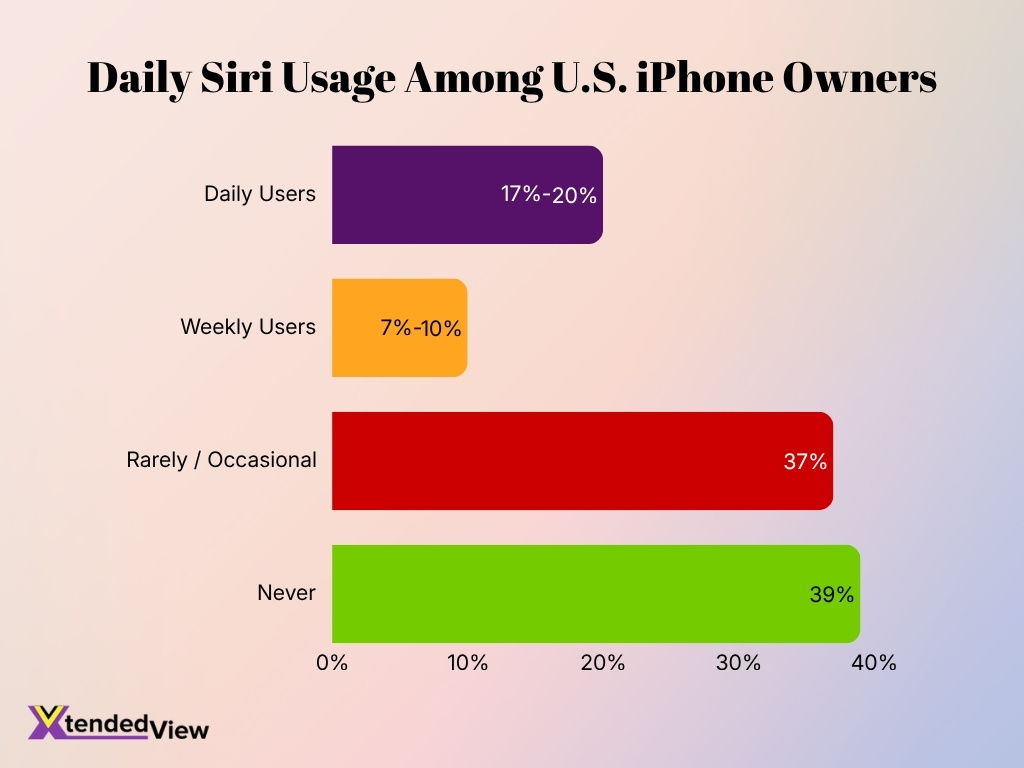
- Daily Siri engagement remains relatively modest, with approximately 17% to 20% of U.S. iPhone users estimated to use the assistant every day in 2026.
- Around 7% to 10% of iPhone users engage with Siri weekly, commonly relying on it for CarPlay, reminders, and other routine voice commands.
- Approximately 37% of iPhone users use Siri only rarely or occasionally, typically for simple tasks such as setting timers and alarms.
- An estimated 39% of iPhone owners never use Siri, making non-users the largest single usage-frequency group in the dataset.
- The expansion of Apple Intelligence could help increase Siri’s daily engagement as more advanced assistant capabilities become available across compatible iPhones.
Siri Usage by Age and Gender
- A 2025 U.S. study found that 37% of parents with children age 12 or younger said their child had interacted with a voice-activated assistant such as Siri or Alexa.
- Voice-assistant exposure increased sharply with age among children. Usage reached 12% for children under age 2, 27% for ages 2-4, and 36% for ages 5-7.
- Among children ages 8-10, 46% had interacted with a voice assistant, rising to 53% among 11- to 12-year-olds.
- Zillennials, consumers born from 1991 through 1999, showed especially strong engagement in one 2025 study; nearly two-thirds had used voice assistants for home-related tasks during the previous year.
- 68% of zillennials reported regular voice-technology use for activities such as gathering information or verifying identity, making them 18% more likely than the broader sample to do so.
- Baby boomers who use digital assistants were more likely than Gen Z users to look up information, at 55% versus 38%, according to 2025 U.S. behavioral data.
- Baby boomers were also nearly twice as likely as Gen Z users to get news through digital assistants, 22% versus 12%.
- Millennials showed stronger timer and alarm usage, at 43%, compared with 30% among Gen Z users. This suggests practical voice-assistant habits vary by generation even when overall adoption remains broad.
- Gender differences also appear in interaction style. A 2025 academic report found that men interrupted voice assistants almost twice as often as women during experimental interactions.
- Reliable 2025-2026 public data does not establish a clear nationwide male-versus-female Siri adoption percentage. Any precise claim that one gender represents a specific majority of Siri users should therefore be treated cautiously unless accompanied by a defined survey methodology.
Siri Voice Search and Voice Commerce Trends
- Only 14% of U.S. digital-assistant users reported shopping through a digital assistant in 2025, compared with 59% who checked weather and 51% who played music.
- British data showed a similar pattern: only 13% of daily digital-assistant users used voice for shopping or recipe assistance in early 2025.
- Zillennials stand out sharply from the overall market. 55% used voice assistants for shopping and payments within the previous year, 34% above the total-population rate in the same study.
- Only 14% of zillennials completed a retail transaction entirely through voice. The comparable figure for the overall survey population was 10%, demonstrating that browsing or starting a purchase through voice remains more common than finishing one.
- Broader AI shopping tools are gaining traction faster than traditional voice commerce. A 2025 U.S. survey found that 43% of Americans knew about AI shopping assistants, but only 14% had used one.
- Gen Z led adoption of AI shopping assistants at 24%, followed by millennials at 17%, Gen X at 12% and baby boomers at 7%.
- Among consumers open to AI shopping assistance, 67% said they would use AI to find the best prices and 56% wanted help comparing products. These behaviors overlap with the product-search functions conversational assistants could increasingly support.
- During the 2025 U.S. holiday season, 47% of Americans reported using some form of AI to assist with shopping. Twenty-one percent used AI for gift ideas, 16% for product research, and 15% for AI-powered shopping searches.
- Trust remains a constraint. Only 13% of U.S. consumers in one 2025 study said they mostly or completely trusted AI-generated shopping advice, while 41% said they did not trust AI shopping assistants at all.
- Siri’s commerce opportunity could expand through Apple Intelligence. iOS 26 already allowed visual intelligence to ask ChatGPT about products visible on an iPhone screen and search supported services for similar products, while order information could be automatically extracted from merchant and delivery emails.
Most Common Siri Use Cases Among Users
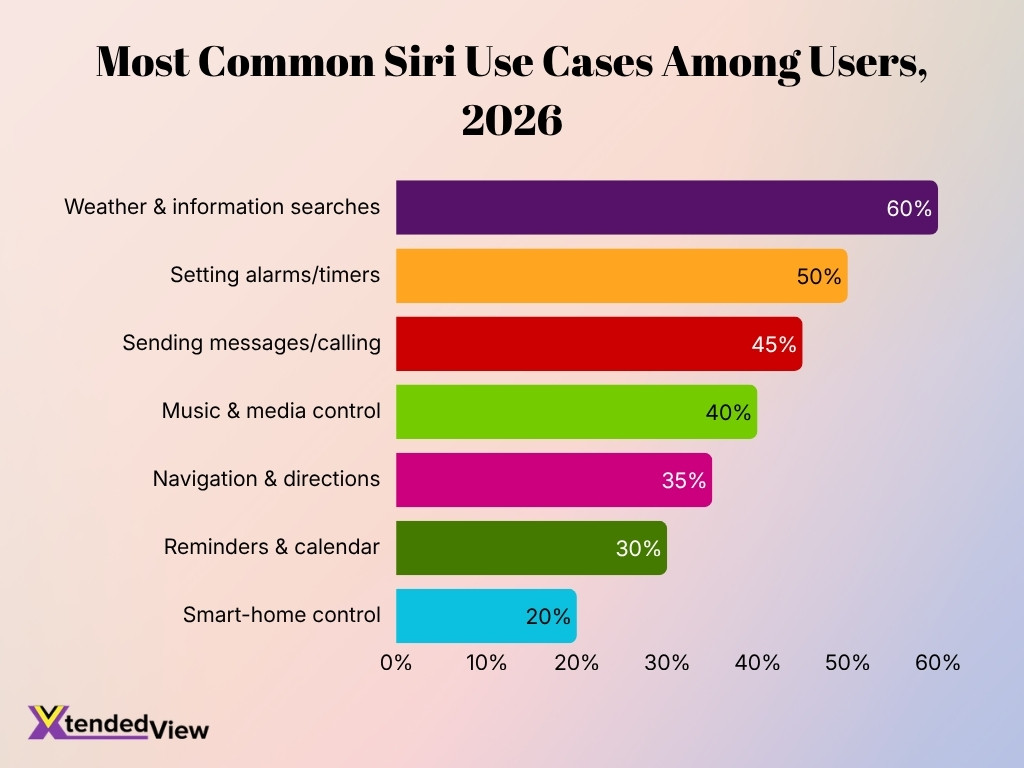
- Weather and information searches are the most common Siri use case, with approximately 60% of users relying on the assistant for quick information and updates.
- Around 50% of Siri users use the assistant to set alarms and timers, making time management its second-most popular function.
- Sending messages and making calls account for roughly 45% of Siri usage, highlighting the importance of hands-free communication.
- About 40% of users rely on Siri for music and media control, including playing songs and managing audio playback.
- Approximately 35% of users use Siri for navigation and directions, allowing them to search for destinations and get route assistance through voice commands.
- Reminders and calendar tasks are used by around 30% of Siri users, showing its role in managing schedules and everyday responsibilities.
- Smart-home control has the lowest adoption among the listed use cases at roughly 20%, indicating that Siri’s usage remains more concentrated around everyday mobile tasks.
Siri Voice Recognition, Answer Accuracy, and Performance
- One clinical test involving 14 postpartum-depression questions found that Siri achieved 100% speech-recognition accuracy, matching the best-performing assistant in that experiment. However, recognition accuracy does not indicate whether every resulting answer was clinically useful.
- A vaccine-information study using 54 questions gave Siri an average quality score of 5.16 out of 6, slightly higher than the 5.10 recorded by the closest competitor in that specific health-information test.
- A Portuguese-language vaccination study found that Siri accurately answered 26.7% of its tested questions. The result illustrates how answer performance can vary substantially by language, subject, and testing methodology.
- In the same Portuguese test, Siri correctly recognized the question without requiring a repeat 80% of the time. Its word-level transcription score reached 86.7%.
- A separate 24-question evaluation found Siri produced correct audible answers for 11 of 24 questions, or 45.8%. Google Assistant reached 83.3% and Alexa reached 66.7% in that particular test.
- A 2025 experiment with 270 participants tested how Siri’s voice, accent and task type affected perceived trust. Functional tasks generated higher ratings for reliability and understandability than more social interactions, suggesting users judge Siri partly by the kind of task they give it.
- Siri AI addresses one longstanding limitation by allowing users to continue almost any response with follow-up questions instead of starting a new isolated command. The new system also supports natural back-and-forth conversation.
- The 2026 architecture adds onscreen awareness, meaning Siri can reason about information already visible on a user’s display and combine that context with personal information and web knowledge.
- Siri AI can also search current web information rather than relying solely on preconfigured assistant answers. This materially expands the range of questions it can attempt, although no public 2026 dataset yet establishes a standardized accuracy rate for these new responses.
Siri Privacy, Data Collection, and On-Device Processing
- Siri processes the audio from requests on the device whenever possible, reducing the amount of raw voice information that needs to leave the user’s hardware.
- By default, audio recordings from Siri and Dictation are not retained for human review. Users must opt in if they want to contribute audio recordings to improvement programs.
- Siri requests that reach servers use a random device-generated identifier rather than a user’s Apple Account or email address.
- That Siri request identifier can rotate multiple times per hour, limiting the ability to link long sequences of server requests directly to one persistent identifier.
- Request history may include transcripts, request categories, completion information, device specifications, configuration, performance data, and approximate location when relevant permissions are enabled.
- Siri request data associated with its random identifier may be retained for up to two years to improve Siri, Dictation, Search, and related language-processing functions. A small reviewed subset can remain longer.
- Users can delete Siri and Dictation requests associated with the active random identifier, although requests more than six months old may no longer remain linked to that identifier and therefore may not be included in the deletion.
- Private Cloud Compute follows a different model: when Siri AI sends a request to these servers, the personal request data is not stored or made accessible to Apple.
- Siri AI’s Spotlight index and App Toolbox can operate entirely on the device, allowing the assistant to retrieve personal context without automatically uploading that underlying data to a remote service.
- Users can generate an Apple Intelligence Report showing requests processed off-device, including Private Cloud Compute requests and, when enabled, requests sent through the ChatGPT extension.
Siri vs Other AI Assistants: User Satisfaction Insights
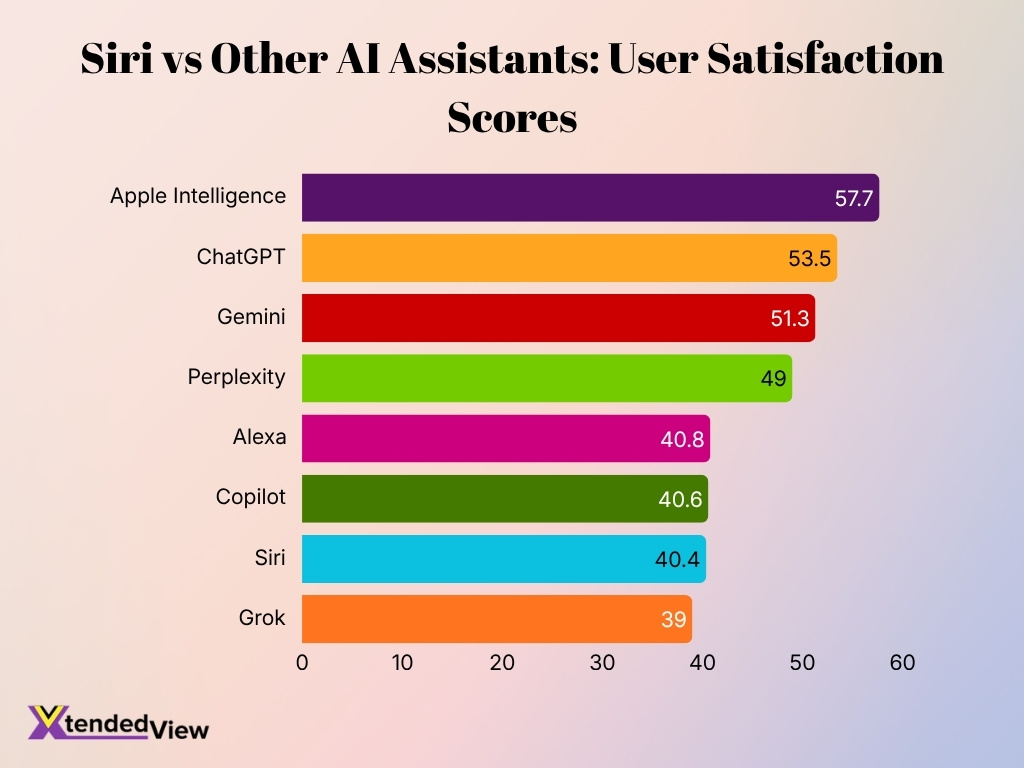
- Apple Intelligence leads the ranking with a net satisfaction score of 57.7, the highest among the eight AI assistants compared.
- ChatGPT ranks second with a satisfaction score of 53.5, followed closely by Gemini at 51.3.
- Perplexity scores 49.0, placing it fourth and ahead of established voice assistants such as Alexa and Siri.
- Siri records a net satisfaction score of 40.4, putting it seventh out of eight AI assistants in the comparison.
- Siri trails Apple Intelligence by 17.3 points, highlighting a substantial satisfaction gap between Apple’s newer AI capabilities and its traditional voice assistant.
- Alexa (40.8), Copilot (40.6), and Siri (40.4) are separated by just 0.4 points, indicating nearly identical satisfaction levels.
- Grok ranks last at 39.0, meaning Siri’s score is only 1.4 points higher than the lowest-rated assistant in the dataset.
Siri Integration With Apple Intelligence and ChatGPT
- Over 450 million Apple Intelligence-capable iPhones shipped globally by Q1 2026.
- The system expanded to support 10 localized languages worldwide in March 2025.
- Cross-device integration synchronizes personal context natively across 5 core Apple hardware categories.
- Spotlight indexing processes personal information securely across 3 primary built-in applications alongside third-party content.
- Users can effortlessly access the ChatGPT extension through 3 native system interfaces.
- Account-free usage automatically guarantees 100% IP address obscuration for all external data queries.
- The stringent privacy framework mandates that exactly 0% of user requests are utilized for model training.
- The system introduces 2 mandatory confirmation gates before securely transmitting files or photos to external servers.
- The backend architecture processes queries utilizing 4 distinct computational layers to ensure speed and privacy.
- The next-generation platform debuts globally alongside iOS 27 on Sept. 14, 2026.
Siri Growth Projections and Competitive Position
- Generative AI-capable smartphones are forecast to account for 45% of worldwide smartphone shipments in 2026, up from 36% in 2025.
- That share is expected to rise again to 52% in 2027, meaning more than half of new smartphones could soon ship with generative AI capabilities.
- The jump from 36% to 45% represents a 9-percentage-point increase in one year, increasing pressure on Siri to compete on AI quality rather than simply built-in availability.
- Apple held the world’s largest consumer base of GenAI-capable smartphones by Q1 2026 after cumulative shipments of compatible iPhones passed 450 million.
- Hardware compatibility remains the main short-term constraint. More than 850 million existing iPhones were estimated to lack support for even basic Apple Intelligence queries when Siri AI was unveiled.
- More than 1.3 billion iPhones were estimated to lack the hardware necessary for Siri’s most advanced AI features, meaning classic Siri’s installed base is far larger than Siri AI’s immediately addressable base.
- Premium AI competition is intensifying because generative AI features have effectively become standard in smartphones priced above roughly $400 wholesale.
- Consumer perception remains a competitive weakness; Siri’s 2026 U.S. satisfaction score trails Apple Intelligence, ChatGPT, Gemini, Claude and several other AI products, despite Siri’s much broader default distribution.
- Regional regulations could slow global growth. Siri AI will not initially launch on iPhone, iPad and Apple Watch in the EU, while China also remains excluded until regulatory issues are resolved.
- Siri’s main strategic advantage is therefore distribution combined with deep operating-system access. Its main risk is whether those structural advantages translate into greater daily engagement before competing assistants establish stronger AI habits among smartphone users.
Frequently Asked Questions (FAQs)
More than 450 million Apple Intelligence-capable iPhones had shipped cumulatively by Q1 2026, giving Apple the largest consumer base of GenAI-capable smartphones among individual brands.
About 67.8% of previous digital voice-assistant users in the study had used Siri, compared with 46.7% for Google Assistant and 46.1% for Alexa.
Siri recorded a 40.4 net satisfaction score among current and former U.S. users measured from February through July 2026.
In a 2025 study, 88.8% of previous digital voice-assistant users accessed an assistant through their personal cellphone.
About 42.6% of surveyed digital voice-assistant users said they used an assistant often or always, while 57.4% used one rarely or sometimes.
Conclusion
Siri statistics show an established voice assistant undergoing one of the most important transitions in its history. Siri benefits from Apple’s enormous device ecosystem, strong iPhone presence in markets such as the United States, Canada, and Japan, and integration across products including iPhone, iPad, Mac, Apple Watch, AirPods, and CarPlay. Everyday activities such as checking weather, playing music, setting timers, finding information and communicating hands-free continue to form an important part of voice-assistant usage.
At the same time, the competitive standard has shifted from executing simple voice commands to understanding context, holding conversations and completing more complicated AI-assisted tasks. Apple Intelligence, personal-context capabilities, onscreen awareness, Private Cloud Compute and optional ChatGPT integration represent Apple’s response to that change. However, hardware requirements, uneven satisfaction levels, regional availability, and the large number of older devices that cannot support advanced AI features could limit the speed of adoption.
Ultimately, Siri’s position will depend less on the sheer number of devices capable of accessing the assistant and more on how frequently and effectively people choose to use it. As advanced Siri AI features reach more devices, languages and markets, future usage, satisfaction and retention statistics should provide a clearer picture of whether Apple can turn Siri’s enormous potential reach into sustained engagement with a modern AI assistant.