

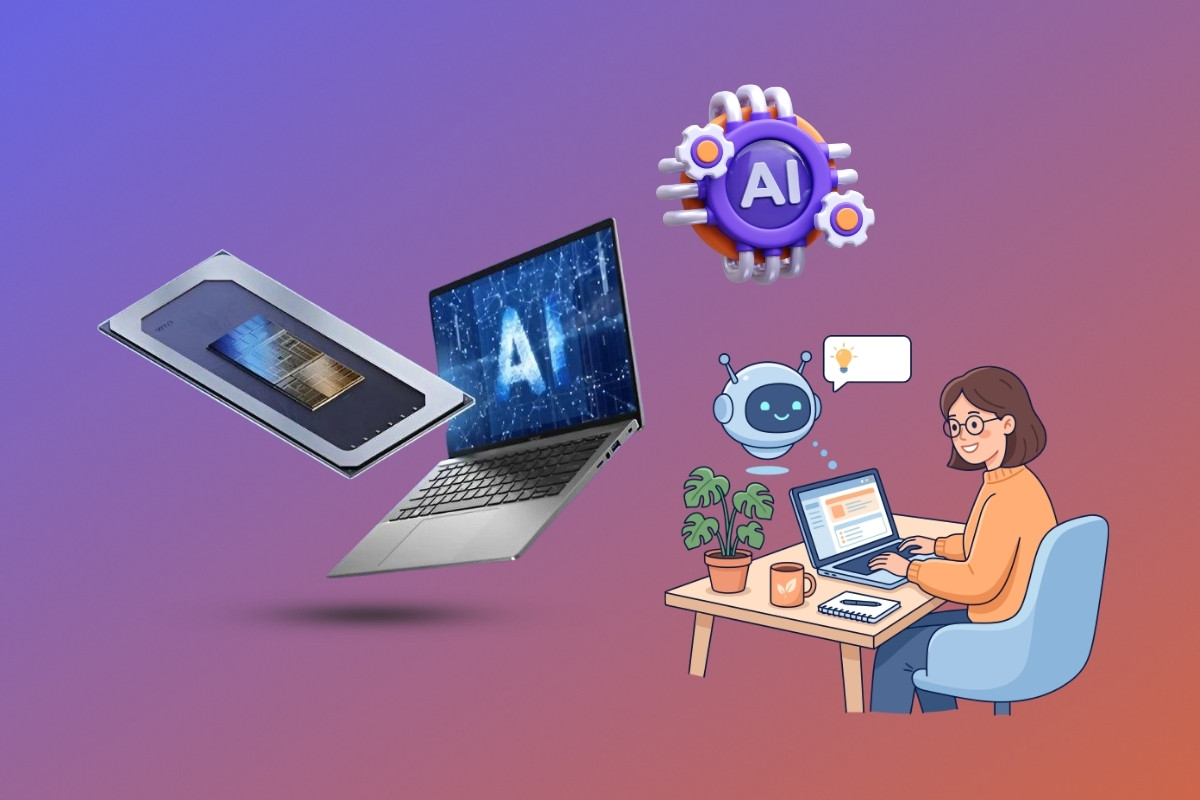
AI PCs are becoming a major part of the global computer market as manufacturers add dedicated neural processing units and other AI-focused hardware to laptops, desktops, and workstations. These systems can run more AI tasks directly on the device, supporting applications such as document summarization, meeting transcription, image editing, security monitoring, and software development without relying entirely on cloud processing.
For enterprises, AI PCs can support faster workflows, stronger data control and new productivity tools, while consumers are gaining access to increasingly capable AI features in mainstream notebooks. The statistics in this article examine how AI PC shipments, adoption, market value, hardware performance and regional demand are changing.
Editor’s Choice
- AI PCs are forecast to account for 54.7% of worldwide PC shipments in 2026, making AI-capable systems the majority of the market under the forecast definition.
- One August 2026 market estimate values the global AI PC market at $131.81 billion in 2026, up from $109.66 billion in 2025.
- Worldwide PC shipments fell 4.9% year over year to 68.2 million units in Q2 2026, showing that AI PC adoption can rise even while the overall PC market contracts.
- Worldwide AI PC shipments were forecast at 77.8 million units in 2025, compared with substantially lower volumes one year earlier.
- By the end of 2026, 40% of software vendors are expected to prioritize investment in AI capabilities that run directly on PCs, compared with only 2% in 2024.
- AI laptops are forecast to represent 58.7% of all laptop shipments in 2026, indicating that notebooks will reach majority-AI status faster than desktops.
- In India, shipments of AI-capable PCs increased 109.9% year over year in Q2 2026, one of the clearest recent examples of accelerated AI PC adoption in a major growth market.
Recent Developments
- Global desktop, notebook, and workstation shipments totaled 65.7 million units in Q2 2026 under another industry tracker, down 3.6% year over year as higher component costs affected demand.
- Within that Q2 2026 total, notebook and mobile workstation shipments reached 51.7 million units, declining 4.2% year over year.
- Desktop and desktop-workstation shipments totaled 13.9 million units in Q2 2026, down 1.3% from the prior-year quarter.
- Combined DRAM and SSD prices could surge 130% by the end of 2026 versus 2025 levels, creating a significant cost obstacle for PC manufacturers and buyers.
- Higher memory costs could raise PC prices by about 17% in 2026, pushing more buyers toward premium devices while making low-cost systems harder to sustain.
- India shipped 4.4 million traditional PCs in Q1 2026, up 31.1% year over year and marking a third consecutive quarter above the 4-million-unit level.
- AI notebook shipments in India increased 96.1% year over year in Q1 2026, demonstrating that AI-capable notebooks grew much faster than the country’s already strong overall PC market.
- Current Copilot+ PC specifications require at least 16 GB of RAM and 256 GB of storage, alongside a compatible processor containing an NPU capable of 40 or more TOPS.
General AI PC Statistics
- Worldwide AI PC shipments reached an estimated 38.1 million units in 2024, establishing the base for the category’s rapid expansion through 2025 and 2026.
- AI PCs represented 15.6% of the total PC market in 2024, meaning roughly one in six PCs shipped already met the NPU-based AI PC definition used in the forecast.
- The AI PC share increased to an estimated 31% in 2025, roughly doubling its share of worldwide shipments within one year.
- AI-capable laptops represented 35.7% of the laptop market in 2025, compared with 19.4% in 2024.
- AI desktops accounted for 16.4% of desktop shipments in 2025, up substantially from just 3.8% in 2024.
- In the business AI laptop segment, x86-based Windows systems were forecast to hold a 71% share in 2025, while Arm-based systems were expected to account for 24%.
- Copilot+ PCs require an NPU capable of at least 40 trillion operations per second, creating a clear hardware threshold between these devices and many first-generation AI PCs.
- More than 30 PC models using Snapdragon X Series processors were available globally by early 2025, with each offering 45 NPU TOPS of on-device AI processing capacity.
AI PC Market Size
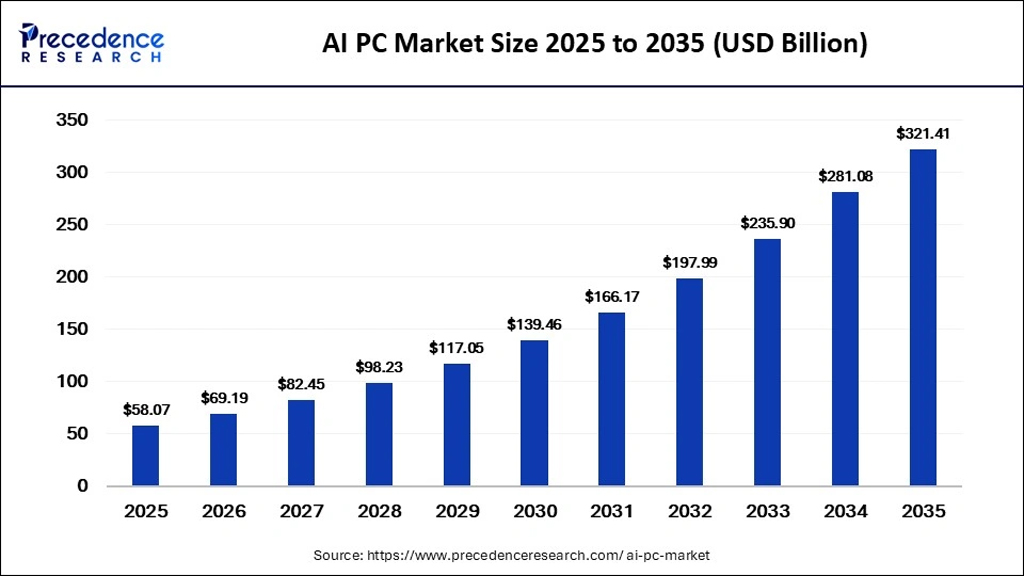
- The global AI PC market is projected to grow from $58.07 billion in 2025 to $321.41 billion by 2035, representing more than a 5.5x increase over the forecast period.
- In 2026, the AI PC market is expected to reach $69.19 billion, up from $58.07 billion in 2025.
- The market is forecast to surpass $100 billion by 2029, reaching approximately $117.05 billion.
- By 2030, global AI PC market revenue is projected to climb to $139.46 billion, rising to $166.17 billion in 2031.
- AI PC market size is expected to approach $200 billion in 2032, reaching $197.99 billion.
- Growth is projected to accelerate further, with the market increasing from $235.90 billion in 2033 to $281.08 billion in 2034.
- By 2035, the AI PC market is forecast to hit $321.41 billion, an increase of approximately $263.34 billion compared with 2025.
AI PC Market Growth and Forecast Statistics
- One widely followed shipment forecast expects 143.1 million AI PCs to ship worldwide during 2026.
- Based on the same forecast series, AI PC shipments expanded by roughly 104% from 2024 to 2025, signaling a near-doubling of annual unit volume.
- The forecast implies another increase of about 84% from 2025 to 2026, despite slower growth in the overall PC market.
- One revenue forecast expects the AI PC market to expand at a 20.2% CAGR from 2026 through 2034, reaching $574.36 billion by the end of the period.
- A separate forecast projects a 19.1% CAGR from 2025 through 2031, with AI PC revenue reaching $260.43 billion in 2031.
- Another higher-growth scenario projects a 42.8% CAGR from 2026 through 2036, with market value reaching approximately $3.65 trillion by 2036.
- The U.S. AI PC market is projected to grow from about $7.58 billion in 2025 to $23.63 billion by 2030, representing a 20.9% CAGR.
- India’s AI PC market is forecast to grow at a faster 28.3% CAGR, from about $2.49 billion in 2025 to $11.08 billion in 2030.
AI PC Shipment and Global PC Shipment Share Statistics
- AI PC shipment volume is forecast to rise to approximately 143.11 million units in 2026, nearly four times the 2024 level in only two years.
- The AI desktop share of the worldwide desktop market is projected to reach 42.1% in 2026, compared with a low-single-digit share only two years earlier.
- AI PCs gained about 15.4 percentage points of global PC shipment share from 2024 to 2025, reflecting one of the fastest hardware transitions in the current PC replacement cycle.
- The forecast increase from 2025 to 2026 adds another 23.7 percentage points to AI PCs’ global shipment share.
- Worldwide PC shipments reached 62.8 million units in Q1 2026 under another current industry estimate, up 4% from Q1 2025 as channels stocked inventory ahead of expected component-price increases.
- A separate Q2 2026 estimate put global PC shipments at approximately 65 million units, down 4% year over year and marking the first contraction after a growth run that began in Q1 2025.
- The overall PC market could contract 10.4% in 2026 under one forecast as high memory prices discourage upgrades, even while vendors continue shifting their portfolios toward AI-enabled models.
- Another current forecast expects worldwide PC units to fall to roughly 253 million in 2026, from about 285.2 million in 2025, while average selling prices increase as shortages favor higher-value configurations.
AI PC Adoption Statistics
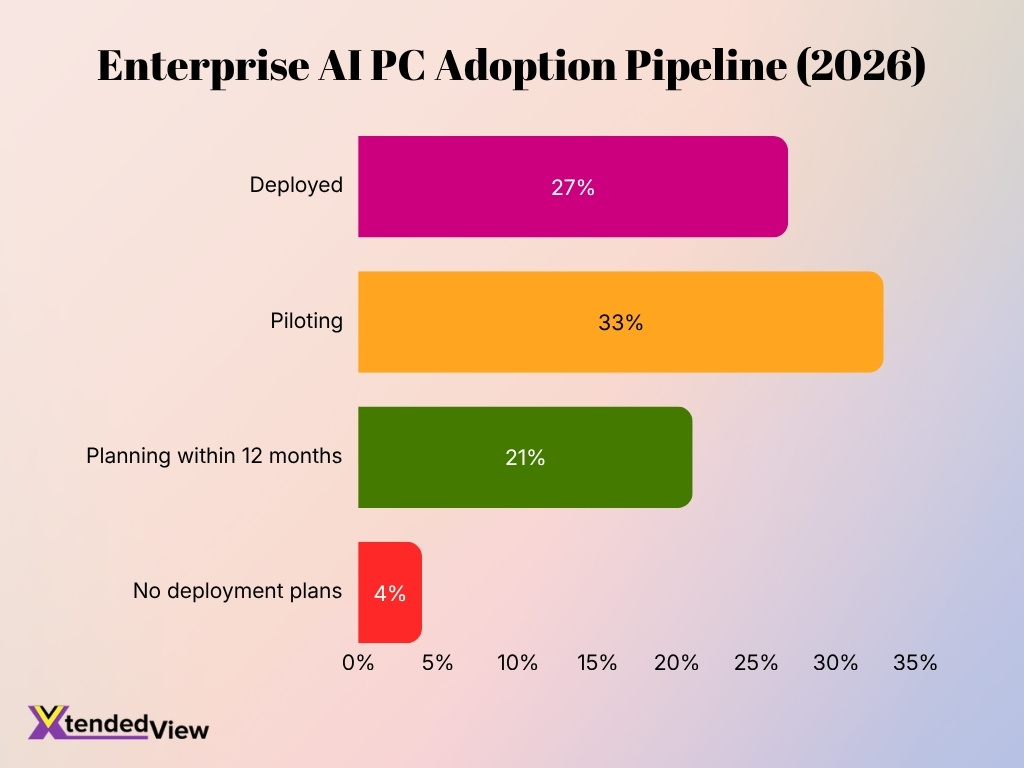
- In a February 2026 global survey of PC purchasing decision-makers, 27% of organizations had already deployed AI PCs, showing that adoption has moved beyond early experimentation.
- Another 33% of organizations were actively piloting AI PCs in 2026. Combined with completed deployments, this means 60% had AI PCs operating somewhere in their organization.
- A further 21% planned to deploy AI PCs within 12 months, signaling a substantial near-term pipeline beyond current pilots.
- Only 4% of surveyed organizations had no AI PC deployment plans in 2026, compared with much higher uncertainty when the category first entered the market.
- 80.4% of enterprise IT decision-makers surveyed in Q2 2026 said they had become more likely to purchase AI PCs during the previous six months.
- By comparison, only 1.8% said they had become less likely to buy AI PCs, giving the category a net purchase-intent score of +78.6 in that enterprise survey.
- Research published in 2025 found that 87% of businesses were either upgrading to AI PCs or planning an upgrade during their next PC modernization cycle.
- Among organizations that had already adopted AI PCs, 50% cited employee demand for AI tools as a motivation for investment, indicating that workplace demand now influences hardware refresh decisions.
- Familiarity has also increased: 81% of 2026 respondents reported meaningful knowledge of AI PCs, including 46% who said they knew a lot about the category and 35% who knew something about it.
Enterprise and Consumer AI PC Adoption Statistics
- Enterprise demand shows a clear preference for the established Windows ecosystem: x86 systems were forecast to capture 71% of the business AI laptop market in 2025.
- Arm systems were expected to represent 24% of business AI laptops in 2025, leaving x86 with a substantial advantage among enterprise buyers concerned about application compatibility and device management.
- Looking further ahead, AI laptops are expected to become the only laptop option for large businesses in 2026, compared with less than 5% of large-business laptop choices in 2023.
- In a 2026 enterprise buying survey, 47.1% of IT leaders said they had become more likely to purchase traditional PCs during the previous six months, far below the corresponding purchase intent for AI PCs.
- Conversely, 19.7% of enterprise respondents said they were less likely to purchase traditional PCs, more than 10 times the 1.8% negative-intent rate recorded for AI PCs.
- An earlier enterprise survey found 58% of IT decision-makers were very or extremely interested in AI PCs, including 22% who reported extreme interest and 37% who reported very high interest.
- AI PC understanding remains stronger among senior staff: business respondents estimated that about 50% of leadership teams had a deep understanding of AI PC value, versus 33% of employees.
- IT decision-makers gave higher estimates, reporting that 56% of leadership teams deeply understood AI PC value, compared with 41% of employees.
- Consumer adoption is expected to give Arm a greater role than it has in enterprises as compatibility barriers decline, while x86 remains the preferred architecture in business environments. This divergence helps explain why processor architecture has become one of the main distinctions between consumer and commercial AI PC purchasing.
AI PC Regional and Country Market Statistics
- North America accounted for an estimated 43.29% of global AI PC market revenue in 2025, making it the largest regional market under one current industry model.
- Asia-Pacific is forecast to record a 13.81% CAGR through 2031, supported by large PC manufacturing ecosystems and rising adoption across China, India, Japan and other regional markets.
- In the U.S., 88% of surveyed businesses were familiar with AI PCs in research published in 2025, showing high category awareness among American organizations.
- India recorded an even higher 92% AI PC familiarity rate, the highest among the four markets detailed in the same survey.
- AI PC familiarity reached 82% in the U.K. and 83% in South Africa, indicating that awareness was already broad across both mature and emerging PC markets.
- India’s overall PC market shipped 15.9 million units in 2025, growing 10.2% year over year and exceeding 15 million annual shipments for the first time.
- India’s PC market then reached 3.9 million units in Q2 2026, up 12.1% year over year, while AI-capable PC shipments grew far faster than the overall category.
- Commercial PC shipments in India increased 16.6% year over year in Q2 2026 to 2.2 million units, compared with 6.6% growth in consumer shipments.
- Premium notebook shipments priced above $1,000 grew 78.7% year over year in India during Q2 2026, reinforcing the link between AI-capable hardware and the premium end of the PC market.
AI PC Usage and Use Case Statistics
- 66% of organizations using or testing AI PCs reported increased employee productivity in a 2026 global enterprise study.
- 70% reported faster performance and lower latency with AI PCs, highlighting one of the practical advantages of moving eligible AI inference from remote servers to local hardware.
- 58% identified improved data security as a major benefit of on-device AI processing because local execution can reduce the amount of sensitive information sent to cloud services.
- 59% considered high-performance NPUs critical for enabling the next generation of AI experiences on employee PCs.
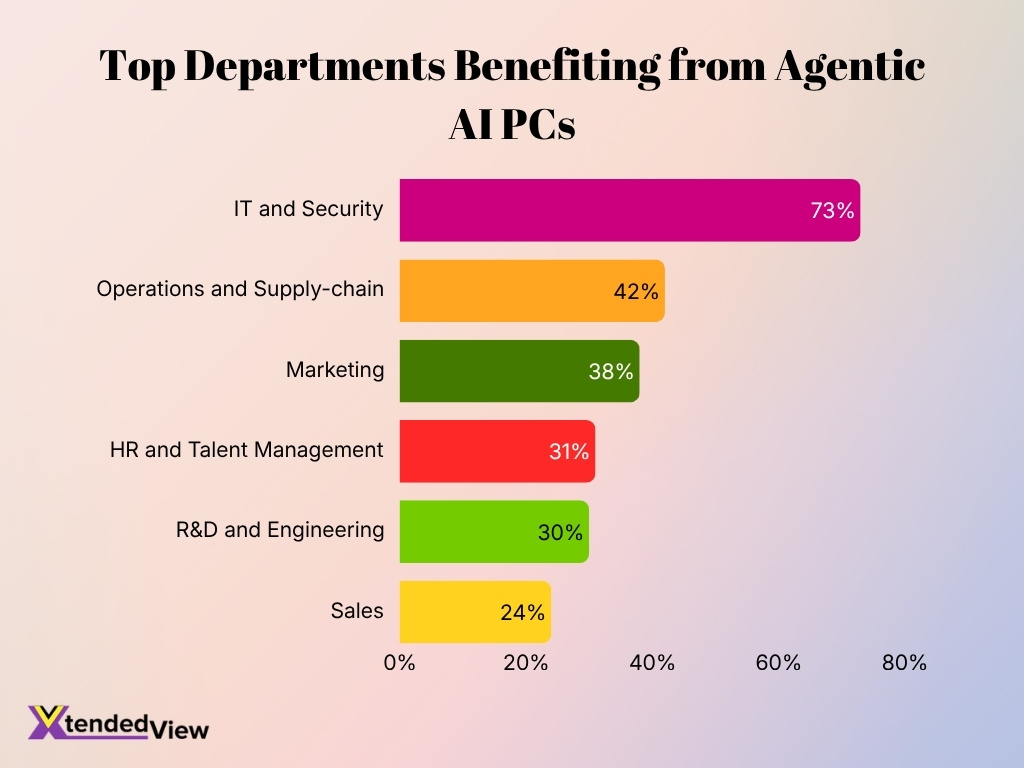
- IT and security represent the leading departmental AI PC use case, with 73% of surveyed organizations saying this area could benefit most from agentic AI on PCs.
- Operations and supply-chain functions ranked second, selected by 42% of respondents as a priority area for agentic AI running through PCs.
- Marketing followed at 38%, reflecting use cases such as content creation, campaign analysis, local generative AI, and faster processing of customer data.
- HR and talent management reached 31% in 2026, up from 26% in a comparable 2024 survey, suggesting growing interest in AI-assisted recruiting, employee support and workforce workflows.
- R&D and engineering were identified by 30% of respondents, while sales registered 24%, down from 44% in the comparable 2024 survey.
- In earlier enterprise research, 32% of IT decision-makers selected improved automation and efficiency as an important employee benefit of AI PCs, while 20% highlighted faster data analysis and insight.
AI PC Statistics by Device Type
- Laptops generated 46.21% of AI PC market revenue in 2025, making notebooks the largest form-factor category in one current market assessment.
- Mini PCs represent a smaller base but are forecast to grow at a 13.58% CAGR through 2031, supported by compact enterprise, industrial, and retail-edge deployments.
- AI laptops represented 19.4% of all laptop shipments in 2024, showing that NPU-equipped notebooks already had a meaningful market presence before the 2025 refresh cycle.
- That laptop share increased to 35.7% in 2025, meaning more than one-third of worldwide notebook shipments qualified as AI PCs under the forecast definition.
- AI desktops represented only 3.8% of global desktop shipments in 2024, leaving considerably more room for upgrades than in the notebook category.
- By 2025, AI desktops had increased to 16.4% of desktop shipments, more than quadrupling their category share in one year.
- Global AI laptop shipments totaled approximately 40.5 million units in 2024, compared with only about 2.5 million AI desktop shipments.
- The earlier market forecast projected 102.4 million AI laptop shipments for 2025, versus approximately 11.8 million AI desktops, illustrating the notebook category’s much larger unit opportunity.
- Workstations remain a smaller unit segment, but their role in local model development, engineering, media rendering, and data analysis gives them a concentrated AI workload profile; broader workstation shipments climbed above 2 million units in Q1 2026.
AI Laptop, Desktop, and Workstation Statistics
- AI laptops are forecast to reach 58.7% of worldwide laptop shipments in 2026, crossing the majority threshold for the first time.
- AI desktops are projected to reach 42.1% of total desktop shipments in 2026, narrowing much of the adoption gap between desktop and notebook AI hardware.
- An earlier forecast estimated total AI PC shipments at 114.2 million units for 2025, of which roughly 90% were expected to be AI laptops.
- Under that earlier forecast, AI laptop shipments were projected to grow approximately 153% from 2024 to 2025, from 40.5 million to 102.4 million units.
- AI desktop shipments were forecast to rise roughly 371% over the same period, from 2.5 million units in 2024 to 11.8 million in 2025, albeit from a much smaller base.
- India’s notebook market grew 12.4% during full-year 2025, while its Q4 notebook shipments increased 23.9% year over year.
- Desktop shipments in India increased a more modest 3.6% in 2025, followed by 6.2% year-over-year growth during Q4, reinforcing notebooks as the stronger growth category.
- During Q2 2026, worldwide notebook and mobile workstation shipments totaled 51.7 million units, compared with 13.9 million desktop and desktop-workstation units.
- In Q2 2026, mobile PC shipments declined 4.2% year over year, while desktop and desktop-workstation shipments decreased only 1.3%, showing that short-term overall category movements can diverge from the longer-term AI adoption trend.
AI PC Statistics by Operating System
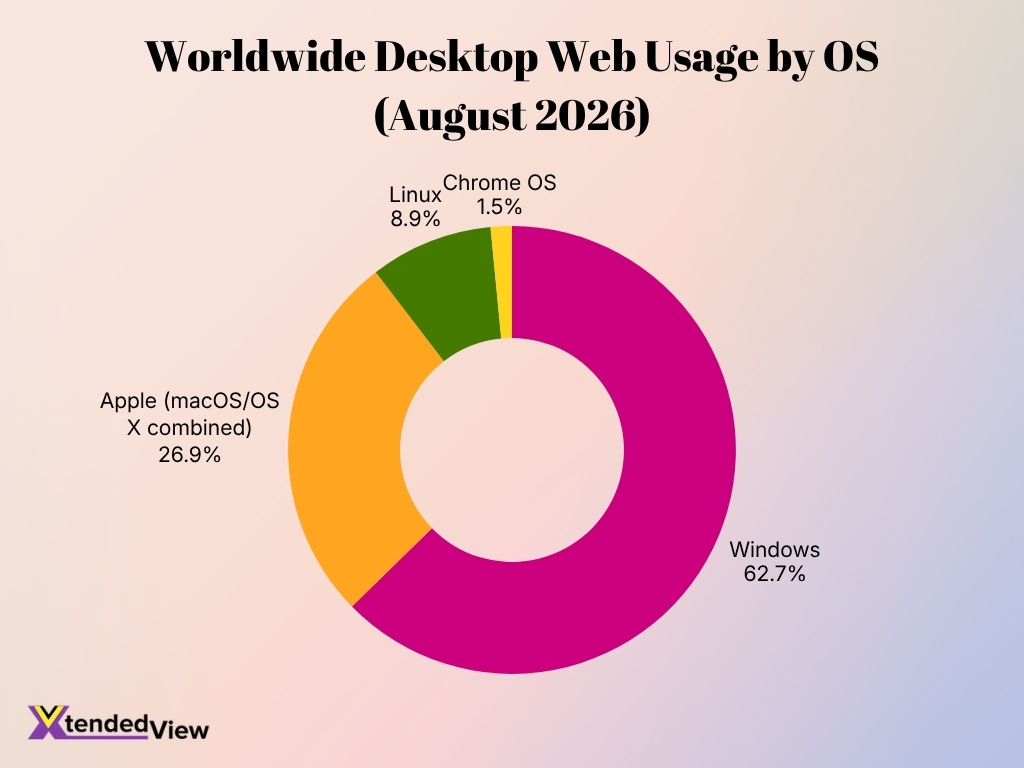
- Windows remained the largest desktop operating-system family in August 2026, accounting for 62.67% of worldwide desktop web usage.
- Apple’s two separately reported desktop operating-system categories represented 26.91% combined in August 2026, comprising 15.31% for macOS and 11.6% for OS X.
- Linux reached 8.88% of worldwide desktop usage in August 2026, while Chrome OS accounted for 1.53%.
- Within the Windows installed base, Windows 11 held a 68.6% share in August 2026, making it the dominant Windows desktop version as new AI PCs increasingly ship with Windows 11.
- Windows 10 still represented 30.14% of Windows desktops in August 2026, despite the shift toward Windows 11 hardware and the end of standard Windows 10 support in October 2025.
- Windows 11 held only 53.51% of Windows desktop usage in July 2025, meaning its share had risen by more than 15 percentage points by July 2026.
- In India, Windows represented 76.14% of desktop operating-system usage in August 2026, a substantially higher share than its worldwide desktop figure.
- Linux held 12.56% of India’s desktop operating-system usage in August 2026, while the two Apple desktop categories together accounted for roughly 10.8%.
- AI PCs span more than one operating system and processor architecture: the industry definition used in major forecasts includes Windows on x86, Windows on Arm, and macOS on Arm when the system contains a dedicated NPU.
Windows AI PC and Copilot+ PC Statistics
- Recall requires at least 50 GB of free storage before users can enable snapshot saving on a compatible Copilot+ PC. The feature automatically stops saving new snapshots when free storage falls below 25 GB.
- Recall also requires Windows Hello Enhanced Sign-in Security with at least one biometric sign-in method, adding hardware-backed authentication before users can access stored snapshots.
- Recall support on commercial Copilot+ systems requires the April 2025 Windows non-security preview update or later, showing how AI PC capabilities continue to depend on operating-system updates as well as hardware.
- Copilot+ PC intelligent search is optimized for six languages: English, Simplified Chinese, French, German, Japanese, and Spanish.
- Current Copilot+ PC documentation highlights five major NPU-centered experiences delivered through 2026: Recall, Click to Do, improved Windows search, Live Captions with translation, and Windows Studio Effects.
- A 2025 economic-impact study projects that Copilot+ PCs could save employees up to five hours per week in a modeled enterprise deployment by reducing time spent on routine work and device friction.
- The same modeled deployment projected 70% coverage of potential breach vectors, reflecting the combination of secured-core protections, local AI features, and newer Windows security hardware.
- Device-management time could decline by up to 30% in the same enterprise model, making fleet administration another measurable part of the AI PC business case beyond generative AI.
- The 13-inch Surface Laptop Copilot+ PC lists 45 NPU TOPS, 16 GB of LPDDR5x memory and an eight-core Snapdragon X Plus processor, illustrating how mainstream Copilot+ systems now exceed the platform’s original minimum AI-compute requirement.
AI PC Processor and Neural Processing Unit Statistics
- Core Ultra 200V processors can deliver up to 48 NPU TOPS, roughly three times the NPU throughput of the preceding generation cited in their architecture documentation.
- Their integrated Xe2 GPU adds more than 60 TOPS of AI throughput, allowing AI applications to distribute work between the NPU, GPU, and CPU rather than relying on a single accelerator.
- Ryzen AI 300-series processors offer up to 50 NPU TOPS, while mainstream Ryzen AI 7 350 and Ryzen AI 5 340 processors both carry the same 50-TOPS NPU rating.
- Ryzen AI Max+ 395 combines 16 CPU cores, 32 threads, and 40 integrated graphics compute units with its dedicated AI accelerator, moving workstation-level specifications into mobile AI PC designs.
- Ryzen AI Max systems can support up to 128 GB of unified memory, with as much as 96 GB available to graphics workloads, enabling significantly larger local models than ordinary notebook configurations.
- Snapdragon X2 Elite configurations now reach up to 85 NPU TOPS, almost twice the 45-TOPS capability of first-generation Snapdragon X Elite processors.
- High-end Snapdragon X2 Elite variants offer up to 18 CPU cores and 5.0 GHz clock speeds, while selected configurations provide memory bandwidth as high as 228 GB/s.
- The M5 processor uses a 10-core GPU with a Neural Accelerator in every GPU core and delivers more than four times M4’s peak GPU compute performance for AI workloads.
- RTX Spark raises local AI processing into workstation territory with up to 1 petaflop of FP4 AI performance, a 20-core Grace CPU, 6,144 Blackwell GPU cores and as much as 128 GB of unified memory.
AI PC Performance, Battery Life, and Power-Efficiency Statistics
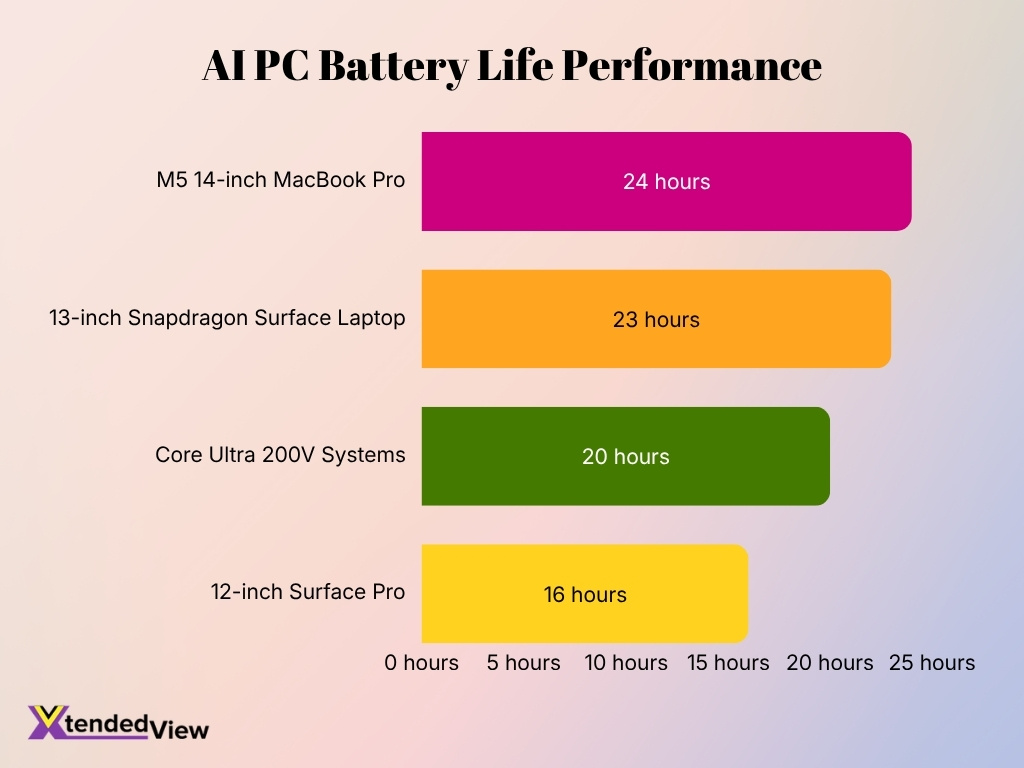
- Core Ultra 200V systems are rated for up to 20 hours of battery life in productivity workloads, reflecting a broader AI PC shift toward dedicated low-power acceleration rather than continuously loading the CPU or GPU.
- The same processor family was introduced with architecture changes designed to reduce system-on-chip power consumption by up to 40%, an important metric for thin-and-light AI notebooks.
- Core Ultra 200V documentation cites up to 80% higher peak performance in selected processor comparisons, alongside performance-per-thread gains of as much as three times.
- The M5 14-inch MacBook Pro supports up to 24 hours of battery life, placing high-performance local AI and all-day mobile operation in the same professional notebook.
- That M5 notebook delivers up to 3.5 times higher AI workflow performance than its preceding generation in selected tests, while graphics performance improves by as much as 1.6 times.
- The 13-inch Snapdragon-powered Surface Laptop is rated for up to 23 hours of local video playback and as much as 16 hours of active web use.
- The 12-inch Surface Pro lists up to 16 hours of local video playback and 12 hours of active web use, demonstrating how battery targets differ by AI PC form factor and screen design.
- Ryzen AI Max+ 395 testing cited up to 2.2 times the token-generation rate at roughly one-sixth the TDP of an RTX 4090 desktop GPU when running a 70-billion-parameter Llama model. This remains a vendor-tested comparison rather than an independent industry benchmark.
- September 2026 software optimizations improved local inference performance by up to 1.9 times on supported RTX systems through updated llama.cpp and vLLM implementations.
On-Device AI and Cloud AI Statistics
- By 2030, up to 50% of enterprise AI inference workloads in Asia-Pacific and Japan could run locally on endpoints or edge nodes rather than exclusively in centralized cloud environments.
- By 2029, 40% of enterprise workflows in the same region are forecast to span multiple connected endpoints, with AI agents handling contextual recall, state continuity and task handoffs.
- In a 2026 enterprise survey, 70% of organizations expected agentic AI systems to affect employee workflows within the following two years, increasing the need for endpoint processing alongside cloud AI.
- 67% of surveyed organizations reported expanding AI initiatives across multiple departments in 2026, showing that AI workloads increasingly extend beyond isolated pilot teams.
- Another 61% said they were embedding AI directly into business workflows, which increases demand for hybrid architectures that can select local or cloud processing depending on the task.
- 55% of privacy decision-makers said their organizations were developing controls and policies specifically for generative AI, underscoring the governance pressure behind interest in local processing.
- Data-exposure concern varies sharply by market: 68% of respondents in Japan and 62% in Brazil identified it as a major AI concern, compared with 37% in Germany and 37% in Thailand.
- Concern about AI-related data exposure reached 50% among business leaders and 48% among IT leaders, reinforcing the security argument for keeping suitable AI inference and sensitive inputs on the device.
- Local AI capabilities increasingly support large models: Snapdragon X Elite was demonstrated running 7-billion-parameter models at up to 30 tokens per second and supporting models larger than 13 billion parameters without cloud processing.
AI PC Vendor, Sales, Pricing, and Market Share Statistics
- The worldwide PC market leader shipped 16.6 million PCs in Q2 2026, capturing about 25.3% of tracked shipments despite a 2.1% year-over-year unit decline.
- The second-largest vendor shipped 13.0 million units during Q2 2026 for a 19.8% worldwide share, while its shipment volume declined 9% from the prior year.
- The third-ranked PC supplier shipped 9.3 million systems and held approximately 14.1% of the market in Q2 2026, with shipments down 4.9% year over year.
- Mac shipments reached 7.3 million units in Q2 2026 under one tracker, producing 11.1% share and 15.9% year-over-year growth, the strongest performance among the five largest vendors in that dataset.
- The fifth-largest vendor shipped approximately 5.0 million PCs in Q2 2026 and captured 7.6% of the market, with unit shipments roughly flat from a year earlier.
- The five largest PC vendors together controlled nearly 78% of global shipments during Q2 2026, illustrating continued industry concentration as component shortages favor manufacturers with scale and stronger procurement positions.
- By early September 2026, PC prices had risen by roughly 20% year over year amid constrained memory supply, even as global unit shipments declined. The pricing shift favors premium and AI-oriented configurations with higher margins.
- One major PC vendor reported an 18% revenue increase despite a 16% decline in unit sales, illustrating how pricing and premium product mix can offset lower shipment volumes during the 2026 supply squeeze.
- Two other leading PC businesses recorded approximately 20% and 30% revenue growth, respectively, in their PC segments as vendors emphasized higher-priced systems despite weaker industry unit demand.
Frequently Asked Questions (FAQs)
Worldwide AI PC shipments are forecast to reach approximately 143.1 million units in 2026, up from 77.8 million in 2025.
AI PCs are projected to account for 54.7% of worldwide PC shipments in 2026, compared with 31% in 2025.
About 60% of organizations have either deployed AI PCs (27%) or are actively piloting them (33%), while another 21% plan deployment within 12 months.
One current market estimate values the global AI computer market at $82.2 billion in 2026 and projects it to reach $281.7 billion by 2030, representing a 34.4% CAGR from 2025 to 2030.
A Copilot+ PC requires an NPU capable of more than 40 TOPS, or roughly 40 trillion AI operations per second.
Conclusion
AI PCs have moved from a specialized hardware category toward a central part of the PC industry’s next upgrade cycle. Shipment forecasts, enterprise adoption figures and rapidly improving NPU performance all indicate that AI capabilities are becoming standard features across notebooks, desktops and professional workstations rather than remaining limited to premium experimental devices.
At the same time, the market faces practical constraints, including higher memory costs, rising PC prices and differences in how businesses value local AI compared with cloud services. Mainstream systems are increasingly using efficient NPUs for everyday tasks such as transcription, search and productivity assistance, while higher-end devices are supporting larger local models, advanced creative workloads and agentic AI applications. As a result, the strongest AI PCs will likely compete on a combination of local performance, battery efficiency, security, software compatibility and price, rather than AI processing power alone.