



Linux continues to power the digital infrastructure behind cloud platforms, enterprise servers, AI workloads, and billions of smart devices. Organizations rely on Linux to run web applications, containerized services, and edge computing environments because it offers flexibility, scalability, and strong community support. At the same time, developers, governments, and technology companies keep expanding Linux adoption across desktops, embedded systems, and cloud-native applications. Explore the latest Linux statistics to understand where adoption is growing, which markets drive demand, and how Linux continues to shape the global technology landscape.
Editor’s Choice
- Linux powers 61.5% of all websites whose operating system is known, maintaining its position as the dominant web server operating system in 2026.
- Linux accounts for 4.36% of the worldwide desktop operating system market as of June 2026, continuing its gradual year-over-year growth.
- Linux represents approximately 2.77% of the global operating system market across all devices in June 2026.
- Websites running Nginx use Linux in 92.8% of deployments, highlighting Linux’s leadership in modern web infrastructure.
- Among Linux-powered websites, 44.2% use Nginx, making it the most widely deployed web server on Linux systems in 2026.
- Linux remains the preferred operating system for most public cloud workloads, container platforms, Kubernetes clusters, and supercomputers worldwide.
- The Linux ecosystem continues to benefit from thousands of active contributors each release cycle, making it one of the world’s largest collaborative open-source software projects.
Recent Developments
- In 2024, the Linux kernel became its own Common Vulnerabilities and Exposures (CVE) Numbering Authority (CNA), improving vulnerability identification and tracking through an independent process that continues into 2025 and 2026.
- Linux kernel developers increasingly prioritize patching newer kernel versions faster than legacy releases, according to recent research published in 2026.
- Linux continues to strengthen its position as the operating system of choice for AI infrastructure due to expanding GPU, accelerator, and container ecosystem support.
- Enterprise adoption of immutable Linux distributions has accelerated as organizations seek stronger security and simplified system management.
- Container-native Linux environments continue replacing traditional virtual machine deployments across cloud infrastructure.
- Linux distributions have expanded built-in support for confidential computing, hardware security modules, and secure boot technologies during the last two years.
- ARM-based Linux servers continue gaining momentum across cloud providers because they deliver improved performance-per-watt for many workloads.
- Linux remains the preferred operating system for Kubernetes nodes, with nearly all production Kubernetes environments relying on Linux-based worker nodes.
- Linux desktop adoption has benefited from improvements in gaming compatibility through Proton, Vulkan, and broader hardware support.
- Open-source AI frameworks continue releasing Linux-first optimizations before supporting many proprietary operating systems.
Linux Worldwide Operating System Market Share Trends
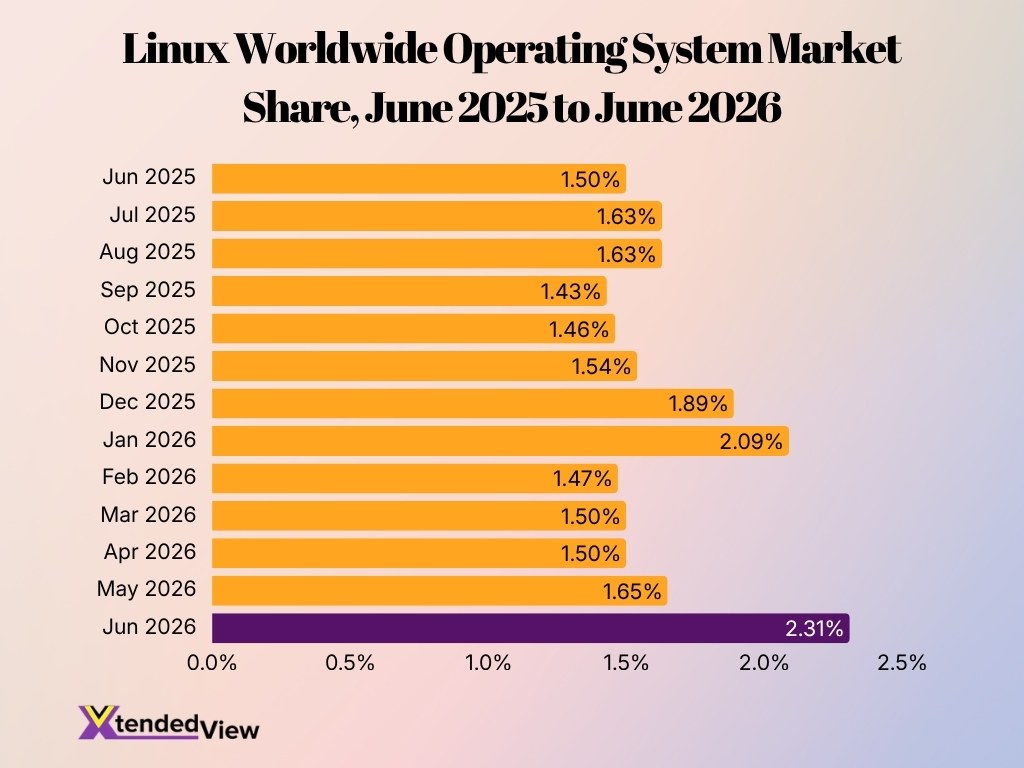
- Linux’s worldwide operating system market share increased from 1.50% in June 2025 to 2.31% in June 2026.
- The highest market share during the period was recorded in June 2026 at 2.31%.
- Linux reached another notable peak of 2.09% in January 2026 before declining the following month.
- The lowest market share was 1.43% in September 2025, followed by a slight recovery to 1.46% in October.
- Market share rose steadily from 1.54% in November 2025 to 1.89% in December and 2.09% in January 2026.
- Linux experienced its sharpest monthly decline from 2.09% in January 2026 to 1.47% in February 2026.
- The share remained stable at 1.50% in March and April 2026, showing limited month-to-month movement.
- From April to June 2026, Linux market share climbed from 1.50% to 2.31%, indicating strong recent growth.
- Overall, Linux gained 0.81 percentage points over the 12-month period.
- The June 2026 figure was approximately 54% higher than the June 2025 market share.
Linux Desktop Usage Statistics
- Linux reached 4.36% of the worldwide desktop operating system market in June 2026.
- The United States officially crossed the 5.03% desktop market share threshold in June 2025.
- Linux gaming reached a record 5.33% on the Steam Hardware Survey during March 2026.
- Compatibility tools currently allow 89.7% of popular Windows games to run flawlessly on Linux.
- Over 78.5% of developers worldwide utilize Linux as a primary or secondary programming platform.
- Cloud-native developers demonstrate a staggering 90.1% overall Linux adoption rate for modern workflows.
- India leads major global economies with a 16.21% desktop share driven by educational deployments.
- The broader Linux operating system market grew to an estimated $10.73 billion valuation in 2026.
- Machine learning and DevOps workloads running natively on Linux reached an impressive 87.8% in 2025.
Linux Server Usage Statistics
- Linux powers 61.5% of websites, reinforcing its leadership in server environments.
- 92.8% of websites using Nginx run on Linux, demonstrating its dominance in web server deployments.
- 64.9% of Apache-powered websites operate seamlessly on Linux servers.
- Among Linux-powered websites, 44.2% use Nginx as their primary web server software.
- An overwhelming 96.4% of production Kubernetes clusters operate on Linux node operating systems.
- Google Cloud runs 91.6% of its virtual machines on Linux due to lower operating costs.
- Red Hat Enterprise Linux commands a massive 43.1% market share within enterprise server environments.
- Linux exclusively powers 100% of the world’s top 500 fastest supercomputers.
- Linux controls roughly 90% of all public cloud infrastructure across major global cloud providers.
- The global Linux server OS segment reached an estimated value of $17.2 billion in 2026.
Linux Distribution Popularity
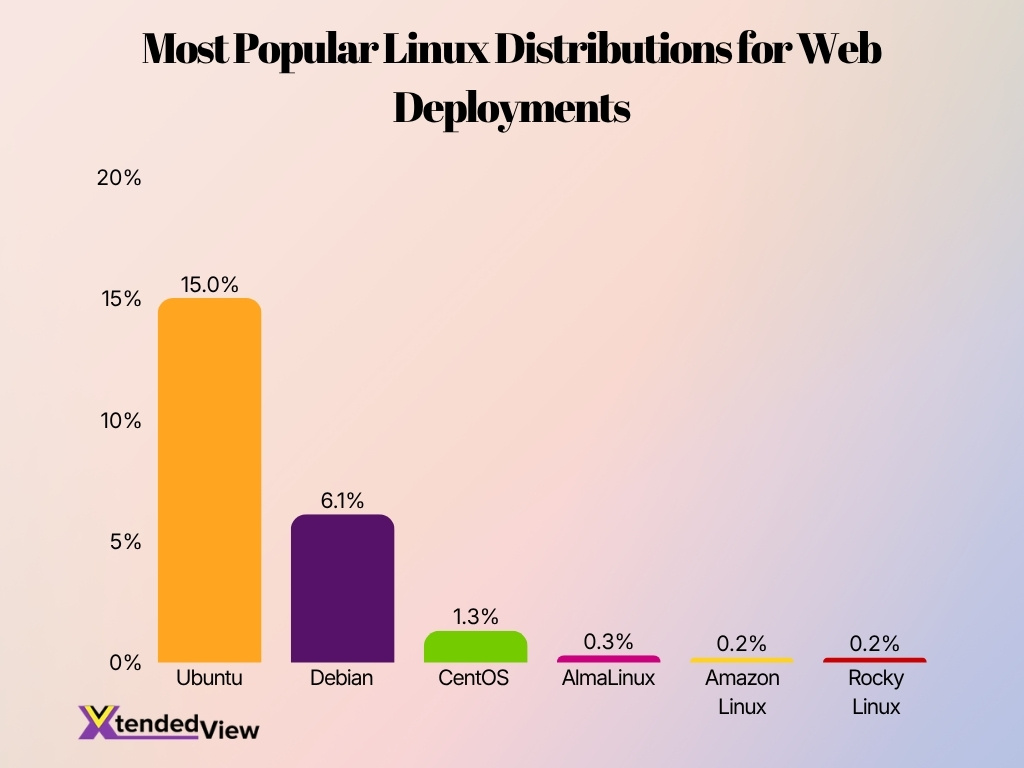
- Ubuntu powers 15.0% of Linux-powered websites, making it the most widely used Linux distribution for publicly identifiable web deployments.
- Debian accounts for 6.1% of Linux websites, maintaining its reputation as a stable choice for servers and cloud infrastructure.
- CentOS still powers 1.3% of Linux-based websites despite the industry’s migration toward newer enterprise distributions.
- AlmaLinux represents 0.3% of Linux-powered websites, reflecting continued enterprise adoption after the CentOS transition.
- Amazon Linux accounts for 0.2% of Linux websites and remains widely used for cloud-native workloads on AWS.
- Rocky Linux holds 0.2% of Linux-powered websites as organizations continue replacing legacy CentOS deployments.
- Enterprise organizations increasingly standardize on commercial Linux distributions for long-term support, security updates, and compliance requirements.
- Containerized applications allow organizations to deploy multiple Linux distributions while maintaining consistent application behavior across environments.
- Lightweight Linux distributions continue gaining popularity for IoT, edge computing, and embedded systems because they require fewer hardware resources.
- Community-supported Linux distributions remain popular among developers due to frequent software updates, extensive package repositories, and active open-source communities.
Linux Mobile and Embedded Device Statistics
- Android commands 69.14% of the global mobile operating system market as of June 2026.
- The Linux-based Android platform operates on approximately 3.9 billion active smartphones globally.
- Embedded Linux leads the industry with a 46% developer adoption rate for embedded projects.
- Over 58% of the world’s 14.2 billion connected IoT devices run on Linux-based systems.
- The global embedded Linux market is officially projected to grow to $0.90 billion by 2035.
- Linux dominates the automotive infotainment sector with a commanding 60% market share.
- More than 80 million vehicles worldwide currently utilize Linux-based infotainment systems.
- Connected cars running Linux represent an overwhelming 78% of the global connected vehicle market.
- The Linux-native Raspberry Pi computer series has successfully surpassed 68 million total units sold.
- North America currently controls a leading 37% regional share of the overall embedded Linux market.
Linux User Growth Trends
- The Linux desktop market share reached 4.36% worldwide in June 2026, maintaining a steady upward adoption trend.
- The global cloud-native developer community expanded to 19.9 million developers in early 2026, relying heavily on Linux.
- Around 7.3 million AI developers currently operate within cloud-native environments predominantly powered by Linux infrastructure.
- India is currently home to approximately 2.25 million cloud-native developers, representing 11% of the worldwide community.
- The global Linux operating system market achieved an estimated valuation of $10.73 billion in 2026.
- Approximately 78.5% of software developers globally utilize Linux as either a primary or secondary operating system.
- Linux gaming adoption reached a record high of 5.33% among PC gamers in March 2026, driven by strong compatibility layers.
- Linux server infrastructure powers an estimated 51.3% of all server operating systems worldwide in 2026.
- Across major enterprise deployments, Linux currently accounts for roughly 90% of public cloud infrastructure workloads.
- All 500 of the world’s fastest supercomputers continue to run Linux, maintaining an unbroken streak since November 2017.
Countries With the Highest Linux Usage
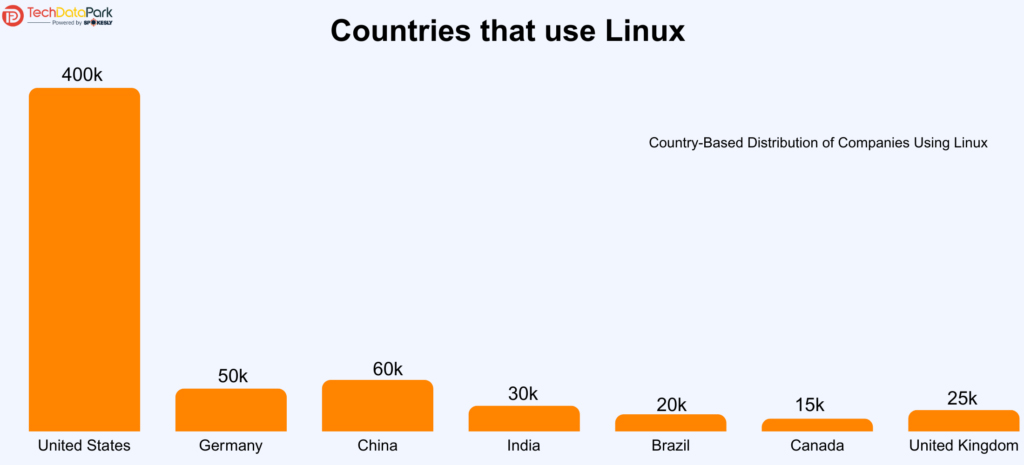
- The United States leads by a wide margin, with approximately 400,000 companies using Linux.
- China ranks second with around 60,000 companies, significantly below the U.S. total.
- Germany follows closely with nearly 50,000 companies relying on Linux.
- India records approximately 30,000 companies using Linux across business operations.
- The United Kingdom has around 25,000 companies using Linux.
- Brazil accounts for approximately 20,000 Linux-using companies.
- Canada has the lowest figure among the listed countries, with about 15,000 companies.
- The U.S. total is more than six times higher than China’s and roughly 27 times higher than Canada’s.
Linux in Web Hosting Statistics
- 61.5% of websites with a known operating system run on Linux servers.
- Among Linux-powered websites, Hostinger hosts 20.8%, making it the largest hosting provider within this segment.
- Wix accounts for 20.6% of Linux-hosted websites among identified hosting providers.
- Vercel hosts 5.9% of Linux-powered websites, reflecting continued growth in modern web application deployment.
- 95.9% of websites hosted on Hostinger use Linux as their operating system.
- 69.6% of Shopify-hosted websites with a known operating system run on Linux.
- 67.2% of Amazon-hosted websites operate on Linux infrastructure.
- Linux remains the preferred operating system for shared hosting, VPS hosting, cloud hosting, and managed hosting services because of its stability and efficiency.
- Open-source web stacks based on Linux continue reducing infrastructure costs for hosting providers worldwide.
- Linux supports most high-performance web technologies, including Nginx, Apache, Docker, Kubernetes, and modern reverse proxies.
Linux in Cloud Computing Statistics
- The worldwide cloud-native developer community reached 19.9 million in 2026.
- Approximately 7.3 million AI developers build applications predominantly on Linux.
- Exactly 54% of surveyed organizations prefer enterprise Linux for hybrid deployments.
- Linux currently powers an impressive 90% of all public cloud infrastructure.
- Google Cloud operates 91.6% of its total virtual machines entirely on Linux.
- An overwhelming 96.4% of production Kubernetes clusters currently operate on Linux.
- Red Hat Enterprise Linux holds 43.1% of the enterprise Linux server market share.
- Around 90.1% of global cloud-native developers prefer Linux-based environments.
- Linux held 51.3% of the global server operating system market in 2026.
- The global Linux operating system market is projected to reach $130.75 billion by 2034.
Linux Adoption by Industry
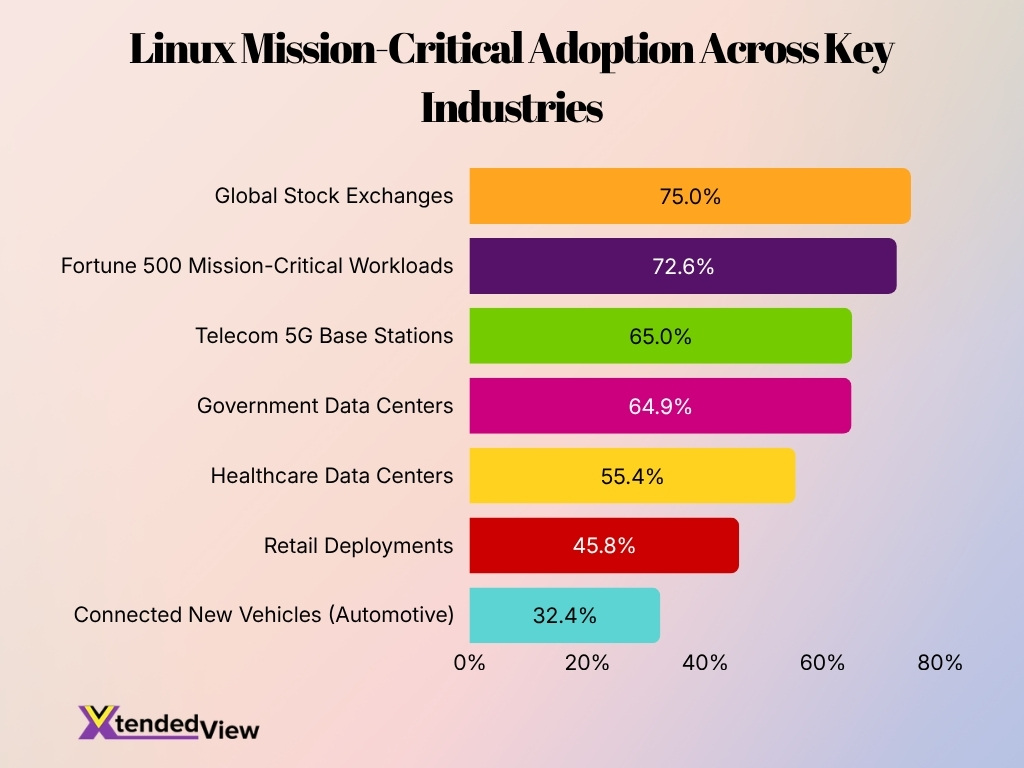
- Financial services posted a 21.5% YoY infrastructure growth, with over 75% of global stock exchanges running on Linux.
- Healthcare data centers reached a 55.4% adoption rate for Linux servers to support critical medical platforms.
- Manufacturing companies deploying SUSE Linux account for 11.2% of the enterprise market share for industrial automation.
- Telecommunications providers currently run 65% of their emerging 5G base stations on Linux infrastructure.
- Retail organizations reported a 45.8% increase in Linux deployments for point-of-sale and inventory management systems.
- Government data centers worldwide reached a 64.9% Linux deployment rate for improved security and transparency.
- Automotive manufacturers use Linux-based solutions in 32.4% of new connected vehicles globally.
- 100% of the world’s TOP500 supercomputers, often used for research and rendering, run strictly on Linux.
- Embedded Linux powered 58% of the world’s 14.2 billion connected IoT devices used across various sectors.
- 72.6% of Fortune 500 companies across all industries run their mission-critical workloads on Linux.
Linux in Enterprise Environments
- 72.6% of Fortune 500 companies run mission-critical workloads on Linux systems.
- The global Linux operating system market is projected to reach $99.69 billion by 2032.
- Linux powers 49.2% of all global cloud workloads across major enterprise providers.
- Red Hat Enterprise Linux commands 43.1% of the enterprise Linux server segment.
- Linux controls 90% of public cloud infrastructure across the largest global networks.
- Approximately 78.5% of developers use Linux as their primary or secondary operating system.
- Over 96.4% of production Kubernetes clusters currently operate on Linux infrastructure.
- Machine learning workloads demonstrate a massive 87.8% reliance on enterprise Linux platforms.
- Embedded Linux powered 58% of the world’s 14.2 billion connected IoT devices in 2024.
- Google Cloud runs an unprecedented 91.6% of its total virtual machines on Linux.
Linux in Developer Workflows
- The global cloud-native ecosystem reached 19.9 million developers in 2026, largely built on Linux.
- Around 7.3 million AI developers run machine learning workloads predominantly on Linux infrastructure.
- Corporate engineers across 1,780+ organizations contributed 84.3% of all Linux kernel commits in 2026.
- Approximately 27.7% of developers actively use Ubuntu Linux for both personal and professional workflows.
- An additional 17.1% of professionals leverage Windows Subsystem for Linux (WSL) for native development.
- Linux securely powers the foundational infrastructure for 100% of the world’s top 500 supercomputers.
- Over 82% of container users run Kubernetes in production environments operating directly on Linux nodes.
- Linux currently maintains a commanding 63.1% market share across all global server operating systems.
Linux Gaming Statistics
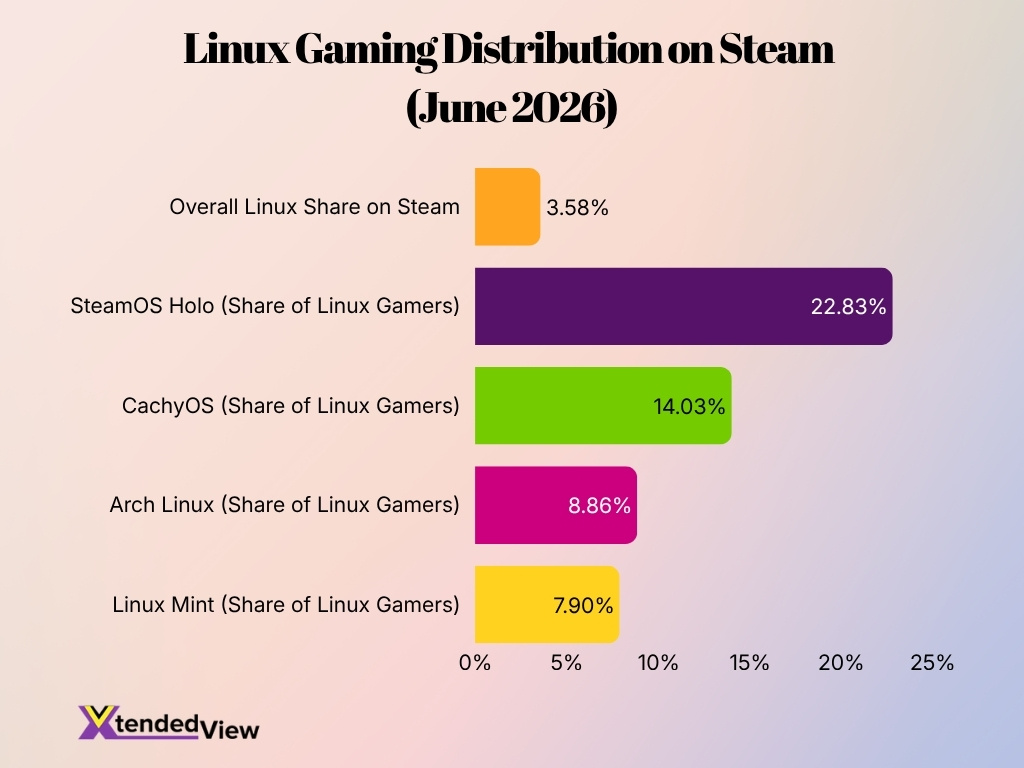
- Linux represented 3.58% of Steam users in December 2025, reaching one of its highest recorded shares on the platform.
- According to the June 2026 Steam survey, SteamOS Holo accounted for 22.83% of Linux gaming systems, making it the most widely used Linux gaming distribution.
- CachyOS represented 14.03% of Linux systems participating in the June 2026 Steam survey, reflecting rapid growth among gaming-focused distributions.
- Arch Linux accounted for 8.86% of Linux gaming systems in the June 2026 Steam survey.
- Linux Mint reached 7.90% of Linux gaming installations among surveyed Steam users in June 2026.
- Valve’s continued investment in Proton and SteamOS has significantly expanded the number of Windows games that run smoothly on Linux systems.
- Handheld gaming devices powered by Linux have contributed to increased consumer awareness and broader Linux desktop adoption.
- Vulkan graphics support continues improving gaming performance across AMD, Intel, and NVIDIA hardware on Linux.
- More game developers now release Linux-compatible titles or ensure compatibility through Proton testing during development.
- Gaming continues serving as one of the fastest-growing consumer use cases for Linux desktops during 2025 and 2026.
Linux Kernel Development Statistics
- More than 2,057 developers contributed to the massive Linux 6.16 kernel release.
- Exactly 310 new developers submitted their first kernel patch in Linux 6.16.
- Linux ranks among the top 3 global open-source projects based on development velocity.
- Every release includes contributions from hundreds of distinct organizations worldwide.
- The kernel ecosystem continuously tests updates across thousands of hardware configurations.
- The modern Linux kernel codebase comprises well over 30 million lines of code.
- Developers merge an average of 10,000 to 15,000 patches per kernel release cycle.
- The overall project averages around 13.5 accepted commits per hour from the contributor community.
Linux Open Source Contribution Statistics
- More than 9.29 million contributors actively build critical open-source technology stacks.
- 83% of organizations consider open source essential for their long-term business strategy.
- 46% of organizations reported experiencing greater business value from open-source software year-over-year.
- 55% organizational adoption was successfully recorded for open-source operating systems.
- 49% organizational adoption was reached by essential cloud and container technologies.
- 11,089 active contributors drive modern Linux kernel development across 1,780 global organizations.
- 84.3% of total commits to the Linux kernel are fueled by direct corporate contributions.
- 34.1 million lines of code currently make up the Linux kernel’s massive collaborative infrastructure.
- 2-5x return on investment is consistently realized by organizations engaged in active open-source contribution.
Open Source Software Adoption Trends
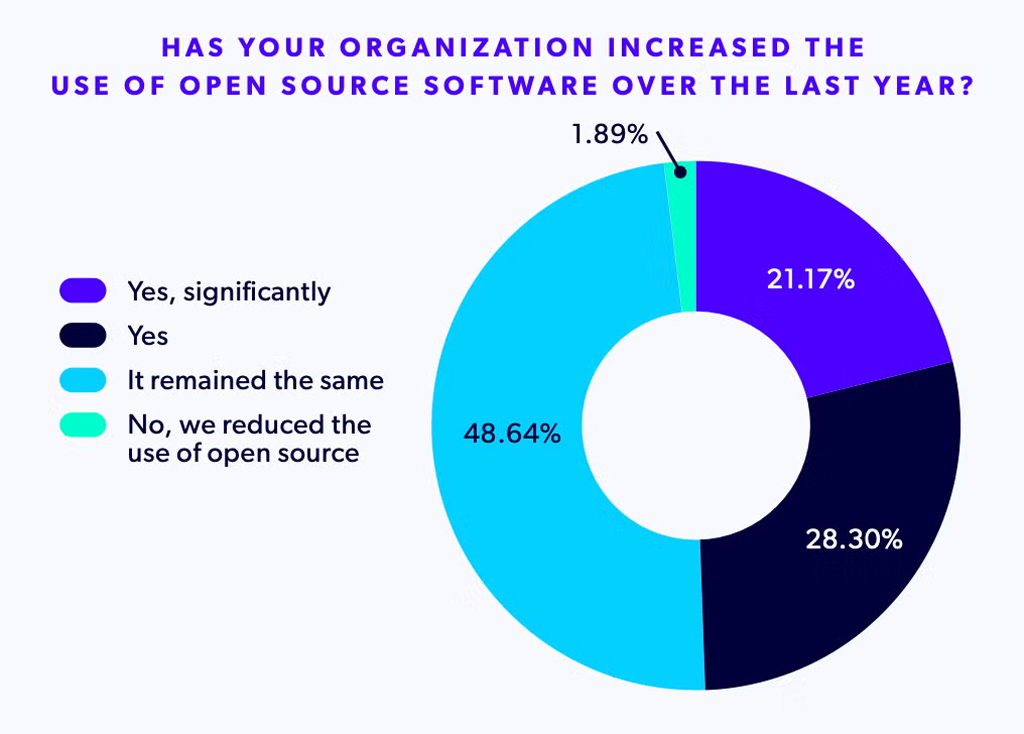
- Nearly half of organizations, 48.64%, reported that their use of open source software remained unchanged over the past year.
- Around 28.30% of organizations said they increased their open source software usage, showing steady adoption across businesses.
- Another 21.17% reported a significant increase, indicating strong confidence in open source tools and platforms.
- Combined, 49.47% of organizations increased their use of open source software either moderately or significantly.
- Only 1.89% of organizations reduced their use of open source software, highlighting its continued importance in enterprise technology strategies.
Linux Security and Vulnerability Statistics
- Linux currently powers 61.1% of all identifiable websites and 91.6% of Google Cloud virtual machines.
- The Linux kernel recorded 3,529 CVEs in 2024 after becoming an official CVE Numbering Authority.
- Vulnerability disclosures for the Linux kernel reached 5,530 in 2025, marking a 28% increase.
- Brute-force attacks account for 89% of all malicious endpoint behaviors directed at Linux systems.
- Linux ransomware attacks experienced a significant 62% surge between the years 2022 and 2023.
- Only 1.3% of all global malware detections in 2025 were attributed to Linux environments.
- Webshells act as the primary attack vector, representing 49.6% of all active Linux malware exploits.
- An overwhelming 90% of all public cloud workloads globally operate entirely on Linux infrastructure.
- Despite the high volume of reported vulnerabilities, the actual exploitation rate for Linux CVEs is just 0.02%.
Frequently Asked Questions (FAQs)
Linux holds 4.36% of the worldwide desktop operating system market as of June 2026.
61.4% of websites with a known operating system run Linux, making it the leading web server operating system.
The Linux 7.0 kernel received contributions from 2,362 developers, including 489 first-time contributors.
The Linux Kernel project reported approximately 4,148 quarterly active contributors, with a 56% contributor retention rate.
Linux accounts for approximately 3.58% of Steam users based on the latest available platform usage data.
Conclusion
Linux continues to strengthen its position across cloud computing, enterprise infrastructure, web hosting, software development, gaming, and embedded systems. The latest statistics show steady growth in desktop adoption, expanding enterprise investment, increasing cloud-native development, and one of the world’s largest open-source contributor communities.
As organizations continue modernizing infrastructure and accelerating AI, edge computing, and container adoption, Linux remains a foundational technology that powers critical digital services worldwide. Its combination of security, flexibility, performance, and community-driven innovation positions Linux to remain a leading operating system for businesses, developers, and governments.
