


Microsoft OneNote remains a widely used digital note-taking and knowledge-management tool, serving individuals, businesses, educators, and students across desktop, mobile, and web environments. Its 1 billion-plus Android download footprint demonstrates the scale of its distribution, while Microsoft 365 integration makes OneNote a practical workspace for meeting notes, project planning, research, classroom activities, and collaborative knowledge sharing. Recent Copilot developments have expanded the platform beyond traditional note-taking by adding AI-assisted summarization, task extraction, content organization, project planning, and audio overviews. The statistics in this article examine OneNote’s users, downloads, adoption, market position, business and education usage, cross-platform capabilities, AI features, and competitive standing to provide a clearer picture of the platform.
Editor’s Choice: Microsoft OneNote Key Facts
- OneNote has now surpassed 1 billion Android downloads, placing it among a relatively small group of productivity apps to cross that installation threshold.
- An independent Android installation tracker estimated about 1.161 billion cumulative installs by Aug. 15, 2026. Because this is an estimate rather than an official user count, it should not be interpreted as 1.161 billion active people.
- Current technology-detection data identifies approximately 24,446 organizations using OneNote.
- Within that technology dataset, OneNote represents roughly 0.1% of tracked office-productivity implementations. This measures detectable organizational adoption, not consumer market share.
- One separate technology dataset tracks 2,556 current websites or companies associated with OneNote, highlighting how company counts can differ sharply depending on detection methodology.
- The current iOS application package is approximately 417.6 MB, reflecting the expanding set of sync, handwriting, audio, and AI capabilities inside the mobile app.
- On the U.S. iOS productivity chart, OneNote ranked No. 79 when the current listing was retrieved. App-store rankings change frequently, so this figure provides a 2026 snapshot rather than a fixed annual ranking.
Recent Developments
- On July 1, 2025, Copilot Notebooks were introduced inside OneNote, allowing users to combine notes with Word documents, PowerPoint files, Excel files, and other project material in an AI-grounded workspace.
- The 2025 implementation allowed users to attach more than 20 references, although Copilot initially used only the first 20 references for grounding its responses.
- On Oct. 14, 2025, OneNote for Windows 10 reached end of support. The older application moved to read-only operation and stopped supporting note creation, editing, and synchronization.
- On March 12, 2026, the refreshed Copilot Notebooks experience reached general availability with a three-column layout designed to place references, conversation, and notebook work in a more unified view.
- An April 29, 2026 update expanded Copilot’s understanding beyond typed text to four additional content forms highlighted in the announcement: note tags, images, tables, and inked notes.
- That April release required at least OneNote for Windows version 2601, build 19628.20128, or version 16.106, build 26020821, on supported Mac and iOS devices.
- A May 2026 mobile update combined three capture modes in one iPhone session: live audio, photographs and typed notes, after which Copilot could organize the material into a structured notebook page.
- On June 11, 2026, Copilot Notebooks began rolling out to Copilot Chat users in both commercial and education environments, expanding access beyond users with the full Microsoft 365 Copilot license.
- In August 2026, Copilot Notebooks formalized two connected experiences: a lighter workflow in the Copilot app and a deeper workspace in OneNote. The two environments synchronize so users can move between them without losing notebook context.
Microsoft OneNote User Statistics
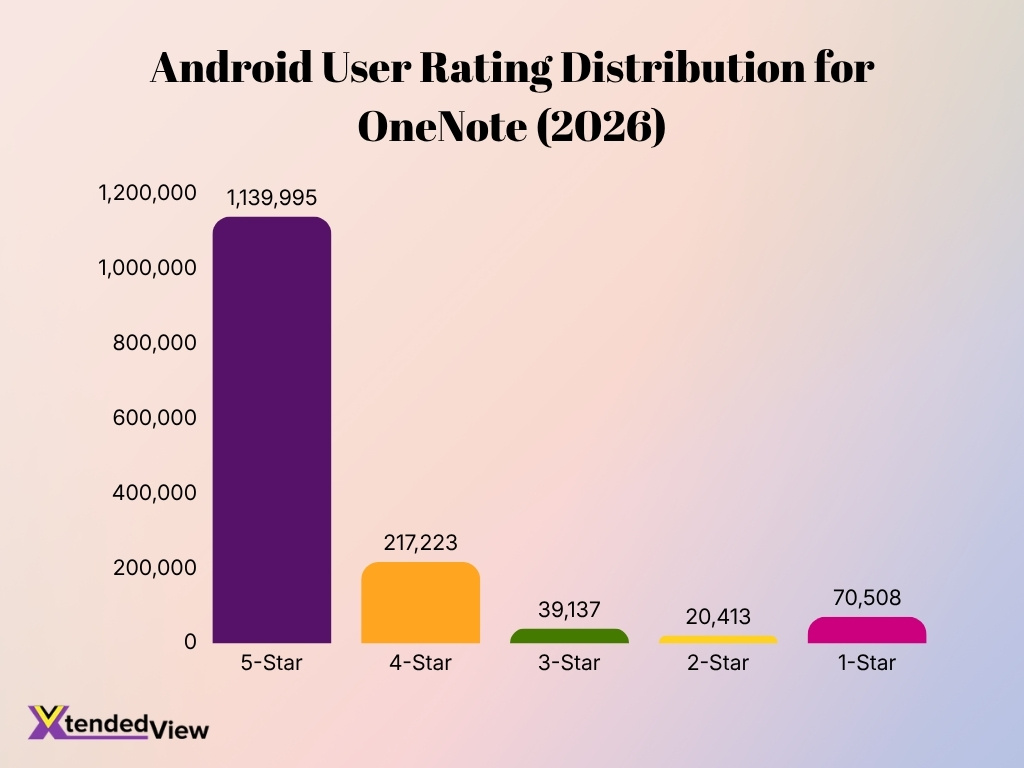
- The Android application had approximately 1,487,303 ratings as of Aug. 15, 2026, providing one of the largest publicly observable samples of OneNote’s mobile audience.
- About 1,139,995 Android ratings in that dataset were five-star ratings, representing the largest single rating category.
- Four-star Android ratings totaled approximately 217,223, showing a sizable second tier of highly positive user feedback.
- Three-star ratings accounted for roughly 39,137 submissions in the same 2026 Android dataset.
- Two-star feedback totaled around 20,413 ratings, making it the smallest of the five rating groups reported.
- One-star feedback stood at about 70,508 ratings, meaning negative reviews remained materially smaller than the five-star cohort.
- In India, the iOS listing had accumulated about 126,000 ratings, illustrating substantial engagement in a market outside North America.
- One corporate-adoption dataset identified 15,311 companies with detectable OneNote usage, while another current dataset records a larger total. The difference illustrates why enterprise technology counts should be treated as samples rather than a definitive census of all OneNote users.
Microsoft OneNote Active Users
- Microsoft defines an active app user as someone who performs an intentional action in an application, rather than someone who merely holds an eligible license.
- Microsoft 365 administrators can track OneNote active-user trends alongside five other named core applications in the standard usage chart: Outlook, Word, Excel, PowerPoint and Teams.
- Usage reporting also separates application activity across four platforms, Windows, Mac, web and mobile, which helps organizations distinguish desktop adoption from mobile or browser use.
- In 2026, Copilot reporting added a specific OneNote Active Users measurement so organizations can track people who actually use Copilot capabilities inside OneNote.
- Any use of a Copilot feature in OneNote counts toward the active-user metric, and the reporting system records the user’s last activity date in UTC.
- Partner analytics introduced a separate Copilot in OneNote MAU signal in 2026, covering activities such as summaries, task generation, and organizing notes into new content.
- The reporting API supports a 7-day trend period in its documented usage example, enabling administrators to analyze short-term changes in enabled and active Copilot users.
- The same reporting framework can separate enabled users from active users, making it possible for enterprises to calculate actual adoption rates instead of treating every provisioned license as a OneNote user.
Microsoft OneNote Usage Statistics
- OneNote supports at least three primary input approaches described in its current integration documentation: typing, sketching, and voice capture.
- Users can move among four device environments, web, phone, tablet and desktop, while maintaining access to synchronized notebook content.
- Copilot Notebooks can draw context from at least six explicitly listed reference formats in its 2025 implementation: Word, PowerPoint, Excel, PDF, Loop and OneNote content.
- By June 2026, Copilot Notebook audio overviews supported eight languages: English, Spanish, Japanese, French, German, Portuguese, Italian, and Chinese.
- Audio playback includes 15-second skip controls, allowing users to move forward or backward through generated notebook summaries.
- Creating an audio overview requires at least one reference file, such as a Word document or OneNote page, so the AI output remains grounded in notebook material.
- Starting March 31, 2025, the OneNote API stopped supporting app-only authentication, shifting supported integrations toward delegated authentication.
- In 2026, OneNote’s iPhone multimodal workflow could combine audio transcription, image capture, and typed input into one recording session, reducing the need to capture each content type separately.
- Copilot can now reason across at least five notebook content types in a page-level workflow: typed text, tags, images, tables and digital ink, which broadens the range of notes that users can analyze without manually converting them to plain text.
Microsoft OneNote Downloads and Installs
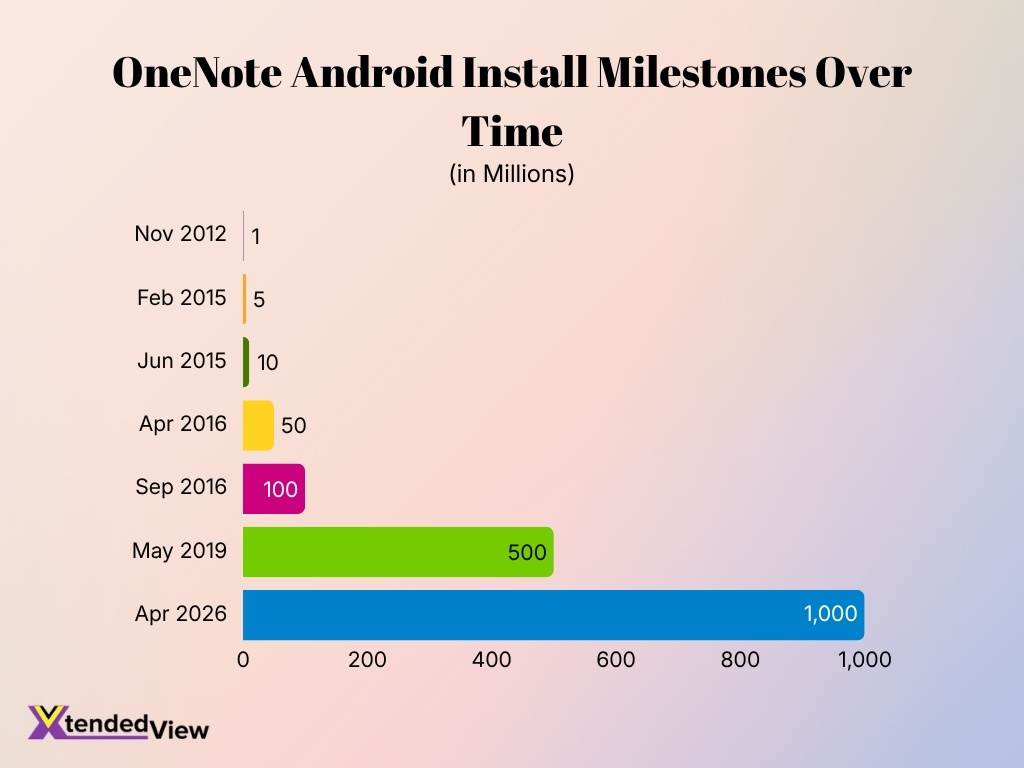
- OneNote reached the 1 million Android install threshold on Nov. 21, 2012.
- It reached 5 million installs by Feb. 3, 2015, showing a fivefold expansion from its first million-install milestone.
- Android installations passed 10 million on June 11, 2015.
- OneNote crossed 50 million installs on April 9, 2016, less than a year after reaching the 10 million threshold.
- The Android app reached 100 million installs on Sept. 10, 2016.
- It subsequently crossed 500 million installs on May 1, 2019, marking another fivefold increase from the 2016 milestone.
- The next recorded milestone arrived on April 5, 2026, when Android installations crossed 1 billion. That means the app doubled its recorded installation threshold from 500 million to 1 billion between those milestones.
- Current Android download tracking shows roughly 1.01 billion recorded downloads in one 2026 dataset, reinforcing the billion-plus scale seen in the official store listing.
Microsoft OneNote Adoption and Growth Trends
- OneNote passed 1 billion Android downloads in 2026, compared with 500 million in May 2019. The milestone indicates that its cumulative Android installation tier doubled in roughly seven years.
- A current technology-tracking dataset detects OneNote at 24,446 companies, providing one measure of its enterprise installed base in 2026.
- A separate dataset identifies 15,311 organizations using OneNote. The gap between the two totals illustrates how customer estimates change with collection and detection methods.
- Another 2026 database tracks 14,594 companies using OneNote, further reinforcing the need to treat third-party company counts as samples rather than an official global total.
- A narrower customer database, updated May 16, 2026, records 4,244 companies using OneNote. Its sample includes organizations from the U.S., Sweden, Germany, Australia, Spain, Hungary, Hong Kong and the U.K.
- The longest-running technology dataset used here says its OneNote usage history extends back 10 years and 11 months, providing nearly 11 years of organizational adoption signals.
- OneNote’s growth path increasingly connects to Microsoft 365 deployment because OneNote comes with Word, Excel, and PowerPoint in Microsoft 365 Apps. IT teams therefore do not need a separate installation step during a standard deployment.
- The October 2025 retirement of OneNote for Windows 10 consolidated Microsoft’s Windows strategy around the current OneNote application. Enterprise and education customers had to migrate to the supported Windows version to continue receiving updates.
- Adoption also expanded into AI workflows in 2025 and 2026. Copilot Notebooks brought Word, Excel, PowerPoint, and other project references into OneNote, extending the product from note capture toward AI-assisted project organization.
Microsoft OneNote Market Share and Market Position
- One technology dataset estimates OneNote at about 0.15% of the office-productivity market, based on 15,311 detected organizations.
- A second dataset rounds OneNote’s office-productivity share to approximately 0.1%, based on a larger sample of 24,446 organizations.
- OneNote’s 1B+ Android download tier gives it a much larger consumer installation footprint than its narrow enterprise technology-share percentage might suggest.
- The Android application maintains a 4.6-star rating based on roughly 1.49 million reviews in 2026, giving OneNote both large-scale distribution and substantial public user feedback.
- One enterprise dataset counts 14,594 OneNote companies, compared with 26,811 for Dropbox in the same technology environment. This puts the detected OneNote base at roughly 54% of the Dropbox count within that particular dataset.
- The same dataset identifies 52,819 OneDrive companies, about 3.6 times the number detected for OneNote. This comparison reflects technology detections, not unique end users.
- OneNote’s market position benefits from bundling: Microsoft 365 Apps deployments include OneNote alongside three core creation applications, Word, Excel, and PowerPoint, without requiring a separate OneNote deployment.
- In education, OneNote also occupies a specialized position through Class Notebook, which combines three distinct spaces: private Student Notebooks, a Content Library and a Collaboration Space.
- OneNote’s market position expanded further in 2025 when Copilot Notebooks became available to eligible enterprise customers running Windows version 2504, build 18827.20128, or later, tying note-taking more closely to AI-assisted knowledge work.
Companies Using Microsoft OneNote
- One 2026 technology dataset identifies 14,594 companies with OneNote usage signals.
- Another detects 24,446 organizations, about 9,852 more than the 14,594-company dataset because the providers use different collection methodologies.
- KPMG US appears in a current OneNote customer sample with approximately 53,000 employees, demonstrating usage within a large professional and financial services environment.
- CBRE appears with about 115,000 employees and $31 billion in reported revenue in the same sample, showing adoption within a major global real estate organization.
- IQVIA appears with approximately 80,000 employees and $14 billion in revenue, providing an example from the health care and life sciences sector.
- PCL Construction appears with approximately 13,000 employees and $6.3 billion in revenue, illustrating OneNote adoption in construction.
- A separate 2026 customer sample includes Spotify in Sweden in the 5,000-to-10,000-employee range.
- Canva appears in the same database as an Australian OneNote customer with 1,000 to 5,000 employees, demonstrating adoption among digital design businesses.
- Other detected customers span much smaller organizations: the same sample places Animoto at 50 to 100 employees and Otter.ai at 100 to 500, showing that organizational OneNote use is not limited to large enterprises.

Microsoft OneNote Customers by Industry and Company Size
- One large 2026 customer dataset estimates that 28% of detected OneNote organizations operate in technology, making it the largest industry category in that sample.
- Financial services account for another 18% of organizations in the same dataset, placing the sector second among its reported OneNote industries.
- Health care represents 16% of the dataset, indicating substantial use in organizations that handle clinical, administrative, and operational information.
- Professional services account for 14%, while education contributes another 12%. Combined, those two categories represent 26% of the detected installed base.
- By revenue, 42% of organizations in that dataset fall into the $50 million-to-$500 million midmarket segment, the largest revenue group reported.
- Businesses with less than $50 million in revenue represent 18% of the sample, showing that smaller companies also form a meaningful part of OneNote’s detected commercial base.
- Companies generating $500 million to $1 billion account for 24%, while organizations above $1 billion represent another 16%. Together, those higher-revenue groups make up 40% of the dataset.
- A separate enterprise dataset finds that OneNote most commonly appears at companies with 1,000 to 5,000 employees and $10 million to $50 million in revenue.
- Another customer sample demonstrates the breadth of company sizes directly: Animoto falls in the 50-to-100-employee range, while Spotify sits between 5,000 and 10,000 employees.
Microsoft OneNote Business Usage Statistics
- One current dataset tracks 24,446 companies using OneNote, with information technology and services identified as the most common industry in that particular sample.
- Companies with 1,000 to 5,000 employees form the most common employee-size bracket in that dataset, indicating a strong mid-to-large-enterprise presence.
- Organizations generating $10 million to $50 million in annual revenue form its most common revenue band for OneNote usage.
- OneNote deployment can occur automatically with Microsoft 365 Apps because it ships alongside Word, Excel, and PowerPoint. This reduces the number of separate application deployment steps required by IT administrators.
- Copilot Notebooks initially supported a maximum of 20 reference files in the 2025 enterprise implementation, allowing workers to ground AI interactions in a focused set of project materials.
- That 2025 Copilot Notebook implementation required two licensing components for eligible enterprise users: a Microsoft 365 Copilot license plus a SharePoint or OneDrive license.
- A 2026 corporate deployment example standardized collaboration across five named productivity components: Teams, SharePoint, OneNote, Planner, and Microsoft 365 Copilot, illustrating OneNote’s role inside broader workplace collaboration architecture.
- In a 2026 executive workflow example, a CIO reported drafting increasingly complex Copilot prompts in OneNote after roughly two years of using the AI assistant, showing how OneNote can function as a staging area for structured AI work.
- The retirement of OneNote for Windows 10 in October 2025 also affected business IT planning. Enterprise customers had to migrate to OneNote on Windows, which supports administrative controls such as Group Policy.
Microsoft OneNote Users by Country
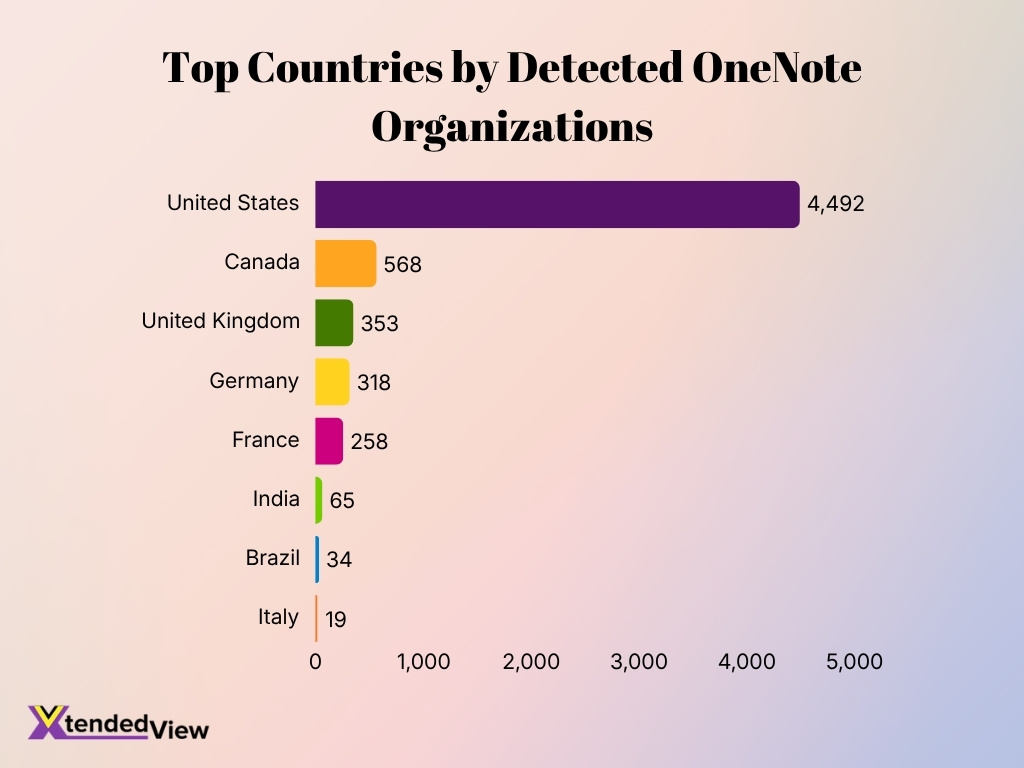
- The United States accounts for 4,492 detected OneNote companies in one current dataset, making it the largest named country in that sample.
- Canada follows with approximately 568 companies, although a country-specific extraction from the same data environment lists 566. Small differences can occur as datasets refresh.
- The United Kingdom has 353 detected companies using OneNote, placing it behind the U.S. and Canada among the named markets in the dataset.
- Germany accounts for 318 detected organizations, making it the largest explicitly reported continental European country in that sample.
- France contributes another 258 organizations, giving Germany and France a combined 576 detected OneNote companies.
- India has 65 detected companies in the country-specific dataset, compared with 34 in Brazil and 19 in Italy.
- At the continental level, North America accounts for 5,092 detected companies, more than three times Europe’s 1,580 in the same dataset.
- Asia accounts for 167 detected organizations, while Oceania contributes 157. These figures measure observable enterprise technology signals and should not be interpreted as total OneNote users in those regions.
- A broader 2026 commercial dataset reports OneNote-related company records across 190+ countries, indicating a substantially wider geographic footprint when different collection methods are used.
Microsoft OneNote Education and Online Learning Statistics
- A historical adoption benchmark recorded 400,000 teachers and 3.5 million students using OneNote Class Notebooks by mid-2016. Although this is not a current user count, it demonstrates that OneNote had already reached multimillion-student scale a decade before 2026.
- By the 2017-18 school year, more than 15 million new student notebooks had been added in only the early portion of that academic year, demonstrating rapid historical expansion of Class Notebook.
- Class Notebook organizes learning into three core areas: private Student Notebooks, a teacher-managed Content Library, and a shared Collaboration Space.
- Educators generally need only 5 to 10 minutes to set up a Class Notebook for one class, according to current setup guidance.
- Every class created in Teams for Education can have one linked Class Notebook, connecting notebook activities directly with the class team’s workflow.
- A current educator training module contains 12 units and takes approximately 1 hour and 7 minutes to complete, covering setup, content distribution, assignments, assessment, collaboration, and accessibility.
- The same training module allocates seven minutes each to several core Class Notebook workflows, including setup, Content Library use, page distribution, Teams assignments, student assessment, and Collaboration Space use.
- In 2025, the Class Notebook toolbar became natively available on Windows and Mac rather than requiring educators to install the older add-in. Microsoft 365 LTI 1.3 integration also expanded connections among Class Notebook, assignments, Reflect and learning management systems.
- One education platform integrated with OneNote Class Notebook reports nearly 2 million paid users. The figure belongs to the broader learning platform rather than OneNote itself, but it demonstrates OneNote integration operating within a large K-12 ecosystem.
Microsoft OneNote Cross-Platform Usage
- OneNote is officially available across six platform categories: Windows, macOS, iPad, iPhone, Android, and the web.
- The core navigation interface follows a consistent design across four native environments, Windows, Mac, iOS and Android, reducing the learning curve when users switch devices.
- Cloud-connected notebooks remain accessible through any modern web browser, giving users an additional option when their primary computer or mobile device is unavailable.
- Data-protection documentation currently compares OneNote features across six environments: Windows, Mac, iPad, iPhone, Android, and web.
- Windows automatically backs up notebooks daily by default, while the Mac version uses a weekly default backup schedule.
- Windows local backups have a default retention window of two weeks, while Mac keeps the two most recent backup copies.
- Deleted notes remain recoverable for up to 60 days on supported OneNote platforms unless a user empties the notebook recycle bin earlier.
- Sync-error visibility appears across all six platforms covered by current data-protection documentation, helping users identify problems instead of silently losing synchronization.
- Android and iPhone users can consume synchronized notebooks on mobile, while full notebook sharing remains centered on three environments, PC, Mac, and web, according to current sharing guidance.
Microsoft OneNote Use Cases
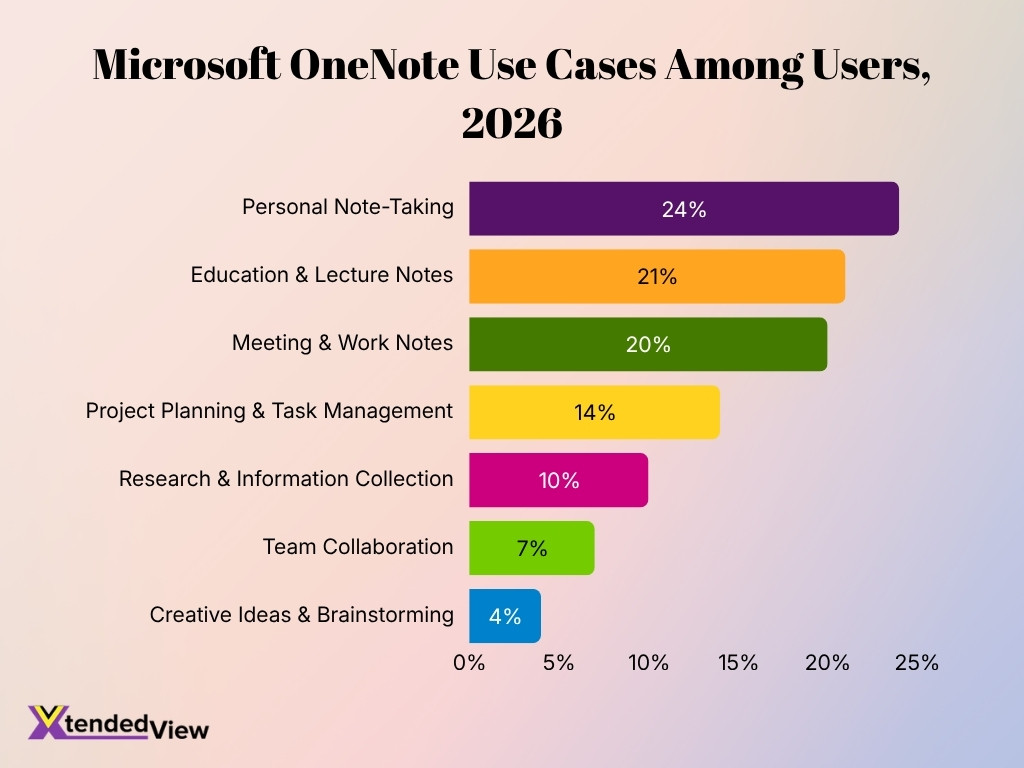
- Personal note-taking is the leading OneNote use case, accounting for an estimated 24% of usage.
- Education and lecture notes represent 21% of OneNote usage, highlighting its strong presence among students and educators.
- Meeting and work notes make up 20% of usage, showing OneNote’s importance in professional environments.
- Project planning and task management account for 14% of estimated usage among OneNote users.
- Research and information collection contribute another 10%, reflecting OneNote’s role in organizing reference material.
- Team collaboration represents 7% of usage, while creative ideas and brainstorming account for the remaining 4%.
- Combined, personal note-taking, education, and work notes account for 65% of estimated OneNote use cases.
Microsoft OneNote Features and Collaboration Statistics
- OneNote notebooks support two principal sharing permission levels: Can View and Can Edit. Notebook owners can change these permissions after sharing.
- Collaborative notebooks can support multiple simultaneous authors, with changes appearing automatically as each authorized participant adds meeting notes or other content.
- OneNote updates from co-authors can appear immediately, unlike workflows that depend on users manually saving a document before collaborators see changes.
- Shared notebooks need to reside in one of two supported cloud environments highlighted in current guidance: OneDrive or SharePoint.
- Notebook owners can distribute access through two core methods: direct invitations to specified people or a copied sharing link.
- OneNote no longer supports independent sharing of a single notebook page from personal cloud notebooks; sharing normally applies at the notebook level.
- Deleted pages or sections remain recoverable for up to 60 days, giving collaborative teams time to reverse accidental deletions.
- Current recovery documentation covers six OneNote platforms, although recycle-bin and backup behavior differs by device.
- A SharePoint-hosted team notebook requires collaborators to have two access capabilities, read and write permission, if they need to view and edit shared notes.
- Windows and Mac each support two backup modes, automatic and manual, providing additional recovery options for users working with important notebooks.
Microsoft OneNote AI Features
- Copilot Chat in OneNote highlights at least three major AI workflows in current documentation: summarizing notes, creating to-do lists, and drafting project plans.
- Copilot Notebooks can bring together at least five explicitly described content sources: Copilot chats, Microsoft 365 files, OneNote pages, links, and other project material, before generating answers or drafts.
- Audio Overview supports eight input and output languages as of June 2026, expanding AI-assisted notebook review beyond English.
- The audio player includes 15-second forward and backward controls, as well as adjustable playback speed, pause, customization, and saving.
- Audio generation requires at least one grounded reference, such as a Word document or OneNote page, before Copilot can create the spoken overview.
- The Take notes with Copilot feature can retrieve information from three named Microsoft 365 content categories, documents, messages and emails, and place relevant material directly onto a OneNote canvas.
- OneNote’s AI organization workflow can reorganize notebook sections using prompts such as organizing by two explicit criteria: date or priority. The feature remains in public preview in 2026.
- Copilot supports at least four major text-transformation tasks across current OneNote guidance: summarizing, rewriting, outlining, and extracting to-do items.
- Copilot Notebooks now operate across two connected experiences: the broader Copilot environment and the fuller workspace inside OneNote.
- Access to Copilot in OneNote depends on the appropriate Copilot entitlement, while Copilot Notebooks require one Copilot or Copilot Chat license category and, for some functionality, supporting cloud storage access.
Microsoft OneNote Market Share Compared With Competitors
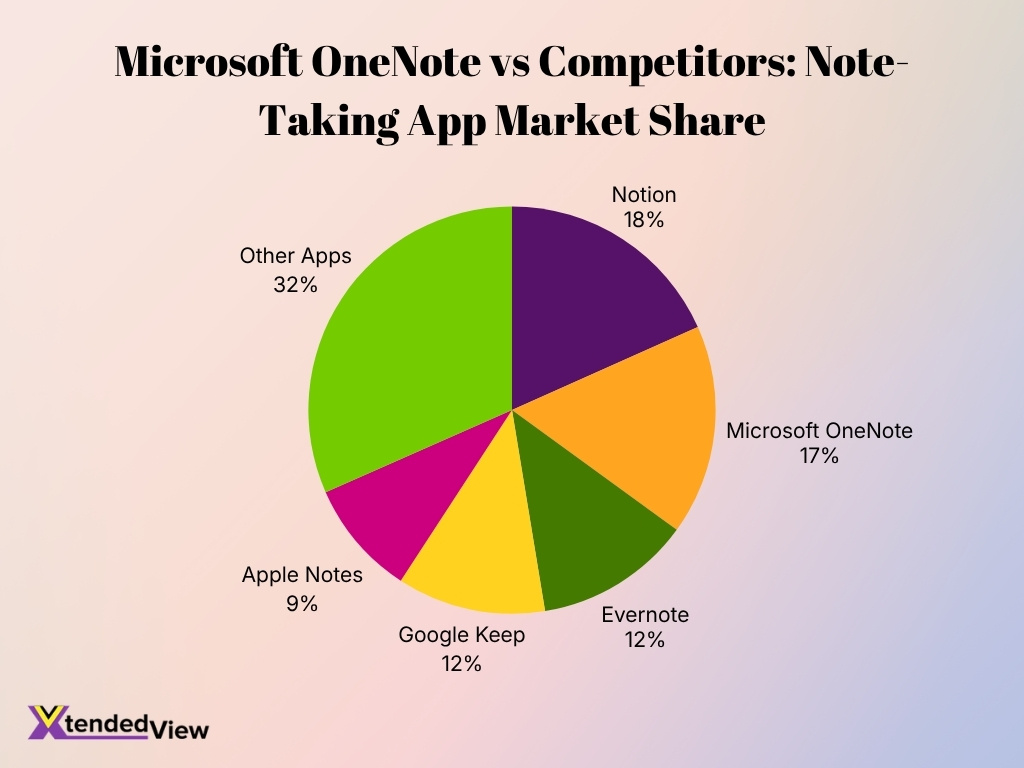
- Notion leads the named note-taking apps with an estimated 18.3% market share, positioning it slightly ahead of Microsoft OneNote in the competitive productivity and note-taking software market.
- Microsoft OneNote holds an estimated 16.7% market share, making it the second-largest named platform and highlighting its strong position among widely used note-taking applications.
- The market-share difference between Notion at 18.3% and Microsoft OneNote at 16.7% is just 1.6 percentage points, suggesting relatively close competition between the two leading named platforms.
- Evernote captures an estimated 12.4% market share, placing it behind OneNote by 4.3 percentage points but still maintaining a notable presence in the note-taking app landscape.
- Google Keep accounts for 11.8% of the estimated market, putting it close to Evernote, while Apple Notes holds 9.2%, the smallest share among the individually listed platforms.
- Other note-taking apps collectively represent 31.6% of the market, meaning nearly one-third of total market share remains spread across smaller, specialized, or alternative note-taking platforms.
Frequently Asked Questions (FAQs)
Microsoft OneNote has surpassed 1 billion Android downloads as of September 2026.
Microsoft OneNote holds a 4.7 out of 5 rating from approximately 1.1 million ratings on the U.S. App Store.
The iOS version of Microsoft OneNote supports English plus 32 additional languages, or 33 languages in total.
Copilot Notebook audio overviews currently support 8 languages: English, Spanish, Japanese, French, German, Portuguese, Italian, and Chinese.
A OneNote Class Notebook typically takes about 5 to 10 minutes to set up for a single class.
Conclusion
Microsoft OneNote enters the year as an established note-taking platform that increasingly overlaps with collaboration, knowledge management, and AI-assisted productivity. Its 1 billion-plus Android installation footprint, extensive cross-platform availability, and presence across thousands of detected organizations demonstrate substantial reach, while Class Notebook continues to support structured education workflows. At the same time, Copilot is changing how people interact with their notes by helping users summarize information, identify tasks, organize content, develop plans, and generate audio overviews from existing material.
The statistics also show why OneNote’s scale requires careful interpretation. Cumulative downloads, app ratings, detected business customers, and Microsoft 365 deployments measure different aspects of adoption and cannot substitute for an official worldwide active-user figure. No reliable current global OneNote MAU total has been publicly disclosed, so these indicators provide the strongest available view of its reach. Overall, OneNote’s position reflects a mature note-taking product evolving into a broader AI-supported productivity and knowledge workspace, while retaining its established roles in personal organization, business collaboration, and education.
