


Airtable has evolved from a flexible database and collaboration tool into a broader platform for building business applications, automating workflows, organizing operational data, and supporting AI-assisted work. Its use now extends across marketing, product development, content production, customer research, project management, and other business functions. Real-world deployments show teams using Airtable to analyze large volumes of customer feedback, coordinate global campaigns, manage product launches, and automate repetitive operational tasks.
With 10 million active users and more than 500,000 organizations reported on the platform, Airtable has established a sizable footprint across businesses of different sizes. The following Airtable statistics examine its adoption, customers, market share, revenue, AI usage, integrations, pricing, productivity impact, and outlook.
Overview of Airtable
- Airtable’s current corporate history dates the company’s beginning to 2012, although the commercial product reached the market several years later.
- The original Airtable product launched in 2015, making 2025 its 10th year as a commercially available collaborative application platform.
- By 2021, people across more than 250,000 organizations had already used Airtable, providing a useful historical benchmark for its later expansion.
- Airtable reported more than 1 million active applications running on its platform in 2021, several years before its current emphasis on AI-powered apps and agents.
- The company currently lists six offices worldwide, reflecting its expansion beyond its original U.S. base.
- Airtable launched a services partner program with 41 launch partners, extending implementation support for larger enterprise deployments.
- In June 2025, Airtable repositioned the product as an AI-native app platform, marking one of the largest changes to its positioning since its original launch.
Editor’s Choice
- Airtable now reports 10 million active users, making its active-user base one of the clearest indicators of its scale in 2026.
- More than 500,000 organizations currently build or operate workflows with Airtable.
- Airtable’s current company overview states that 90% of Fortune 100 companies use the platform.
- Users have created more than 50 million apps and agents, highlighting how Airtable usage now extends beyond conventional tables and databases.
- Airtable reached approximately $480 million in annual recurring revenue by June 2026.
- Annual recurring revenue was growing by more than 20% year over year as of June 2026.
- The acquisition announced in August 2026 assigned Airtable an enterprise value of $1.285 billion in an all-cash transaction.
Recent Developments
- On Sept. 4, 2026, Airtable confirmed completion of its acquisition, one day before this article’s Sept. 5, 2026 reference date.
- The acquisition agreement had originally been announced on Aug. 4, 2026, meaning roughly one month separated the announcement from completion.
- The transaction covered 100% of Airtable’s issued and outstanding shares and used an all-cash structure.
- Airtable’s July 2026 product update highlighted three newer access surfaces for human-and-agent workflows: Airtable Mobile, Omni in Slack, and MCP skills.
- On Dec. 15, 2025, Airtable introduced an integration that lets users reference, analyze, and update Airtable information directly from ChatGPT.
- On June 24, 2025, the company formally relaunched Airtable around an AI-native app-platform strategy rather than treating generative AI as an isolated add-on.
- On April 9, 2025, Airtable introduced its AI Assistant in beta, with the beta scheduled to roll out to eligible customers during the following week.
Airtable Market Share and Adoption
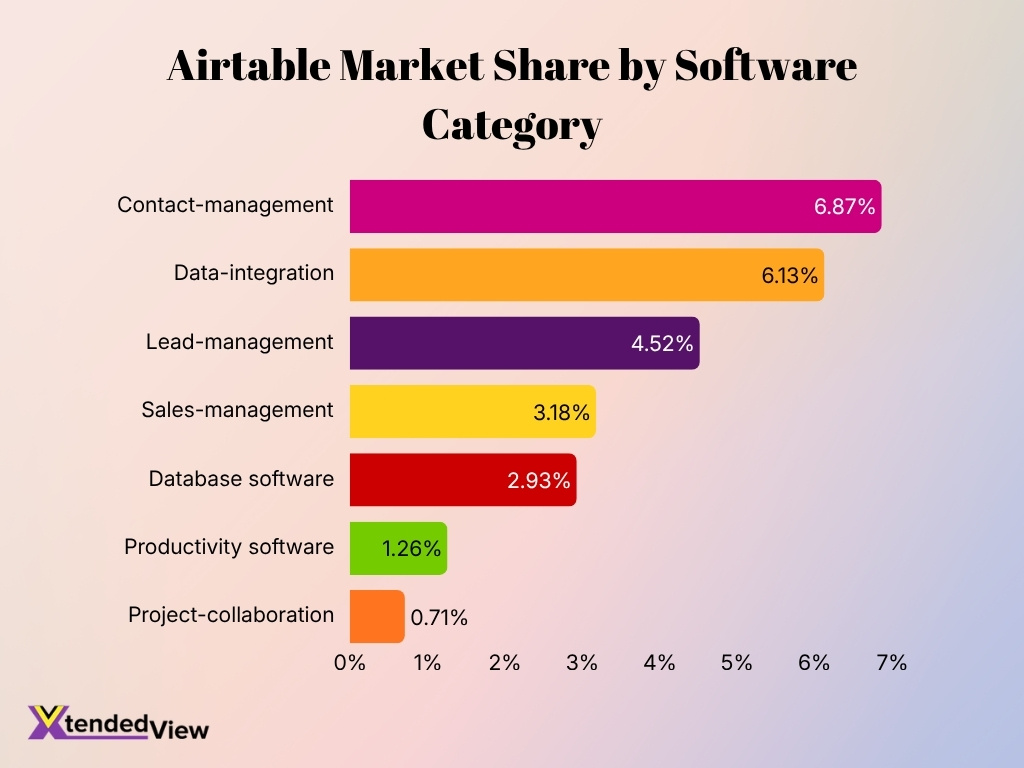
- In the data-integration category, Airtable holds an estimated 6.13% market share, with 24,559 identified customers, placing it fifth in that dataset.
- In database software, Airtable accounts for an estimated 2.93% share and ranks No. 8, based on 30,190 identified customers.
- Within productivity software, Airtable has an estimated 1.26% market share and ranks No. 14 among tracked technologies.
- Airtable’s estimated share rises to 3.18% in sales-management software, where it ranks seventh in the tracked market.
- In lead-management technology, Airtable holds an estimated 4.52% share, placing it eighth among tracked platforms.
- Airtable reaches an estimated 6.87% market share in contact-management software, where it ranks fourth in the category.
- In project-collaboration software, Airtable represents approximately 0.71% of tracked adoption, ranking No. 14 in a category dominated by much larger general-purpose collaboration suites.
Airtable User Statistics
- A single large creative-agency deployment connects roughly 500 Airtable users across 18 departments, showing how adoption can expand beyond the team that first introduces the software.
- Within the same organization, a 60-person production department became an early center of adoption before usage spread more broadly across the business.
- One financial-services implementation connects 300+ global team members, illustrating Airtable’s ability to support cross-region workflows rather than only small-team projects.
- At a health care technology company, AI-assisted feedback synthesis reduced the people required for a quarterly process from four employees to one.
- That same team reduced the time required to create an account plan from five to six hours to about 30 minutes, a decline of roughly 90% in hands-on preparation time.
- One product organization uses Airtable AI to summarize 50 to 60 active projects every week, reducing the need for teams to manually compile project updates.
- The same product workflow maintains an eight-week rolling view of upcoming milestones, giving teams a continuously updated planning horizon rather than a static project snapshot.
Airtable Growth and Usage Trends
- Airtable now reports 10 million active users, showing how far adoption has expanded beyond its early no-code and spreadsheet-style user base.
- More than 500,000 organizations currently build workflows, applications, or agents on Airtable.
- Users have created more than 50 million apps and agents, which signals a shift from basic database usage toward custom operational systems.
- In 2021, Airtable reported usage across 250,000 organizations. Its current 500,000-company figure indicates that the organization base has roughly doubled from that historical level.
- A large agency deployment now connects around 500 employees across 18 departments, compared with an initial 60-person production team.
- That agency estimates Airtable saves at least 10,000 employee hours per year, including more than 5,000 hours within the production department alone.
- One consulting operation runs 100% of its agency operations through Airtable and reports that customers can increase campaign capacity by 10 times without adding staff.
- A creative organization has tracked more than 500,000 working hours across 3,500 projects since implementing Airtable, illustrating long-term usage beyond isolated projects.
- Current corporate data lists approximately 700 employees across five offices, giving Airtable a sizable internal operating footprint alongside its external user base.
Airtable Revenue and Financial Statistics
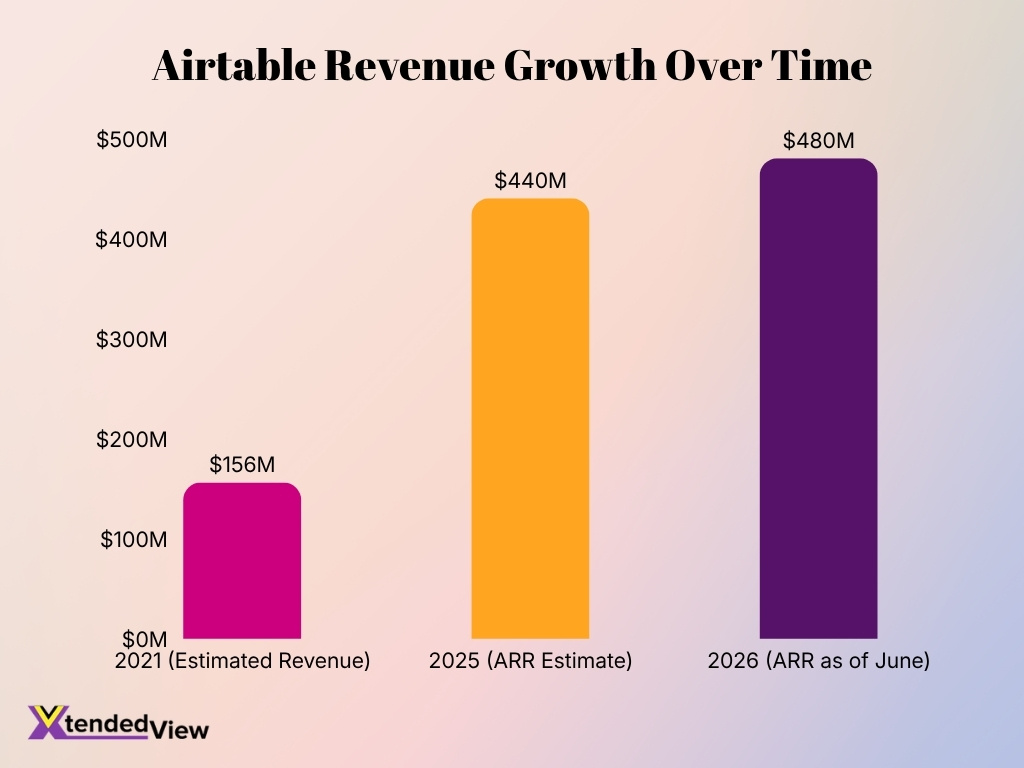
- Airtable reached approximately $480 million in annual recurring revenue as of June 2026, according to figures disclosed in connection with its acquisition.
- Annual recurring revenue was growing at more than 20% year over year in June 2026.
- An independent financial estimate places Airtable’s year-end 2025 recurring revenue at roughly $440 million, providing a recent benchmark before the 2026 acquisition.
- The same estimate puts 2026 recurring revenue at about $480 million, broadly aligning with the acquisition disclosure.
- Historical financial tracking estimated Airtable’s 2021 revenue at approximately $156 million, highlighting the scale of revenue expansion over the following five years.
- Airtable was reported to have roughly 90% gross margins in 2025, although management signaled a willingness to trade some margin efficiency for faster AI-product expansion.
- By early 2026, Airtable reportedly still held roughly half of the capital it had raised, while also generating positive cash flow.
- The 2026 acquisition valued Airtable’s operating business at $1.285 billion in enterprise value.
- After accounting for net cash and cash equivalents, the transaction implied an equity value of approximately $2.25 billion.
Airtable Customer and Organization Statistics
- One media customer manages approximately 3.5 million pieces of on-demand content through Airtable-based editorial and rights workflows.
- A global e-commerce deployment processes more than 1 million customer insights in real time, demonstrating Airtable’s use in high-volume customer-feedback operations.
- One creative organization has tracked more than 500,000 hours of work across 3,500 projects since implementing its Airtable system.
- That organization also reports saving more than 3,000 hours each year through workflow automations.
- Another agency consolidated important production operations into three connected Airtable apps, rather than maintaining a wider set of disconnected tools and processes.
- One enterprise deployment consolidated five separate systems into one central source, illustrating how organizations can use Airtable as a unifying operational layer.
- A media organization uses one shared collaborative platform to connect editorial, legal, and production teams around its content and rights-management process.
Airtable Enterprise Adoption Statistics
- Airtable says 90% of Fortune 100 companies now use its platform, although some earlier 2025 pages still cited 80%, indicating that the reported penetration rate increased over time.
- In 2021, Airtable said more than half of the Fortune 1,000 used the platform, showing that large-company adoption was already substantial before its AI-focused expansion.
- One enterprise product organization uses Airtable as one source of truth for product development while AI summarizes 50 to 60 active projects every week.
- That organization maintains an eight-week rolling view of upcoming product milestones, giving executives and operating teams a shared planning window.
- One global software business reduced campaign launch time by 60% after centralizing marketing workflows and connecting Airtable with downstream sales systems.
- The same deployment achieved a 100% reduction in its campaign-creation SLA, moving campaign setup from a waiting period to effectively instant creation.
- One health care product organization manages more than 40 team roadmaps through a connected Airtable operating system.
- Another enterprise deployment brings together more than 300 global team members and frees roughly 580 employee hours each month.
- Airtable’s enterprise reach has expanded alongside its overall customer base, which grew from about 250,000 organizations in 2021 to more than 500,000 in 2026.
Airtable Valuation and Funding Statistics
- Airtable has raised approximately $1.36 billion in total funding since its founding.
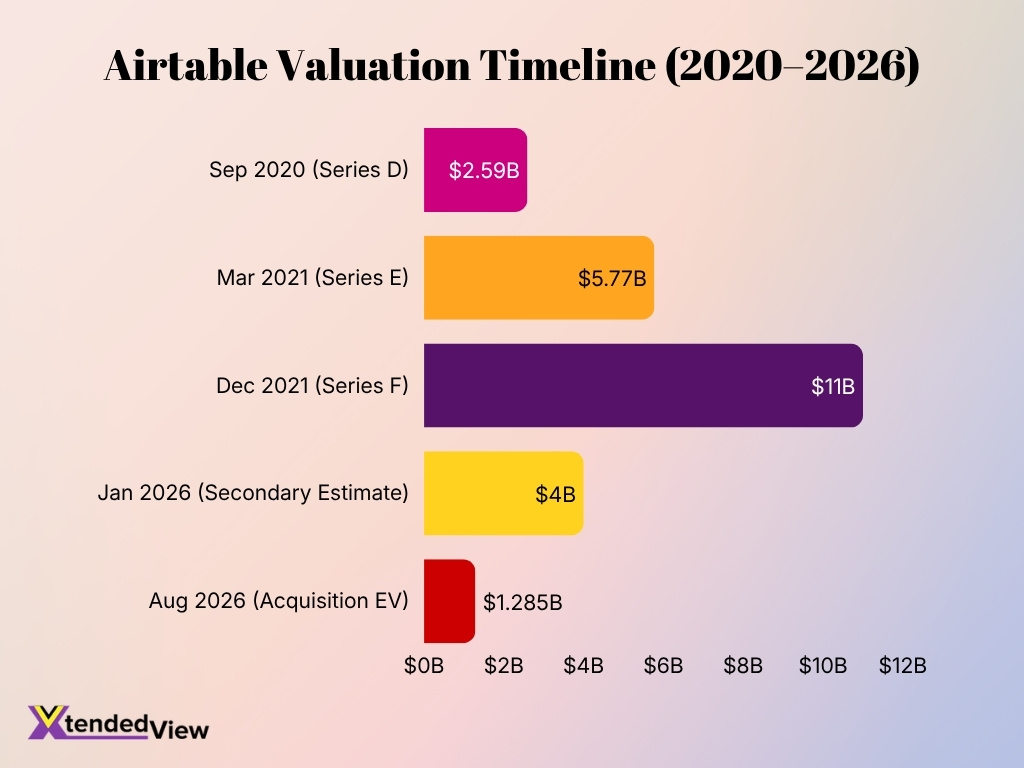
- Its largest disclosed round was a $735 million Series F completed in December 2021.
- That Series F assigned Airtable an $11 billion pre-money valuation, while contemporary reporting placed the post-financing value at roughly $11.7 billion.
- Earlier in March 2021, Airtable raised $270 million in Series E funding at a $5.77 billion post-money valuation.
- Just six months before that Series E, Airtable had raised $185 million in Series D funding at approximately a $2.59 billion post-money valuation.
- The Series E valuation of $5.77 billion was more than twice the roughly $2.6 billion valuation attached to the September 2020 round.
- Secondary-market estimates placed Airtable at roughly $4 billion in January 2026, well below its 2021 private-market peak.
- The August 2026 acquisition agreement subsequently assigned the business a $1.285 billion enterprise value and an implied equity value near $2.25 billion.
- The difference between Airtable’s 2021 financing valuation and its 2026 transaction value illustrates how private software valuations reset after the 2020-2021 technology funding boom.
Airtable AI and Automation Statistics
- In a 2026 internal AI program, 61% of employees shipped production AI agents within a 60-day period.
- Weekly internal AI usage reached 97% of employees after the initiative.
- Roughly 200 business workflows became agent-driven during the program.
- Employees submitted 528 individual builds and 43 team builds, indicating broad participation rather than adoption by a small technical group.
- The initiative produced a 44% increase in higher-conversion AI pipeline, connecting internal AI adoption with a measurable commercial outcome.
- A seven-agent sales workflow reduced preparation of an enterprise business case from about five days to 30 minutes and was used across 819 accounts.
- An accounting workflow cut commentary preparation from 35 minutes to five minutes per line, returning roughly 52 hours during each monthly close.
- A finance workflow reduced preparation of the weekly business review from five hours to two minutes.
- Support automation expanded quality-review coverage from 5% of cases to 100%, while an engineering workflow increased agent-assisted pull-request merges from zero to 25%.
- In an external consulting deployment, AI reduced task estimation and QA time by 50% while enabling clients to scale campaign capacity tenfold without extra headcount.
Airtable Integration Statistics
- Airtable’s current integrations directory lists more than 25 named integrations across categories including analytics, CRM, communications, payments, development, forms, and file management.
- The integration catalog spans at least 13 distinct categories, including artificial intelligence, analytics, social networking, events, customer support, and collaboration.
- Native no-code integrations remain available on all four plan levels for selected messaging, attachment, and service connections.
- Airtable’s Web API is also available across all four plan levels, giving developers another route for connecting external applications and services.
- Native automation actions currently cover at least 13 external service or action categories, including messaging, CRM, development, social media, SMS, and project-management workflows.
- Airtable Sync remains a one-way synchronization system from an external source into a destination base rather than a general bidirectional sync layer.
- In December 2025, Airtable added a direct ChatGPT connection that lets users reference and update Airtable information from within a conversational AI environment.
- By mid-2026, Airtable also exposed its AI assistant directly inside Slack, where users can query data, create records, update records, and request summaries without switching applications.
- A 2026 product update added three prominent access surfaces for connected human-and-agent work: mobile access, Slack-based AI interaction, and MCP skills.
Airtable Pricing by Plan Statistics
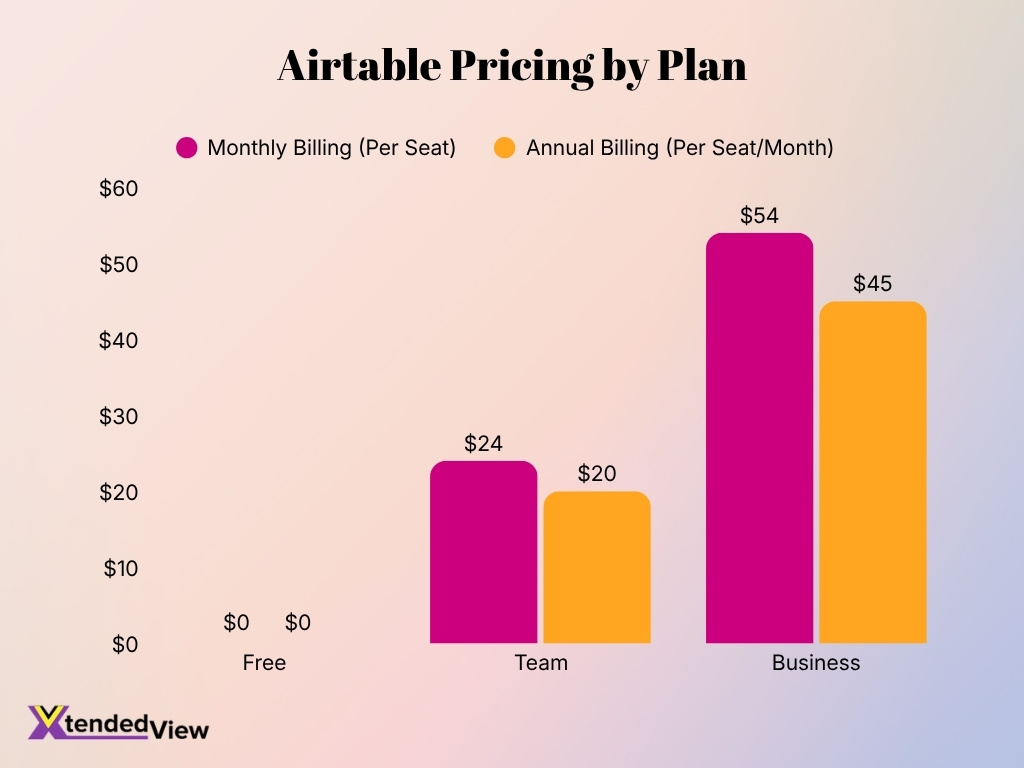
- Airtable’s Free plan costs $0 per seat, making it suitable for individuals and teams looking to start without a paid subscription.
- The Team plan costs $24 per seat per month with monthly billing, while annual billing lowers the effective price to $20 per seat per month.
- Choosing annual billing for the Team plan saves $4 per seat per month, equivalent to a 16.7% discount compared with monthly billing.
- Airtable’s Business plan costs $54 per seat per month on monthly billing, compared with $45 per seat per month when billed annually.
- Annual billing on the Business plan saves $9 per seat per month, also representing a 16.7% reduction from the monthly rate.
- Based on annual billing, the Team plan costs $240 per seat per year, while the Business plan costs $540 per seat per year.
- The Business plan is $25 more per seat per month than the Team plan when both are billed annually.
Airtable Mobile App Statistics
- The Android version of Airtable has surpassed 1 million downloads, providing a measurable indication of its mobile reach.
- The Android app currently carries a rating of about 4.4 out of 5 stars.
- Its public app listing shows roughly 16,000 reviews, although the displayed count can vary slightly depending on device and listing view.
- Airtable supports both iOS and Android, giving the platform native mobile coverage across the two dominant smartphone operating systems.
- Current iOS support requires iOS 16.0 or later, while Android devices require Android 7.0 or newer.
- In 2026, Omni became available inside the mobile app, allowing users to use voice or text to query records, summarize information, and analyze trends.
- Mobile interfaces support at least four core record layouts specifically identified in current documentation: record list, gallery, kanban, and calendar.
- Current mobile documentation warns that performance can decline when a base contains tens of thousands of records, an important limitation for high-volume enterprise use.
- Airtable’s July 2026 product update positioned mobile as one of three major new surfaces for interacting with data and agents, alongside Slack and MCP-enabled tools.
Airtable Industry and Geographic Distribution
- The United States accounts for 69.94% of data-management customers with 14,452 organizations.
- The United Kingdom represents 7.15% of the data-management market with 1,477 organizations.
- France ranks third in data-management, capturing 6.32% or 1,306 customers.
- In database tracking, the U.S. leads with 70.05%, followed by the U.K. at 6.72% and France at 6.37%.
- Education is the largest database-category industry with 532 organizations.
- Marketing and technology follow in the database category with 467 and 433 organizations, respectively.
- In data management, education leads with 408 customers, ahead of technology with 320 and marketing with 306.
- Small businesses dominate data management, with 10,862 customers having 0-9 employees.
- Database tracking shows similar adoption, with 11,613 customers in the 0-9 employee range.
Airtable vs Competitors Statistics
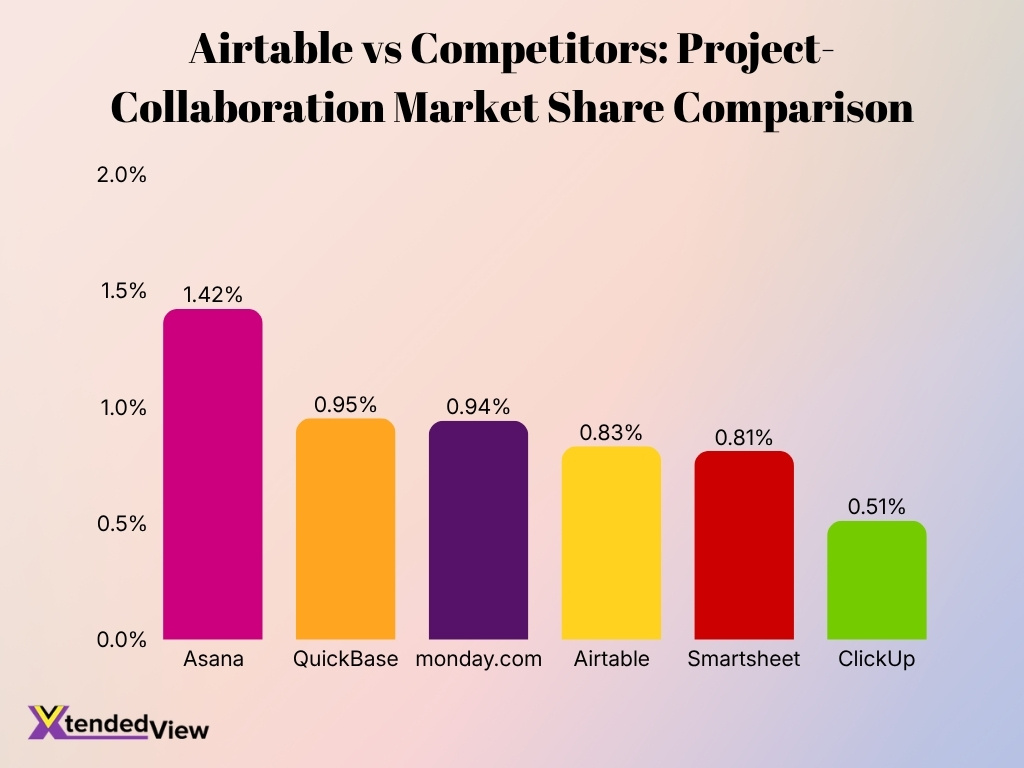
- Airtable holds an estimated 0.83% share of the project-collaboration market in the latest comparable dataset, based on approximately 30,190 identified customer domains.
- Asana reaches 1.42% market share in the same current dataset, giving it roughly 1.7 times Airtable’s estimated category share.
- monday.com records approximately 0.94% market share, putting it only 0.11 percentage points ahead of Airtable in that comparison.
- QuickBase holds roughly 0.95%, representing another close competitor for companies comparing customizable workflow and app-building systems.
- Smartsheet accounts for about 0.81% of the same project-collaboration dataset, slightly below Airtable’s latest 0.83% estimate.
- ClickUp holds an estimated 0.51% share in the comparable dataset, below Airtable’s measured footprint in project collaboration.
- Airtable’s competitive position looks stronger outside pure project collaboration. It holds an estimated 6.13% share in data management, compared with 0.83% in the broader project-collaboration category.
- Airtable also reaches 6.87% in contact management, while its estimated shares stand at 4.52% in lead management and 3.18% in sales management.
- These category differences show why a single Airtable-versus-competitors statistic can mislead: its measured share varies from below 1% to nearly 7% depending on whether researchers classify the product as collaboration, database, sales, or contact-management software.
Airtable Use Cases and Productivity Statistics
- A creative agency reduced operating costs by 12% in its first year after moving major operational workflows into Airtable.
- The same organization saves more than 3,000 hours per year through automations, while tracking more than 500,000 hours of work across 3,500 projects.
- Another agency estimates that its implementation saves at least 10,000 employee hours annually across roughly 500 users and 18 departments.
- Within that agency’s 60-person production department alone, employees saved more than 5,000 hours in a single year.
- A health care workflow reduced its customer-feedback cycle by 75%, cutting turnaround from four weeks to one week through AI-assisted analysis.
- A global content operation cut its content-creation time by 50% by combining structured workflows with AI.
- A media and entertainment organization reduced reporting time by 10 times using AI-enabled workflows.
- One marketing organization accelerated campaign execution by 99%, highlighting how Airtable can function as an operational system rather than only a task tracker.
- A consumer-products business now coordinates launches of roughly 600 products per quarter using six AI agents, illustrating a newer use case in which agents execute portions of complex merchandising workflows.
Airtable Future Outlook and Projections
- A 2026 study covering 1,001 organizations found that 88% already use AI regularly in at least one business function, indicating that Airtable’s future growth increasingly depends on operational AI rather than basic AI adoption.
- The same research found that agent activity rises 12 times when companies move from isolated AI prompts to agents embedded directly into workflows.
- Airtable’s 2026 product direction centers on humans and AI agents operating on the same underlying operational data, rather than placing AI in a separate assistant layer.
- By July 2026, Airtable had extended agent access across three prominent new surfaces: mobile, Slack, and MCP-enabled tools.
- Airtable’s included AI allocations now reach as high as 25,000 monthly credits per paid Enterprise Scale user, suggesting that AI consumption has become part of the platform’s core commercial model.
- The company also allows customers to buy as many as 400,000 additional credits for $800 per month in a standard listed package, creating a direct path for AI usage to expand alongside workflow volume.
- Following the September 2026 acquisition, the new owner said it plans to invest heavily in product development, customer support, and go-to-market capabilities, giving Airtable additional capital support for its next growth phase.
- Airtable’s future competitive position will likely depend less on traditional project-management features and more on whether organizations adopt its system-of-record approach for AI agents. This is an inference from the company’s 2026 product strategy rather than a published revenue forecast.
- With 2026 recurring revenue previously reported at roughly $480 million and growth above 20% year over year, Airtable entered its new ownership phase with a sizable recurring-revenue base. However, no credible public source currently provides a verified 2027 revenue forecast, so projecting a specific figure would be speculative.
Frequently Asked Questions (FAQs)
Airtable reports 10 million active users and more than 500,000 organizations using the platform.
Airtable reports that 90% of Fortune 100 companies use its platform.
Airtable reached approximately $480 million in annual recurring revenue by June 2026, with ARR growing more than 20% year over year.
The 2026 acquisition valued Airtable at $1.285 billion in enterprise value and approximately $2.25 billion in implied equity value.
Research across 1,001 organizations found that agent activity increased 12× when AI agents were embedded into workflows, while 88% of respondents already used AI regularly in at least one business function.
Conclusion
Airtable enters the year with 10 million active users, more than 500,000 organizations, and an expanding role in how companies organize operational data and automate everyday work. Its use cases now extend well beyond traditional spreadsheets and project tracking, with organizations applying the platform to product development, marketing operations, customer insights, content production, enterprise planning, and AI-assisted workflows. Reported customer results include substantial reductions in processing time, thousands of employee hours saved, lower operating costs, and faster campaign and product workflows.
At the same time, Airtable’s growing emphasis on AI agents, automation, integrations, and enterprise applications is changing its position in the software market. Its acquisition begins another phase for the company as it competes across database, collaboration, workflow management, and application-building categories. While future revenue and market-share gains remain uncertain, current adoption and usage statistics suggest that Airtable’s next stage will increasingly depend on how effectively businesses can combine structured operational data, automation, and AI agents within a single working environment.
