


AI agents have moved beyond experimental tools and are now becoming active participants in business operations. Companies use them to automate customer support, streamline software development, improve sales workflows, and manage enterprise knowledge at scale. From retail chat assistants that handle thousands of customer inquiries to enterprise agents that coordinate internal workflows, adoption continues to accelerate across industries. The statistics below highlight how AI agents are reshaping the global economy and enterprise operations.
Editor’s Choice
- The global AI agents market reached $7.63 billion in 2025 and is projected to grow to $10.9 billion in 2026.
- The AI agents market is forecast to expand at a 49.6% CAGR between 2026 and 2033.
- North America accounted for 39.63% of global AI agent revenue in 2025, making it the largest regional market.
- Another market forecast estimates AI agent revenue will increase from $7.84 billion in 2025 to $52.62 billion by 2030.
- Gartner projections cited by industry analysts indicate 40% of enterprise applications could embed task-specific AI agents by the end of 2026, up from less than 5% in 2025.
- ChatGPT became the first AI application to surpass 1 billion monthly active users in 2026, highlighting mainstream acceptance of AI-powered assistants.
- Machine learning represented 30.56% of AI agent technology revenue in 2025, making it the leading technology segment.
- Single-agent systems accounted for 59.24% of the market in 2025, ahead of multi-agent deployments.
- Industry forecasts suggest AI agents could intermediate more than $15 trillion in B2B spending by 2028.
Recent Developments
- Meta launched a new enterprise-focused AI Business Agent in 2026 to automate sales, customer support, and appointment booking workflows.
- More than 1 million businesses had already used earlier versions of Meta’s business messaging AI before the latest enterprise rollout.
- Microsoft announced AI deployments exceeding 300,000 Copilot licenses across Infosys, TCS, and Wipro within six months.
- Microsoft introduced Scout, an autonomous AI “Autopilot” agent designed to monitor workflows and act without direct prompts.
- Industry analysts describe 2026 as the year AI agents moved from pilot projects to production-scale enterprise deployments.
- Many enterprises are now prioritizing workflow-specific AI agents over generic copilots because they produce clearer ROI measurements.
- Organizations increasingly use AI agents inside CPQ and contract management systems to support autonomous business decisions.
- Enterprise AI rollouts increasingly focus on agents that work alongside employees rather than simple automation tools.
- Industry experts expect nearly half of enterprise applications to include AI-agent functionality in the near term.
AI Agents Market Growth StatisticsThe
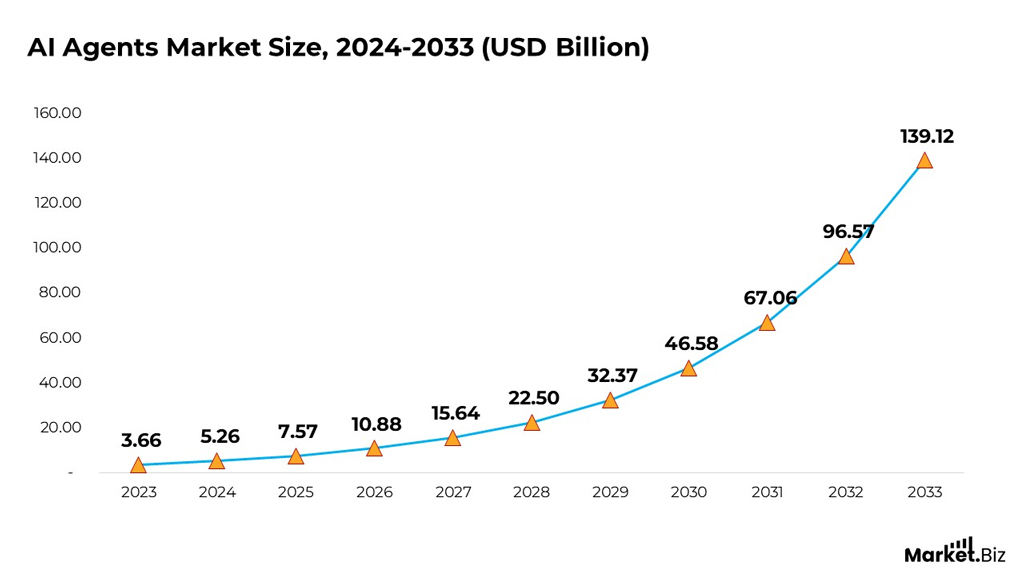
- The AI agents market size is projected to grow from $5.26 billion in 2024 to $139.12 billion by 2033, highlighting explosive long-term expansion.
- The market is expected to reach $7.57 billion in 2025, reflecting strong early adoption across industries.
- By 2026, the AI agents market is forecast to surpass $10.88 billion, nearly doubling its 2024 value.
- Global market value is projected to climb to $22.50 billion in 2028, crossing the $20 billion milestone.
- The industry is expected to exceed $32.37 billion in 2029, signaling accelerating enterprise investment.
- In 2030, AI agents are forecast to generate $46.58 billion in market revenue worldwide.
- The market is projected to grow to $67.06 billion in 2031, marking a significant jump from the previous year.
- By 2032, AI agents market value is expected to approach $96.57 billion, nearing the $100 billion threshold.
- The largest annual increase occurs between 2032 and 2033, when the market expands by over $42.55 billion.
- Overall, the AI agents market is forecast to surge by more than 26x between 2024 and 2033, underscoring exceptional growth potential.
AI Agents Market Share Statistics
- North America held 39.63% of global AI agent revenue in 2025, the highest regional share.
- Machine learning captured 30.56% of technology-segment revenue in 2025.
- Single-agent architectures controlled 59.24% of market revenue in 2025.
- Research and summarization agents account for approximately 24% of agent roles across deployments.
- Productivity and personal assistant agents represent roughly 22% of agent roles.
- Machine learning-based agents are expected to remain the dominant technology segment throughout the forecast period.
- Small and midsize businesses hold the largest share of enterprise adoption in several market forecasts.
- The U.S. remains the largest single-country AI agent market due to strong enterprise investment and AI infrastructure.
- Industrial applications are projected to be among the fastest-growing end-use segments through 2033.
AI Agents in Customer Service and Support
- The global AI customer service market is projected to reach $47.82 billion by 2030.
- 80% of routine customer interactions are expected to be fully handled by AI in 2026.
- Companies implementing AI support systems are seeing 3.5x to 8x returns on their initial investment.
- AI-enabled service teams resolve customer issues 44% faster while saving 45% of time spent on calls.
- Conversational AI within contact centers is forecast to cut agent labor costs by $80 billion in 2026.
- Human support agents utilizing generative AI can handle 13.8% more customer inquiries per hour.
- Top-performing organizations achieve 87.2% positive customer ratings within 6 months of AI implementation.
- Generative AI tools are reported to reduce first response times by up to 74% within the very first year.
- 70% of customer service organizations adopting AI agents observe measurable value within 60 days of deployment.
- Nearly two-thirds of all customer service tasks could be fully automated with modern AI solutions.
AI Agent Adoption by Business Function
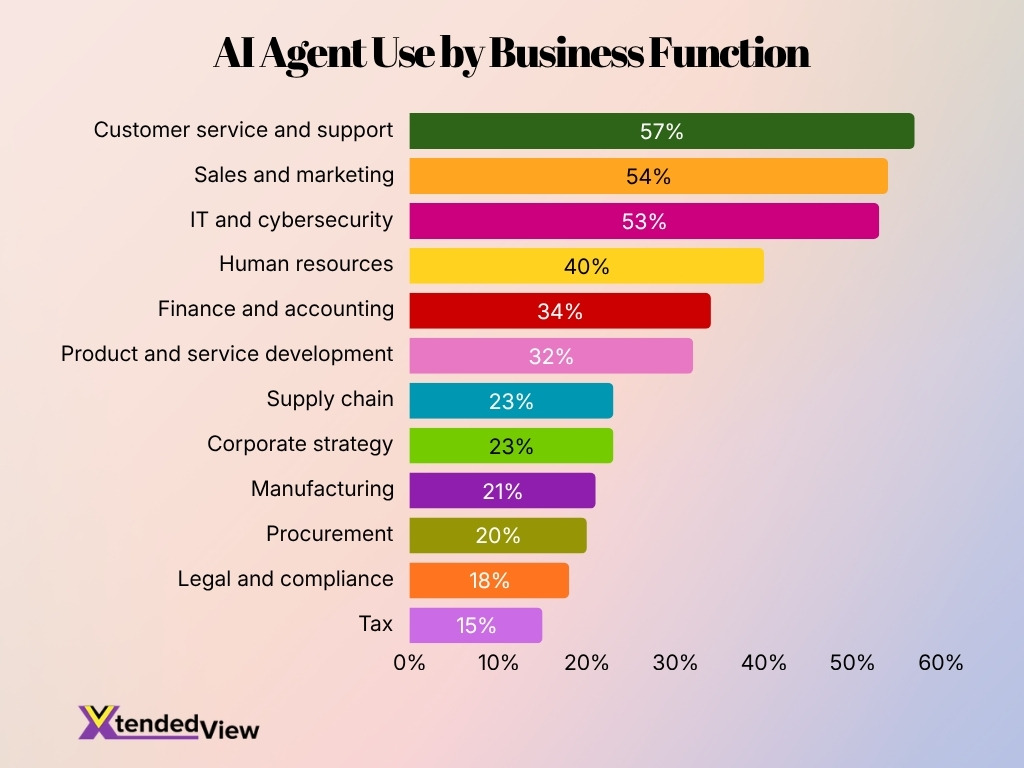
- Customer service and support leads AI agent adoption, with 57% of businesses currently using or planning to use AI agents.
- Sales and marketing ranks second, as 54% of organizations deploy AI agents to improve customer engagement and revenue generation.
- IT and cybersecurity closely follow at 53%, highlighting strong demand for automated monitoring and threat detection.
- Human resources reports 40% AI agent usage, reflecting growing automation in recruitment and employee management.
- Finance and accounting sees 34% adoption, driven by efficiency gains in reporting, forecasting, and compliance tasks.
- Product and service development records 32% usage, showing AI’s expanding role in innovation and product enhancement.
- Supply chain operations achieve 23% adoption, leveraging AI agents for logistics optimization and demand planning.
- Corporate strategy matches supply chain at 23%, indicating increased reliance on AI for business decision support.
- Manufacturing reports 21% adoption, with AI agents helping improve operational efficiency and production workflows.
- Procurement reaches 20% usage, as organizations automate sourcing, purchasing, and vendor management processes.
- Legal and compliance records 18% adoption, reflecting cautious but growing implementation in regulatory functions.
- Tax shows the lowest adoption rate at 15%, making it the least common business function for AI agent deployment.
Workplace Productivity and Efficiency Statistics
- AI-assisted employees completed customer support tasks 13.8% faster on average in a large-scale field study.
- The same study found that less-experienced workers improved productivity by 34% when supported by generative AI tools.
- Organizations implementing AI copilots and agents reported productivity gains ranging from 20% to 40% across knowledge-work functions in 2025.
- Research shows generative AI can automate activities that consume 60% to 70% of employees’ working time.
- Developers using AI agents completed coding tasks up to 55% faster than those working without AI assistance.
- A controlled software engineering study found developers finished tasks 56% faster when using AI coding assistants.
- AI-powered workflow automation reduced manual document-processing time by up to 80% in enterprise environments.
- Enterprise users report saving an average of 30 minutes to 2 hours per day through AI-driven task automation.
- Organizations deploying agentic AI systems in operations reported measurable reductions in repetitive administrative workloads.
Cost Reduction and ROI Expectations
- Organizations using AI extensively report average cost reductions of 20% to 30% in selected business processes.
- More than 40% of companies using AI reported revenue increases from AI initiatives in 2025.
- Generative AI could contribute between $2.6 trillion and $4.4 trillion annually to the global economy.
- Customer service automation remains one of the highest-return AI use cases, often generating ROI within 12 months.
- Companies implementing AI-driven support agents report handling significantly higher ticket volumes without proportional staffing increases.
- AI-powered software development tools reduce engineering costs by accelerating coding, debugging, and testing cycles.
- A majority of enterprise leaders expect agentic AI projects to produce measurable ROI within one to three years.
- AI adoption in supply-chain operations has reduced forecasting and planning costs by up to 15% in some deployments.
- Organizations increasingly prioritize workflow-specific AI agents because they provide easier ROI tracking than broad AI transformation programs.
Top AI Agents by Monthly Active Users
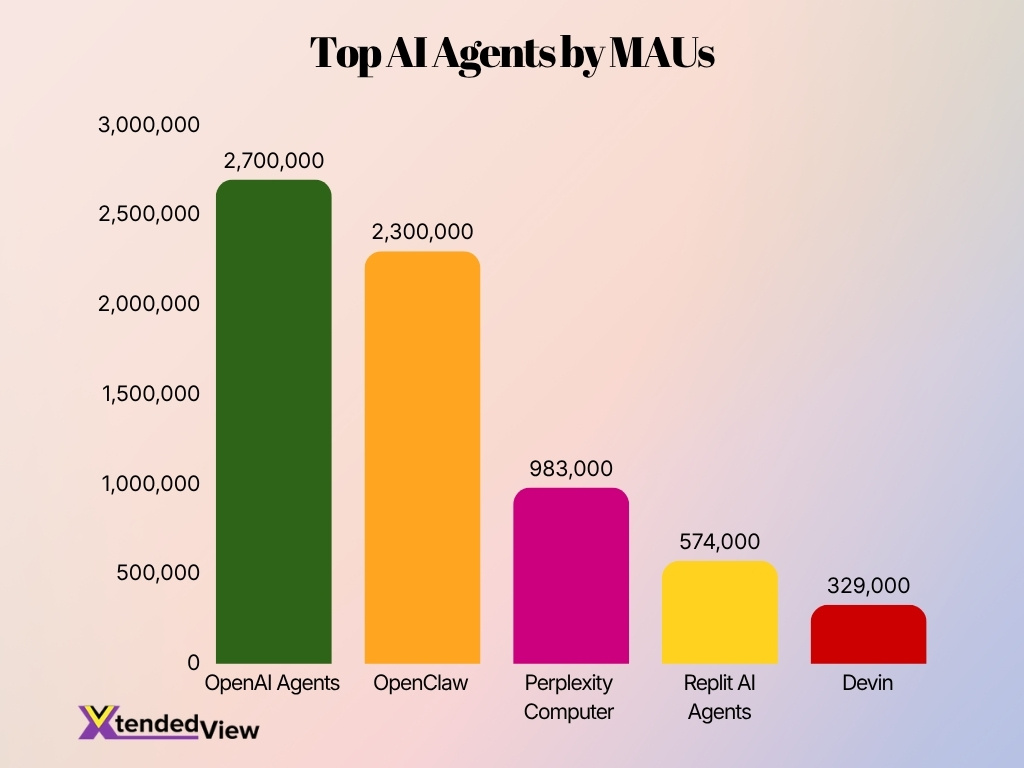
- OpenAI Agents lead the market with 2.7 million MAUs, making them the most widely used AI agent platform in the ranking.
- OpenClaw ranks second with 2.3 million MAUs, trailing OpenAI Agents by just 400,000 users.
- Perplexity Computer recorded 983,000 MAUs, placing third and approaching the 1 million user milestone.
- Replit AI Agents attracted 574,000 MAUs, highlighting strong adoption among developer-focused AI tools.
- Devin reached 329,000 MAUs, securing a place among the top five AI agent platforms.
- The combined audience of the top five AI agents exceeds 6.8 million monthly active users.
- OpenAI Agents and OpenClaw together account for 5.0 million MAUs, representing the majority of usage among the leading platforms.
- OpenAI Agents have nearly 2.7 times more users than Perplexity Computer, underscoring their market dominance.
- The gap between OpenClaw (2.3 million) and Perplexity Computer (983,000) is more than 1.3 million users.
- Developer-focused AI agents, including Replit AI Agents and Devin, collectively serve over 903,000 monthly active users.
Consumer Trust and Acceptance Metrics
- Approximately 72% of organizations worldwide reported using AI in at least one business function in 2025, indicating growing market acceptance.
- ChatGPT surpassed 1 billion monthly active users in 2026, reflecting rapid consumer adoption of AI assistants.
- Roughly 82% of consumers state they are more likely to trust AI when human oversight remains part of the decision-making process.
- Around 52% of Americans express more concern than excitement about increased AI use in their daily life.
- More than 76% of consumers demand brand transparency when AI systems make recommendations or decisions.
- Customer trust levels can increase by up to 20% when organizations clearly disclose how AI agents use their data.
- Over 90% of Gen Z consumers demonstrate higher AI acceptance rates compared to just 63% of Baby Boomers.
- About 85% of consumers remain highly comfortable with AI applications in customer support, search, and recommendations.
- Nearly 82% of users cite privacy concerns as one of the leading barriers to broader AI agent adoption.
Autonomous AI Agent Performance and Capabilities
- Modern AI agents resolve 83.5% of real-world software engineering issues.
- Coordinated multi-agent systems achieve a 42.68% success rate on complex planning tasks.
- Implementing autonomous AI agents reduces enterprise customer service costs by up to 30%.
- Multi-agent coordination drives an 81% performance improvement on parallelizable tasks.
- Over 72% of enterprises have deployed at least one AI workload into production.
- Approximately 87% of global CIOs report that AI agents are already embedded in their workflows.
- Projections indicate 15% of routine enterprise decisions will be fully autonomous by 2028.
- Enterprise spending on agentic AI is forecast to reach $24.5 billion by 2030.
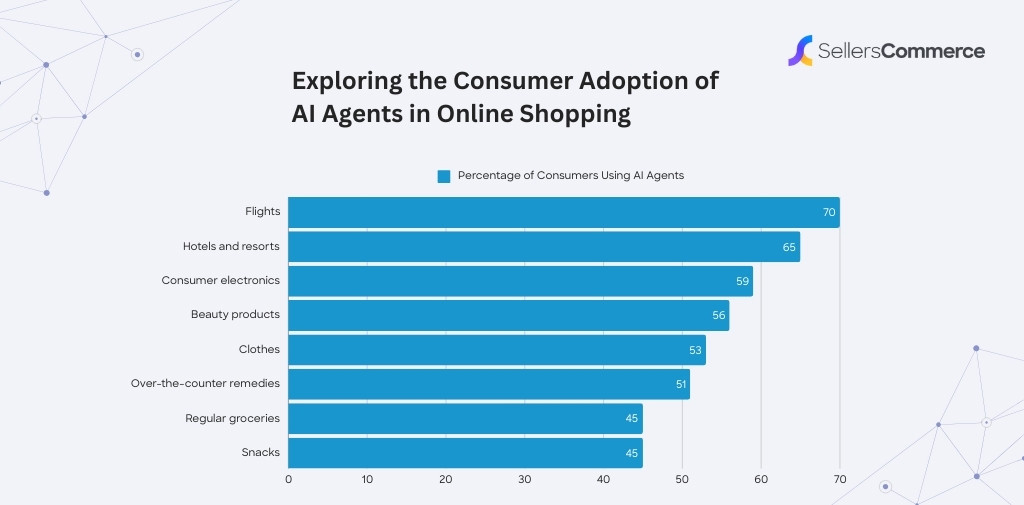
Consumer Adoption of AI Agents in Online Shopping
- 70% of consumers use AI agents for flight bookings, making it the most popular online shopping category.
- 65% of shoppers rely on AI agents for hotels and resorts, highlighting strong adoption in travel planning.
- 59% of consumers use AI-powered assistance for consumer electronics purchases, reflecting demand for product comparisons.
- 56% of shoppers leverage AI agents when buying beauty products, showing growing trust in personalized recommendations.
- 53% of consumers use AI tools for clothing purchases, indicating widespread adoption in fashion e-commerce.
- 51% of shoppers depend on AI agents for over-the-counter remedies, demonstrating increasing use in health-related purchases.
- 45% of consumers use AI assistance for regular grocery shopping, suggesting moderate adoption for everyday essentials.
- 45% of shoppers rely on AI agents when purchasing snacks, matching grocery-related adoption levels.
- The gap between the highest-adoption category (Flights, 70%) and the lowest-adoption category (Groceries and Snacks, 45%) is 25 percentage points.
- Travel-related purchases dominate AI agent usage, with Flights (70%) and Hotels (65%) leading all categories.
The Impact of AI Agents on Healthcare and Medicine
- The global AI in healthcare market is projected to reach $1,033.27 billion by 2034.
- Administrative activities account for up to 25% of U.S. healthcare spending, creating massive automation opportunities.
- AI diagnostic tools can achieve over 95% accuracy in specific imaging tasks like retinal disease screening.
- Implementing AI in healthcare administration has proven to reduce staff workload by up to 40%.
- Physicians currently spend 49% of their time on EHR and desk work, which AI scribes can significantly reduce.
- AI-driven scheduling systems in medical centers have successfully reduced schedule creation time by 77%.
- Advanced AI models can achieve 88% to 99.7% accuracy in extracting clinical data and billing codes.
- Integrating AI in radiology has been shown to reduce diagnostic turnaround times by 30%.
- Broad AI adoption demonstrates potential cost savings of 5% to 10% in total national health expenditures.
AI Agents in Banking and Financial Services
- The global AI agents market in financial services is projected to reach $6.7 billion by 2033.
- Fraud detection agents currently account for the largest revenue share at 33.8% in the industry.
- Implementing AI-driven chatbots has successfully reduced average customer response times by over 70%.
- AI-powered tools and risk models are now processing financial transactions up to 90% faster.
- 87% of financial decision-makers expect specialized AI agents to drive significant productivity and growth.
- Generative AI is estimated to augment global banking revenues by $200 billion to $340 billion annually.
- Intelligent virtual agents have successfully cut the number of routine calls requiring human agents by 50%.
- The broader generative AI market in banking is expected to expand at a rapid CAGR of over 31%.
- More than 80% of banking leaders have placed the deployment of AI agents as a top priority for 2026.
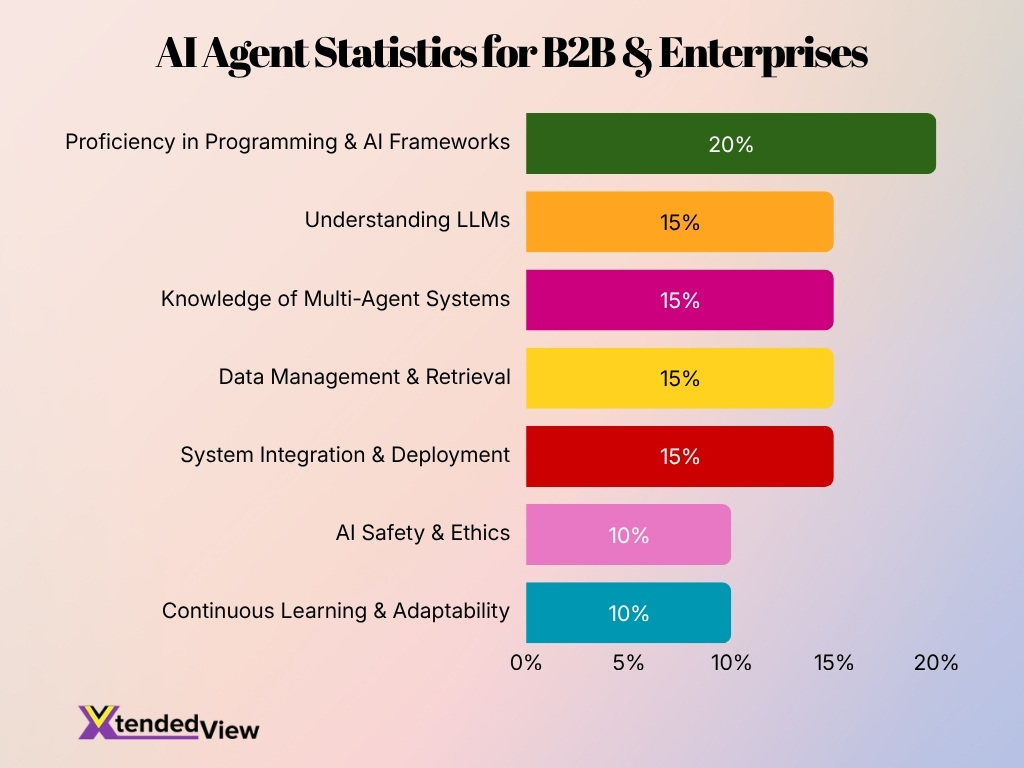
Key AI Agent Skills for B2B & Enterprises
- Programming & AI Framework Proficiency is the top priority, accounting for 20% of the essential skills required for enterprise AI agent development.
- Understanding Large Language Models (LLMs) represents 15% of the core competencies needed to build effective AI agents.
- Knowledge of Multi Agent Systems makes up 15%, highlighting the importance of coordinating multiple AI agents in enterprise environments.
- Data Management & Retrieval accounts for 15%, emphasizing the need for efficient handling of enterprise data sources.
- System Integration & Deployment contributes 15%, reflecting the importance of connecting AI agents with existing business infrastructure.
- AI Safety & Ethics represents 10% of required skills, underscoring the growing focus on responsible AI implementation.
- Continuous Learning & Adaptability accounts for 10%, showing that ongoing skill development remains critical in the fast-evolving AI landscape.
- Combined technical skills, including Programming, LLMs, Multi Agent Systems, Data Management, and Integration, make up 80% of the total competency requirements.
- Governance-focused areas, including AI Safety & Ethics and Continuous Learning, collectively account for 20% of enterprise AI agent expertise requirements.
Generative AI and Agentic AI Statistics
- Generative AI could add between $2.6 trillion and $4.4 trillion annually to the global economy.
- Global AI adoption reached 72% of organizations in 2025, up from 55% the previous year.
- More than 65% of enterprises are currently experimenting with agentic AI systems beyond basic chatbots.
- The global agentic AI market is projected to grow from $7.4 billion in 2025 to $171.2 billion by 2034.
- Roughly 88% of organizations report using AI technologies in at least one business function.
- By 2028, agentic AI is projected to manage 68% of all customer service interactions.
- Nearly 40% of enterprise applications will include embedded task-specific AI agents by the end of 2026.
- The multi-agent systems segment is anticipated to register a massive 48.5% CAGR through 2030.
- Only 34% of companies have achieved full AI implementation despite making significant financial investments.
- Businesses successfully adopting generative AI are projected to achieve 15.2% in average cost savings.
AI Agent Investment and Funding Statistics
- Disclosed funding for agentic AI startups doubled to $2.9 billion across 50 deals in 2025.
- Early 2026 agentic AI funding has already reached roughly $1.1 billion across 29 deals.
- The global agentic AI market size is projected to surge from $7.92 billion in 2025 to $236.03 billion by 2034.
- Approximately 43% of organizations allocate more than half of their AI budgets strictly to agentic systems.
- About 88% of executives plan to aggressively increase AI-related budgets specifically for agentic capabilities in 2026.
- The global enterprise agentic AI market is anticipated to expand from $2.58 billion in 2024 to $24.50 billion by 2030.
- Organizations actively adopting agentic AI typically achieve a 2.3x investment return within just 13 months.
- Global venture capitalists have poured over $9.7 billion into innovative agentic AI startups since 2023.
- Nearly 92% of firms intend to increase their overall AI budgets over the next three years to fuel agentic expansion.
- North America continues to dominate the agentic AI market, consistently capturing over 38% of the global share.
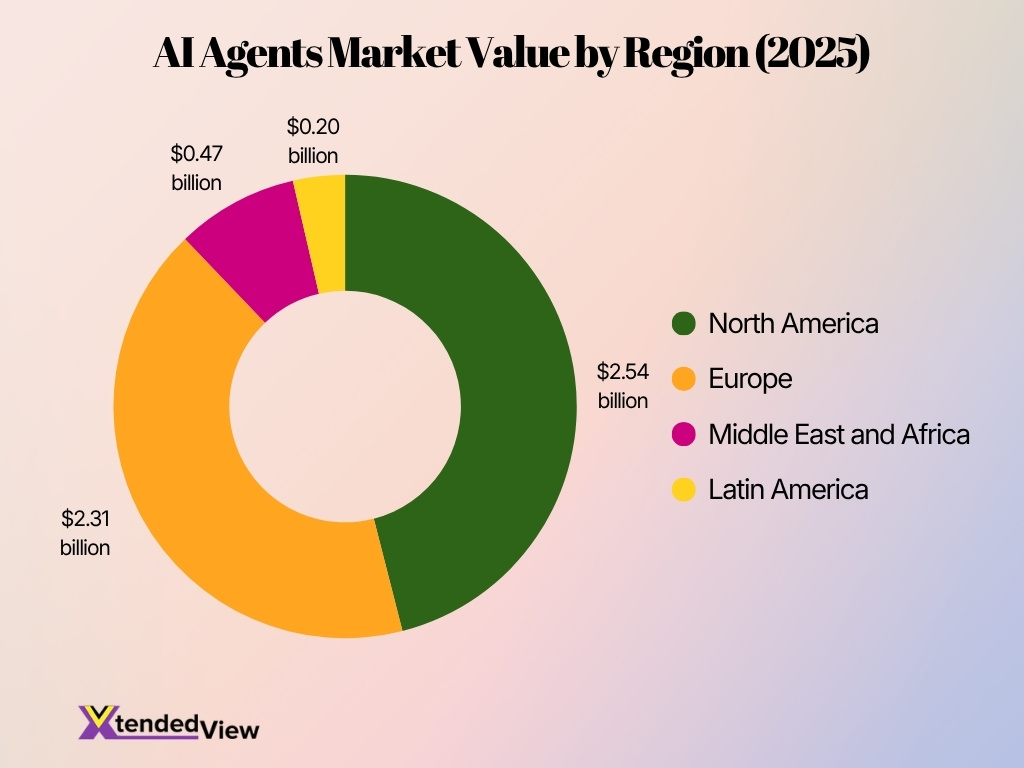
Regional AI Agent Statistics
- North America represented 39.63% of the global AI agent market revenue in 2025.
- The United States remained the largest national market, reaching a valuation of $2.54 billion in 2025.
- The Asia-Pacific region is projected to record the fastest growth rate with a CAGR of 42.0% through 2034.
- China drove autonomous systems growth, contributing to Asia’s 70% share of all new global robotic deployments.
- India emerged as a rapidly growing market, supported by a recent $1.25 billion government investment in AI projects.
- European organizations reached a market value of $2.31 billion in 2025 under evolving AI governance frameworks.
- The Middle East and Africa accelerated national AI strategies, achieving a regional market valuation of $470 million.
- Financial services remained the leading AI adopter, capturing 35.8% of the total market share across regions.
- Latin American organizations expanded banking and e-commerce deployments, reaching a $200 million market size in 2025.
Security, Risks, and Implementation Challenges
- Over 60% of executives view data privacy and security as the primary obstacle to AI deployment.
- Around 51% of organizations report negative consequences directly stemming from AI hallucinations and inaccuracy.
- Nearly two-thirds of companies lack mature governance frameworks to manage AI accountability and compliance.
- About 85% of large companies doubt their current legacy architecture can securely support autonomous AI agents.
- Data quality issues are responsible for 27% of AI project delays and production failures.
- Experts predict 33% of enterprise software will integrate agentic AI by 2028, challenging legacy workflows.
- Driven by strict regulatory compliance, AI-specific governance roles have grown by 17% in recent years.
- Approximately 74% of large firms currently rely on human-in-the-loop safeguards for high-impact AI decisions.
- Implementing oversight for explainability and transparency can deliver 30-35% productivity gains and boost enterprise trust.
Future Predictions and Workforce Impact
- By 2030, AI could automate activities that account for up to 30% of current work hours in advanced economies.
- Generative AI may affect as many as 300 million full-time jobs globally, although many roles will be augmented rather than replaced.
- AI is expected to contribute approximately 7% to global GDP growth over the next decade.
- Industry forecasts suggest 40% of enterprise applications will contain embedded AI agents by the end of 2026.
- The World Economic Forum estimates that technology transformation could create 69 million new jobs while displacing 83 million roles over a five-year period.
- AI-related skills continue to rank among the fastest-growing workforce competencies worldwide.
- Organizations increasingly invest in employee reskilling programs to prepare workers for AI-enabled environments.
- Agentic AI systems are expected to evolve from task automation toward autonomous business process execution.
- Experts predict that human-AI collaboration models will become more common than fully autonomous workforce replacement strategies.
Frequently Asked Questions (FAQs)
The global AI agents market was valued at $7.63 billion in 2025 and is projected to reach $182.97 billion by 2033, growing at a 49.6% CAGR.
40% of enterprise applications are expected to feature task-specific AI agents by the end of 2026, up from less than 5% in 2025.
Around 79% of companies report that AI agents are already being adopted within their organizations for real-world business operations.
The AI agents market is forecast to grow from $7.84 billion in 2025 to $52.62 billion by 2030, representing a 46.3% CAGR.
57% of all AI agent queries are related to productivity and workflow activities, making it the largest use-case category.
Conclusion
AI agents have rapidly evolved from experimental software into practical business tools that support customer service, software development, healthcare, banking, retail, and enterprise operations. Market forecasts point to sustained double-digit growth, while adoption rates continue to rise across organizations of all sizes.
The data also shows that agentic AI is moving beyond simple chatbot interactions toward autonomous workflow execution, decision support, and multi-step task completion. At the same time, organizations must address challenges related to security, governance, transparency, and workforce adaptation.
Looking ahead, AI agents are positioned to become a foundational layer of enterprise software. Companies that invest in responsible deployment, employee upskilling, and measurable business outcomes will likely capture the greatest value from the next generation of intelligent systems.
