



Artificial intelligence is reshaping healthcare at a pace few technologies have matched. Hospitals now use AI to support clinical decisions, automate documentation, accelerate drug discovery, and improve medical imaging accuracy. At the same time, healthcare organizations are investing heavily in generative AI to reduce administrative burdens and improve patient experiences.
From helping radiologists identify diseases earlier to enabling health systems to manage staffing shortages more efficiently, AI has become a practical tool rather than an experimental technology. The statistics in this report highlight how AI adoption, investment, and innovation continue to expand across the healthcare ecosystem.
Editor’s Choice
- The global AI in healthcare market is expected to reach approximately $50.7 billion in 2026, up from $36.7 billion in 2025.
- Another industry forecast estimates the market will grow from $51.2 billion in 2026 to over $744 billion by 2035.
- The global AI healthcare market recorded a valuation of $21.66 billion in 2025, according to industry estimates.
- As of December 2025, the FDA had authorized a cumulative 1,451 AI/ML-enabled medical devices.
- FDA clearances for AI-powered medical devices reached a record 295 approvals during 2025.
- Healthcare organizations reported a 7-fold increase in domain-specific AI implementation between 2024 and 2025.
- Clinicians using AI reported being able to see an average of five additional patients per week.
Recent Developments
- In 2025, healthcare startup Abridge raised $250 million to expand AI-powered clinical documentation capabilities.
- Around 100 U.S. healthcare systems had already deployed Abridge’s AI documentation platform by early 2025.
- The FDA finalized recommendations in late 2024 to streamline updates for AI-enabled medical devices.
- Industry data shows FDA AI-device clearances increased from 221 in 2023 to 253 in 2024 and 295 in 2025.
- Research published in 2025 reported that FDA approvals of AI-enabled medical devices increased by approximately 350% over the previous five years.
- More than 1,200 AI-enabled medical devices had FDA approval by mid-2025, spanning radiology, cardiology, neurology, and other specialties.
- Healthcare AI startups attracted $1.68 billion in funding during the first months of 2025.
- AI companies represented 46.4% of total U.S. startup funding in 2024, reflecting strong investor demand that continued into healthcare.
- In 2025, the FDA issued additional guidance supporting the lifecycle management of AI-enabled medical devices.
- Healthcare providers increasingly use AI for administrative work while keeping major clinical decisions under physician oversight.
AI in Healthcare Market Growth StatisticsThe
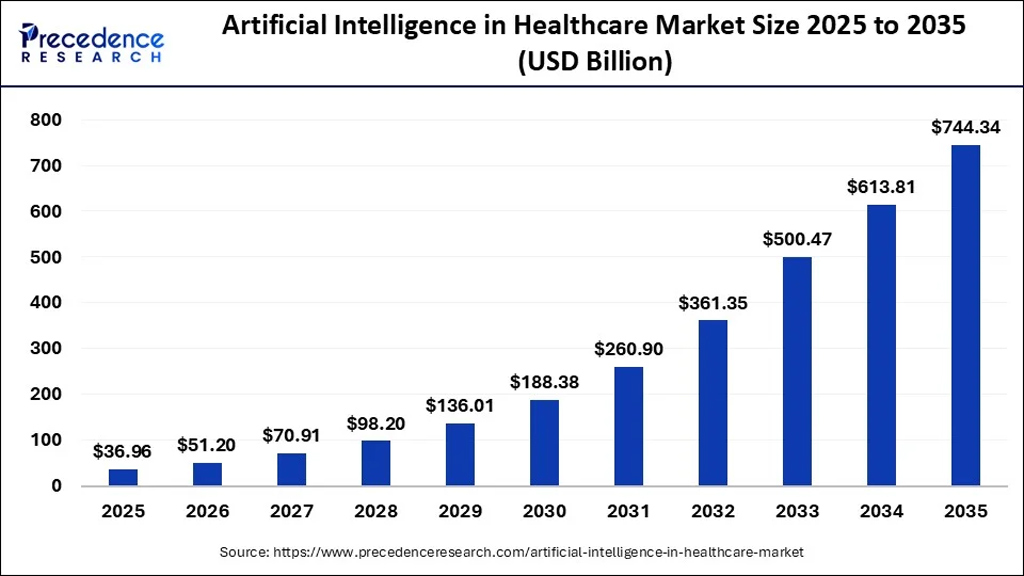
- The AI in healthcare market size is projected to surge from $36.96 billion in 2025 to $744.34 billion by 2035, reflecting explosive long-term growth.
- The market is expected to cross the $100 billion milestone by 2029, reaching $136.01 billion globally.
- By 2030, AI in healthcare is forecast to be worth $188.38 billion, more than 5 times its 2025 value.
- The industry is projected to exceed $260.90 billion in 2031, highlighting accelerating adoption across healthcare systems.
- Market value is expected to jump from $361.35 billion in 2032 to $500.47 billion in 2033, adding over $139 billion in a single year.
- The global market is forecast to surpass $600 billion in 2034, reaching $613.81 billion.
- Between 2025 and 2035, the AI healthcare market is projected to expand by more than $707 billion in absolute value.
- The market is expected to nearly double from $361.35 billion in 2032 to $744.34 billion in 2035, underscoring rapid commercialization.
- Annual market value is projected to rise by over 20 times from $36.96 billion in 2025 to $744.34 billion in 2035.
- The strongest growth phase occurs after 2030, with the market adding more than $555 billion between 2030 and 2035.
Regional AI in Healthcare Market Statistics
- North America remained the largest AI healthcare market during 2024.
- The United States accounts for the majority of FDA-authorized AI medical technologies.
- Among FDA-listed AI devices analyzed in 2024, 51.7% originated from North American applicants.
- Asia-Pacific is projected to record the fastest AI healthcare growth rate through the forecast period.
- Germany’s AI healthcare market is expected to grow from $3.34 billion in 2026 to $52.47 billion by 2035.
- Germany’s projected CAGR stands at approximately 35.8% through 2035.
- A multinational survey conducted across 10 countries found increasing clinician adoption of AI tools in healthcare workflows.
- The same survey gathered responses from 2,011 clinicians and 20,085 patients, providing a broad global perspective.
- China’s regulatory database identified 43 AI-enabled medical software products among more than 2,100 registered medical software solutions.
- Respiratory medicine represented 20.5% of AI-enabled software registrations identified in Chinese regulatory data.
AI Adoption Rates Among Healthcare Organizations
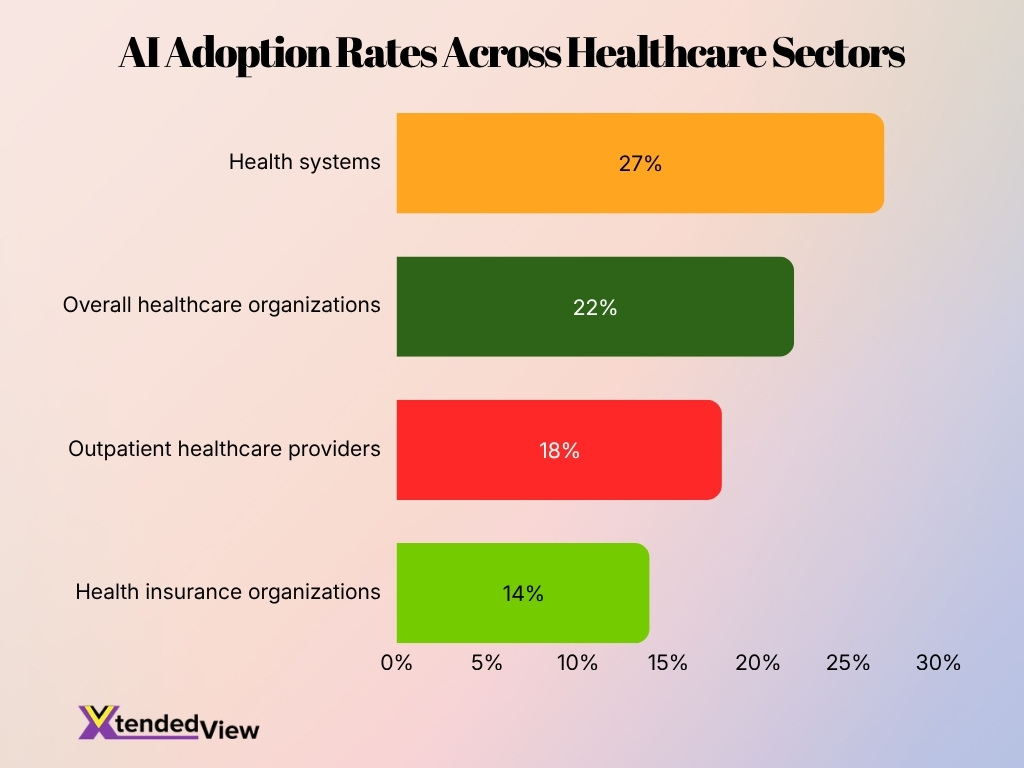
- Research published in 2025 found that 22% of healthcare organizations had implemented domain-specific AI tools.
- Adoption levels increased 7 times compared with 2024.
- Adoption in 2025 was roughly 10 times higher than in 2023.
- Health systems led adoption with a rate of 27%.
- Outpatient healthcare providers reported 18% adoption.
- Health insurance organizations reported 14% adoption.
- A national study published in 2025 examined AI adoption across U.S. healthcare systems during the early generative AI era.
- 36% of clinicians observed higher patient throughput after AI implementation.
- About 30% of physicians reported budget savings linked to AI usage.
- Approximately 27% of clinicians said AI helped prevent medical errors multiple times within a three-month period.
Generative AI in Healthcare Statistics
- The global generative AI healthcare market reached approximately $2.9 billion in 2025.
- The market is forecast to reach $28.2 billion by 2033.
- Expected CAGR from 2026 to 2033 is 33.3%.
- Another forecast values the market at $3.57 billion in 2026.
- Long-term projections suggest the sector could reach $48.23 billion by 2035.
- An alternative forecast estimates market expansion from $3.3 billion in 2025 to $39.8 billion by 2035.
- Another market model places the 2025 market value at $1.84 billion, with growth to $21.64 billion by 2034.
- Clinical note generation remains one of the most widely adopted generative AI use cases in healthcare.
- Generative AI systems increasingly combine medical imaging, electronic health records, and genomic data to support clinical decisions.
- Experts identify documentation automation, clinician assistance, and multimodal diagnostics as leading generative AI applications entering mainstream healthcare workflows.
Patient Perspectives and Trust in Healthcare AI
- A 2025 multinational survey found that 66% of patients reported positive experiences with AI in healthcare interactions.
- The same study surveyed 20,085 patients across 10 countries, making it one of the largest healthcare AI perception studies conducted to date.
- Approximately 59% of patients said AI improved access to healthcare information and support.
- Around 57% of respondents reported that AI helped them better understand their medical conditions.
- A 2025 survey found that 65% of Americans expressed concerns about AI-generated medical misinformation.
- Nearly 60% of U.S. adults said they would feel uncomfortable if AI alone made a diagnosis without physician involvement.
- Research published in 2025 showed that patient trust increases significantly when physicians disclose how AI contributes to clinical decisions.
- About 72% of healthcare consumers stated that privacy protection remains their top concern regarding healthcare AI applications.
- More than 68% of patients reported greater trust in AI systems that provide explainable recommendations rather than black-box outputs.
- Nearly 70% of respondents preferred a model where AI assists clinicians rather than replacing human decision-making.
AI-Enabled Medical Devices Distribution Statistics
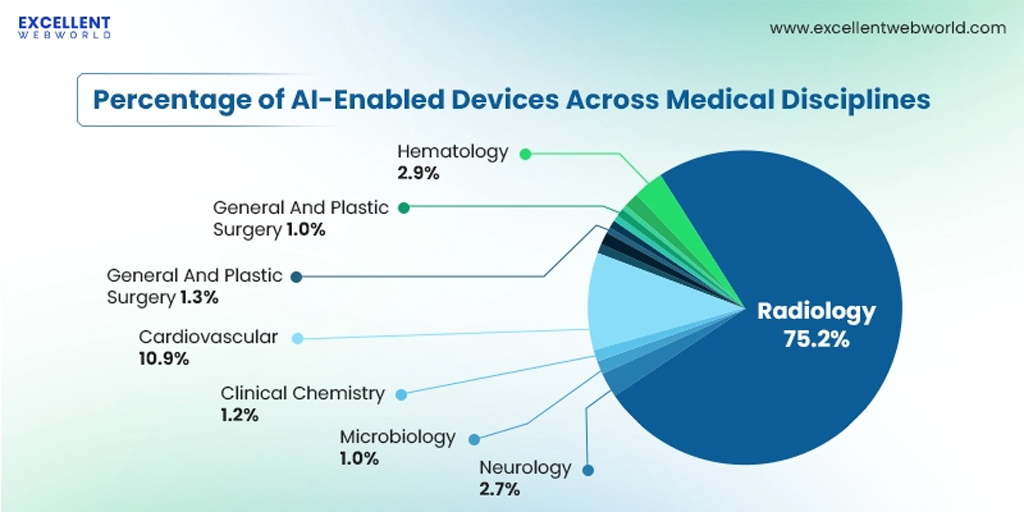
- Radiology dominates AI-enabled medical devices with 75.2% of the total share, far exceeding all other disciplines.
- Cardiovascular medicine ranks second with 10.9%, highlighting strong AI adoption in heart-related diagnostics and care.
- Hematology accounts for 2.9%, making it the third-largest specialty for AI-enabled device deployment.
- Neurology holds 2.7%, reflecting the growing use of AI technologies in brain and nervous system applications.
- General and Plastic Surgery represents 1.3%, indicating relatively limited AI device penetration in the surgical fields.
- Clinical Chemistry contributes 1.2%, showing a modest share of AI-enabled medical technologies.
- General and Plastic Surgery records another 1.0% segment, suggesting further categorization within surgical device usage.
- Microbiology captures 1.0%, marking one of the smallest shares among AI-enabled medical device specialties.
- Radiology alone accounts for more than three-quarters (75.2%) of all AI-enabled devices across medical disciplines.
- All non-radiology specialties combined represent just 24.8%, underscoring the concentration of AI innovation in imaging and diagnostics.
Healthcare Professionals’ Sentiments and Acceptance of AI
- A 2026 international clinician survey found that 81% of healthcare professionals believe AI can improve patient outcomes.
- Approximately 76% of clinicians reported that AI improves diagnostic confidence in certain clinical scenarios.
- Around 73% of healthcare professionals said AI helps reduce administrative workloads.
- Nearly 69% of physicians expect AI tools to become a routine part of clinical practice within five years.
- About 54% of physicians reported using some form of AI technology in their practice during 2025, compared with 38% in 2023.
- Clinicians using AI reported being able to see five additional patients per week on average.
- Roughly 27% of clinicians said AI helped them prevent medical errors multiple times over a three-month period.
- About 30% of physicians reported measurable budget savings after implementing AI-powered solutions.
- Research indicates that physician acceptance rises significantly when AI systems provide transparent reasoning and supporting evidence.
- More than 70% of medical professionals believe AI should remain a decision-support tool rather than an autonomous decision-maker.
AI in Medical Imaging and Diagnostics Statistics
- As of 2025, approximately 75% of all FDA-authorized AI medical devices were designed for radiology applications.
- The FDA had authorized 1,451 AI/ML-enabled medical devices by December 2025.
- Radiology accounted for more than 1,100 FDA-cleared AI devices, making it the largest AI healthcare segment.
- Studies show AI-assisted mammography can improve breast cancer detection rates by up to 20% while reducing radiologist workload.
- Research published in 2025 found AI systems matched or exceeded human specialist performance in several diagnostic imaging tasks.
- AI-supported chest imaging tools demonstrated diagnostic accuracy levels above 90% in multiple clinical studies.
- A 2025 review identified more than 900 published studies evaluating AI applications in diagnostic imaging.
- AI-assisted radiology workflows reduced image interpretation times by 20% to 40% in several hospital implementations.
- Healthcare providers increasingly deploy AI for stroke detection, with some systems identifying abnormalities in under one minute.
- Analysts expect medical imaging to remain the largest healthcare AI application segment through 2030.
Global AI Healthcare Market Applications in 2026
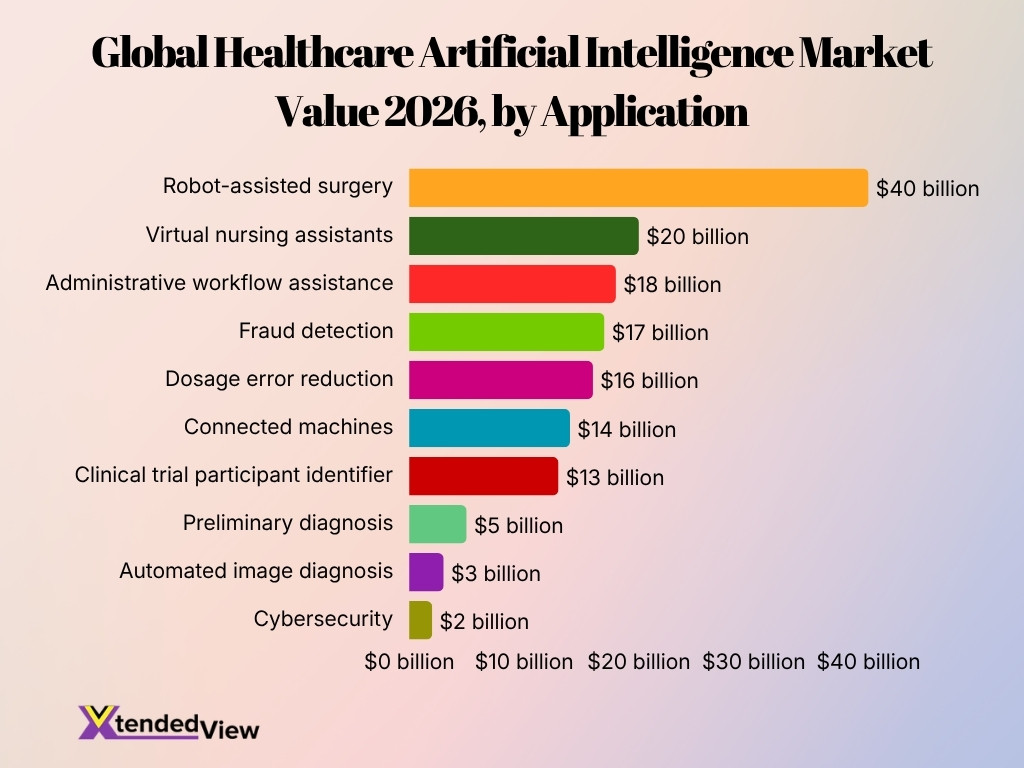
- Robot-assisted surgery is projected to dominate the AI healthcare market with a value of $40 billion, double the size of the next largest segment.
- Virtual nursing assistants are expected to generate $20 billion, making them the second-largest AI healthcare application.
- Administrative workflow assistance could reach $18 billion, highlighting strong demand for AI-driven operational efficiency.
- Fraud detection is forecast at $17 billion, reflecting growing investment in healthcare security and claims monitoring.
- AI solutions for dosage error reduction are projected to be worth $16 billion, emphasizing patient safety improvements.
- Connected machines are expected to contribute $14 billion, supporting smarter and more automated healthcare systems.
- Clinical trial participant identifier applications are forecast to reach $13 billion, aiding faster and more efficient research.
- Preliminary diagnosis tools are projected to generate $5 billion, showing continued adoption of AI-assisted diagnostics.
- Automated image diagnosis is expected to account for $3 billion, despite its growing role in medical imaging.
- Cybersecurity represents the smallest segment at $2 billion, indicating a comparatively niche AI healthcare application market.
AI in Drug Discovery and Development Statistics
- AI-driven drug discovery could generate $350 billion to $410 billion annually for the pharmaceutical industry.
- AI technologies reduce early-stage drug discovery timelines by up to 50%.
- Over 300 AI-focused drug discovery companies operated globally by 2025.
- AI can reduce preclinical candidate identification from years to just months.
- Multiple AI-discovered drug candidates have advanced into Phase II clinical trials.
- Pharmaceutical companies invested billions of dollars into AI partnerships during 2024 and 2025.
- AI platforms rapidly screen millions of molecular combinations in a fraction of traditional time.
- The global AI drug discovery market is projected to exceed $15 billion by 2030.
Predictive AI and Analytics in Healthcare Statistics
- The predictive analytics healthcare market is expanding at an annual growth rate exceeding 25%.
- Hospitals utilizing predictive tools reported a 10% to 20% reduction in preventable readmissions.
- AI predictive systems can identify high-risk patient deterioration up to 4 hours before clinical onset.
- Predictive algorithms successfully detect sepsis cases up to 5 hours earlier than traditional monitoring.
- Deploying predictive AI for hospital staffing optimization cut understaffing instances by 15%.
- Machine learning models demonstrated a predictive accuracy above 85% for chronic disease management.
- Predictive AI increases the accuracy of hospital patient admission forecasting by 25%.
- Over 60% of U.S. health systems currently deploy predictive analytics for population health tracking.
- Early predictive interventions helped reduce severe cardiovascular complications by 12%.
- The global predictive healthcare analytics sector is projected to cross $47 billion by 2030.
Hospital AI Adoption Gap Across U.S. States
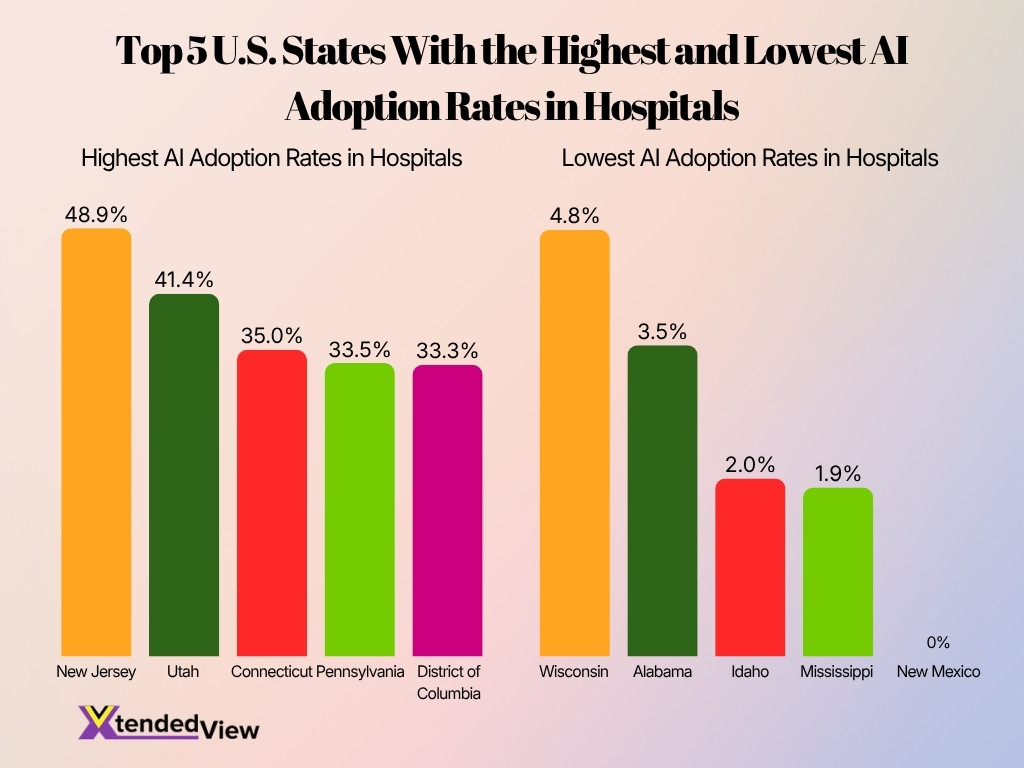
- New Jersey leads hospital AI adoption with 48.9%, the highest rate among all states analyzed.
- Utah ranks second with a strong 41.4% hospital AI adoption rate.
- Connecticut reports 35.0% adoption, placing it among the top AI-enabled healthcare states.
- Pennsylvania and the District of Columbia follow closely at 33.5% and 33.3%, respectively.
- Wisconsin has the highest adoption among the bottom five states at just 4.8%.
- Alabama’s hospital AI adoption rate stands at only 3.5%, highlighting a major regional disparity.
- Idaho and Mississippi report extremely low adoption levels of 2.0% and 1.9%, respectively.
- The gap between New Jersey (48.9%) and Mississippi (1.9%) is a substantial 47 percentage points.
- Top-performing states show hospital AI adoption rates that are more than 10 times higher than those in the lowest-performing states.
- The data reveals a significant geographic divide in healthcare AI implementation across the United States.
AI in Robot-Assisted Surgery Statistics
- The global AI-based surgical robots market size was valued at $7.42 billion in 2025.
- North America dominated the AI-driven robotic surgery market with a 51.04% share.
- Analysts project the AI-enabled surgical robotics industry to reach $207.56 billion by 2034.
- The market is expected to expand at a compound annual growth rate (CAGR) of 45.04% through 2034.
- General surgery applications are anticipated to command a 33.2% revenue share by 2035.
- Advanced robot-assisted procedures have been shown to reduce hospital readmissions by 52%.
- Over 2,000 hospitals in the United States currently utilize robotic surgical systems.
- The instruments and accessories segment constitutes 60.0% of the total surgical robotics sector.
AI in Hospital Administration and Workflow Statistics
- Healthcare organizations report that clinicians spend nearly 50% of their workday on administrative tasks and documentation, creating a major opportunity for AI automation.
- AI-powered clinical documentation tools have reduced physician documentation time by up to 70% in several health system deployments.
- A 2026 clinician survey found that 73% of healthcare professionals believe AI helps reduce administrative burdens.
- Healthcare providers using AI-assisted workflows reported the ability to see an average of five additional patients per week.
- Approximately 36% of clinicians said AI improved patient throughput after implementation.
- AI scheduling systems have helped hospitals reduce appointment no-show rates by 15% to 30% in pilot programs.
- Research shows AI-enabled revenue cycle management solutions can reduce claim denial rates by 10% to 20%.
- Hospitals increasingly use AI-powered virtual assistants to manage appointment scheduling, patient inquiries, and intake processes.
- AI-driven workflow optimization has reduced administrative processing times by 20% to 40% in several healthcare settings.
- Analysts expect hospital operations and workflow automation to remain among the fastest-growing healthcare AI applications through 2030.
Where Health Care Leaders See the Biggest AI Value in 2026
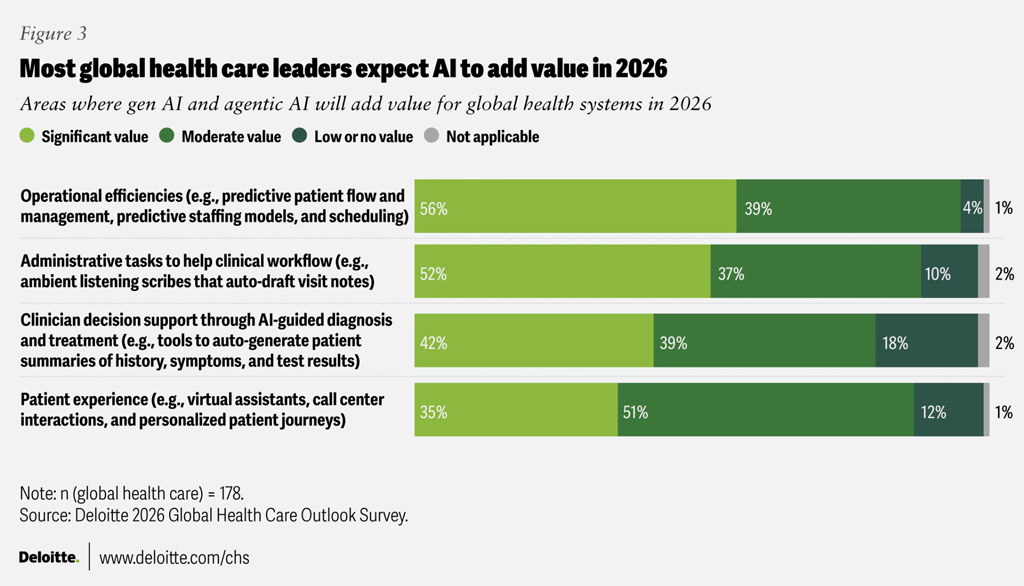
- Operational efficiencies rank highest, with 56% of global health care leaders expecting significant value from AI in 2026.
- Administrative workflow support follows closely, with 52% anticipating significant value from AI-powered clinical documentation and note drafting.
- Clinician decision support is viewed positively, with 42% expecting significant value and 39% expecting moderate value.
- Patient experience improvements receive the strongest combined support, with 86% expecting either significant (35%) or moderate (51%) value.
- Operational efficiencies have the lowest skepticism, with only 4% reporting low or no value from AI adoption.
- Clinician decision support faces the greatest uncertainty, with 18% of leaders expecting low or no value.
- Across all use cases, 1%–2% of respondents said AI’s impact was not applicable, indicating broad relevance across health systems.
- More than 80% of leaders expect AI to deliver either significant or moderate value in every major health care application area surveyed.
Financial Impact and ROI of AI in Healthcare
- AI could generate $200 billion to $360 billion annually in healthcare value worldwide.
- AI-driven automation can reduce healthcare administrative costs by up to 30%.
- Around 30% of physicians reported direct budget savings from AI adoption.
- AI revenue management solutions demonstrate financial ROI within 12 to 24 months.
- Predictive analytics helps hospitals save millions of dollars in readmission costs.
- Generative AI could create $60 billion to $110 billion in annual economic value.
- Healthcare AI spending is projected to grow at an annual rate above 30%.
- AI is ranked a top-three technology investment priority for 2026.
Healthcare Productivity and Efficiency Statistics
- 34% of clinicians reported significant productivity improvements after adopting AI tools.
- Healthcare professionals using AI reported seeing an average of five more patients weekly.
- AI-supported clinical documentation platforms have reduced note-completion times by more than 50%.
- Predictive analytics in hospitals has improved bed utilization by up to 18%.
- AI-assisted imaging solutions can reduce radiology reporting times by 20% to 40%.
- AI-powered optimization tools can accurately forecast workforce needs and reduce staff overtime by 15%.
- Integrating AI with hospital administrative workflows can boost employee productivity by over 14%.
- AI-driven forecasting models have helped hospitals reduce emergency room wait times by up to 22%.
- Using AI-powered imaging analysis can detect abnormalities up to 30% faster than traditional diagnostic methods.
Challenges and Barriers to AI Adoption in Healthcare
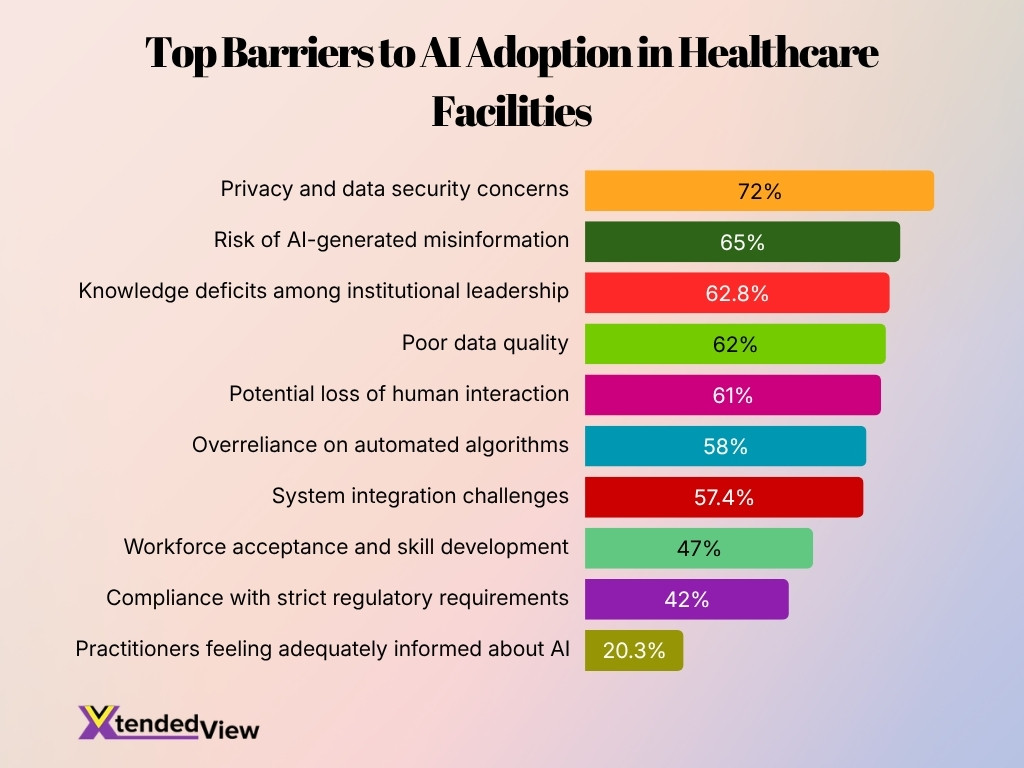
- A recent survey found that 72% of consumers are concerned about privacy and data security regarding healthcare AI.
- Approximately 65% of patients express significant worries about the risk of AI-generated misinformation in medical settings.
- Knowledge deficits among institutional leadership are cited as a primary adoption roadblock by 62.8% of surveyed facilities.
- Poor data quality is recognized as a major implementation obstacle by 62% of healthcare organizations.
- The potential loss of human interaction in patient care is a critical concern for 61% of surveyed medical professionals.
- Overreliance on automated algorithms for medical diagnoses worries 58% of healthcare industry executives.
- System integration challenges with existing infrastructure are reported as a primary barrier by 57.4% of clinical facilities.
- Workforce acceptance and the need for AI skill development pose significant hurdles for 47% of healthcare providers.
- Compliance with strict regulatory requirements remains a top barrier for 42% of institutions adopting AI tools.
- Despite widespread enthusiasm, only 20.3% of medical practitioners feel adequately informed about healthcare AI applications.
Patient Outcomes and Satisfaction Statistics
- An international survey found that 81% of clinicians believe AI contributes to better patient outcomes.
- Approximately 66% of patients reported positive experiences with healthcare AI technologies.
- Around 59% of patients stated that AI improved access to healthcare services and information.
- AI-assisted diagnostics can improve disease detection rates by up to 90% to 95% across clinical specialties.
- AI stroke detection reduces care-team notification time by 30% to 52%, identifying anomalies within minutes.
- AI-enabled sepsis prediction tools can reduce patient mortality by 8% to 10% via early intervention.
- Hospitals using predictive AI have reported a 10% to 45% reduction in preventable readmission rates.
- AI-powered remote monitoring solutions help reduce avoidable ER visits by 25% to 30% through early detection.
- Hospitals using AI-enhanced patient engagement tools report up to a 20% improvement in satisfaction scores.
- Clinical studies show AI paired with healthcare professionals reduces diagnostic errors by up to 85%.
Frequently Asked Questions (FAQs)
The global AI in healthcare market is projected to reach $51.2 billion in 2026.
The market is expected to grow at a 35.0% CAGR from 2026 to 2035.
The FDA had authorized 1,451 AI/ML-enabled medical devices as of December 2025.
The FDA cleared a record 295 AI/ML-enabled medical devices in 2025.
Radiology accounts for approximately 76% of all FDA-authorized AI medical devices.
Conclusion
AI has moved beyond experimentation and now plays an active role in healthcare delivery, diagnostics, drug discovery, hospital operations, and patient engagement. Market growth remains exceptionally strong, with global investment, adoption rates, and regulatory approvals continuing to accelerate.
The data also shows that healthcare organizations are increasingly using AI to improve productivity, reduce administrative burdens, enhance clinical decision-making, and support better patient outcomes. At the same time, concerns around privacy, transparency, bias, and regulation remain important challenges that organizations must address.
Looking ahead, healthcare AI will likely continue evolving from standalone tools into integrated systems that support clinicians across the entire care continuum. Organizations that combine strong governance with responsible AI deployment may be best positioned to capture the technology’s clinical and financial benefits over the coming decade.
