



Predictive AI helps organizations forecast future outcomes by analyzing historical and real-time data with machine learning models. Businesses now rely on predictive AI to improve demand forecasting, detect fraud, optimize maintenance schedules, and personalize customer experiences. Healthcare providers use it to identify high-risk patients earlier, while retailers use it to forecast inventory and consumer demand with greater accuracy.
As investment and adoption continue to accelerate across industries, predictive AI is becoming a core business capability rather than an experimental technology. Explore the statistics below to understand how predictive AI is reshaping industries, investment, and enterprise decision-making.
Editor’s Choice
- Global AI spending is projected to reach $2.59 trillion in 2026, representing 47% year-over-year growth from approximately $1.76 trillion in 2025.
- The AI infrastructure segment alone is expected to generate $1.43 trillion in spending during 2026, accounting for more than 45% of total AI expenditure.
- The global artificial intelligence market is estimated at $539.5 billion in 2026, up from $390.9 billion in 2025, reflecting continued enterprise adoption of predictive and generative AI.
- The predictive analytics market is forecast to grow from $22.22 billion in 2025 to $27.56 billion in 2026, supported by expanding use in forecasting, fraud detection, and customer analytics.
- North America accounted for 38.7% of the global predictive analytics market in 2025, making it the largest regional market entering 2026.
- The global machine learning market is expected to reach $135.8 billion in 2026, increasing from $100 billion in 2025, driven largely by predictive AI deployments.
- Enterprise investment increasingly favors predictive and agentic AI embedded into business software rather than standalone AI models, with organizations prioritizing workflow automation and operational efficiency throughout 2026.
Recent Developments
- Analysts identify 2026 as an inflection year when enterprise AI investment begins shifting from pilot projects toward broader operational deployment.
- Organizations increasingly integrate predictive AI with agentic AI to automate multi-step decision-making across enterprise workflows.
- AI infrastructure spending continues to outpace software growth as organizations expand compute capacity for predictive workloads.
- Data centers supporting AI workloads are projected to exceed $650 billion in spending during 2026 after approaching $500 billion in 2025.
- AI-optimized server spending is forecast to triple within five years, reflecting growing enterprise demand for predictive modeling and inference workloads.
- Major consulting firms report that organizations increasingly modernize legacy systems before expanding predictive AI deployments because fragmented data limits forecasting accuracy.
- AI vendors continue embedding predictive capabilities directly into CRM, ERP, cybersecurity, and analytics platforms, reducing implementation complexity for enterprises.
- Businesses increasingly prioritize measurable productivity improvements over experimental AI deployments, making predictive analytics one of the fastest-growing enterprise AI applications.
Artificial Intelligence (AI)-Driven Predictive Maintenance Market Statistics
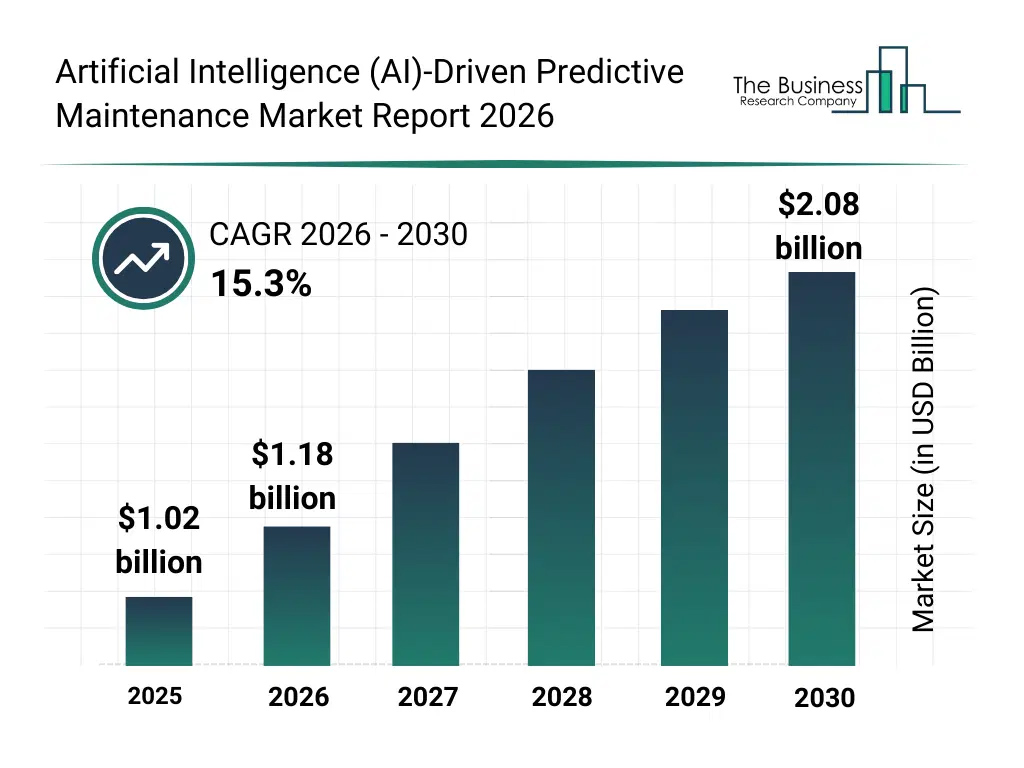
- The AI-driven predictive maintenance market is projected to grow from $1.02 billion in 2025 to $2.08 billion by 2030, more than doubling in market value over the forecast period.
- The market is expected to reach $1.18 billion in 2026, marking the beginning of a strong growth trajectory fueled by increasing AI adoption across industries.
- With a projected CAGR of 15.3% between 2026 and 2030, the market is forecast to expand at a robust double-digit annual growth rate.
- The market is estimated to reach approximately $1.36 billion in 2027, reflecting continued investment in AI-powered maintenance technologies.
- By 2028, the market is projected to climb to around $1.56 billion, highlighting growing demand for predictive analytics and machine learning solutions.
- The market is forecast to increase further to approximately $1.80 billion in 2029, driven by wider deployment of industrial AI and IoT-enabled monitoring systems.
- The industry is expected to surpass the $2 billion milestone in 2030, reaching $2.08 billion, underscoring the expanding role of AI in reducing downtime and improving operational efficiency.
- The steady year-over-year increase throughout 2025 to 2030 indicates consistent market momentum, supported by digital transformation initiatives and greater enterprise adoption of predictive maintenance solutions.
Predictive AI Adoption Statistics
- AI services are projected to reach $585.5 billion globally during 2026 to meet implementation demand.
- AI software spending is forecast to increase to $453.2 billion in 2026 from approximately $282.9 billion in 2025.
- AI cybersecurity spending is expected to nearly double from $25.9 billion in 2025 to $51.3 billion in 2026.
- Around 88% of organizations currently utilize predictive AI in at least one core business function.
- Total worldwide enterprise AI spending is forecast to reach a record $2.59 trillion by the end of 2026.
- Approximately 72% of enterprises have successfully scaled their AI models into full production environments.
- Nearly 30% of businesses are actively redesigning their operational processes specifically around AI adoption.
- Manufacturing AI spending experienced a massive 48% year-over-year growth during 2026 for predictive maintenance.
Predictive AI Key Use Cases
- AI-powered demand forecasting can reduce inventory stockouts by up to 65% and improve overall forecasting accuracy by 20%.
- Implementing predictive maintenance reduces machinery downtime by up to 45% and lowers routine maintenance costs by 25%.
- Machine learning models deployed for fraud detection reduce false positive declines by 70% while increasing fraud catch rates by 50%.
- Businesses utilizing predictive AI to identify at-risk accounts can successfully decrease their customer churn rates by 20%.
- AI-driven dynamic pricing models can yield a 10% increase in profit margins and boost overall sales revenue by up to 13%.
- Predictive analytics in clinical settings can reduce unexpected patient mortality by 20% and lower hospital readmission rates by 12%.
- Organizations utilizing predictive AI in cybersecurity reduce the average data breach lifecycle by 74 days and save $1.8 million per incident.
- Sales teams leveraging predictive lead scoring experience up to a 30% increase in conversion rates by efficiently prioritizing high-value prospects.
Predictive AI Usage by Industry
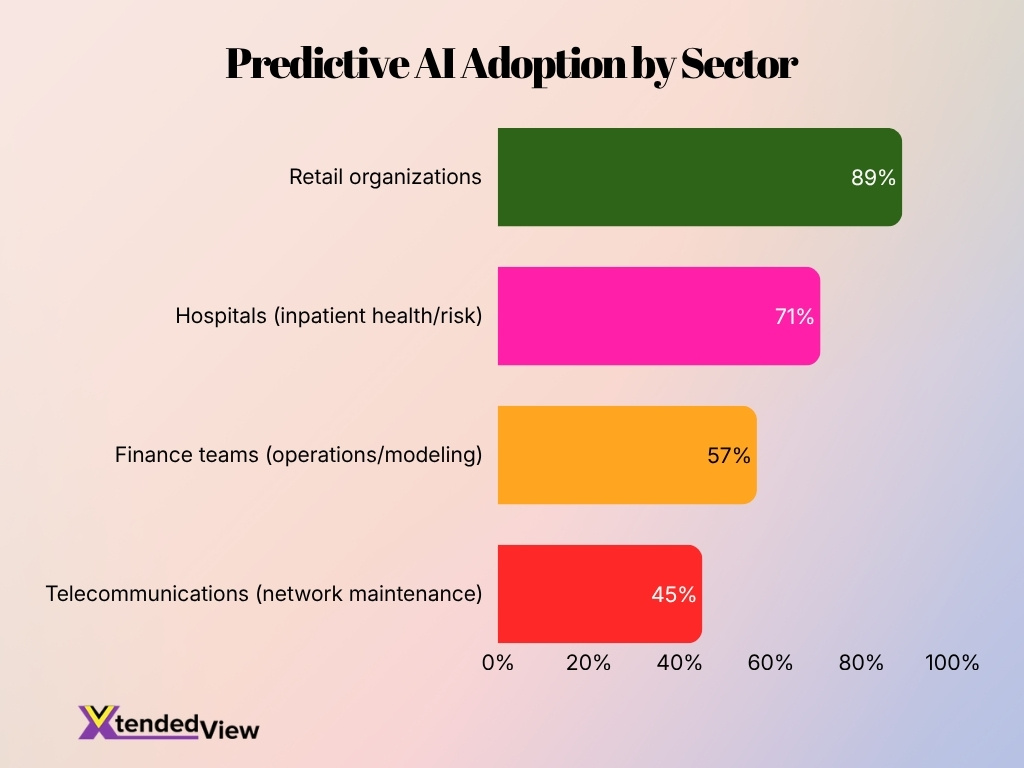
- 57% of finance teams actively use AI for operations like predictive modeling and data analysis.
- 71% of hospitals use integrated predictive AI systems to assess inpatient health trajectories and patient risks.
- 89% of retail organizations actively leverage AI technologies for operations like predictive analytics and demand forecasting.
- AI-driven predictive maintenance in manufacturing cuts equipment stoppages by 30-50% and reduces costs by up to 40%.
- 45% of telecommunications providers currently utilize AI for the predictive maintenance of their network infrastructure.
- The banking, financial services, and insurance sector captures over 21% of the global predictive AI market share.
- Infrastructure and network operations optimized by predictive analytics can reduce overall energy consumption by up to 20%.
- The global predictive AI market is projected to reach a valuation of $108 billion by 2033 across enterprise and government sectors.
Predictive AI in Business Operations
- Organizations increasingly deploy predictive AI to automate operational planning, workforce scheduling, and resource allocation instead of relying solely on historical reporting.
- According to the 2026 AI Index, 91% of organizations in developing markets and 90% in North America report using AI in at least one business function, reflecting rapid operational adoption.
- The 2025 global AI survey found 21% of organizations regularly use AI in service operations, while 23% use it for product or service development.
- AI adoption in strategy and operations reached 56% among surveyed Indian enterprises operating AI at scale, demonstrating growing confidence in predictive business planning.
- Around 40% of surveyed Indian organizations report significant or full AI usage across enterprise operations, exceeding the global average of approximately 28%.
- AI-powered predictive maintenance and operational monitoring continue reducing equipment downtime while improving asset utilization across industrial environments.
- Organizations increasingly integrate predictive AI into ERP and workflow platforms to improve procurement, inventory management, and operational forecasting rather than deploying standalone models.
- Business leaders continue prioritizing measurable productivity improvements and operational efficiency when expanding predictive AI investments during 2026.
Predictive AI in Marketing
- 46% of organizations regularly utilize predictive AI for marketing and sales functions.
- 55% of technology companies already integrate AI into their core marketing activities.
- 51% of retail organizations report significant AI adoption for predictive customer analytics.
- 74% of B2B marketing teams leverage AI marketing analytics to secure a competitive advantage.
- 32% higher lead quality is consistently achieved by companies using predictive marketing analytics.
- 23% productivity improvement is seen by organizations within their first year of AI implementation.
- 30% higher conversion rates are reported by businesses integrating predictive AI into campaigns.
- 72% of modern marketers now use predictive analytics to guide audience targeting decisions.
- 92% of top-performing teams rely heavily on AI-driven predictions for campaign optimization.
- 42% reduction in wasted ad spend is achieved through AI campaign performance forecasting.
Predictive AI in Finance
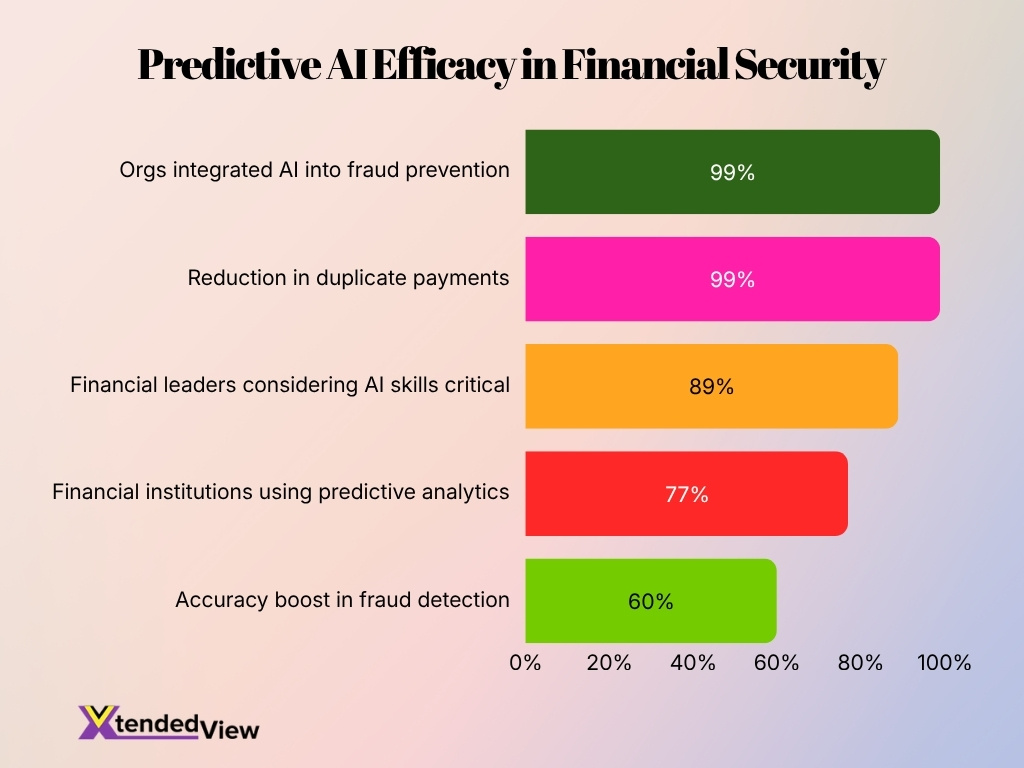
- Over 77% of financial institutions now utilize some form of predictive analytics in their operations.
- The banking and finance sector currently captures over 21% of the entire global predictive AI market share.
- Implementing predictive AI in finance generates a massive ROI of 200% to 500% within the very first year.
- Advanced AI fraud detection provides a 60% boost in accuracy when directly compared to traditional monitoring methods.
- Stopping fraudulent transactions with predictive AI models saves the financial industry roughly $15 billion each year.
- Approximately 89% of financial leaders consider predictive AI skills absolutely critical for organizational success.
- Continuous AI transaction monitoring reduces duplicate payments and hidden financial leakage by up to 99%.
- Deploying AI algorithms for cash flow forecasting yields a 10% to 20% improvement in available working capital.
- Nearly 99% of surveyed financial organizations have already integrated AI models into their fraud prevention systems.
- Enterprise finance teams experience 26% to 55% productivity gains after successfully implementing new AI solutions.
Predictive AI in Sales
- The 2025 AI survey shows 46% of organizations regularly use predictive AI in marketing and sales.
- Indian enterprises report 55% at-scale AI deployment across marketing and sales for predictive technologies.
- The global predictive AI market size is projected to reach a massive $155.72 billion by 2035.
- Sales teams utilizing AI-powered tools report notable conversion rate improvements of 40% or higher.
- Approximately 87% of sales firms presently employ AI in some capacity for lead scoring and forecasting.
- A significant 65% of businesses currently view AI as a key driver of overall sales growth.
- Utilizing AI-powered qualification and automated delivery can shorten sales cycles by 20-30%.
- Sales organizations expect their Net Promoter Scores to increase to 51% in 2026 via AI-enabled engagement.
- Relying on AI automation effectively gives sales representatives 15+ hours per week back for actual selling.
Predictive AI in Healthcare
- The global predictive AI in healthcare market is projected to exceed $25 billion by 2027.
- Hospitals using predictive models see up to a 20% reduction in patient readmission rates.
- Early disease prediction algorithms demonstrate over 85% accuracy in identifying high-risk patients.
- Implementation of clinical predictive analytics can save the healthcare industry roughly $150 billion annually.
- Over 60% of healthcare executives report actively deploying predictive AI for resource allocation.
- AI-driven capacity planning reduces emergency room wait times by approximately 15%.
- More than 75% of healthcare organizations report achieving positive ROI within two years of AI adoption.
- Predictive staffing models improve operating room utilization by up to 12% across hospital networks.
Predictive AI Deployment Models
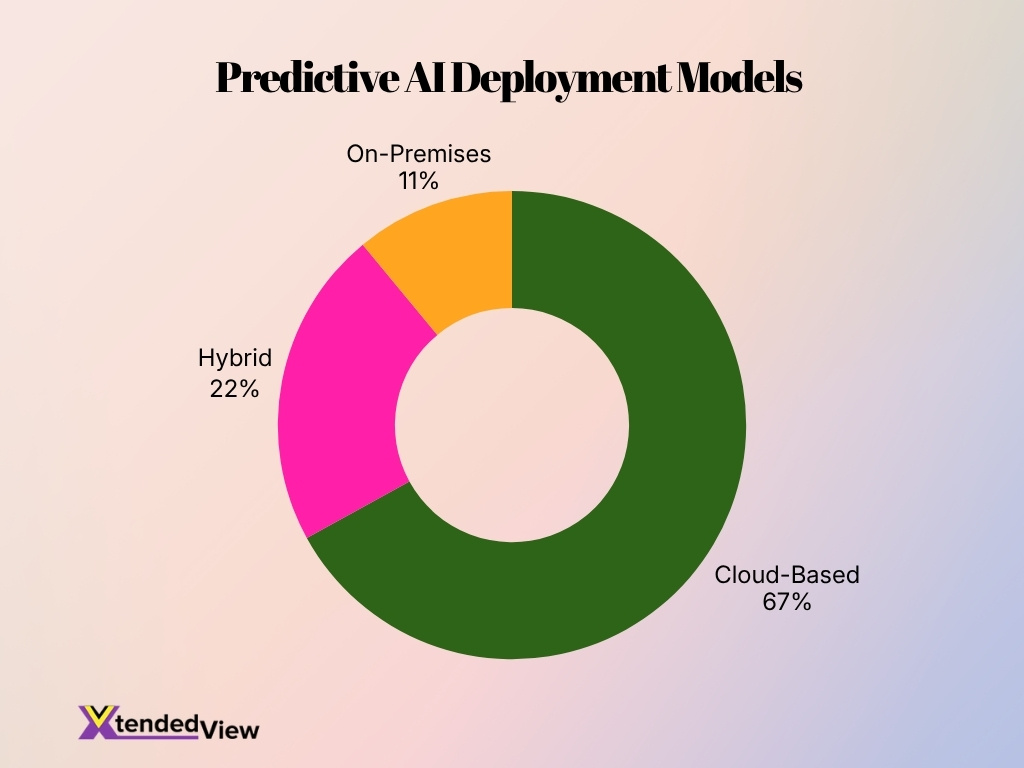
- Cloud-based deployment dominates the market with a 67% share, making it the most widely adopted model for predictive AI solutions in 2026.
- Hybrid deployment accounts for 22% of the market, reflecting growing demand for organizations that need a balance between cloud scalability and on-premises control.
- On-premises deployment represents just 11% of the market, indicating that fewer businesses rely solely on traditional in-house infrastructure for predictive AI.
- The combined 89% share of cloud-based and hybrid models highlights a strong industry shift toward flexible and scalable AI deployment environments.
- The 56 percentage point gap between cloud-based (67%) and on-premises (11%) deployments underscores the clear preference for cloud-first predictive AI strategies.
- These figures suggest that organizations increasingly prioritize cost efficiency, scalability, and faster deployment, driving the widespread adoption of cloud-based predictive AI solutions.
Predictive AI in Retail and E-commerce
- Over 80% of retail organizations are currently using or piloting generative AI for their operations.
- Predictive AI-enabled supply chain planning can reduce inventory by up to 20% and lower overall costs.
- The global AI in retail market is projected to surge to an estimated $105.88 billion by 2034.
- Advanced predictive analytics and AI forecasting can successfully cut inventory stockouts by 25%.
- Product recommendations powered by AI can drastically increase retail revenue by up to 300%.
- Generative AI integration has the significant potential to elevate the retail sector’s profitability by 20%.
- Predictive analytics applications are anticipated to hold a dominant 26.57% market share within retail AI in 2026.
- 84% of e-commerce businesses now rank AI and predictive analytics as their absolute highest strategic priority.
Predictive AI in Manufacturing
- Unplanned downtime costs global manufacturers up to $1.4 trillion annually due to equipment failures.
- Approximately 40% of manufacturing companies currently deploy AI for predictive modeling.
- Around 43% of manufacturing firms utilize AI to automate routine operational tasks.
- Predictive AI systems can successfully reduce machine downtime by 30% to 50%.
- Deploying AI-driven algorithms lowers overall maintenance costs by 10% to 20%.
- The global market for AI in manufacturing is expected to reach $68 billion by 2032.
- Implementing predictive maintenance increases overall equipment effectiveness by up to 15%.
- Over 60% of manufacturing leaders prioritize predictive maintenance as their primary AI investment.
Predictive AI Benefits for Enterprises
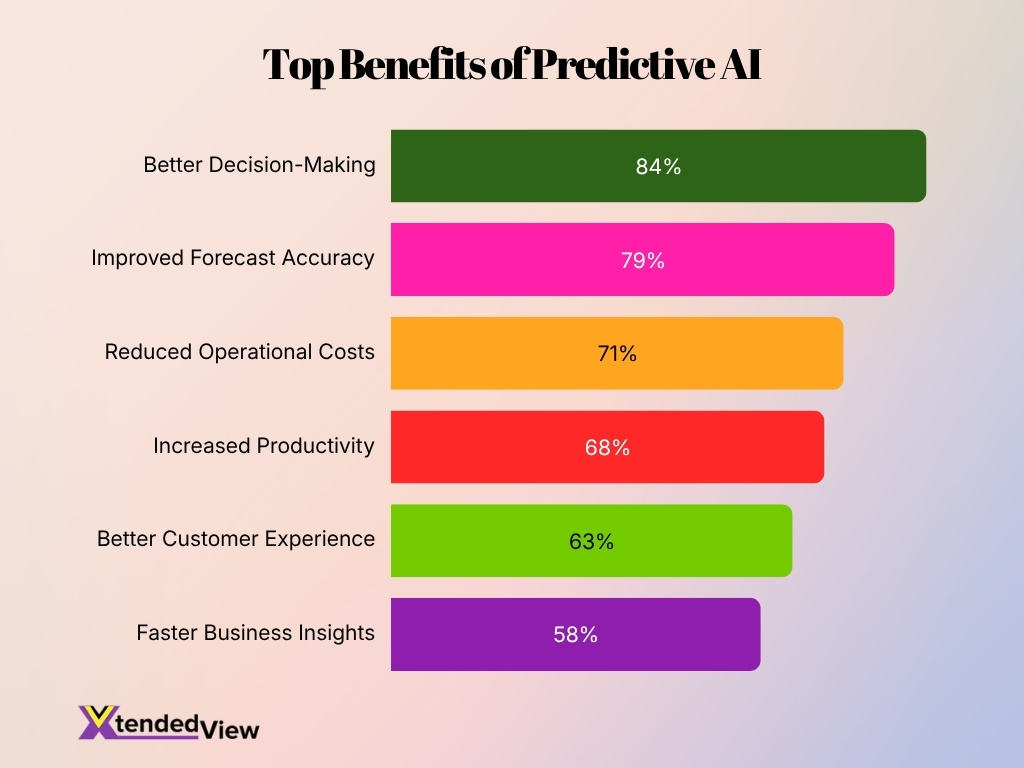
- Better decision-making is the leading benefit, reported by 84% of organizations using predictive AI.
- Improved forecast accuracy ranks second, with 79% of organizations gaining more reliable business projections.
- Reduced operational costs are reported by 71% of organizations, highlighting predictive AI’s role in improving efficiency.
- Increased productivity benefits 68% of organizations by automating analysis and supporting faster planning.
- Better customer experience is achieved by 63% of organizations through more accurate personalization and demand prediction.
- Faster business insights are reported by 58% of organizations, helping teams respond more quickly to emerging trends.
- Overall, every listed benefit is reported by more than half of organizations, indicating the broad enterprise value of predictive AI.
Predictive AI in Cybersecurity
- The predictive AI cybersecurity market is projected to rise from $31.5 billion in 2025 to $39.1 billion in 2026, a one-year increase of about 24%.
- Market revenue could reach $182.9 billion by 2033, representing a compound annual growth rate of 24.7% from 2026.
- North America generated 29.8% of global revenue in the AI cybersecurity market during 2025, giving the region the largest market share.
- The global average cost of a data breach fell 9% to $4.4 million in 2025, partly because organizations detected and contained incidents more quickly.
- Organizations with extensive use of AI and automation in security saved an average of $1.9 million per breach compared with organizations that did not use those capabilities.
- Among organizations reporting an AI-related security incident, 97% lacked appropriate AI access controls, exposing a major gap between adoption and protection.
- 63% of organizations lacked governance policies designed to manage AI systems or prevent employees from using unauthorized AI tools.
- AI security spending is growing because predictive systems can analyze network behavior, authentication activity, and endpoint signals to identify anomalies before they develop into larger incidents. However, these systems still require accurate data and human review to control false alerts.
Predictive AI in Customer Support
- Customer service teams estimated that AI handled 30% of service cases in 2025 and predicted that the share would reach 50% by 2027.
- AI moved from the 10th-highest to the second-highest priority for customer service leaders in one year, ranking behind only customer experience improvement.
- Service representatives who used AI spent 20% less time on routine cases, equal to an estimated four hours saved per employee each week.
- Representatives working with agentic AI spent approximately 25% of their week resolving high-complexity cases that required human judgment.
- 71% of service representatives using AI said the technology created career development and professional growth opportunities.
- Among service employees using AI, 86% developed new skills, while 81% said their roles became more specialized.
- Service professionals expected agentic AI to increase upsell revenue by 15% overall and by 20% in life sciences and biotechnology.
- Security remains a barrier to wider deployment: 51% of service leaders said security concerns had delayed or limited their AI initiatives.
Tasks That Machines Can Easily automate
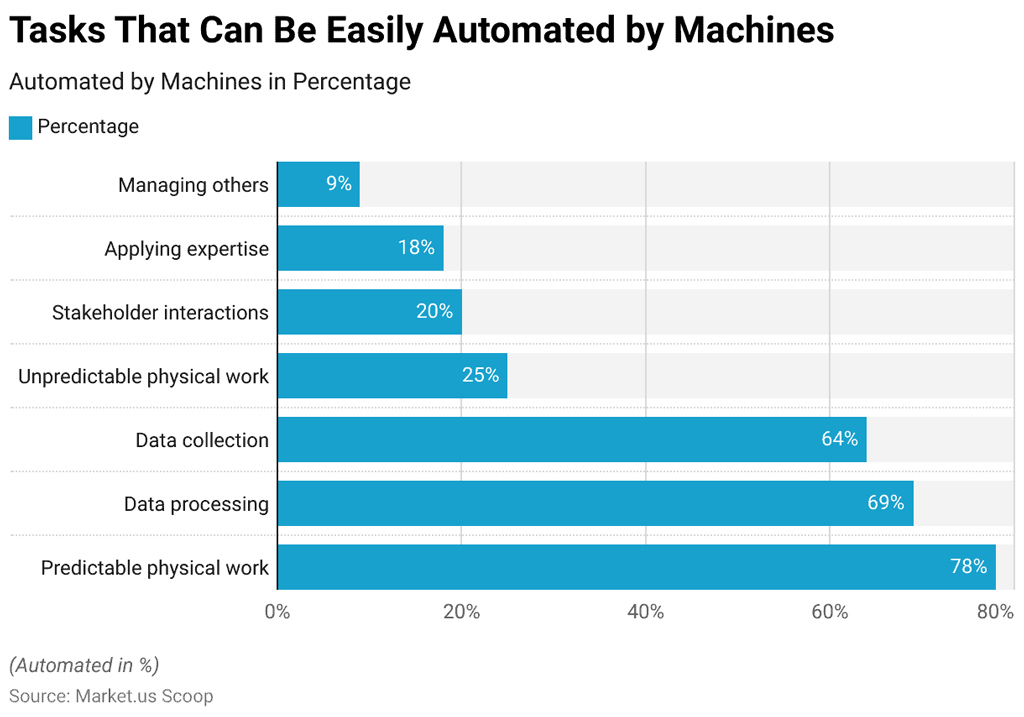
- Predictable physical work has the highest automation potential at 78%, making repetitive and structured manual tasks the easiest for machines to perform.
- Data processing ranks second, with 69% of tasks considered highly suitable for automation through AI and software systems.
- Data collection follows closely, as 64% of these activities can be automated, reducing the need for manual information gathering.
- Unpredictable physical work has a much lower automation rate of 25%, reflecting the complexity of dynamic real-world environments.
- Stakeholder interactions are only 20% automatable, highlighting the continued importance of human communication and relationship management.
- Tasks involving applying expertise have an automation potential of just 18%, showing that specialized knowledge and judgment remain difficult to replace.
- Managing others is the least automatable task at only 9%, emphasizing the value of human leadership, decision-making, and emotional intelligence.
- The data reveals a clear trend that routine, repetitive, and data-driven tasks are significantly more likely to be automated than leadership, interpersonal, and expert knowledge-based responsibilities.
Predictive AI in Supply Chain Management
- 72% of supply chain organizations have deployed generative AI to improve operations.
- Desk-based supply chain workers save an average of 4.11 hours per week using AI.
- Team-level AI time savings average only 1.5 hours per employee every week.
- The average supply chain employee currently utilizes 3.6 generative AI tools.
- Approximately 94% of supply chain companies plan to adopt AI for decision support.
- Mature AI adopters are forecasted to achieve 30-40% reductions in delivery delays.
- Supply chains with mature AI adoption are 23% more profitable than their competitors.
- AI-enabled distribution operations can successfully reduce inventory costs by 20-30%.
- Around 60% of supply chain leaders plan to invest in predictive AI technologies.
Predictive AI ROI Statistics
- 85% of organizations increased their AI investment during the 12 months leading into the 2025 survey period.
- 91% planned to raise AI investment again during the following year, which extends through August 2026 for the surveyed organizations.
- Most organizations required two to four years to achieve satisfactory returns from a typical AI use case.
- Only 6% of organizations achieved AI payback in less than one year, compared with a typical seven- to 12-month expectation for major technology investments.
- Even among the most successful AI projects, only 13% produced returns within 12 months.
- 15% of organizations using generative AI reported significant and measurable returns, while 38% expected to reach that point within one year.
- Among organizations using agentic AI, just 10% reported significant current ROI. Half expected returns within three years, while about one-third expected a three- to five-year timeline.
- Approximately 20% of surveyed organizations qualified as AI ROI leaders. Among these leaders, 95% allocated more than 10% of their technology budgets to AI.
- 85% of AI ROI leaders used different measurement frameworks or timelines for generative and agentic AI, rather than applying one financial model to every deployment.
- 65% of organizations had incorporated AI into corporate strategy, indicating that businesses increasingly evaluate value through revenue, resilience, customer outcomes, and productivity as well as direct cost savings.
Predictive AI Challenges and Risks
- Reported AI-related incidents reached a record 233 cases in 2024, increasing 56.4% from 2023. The figure provides the latest complete annual benchmark included in the 2025 AI research.
- Only 64% of surveyed organizations identified model inaccuracy as a responsible AI concern, even though unreliable predictions can affect medical, financial, and operational decisions.
- 63% cited regulatory compliance as an AI risk, while 60% identified cybersecurity as a significant concern.
- Access restrictions on web data grew sharply between 2023 and 2024. Within actively maintained domains in a major training dataset, restricted tokens increased from 5%-7% to 20%-33%.
- The average transparency score among major model developers improved from 37% in October 2023 to 58% in May 2024, but substantial gaps remained in training-data, risk, and evaluation disclosures.
- Responsible AI research expanded, with accepted papers at major conferences increasing 28.8%, from 992 in 2023 to 1,278 in 2024.
- The number of organizations publishing frontier AI safety frameworks more than doubled during 2025, reflecting rising concern about misuse, monitoring, and model control.
- Predictive AI can reproduce historical bias when organizations train models on incomplete or unrepresentative data. Even systems designed to reduce explicit bias can retain implicit racial, gender, and occupational associations.
- Poor infrastructure and fragmented data remain financial barriers: one in four organizations cited inadequate infrastructure or data as an obstacle to achieving AI ROI.
- Governance often trails deployment. Weak access controls, unauthorized AI use, and limited model monitoring can increase breach exposure, compliance costs, and the risk of inaccurate business decisions.
Frequently Asked Questions (FAQs)
The global predictive analytics market is projected to reach $27.56 billion in 2026, up from $22.22 billion in 2025.
The predictive analytics market is forecast to grow at a 19.8% CAGR between 2026 and 2034.
Worldwide AI spending is expected to total $2.59 trillion in 2026, representing 47% year-over-year growth.
North America accounted for 38.7% of the global predictive analytics market in 2025.
The global predictive analytics market is projected to reach $116.65 billion by 2034.
Conclusion
Predictive AI entered the year as a core tool across cybersecurity, customer service, supply chains, finance, healthcare, retail, and manufacturing. Organizations can use it to improve forecasts, reduce costs, detect risks earlier, and strengthen customer outcomes. However, strong returns depend on reliable data, secure access, employee training, clear governance, and measurable business goals. Companies that connect predictive AI to defined operational problems will create more value than those that invest without a structured deployment plan.