


GE Appliances enters the year as a major force in the U.S. home appliance industry, supported by a large domestic manufacturing network, expanding connected-product capabilities, and substantial investment in American production. The company employs approximately 15,500 people nationwide, while its operations and wider economic activity support thousands of additional jobs across manufacturing, engineering, logistics, distribution, and its supplier network. Its estimated contribution to the U.S. economy reaches $30.2 billion in annual GDP, highlighting an impact that extends well beyond appliance sales.
Manufacturing remains central to the company’s strategy. GE Appliances operates 11 U.S. manufacturing plants and microfactories and has announced multibillion-dollar investments in laundry, refrigeration, cooking, water products and other categories. At the same time, the company is expanding its use of artificial intelligence, automation and connected technologies, including the deployment of more than 800 AI agents across manufacturing, logistics and supply chain operations. These GE Appliances statistics provide a detailed look at the company’s financial performance, market position, workforce, investments, manufacturing footprint, innovation, sustainability and future growth plans.
Editor’s Choice
- GE Appliances’ latest market-position disclosure says it remained No. 1 in North America for a fourth consecutive year in 2025.
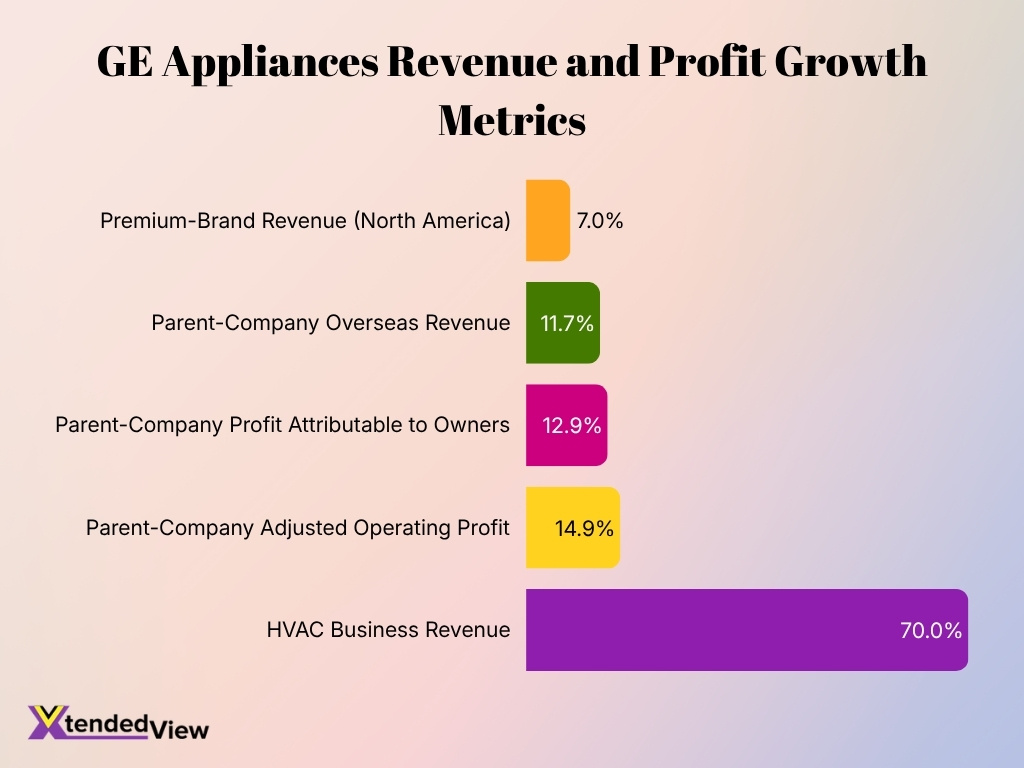
- Premium-brand revenue in North America increased 7% in 2025, according to its parent company’s full-year results.
- GE Appliances announced a $3 billion, five-year U.S. investment plan in August 2025 covering manufacturing, technology development, products, workforce and communities.
- The investment program targets the company’s 11 U.S. manufacturing plants and microfactories, including facilities in Kentucky, Alabama, Georgia, Tennessee and South Carolina.
- The company’s September 2026 Louisville plan adds $1 billion in investment and aims to establish Appliance Park as the largest U.S. home-appliance manufacturing site based on production output, employment and campus footprint.
- The Louisville transformation is intended to help secure 4,700 production jobs at Appliance Park once fully implemented.
- GE Appliances’ 2025 Louisville washer project represents $490 million in investment and is expected to add 800 full-time jobs.
- In 2026, the company said it had put 800+ AI agents to work across manufacturing, logistics and supply chain functions.
- The company’s 2026 side-by-side refrigerator refresh covers 43 new models, while its new smart wall-oven portfolio adds another 39 models across several brands.
- GE Appliances’ 2024 economic impact analysis estimated $3.1 billion in annual generated taxes, adding another measure of its broader U.S. economic footprint.
Recent Developments
- On Sept. 2, 2026, GE Appliances announced a $1 billion transformation of Appliance Park in Louisville, with production changes planned across Buildings 1, 2, and 5.
- More than $400 million of that Louisville program will transform Building 5 into a high-output dryer operation, shifting dryer production from Mexico to Kentucky.
- GE Appliances expects the Building 5 conversion to require roughly nine to 12 months, with new dryer production scheduled to start in late 2027.
- In August 2026, the company disclosed a 67,000-square-foot expansion of its Selmer, Tennessee, manufacturing plant to support premium refrigerators and hospitality air-conditioning products.
- In April 2026, GE Appliances announced that more than 800 AI agents were already operating across manufacturing, logistics, and supply chain activities.
- Also in April 2026, the Decatur, Alabama, refrigeration operation received $28 million for equipment upgrades and a new on-site primary care clinic.
- A new 2026 side-by-side refrigerator portfolio contains 43 models across GE®, CAFÉ™ and GE Profile™ offerings, with rollout occurring throughout the year.
- GE Appliances introduced 39 new smart wall-oven models in February 2026 across Monogram™, GE Profile™, and CAFÉ™.
- The GE Profile™ Opal Mini launched in 2026 with a footprint 30% smaller than the Opal Ultra while producing up to 36 pounds of nugget ice per day.
- In January 2026, GE Appliances started its first in-house refrigerator water-filter manufacturing operation at Appliance Park, using 100% in-line testing alongside automation and machine vision.
GE Appliances Revenue and Financial Statistics
- GE Appliances recorded positive year-over-year sales growth in North America during the first half of 2025, while its premium and mass-premium brands delivered double-digit sales growth.
- For full-year 2025, GE Appliances maintained its leading North American market position, while premium-brand revenue increased 7%.
- Its parent company surpassed RMB300 billion in annual revenue for the first time in 2025, providing context for the global business in which GE Appliances operates.
- In the first half of 2025, the parent company generated RMB156.494 billion in revenue, up 10.2% year over year.
- Overseas revenue grew 11.7% during the first half of 2025, with U.S. white-goods and HVAC operations reported as outperforming their respective industries.
- In 2024, parent-company revenue reached approximately RMB285.97 billion, up 4.3% from RMB274.20 billion in 2023.
- Parent-company profit attributable to owners reached RMB18.741 billion in 2024, an increase of 12.9% from approximately RMB16.597 billion in 2023.
- Adjusted operating profit increased 14.9% to RMB20.437 billion in 2024, compared with RMB17.793 billion in 2023.
- GE Appliances’ HVAC business posted 70% revenue growth in 2024, while its recreational-vehicle appliance business recorded double-digit growth.
- Parent-company operating cash flow totaled RMB26.543 billion in 2024, equivalent to about 1.4 times reported net profit for that year.
GE Appliances Market Share and Industry Rankings
- GE Appliances remained No. 1 in North America for the fourth consecutive year in 2025, according to its parent company’s 2025 results.
- The company’s U.S. No. 1 appliance-company claim is based on retail-unit volume across total major appliances, microwave ovens, and room air conditioners in a Q1-Q4 2024 consumer tracking survey.
- GE Appliances products are installed in more than half of U.S. homes, giving the company a substantial installed base for replacement purchases, service and connected-home expansion.
- GE Appliances operates six major consumer brands in the U.S. portfolio: Monogram™, CAFÉ™, GE Profile™, GE®, Haier™ and Hotpoint™.
- Premium-brand revenue grew 7% in North America in 2025, indicating growth beyond the company’s mass-market appliance base.
- During the first half of 2025, both premium and mass-premium GE Appliances brand sales posted double-digit increases.
- The company’s 2025 Louisville investment was designed to position GE Appliances to become the largest American washer manufacturer as production shifts to Kentucky.
- GE Appliances describes its Decatur facility as the largest refrigeration manufacturing operation in the U.S., with the site continuing to produce millions of refrigerators domestically.
- Its 2026 Monogram dishwasher introduced a Quiet Cycle rated at 37 dBA, which the company identified as the quietest residential dishwasher cycle performance in North America based on products assessed Jan. 1, 2026.
- The wider parent company reported a 14.4% global washing-machine market share in 2025, ranking No. 1 worldwide in that category; this figure covers the global parent business rather than GE Appliances alone.
GE Appliances Ownership and Acquisition History
- In January 2016, General Electric initially agreed to sell its appliance business to Qingdao Haier for $5.4 billion.
- The original agreement valued the business at approximately 10 times trailing 12-month EBITDA, according to the transaction announcement.
- Another transaction disclosure placed the value at approximately 8.2 times estimated 2015 EBITDA after accounting for certain expected benefits.
- GE Appliances’ estimated 2015 EBITDA had risen nearly 50% over two years before the acquisition agreement.
- The transaction formally closed on June 6, 2016, making GE Appliances part of Qingdao Haier.
- The final transaction price reached $5.6 billion, including an approximately $200 million increase from the original price to reflect higher working capital in the business.
- General Electric expected the completed sale to generate an after-tax gain of approximately $0.20 per share.
- After the acquisition, GE Appliances retained its Louisville, Kentucky, headquarters and continued operating under its existing day-to-day management structure.
- The acquisition structure included a board with representatives from senior leadership at both businesses plus two independent directors.
- Since the 2016 acquisition, GE Appliances says its U.S. investment commitments have reached $6.5 billion, illustrating the scale of expansion under its current ownership.
GE Appliances Employment and Workforce Statistics
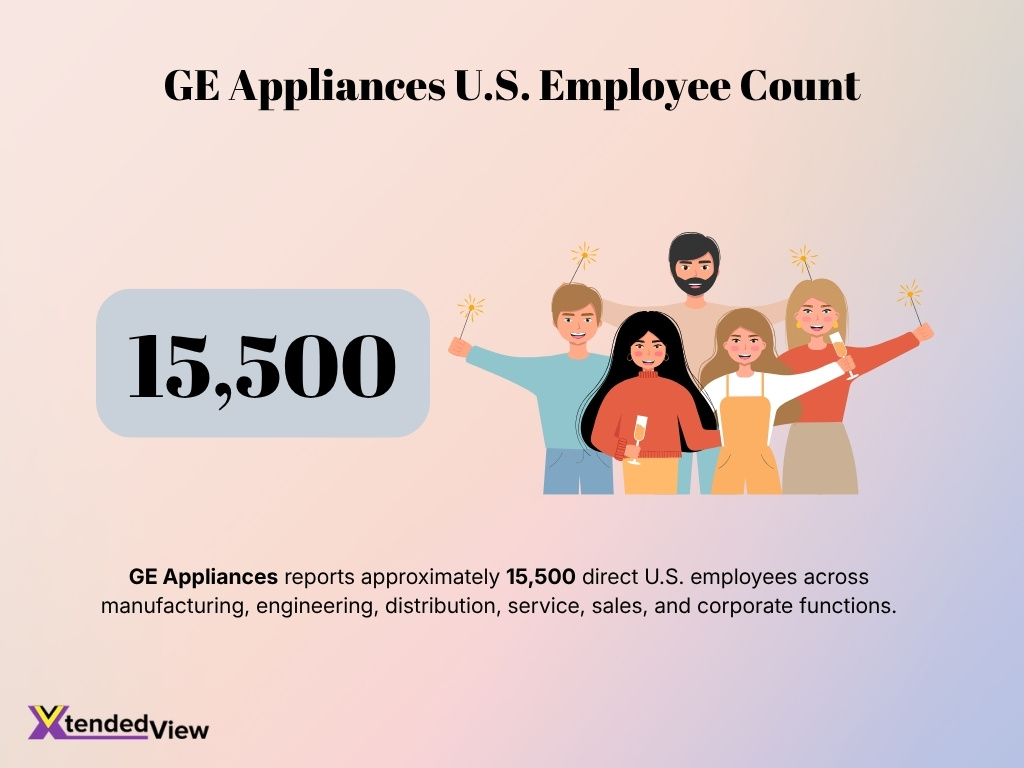
- GE Appliances reports approximately 15,500 direct U.S. employees across manufacturing, engineering, distribution, service, sales, and corporate functions.
- Its operations, employees, and supplier network support another 98,000 U.S. jobs, taking the company’s direct and indirect employment footprint above 113,000 jobs.
- Appliance Park in Louisville has more than 6,500 employees, making it the company’s largest operating location.
- The Louisville operation includes approximately 900 design and manufacturing engineers, illustrating the concentration of technical jobs alongside production roles.
- GE Appliances’ $490 million Louisville washer expansion announced in 2025 is expected to create 800 new full-time jobs.
- Investments made since 2016 have helped the company create more than 4,000 U.S. jobs as its manufacturing footprint expanded.
- GE Appliances directly employs about 2,650 people in Georgia, while its broader activities support another 7,500 jobs in the state.
- The company directly employs approximately 1,600 people in Alabama, where its Decatur facility anchors U.S. refrigeration production.
- GE Appliances’ 2025-2029 manufacturing commitment is expected to create more than 1,000 high-quality jobs nationally as production and sourcing move closer to U.S. customers.
- Workforce programs tied to the five-year investment include four-day workweeks, part-time shifts, transportation assistance, manufacturing apprenticeships, and free on-site primary care for employees and their families at selected operations.
GE Appliances Manufacturing and Production Statistics
- GE Appliances operates 11 manufacturing plants and microfactories in the U.S., with manufacturing concentrated in Kentucky, Georgia, Alabama, Tennessee, and South Carolina.
- Since 2016, the company has invested more than $3.5 billion in its U.S. operations and has committed another $3 billion through its five-year expansion program.
- The September 2026 Appliance Park expansion adds $1 billion to the Louisville manufacturing operation, with production changes planned across Buildings 1, 2 and 5.
- More than $400 million of the Louisville investment will convert Building 5 into a high-output dryer operation and bring dryer production from Mexico to Kentucky.
- GE Appliances’ Decatur, Alabama, operation remains the largest refrigeration manufacturing operation in the U.S. and received another $28 million in factory and employee-health investments in 2026.
- The company’s Selmer, Tennessee, operation started a 67,000-square-foot expansion in 2026 to support premium refrigerator and hospitality air-conditioning production.
- A completed $180 million expansion of the LaFayette, Georgia, cooking-products plant has added more than 600 jobs.
- The Georgia plant operates 15 production lines for cooktops, ranges and wall ovens, with stamping, welding, paint, enamel, graphics and production integrated at the site.
- GE Appliances launched its first in-house refrigerator water-filter manufacturing operation in Louisville in January 2026. The line combines automation and machine vision with 100% in-line testing.
- The company’s 2025 $490 million laundry expansion is bringing production of GE Profile™ UltraFast Combo Washer/Dryers and GE® and GE Profile™ UltraFresh front-load washers to Louisville.
GE Appliances Economic Impact in the United States
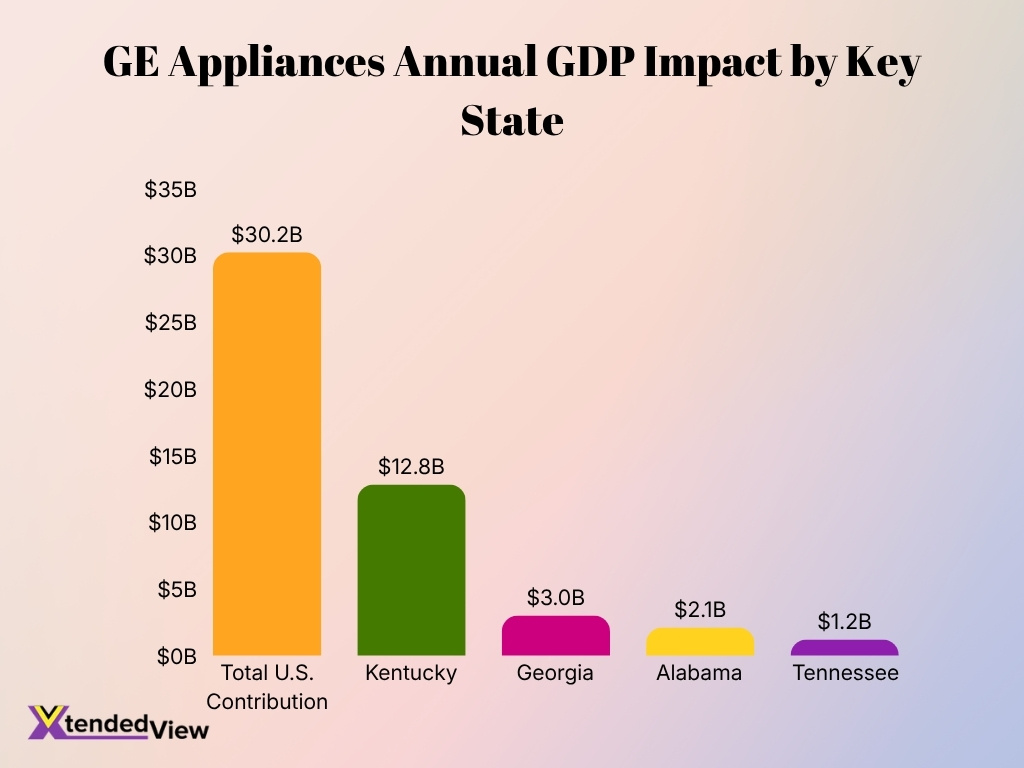
- GE Appliances contributes an estimated $30.2 billion annually to U.S. GDP, according to its latest national economic impact assessment.
- The company’s activities generate an estimated $3.1 billion in taxes annually across federal, state, and local governments.
- Its direct workforce totals 15,500 people, while economic activity associated with GE Appliances supports another 98,000 jobs nationwide.
- Kentucky receives the company’s largest state-level impact, at approximately $12.8 billion in annual GDP and 38,500 supported jobs.
- Georgia receives approximately $3 billion in annual GDP impact, with 10,150 jobs supported through direct employment and wider economic activity.
- Alabama accounts for about $2.1 billion in annual GDP impact and 6,750 supported jobs.
- Tennessee receives approximately $1.2 billion in annual GDP impact, while the company’s activities support 4,290 jobs in the state.
- South Carolina records approximately $389 million in annual GDP impact and 1,699 supported jobs from the company’s presence.
- GE Appliances spends approximately $4.6 billion annually with U.S. suppliers, spreading its manufacturing impact across all 50 states.
- The broader manufacturing multiplier helps explain this impact: every $1 spent in manufacturing adds an estimated $2.64 to the U.S. economy, according to the manufacturing-sector benchmark cited in the company’s economic impact report.
GE Appliances Brand Portfolio and Product Lines
- GE Appliances markets products under six core appliance brands: Monogram™, Café™, GE Profile™, GE®, Haier and Hotpoint.
- Its product portfolio spans at least 12 major categories, including refrigerators, freezers, cooking products, dishwashers, washers, dryers, air conditioners, small appliances, water filtration, water heaters and RV-ready products.
- GE Appliances introduced 39 new smart wall-oven models across Monogram™, GE Profile™, and Café™ in February 2026.
- Its refreshed 2026 side-by-side refrigerator portfolio contains 43 models, broadening the company’s refrigeration offering across multiple consumer segments.
- The 2026 Monogram™ 900 Series dishwasher includes a Quiet Cycle operating at 37 dBA, based on North American residential dishwasher products assessed at the start of 2026.
- GE Profile™ expanded its Opal™ line in July 2026 with the Opal Mini, which has a 30% smaller footprint than the Opal Ultra.
- Despite its smaller size, the 2026 Opal Mini can produce up to 36 pounds of nugget ice per day.
- Opal Mini pricing started at $279-$299, while Mini Pro and Mini Pro+ models launched at $379 and $399, respectively.
- GE Appliances expanded panel-ready dishwasher options across three brands, Monogram™, Café™ and GE Profile™, in 2026 to address demand for appliances integrated into kitchen cabinetry.
- The LaFayette manufacturing operation supports four brands, Monogram™, Café™, GE Profile™, and GE®, across cooktops, ranges, and wall ovens.
GE Appliances Digital Transformation and AI Initiatives
- By April 2026, GE Appliances had deployed more than 800 AI agents across manufacturing, logistics and supply chain operations.
- The 800-agent deployment means the company’s AI program now operates across three core operational areas rather than remaining limited to isolated office-use cases.
- The company says its AI deployment targets three measurable operational outcomes: faster decision-making, better product quality and greater operational efficiency.
- GE Appliances’ Louisville headquarters includes approximately 900 design and manufacturing engineers, providing a large technical workforce for advanced manufacturing and digitally enabled product development.
- The company’s $3 billion 2025-2029 investment plan covers technology development, product innovation and advanced manufacturing, linking digital modernization with its physical factory expansion.
- Its new Louisville water-filter manufacturing line uses 100% in-line testing, machine vision, and advanced automation to improve product quality and traceability.
- The 2026 smart wall-oven expansion includes 39 models with connected controls and adaptive cooking functions, showing how digital technology is moving from factory operations into consumer products.
- One of the company’s 2026 connected refrigerators includes an 8-inch interactive LCD touchscreen, built-in speakers and a microphone, while over-the-air updates allow functionality to evolve after purchase.
- That connected refrigerator can scan grocery or household products and add item details to a digital shopping list in the SmartHQ™ app, linking the physical appliance with a mobile digital ecosystem.
- The company’s FirstBuild development model has previously shortened some product-development cycles from approximately two years to three months, illustrating the faster innovation approach underlying its broader digital transformation.
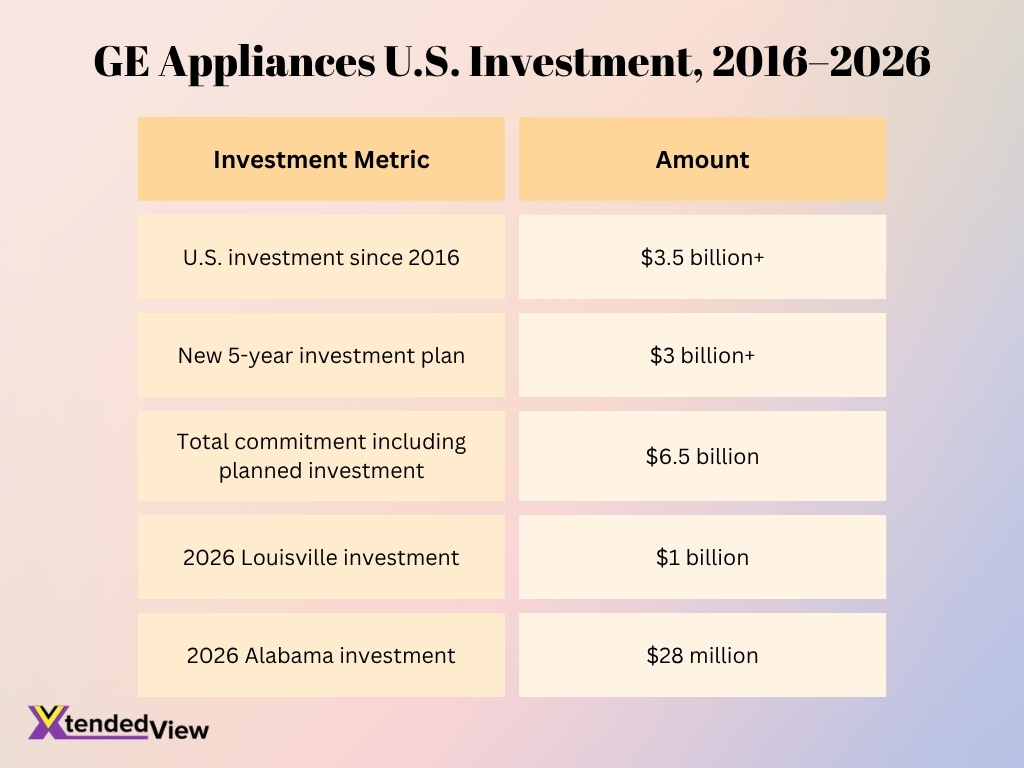
GE Appliances U.S. Investment Statistics
- GE Appliances has invested more than $3.5 billion in the U.S. since 2016, underscoring its long-term commitment to domestic manufacturing and operations.
- The company has announced a new 5-year investment plan exceeding $3 billion, aimed at further expanding its U.S. footprint.
- Including planned investments, GE Appliances’ total U.S. commitment reaches approximately $6.5 billion.
- In 2026, GE Appliances committed $1 billion to its Louisville operations, making it one of the company’s largest recent domestic investments.
- The company also announced a $28 million investment in Alabama in 2026, supporting additional manufacturing and operational capacity.
GE Appliances Smart and Connected Appliance Statistics
- GE Appliances earned the Smart Appliance Company of the Year recognition for the ninth consecutive year in 2026, reflecting its long-running investment in connected-home products.
- The company’s 2026 smart wall-oven launch includes 39 new models across Monogram™, GE Profile™ and Café™, connecting cooking functions with the SmartHQ™ ecosystem.
- Select GE Profile™ smart wall ovens include a 7-inch color LCD touchscreen that provides recipes, video cooking tips, calendars, weather information, and cooking-mode controls.
- Built-in Wi-Fi allows owners of compatible 2026 wall ovens to monitor cooking, adjust temperatures, and receive over-the-air software upgrades through SmartHQ™.
- GE Appliances’ refreshed 2026 side-by-side refrigerator portfolio includes 43 new models, with built-in Wi-Fi available on selected products.
- Connected GE Profile™ side-by-side refrigerators scheduled for October 2026 will offer eight selectable ice sizes through SmartHQ™.
- The GEOSPRING™ Smart Hybrid Heat Pump Water Heater can deliver efficiency of up to 4.7 times that of standard electric models while using SmartHQ™ for scheduling and energy-cost management.
- SmartHQ™ now extends into whole-home water management. Its 2026 leak-detection ecosystem links connected sensors, water heaters and treatment products to monitor water use and respond to leaks.
- The financial case for connected leak detection is significant: the average water-damage insurance claim reached $11,098 as of December 2025, according to the figure cited with the 2026 system launch.
- Connected laundry updates have also targeted resource use. A Pet Hair Remover software feature for the GE Profile™ UltraFast Combo was reported to use 65% less water and 50% less energy than alternative pet-hair removal solutions assessed by the company.
GE Appliances Sustainability and Environmental Statistics
- GE Appliances diverted 84% of manufacturing waste from landfill or incineration in 2023, up from previous-year performance.
- That diversion effort recycled or reused more than 160 million pounds of waste during 2023.
- Its plastics regrind operations processed more than 1 million pounds of plastic scrap in 2023, allowing material to return to appliance production.
- Total production waste amounted to 95,465 metric tons in 2023, of which 80,342 metric tons were diverted from disposal.
- U.S. manufacturing withdrew approximately 264.2 million gallons of water from municipal sources in 2023 for factory operations and product testing.
- Scope 1 greenhouse gas emissions totaled 67,792 metric tons of CO2 equivalent in 2023, while Scope 2 emissions totaled 145,148 metric tons.
- Combined Scope 1 and Scope 2 emissions intensity stood at 0.0238 metric tons of CO2 equivalent per U.S.-made unit in 2023.
- Manufacturing energy intensity had fallen 13.5% from its 2020 level by 2023, putting the company close to its stated 2026 energy-intensity target.
- The company’s refrigerant transition from R-410A to R-32 was estimated to reduce more than 700,000 tons of CO2-equivalent emissions annually.
- In 2025, several GE Appliances factories began piloting a circular landfill-diversion model that recovers packaging materials and defective products through supplier collaboration.
GE Appliances Website Traffic and Digital Presence Statistics
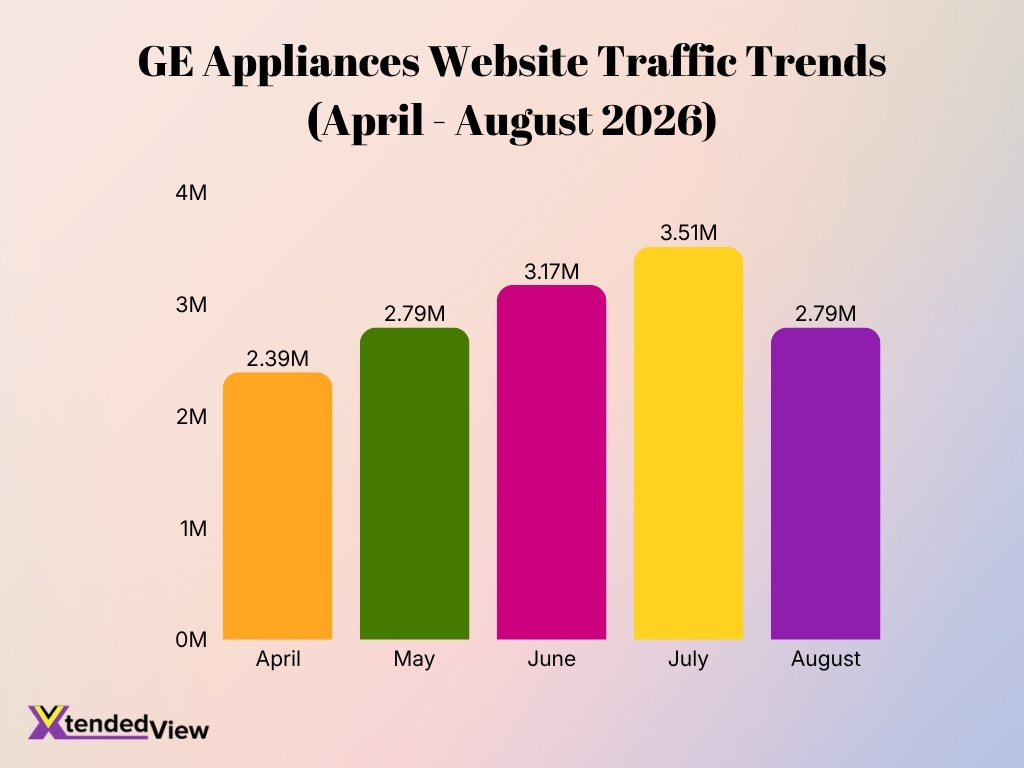
- The consumer website attracted an estimated 3.17 million visits in June 2026, up 13.5% from May.
- Monthly visits increased from approximately 2.39 million in April to 2.79 million in May and 3.17 million in June 2026.
- The site’s estimated worldwide rank stood at No. 16,659 in June 2026, while its U.S. rank was No. 3,924.
- U.S. users accounted for approximately 92.2% of June 2026 visits, equal to about 2.92 million visits for the month.
- Visitors viewed an estimated 3.89 pages per visit in June, while the modeled bounce rate stood at 53.42%.
- Average visit duration reached approximately 6 minutes and 43 seconds in June 2026.
- Organic search generated about 1.58 million visits in June 2026, making search a major customer-acquisition channel.
- By August 2026, monthly traffic stood at approximately 2.79 million visits, following 3.51 million in July.
- The website’s August 2026 estimated Authority Score stood at 62, with approximately 20,400 referring domains and 2.49 million backlinks in the analytics dataset.
- AI platforms were becoming a measurable referral source by August 2026, including approximately 8,000 visits from ChatGPT, 1,000 from Gemini, 644 from Copilot, and 475 from Perplexity in the reported dataset.
GE Appliances Supplier and Supply Chain Statistics
- GE Appliances works with more than 6,500 U.S. suppliers across all 50 states.
- Annual purchasing from U.S. suppliers totals approximately $4.6 billion in parts, components, and services.
- Domestic supplier spending has increased 69% since 2019, according to the company’s economic impact assessment.
- The number of U.S. suppliers increased 58% since 2019, expanding the company’s domestic sourcing network.
- In November 2025, GE Appliances awarded more than $150 million in new supplier contracts across 10 states for steel, resins, castings, parts and other components.
- Kentucky suppliers received more than $40 million of those new contracts, including agreements with four plastics suppliers.
- GE Appliances already spends approximately $318 million annually with 481 Kentucky suppliers, making the state a major part of its domestic supply network.
- Its national logistics network includes 14 area distribution centers, 105 local delivery locations, and two logistics centers, according to its latest economic footprint data.
- Approximately 95% of the steel and aluminum used by the company’s 11 U.S. plants comes from U.S. suppliers.
- About 90% of the resins used by its U.S. manufacturing operations are also purchased domestically, reducing dependence on overseas sourcing for key materials.
GE Appliances Innovation and R&D Statistics
- GE Appliances filed more patent applications in 2024 than in any previous year in its history.
- The company has more than doubled its patent portfolio within five years, indicating faster accumulation of intellectual property.
- More than 1,000 GE Appliances engineers have filed at least one approved patent.
- Its highest-volume patent-filing engineer had accumulated 119 patents as of the 2025 Edison program update.
- GE Appliances employs approximately 1,600 engineers in Louisville, placing a substantial share of its product-development talent close to its largest manufacturing campus.
- Its Edison Engineering Development Program celebrated 50 years in 2025, having operated since 1975 as a three-year engineering development and graduate-education program.
- More than 100 engineers participate in the Edison program each year, while more than 220 annual engineering co-op positions help supply its talent pipeline.
- The Edison program has recorded an approximately 80% graduate retention rate since 2018, indicating that most graduates remain with the business after completing the program.
- Since 2019, Edison participants have come from 57 engineering schools, with one-third drawn from Kentucky universities and two-thirds from institutions elsewhere in the U.S.
- Individual inventors also demonstrate the depth of the patent portfolio: one featured cooking-products engineer holds 70 patents, while other highlighted engineers hold seven, 43, and more than 10 patents, respectively.
GE Appliances Future Growth Projections and Targets
- GE Appliances plans to invest more than $3 billion over five years in U.S. operations, employees and communities under the program announced in August 2025.
- Completion of that program would bring cumulative U.S. manufacturing and distribution investment since 2016 to approximately $6.5 billion.
- The five-year expansion is expected to create more than 1,000 additional U.S. jobs, on top of more than 4,000 jobs added since 2016.
- Investment will modernize 11 U.S. manufacturing plants and microfactories with automation, new equipment and increased production capacity.
- The plan calls for higher production across all product lines, alongside expansion of the company’s air-conditioning and water-heating portfolio.
- A separate Air & Water Solutions plan calls for $98.5 million of investment over five years to expand U.S. manufacturing, infrastructure and innovation.
- The Air & Water Solutions professional network already includes more than 2,000 dealers, providing an installed channel for future HVAC and water-product growth.
- GE Appliances’ $490 million Louisville laundry project is expected to add 800 full-time jobs while increasing domestic washer and combo washer-dryer production.
- The 2026 Appliance Park dryer expansion allocates more than $400 million toward bringing additional production from Mexico to Kentucky, with production expected to begin in late 2027.
- Supplier expansion will accompany manufacturing growth: the first wave alone produced more than $150 million in new U.S. contracts, indicating that the five-year investment will affect businesses outside GE Appliances’ own factories.
Frequently Asked Questions (FAQs)
GE Appliances has committed $6.5 billion to U.S. operations since 2016, including a five-year $3 billion expansion plan announced in 2025.
GE Appliances has approximately 15,500 direct U.S. employees, while its wider economic activity supports another 98,000 jobs nationwide.
GE Appliances contributes approximately $30.2 billion annually to U.S. GDP and spends about $4.6 billion per year with U.S. suppliers.
GE Appliances held the No. 1 market position in North America for the fourth consecutive year in 2025, while its premium-brand revenue increased 7%.
By April 2026, GE Appliances had deployed more than 800 AI agents across manufacturing, logistics, and supply chain operations.
Conclusion
GE Appliances statistics show a company combining large-scale U.S. manufacturing with expanding investments in automation, connected appliances, artificial intelligence, and domestic sourcing. Its operations include 11 U.S. manufacturing plants and microfactories, while its supply chain reaches more than 6,500 U.S. suppliers across all 50 states. The company’s broader logistics infrastructure, engineering workforce and multibillion-dollar manufacturing commitments further demonstrate the scale of its U.S. presence.
The company’s growth strategy also extends beyond factory capacity. Investments in smart appliances, SmartHQ™, AI-enabled operations, engineering programs and product development are connecting traditional appliance manufacturing with digital technology. Meanwhile, planned spending of more than $3 billion over five years is expected to expand production, strengthen domestic sourcing and create more than 1,000 additional U.S. jobs. With cumulative U.S. manufacturing and distribution investment since 2016 expected to reach approximately $6.5 billion, GE Appliances enters the second half of the decade with domestic production, supply chain expansion, and technology-led innovation at the center of its growth strategy.
