


The appliances industry continues to evolve as consumers prioritize convenience, connectivity, and energy savings in their homes. From smart refrigerators that integrate with mobile apps to high-efficiency washing machines that reduce utility costs, appliances now play a central role in everyday life. Businesses, retailers, manufacturers, and policymakers also rely on appliance market data to guide product development, inventory planning, and sustainability initiatives. The statistics in this report highlight the latest market trends, growth forecasts, and regional developments shaping the global appliances industry.
Editor’s Choice
- The global household appliances market is projected to generate approximately $734.8 billion in revenue in 2026.
- The worldwide home appliances market is expected to reach $826.7 billion in 2026, up from $755.7 billion in 2025.
- North America accounted for 32.6% of the global home appliance market share in 2025, maintaining its position as one of the largest regional markets.
- The smart appliances market is forecast to grow from $42.35 billion in 2025 to $71.28 billion by 2030.
- Large appliances are expected to represent approximately 62% of global appliance sales in 2025.
- E-commerce channels are projected to account for 36% of appliance distribution revenue in 2025.
- India’s household appliances market generated roughly $23.7 billion in revenue during 2025 and continues to expand rapidly.
Recent Developments
- The global home appliance market value increased from $755.72 billion in 2025 to an estimated $826.66 billion in 2026.
- Smart appliance installations expanded by 42% worldwide during 2025, reflecting rising adoption of connected devices.
- Energy-efficient appliance preference reached 63% among urban consumers in 2025.
- More than 58% of millennials preferred appliances integrated with mobile applications and voice assistants in 2025.
- Connected home integration influenced 48% of appliance purchasing decisions across urban households in 2026.
- Smart appliance penetration surpassed 30% globally in 2026, signaling continued digital transformation.
- The smart home appliances market is expected to expand by $98.02 billion between 2025 and 2030.
- Air conditioners are expected to hold the largest share of the smart appliance category during 2025.
- Online sales channels are projected to record the fastest growth rate among appliance distribution channels through 2030.
Global Household Appliances Statistics and Market Size
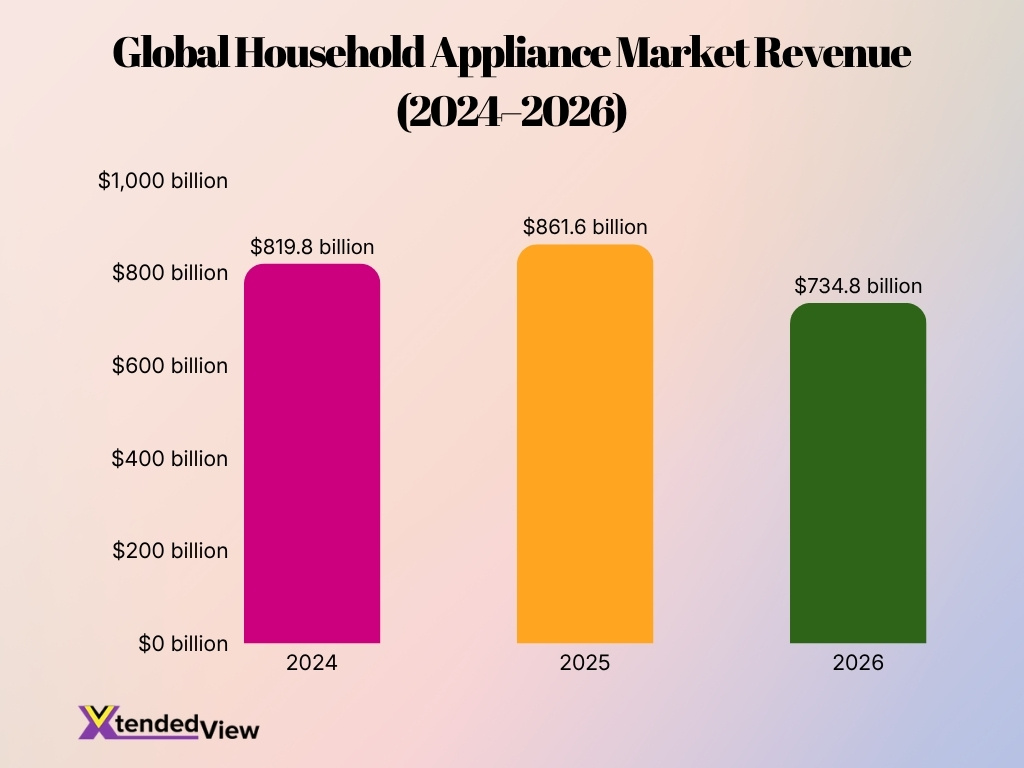
- Global household appliance revenue is forecast to reach $734.8 billion in 2026.
- The global household appliances market was valued at approximately $819.8 billion in 2024.
- Market value increased to $861.6 billion in 2025.
- Another industry estimate places the global household appliances market at $802.7 billion in 2025.
- The market is expected to surpass $1.22 trillion by 2035 under current growth projections.
- Forecasts indicate a long-term CAGR ranging between 5.1% and 6.8% through the next decade.
- The electric household appliances segment generated $613.7 billion in 2025.
- The household appliance market is expected to add $124.1 billion in incremental value between 2024 and 2029.
- Annual growth for the worldwide household appliance sector is projected at 4.66% from 2026 onward.
- Large appliances continue to generate the majority of industry revenue, accounting for roughly 62% of product sales.
Projected Growth and Future Appliances Statistics
- The home appliances market is projected to reach $1.39 trillion by 2034.
- Global household appliance revenue could exceed $1.56 trillion by 2035.
- The smart appliances market is forecast to grow at an 11.0% CAGR between 2025 and 2030.
- The smart home appliances sector is expected to achieve 11.5% CAGR through 2034.
- Household appliance market revenue is projected to rise from $745.4 billion in 2026 to $1.22 trillion in 2035.
- Kitchen appliances revenue is forecast to increase from $186.9 billion in 2026 to $295.5 billion by 2035.
- Smart appliance market value is expected to reach $71.3 billion by 2030.
- The smart home appliance industry could grow to $298.7 billion by 2034.
- Asia-Pacific is expected to record the fastest smart appliance growth rate through 2030.
- India is forecast to be among the fastest-growing appliance markets globally through the end of the decade.
Regional Market Share and Demographics Appliances Statistics
- North America held 32.58% of the global home appliance market in 2025.
- Asia-Pacific generated approximately 36.7% of smart home appliance revenue in 2025, the largest regional share.
- Asia-Pacific produced around $41.2 billion in smart appliance revenue during 2025.
- The U.S. kitchen appliances market reached $28.4 billion in 2025.
- Residential buyers represented 74.5% of kitchen appliance demand in 2025.
- Residential households accounted for 74.5% of global smart appliance revenue in 2025.
- India’s appliance market is projected to grow at 8.3% CAGR between 2026 and 2033, outpacing many mature markets.
- The Middle East and Africa are expected to be among the fastest-growing regions for kitchen appliances through 2035.
- China, India, Japan, and South Korea remain key drivers of appliance demand growth across Asia-Pacific.
- Urbanization and rising disposable income continue to be the leading demographic drivers of appliance adoption worldwide.
U.S. Household Appliances Industry Revenue Growth Statistics
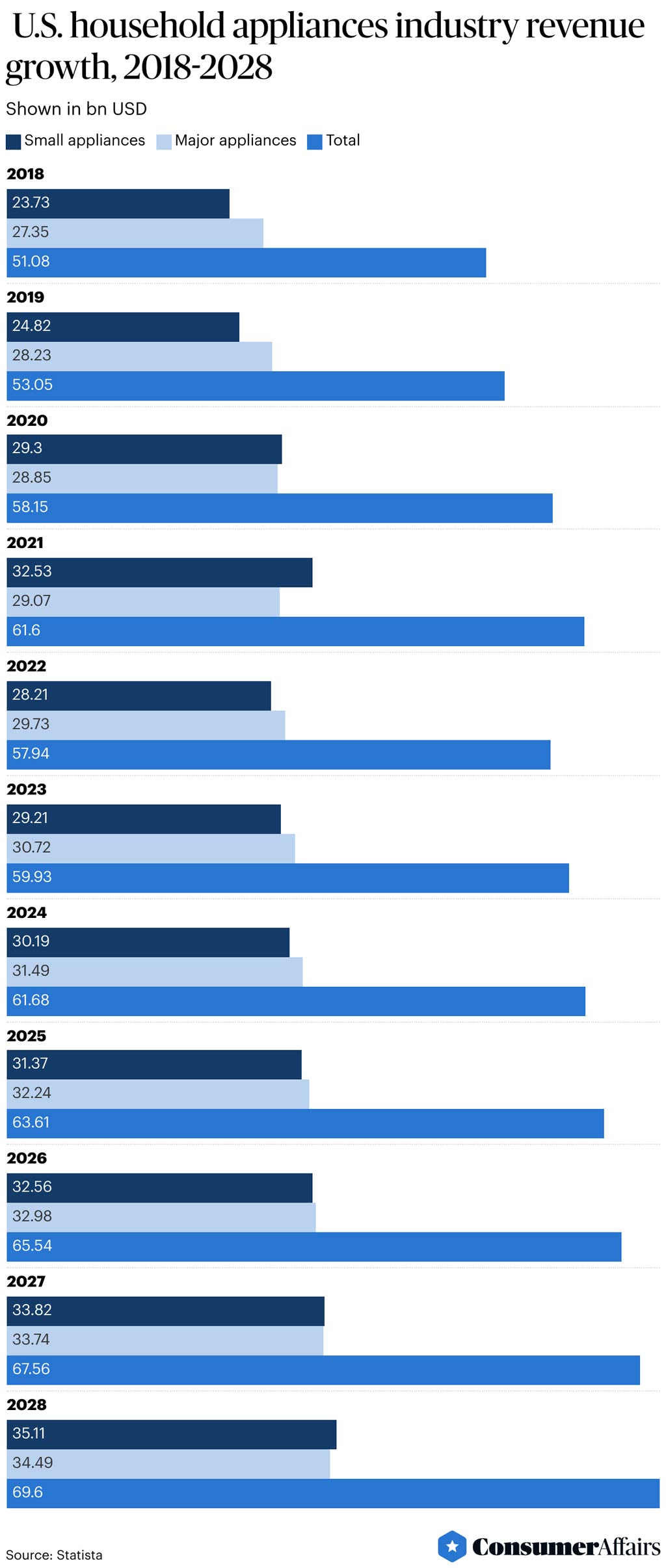
- The total U.S. household appliances market revenue increased from $51.08 billion in 2018 to a projected $69.60 billion in 2028, representing an overall growth of 36.3% over the decade.
- Revenue climbed steadily from $51.08 billion in 2018 to $61.60 billion in 2021, highlighting strong consumer demand for home appliances during the period.
- The industry experienced a temporary decline in 2022, with total revenue falling to $57.94 billion, down from $61.60 billion in 2021.
- Following the 2022 slowdown, total market revenue rebounded to $59.93 billion in 2023 and is expected to reach $69.60 billion by 2028.
- The small appliances segment grew from $23.73 billion in 2018 to $35.11 billion in 2028, adding more than $11.3 billion in revenue over the period.
- The major appliances segment increased from $27.35 billion in 2018 to $34.49 billion in 2028, reflecting sustained long-term market expansion.
- In 2028, small appliances revenue ($35.11 billion) is projected to slightly exceed major appliances revenue ($34.49 billion), making it the largest segment.
- The revenue gap between small and major appliances narrowed significantly, with small appliances overtaking major appliances beginning in the latter years of the forecast period.
- Total industry revenue is forecast to rise from $61.68 billion in 2024 to $69.60 billion in 2028, an increase of approximately $7.92 billion in just four years.
- The market is expected to maintain annual growth throughout 2024–2028, with total revenue increasing from $63.61 billion in 2025 to $67.56 billion in 2027 before reaching $69.60 billion in 2028.
- By 2028, small appliances are expected to account for approximately 50.4% of total industry revenue, while major appliances contribute about 49.6%.
- The data indicates a long-term shift toward stronger consumer spending on small household appliances, driven by convenience, smart home integration, and lifestyle-focused purchases.
Kitchen and Cooking Appliances Statistics
- The global kitchen appliances market reached approximately $248 billion in 2025.
- Kitchen appliance revenue is projected to surpass $295 billion by 2035.
- Residential users accounted for 74.5% of kitchen appliance purchases in 2025.
- Smart ovens and connected cooking appliances are forecast to grow at a CAGR of more than 12% through 2030.
- Air fryer ownership in North America exceeded 40% of households in 2025.
- Coffee maker sales represented nearly 18% of small kitchen appliance revenue worldwide in 2025.
- Induction cooktop demand increased by approximately 13% year over year in 2025, fueled by energy-efficiency regulations.
- Built-in kitchen appliances generated more than $80 billion in global sales during 2025.
- Online purchases accounted for nearly 35% of kitchen appliance sales in 2025, reflecting continued digital shopping adoption.
- Premium kitchen appliances featuring Wi-Fi connectivity recorded sales growth above 14% during 2025.
Laundry and Cleaning Appliances Statistics
- The global washing machine market exceeded $67 billion in 2025.
- Front-load washing machines represented approximately 58% of worldwide washing machine revenue in 2025.
- Smart washing machines are projected to grow at a CAGR of more than 10% through 2030.
- The robotic vacuum cleaner market surpassed $10 billion globally in 2025.
- Robotic vacuum shipments increased by roughly 18% year over year in 2025.
- Energy-efficient washing machines reduced average household water consumption by up to 40% compared with older models.
- More than 70% of new washing machines sold in the U.S. carried high-efficiency certifications during 2025.
- Global dryer market revenue exceeded $18 billion in 2025.
- Commercial laundry equipment demand expanded by approximately 8% in 2025, supported by the hospitality and healthcare industries.
- Consumers replacing laundry appliances cited energy savings as the leading purchase factor in over 55% of cases.
Home Appliances Market Share by Product Category
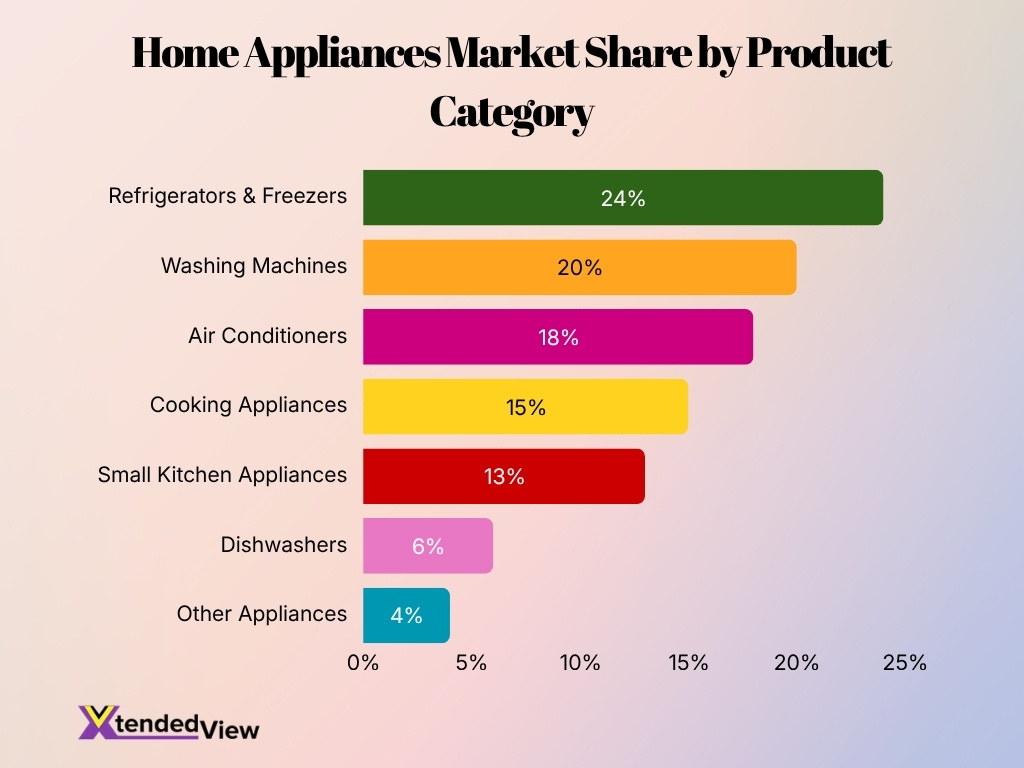
- Refrigerators & Freezers hold the largest market share at 24%, making them the most dominant category in the home appliances industry.
- Washing Machines account for 20% of the market, reflecting strong consumer demand for laundry solutions and household convenience.
- Air Conditioners represent 18% of the total market share, highlighting the growing importance of cooling appliances, especially in warmer regions.
- Cooking Appliances contribute 15% of the market, demonstrating consistent demand for products such as ovens, cooktops, and microwaves.
- Small Kitchen Appliances make up 13% of the market, driven by the popularity of compact and multifunctional devices.
- Dishwashers hold a 6% share, indicating a smaller but steadily expanding segment as consumers increasingly seek time-saving appliances.
- The Other Appliances category accounts for just 4%, making it the smallest segment in the market.
- The top three categories, Refrigerators & Freezers (24%), Washing Machines (20%), and Air Conditioners (18%), collectively represent 62% of the total home appliances market.
- Major household appliances dominate consumer spending, with large appliances accounting for 77% of the market when combining refrigerators, washing machines, air conditioners, and cooking appliances.
- The market distribution suggests that consumers prioritize essential household appliances, while niche and specialty products occupy a relatively small share of overall sales.
Retail Sales and E-commerce Appliances Statistics
- E-commerce channels accounted for approximately 36% of appliance sales revenue in 2025.
- Online appliance sales grew by roughly 11% year over year during 2025.
- More than 60% of appliance buyers used digital channels during their purchase journey.
- Mobile commerce represented nearly 45% of online appliance transactions in 2025.
- Direct-to-consumer appliance sales increased by approximately 14% in 2025.
- Large-format retail chains continued to account for over 40% of offline appliance sales worldwide.
- Buy-online-pickup-in-store services influenced nearly 30% of appliance purchases in North America during 2025.
- Online marketplaces generated more than one-third of global appliance e-commerce revenue in 2025.
- Appliance retailers investing in AI-driven recommendations reported conversion improvements of up to 20%.
- Global appliance retail revenue exceeded $800 billion in 2025, combining online and offline channels.
Energy Efficiency and Sustainability Appliances Statistics
- Energy-efficient appliances can reduce household energy consumption by 10% to 50%, depending on the appliance category and replacement cycle.
- Appliances certified under recognized efficiency programs helped U.S. households save approximately $40 billion in annual energy costs in recent years.
- More than 70% of new major appliances sold in the U.S. during 2025 carried high-efficiency certifications.
- High-efficiency washing machines use up to 25% less energy and 33% less water than conventional models.
- Heat pump dryers consume roughly 50% less electricity than standard electric dryers.
- Consumer surveys in 2025 found that 63% of buyers considered energy efficiency a key appliance purchasing factor.
- Smart energy-management features are expected to be included in more than 45% of premium appliances by 2027.
- Appliance manufacturers continue increasing recycled material usage, with some leading brands targeting 30% to 50% recycled content across product lines by 2030.
- The global market for energy-efficient appliances is forecast to grow at more than 8% CAGR through the end of the decade.
- Residential appliance efficiency improvements are expected to avoid millions of metric tons of carbon emissions annually through 2030.
Consumer Purchase Drivers for Home Appliances Statistics
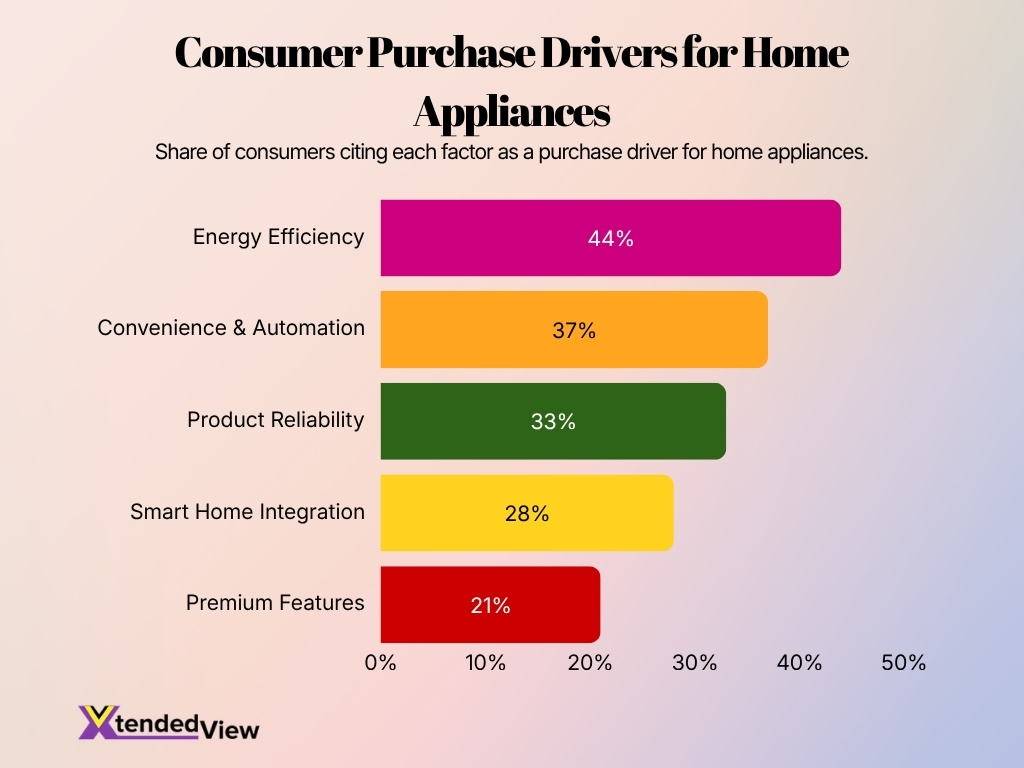
- Energy Efficiency is the leading purchase driver, with 44% of consumers prioritizing appliances that reduce electricity consumption and lower utility bills.
- More than one-third of buyers (37%) consider Convenience & Automation important, reflecting growing demand for time-saving and user-friendly appliances.
- Product Reliability influences 33% of purchasing decisions, showing that durability and long-term performance remain critical factors for consumers.
- Nearly 3 in 10 consumers (28%) are motivated by Smart Home Integration, highlighting the increasing adoption of connected and IoT-enabled appliances.
- Premium Features attract 21% of buyers, indicating that advanced functionalities and enhanced user experiences can influence purchasing behavior.
- The gap between Energy Efficiency (44%) and Premium Features (21%) is 23 percentage points, suggesting that practical benefits outweigh luxury enhancements for most consumers.
- Combined, Energy Efficiency, Convenience & Automation, and Product Reliability account for the top three purchase considerations, each receiving support from at least one-third of consumers.
- Demand for smart and automated appliances is evident, with 65% of consumers prioritizing either Convenience & Automation (37%) or Smart Home Integration (28%).
- The data indicates that consumers increasingly value appliances that offer a balance of cost savings, reliability, and technological convenience.
- Manufacturers focusing on energy-saving technologies, automation capabilities, and dependable performance are likely to align more closely with current consumer preferences.
Manufacturing, Import, and Export Appliances Statistics
- China remained the world’s largest appliance manufacturing hub in 2025, accounting for more than 35% of global production output.
- Global appliance manufacturing value exceeded $800 billion in 2025.
- The United States imported more than $35 billion worth of household appliances and related equipment during 2025.
- Mexico remained one of North America’s largest appliance export centers, supplying refrigerators, cooking appliances, and laundry equipment to the U.S. market.
- Southeast Asia continued attracting appliance manufacturing investment, with production capacity expanding by approximately 9% in 2025.
- Smart appliance manufacturing output grew faster than conventional appliances, increasing by roughly 12% year over year during 2025.
- Global supply-chain normalization reduced appliance lead times by nearly 20% compared with 2022 levels.
- Appliance exports from India recorded steady growth, supported by production-linked incentive programs and domestic manufacturing expansion.
- Refrigerators, washing machines, and air conditioners remained the most traded appliance categories globally in 2025.
- Automated manufacturing technologies are now used in over 60% of large appliance production facilities worldwide.
Top Brand Market Share and Industry Appliances Statistics
- Whirlpool’s North American portfolio underwent a double-digit price increase in 2025 to sustain its market position against inflation.
- Haier led the global major appliance market by volume for 17 consecutive years, achieving $59.8 billion in global revenue in 2025.
- LG advanced its smart appliances footprint by launching an AI-powered series targeted for export to 22 international markets in 2025.
- Samsung expanded its premium appliance segment through a EUR 1.5 billion strategic acquisition to scale its smart HVAC portfolio.
- The global home appliances market reached a massive valuation of $755.72 billion in 2025, with the top five brands driving the majority of revenue.
- Innovation-led premium appliances, such as AI-powered vacuum cleaners, achieved a steady 3% value growth globally during 2025.
- The smart home appliance sector hit an impressive $135 billion valuation in 2025 due to heavy multi-billion-dollar investments in AI integration.
- The global major appliances industry successfully sold over 570 million units in 2025, largely driven by demand for connected ecosystems.
- Industry consolidation accelerated in 2025 when major manufacturers like Electrolux and Midea formed strategic North American joint ventures.
- North America dominated the premium global home appliances market by securing a leading 32.58% market share throughout 2025.
Lifespan, Repair, and Replacement Appliances Statistics
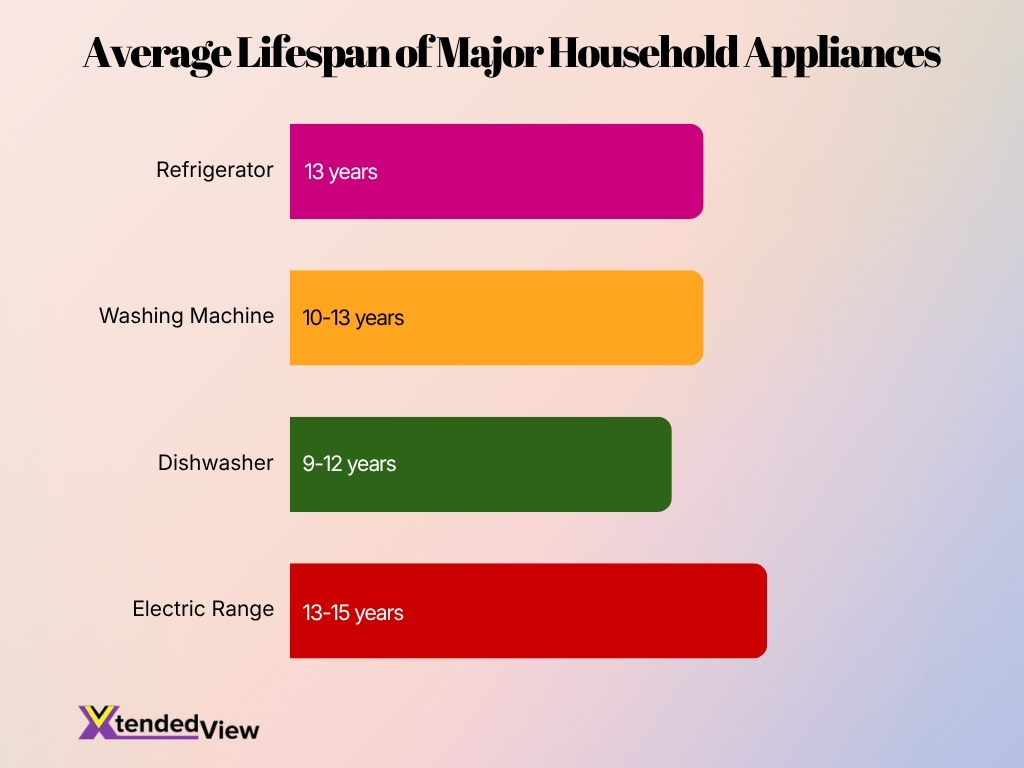
- Refrigerators have an average lifespan of approximately 13 years.
- Washing machines typically last between 10 and 13 years under normal household usage.
- Dishwashers generally remain operational for about 9 to 12 years before replacement.
- Electric ranges often last around 13 to 15 years, among the longest-lasting household appliances.
- More than 70% of major appliance purchases in developed economies are replacement purchases rather than first-time purchases.
- Repair costs exceeding 50% of replacement value frequently trigger consumer replacement decisions.
- Consumers increasingly prioritize energy savings when replacing older appliances, particularly refrigerators and washing machines.
- Smart diagnostic systems can reduce appliance troubleshooting time by up to 30%.
- Extended warranty adoption increased during 2025, especially for premium appliances priced above $1,000.
- The right-to-repair movement continues influencing appliance design and serviceability across North America and Europe.
Appliance Revenue Statistics
- Global household appliance revenue is expected to reach approximately $734.8 billion in 2026.
- The broader home appliance market is projected to generate around $826.7 billion in 2026.
- Revenue from large household appliances accounted for roughly 62% of industry sales in 2025.
- Kitchen appliances represented one of the largest revenue-generating categories, exceeding $248 billion in 2025.
- Smart appliance revenue reached approximately $42.35 billion in 2025.
- The smart appliance segment is forecast to surpass $71.28 billion by 2030.
- North America generated more than 32% of global appliance revenue during 2025.
- Asia-Pacific remained the fastest-growing regional revenue contributor in the appliance industry.
- E-commerce appliance sales contributed more than one-third of industry revenue in 2025.
- Industry forecasts suggest appliance revenue could exceed $1.2 trillion by 2035.
Connected Appliances Statistics
- More than 30% of global households are expected to own at least one connected appliance in 2026.
- The connected appliance market is projected to grow at approximately 11% CAGR through 2030.
- Wi-Fi-enabled devices accounted for nearly 60% of smart appliance shipments in 2025.
- Smart refrigerators represented around 21% of connected appliance sales during 2025.
- Connected air conditioners remained the largest smart appliance category worldwide in 2025.
- More than 45% of smart appliance buyers considered voice assistant compatibility a key feature.
- AI-powered appliance features increased consumer engagement and energy optimization across connected homes.
- Predictive maintenance capabilities can reduce service interruptions by up to 30%.
- Connected appliances increasingly integrate with broader smart-home ecosystems, including lighting, security, and energy management platforms.
- The connected appliance user base is expected to grow substantially as 5G and home automation adoption expand globally.
India Home Appliances Market Regional Share Statistics
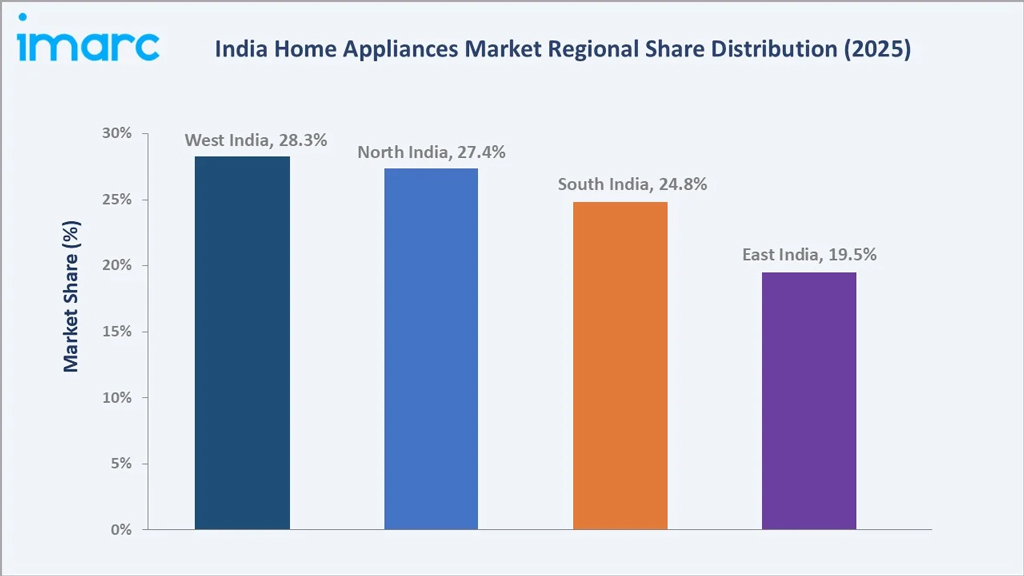
- West India leads the Indian home appliances market with a 28.3% market share, making it the largest regional contributor in 2025.
- North India follows closely with 27.4%, trailing West India by just 0.9 percentage points.
- South India accounts for 24.8% of the market, representing nearly one-quarter of total home appliance sales nationwide.
- East India holds a 19.5% share, making it the smallest regional market among the four major regions.
- The combined market share of West India and North India reaches 55.7%, meaning these two regions generate more than half of India’s home appliances demand.
- South India and East India together contribute 44.3% of the total market, highlighting their significant role in industry growth.
- The gap between the largest region (West India, 28.3%) and the smallest region (East India, 19.5%) is 8.8 percentage points.
- All four regions maintain a market share above 19%, indicating a relatively balanced distribution of home appliance demand across India.
- The top three regions, West India (28.3%), North India (27.4%), and South India (24.8%), collectively account for 80.5% of the Indian home appliances market.
- Strong urbanization, rising disposable incomes, and growing consumer demand continue to support the dominance of West, North, and South India in the home appliances sector.
India Appliances Market Statistics
- India’s household appliances market generated approximately $23.7 billion in revenue during 2025.
- The market is officially projected to grow at a CAGR of 8.3% between 2026 and 2033.
- Major appliances remained the dominant segment by accounting for 63% of the total market share in 2024.
- Refrigerators led all product categories by capturing a 29.9% share of the overall market size in 2025.
- Air conditioner sales have surged and are projected to expand at a rapid 17.5% CAGR by 2031.
- E-commerce platforms contributed a significant 32.5% revenue share to overall appliance sales in 2025.
- Smart appliance adoption continues accelerating and is expected to grow at a robust 13.5% CAGR going forward.
- West India represented the largest regional customer segment by commanding a 28.3% market share in 2025.
Frequently Asked Questions (FAQs)
The global household appliances market is projected to generate $734.8 billion in revenue in 2026.
The global home appliances market is forecast to grow at a 6.68% CAGR from 2026 to 2034.
The global smart appliances market is valued at approximately $42.35 billion in 2025.
North America accounted for 32.58% of the global home appliances market in 2025.
India’s household appliances market generated approximately $23.7 billion in revenue in 2025 and is expected to grow at an 8.3% CAGR through 2033.
Conclusion
The appliance industry entered the year with strong momentum driven by smart technology, energy efficiency, and rising consumer demand across both developed and emerging markets. Large appliances continue to generate the majority of industry revenue, while connected devices, smart kitchens, and automated cleaning products deliver some of the fastest growth rates. North America remains a major revenue contributor, but Asia-Pacific and India are expanding at a faster pace and reshaping future market opportunities.
Looking ahead, manufacturers that focus on sustainability, connectivity, and premium user experiences will likely capture the greatest share of industry growth through 2030 and beyond.