

Smart homes have moved beyond convenience and now play a growing role in home security, energy management, healthcare monitoring, and aging-in-place solutions. AI-powered automation, connected appliances, and interoperable standards continue to reshape how households manage everyday tasks while helping reduce energy consumption and improve safety. As adoption accelerates across the US and worldwide, the latest statistics reveal where the market is growing, which devices consumers prefer, and what trends will define the connected home. Explore the data below to understand how smart home technology continues to evolve.
Editor’s Choice
- The global smart home market is projected to generate $159.5 billion in revenue in 2026, with the United States contributing approximately $20.1 billion, making it the world’s largest national market.
- Global household penetration is expected to reach 82.1% in 2026, reflecting continued expansion of connected home technologies.
- The global smart home market was valued at $162.8 billion in 2025 and is forecast to reach $207 billion in 2026.
- Security and access control represented more than 31% of total smart home revenue in 2025, making it the largest product category.
- Asia Pacific accounted for 38.2% of global smart home revenue in 2025, while the US remained the single largest country market.
- AI-powered automation continues to drive new product launches, with recent devices emphasizing AI detection, intelligent summaries, and advanced voice control.
- Industry forecasts consistently estimate the smart home market will exceed $200 billion during 2026, despite differences in research methodologies.
Recent Developments
- During 2026, manufacturers expanded AI-powered cameras featuring automatic object recognition, event summaries, and improved low-light performance.
- New smart home products increasingly support Matter, enabling devices from different brands to communicate through a common standard.
- The Connectivity Standards Alliance now supports more than 1,200 certified Matter products, demonstrating continued ecosystem growth.
- Matter Version 1.6 introduced Joint Fabric capabilities that improve multi-platform device management across ecosystems.
- Smart home vendors increasingly bundle AI-powered security features such as facial recognition, package detection, and intelligent alerts into cameras and doorbells.
- AI is shifting from premium products to mainstream household devices, including refrigerators, washing machines, coffee makers, and robot vacuums.
- Hardware makers continue expanding Thread-enabled devices to improve reliability, lower latency, and reduce energy consumption within connected homes.
- Product launches in 2026 placed greater emphasis on 4K cameras, AI-enhanced lighting, and smart control panels, reflecting growing consumer demand for integrated home ecosystems.
Smart Home Market Size Insights
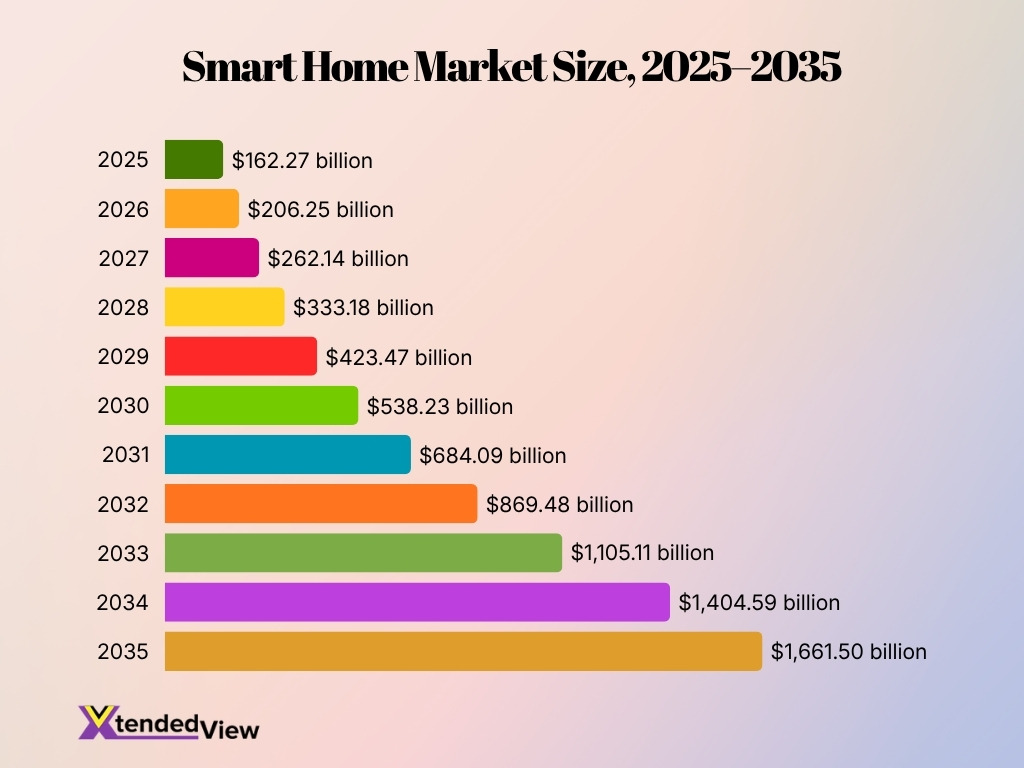
- The global smart home market is projected to grow from $162.27 billion in 2025 to $1,661.50 billion by 2035, representing more than a 10-fold increase over the forecast period.
- The market is expected to surpass $200 billion in 2026, reaching $206.25 billion, highlighting the early acceleration in smart home adoption.
- By 2028, the industry is forecast to exceed $333.18 billion, reflecting sustained growth in connected home technologies.
- The market is projected to cross the $500 billion milestone in 2030, with a value of $538.23 billion.
- In 2031, the global smart home market is expected to reach $684.09 billion, approaching the $700 billion mark.
- The industry is forecast to exceed $869.48 billion in 2032, placing it on the verge of becoming a $1 trillion market.
- The smart home market is expected to surpass the $1 trillion milestone in 2033, reaching $1,105.11 billion.
- By 2034, market value is projected to climb to $1,404.59 billion, demonstrating strong year-over-year expansion.
- The forecast indicates the market will reach an estimated $1.66 trillion by 2035, making it one of the fastest-growing segments within the consumer technology industry.
Smart Home Adoption and Ownership Rates
- Global household penetration is forecast to reach 82.1% during 2026.
- The United States remains the largest single smart home market by revenue, reflecting high household adoption and spending.
- Consumer demand continues shifting from individual connected devices toward fully integrated smart home ecosystems.
- Smartphone ownership remains one of the strongest drivers of connected home adoption because most devices rely on mobile applications for setup and management.
- Homeowners continue adopting smart devices primarily for security, convenience, and lower energy costs.
- AI-powered assistants increasingly simplify home automation by allowing natural language control across multiple connected devices.
- Interoperability improvements through Matter are reducing compatibility concerns that previously slowed adoption.
- Retrofit installations continue to represent the largest application segment, showing that existing homes account for most new smart home deployments.
Smart Home Security Statistics
- The global smart home security market is projected to reach $104.6 billion by 2033.
- Security hardwareaccounted for 55.3% of the total global market revenue in 2025.
- Smart camerasare estimated to command 38% of the industry’s total revenue share in 2025.
- North Americadominated the global market with a massive 36.6% revenue share in 2025.
- The industry is expected to grow at an 11.4% compound annual growth rate from 2026 to 2033.
- Wi-Fi connectivityremains the foundational infrastructure, retaining a 53% market share in 2025.
- Security adoption in condominiums and apartments is growing at a rapid 12.3% annual rate.
- ZigBee technologyfor connected home systems is poised for strong growth with a 10% CAGR.
Smart Home Device Adoption Statistics
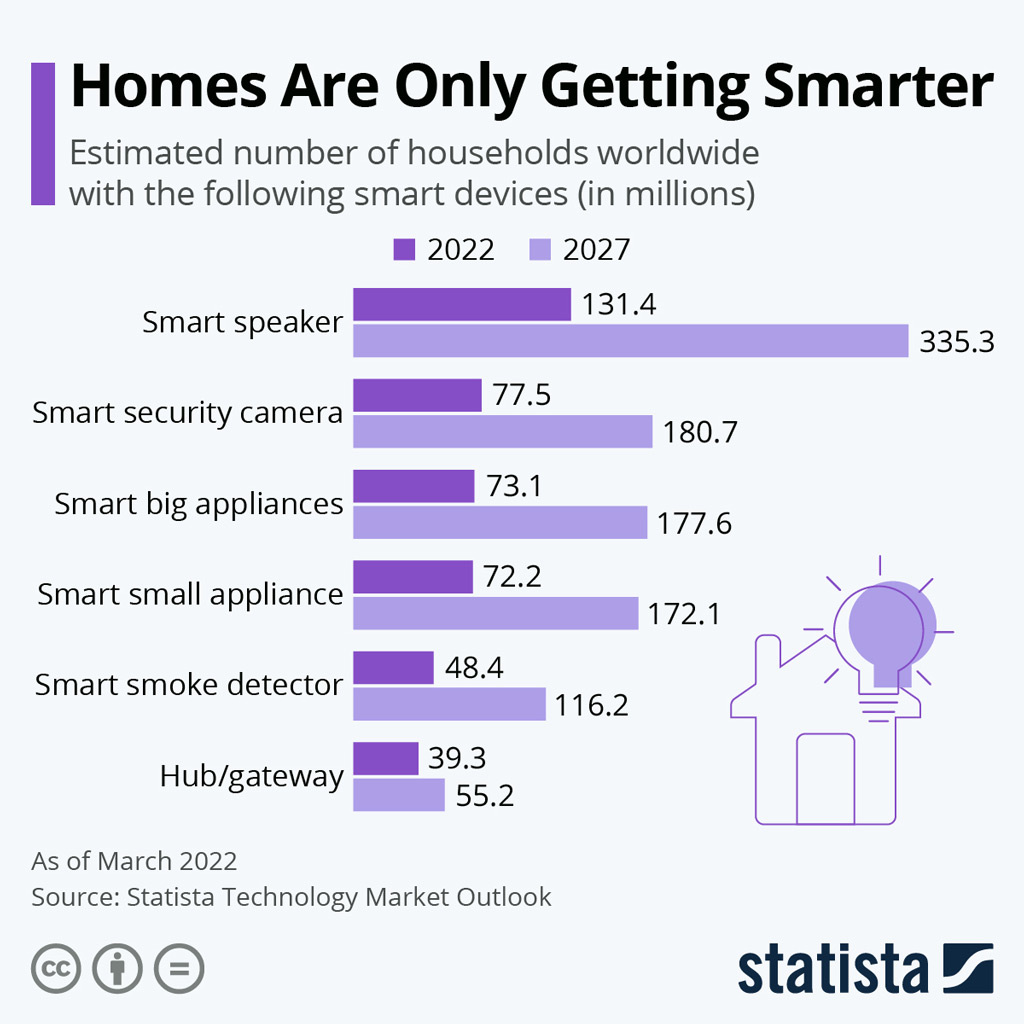
- Smart speakers are projected to remain the most widely adopted smart home device, growing from 131.4 million households in 2022 to 335.3 million households by 2027, an increase of more than 203 million households.
- Smart security cameras are expected to expand significantly, rising from 77.5 million to 180.7 million households between 2022 and 2027.
- Smart big appliances are forecast to more than double in adoption, increasing from 73.1 million to 177.6 million households worldwide.
- Smart small appliances are also projected to see rapid growth, climbing from 72.2 million households in 2022 to 172.1 million in 2027.
- Smart smoke detectors are expected to grow from 48.4 million to 116.2 million households, reflecting increasing demand for connected home safety devices.
- Hub/gateway devices show the slowest growth among the listed categories, increasing from 39.3 million to 55.2 million households over the five-year period.
- Every smart home device category shown is projected to have higher household adoption in 2027 than in 2022, highlighting the continued expansion of the global smart home ecosystem.
- The data indicates that entertainment, security, and connected appliances are expected to remain the primary drivers of smart home adoption worldwide.
Energy Savings and Sustainability
- Independent research places smart thermostat heating and cooling savings at 10% to 15%.
- Certified smart thermostats yield an average energy savings of about 8% for households.
- Purchasing a smart thermostat commonly costs between $100 and more than $350.
- The accumulated utility savings generally offset the device cost within one to two years.
- A 2025 survey gathered purchasing insights from 5,000 US homeowners regarding smart technology.
- Within that survey, 64% of homeowners prioritized energy efficiency in their purchase decisions.
- The ENERGY STAR program generated over $500 billion in cumulative energy-cost savings.
- These certified products also prevented about 4 billion metric tons of greenhouse gas emissions.
Voice Assistant and Smart Speaker Usage
- The United States had an estimated 153.5 million voice assistant users in 2025, showing that voice interfaces extend far beyond dedicated smart speakers.
- About 35% of Americans age 12 and older owned a smart speaker in 2025, equal to more than 100 million potential users.
- US smart speaker ownership exceeded 101 million people in 2025, according to compiled industry estimates.
- Google Assistant had an estimated 91.9 million US users in 2025, compared with 86.5 million for Siri and 77.2 million for Alexa.
- The global voice assistant market was valued at approximately $9.05 billion in 2025 and was projected to reach $11.71 billion in 2026.
- Smart speaker household penetration was projected to reach about 30.8% globally in 2026, reflecting broader access across both developed and emerging markets.
- Global smart speaker shipments were expected to exceed 154.3 million units in 2025, supported by lower-priced devices and integration with TVs, cars and appliances.
- About 20.5% of people worldwide use voice search, while 27% of voice searches take place on mobile devices.
- Voice assistants now control lighting, thermostats, locks, cameras, entertainment systems and appliances, making them central interfaces for multi-device home automation.
Global Smart Home Market Share by Region
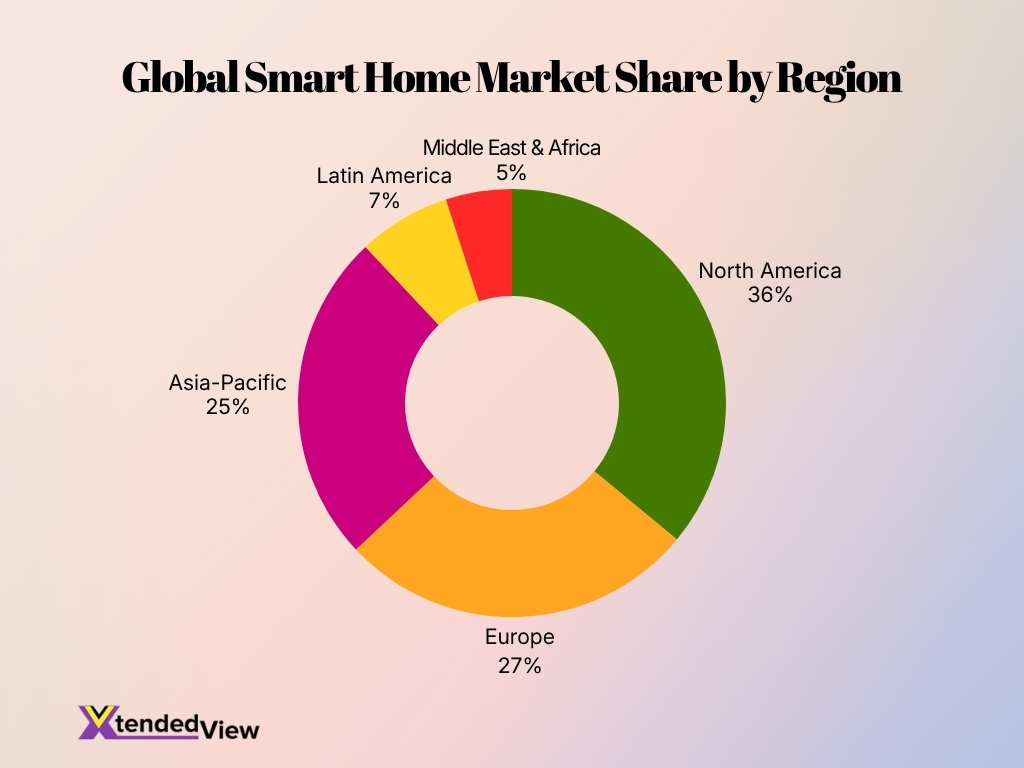
- North America leads the global smart home market with a 36% market share, making it the largest regional market in 2026.
- Europe ranks second, accounting for 27% of the global smart home market, supported by strong adoption of connected home technologies.
- Asia-Pacific holds a significant 25% market share, highlighting the region’s rapidly expanding smart home ecosystem and consumer demand.
- Latin America represents 7% of the global market, reflecting steady but comparatively lower smart home adoption.
- Middle East & Africa account for the remaining 5% market share, indicating an emerging market with future growth potential.
- The combined share of North America, Europe, and Asia-Pacific reaches 88%, demonstrating that these three regions dominate the global smart home industry.
- The difference between the largest market (North America, 36%) and the smallest market (Middle East & Africa, 5%) is 31 percentage points, illustrating substantial regional disparities in smart home adoption.
- North America exceeds Europe by 9 percentage points and Asia-Pacific by 11 percentage points, reinforcing its leadership in the global smart home market.
Matter and Thread Protocol Adoption
- The Matter smart home market was valued at $14.8 billion in 2025 and will reach $52.6 billion by 2034.
- Over 4,800 certified Matter devices were available across major global product categories in 2025.
- Nearly 62% of new smart home devices launched in 2025 included Matter certification or a support roadmap.
- An average Matter-capable household owned 8.3 connected devices in 2025, increasing from 5.1 in 2022.
- Around 230 million Thread Border Routers have already been globally deployed across premium smart homes.
- Thread networking is the fastest-growing protocol with a 29.6% Compound Annual Growth Rate.
- Wi-Fi holds 41.3% of the connectivity share, remaining the most dominant protocol for Matter adoption.
- North America leads the global Matter market with a 38.2% share, while Europe holds 26.7%.
- Overall smart home device shipments are projected to hit 931.1 million units globally in 2025.
Demographics of Smart Home Users
- Approximately 47% of millennials have installed at least one connected home device.
- Gen X ownership of smart home technology has reached about 33%.
- Only 24% of adults age 55 and older report interest in smart home devices.
- About 21% of households led by consumers ages 18 to 49 own smart speakers.
- Up to 96% of Gen Z respondents in tech-focused groups own at least one smart home device.
- Up to 93% of millennials in tech-focused groups own at least one smart home device.
- A 2025 survey studied 401 US smart home users to examine their privacy perceptions.
Key Benefits of Smart Home Technology
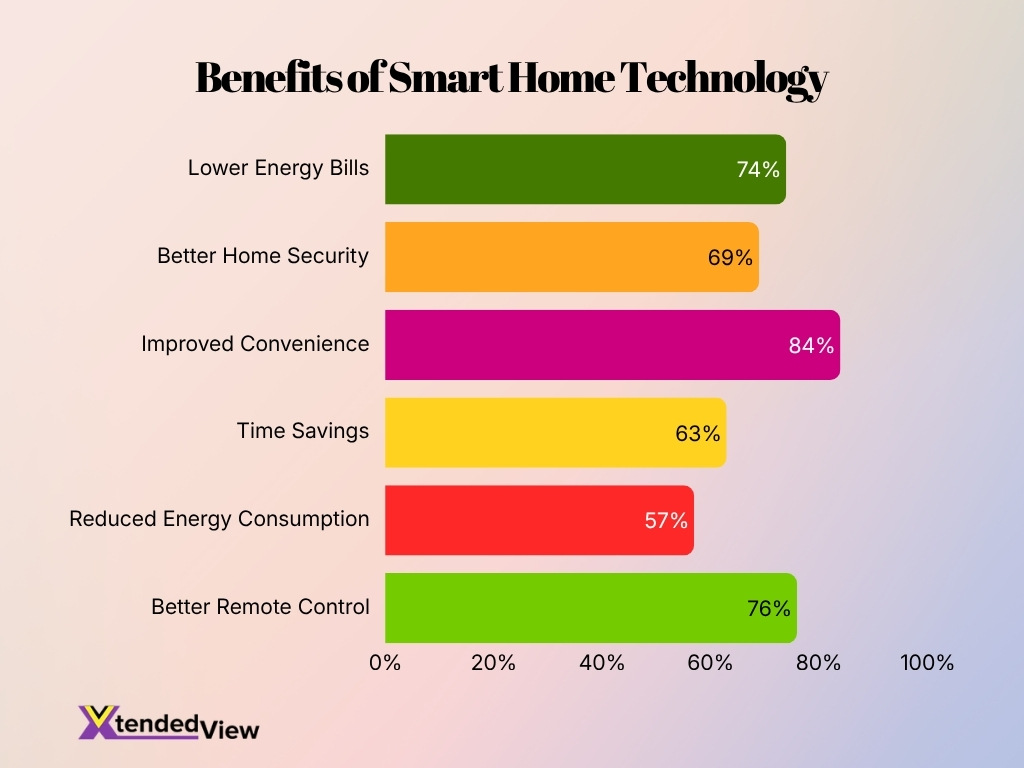
- Improved convenience is the most widely reported benefit, cited by 84% of users.
- Better remote control ranks second, with 76% of users valuing the ability to manage devices from anywhere.
- Lower energy bills are reported by 74% of users, highlighting the financial value of smart home systems.
- Better home security is a key advantage for 69% of users, driven by connected cameras, sensors, and smart locks.
- Time savings benefit 63% of users through automation and simplified household routines.
- Reduced energy consumption is reported by 57% of users, showing the role of smart devices in improving household efficiency.
- Overall, the findings indicate that users prioritize convenience and control, while also gaining meaningful cost, security, and energy-saving benefits.
Smart Home Investment and Spending
- US households spent an average of $896 on connected devices in 2025, up from $764 in 2024.
- The year-over-year increase in average connected-device spending reached $132, or approximately 17.3%.
- 29% of US consumers planned to increase their connected-device spending after 2025, three times the share reported in 2023.
- At the same time, 24% planned to reduce device spending, highlighting continued pressure from household budgets.
- A separate survey found that US homeowners had spent an average of more than $2,000 on smart devices during the previous five years.
- More than half of surveyed homeowners planned to add another smart device during the following year.
- Planned purchases included smart lighting for 22% of respondents, keyless entry products for 17%, and indoor or outdoor security cameras for a similar share of households.
- Devices priced below $25 represented a projected 41.3% share of smart home device sales in 2025, showing the importance of low-cost entry products.
- The global smart home device market reached an estimated $81 billion in 2025 and could grow to $389.8 billion by 2035.
- Security and lighting control products represented approximately 28.6% of device revenue in 2025, reflecting continued household spending on safety and basic automation.
AI Integration in Smart Homes
- 35% of US adults reported owning a smart speaker with AI capabilities in February 2026.
- Smart doorbells with AI features reached 18% of US adults, making them the second-most common AI-enabled home device measured in the same survey.
- Approximately 13% of US adults owned a robot vacuum with AI features in 2026.
- 11% of US adults reported having a smart thermostat with AI capabilities.
- AI chatbot use among US adults increased from 33% in 2024 to 49% in 2026, creating a broader consumer base familiar with conversational interfaces that can extend into smart home control.
- Google introduced Gemini-based home controls that interpret natural-language requests and provide AI-generated camera descriptions and activity searches.
- Alexa+ added generative AI to support more conversational requests and complete multistep household tasks.
- Consumer demand still centers on practical benefits, only 12% of robot vacuum buyers and 7% of washing machine buyers said AI strongly influenced their purchase.
- Edge-AI-enabled smart home hubs represent one of the market’s fastest-growing hub types because they can process more data locally and reduce dependence on cloud connections.
Smart Home Market Share by Leading Companies
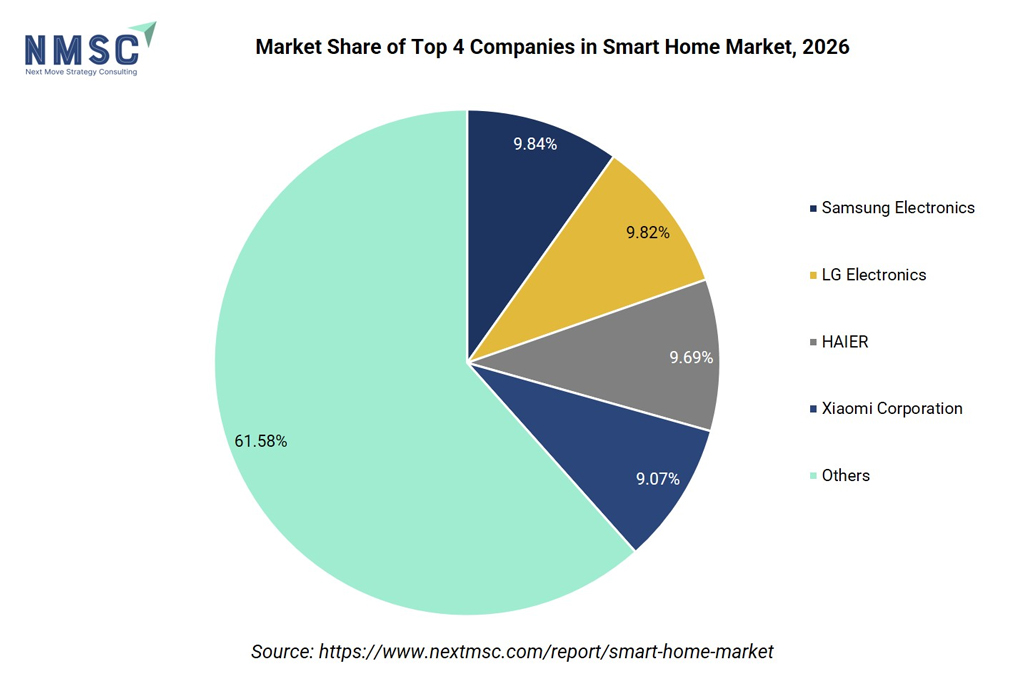
- Others accounted for the largest share at 61.58%, indicating that the smart home market remains highly fragmented with numerous smaller manufacturers collectively dominating the industry.
- Samsung Electronics led among the top named companies with a 9.84% market share, making it the largest individual branded player in the market.
- LG Electronics closely followed Samsung, capturing 9.82% of the global smart home market, highlighting strong competition between the two South Korean technology companies.
- HAIER held a 9.69% market share, reinforcing its position as one of the world’s leading smart home appliance manufacturers.
- Xiaomi Corporation represented 9.07% of the market, reflecting its growing influence in the connected home ecosystem through affordable smart devices.
- The combined market share of Samsung Electronics, LG Electronics, HAIER, and Xiaomi Corporation totaled 38.42%, while all other companies together controlled 61.58% of the market.
- The difference between the largest named company (Samsung at 9.84%) and the smallest among the top four (Xiaomi at 9.07%) was only 0.77 percentage points, indicating a highly competitive landscape among the leading brands.
- No single company held more than 10% of the market individually, suggesting that the global smart home industry remains diverse and competitive with market share distributed across many vendors.
Smart Home Cybersecurity Statistics
- A 2025 study surveyed 401 US smart home users regarding their overall confidence in connected device security.
- Approximately 33% of respondents identified privacy concerns as a major barrier to adopting additional smart technology.
- Around 23% of surveyed homeowners cited frequent software glitches as a primary deterrent affecting device reliability.
- The average connected home utilizes 22 IoT devices and faces nearly 30 cyberattacks every 24 hours.
- Streaming devicesare the most vulnerable home technology, accounting for over 25% of all detected security flaws.
- An estimated 98% of IoT device traffic across networks remains completely unencrypted and vulnerable to interception.
- Approximately 62% of consumer IoT devices actively collect and store personally identifiable information.
- Nearly 35% of consumer smart devices are shipped and installed with their default credentials still enabled.
- Connected routers absorb more than 75% of IoT network attacks and harbor over 50% of critical vulnerabilities.
- Global industry projections estimate that 672.6 million households will actively utilize smart home devices by 2027.
Future Growth Projections
- One 2026 forecast values the global smart home market at $186.3 billion in 2026, up from $172 billion in 2025.
- Under that forecast, global revenue could reach $413.7 billion by 2035, representing a 9.3% compound annual growth rate.
- A higher-growth estimate places the market at $207 billion in 2026 and projects it will reach $887.4 billion by 2033.
- Another projection expects market value to rise from $147.52 billion in 2025 to $848.47 billion by 2034, equal to a 21.4% annual growth rate.
- The large differences between forecasts reflect varying definitions of smart homes, connected appliances, software services and professional installations.
- Asia Pacific is expected to remain the fastest-growing regional market, while North America continues to generate one of the largest revenue totals.
- Cloud-connected products accounted for 62.6% of the market in 2025, although local and edge processing should gain ground as consumers demand faster responses and stronger privacy.
- Entertainment and media devices generated approximately $45.4 billion in 2025, providing a large installed base for future home automation services.
- Future growth will depend on lower device prices, longer software support, simpler installation and stronger interoperability across platforms.
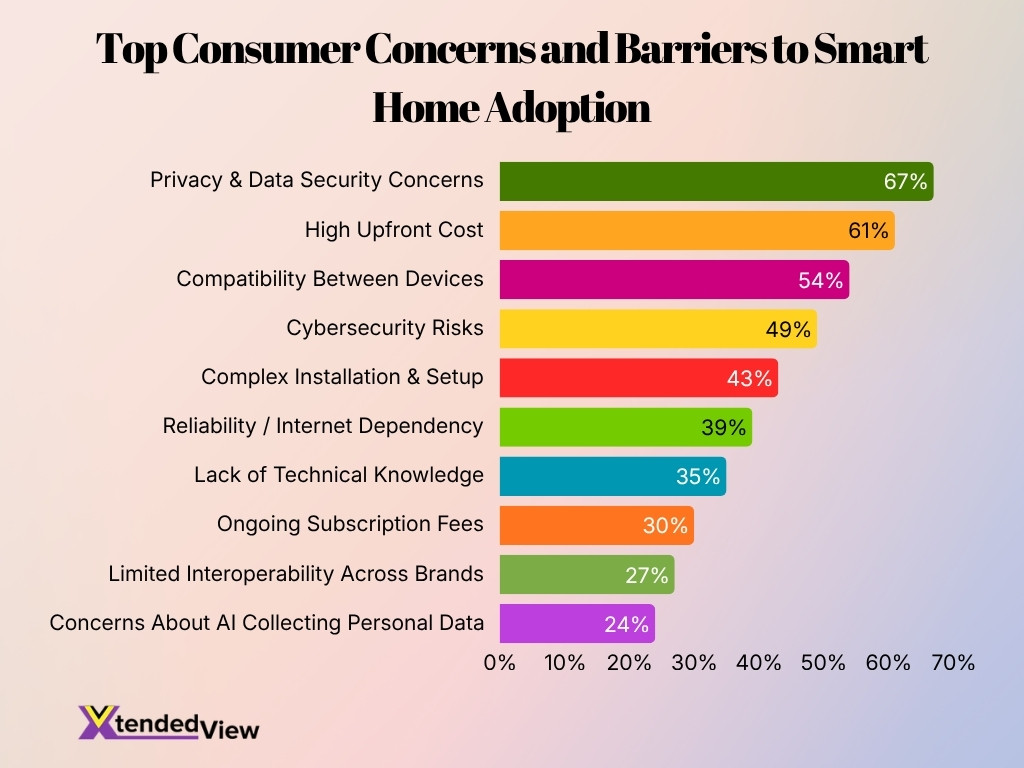
Consumer Concerns and Barriers to Smart Home Adoption
- Privacy and data security concerns are the biggest obstacle to smart home adoption, with 67% of consumers citing them as their primary concern.
- High upfront costs remain a major barrier, as 61% of consumers believe the initial investment in smart home devices is too expensive.
- 54% of consumers are concerned about compatibility between devices, highlighting the challenge of integrating products from different manufacturers.
- Nearly 49% of consumers worry about cybersecurity risks, reflecting growing awareness of connected device vulnerabilities.
- Complex installation and setup discourage 43% of consumers, emphasizing the need for simpler, user-friendly smart home solutions.
- 39% of respondents cite reliability and internet dependency as a concern, showing that uninterrupted connectivity remains important for smart home performance.
- More than one-third, 35% of consumers, report a lack of technical knowledge as a barrier to adopting smart home technology.
- Ongoing subscription fees are a concern for 30% of consumers, indicating that recurring costs can reduce long-term adoption.
- 27% of consumers are concerned about limited interoperability across brands, making seamless cross-platform functionality a key industry challenge.
- 24% of respondents express concerns about AI collecting personal data, suggesting that transparency and responsible AI practices are becoming increasingly important.
Emerging Smart Home Trends
- The smart home industry reached over 4,800 certified Matter and Thread devices globally in 2025.
- Approximately 62% of new smart home devices launched in 2025 included Matter or Thread support for robust connectivity.
- The value of voice assistant transactions across smart homes surged to $164 billion by 2025 due to generative AI adoption.
- The security and access control segment dominated the market with a 31% revenue share in 2025 fueled by AI-enabled cameras.
- Smart thermostats and energy management devices claimed a substantial 13.7% share of the Matter smart home market.
- Dedicated Matter Border Router Hubs captured 43.2% of the hub market in 2025 to facilitate seamless local edge processing.
- Over 50% of smart home consumers globally prioritize rigorous home safety and cybersecurity features for their connected devices.
- Expanding beyond residential use, the commercial smart device segment grew rapidly to hold a 24.8% market share.
- Achieving financial savings is the top priority for 41% of consumers, far outweighing the appeal of standalone AI features.
- A massive 71% of prospective U.S. buyers now consider interoperability standards like Matter an essential criterion when making purchases.
Frequently Asked Questions (FAQs)
The global smart home market is projected to reach $159.5 billion in revenue during 2026, although some research firms estimate it could be as high as $207 billion, depending on market scope and methodology.
Global smart home household penetration is expected to reach 82.1% in 2026, indicating widespread adoption of connected home devices.
The United States is forecast to remain the largest national smart home market, generating approximately $20.1 billion in revenue during 2026.
One widely cited forecast projects the global smart home market to grow at a 23.1% CAGR from 2026 to 2033, reaching $887.4 billion by 2033.
Asia Pacific accounted for 38.2% of global smart home market revenue in 2025, making it the largest regional market by revenue.
Conclusion
Smart home technology continues to evolve from standalone connected devices into fully integrated ecosystems powered by AI, automation and improved interoperability. While market forecasts differ, they consistently point to strong long-term growth driven by increasing consumer demand for security, energy efficiency and convenience. At the same time, advances in Matter, Thread, edge computing and cybersecurity are making connected homes more reliable and accessible. As costs decline and cross-platform compatibility improves, smart home adoption is expected to accelerate across households worldwide, making connected living an increasingly common part of everyday life.