



4D printing builds on 3D printing by creating objects that can change shape, properties, or function after production when they encounter triggers such as heat, moisture, light, magnetic fields, pressure, or changes in pH. This added time-based behavior gives manufacturers a way to design components that can adapt after printing instead of remaining fixed in one form. In healthcare, researchers are testing responsive implants, tissue-engineering scaffolds, drug-delivery systems, and other structures that can react to conditions inside the body. Aerospace and defense teams are also exploring shape-changing materials for lightweight components, self-deploying structures, and systems that could reduce reliance on conventional hinges, motors, or complex assemblies.
Automotive applications are emerging as well, particularly in adaptive interiors, lightweight composites, and responsive vehicle components. Although 4D printing remains an early-stage technology, rapid research growth and market forecasts above 30% annual growth in several datasets show why it is attracting attention across advanced manufacturing. The statistics below explain the market size, adoption trends, regional growth, leading applications, opportunities, and barriers shaping 4D printing.
Editor’s Choice
- The global 4D printing market is projected to reach $6.3 billion by 2030 under one current forecast.
- That same forecast expects the industry to expand at a 35.4% CAGR through 2030.
- A separate outlook projects the market to reach $2.69 billion by 2033, reflecting a narrower market definition than several competing forecasts.
- North America is projected to account for 39% of the market in 2026 under one segmentation model.
- Military and defense represents 41% of 2026 end-user revenue in one current market model, making it the largest listed end-use segment in that dataset.
- Fused deposition modeling accounts for an estimated 36% of the 2026 market by printing technology in the same analysis.
- Self-assembly structures represent an estimated 32% of the 2026 market by application, underscoring commercial interest in parts that can deploy or reconfigure without conventional assembly mechanisms.
Recent Developments
- A 2026 bone-regeneration study used a multilayer perceptron model that achieved an R² of 0.983 when predicting scaffold biocompatibility.
- The same research produced an R² of 0.955 for osteogenesis prediction, showing how machine learning can help optimize 4D-printed implant parameters before biological testing.
- Researchers reported a 1.4-fold increase in vascular branches in an optimized scaffold group compared with the control, suggesting that adaptive structures can influence both bone growth and angiogenesis.
- Shape-memory composites in that study maintained glass-transition temperatures within approximately 60°C to 70°C when bioactive-glass content varied from 5% to 20%.
- Separate 2026 research on self-folding, cell-laden hydrogel tubes reported more than 95% cell viability after seven days, supporting continued development of dynamic tissue-engineering structures.
- Recent aerospace-focused research reported a bending deformation curvature of 0.33 mm⁻¹ at 150°C for a 4D-printed continuous aramid-fiber composite.
- A 2026 healthcare forecast projects the specialized 4D printing healthcare segment to expand at 48.2% annually from 2025 through 2030, considerably faster than many broad 4D-printing market forecasts.
- Current biomedical research is expanding beyond simple shape changes toward structures that combine adaptive geometry with drug delivery, tissue regeneration, photothermal treatment and changing mechanical properties.
What is 4D Printing
- Unlike conventional 3D printing, 4D printing adds programmed changes that occur over time, allowing a printed structure to bend, expand, contract, fold, twist, or assemble itself after production.
- Researchers commonly design 4D-printed structures to respond to stimuli such as temperature, pH, moisture, light, electricity, magnetic fields, pressure, or solvents.
- Shape-memory polymers can return from a temporary configuration to a programmed permanent form after receiving a trigger, making them one of the central material families used in 4D printing.
- Hydrogels can swell or shrink when environmental conditions change, which makes them useful for self-folding structures, controlled drug delivery, tissue engineering, and other biomedical applications.
- Other responsive materials include shape-memory alloys, shape-memory ceramics, liquid-crystal elastomers, magnetic-responsive materials, and stimuli-sensitive composites.
- Current commercial market classifications generally divide the technology into shape-memory polymers, self-assembly, and bioprinting, although academic definitions can cover a wider range of responsive mechanisms.
- In healthcare research, 4D-printed structures can support one-way transformations that retain a new shape or reversible two-way transformations that repeatedly respond to changing conditions.
4D Printing Market Size and Growth Statistics
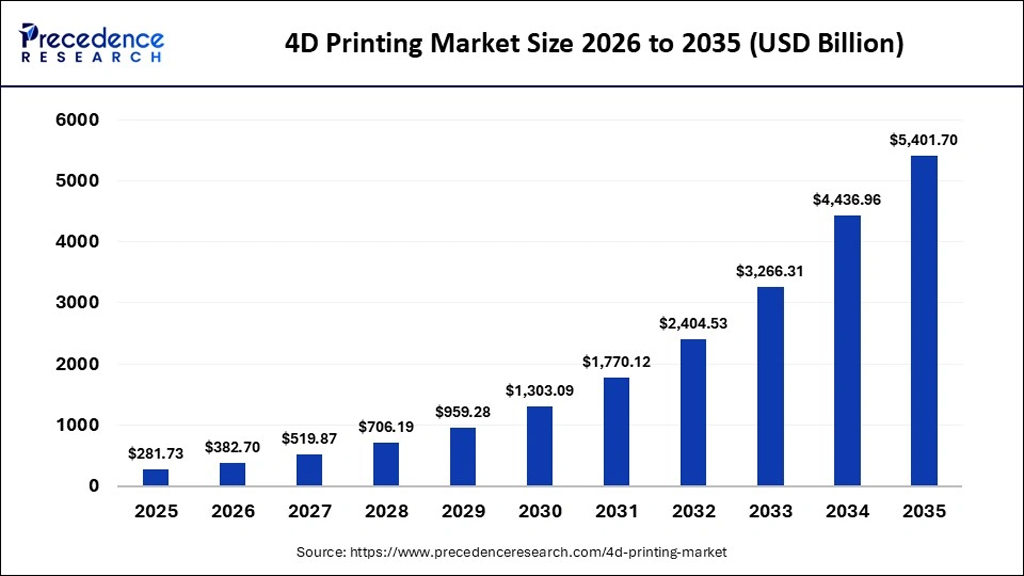
- The global 4D printing market is projected to increase from $281.73 billion in 2025 to $5,401.70 billion by 2035, indicating substantial long-term market expansion.
- In 2026, the 4D printing market is estimated at $382.70 billion, up approximately 35.8% from $281.73 billion in 2025.
- The market is forecast to surpass $500 billion in 2027, reaching approximately $519.87 billion.
- By 2029, the market is expected to approach the $1 trillion milestone, with a projected value of $959.28 billion.
- The 4D printing market is forecast to exceed $1 trillion in 2030, reaching approximately $1,303.09 billion.
- Market size is projected to climb to $1,770.12 billion in 2031 before exceeding $2.4 trillion in 2032.
- By 2033, the market could reach $3,266.31 billion, representing more than an 11-fold increase compared with its 2025 level.
- The market is projected to rise further to $4,436.96 billion in 2034 and reach $5,401.70 billion by 2035.
- Overall, the figures indicate that the 4D printing market could expand by roughly 19.2 times between 2025 and 2035, highlighting the sector’s rapid projected growth.
4D Printing Market Forecast and CAGR
- One market forecast expects the industry to rise from its 2026 base to approximately $2.75 billion by 2035, representing substantial long-term expansion.
- That forecast applies a 32.7% CAGR across its 2026-2036 projection period.
- Another model projects 32.2% annual growth from 2026 to 2033, with commercialization of programmable matter driving the expansion.
- A separate 2025 analysis forecasts a 44.75% CAGR from 2025 to 2030, one of the faster broad-market growth scenarios currently available.
- Under that scenario, the market would climb to approximately $4.14 billion in 2030.
- Another forecast places 2025-2030 CAGR at 35.7%, with demand for adaptive and shape-changing structures supporting market growth.
- A longer-range forecast expects approximately 38.2% CAGR between 2024 and 2034, supported by biomedical, self-assembling and programmable-material applications.
- One of the most aggressive current projections forecasts 45% CAGR from 2026 through 2035, illustrating the upside scenario if smart materials and commercial applications scale quickly.
- Taken together, the reviewed forecasts generally place long-term annual growth above 30%, but the substantial spread means readers should avoid comparing terminal market values without checking each report’s definition and forecast period.
4D Printing Market by End-User Industry
- Military and defense accounted for 34.5% of global 4D printing revenue in 2023, making it the largest measured end-use segment.
- Military and defense 4D printing generated $54.1 million in 2023 and could reach $456 million by 2030.
- The military and defense segment is forecast to expand at a 36.1% CAGR from 2024 to 2030, slightly faster than the overall 4D printing market in the same dataset.
- Aerospace generated approximately $42 million in 2023 and is projected to reach $348.7 million by 2030.
- Aerospace 4D printing is forecast to grow at a 35.8% CAGR through 2030, supported by demand for lightweight, adaptive and shape-changing structures.
- Automotive applications generated $26.9 million in 2023, making the industry smaller than defense and aerospace but larger than healthcare in the same market model.
- Automotive 4D printing revenue is forecast to rise to $232.8 million by 2030, representing a CAGR of 36.6% from 2024 through 2030.
- Healthcare generated about $13.3 million in 2023 under one narrowly defined end-use model and is forecast to reach $108.8 million by 2030.
- The healthcare segment is forecast to expand at 35.6% annually from 2024 to 2030 in that dataset, reflecting demand for adaptive implants, tissue-engineering structures and responsive medical devices.
4D Printing Market Share by Material Type
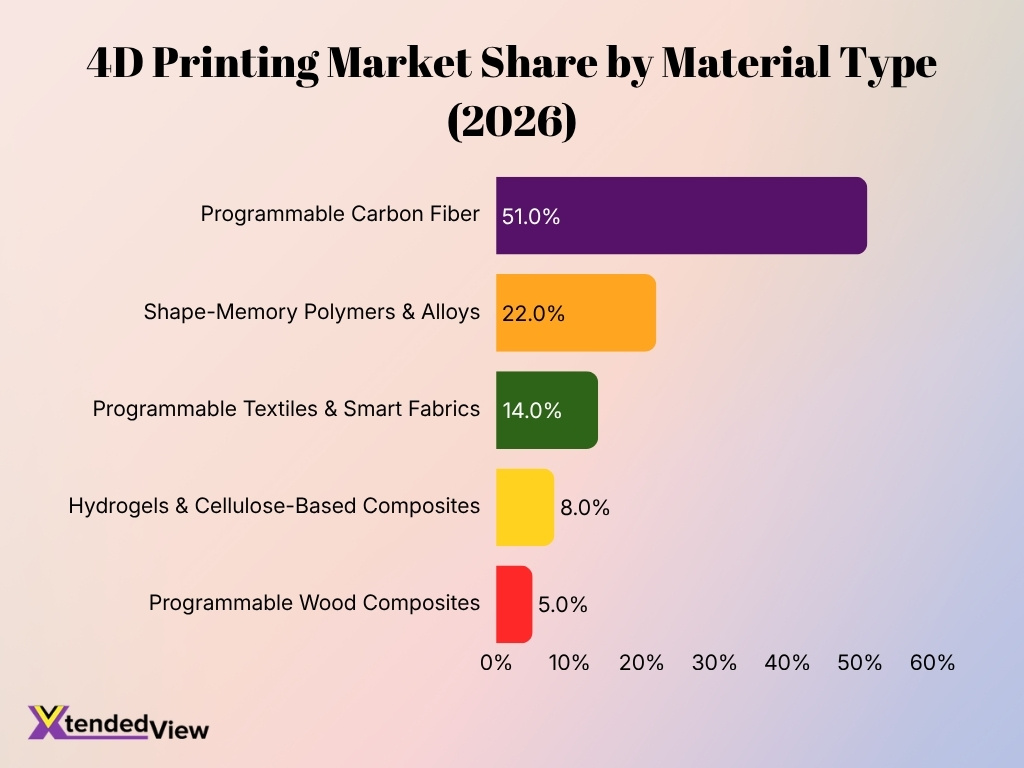
- Programmable carbon fiber dominates the 4D printing materials market with a 51.0% share, accounting for more than half of the total market.
- Shape-memory polymers and alloys rank second with a 22.0% market share, less than half the share held by programmable carbon fiber.
- Programmable textiles and smart fabrics represent 14.0% of the market, highlighting their growing role in adaptive and responsive applications.
- Hydrogels and cellulose-based composites account for 8.0% of the 4D printing market by material type.
- Programmable wood composites hold the smallest share at 5.0%, indicating relatively limited adoption compared with other programmable materials.
- Together, programmable carbon fiber and shape-memory polymers and alloys control 73.0% of the market, showing a strong concentration among the two leading material categories.
4D Printing Technology Adoption Rates
- Academic journals represent 80% of 4D printing output, with patents accounting for just 20%.
- A 2026 study of five specialists evaluated 15 separate barriers to industrial production.
- High initial investment scored 0.1287 as a major causal barrier suppressing manufacturing adoption.
- Resolving scalability and capital requirements can reduce downstream adoption barriers by 32%.
- The global 4D printing market size is projected to reach $1.88 billion in 2026.
- The industry is expected to grow at a 35.9% compound annual growth rate (CAGR) into 2026.
- North Americais poised to dominate the 2026 market with a 39.0% overall revenue share.
- Programmable carbon fibermaterials will account for 51% of the global market in 2026.
- Fused deposition modeling (FDM)technology is projected to capture 36% of 2026 market usage.
- Self-assembly structuresrepresent 32% of the global 4D printing market applications in 2026.
4D Printing in Aerospace and Defense
- The global aerospace 4D printing segment generated $42 million in 2023.
- Aerospace revenue is projected to reach $348.7 million by 2030, more than eight times its 2023 level.
- The aerospace segment is expected to achieve a 35.8% CAGR from 2024 to 2030.
- Military and defense generated $54.1 million in 2023, exceeding aerospace revenue by $12.1 million in the same dataset.
- Military and defense is projected to reach $456 million by 2030, with a 36.1% CAGR from 2024 to 2030.
- Military and defense represented 34.5% of total 4D printing revenue in 2023, giving it the largest end-user share.
- A separate military-only forecast expects the segment to reach $651.5 million by 2030, with annual growth estimated at 43.5%, illustrating how forecast definitions can materially alter projected revenue.
- Another long-term military forecast starts at $16.1 million in 2030 and projects $673.4 million by 2040, corresponding to a 45.2% CAGR.
- Under that military forecast, the Army is expected to contribute nearly half of revenue in 2030, while the Navy is projected to record the fastest application CAGR at 47.3% between 2030 and 2040.
- North America represented roughly two-fifths of the projected military 4D printing market in that 2030 regional model, reflecting continued U.S. investment in advanced defense manufacturing.
4D Printing in Healthcare Statistics
- One 2026 healthcare-specific market model values the sector at $392.83 million in 2026, up from $288.18 million in 2025.
- That represents approximately 36.3% year-over-year growth between 2025 and 2026, based on the reported market values.
- The same forecast expects healthcare 4D printing revenue to reach $4.68 billion by 2034, with a 36.32% CAGR over the forecast period.
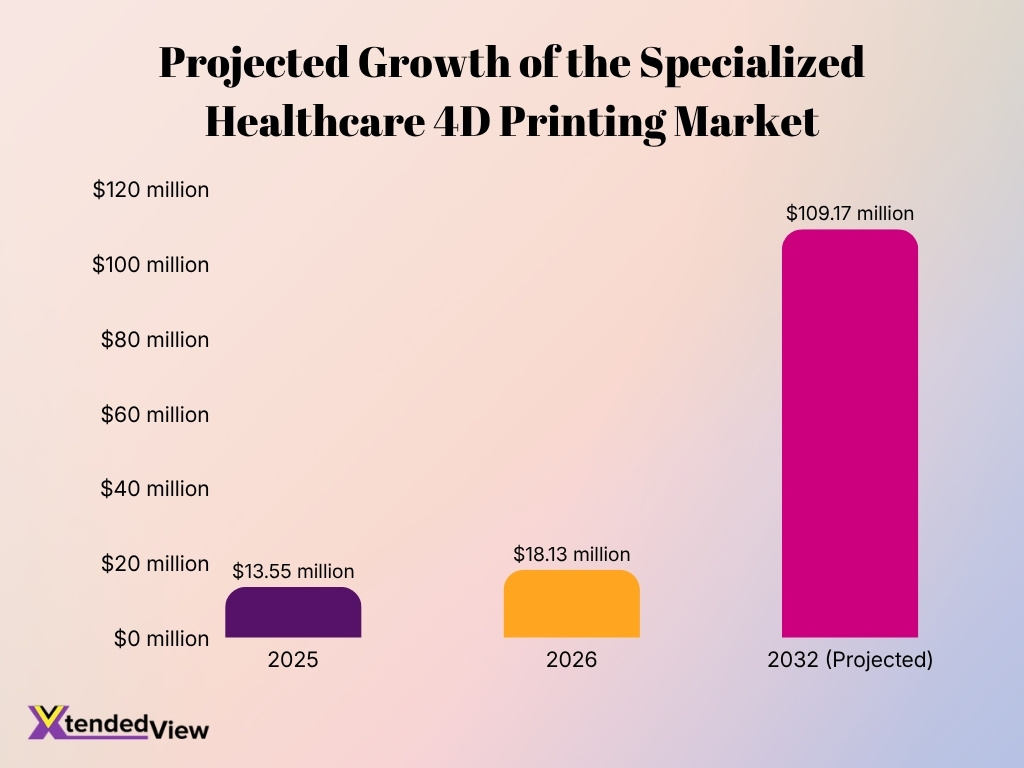
- A narrower June 2026 estimate values the specialized healthcare market at $18.13 million in 2026, compared with $13.55 million in 2025.
- Under that definition, the market is forecast to reach $109.17 million by 2032, representing a 34.71% CAGR.
- Another current forecast expects healthcare-related 4D printing revenue to increase by $226.46 million between 2025 and 2030, with a 48.2% CAGR during the period.
- A separate 2026 forecast places dedicated healthcare 4D printing revenue at $29.84 million in 2026 and $207.09 million in 2034, representing annual growth of 27.4%.
- An established technology forecast projects the healthcare market to reach $32 million in 2026, up from $9 million in 2021, corresponding to a 29.9% CAGR.
- In a broader end-use dataset, healthcare 4D printing generated $13.3 million in 2023 and is projected to reach $108.8 million by 2030, with North America serving as the largest regional market in the base year.
4D Printing in Automotive Industry
- Automotive 4D printing generated approximately $26.9 million in 2023 under one global end-use model.
- The automotive segment is projected to reach $232.8 million by 2030, an increase of about $205.9 million from the 2023 base.
- Automotive 4D printing is forecast to grow at a 36.6% CAGR from 2024 to 2030, slightly faster than the overall market’s 35.2% CAGR.
- Automotive represented approximately 17% of global 2023 4D printing revenue when its $26.9 million segment value is compared with the $156.8 million total market in the same dataset.
- By comparison, automotive revenue in 2023 was roughly 50% of military and defense revenue, highlighting the industry’s smaller but still meaningful early commercial position.
- Automotive’s projected $232.8 million revenue in 2030 would equal roughly 18% of the $1.30 billion global market forecast for that year under the same methodology.
- North America held the largest revenue position for automotive 4D printing in 2023, reflecting the region’s established additive-manufacturing and automotive engineering base.
- South Korea is forecast to record the fastest country-level automotive growth rate between 2024 and 2030 within the tracked markets.
- Programmable carbon fiber held 50.9% of the overall 4D printing material market in 2023, a relevant indicator for automotive adoption because high strength-to-weight ratios make responsive carbon composites attractive for vehicle structures.
Global 4D Printing Market Share by Region
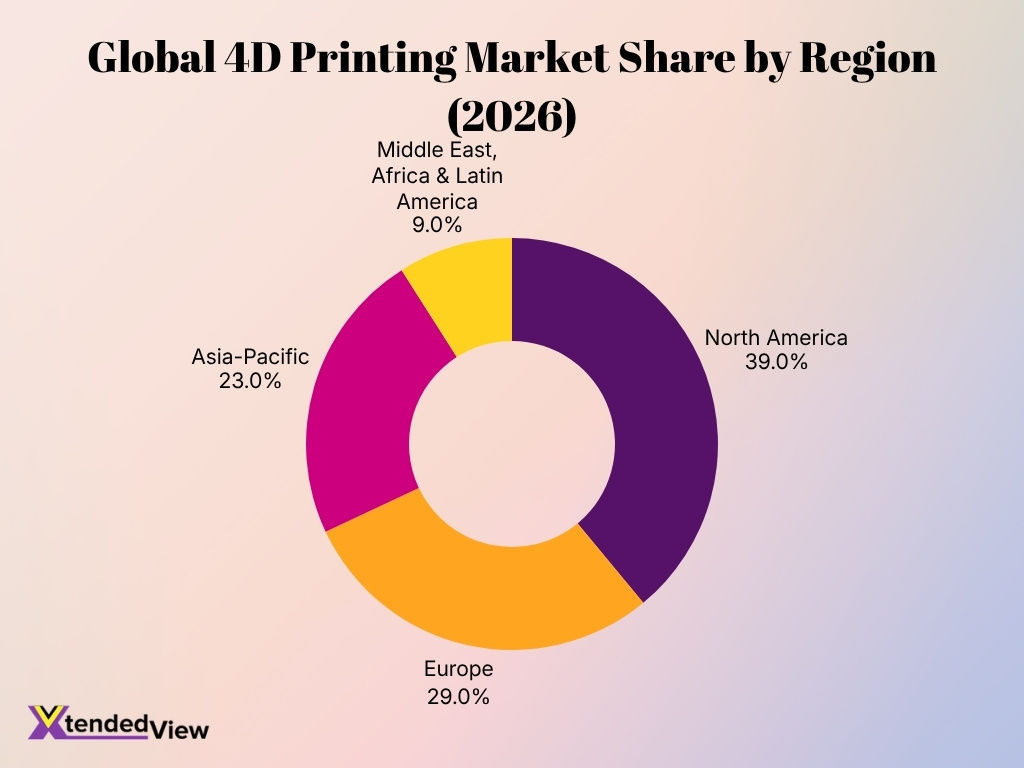
- North America leads the global 4D printing market with a 39.0% share, making it the largest regional market in 2026.
- Europe ranks second with 29.0% of the global market, trailing North America by 10 percentage points.
- Asia-Pacific accounts for 23.0% of the market, giving the region nearly one-quarter of global 4D printing activity.
- Together, North America and Europe control 68.0% of the global 4D printing market, highlighting the strong concentration of the industry in developed markets.
- North America, Europe and Asia-Pacific collectively represent 91.0% of the market, leaving only 9.0% for the remaining regions.
- Middle East, Africa and Latin America collectively hold 9.0%, indicating a comparatively smaller presence in the global 4D printing market.
North America 4D Printing Market Statistics
- North American 4D printing revenue totaled $56.9 million in 2023 under one consistent regional dataset.
- The region accounted for 36.3% of worldwide revenue in 2023, the largest share globally.
- North American revenue is projected to reach $474.4 million by 2030, representing an increase of more than $417 million from the 2023 level.
- The North American market is forecast to expand at a 35.4% CAGR from 2024 to 2030.
- North America’s projected 2030 revenue would represent roughly 36.6% of the $1.30 billion global forecast under the same dataset, indicating that the region is expected to retain a similar share as the market scales.
- Programmable carbon fiber was the largest revenue-generating material in North America in 2023 and is also forecast to be the region’s fastest-growing material category.
- Mexico is projected to record the highest country-level CAGR in North America from 2024 through 2030, even though the U.S. remains the region’s primary commercial center.
- North America was the largest revenue-generating region for aerospace, automotive, military and defense, and healthcare 4D printing in the 2023 segment datasets.
- One separate 2026 market model projects North America to hold approximately 39% of the global 4D printing market in 2026, supporting the broader finding that the region remains the current commercial leader.
Asia-Pacific 4D Printing Market Growth
- Asia-Pacific generated $31.3 million in 4D printing revenue in 2023 and is projected to reach $266.8 million by 2030.
- The region is forecast to grow at a 35.8% CAGR from 2024 to 2030, slightly faster than both Europe and North America under the same methodology.
- Applying the published 35.8% CAGR to the 2023 base implies an estimated Asia-Pacific market of about $78.4 million in 2026. This is a calculated estimate rather than a separately reported market value.
- China generated $8.3 million in 2023 and is projected to reach $69.1 million by 2030.
- China’s 4D printing market is expected to expand at a 35.4% CAGR from 2024 to 2030, supported by automotive, aerospace and advanced manufacturing activity.
- China accounted for 22.5% of the Asian 4D printing market in the reported base period, making it the region’s largest individual country market.
- South Korea is expected to record the fastest national growth rate in Asia-Pacific through 2030, indicating that future regional expansion will extend beyond China.
- Programmable carbon fiber was Asia-Pacific’s largest material segment in 2023 and is also projected to remain its fastest-growing material category through 2030.
- The broader Asia-Pacific additive manufacturing ecosystem reached $5.20 billion in 2025 and is forecast to reach $13.62 billion by 2030, providing a sizable production base for future 4D printing commercialization.
Europe 4D Printing Market Trends
- Europe’s 4D printing market generated $42.2 million in 2023.
- Revenue is projected to reach $345.9 million by 2030, representing more than an eightfold increase from the 2023 base.
- Europe is expected to grow at a 35.1% CAGR from 2024 to 2030, closely tracking the projected 35.2% global rate.
- Applying that CAGR to the 2023 base implies a European 4D printing market of approximately $104.1 million in 2026. This figure is calculated from the published base value and CAGR.
- Europe represented 26.9% of global 4D printing revenue in 2023, making it one of the industry’s three largest regional markets.
- Programmable carbon fiber ranked as Europe’s largest material category in 2023 and is forecast to deliver the fastest material-segment growth through 2030.
- France is projected to record the highest country-level CAGR in Europe between 2024 and 2030.
- Germany remains strategically important because its large automotive manufacturing base creates demand for adaptive, lightweight and programmable components.
- Europe’s wider 3D printing market stood at $4.40 billion in 2025 and is forecast to reach $9.04 billion by 2030, giving 4D printing access to an established additive manufacturing supply chain.
Key Players in the 4D Printing Market
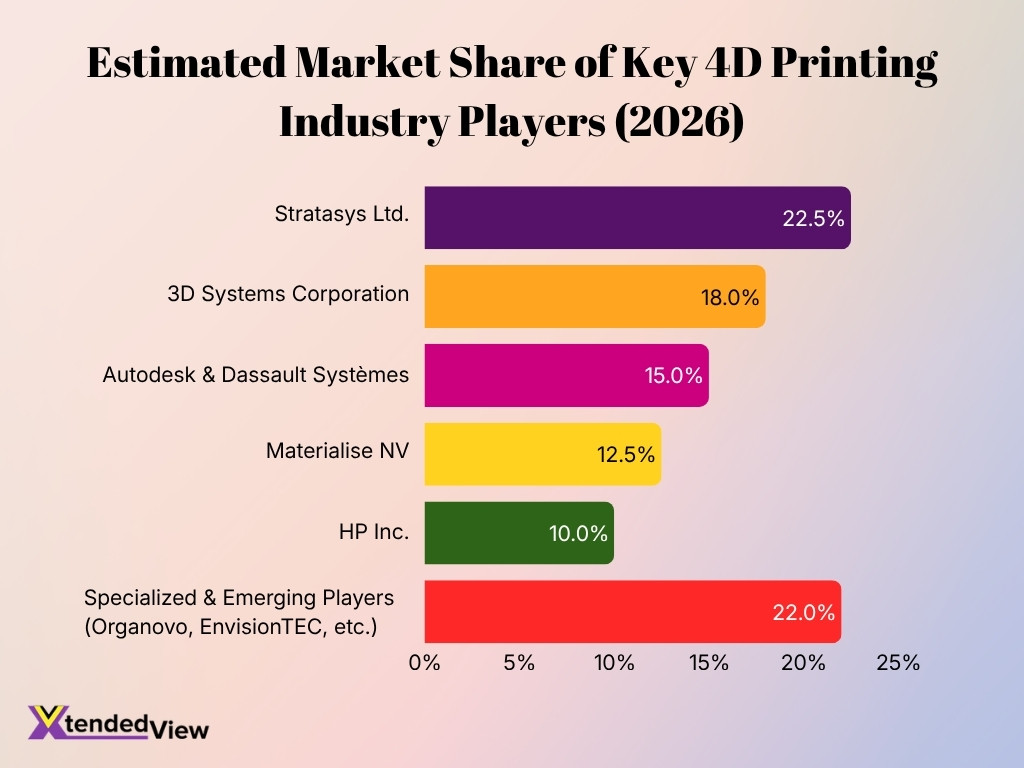
- Stratasys Ltd. leads the individual companies with an estimated 22.5% market share in 2026, supported by its strength in aerospace composites and multi-material jetting.
- Specialized and emerging players collectively account for 22.0% of the market, highlighting the importance of bioprinting, hydrogels and advanced R&D.
- 3D Systems Corporation holds an estimated 18.0% share, driven primarily by its capabilities in healthcare implants and shape-memory polymers.
- Autodesk and Dassault Systèmes together represent 15.0% of the market, with a strong focus on CAD simulation and programmable transformation software.
- Materialise NV captures approximately 12.5% of the market, supported by its expertise in software tooling and medical engineering solutions.
- HP Inc. accounts for an estimated 10.0% share, with its position centered on high-speed production and smart polymer integration.
- The top two individual company positions, Stratasys and 3D Systems, collectively represent 40.5% of the estimated market, indicating a relatively concentrated competitive landscape.
- Overall, the figures show a diverse 4D printing ecosystem, where established additive manufacturing companies compete alongside software specialists and emerging technology developers.
4D Printing Market Drivers and Opportunities
- One current forecast expects the global market to rise from $1.88 billion in 2026 to $6.3 billion by 2030, implying rapid commercialization if smart-material and manufacturing advances continue.
- That forecast represents a 35.9% CAGR from 2026 to 2030, significantly above growth rates typical of mature manufacturing technologies.
- Under a narrower methodology, the global market is projected to expand from $370 million in 2026 to $1.30 billion in 2030, reinforcing strong growth despite differences in market definitions.
- Military and defense already represented 34.5% of global revenue in one measured base year, creating an early commercial pathway for adaptive components and self-deploying structures.
- Programmable carbon fiber held 50.9% of material revenue, indicating that lightweight responsive composites currently offer one of the clearest material opportunities.
- Asia-Pacific’s projected 35.8% CAGR through 2030 creates a geographic opportunity for suppliers targeting expanding manufacturing and R&D programs in China, South Korea, Japan and India.
- 4D bioprinting is forecast to grow at 29.9% annually from 2026 to 2030, opening opportunities in tissue engineering, regenerative medicine and responsive biological structures.
- Recent research identifies self-adjusting and self-repairing components as potential routes to longer product lifespans and lower material waste, linking 4D printing with sustainable manufacturing objectives.
- A 2026 barrier analysis found that solving initial-investment and scalability problems could reduce downstream adoption barriers by as much as 32%, suggesting that improvements in these two areas could accelerate commercialization across multiple industries.
Key 4D Printing Technical Challenges
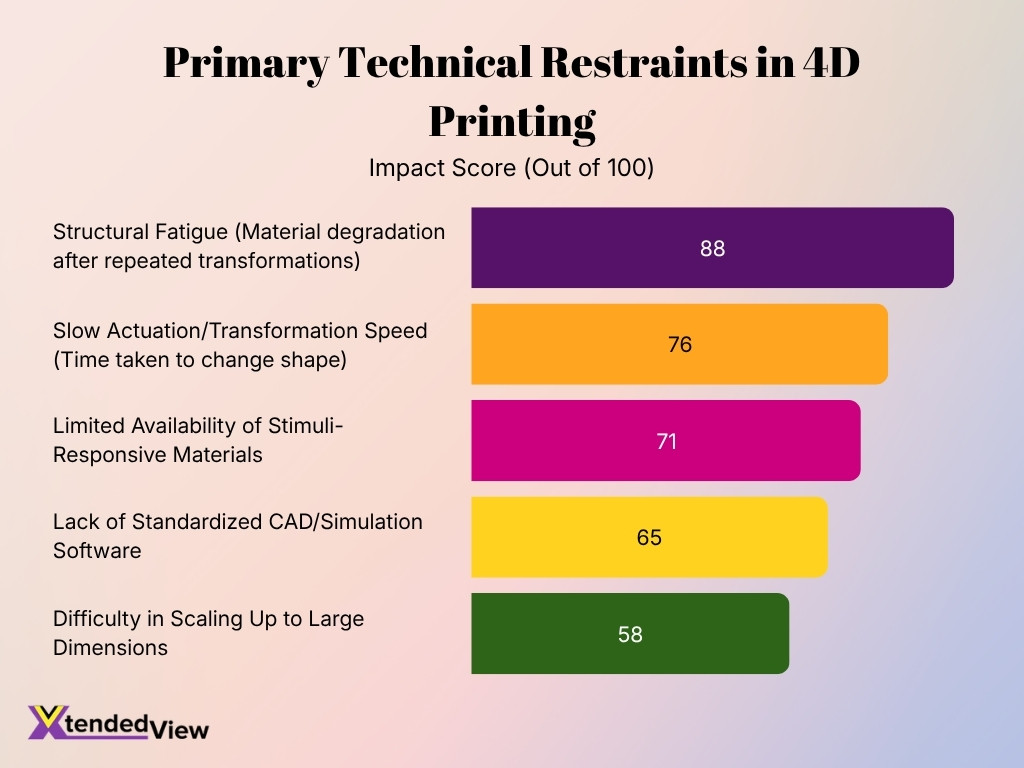
- Structural fatigue is the most significant technical restraint in 4D printing, recording the highest impact score of 88 out of 100, largely due to material degradation after repeated transformations.
- Slow actuation and transformation speed ranks second with an impact score of 76, highlighting the difficulty of achieving rapid and responsive shape changes.
- The limited availability of stimuli-responsive materials carries an impact score of 71, restricting material choices and potential applications for 4D printing.
- The lack of standardized CAD and simulation software scores 65, creating challenges in designing, testing, and predicting programmable material behavior.
- Scaling 4D-printed structures to larger dimensions has an impact score of 58, indicating ongoing difficulties in moving the technology from laboratory prototypes to larger commercial applications.
- Overall, the data suggests that material durability, transformation performance, and specialized design infrastructure remain the most important technical barriers to wider 4D printing adoption.
Frequently Asked Questions (FAQs)
The global 4D printing market is estimated at $1.88 billion in 2026, up from $1.38 billion in 2025, representing 35.9% annual growth under one current market model.
One current forecast projects the global market to reach $6.3 billion by 2030, expanding at a 35.4% CAGR over the forecast period.
North America accounted for approximately 36.3% of global 4D printing revenue in the reported base year, making it the largest regional market.
A 2026 healthcare-specific forecast values the market at $18.13 million in 2026 and projects it to reach $109.17 million by 2032 at a 34.71% CAGR.
Programmable carbon fiber accounted for more than 51% of the 4D printing materials market in 2023 in one dataset, while its revenue is projected to increase from $79.8 million in 2023 to $676.9 million by 2030.
Conclusion
4D printing remains an emerging manufacturing technology, but the available data shows a clear shift from laboratory experimentation toward specialized commercial use. Major forecasts generally expect annual market growth above 30%, although published market-size estimates vary because researchers use different definitions for materials, software, equipment, bioprinting, and end-use applications. North America continues to lead current commercialization, supported by aerospace, defense, healthcare, and advanced-material research, while Asia-Pacific is expected to post some of the fastest regional growth through the end of the decade.
Healthcare, aerospace, defense, automotive, and bioprinting stand out as the most active application areas because they can benefit directly from components that respond to environmental conditions after production. At the same time, high material costs, limited scalability, regulatory requirements, technical complexity, and the lack of standardized testing continue to slow mass adoption. The next stage of 4D printing growth will therefore depend on whether manufacturers can turn programmable structures into products that are repeatable, certifiable, durable, and economical at scale.