


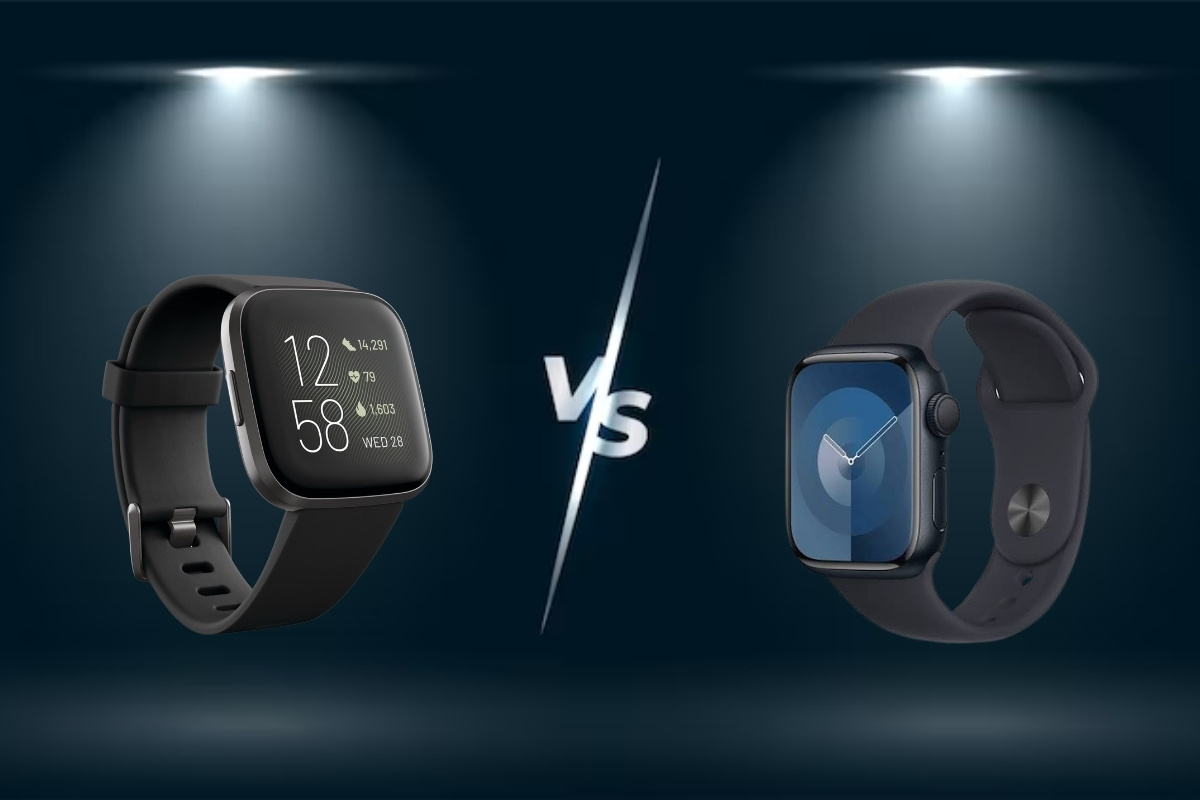
Fitbit and Apple Watch remain two of the most recognizable names in wearable technology, but their product strategies have become increasingly different. Apple Watch focuses on a full smartwatch experience that combines communication, apps, workouts, health monitoring, and safety features, while Fitbit places greater emphasis on fitness tracking, sleep, recovery, battery life, and continuous health insights. These differences matter as more consumers use wearables not only for exercise, but also for monitoring heart-rate trends, sleep quality, daily activity, and long-term wellness patterns. The statistics in this article compare the two platforms across market share, sales, pricing, subscriptions, battery life, health tracking, accuracy, customer satisfaction, and other major performance areas.
Editor’s Choice
- The global smartwatch market returned to annual growth in 2025, with worldwide shipments increasing 4% year over year after the market contracted in 2024.
- Apple Watch recorded its first annual shipment growth since 2022 during 2025, reversing two consecutive years of declines.
- Fitbit sold an estimated 4.3 million devices in 2025, reflecting its smaller hardware scale compared with leading smartwatch vendors.
- Estimated Fitbit revenue stood at approximately $770 million in 2025. Google does not report Fitbit revenue separately, so this figure should be treated as a third-party estimate rather than a company disclosure.
- U.S. wearable-owner research conducted in December 2025 found Apple products in 63% of respondents’ wearable portfolios, compared with 27% for Fitbit.
- By Q2 2026, global smartwatch shipments were 4% lower year over year, highlighting continued volatility despite the 2025 recovery.
- Fitbit’s registered-user base reached an estimated 137 million in 2025, although registered accounts should not be interpreted as monthly active users.
Recent Developments
- Fitbit introduced the Fitbit Air in May 2026 with a U.S. starting price of $99.99, positioning it below most premium smartwatches and returning Fitbit’s focus to a lightweight fitness-tracker format.
- The Fitbit Air uses a screenless design, shifting interaction toward passive data collection and the companion health app rather than notifications and on-device apps.
- Fitbit Air offers up to seven days of battery life, giving the brand a clear product strategy around continuous wear and reduced charging frequency.
- Each Fitbit Air includes a three-month trial of the paid health service, connecting Fitbit’s hardware strategy more closely with recurring software revenue.
- The paid health plan introduced in 2026 starts at $9.99 per month or $99 per year and includes access to the AI-assisted Health Coach.
- A Fitbit Air Special Edition launched at $129.99, giving the new tracker a $30 premium over the standard model.
- Support for legacy Fitbit accounts ended May 19, 2026, requiring users to transition into a Google Account-based health ecosystem.
- Meanwhile, the Fitbit app began transitioning into the Google Health app in 2026, creating a single platform designed to combine wearable data, Health Connect information, Apple Health data, and medical records.
- By late August 2026, Fitbit also had a $129 Pokémon Sleep edition scheduled to ship Sept. 15, expanding its sleep-focused positioning through a consumer entertainment partnership.
Worldwide Wearable Band Market Share
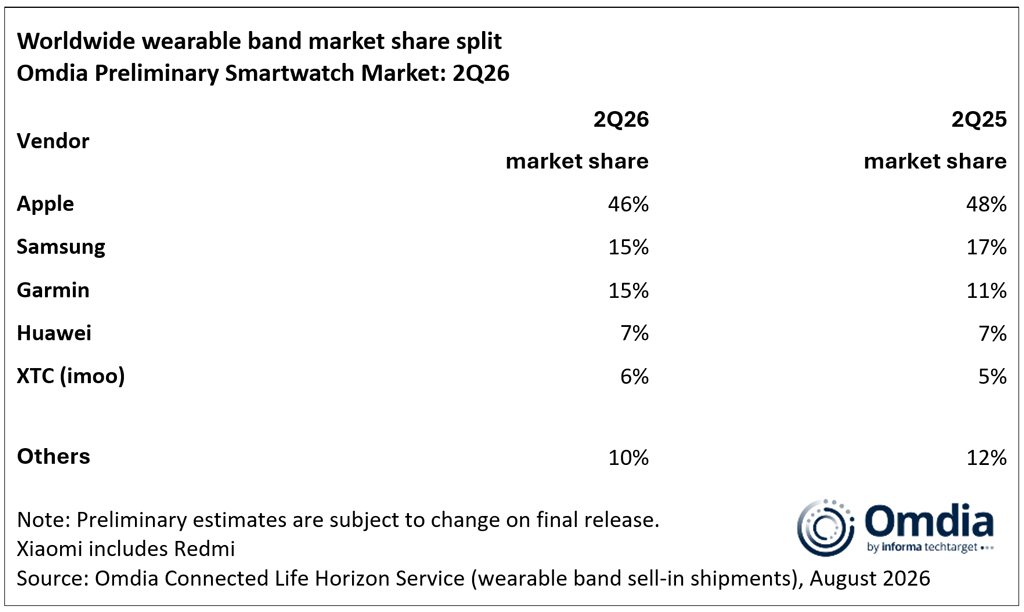
- Apple remained the global market leader in 2Q26 with a 46% market share, although its share declined by 2 percentage points from 48% in 2Q25.
- Samsung held 15% of the market in 2Q26, down from 17% a year earlier, representing a 2-percentage-point decline.
- Garmin recorded the strongest growth among the leading vendors, increasing its market share from 11% in 2Q25 to 15% in 2Q26, a gain of 4 percentage points.
- Samsung and Garmin were tied at 15% market share in 2Q26, placing both vendors behind market leader Apple.
- Huawei maintained a stable 7% market share, showing no year-over-year change between 2Q25 and 2Q26.
- XTC (imoo) increased its share to 6% in 2Q26, up from 5% in 2Q25, gaining 1 percentage point year over year.
- The Others category declined from 12% to 10%, indicating that a larger portion of the market was concentrated among the named leading vendors.
- Despite its decline, Apple’s 46% share was more than three times Samsung’s or Garmin’s 15% share, highlighting its substantial lead in the worldwide wearable band market.
Fitbit vs Apple Watch Sales and Revenue
- Apple’s Wearables, Home and Accessories segment generated $35.69 billion in fiscal 2025 net sales. However, Apple combines Apple Watch with products such as AirPods, accessories, and home products, so this figure is not Apple Watch revenue alone.
- The same Apple segment generated $37.01 billion in fiscal 2024, meaning sales fell about $1.32 billion year over year.
- The segment’s fiscal 2025 revenue declined 4% year over year, while Apple’s companywide sales increased 6%.
- Total Apple net sales reached $416.16 billion in fiscal 2025, putting Wearables, Home and Accessories at roughly 8.6% of company revenue.
- Apple does not disclose Apple Watch unit sales. One 2026 third-party estimate places 2025 Apple Watch shipments at approximately 33.3 million units, following the brand’s return to annual growth.
- Based on that estimate and reported annual growth, 2024 Apple Watch shipments would have been approximately 30.8 million units. This is a calculated estimate, not an Apple-reported figure.
- Fitbit’s estimated 2025 hardware volume equaled only about 13% of the 33.3 million-unit Apple Watch estimate, illustrating the large difference in current hardware scale. This comparison uses third-party estimates for both Fitbit and Apple Watch rather than official company unit disclosures.
- Apple Watch also benefits from the premium end of the market. In India, for example, Apple’s smartwatch shipments grew 141% in 2024, while the country’s total smartwatch market contracted 30%.
- That Indian expansion gave Apple approximately 50% of the country’s premium smartwatch segment in 2024, showing how premium pricing can generate commercial influence even when overall unit share remains modest.
Fitbit vs Apple Watch Users and Brand Popularity
- Current U.S. opinion tracking gives Apple Watch 95% brand awareness, making it one of the most widely recognized wearable product lines.
- Apple Watch records a 53% positive-opinion rating among U.S. adults in the latest available public-opinion snapshot.
- Google Fitbit records 81% awareness in comparable U.S. public-opinion tracking, 14 percentage points below Apple Watch.
- Google Fitbit’s corresponding positive-opinion score stands at 34%, compared with 12% who report a negative opinion.
- Among U.S. wearable users surveyed in 2025, 48% still used the wearable they started with, highlighting the importance of long-term platform retention.
- Another 27% had upgraded to a newer device from the same brand, while only 23% reported switching brands, which helps explain the strength of established Apple and Fitbit ecosystems.
- Nearly half of surveyed owners, 47%, had used wearables for at least three years, suggesting that the category increasingly depends on replacement cycles rather than first-time buyers.
- In separate U.S. brand research, 85% of Apple wearable users showed brand loyalty, giving Apple a substantial advantage in retaining customers within its device ecosystem.
- In a repeat cross-sectional wearable study, current users reported a median usage period of 18 months in 2023, up from seven months in 2016, providing further evidence that consumers now keep and use wearables longer.
Fitbit vs Apple Watch Product Range and Price Comparison
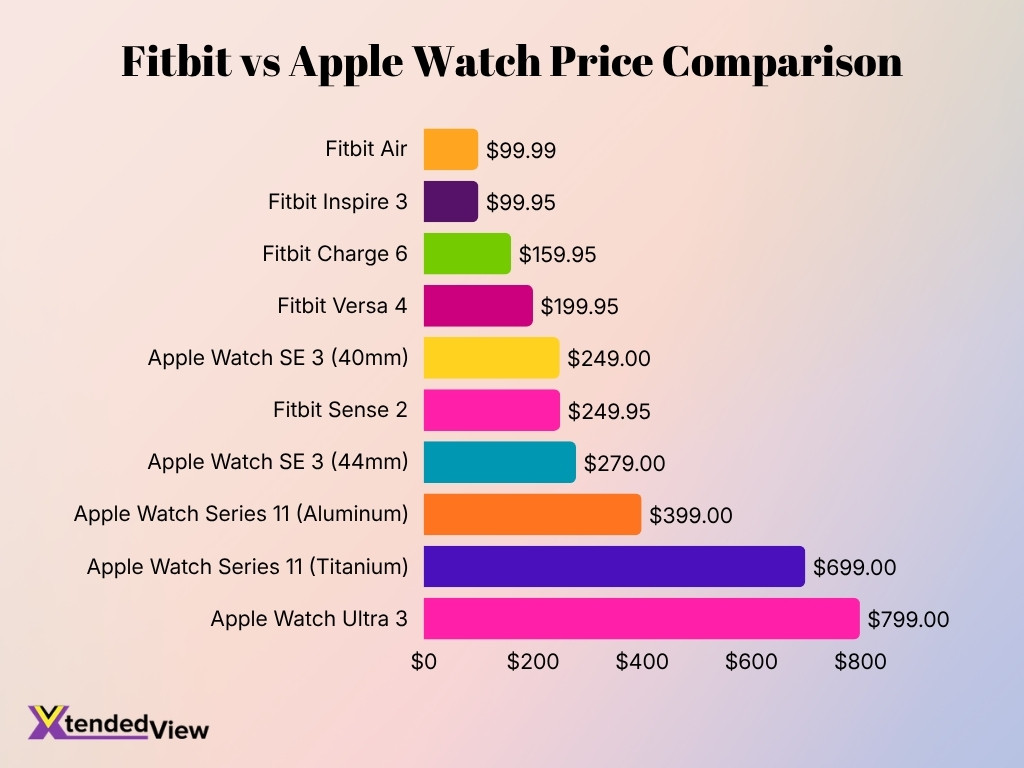
- In 2026, the core Fitbit lineup spans the screenless Fitbit Air, Inspire 3, Charge 6, Versa 4, and Sense 2. The Fitbit Air starts at $99.99, creating a low-cost entry point for passive health tracking.
- Fitbit Inspire 3 carries a $99.95 U.S. list price, making it roughly the same price as Fitbit Air but with a built-in display.
- Fitbit Charge 6 has a $159.95 regular U.S. price, placing it about $60 above Fitbit Air and Inspire 3.
- Fitbit Versa 4 lists for $199.95, while Fitbit Sense 2 sits at $249.95. As a result, Fitbit’s mainstream wearable range covers roughly $100 to $250 before promotions.
- Apple Watch SE 3 starts at $249 in the U.S., matching the top end of Fitbit’s current mainstream range rather than its entry-level products.
- Apple Watch Series 11 starts at $399, which is about $239 more than the regular price of Fitbit Charge 6 and $299 more than Fitbit Air.
- Apple Watch Series 11 buyers can move from a $399 aluminum GPS model to titanium configurations starting around $699, showing a much wider premium-price range than Fitbit offers.
- Apple Watch Ultra 3 starts at $799 for its 49mm titanium configuration, roughly eight times the entry price of Fitbit Air.
- Apple Watch SE 3’s larger 44mm GPS configuration starts at $279, while the 40mm GPS + Cellular version starts at $299. This illustrates how case size and cellular connectivity can increase Apple Watch pricing even within the entry line.
- Overall, Fitbit’s 2026 lineup emphasizes the $100-$250 fitness and health segment, while Apple’s mainstream range starts at $249 and stretches to $799 before luxury configurations. This pricing structure gives Fitbit a clear advantage for buyers who prioritize tracking over smartphone-like watch functions.
Fitbit vs Apple Watch Device Shipments
- Apple shipped 7.6 million watches in Q1 2025, representing 5% year-over-year growth in the broader wrist-worn device analysis.
- Xiaomi shipped 8.7 million wrist-worn devices during the same quarter, meaning Apple’s Q1 volume trailed the market leader by 1.1 million units.
- Huawei shipped 7.1 million units in Q1 2025, putting Apple’s quarterly volume approximately 500,000 units higher.
- By Q3 2025, the worldwide smartwatch market reached 41 million quarterly shipments, up 9% from the same period a year earlier.
- Advanced smartwatch shipments increased 14% year over year in Q3 2025, outperforming the 3% growth recorded by basic smartwatches.
- North American smartwatch shipments increased 15% in Q3 2025, with Apple identified as a primary contributor to the region’s rebound.
- Europe posted an even stronger 16% Q3 2025 shipment increase, again supported primarily by Apple, while China grew 31% as domestic vendors expanded.
- More than half of Apple’s smartwatch shipments in Q2 2025 went to North America, confirming that the U.S.-centered region remains particularly important to Apple Watch volume.
- Fitbit’s estimated 4.3 million full-year device sales show that its volume has moved far below its historical peak. Fitbit sold 21.4 million devices in 2015, meaning its estimated annual volume has fallen about 80% over the decade.
Fitbit vs Apple Watch Subscription Costs
- Google Health Premium, which replaced Fitbit Premium in May 2026, costs $9.99 per month in the U.S.
- The current annual Google Health Premium plan costs $99.99 per year, equivalent to about $8.33 per month when paid annually.
- Fitbit Premium’s previous annual price was $79.99 in 2025, meaning the 2026 annual Google Health Premium price increased by $20, or about 25%.
- Paying monthly for Google Health Premium for a full year costs $119.88, so the $99.99 annual plan saves $19.89 over 12 separate monthly payments.
- Apple Fitness+ costs $9.99 per month in the U.S., matching Google Health Premium’s monthly subscription price.
- Apple Fitness+ costs $79.99 annually, making its yearly plan $20 cheaper than Google Health Premium’s current $99.99 annual subscription.
- Paying for Apple Fitness+ annually saves about $39.89 per year versus paying $9.99 each month for 12 months.
- Eligible new Apple device buyers receive three months of Apple Fitness+ free, while new subscribers without an eligible hardware offer can receive a one-month trial.
- Fitbit Air purchases also include a three-month Google Health Premium trial, linking Fitbit’s $99.99 tracker to its subscription-based coaching and advanced health features.
- Apple Fitness+ can be shared with up to five additional family members, allowing as many as six people to use one eligible subscription while maintaining individual recommendations and histories.
Fitbit vs Apple Watch Battery Life and Charging Time
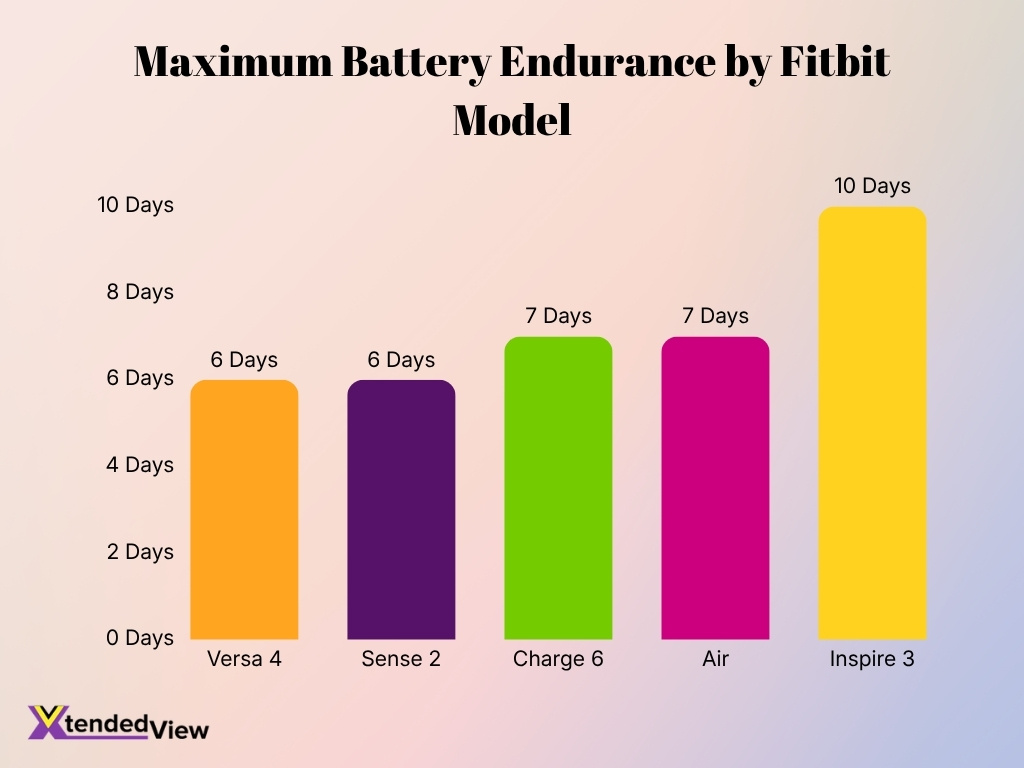
- Fitbit Inspire 3 delivers the longest battery endurance at up to 10 days per charge.
- Fitbit Charge 6 and Fitbit Air provide up to 7 days under typical use.
- Fitbit Versa 4 and Sense 2 offer 6+ days of runtime despite larger smartwatch displays.
- Enabling the always-on display drops Fitbit endurance to as little as 3 days.
- Continuous built-in GPS reduces Charge 6 to 5 hours and Versa 4/Sense 2 to 12 hours.
- Fitbit Air fully charges in 90 minutes, while a 5-minute charge adds 1 day of power.
- Fitbit Inspire 3 and Versa 4 require roughly 2 hours for a 0%–100% charge.
- Apple Watch Series 11 lasts up to 24 hours normally and 38 hours in Low Power Mode.
- Apple Watch Ultra 3 reaches up to 42 hours of standard use and 72 hours in Low Power Mode.
- Series 11 reaches 80% charge in 30 minutes, while SE 3 and Ultra 3 take 45 minutes.
Fitbit vs Apple Watch Design, Display, Weight, and Durability
- Fitbit Air weighs just 12 grams with its band and 5.2 grams without it, making its screenless design substantially lighter than conventional smartwatches.
- Fitbit Inspire 3 weighs 17.69 grams, while Charge 6 weighs 30 grams. Both target users who want less wrist bulk than a conventional smartwatch.
- Fitbit Versa 4 and Sense 2 each weigh approximately 37.64 grams, placing their cases within the weight range of mainstream Apple Watch Series 11 configurations.
- The 42mm aluminum Apple Watch Series 11 weighs 30.3 grams in its GPS configuration, almost identical to the 30-gram Fitbit Charge 6 despite offering a considerably larger display.
- A 46mm aluminum Series 11 weighs 37.8 grams, while its titanium counterpart weighs 43.1 grams. The 42mm titanium version weighs 34.6 grams.
- Apple Watch Ultra 3 weighs approximately 61.6-61.8 grams, making it more than five times as heavy as Fitbit Air with its band.
- Series 11 reaches 2,000 nits peak brightness, SE 3 reaches 1,000 nits, and Ultra 3 reaches 3,000 nits. Higher brightness improves outdoor readability, particularly during running, cycling, and hiking.
- Fitbit Charge 6 uses an AMOLED screen protected by Corning Gorilla Glass 3, while Apple Watch Series 11 uses Ion-X glass on aluminum models and sapphire crystal on titanium versions.
- Fitbit Air and Charge 6 carry 50-meter water-resistance ratings, matching Apple Watch Series 11 and SE 3 for common swimming and everyday water exposure.
- Apple Watch Ultra 3 increases water resistance to 100 meters, supports recreational scuba diving to 40 meters, and carries IP6X dust resistance, making it the more specialized option for demanding outdoor and water activities.
Fitbit vs Apple Watch Compatibility, Operating System, and App Ecosystem
- Current Fitbit devices require Android 11 or iOS 16.4 or later across 2 major mobile platforms.
- Apple Watch Series 11, SE 3, and Ultra 3 require an iPhone 11 or later running iOS 26.
- watchOS 26 supports Apple Watch Series 6 and later, plus SE 2 and later models.
- Installing watchOS 26 requires an iPhone 11 or iPhone SE 3 running iOS 26 or newer.
- The redesigned Google Health app launched in May 2026 around 4 primary category tabs.
- Fitbit Air specifies a maximum wireless sync range of 30 feet via Bluetooth Low Energy.
- Effective May 19, 2026, all remaining users were required to migrate to a Google Account.
- Google Health integrates metrics across 4 external brands: Garmin, Samsung, Whoop, and Oura.
Apple Watch vs. Fitbit Daily Wear Features
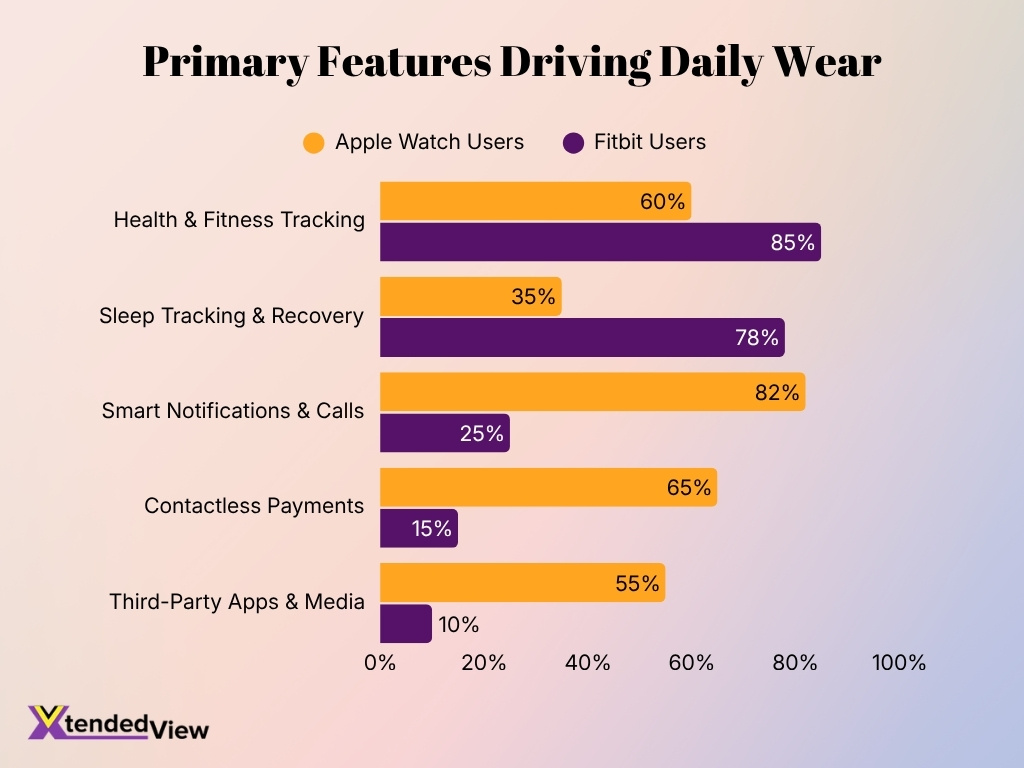
- Health and fitness tracking is the strongest daily-use driver for Fitbit, attracting 85% of Fitbit users, compared with 60% of Apple Watch users.
- Sleep tracking and recovery show another major Fitbit advantage, with 78% of users relying on the feature versus just 35% of Apple Watch users.
- Smart notifications and calls are the leading Apple Watch use case at 82%, more than three times Fitbit’s 25%.
- Contactless payments are significantly more popular among Apple Watch users, with 65% using the feature compared with only 15% of Fitbit users.
- Third-party apps and media drive daily wear for 55% of Apple Watch users, while the feature accounts for just 10% of Fitbit users.
- Overall, the data suggests Fitbit is more strongly associated with health, fitness, and recovery, while the Apple Watch leads in communication, payments, apps, and broader smartwatch functionality.
Fitbit vs Apple Watch GPS and Fitness Tracking Accuracy
- Fitbit Charge 6 supports three GPS approaches: built-in GPS, phone-connected GPS, and Dynamic GPS, which can select the phone’s GPS when it is nearby to preserve tracker battery life.
- Fitbit Sense 2 and Versa 4 also support Dynamic and built-in GPS, while Inspire 3 and the 2026 Fitbit Air rely on connected phone GPS rather than independent onboard GPS.
- Apple Watch Series 11 uses L1 GPS alongside GLONASS, Galileo, QZSS, and BeiDou, while Ultra 3 adds L1 and L5 dual-frequency precision GPS for more challenging positioning environments.
- In a controlled walking study published in 2025, Apple Watch recorded only about 1% relative step-count error at moderate and fast treadmill speeds. Error increased to roughly 4% during slow treadmill walking.
- During overground walking in that study, Apple Watch errors ranged from approximately 1% to 5% across tested walking speeds and generally remained lower than the comparison research-grade accelerometers.
- Another 2025 investigation of slow and altered walking found Apple Watch worn at the waist differed from manually counted steps by only 1.9%, while a Fitbit Charge worn on the leg differed by 4.7%. Device placement materially affected results.
- A 2026 validation study found Fitbit Charge 6 heart-rate mean absolute percentage error of 5.1% in neutral conditions, 5.8% in hot conditions, and 4.1% in cold conditions.
- In the same 2026 study, Fitbit Inspire 3 showed materially larger heart-rate errors, 11.4% in neutral conditions, 24.4% in hot conditions, and 10.1% in cold conditions. This illustrates how accuracy can differ substantially even within one brand.
- Earlier controlled athlete testing found Apple Watch heart-rate measurements achieved a 0.96 concordance coefficient against ECG measurements, compared with 0.89 for the Fitbit model tested. The study involved 50 athletic adults running at six treadmill speeds from 4 to 9 mph.
- Therefore, neither brand should be treated as a clinical reference device for every metric. Current evidence generally gives Apple Watch strong results for step and heart-rate measurement, while Fitbit Charge 6 performs well for heart rate but can depend more heavily on phone-assisted GPS for reliable outdoor route tracking.
Fitbit vs Apple Watch Workout and Exercise Tracking
- Fitbit Charge 6 supports 40+ exercise modes, including running, cycling, strength training, and yoga, while displaying live workout metrics directly on the wrist.
- Charge 6 also includes built-in GPS, allowing users to record outdoor pace and distance without carrying a phone.
- Fitbit’s Active Zone Minutes system gives users double credit for minutes spent in cardio or peak heart-rate zones, tying exercise goals directly to workout intensity.
- Charge 6 can transmit real-time heart-rate data to compatible gym equipment using the Bluetooth Heart Rate Profile, extending tracking beyond the wearable itself.
- Apple Watch supports more than 70 named workout categories, ranging from running and swimming to pickleball, skiing, martial arts, rowing, and wheelchair workouts.
- Apple Watch Series 11 provides advanced running metrics such as stride length, ground contact time, and vertical oscillation, along with Race Route, Pacer, and custom workouts.
- For cycling, Series 11 can record cadence and power data, calculate Functional Threshold Power, and organize effort into power zones when compatible sensors are connected.
- A 2026 validation study involving 40 healthy adults found Apple Watch Series 10 underestimated VO2 max by an average of 6.25 mL/kg/min and produced a mean absolute percentage error of 13.2% versus indirect calorimetry.
- A 2025 study of 35 adults found Apple Watch Series 7 underestimated energy expenditure during cycle-ergometer exercise by an average of 27.4 kcal, showing that calorie estimates remain less dependable than basic activity or heart-rate measurements.
Heart Rate Accuracy: Apple Watch vs. Fitbit
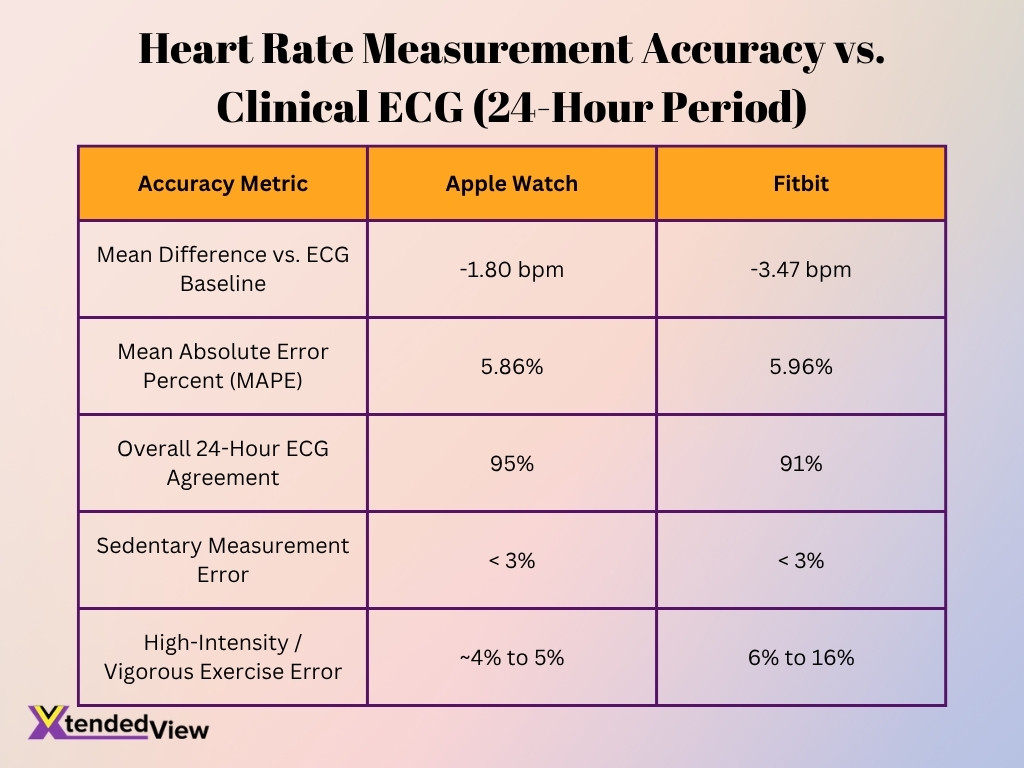
- The Apple Watch showed a smaller mean difference from clinical ECG readings at -1.80 bpm, compared with -3.47 bpm for Fitbit, indicating closer overall alignment with the ECG baseline.
- Mean Absolute Percentage Error was nearly identical, at 5.86% for Apple Watch and 5.96% for Fitbit, showing comparable average heart rate accuracy.
- Over the full 24-hour monitoring period, Apple Watch achieved 95% ECG agreement, outperforming Fitbit at 91%.
- During sedentary activity, both Apple Watch and Fitbit recorded measurement errors of less than 3%, suggesting strong accuracy at rest.
- The biggest accuracy gap emerged during high-intensity or vigorous exercise, where Apple Watch error remained around 4% to 5%, while Fitbit error ranged from 6% to 16%.
- Overall, the data suggests Apple Watch provides more consistent heart rate measurements, particularly during vigorous exercise, while both devices perform similarly during low-activity periods.
Fitbit vs Apple Watch Sleep, Stress, and Recovery Tracking
- Fitbit Charge 6 automatically estimates time spent awake and in light, deep, and REM sleep, then converts overnight information into a personalized Sleep Score.
- In a laboratory comparison of Fitbit Sense 2 and Apple Watch Series 8 against polysomnography, both devices achieved at least 95% sensitivity for identifying sleep versus wakefulness.
- In that 35-person study, Fitbit Sense 2 overestimated light sleep by approximately 18 minutes and underestimated deep sleep by about 15 minutes.
- Sleep-stage sensitivity in the same study ranged from 61.7% to 78.0% for Fitbit and 50.5% to 86.1% for Apple Watch, indicating that neither consumer device matched polysomnography consistently across every sleep stage.
- A separate Fitbit validation study reported 95% sleep sensitivity and 57% specificity, with approximately 54% overall agreement when distinguishing sleep from wake epochs against an EEG-based reference.
- Apple Watch sleep-apnea monitoring requires at least 10 nights of wear within 30 days before its algorithm has sufficient information for periodic evaluation.
- Apple Watch analyzes breathing disturbances over a 30-day window and can notify eligible adults when the pattern shows consistent signs associated with moderate to severe sleep apnea.
- Fitbit’s 2026 Readiness Score uses a 100-point scale; 65 or above indicates high readiness, 30-64 indicates moderate readiness, and 29 or below signals low readiness and a greater need for recovery.
- Fitbit’s newer Resilience metric uses more than 10 tracked factors across responsiveness, exertion balance, and sleep patterns to assess how prepared the body is to handle physiological and mental strain.
- Fitbit Sense-series devices can identify sudden autonomic responses using continuous sensors. When a body-response event occurs, users may receive a reflection prompt approximately 10 minutes later.
Fitbit vs Apple Watch Safety, Privacy, and Security Features
- Fitbit collects up to 24 unique data types, making it the highest data collector among major fitness apps.
- Apple Watch fall detection demonstrates a 76.99% sensitivity rate for accurately identifying standard-induced falls.
- Wearable fall detection algorithms maintain a highly reliable 1.7% false-alarm rate during routine daily activities.
- Apple Watch accurately detects only 4.7% of intentional falls when the user is operating a wheelchair.
- An unsecured third-party database exposed 61 million health records from both Apple and Fitbit users.
- Approximately 79% of popular health apps share sensitive user metrics with third parties for targeted advertising.
- Only 28% of wearable device users remain fully aware that their health data is shared with external organizations.
- Over 78% of fitness applications transmit data to major tech companies even when user accounts are set to private.
Fitbit vs Apple Watch Customer Satisfaction and User Reviews
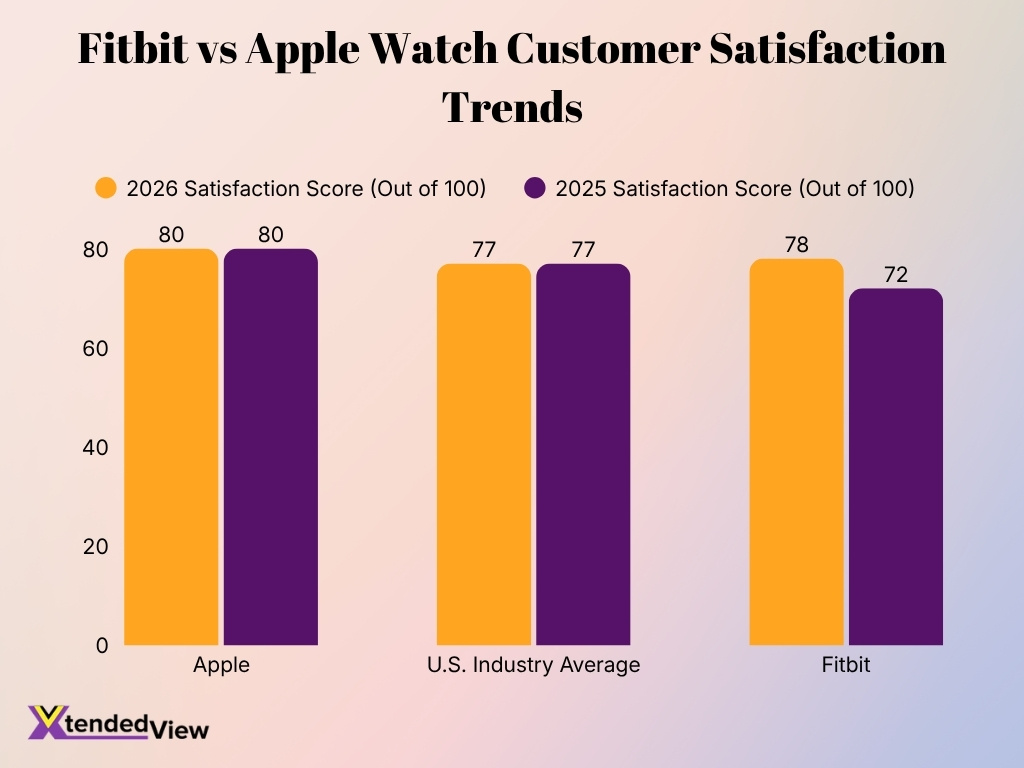
- U.S. smartwatch customer satisfaction held at 77 out of 100 in 2026, unchanged from the industry’s 2025 benchmark.
- Apple earned a customer-satisfaction score of 80 in both 2025 and 2026, showing stable satisfaction despite continued competition and higher premium pricing.
- Fitbit improved from 72 in 2025 to 78 in 2026, a six-point gain and an increase of roughly 8% year over year.
- The improvement narrowed Apple’s satisfaction lead over Fitbit from 8 points in 2025 to just 2 points in 2026.
- Across smartwatch owners, usability of fitness and activity tracking improved from 81 in 2025 to 83 in 2026, making it one of the industry’s highest-rated experience measures.
- Satisfaction with smartwatch battery life increased from 76 to 80 between 2025 and 2026, while GPS quality improved from 78 to 81.
- Sleep-tracking usability rose from 79 in 2025 to 81 in 2026, showing that overnight health features now contribute more strongly to the overall smartwatch experience.
- App and accessory connectivity recorded one of the largest improvements, rising four points from 79 to 83 in 2026.
- Historical user-experience research also shows a major shift in brand preference. Apple accounted for 44% of wearable activity-monitor users in a 2023 survey compared with Fitbit’s 21%, whereas Fitbit held 68% and Apple just 3% in the comparable 2016 survey.
- In that study, current wearable users reported a median usage duration of 18 months, up from seven months in 2016, although respondents also reported more technical issues and discomfort than users in the earlier survey.
Frequently Asked Questions (FAQs)
Apple Watch held 23% of global smartwatch shipments in Q1 2026, up from 20% in Q1 2025; its share was 20% in Q2 2026.
Apple Watch shipments increased 21% year over year in Q1 2026, the fastest growth among the top 10 smartwatch brands during the quarter.
Apple Watch scored 80 out of 100, while Google Fitbit scored 78, leaving Apple ahead by 2 points; Fitbit’s score increased 8% year over year.
Apple’s Wearables, Home and Accessories segment generated $35.69 billion in fiscal 2025, down 4% from $37.01 billion in 2024; Apple does not disclose Apple Watch revenue separately.
Worldwide smartwatch shipments increased 4% year over year in 2025, reversing the market’s decline in 2024.
Conclusion
The statistics show that Fitbit and Apple Watch now serve somewhat different priorities within the wearable market. Fitbit continues to stand out for lower prices, longer battery life, sleep tracking, recovery insights, and continuous health monitoring, making it particularly attractive to users who want focused wellness tracking without a full smartwatch experience. Apple Watch, by comparison, offers a broader ecosystem built around workouts, apps, communication, advanced health features, and emergency functions such as Fall Detection, Crash Detection, and Emergency SOS.
Independent research also shows that both platforms can provide useful measurements for heart rate, activity, sleep, and other health-related metrics, although accuracy varies by device, activity, environment, and measurement type. Consumer wearables should therefore be viewed as tools for tracking trends and supporting daily health decisions rather than as universal substitutes for clinical equipment. Overall, the better choice depends on whether a user values Fitbit’s simplicity, endurance, and health-focused design or Apple Watch’s wider smartwatch capabilities, deeper device integration, and more extensive safety ecosystem.
