


Wireless adapters remain a critical link between computers, connected devices and modern Wi-Fi networks. In homes, USB adapters help extend the useful life of desktops and older laptops, while businesses rely on PCIe, M.2 and embedded wireless connectivity to support hybrid work, high-density offices, industrial systems and edge devices. The shift toward Wi-Fi 6E and Wi-Fi 7 is accelerating these upgrade cycles by adding access to 6 GHz spectrum, wider channels, lower latency and faster multi-gigabit performance.
These improvements matter for real-world applications such as cloud gaming, AI workloads, video collaboration and large-file transfers. As more routers, access points and client devices adopt newer Wi-Fi standards, wireless adapters continue to serve as an important upgrade path for systems that lack built-in next-generation connectivity.
Editor’s Choice
- The worldwide Wi-Fi adapter market is estimated at $3.47 billion in 2026, compared with approximately $3.43 billion in 2025.
- Longer-term projections place the Wi-Fi adapter market at approximately $4.76 billion by 2032, implying a 4.82% CAGR from 2025 through 2032.
- The global USB Wi-Fi adapter segment is forecast to rise from $2.3 billion in 2026 to $4.2 billion by 2033, with an estimated CAGR of 8.9%.
- Wi-Fi 7 generated $958.4 million in enterprise dependent access point revenue during Q1 2026, up 348% year over year from $214.1 million.
- Wi-Fi 7’s share of enterprise dependent AP revenue increased from less than 1% in Q1 2024 to 44.5% in Q1 2026, showing how quickly compatible wireless infrastructure has entered mainstream deployment.
- By comparison, Wi-Fi 6 represented 34.8% of enterprise dependent AP revenue in Q1 2026, down sharply from 54.4% in Q1 2025.
- Wi-Fi 7 is expected to account for 54% of global broadband CPE shipments through operator channels by 2030, strengthening the installed infrastructure base that compatible adapters can use.
- Current Wi-Fi 7 client technology supports theoretical speeds as high as 6.5 Gbps in some implementations, along with 4096-QAM, Multi-Link Operation and PCI Express 4.0 or USB 3.0 interfaces.
Recent Developments
- Enterprise Wi-Fi 7 adoption accelerated sharply in early 2026: its share of dependent AP revenue reached 44.5% in Q1, up 32.7 percentage points from 11.8% a year earlier.
- Wi-Fi 7 enterprise dependent AP revenue increased 348% year over year in Q1 2026, rising from $214.1 million to $958.4 million.
- During Q4 2025, Wi-Fi 7 already represented 39.7% of enterprise dependent AP revenue, compared with 10.25% in Q4 2024.
- Wi-Fi 6E accounted for another 20% of enterprise dependent AP revenue in Q4 2025. Combined, Wi-Fi 6E and Wi-Fi 7 captured roughly 60 cents of every dollar spent in the segment.
- Wi-Fi 7 client adoption also expanded during 2025. About one in six laptops shipped worldwide supported the new standard, based on a reported 17% adoption rate.
- The U.S. regulatory environment gives Wi-Fi 6E and Wi-Fi 7 equipment substantial spectrum to use. Current rules provide access to 1,200 MHz across the 6 GHz band for qualifying unlicensed operations.
- New embedded adapter options continued entering the market in 2026. One Wi-Fi 7 embedded module launched in Q1 2026 with 5.8 Gbps maximum speed, 320 MHz channels, 4096-QAM and Bluetooth 5.4 support.
- Patent activity also shows the commercial importance of newer wireless standards. In August 2026, two major technology companies signed a multiyear cross-license agreement covering Wi-Fi patents, including Wi-Fi 7 technology.
Global Wireless Adapter Market Size and Growth
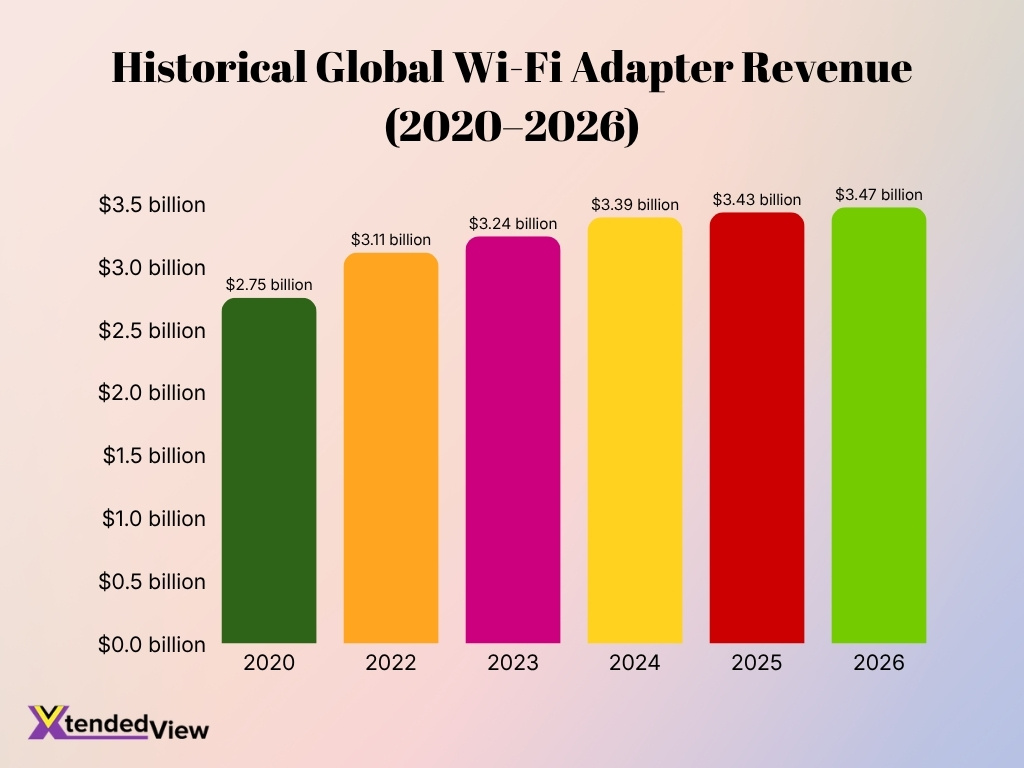
- The global Wi-Fi adapter market increased from approximately $2.75 billion in 2020 to $3.43 billion in 2025, an increase of roughly 24.5% over five years.
- Market value reached about $3.11 billion in 2022, representing 7.46% annual growth and one of the stronger expansion years in the reported 2020-2025 period.
- In 2023, the market increased to approximately $3.24 billion, a 4.27% gain from the previous year.
- Global Wi-Fi adapter revenue then reached approximately $3.39 billion in 2024, with annual growth of 4.73%.
- Growth slowed in 2025, when the estimated market reached $3.43 billion, only 0.94% above the previous year.
- The 2026 market estimate of approximately $3.47 billion represents another 1.32% annual increase, indicating a relatively measured market before projected stronger expansion later in the forecast period.
- USB Wi-Fi adapters show a faster growth profile than the broader adapter estimate. The segment is projected to expand at an 8.9% CAGR between 2026 and 2033.
- Meanwhile, the enterprise WLAN infrastructure market grew 11.4% in 2025 to $10.5 billion. Although WLAN infrastructure is a separate market from client adapters, this growth provides an important demand signal because newer access points encourage endpoint upgrades.
Wireless Adapter Market Forecast and Projections
- One 2026 market forecast expects global Wi-Fi adapter revenue to rise from $3.43 billion in 2025 to $4.76 billion in 2032, representing approximately $1.33 billion in additional annual market value.
- That forecast corresponds to a 4.82% CAGR between 2025 and 2032, although year-to-year growth is expected to vary considerably.
- The market is projected to reach approximately $3.80 billion in 2027, which would represent a 9.51% annual increase from the 2026 estimate.
- The same outlook estimates global Wi-Fi adapter revenue of roughly $3.98 billion in 2029, moving the market close to the $4 billion threshold.
- By 2030, Wi-Fi adapter market revenue could reach approximately $4.29 billion, an estimated 7.92% increase from 2029.
- The USB Wi-Fi adapter segment has a stronger projected growth curve, moving from $2.3 billion in 2026 to $4.2 billion in 2033.
- Wi-Fi 7 infrastructure adoption could support these forecasts. Wi-Fi 7 is projected to represent 54% of operator-channel broadband CPE shipments by 2030, making the standard increasingly common in consumer networks.
- Earlier ecosystem forecasts expected annual Wi-Fi 7 device volumes to move from more than 233 million devices in 2024 toward 2.1 billion devices by 2028. The scale of that transition supports continued demand for compatible desktop, laptop and embedded connectivity hardware.
Market Segmentation by Interface Technology
- Modern wireless adapter research divides the market across several connectivity technologies, including Wi-Fi, Bluetooth and cellular, while Wi-Fi products themselves span multiple IEEE generations.
- Wi-Fi 7 corresponds to IEEE 802.11be and adds technologies such as 320 MHz channels, Multi-Link Operation and 4096-QAM to increase throughput and improve latency.
- A current 2×2 Wi-Fi 7 client adapter can achieve a maximum PHY rate of 5.8 Gbps using a 320 MHz channel and 4096-QAM.
- By comparison, a lower-tier Wi-Fi 7 adapter implementation with 160 MHz and 1024-QAM has a listed maximum speed of 2.4 Gbps, showing how performance can vary substantially even within the same Wi-Fi generation.
- Another Wi-Fi 7 client platform reaches up to 6.5 Gbps through dual-band, dual-concurrent operation and supports 2.4 GHz, 5 GHz and 6 GHz frequencies.
- That client platform also supports both PCI Express 4.0 and USB 3.0 host interfaces, allowing manufacturers to use the same underlying wireless technology across different device designs.
- Wi-Fi 7’s 4096-QAM can provide a 20% higher transmission rate than 1024-QAM under suitable radio conditions, increasing potential throughput without relying solely on additional spectrum.
- Multi-Link Operation allows compatible Wi-Fi 7 devices to transmit and receive over multiple wireless links, while 320 MHz channels double the maximum channel width associated with the previous 160 MHz generation. Together, these capabilities make interface technology a larger differentiator in premium adapters.
Wireless Adapter Market Share by Form Factor
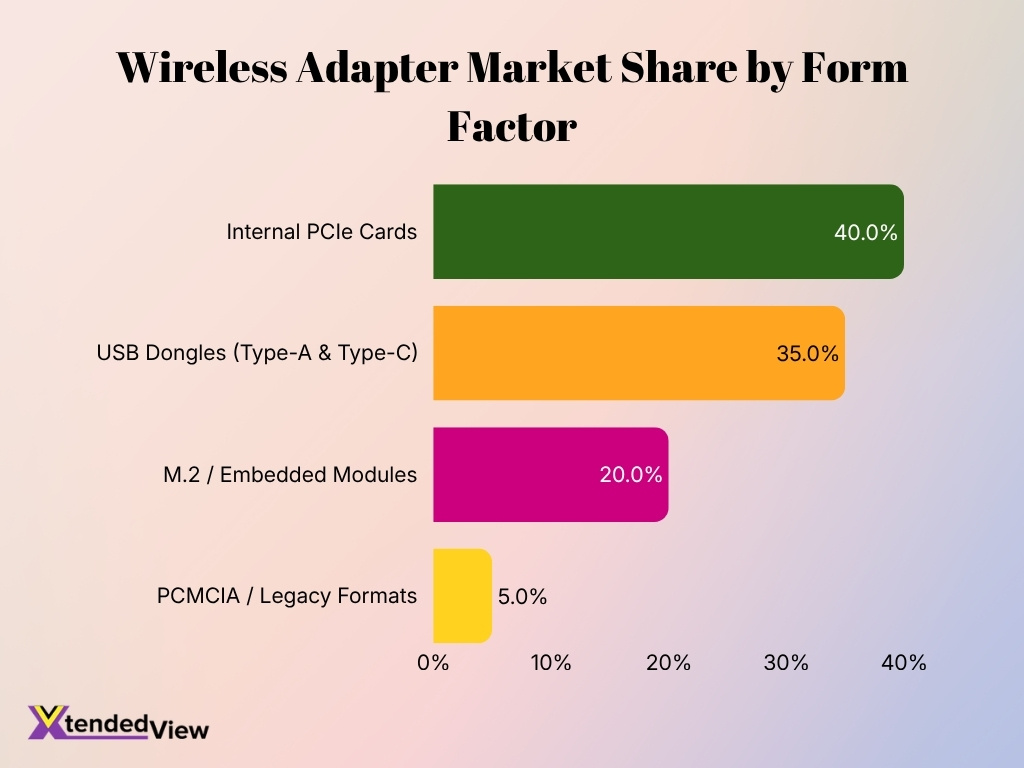
- Internal PCIe cards dominate the wireless adapter market, accounting for an estimated 40.0% share in 2026.
- USB dongles, including Type-A and Type-C models, hold a substantial 35.0% market share, making them the second-largest form factor.
- Together, PCIe cards and USB dongles control 75.0% of the market, highlighting strong demand for easily installed wireless connectivity solutions.
- M.2 and embedded wireless modules represent 20.0% of the market, supported by their integration into compact PCs, laptops and embedded devices.
- PCMCIA and other legacy formats account for just 5.0%, reflecting the continued shift toward newer PCIe, USB and M.2 technologies.
Regional Wireless Adapter Market Statistics
- Asia Pacific generated approximately $454.4 million in wireless USB adapter revenue in 2025, equal to about 33.8% of the worldwide market.
- North America represented roughly 30.4% of 2025 revenue, equivalent to approximately $408.7 million. Strong home networking and PC upgrade demand keeps the region close to the global lead.
- Europe generated around $346.8 million in wireless USB adapter revenue during 2025 and accounted for approximately 25.8% of worldwide sales.
- Latin America accounted for approximately $87.2 million, or 6.5%, of global wireless USB adapter revenue in 2025.
- The Middle East and Africa contributed roughly $48.1 million in 2025, representing about 3.6% of worldwide wireless USB adapter revenue.
- The three largest regions, Asia Pacific, North America and Europe, collectively generated approximately 89.9% of global wireless USB adapter revenue in 2025, based on the reported regional shares.
- Asia Pacific’s 2025 wireless USB adapter revenue exceeded North America’s by approximately $45.7 million, illustrating how narrow the gap remains between the two largest regional markets.
- Looking at the broader Wi-Fi adapter category, Asia Pacific generated approximately $1.32 billion in 2025, compared with about $933.3 million in North America and $789 million in Europe.
- Asia Pacific also led the PCIe wireless adapter segment in a separate 2025 assessment, with approximately 39.2% of global revenue and an estimated market value of $1.49 billion.
Wi-Fi Standard Adoption Rates in Wireless Adapters
- Wi-Fi 5 remains the most widely used enterprise wireless generation in one 2026 survey, accounting for 43% of current deployments. This installed base helps preserve demand for lower-cost backward-compatible adapters.
- Approximately 19% of organizations already deploy Wi-Fi 6E or Wi-Fi 7, indicating that next-generation infrastructure has moved beyond early testing but has not yet replaced legacy Wi-Fi at most organizations.
- Another 59% of organizations plan to deploy Wi-Fi 6E or Wi-Fi 7 within the next year, creating a significant endpoint-upgrade opportunity for compatible wireless adapters.
- Wi-Fi 6E has already reached full deployment at 12% of surveyed organizations, while another 22% report that the standard remains in the pilot stage.
- Wi-Fi 7 has reached full deployment at 7% of organizations, while 15% are piloting the technology. This puts current deployment plus pilot activity at 22%.
- For the next 12 months, 30% of organizations plan Wi-Fi 6E deployments, compared with 29% that plan Wi-Fi 7 deployments.
- Over the longer two-to-five-year window, 39% plan Wi-Fi 7 deployments, substantially above the 28% planning Wi-Fi 6E. This suggests Wi-Fi 7 will increasingly influence adapter replacement decisions.
- Across the wireless USB adapter segment specifically, Wi-Fi 6 and Wi-Fi 6E accounted for approximately 52.6% of 2025 revenue, versus 36.2% for Wi-Fi 5.
- Legacy Wi-Fi 4 and older standards still represented 11.2% of wireless USB adapter revenue in 2025, showing that older PCs and cost-sensitive deployments continue to support a measurable replacement market.
Wireless Adapter Market Share by End-Use
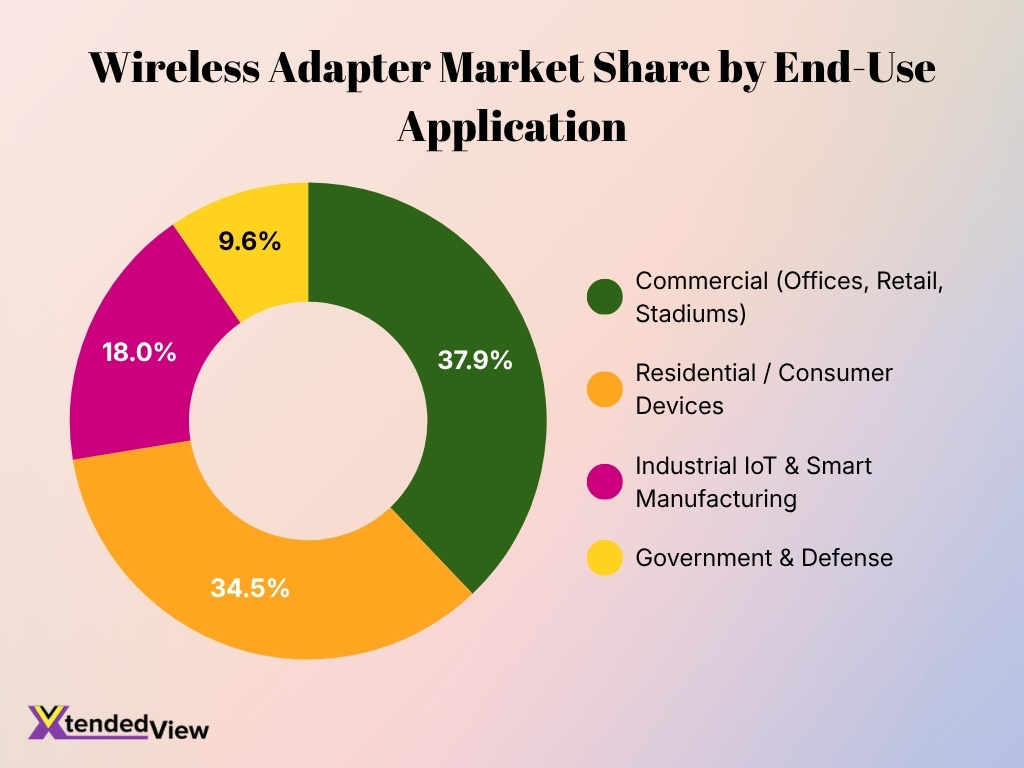
- The commercial sector leads the wireless adapter market in 2026, accounting for 37.9% of total market revenue, driven by demand across offices, retail environments and stadiums.
- Residential and consumer devices represent the second-largest segment at 34.5%, highlighting strong demand for wireless connectivity in home electronics and personal devices.
- Together, commercial and residential applications account for 72.4% of market revenue, making them the dominant end-use categories for wireless adapters.
- Industrial IoT and smart manufacturing capture 18.0% of the market, reflecting growing wireless connectivity requirements across connected equipment, automation and industrial systems.
- Government and defense hold the smallest share at 9.6%, although the sector still represents nearly one-tenth of total wireless adapter market revenue.
- The commercial segment exceeds residential applications by just 3.4 percentage points, indicating relatively balanced demand across business and consumer environments.
USB and PCIe Wireless Adapter Market Statistics
- The worldwide wireless USB adapter market reached approximately $1.35 billion in 2025, up 6.62% from the previous year.
- The same market is estimated at roughly $1.44 billion in 2026, representing another 6.71% year-over-year increase.
- Across the broader Wi-Fi adapter market, USB models generated approximately $2.21 billion in 2025 and controlled 64.6% of revenue.
- PCIe and M.2 adapters collectively generated approximately $1.21 billion in 2025, equivalent to 35.4% of the broader Wi-Fi adapter market.
- Within the Wi-Fi 6 adapter segment specifically, USB models accounted for 61.5% of 2025 revenue, making them the dominant hardware interface.
- PCIe adapters represented approximately 27.4% of Wi-Fi 6 adapter revenue in 2025, while M.2 modules contributed another 11.2%.
- Wi-Fi 6 PCIe adapter revenue totaled an estimated $306.7 million in 2025, compared with $688.4 million for USB Wi-Fi 6 products and $124.9 million for M.2 modules.
- A separate assessment of the PCIe wireless adapter category valued the market at approximately $3.8 billion in 2025 and forecasts an 8.7% CAGR through 2034. Market definitions vary, so this estimate should not be combined directly with narrower Wi-Fi-only figures.
- Online retail generated approximately 63.9% of wireless USB adapter sales revenue in 2025, compared with 36.1% for physical electronics stores, reinforcing the category’s strong direct-to-consumer purchasing pattern.
Wireless Adapter Adoption by Device Category
- Worldwide PC shipments exceeded 270 million units in 2025, increasing 9.1% from 247.6 million units in 2024. Each new PC expands the installed base of integrated or aftermarket wireless connectivity.
- Global PC shipments reached 71.5 million units in Q4 2025, up 9.3% year over year from 65.4 million units.
- Traditional PC shipments totaled 65.6 million units in Q1 2026, representing 3% growth from the same quarter of 2025.
- Traditional PCs and tablets together shipped 103.3 million units in Q1 2026, up 2.8% year over year. These categories represent a major installed base for integrated Wi-Fi radios and external adapters.
- AI PCs accounted for approximately 31% of worldwide PC shipments in 2025, creating demand for high-throughput wireless connectivity alongside increasingly capable local processors.
- AI PC shipments are projected to reach approximately 143.1 million units in 2026, equal to 54.7% of the worldwide PC market under that forecast.
- AI-equipped laptops are projected to represent 58.7% of laptop shipments in 2026, compared with 35.7% in 2025 and 19.4% in 2024.
- AI desktops are expected to rise from 16.4% of desktop shipments in 2025 to 42.1% in 2026, creating a larger premium desktop base where integrated or PCIe Wi-Fi 6E and Wi-Fi 7 hardware can be paired with AI-capable systems.
- Tablet shipments are forecast at approximately 138.9 million units in 2026, although that would represent an 8.6% year-over-year decline. Tablets predominantly use integrated wireless radios rather than external adapters, but they remain an important indicator of Wi-Fi endpoint demand.
Enterprise and Consumer Wireless Adapter Usage Statistics
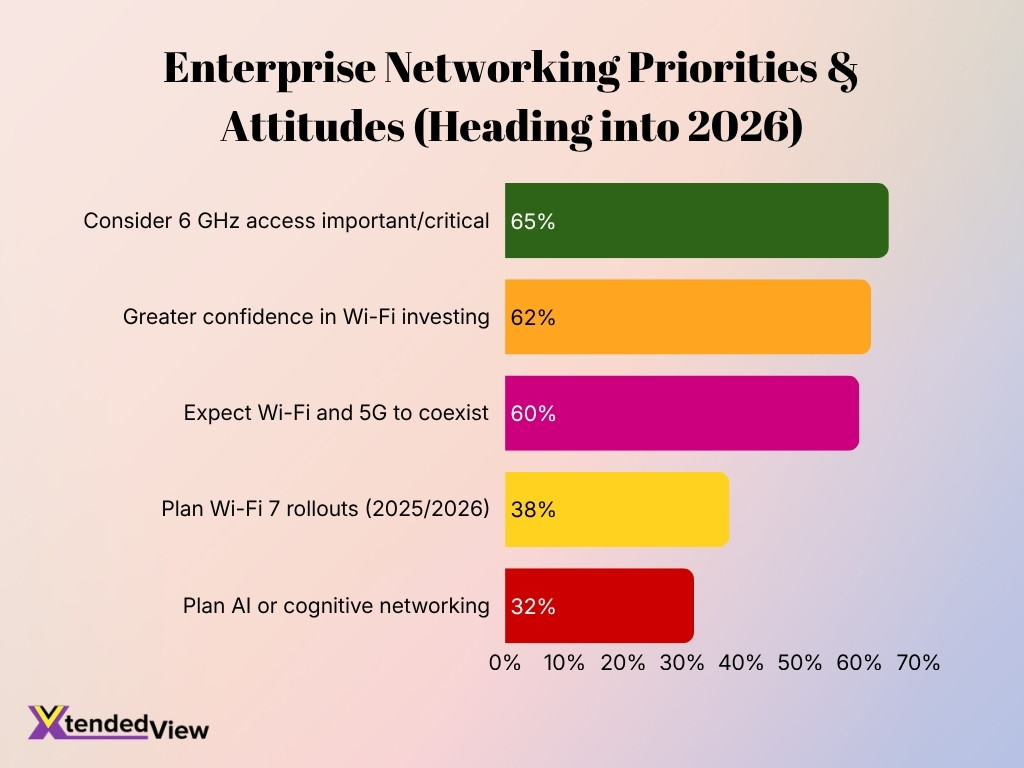
- 62% of wireless industry respondents reported greater confidence in investing in Wi-Fi heading into 2026 than they had 12 months earlier. Another 18% reported unchanged confidence.
- Approximately 38% of respondents planned Wi-Fi 7 rollouts during 2025 or 2026, making it one of the clearest near-term enterprise wireless investment priorities.
- 65% consider access to the 6 GHz band important or critical to their Wi-Fi business, strengthening the case for Wi-Fi 6E and Wi-Fi 7 adapters that can use that spectrum.
- 60% expect Wi-Fi and 5G to coexist as complementary technologies that increase enterprise flexibility rather than forcing organizations to choose one connectivity method.
- Approximately 32% plan to deploy AI or cognitive networking technologies, which could raise requirements for wireless telemetry, automation and high-performance endpoint connectivity.
- Enterprise deployments of Wi-Fi 6E and Wi-Fi 7 access points increased 23% during the second half of 2025 across a telemetry base covering five million networks.
- The number of 6 GHz clients on those networks increased 60% during 2025, indicating that compatible endpoint devices are expanding alongside next-generation infrastructure.
- On the consumer side, global retail Wi-Fi equipment shipments fell 6% year over year in Q1 2026 as broadband providers increasingly supplied higher-quality equipment with subscriptions.
- The retail Wi-Fi equipment market ended 2025 at nearly 34% below its 2021 shipment peak, marking a fourth consecutive annual decline. The shift increases the importance of endpoint upgrades, mesh systems and targeted performance products rather than basic router replacement.
Gaming and High-Performance Adapter Market Trends
- Typical Wi-Fi 7 client performance can reach approximately 5.8 Gbps, compared with roughly 2.4 Gbps for Wi-Fi 6 under comparable client configurations.
- That comparison gives Wi-Fi 7 roughly 2.4 times the typical throughput of Wi-Fi 6, providing more headroom for game downloads, high-resolution streaming and multiple active users.
- Wi-Fi 7 can reduce wireless latency by approximately 60% compared with Wi-Fi 6 under supported conditions, an important improvement for interactive gaming and other latency-sensitive applications.
- Wi-Fi 7 has a theoretical maximum physical-layer speed of approximately 46 Gbps, although real client performance remains far below that figure and depends on hardware, spectrum and network conditions.
- The standard supports channels as wide as 320 MHz, twice the 160 MHz maximum available to Wi-Fi 6E, giving high-performance adapters substantially more spectrum for peak transfers.
- Wi-Fi 7’s 6 GHz support allows gaming systems to use less-congested spectrum while Multi-Link Operation can coordinate multiple wireless links for improved reliability and latency behavior.
- WPA3 used with modern Wi-Fi adapters can employ 256-bit AES encryption, compared with 128-bit AES associated with WPA2 configurations, combining higher wireless performance with stronger current-generation security.
- Retail market data for Q1 2026 identifies cloud and online gaming as drivers of demand for gaming-focused wireless equipment, even as the overall consumer Wi-Fi hardware market declined 6% year over year.
- Gaming performance does not depend on branding alone. Independent 2026 latency testing found that premium “gaming” positioning does not automatically produce the lowest wireless latency, making the underlying Wi-Fi generation, radio design and client adapter capability more important purchasing factors.
Key Vendor Market Share and Competitive Landscape
- The top five suppliers generated 52% of global revenue in 2025, leaving 48% for smaller brands.
- TP-Link, Netgear, ASUS, D-Link, and Linksys collectively held over 50% of total market revenue.
- TP-Link, ASUS, and Netgear accounted for 30% of global volume, with 70% distributed among long-tail competitors.
- Low-cost manufacturers aggressively control the sub-$20 segment, restricting pricing power across cost-sensitive markets.
- A US online retail search tracked 45 competing products for mainstream Wi-Fi USB adapters in August 2026.
- The top 10 US online products averaged 4,200 monthly sales, with peak models reaching 10,000 units.
- Market tracking identified 44 Wi-Fi 7 products in July 2026, with top-tier monthly volumes spanning 500 to 5,000 units.
- The leading enterprise WLAN vendor captured 38.9% revenue share in Q1 2026, followed by peers at 19.9%, 13%, and 6%.
- Rapidly growing enterprise networking rivals achieved 29.1% and 27.7% year-over-year growth in Q1 2026.
Wireless Adapter Pricing and Average Selling Price Trends
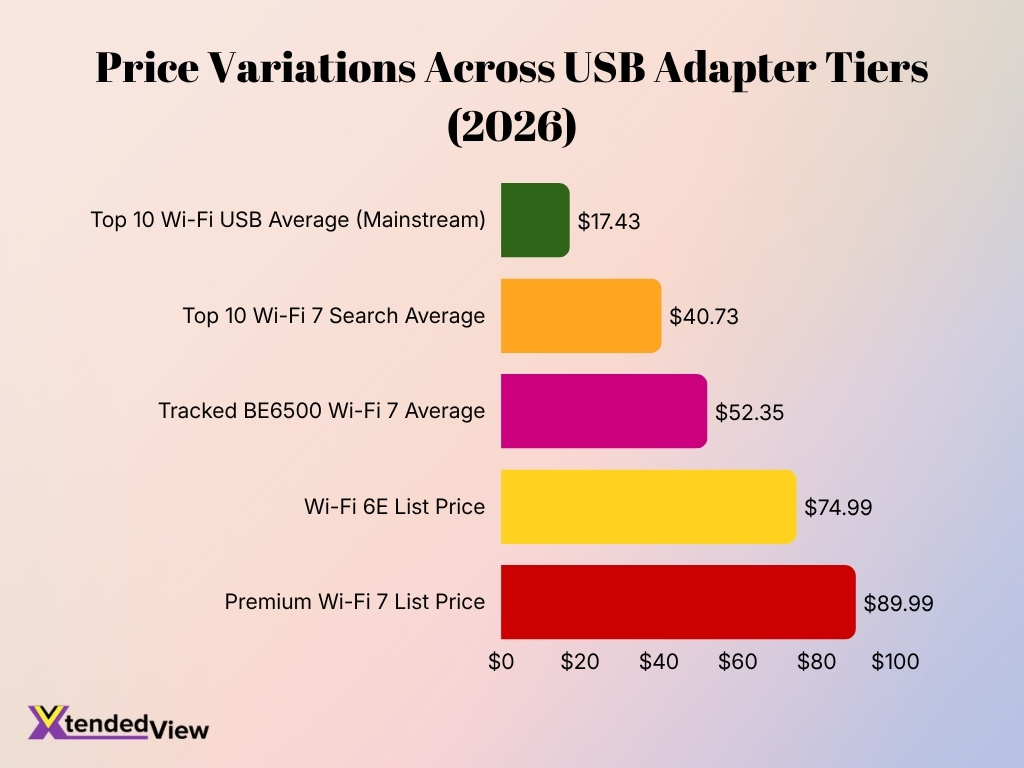
- A current Wi-Fi 7 USB adapter capable of up to 6.5 Gbps carries a US list price of approximately $89.99, placing high-end external adapters well above entry-level Wi-Fi products.
- A second 5 Gbps tri-band Wi-Fi 7 USB model also sells for approximately $89.99, indicating that performance tier and Wi-Fi generation currently influence pricing more than advertised peak speed alone.
- By comparison, a Wi-Fi 6E USB adapter rated for up to 3 Gbps carries a current price of approximately $74.99, leaving a roughly $15 premium for some Wi-Fi 7 products.
- Another tri-band Wi-Fi 7 USB adapter listed at $69.99 has recently sold for approximately $59.99, a discount of about 14%. Promotional pricing is already reducing the effective cost of upgrading to Wi-Fi 7.
- One tracked BE6500 Wi-Fi 7 USB model recorded an average US selling price of $52.35 across 430 days of pricing data, compared with a historical high of $64.99.
- The same Wi-Fi 7 model reached a tracked low of $42.49 in May 2026, approximately 35% below its August 2025 peak. That decline illustrates how quickly retail pricing can fall as Wi-Fi 7 competition increases.
- Across a sample of leading US Wi-Fi USB adapter listings in August 2026, the top 10 products carried an average price of approximately $17.43, highlighting the large gap between mass-market adapters and premium Wi-Fi 7 products.
- A separate July 2026 sample focused on Wi-Fi 7-related adapter searches produced a top-10 average price of approximately $40.73, more than twice the broader Wi-Fi USB adapter average in the comparable retail tracking data.
- Falling semiconductor costs should reduce the Wi-Fi 7 price premium over time. By early 2026, the incremental cost of adding Wi-Fi 7 to premium consumer devices had become negligible in some device categories, supporting wider adoption beyond flagship products.
Wireless Adapter Shipment Volumes and Unit Sales
- Global wireless adapter trade records identified 4,072 export shipments between June 2024 and May 2025, involving 648 verified exporters and 846 buyers.
- Those international wireless adapter shipments changed by approximately 8% year over year during the measured 12-month period, showing continuing cross-border demand for the product category.
- A broader wireless USB device market estimate places worldwide volume at approximately 21 million units in 2024, with shipments projected to reach 38 million units by 2030.
- Reaching 38 million units by 2030 would represent an approximate 10.9% compound annual growth rate from the 2024 base.
- The US portion of that wireless USB device market was estimated at approximately 5 million units in 2024, equivalent to almost one-quarter of estimated worldwide volume.
- China’s wireless USB device market is forecast to reach approximately 9 million units by 2030, supported by an estimated 15.2% CAGR from the report’s base period.
- In mainstream US e-commerce, individual leading Wi-Fi USB adapter listings reached approximately 10,000 estimated monthly units during August 2026.
- The top 10 Wi-Fi USB adapter listings in that retail sample averaged about 4,200 monthly units each, which implies roughly 42,000 monthly units across only those tracked leaders.
- Beyond standalone adapters, annual shipments of all Wi-Fi-enabled devices are projected to climb from approximately 4.3 billion units in 2025 to 4.7 billion in 2026, adding around 400 million Wi-Fi endpoints in one year.
Emerging Technology Impact on Wireless Adapter Demand
- Wi-Fi 7 access point shipments increased from 26.3 million units in 2024 to a projected 66.5 million in 2025, representing growth of more than 150% in one year.
- Wi-Fi 7 access point shipments are forecast to reach 117.9 million units in 2026, approximately 77% above the projected 2025 level. A larger Wi-Fi 7 infrastructure base increases the usefulness of compatible client adapters.
- In 2025, Wi-Fi 7 already appeared in 27% of smartphones, giving the standard its highest penetration among the major consumer-device categories measured.
- Wi-Fi 7 reached 17% of laptop shipments in 2025, which means roughly one in six newly shipped laptops already supported the standard before 2026 began.
- Tablets adopted Wi-Fi 7 more slowly, with approximately 7% penetration in 2025. This leaves a larger multiyear upgrade opportunity as premium features move into mainstream devices.
- By 2030, Wi-Fi 7 is projected to account for 54% of broadband equipment shipments through operator channels, making compatible household infrastructure increasingly common.
- Real-world residential testing published in February 2026 found that Wi-Fi 7 Multi-Link Operation could double throughput under interference compared with single-link operation.
- The same trials found that Multi-Link Operation could reduce latency by nearly 50% in challenging radio conditions, strengthening its relevance to gaming, video calling and real-time applications.
- In the US, current rules make the full 1,200 MHz of the 6 GHz band available for qualifying very-low-power operations, giving Wi-Fi 6E and Wi-Fi 7 devices substantially more spectrum than earlier Wi-Fi generations.
- Organizations are also increasing investment around next-generation connectivity: 38% of surveyed industry participants planned Wi-Fi 7 deployments during 2025 or 2026, while 32% planned AI or cognitive networking deployments.
Wireless Connectivity Technical Restraints
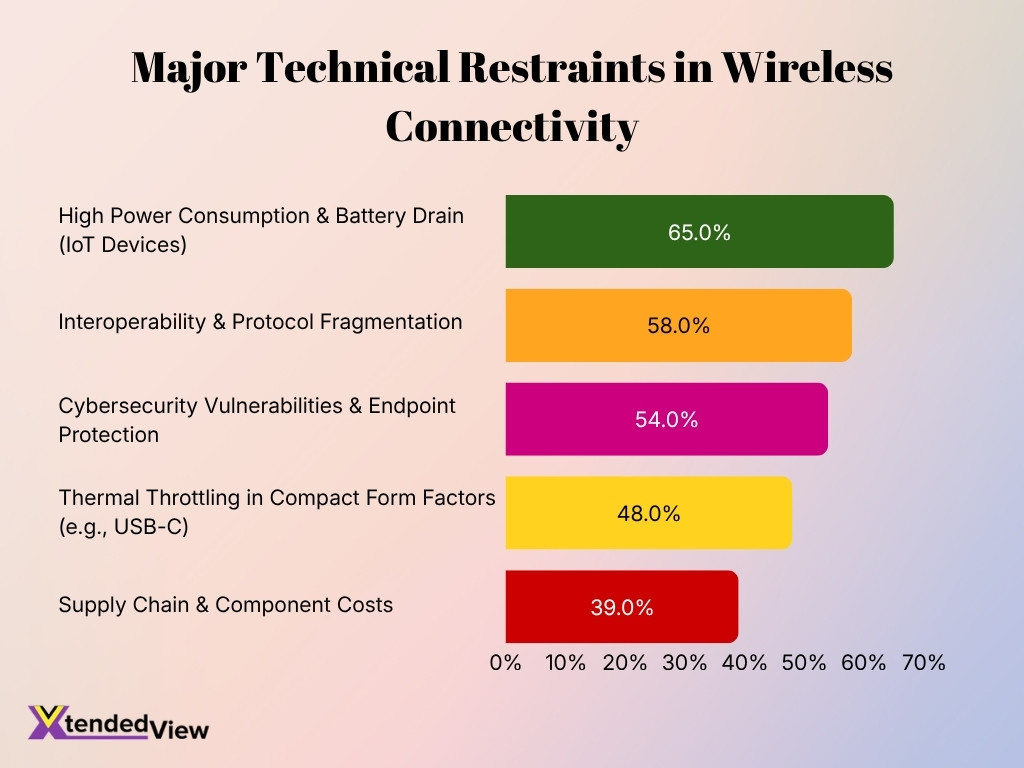
- High power consumption and battery drain is the leading technical obstacle, cited by 65.0% of manufacturers, highlighting efficiency concerns for IoT and battery-powered devices.
- Interoperability and protocol fragmentation ranks second at 58.0%, reflecting difficulties in ensuring seamless connectivity across different devices, standards, and networks.
- Cybersecurity vulnerabilities and endpoint protection are major concerns for 54.0% of manufacturers, emphasizing the growing importance of securing connected devices.
- Thermal throttling in compact form factors, including USB-C wireless adapters, affects 48.0% of manufacturers, potentially limiting sustained performance in smaller devices.
- Supply chain pressures and component costs are cited by 39.0% of manufacturers, making them the least-reported challenge in the dataset but still a significant market restraint.
- Overall, the figures show that power efficiency, interoperability, and cybersecurity are the three most prominent technical barriers shaping wireless connectivity development in 2026.
Challenges and Growth Opportunities in the Wireless Adapter Market
- Worldwide PC shipments are forecast to decline 10.4% in 2026 as rising component costs reduce consumer and business purchases. Fewer new PCs can limit embedded Wi-Fi module shipments.
- Combined DRAM and SSD prices could increase by approximately 130% by the end of 2026, putting substantial cost pressure on computers and other electronics that integrate wireless modules.
- Higher component prices are expected to raise average PC prices by approximately 17% compared with 2025, encouraging some buyers to keep older systems longer. That behavior can benefit inexpensive USB and PCIe upgrade adapters.
- Smartphone prices could rise approximately 13% in 2026 because of the same memory-cost pressures, demonstrating that wireless device demand faces a broader electronics affordability problem.
- Global smartphone shipments are now projected to decline 13.9% in 2026 to 1.08 billion units, potentially slowing the total expansion of the Wi-Fi 7 client installed base.
- LPDDR4 and LPDDR5 memory prices were forecast to triple in Q2 2026 compared with Q4 2025, while available LPDDR4 supply could drop by more than 40% during the year.
- PC shipments still reached 62.8 million units in Q1 2026, up 4% year over year, partly because manufacturers and distributors built inventory before expected component-price increases.
- The standalone wireless USB adapter market nevertheless increased an estimated 6.71% in 2026, from $1.35 billion in 2025 to approximately $1.44 billion. This suggests aftermarket connectivity upgrades can grow even when broader device markets weaken.
- High-quality integrated Wi-Fi modules remain a structural challenge because new laptops and motherboards increasingly ship with capable radios. External adapters therefore compete most effectively in legacy-device upgrades, troubleshooting, desktops and performance upgrades rather than every newly purchased device.
- Spectrum availability creates another opportunity. 65% of wireless industry respondents consider access to 6 GHz important or critical to their Wi-Fi business, supporting continued investment in adapters capable of Wi-Fi 6E and Wi-Fi 7 operation.
Frequently Asked Questions (FAQs)
The global wireless network adapter market was valued at approximately $915 million in 2025 and is projected to reach $1.44 billion by 2034.
The global wireless network adapter market is forecast to grow at a 6.7% CAGR through 2034.
Wi-Fi 7 accounted for 44.5% of enterprise dependent access point revenue in Q1 2026, up from 11.8% in Q1 2025.
Approximately 17% of laptops shipped globally in 2025 supported Wi-Fi 7, compared with 27% of smartphones and 7% of tablets.
The wireless LAN card market is projected to grow from $9.36 billion in 2026 to $12.15 billion by 2030, representing a forecast CAGR of about 6.7%.
Conclusion
Wireless Adapter Statistics show a market moving beyond basic connectivity toward higher-performance Wi-Fi 6E and Wi-Fi 7 hardware. USB adapters remain important for older PCs, troubleshooting and cost-conscious upgrades, while PCIe, M.2 and embedded solutions are increasingly associated with gaming, AI workloads, enterprise networks and other bandwidth-intensive applications. The rapid expansion of Wi-Fi 7 infrastructure, wider access to 6 GHz spectrum and growing demand for lower latency are strengthening the case for newer adapter technologies.
At the same time, longer PC replacement cycles and rising device costs may encourage consumers and businesses to upgrade existing systems instead of replacing them outright. These trends suggest that wireless adapters will remain a relevant upgrade and compatibility market through the late 2020s, even as integrated wireless connectivity becomes more capable.
