



The laptop market reflects a mix of strong technology upgrades and tighter hardware supply. Global notebook shipments reached 219.7 million units in 2025, while the broader PC market shipped 278.7 million units. However, higher memory and storage costs are expected to pressure shipments even as market revenue continues to rise. At the same time, AI-capable laptops, enterprise replacement cycles and premium gaming systems are changing what buyers expect from new devices.
Laptops continue to play a major role in both business and education. Companies are replacing older systems as they move to newer operating systems and AI-ready hardware, while schools continue to rely heavily on 1-to-1 device programs for classroom and remote learning. Consumers are also paying closer attention to battery life, processor performance, display quality and price as average selling prices increase. The following statistics provide a detailed look at laptop market size, shipments, brand share, usage, pricing, technology trends and future growth.
Editor’s Choice
- Worldwide notebook shipments totaled 219.7 million units in 2025, compared with roughly 204 million implied by the reported 7.5% annual growth rate.
- The global laptop market is estimated to increase from $228.8 billion in 2025 to $240.4 billion in 2026, an increase of roughly $11.6 billion.
- However, unit shipments face a different trajectory: a March 2026 outlook projects laptop volumes to contract 12% to 192.2 million units this year.
- Mainstream PC memory and storage costs rose 40% to 70% between Q1 and Q4 2025, creating significant pricing pressure heading into 2026.
- Since Q1 2025, the cost of mainstream memory and storage configurations had risen by approximately $90 to $165 by March 2026.
- Lenovo led the broader worldwide PC market in 2025 with 73.6 million shipments and 27.2% share, followed by HP with 21.3%.
- Apple recorded the fastest Q1 2026 growth among the six leading PC vendors in one major industry dataset, with shipments increasing 12.7% year over year to 6.7 million units.
- The $1,501-$2,000 price segment represented 34.4% of laptop-market revenue in 2025, making it the largest price category in the cited market estimate.
- Business was the largest laptop end-use segment in 2025, generating $104.2 billion in revenue.
- The laptop market is forecast to reach $352 billion by 2033, representing a 5.6% compound annual growth rate from 2026 through 2033.
Recent Developments
- Windows 10 support ended on Oct. 14, 2025, removing regular software updates, security fixes and technical assistance for standard Windows 10 installations. This deadline strengthened the PC replacement cycle entering 2026.
- The broader PC market grew 9.1% in 2025, with Windows 11 upgrades contributing to demand alongside inventory purchases ahead of expected component shortages.
- Global PC shipments reached 62.8 million units in Q1 2026, representing 4% year-over-year growth in one industry estimate despite emerging supply constraints.
- Lenovo shipped 16.6 million PCs in Q1 2026, up 9.5% from 15.2 million a year earlier. Its market share increased from 25.2% to 26.5%.
- Apple shipped about 6.7 million Macs in Q1 2026, up 12.7% year over year, lifting its broader PC-market share to 10.6%.
- Meanwhile, rising component costs changed the outlook quickly. A January 2026 projection expected notebook shipments to fall 14.8% quarter over quarter in Q1, with CPU, memory, PCB, battery and power-management costs all adding pressure.
- By March, the full-year notebook forecast had deteriorated further, with one projection calling for a 14.8% year-over-year decline as weaker demand joined higher supply-chain costs.
- Apple took a different approach by expanding into the $500-$800 mainstream notebook tier. An early-March forecast estimated that its notebook shipments could grow 7.7% in 2026 despite the broader market decline.
- By July, the notebook outlook remained weak: an updated forecast put the 2026 global shipment decline at 13.6%, illustrating how quickly component costs and pricing were changing projections.
- The combination of higher device prices and weaker consumer purchasing has therefore created an unusual 2026 market: revenue can remain comparatively resilient even as manufacturers ship fewer units.
Global Laptop Market Overview
- The global laptop market was valued at $228.8 billion in 2025, reflecting demand across personal, business, education and gaming applications.
- The market’s estimated value rises to $240.4 billion in 2026, despite forecasts for a sharp contraction in physical notebook shipments. Higher prices and a richer product mix help explain the difference between unit and revenue trends.
- Asia-Pacific captured 35.2% of laptop revenue in 2025, placing the region ahead of North America, Europe, Latin America, the Middle East and Africa.
- China held the largest country-level share of the laptop market in the same 2025 assessment.
- Traditional notebooks generated 76.3% of laptop-market revenue in 2025, leaving about 23.7% for 2-in-1 systems under that report’s type segmentation.
- Laptops with 15-inch to 16.9-inch screens formed the largest screen-size segment in 2025. This category covers many mainstream productivity, business and gaming models.
- The $1,501-$2,000 category was the largest laptop price segment by revenue in 2025, accounting for 34.4% of the market.
- Business represented the largest end-use category in 2025, while gaming ranked as the fastest-growing end-use segment in the cited forecast.
- Worldwide notebook shipments reached 219.7 million units in 2025, meaning notebooks represented nearly four-fifths of the 278.7 million desktops, notebooks and workstations shipped during the year.
- The long-term revenue outlook remains positive: global laptop revenue is projected to reach $352 billion in 2033, up about 54% from its 2025 level.
Laptop Market Growth Statistics
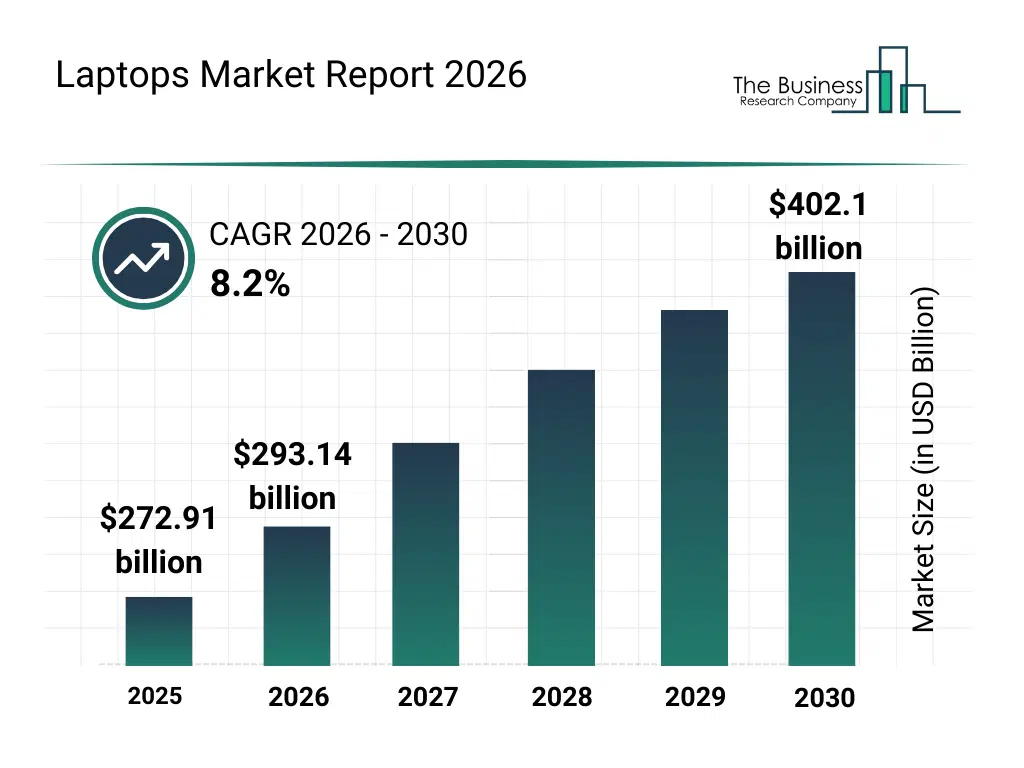
- The global laptop market was valued at $272.91 billion in 2025 and is projected to grow steadily through the end of the decade.
- In 2026, the laptop market is expected to reach $293.14 billion, representing an increase of about $20.23 billion from 2025.
- The market is projected to expand at a CAGR of 8.2% from 2026 to 2030, highlighting strong long-term demand for laptops worldwide.
- Based on the projected growth trajectory, the laptop market could reach approximately $318.5 billion in 2027 and $344.6 billion in 2028.
- By 2029, the global laptop market is projected to approach approximately $372.9 billion, continuing its consistent upward trend.
- The laptop market is forecast to reach $402.1 billion by 2030, crossing the $400 billion milestone for the first time in the forecast period.
- Overall, the market is expected to add approximately $129.19 billion in value between 2025 and 2030, equivalent to growth of roughly 47.3% over five years.
Laptop Shipments and Sales Statistics
- Global notebook shipments totaled 219.7 million units in 2025, increasing 7.5% from 2024.
- Notebook shipments reached 57.8 million units in Q4 2025, accounting for roughly 78% of the 74 million PCs shipped during the quarter.
- For comparison, Q4 2024 notebook shipments totaled 53.7 million units, up 6.2% year over year at the time.
- Total PC shipments reached 278.7 million units in 2025, compared with approximately 255 million in 2024 under the same market-research lineage.
- A March 2026 forecast expects laptop shipments to fall 12% to 192.2 million units during 2026 as memory and storage supply problems reduce demand and availability.
- That forecast implies approximately 27.5 million fewer laptops shipped in 2026 than the 219.7 million recorded in 2025.
- A separate late-March notebook forecast became even more bearish, projecting a 14.8% year-over-year contraction in 2026 because of weak end-market demand and rising supply-chain costs.
- The early-2026 outlook changed rapidly: a December 2025 forecast had expected around 173 million notebook shipments and a 5.4% decline, before subsequent cost and supply developments prompted further revisions.
- Mainstream PC memory and storage costs increased 40% to 70% during 2025, helping explain why manufacturers entered 2026 with more conservative shipment plans.
- The broader 2026 PC forecast expects desktops, notebooks and workstations to fall to 245 million units, down 12%, with laptops accounting for roughly 78% of that projected volume.
Laptop Market Share by Brand
- Lenovo ranked first in the worldwide PC market in 2025 with 73.6 million units and 27.2% market share, up from 25.3% in 2024.
- HP ranked second with 57.5 million units and 21.3% share in 2025. Its shipments increased 8.3% year over year.
- Dell held third place in the broader PC ranking with 41.4 million shipments and 15.3% share in 2025, compared with 15.9% in 2024.
- Apple shipped 24.8 million Macs in 2025, giving it 9.2% of the worldwide PC market and representing 10.3% year-over-year growth.
- ASUS shipped approximately 18.5 million PCs in 2025 for a 6.9% market share, up 6.7% in units from 2024.
- Acer accounted for 6.3% of worldwide PC shipments in 2025, shipping approximately 17 million units.
- Lenovo strengthened its lead in Q1 2026, taking 26.5% of worldwide PC shipments, compared with 25.2% a year earlier.
- Apple increased its Q1 2026 PC share to 10.6%, compared with 9.8% in Q1 2025, after shipments grew 12.7%.
- Dell’s Q1 2026 shipments grew 7.6% to 10.3 million units, increasing its share from 15.9% to 16.5%.
- In the laptop-specific market, Apple has proved more resilient than many competitors: a March 2026 forecast expected its notebook shipments to rise 7.7% year over year even as global notebook shipments contracted sharply.
India Laptop Market Share Statistics
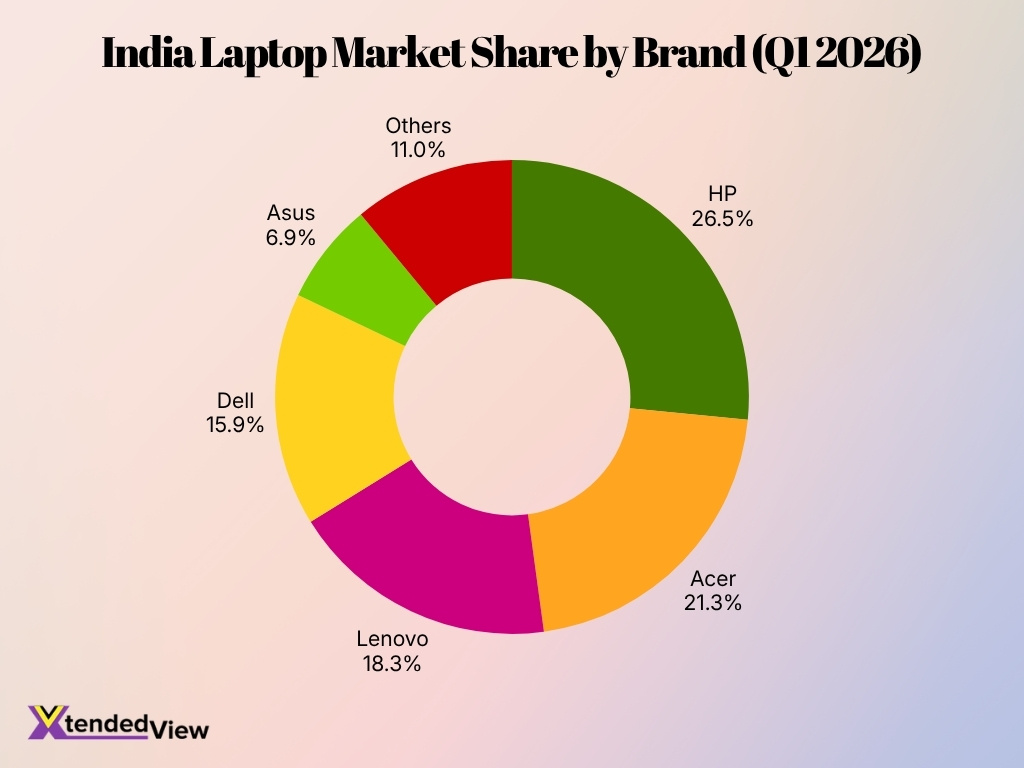
- HP led India’s laptop market in Q1 2026, capturing the largest share at 26.5% of the market.
- Acer ranked second with a 21.3% market share, trailing HP by 5.2 percentage points.
- Lenovo held 18.3% of the Indian laptop market, making it the third-largest laptop brand during the quarter.
- Dell accounted for 15.9% of the market, placing it fourth among the major laptop brands in India.
- Asus captured 6.9% of the market, the smallest individual share among the five major brands shown in the data.
- The top four brands, HP, Acer, Lenovo, and Dell, collectively controlled 82.0% of India’s laptop market in Q1 2026.
- Other laptop brands represented 11.0% of the market, indicating that the Indian laptop sector was heavily concentrated among leading manufacturers.
- Combined, HP and Acer controlled 47.8% of the market, meaning nearly half of India’s laptop market was held by the two leading brands.
Laptop Market Share by Region
- Asia-Pacific accounted for about 35.2% of global laptop revenue in 2025 in one current market estimate, making it the largest regional market under that methodology.
- A separate 2026 industry assessment placed Asia-Pacific’s 2025 laptop share at 42.8%, illustrating how regional estimates vary according to product scope, pricing assumptions and market definitions.
- Another shipment-focused estimate calculated that Asia-Pacific represented approximately 44% of global laptop shipments in 2025, supported by demand across China, India and Southeast Asia.
- North America generated approximately 33.19% of global laptop-market value in 2025 under another current market model, confirming its importance as a high-value premium and enterprise market.
- Asia-Pacific is projected to achieve an 8.78% CAGR through 2031 under that same forecast, making it the fastest-growing major region.
- Latin America represented roughly 6.8% of the global laptop market in 2025, with an estimated market value of $9.24 billion under one regional assessment.
- Latin America’s laptop market is forecast to grow at approximately 5.63% annually over the cited forecast period, supported by expanding connectivity, digital education and demand for affordable devices.
- China’s combination of consumer scale, electronics manufacturing capacity and enterprise demand helped make it the largest individual country market in one 2025 laptop-market assessment.
- Regional demand also differs by price tier. North America remains especially important for premium business, gaming and creator laptops, while emerging Asia-Pacific markets provide larger opportunities for entry-level and midrange systems. This helps explain why shipment share and revenue share can differ materially between regional studies.
Laptop Market Segmentation Statistics
- Traditional clamshell laptops generated 76.3% of global laptop revenue in 2025 under one current market segmentation, keeping them well ahead of convertible and detachable designs.
- As a result, nontraditional and 2-in-1 models represented roughly 23.7% of the market under the same type classification.
- The global 2-in-1 laptop market was separately estimated at approximately $31.6 billion in 2025 and is projected to reach $64.5 billion by 2034.
- That 2-in-1 segment is forecast to grow at an 8.2% CAGR from 2026 through 2034, faster than several broader laptop-market forecasts.
- Laptops with 15-inch to 16.9-inch displays represented the largest screen-size segment in 2025, reflecting the appeal of screens large enough for productivity while remaining portable.
- The $1,501-$2,000 price range captured 34.4% of global laptop revenue in 2025, making it the largest price segment in one industry model.
- Business and enterprise buyers represented 38.53% of 2025 laptop revenue under another segmentation model, making commercial demand one of the industry’s largest revenue pools.
- Online channels generated approximately 56.32% of laptop revenue in 2025 in one current distribution analysis, indicating that more than half of market value now flows through e-commerce channels.
- Online laptop sales are projected to grow at an 8.92% CAGR through 2031, outpacing several overall laptop-market growth estimates.
- Gaming and esports laptops are forecast to expand at roughly 9.16% annually through 2031, making performance notebooks one of the fastest-growing end-use segments.
Laptop Market Share by Operating System
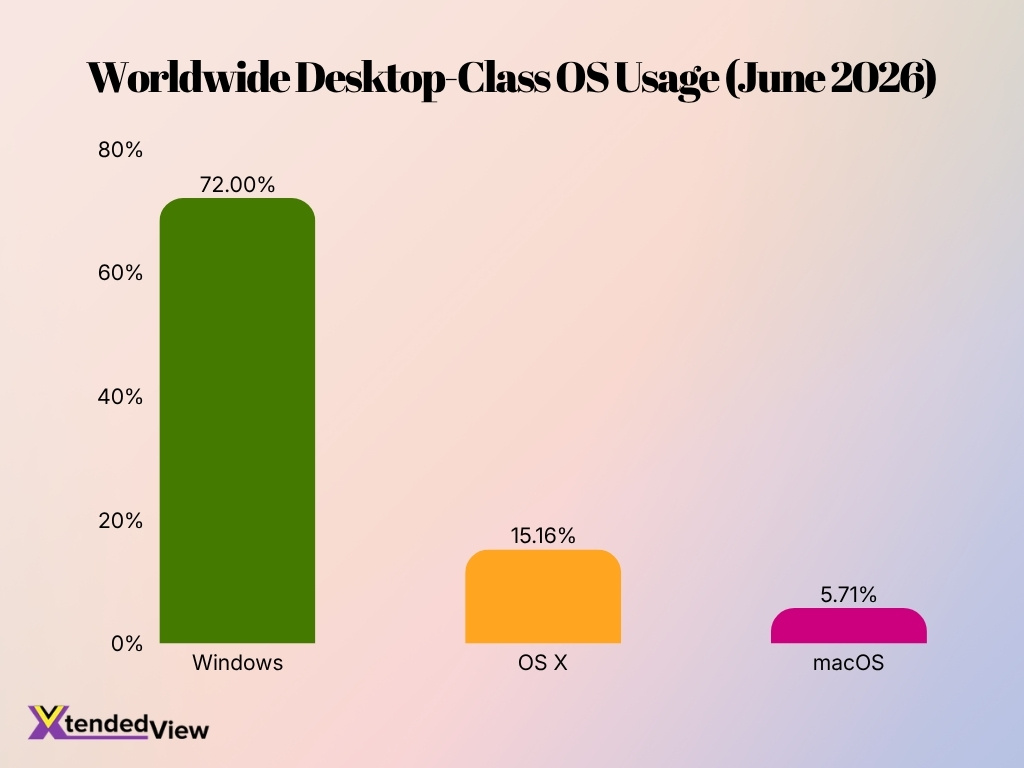
- Windows accounted for about 72% of worldwide desktop-class operating system usage in June 2026, which includes laptop and desktop web traffic. It remains the dominant operating system for conventional PCs.
- OS X represented 15.16% of worldwide desktop-class usage in June 2026, giving Apple a substantial presence in computer operating systems despite its smaller hardware shipment base.
- Separately classified macOS versions accounted for another 5.71% of worldwide desktop-class usage in June 2026. The split reflects the measurement system’s treatment of different Apple operating system versions.
- In May 2025, Windows held roughly 70.21% of global desktop operating system usage, while Linux represented 4.06% and ChromeOS held 1.83%.
- ChromeOS held approximately 1.6% of worldwide desktop and laptop operating system usage in March 2026, although its share was considerably higher in some education-focused markets.
- ChromeOS represented about 5.5% of U.S. desktop and laptop usage in March 2026, more than three times its worldwide share. Its stronger U.S. position reflects Chromebook adoption in schools and lower-cost computing.
- Desktop Linux represented roughly 3.2% of worldwide computer operating system usage in March 2026, maintaining a smaller but established presence among developers, technical users and open-source communities.
- Linux’s share reached approximately 6.4% in Asia in early 2026, while ChromeOS added roughly another 0.6 percentage points in the region.
- The operating system mix increasingly matters for AI software. An estimated 50% of laptops shipped in 2025 were expected to include local generative AI processing capabilities, increasing competition around native AI features across Windows, macOS and ChromeOS devices.
Laptop Production and Manufacturing Statistics
- Worldwide notebook shipments hit 219.7 million units in 2025, highlighting massive global manufacturing scale.
- Current 2026 forecasts project shipments of 192.2 million units, which represents a 12% annual decline.
- Another 2026 projection expects notebook shipments to drop 13.6% due to weakening component conditions.
- Over 55% of notebook production allocation is concentrated among a few major manufacturing partners.
- One contract manufacturer reported a 2% increase in Q2 2025 shipments despite a 9% revenue decline.
- A leading contract manufacturer achieved 46.9 million notebook shipments in 2023 across the global supply chain.
- One producer introduced 80% recycled aluminum and 50% post-consumer recycled content in 2024 notebook housings.
- Persistent memory shortages are expected to last through 2027, severely impacting production costs and prices.
Laptop Price Trends and Average Selling Price
- Average PC selling prices are forecast to increase 18.3% in 2026.
- Under a moderate shortage, PC prices could rise 4% to 6% in 2026.
- A severe shortage projects price increases reaching 6% to 8%.
- Memory and storage costs surged 40% to 70% during 2025.
- Memory configurations cost manufacturers $90 to $165 more by early 2026.
- Premium laptops from $1,501 to $2,000 drove 34.4% of 2025 revenue.
- Entry-level Chromebooks currently feature pricing below $200.
- Mainstream Windows notebooks typically sell in the $400 to $800 range.
- High-memory premium notebooks carry list prices approaching $3,000.
Laptop Brand Loyalty and Customer Retention Statistics
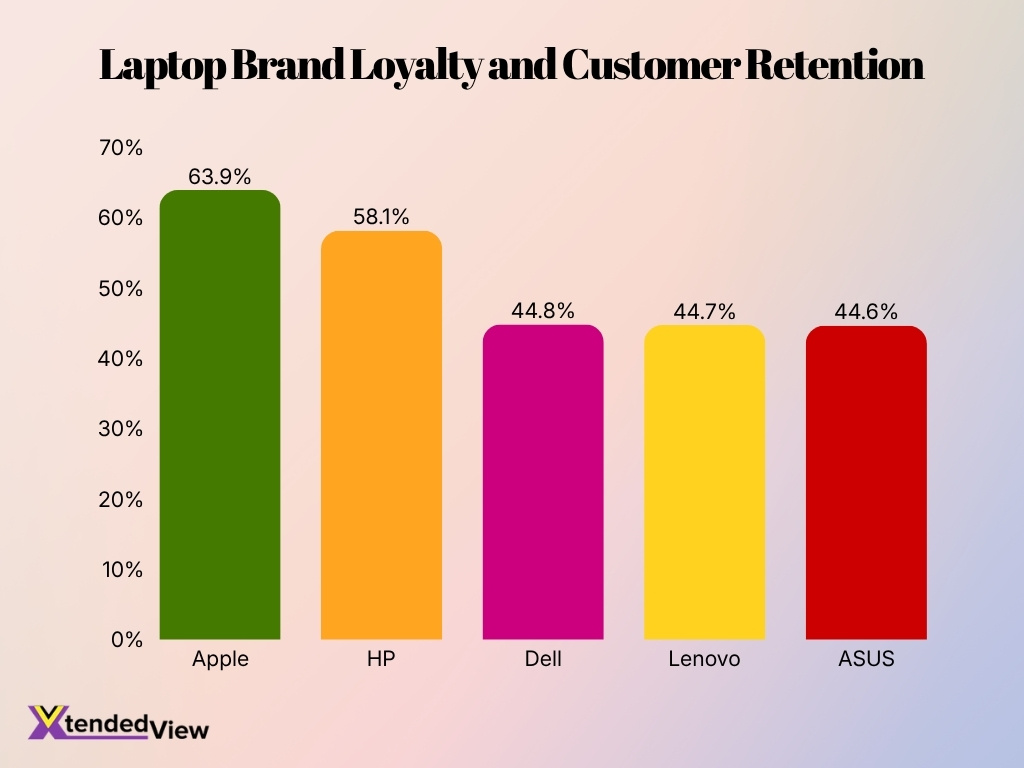
- Apple leads laptop brand loyalty, with 63.9% of users saying they are likely to buy from Apple again when upgrading their laptop.
- HP ranks second at 58.1%, just 5.8 percentage points behind Apple, indicating a strong level of customer retention.
- Brand loyalty falls considerably after the top two, with Dell at 44.8%, nearly 19.1 percentage points below Apple.
- Lenovo records a 44.7% retention rate, putting it almost level with Dell in terms of customers planning to stick with the same brand.
- ASUS stands at 44.6%, only 0.2 percentage points behind Dell, showing very little difference among the bottom three brands.
- Overall, the data highlights a clear loyalty advantage for Apple and HP, while Dell, Lenovo, and ASUS all have customer retention rates of around 45%.
Consumer Preferences and Buying Behaviour
- In 2025, U.S. households spent an average of $896 on consumer technology devices, a 17% increase from the previous year.
- In 2026, 29% of U.S. consumers planned to increase technology-device spending, triple the share from 2023.
- Meanwhile, 24% of consumers planned to reduce device spending due to shifting household finances.
- K-12 households planned to spend an average of $293.11 on electronics in 2026, totaling $14.7 billion.
- In 2025, college shoppers expected to spend an average of $309.50 on electronics, totaling $20.7 billion.
- The online share for back-to-school shoppers fell to 50% in 2026, compared to 55% in 2025.
- Department stores attracted 47% of 2026 back-to-school shoppers, while 44% chose discount stores.
- 41% of men and 28% of women said on-device AI would likely make them upgrade laptops sooner.
- Nearly four in 10 consumers used generative AI by late 2024, weighing affordability alongside innovation.
- Individual consumers account for roughly 50% of annual PC sales, equaling corporate cycles in market importance.
Laptop Usage, Ownership, and Penetration Statistics
- Approximately 95% of U.S. households have at least one computing device, including a desktop, laptop, smartphone or tablet, based on the latest widely available household survey data summarized in 2025.
- Roughly 90% of U.S. households have broadband internet access, supporting widespread laptop use for work, education, streaming and online services.
- Among American teenagers, 88% had access to a desktop or laptop computer at home in the latest national youth technology survey.
- Teen smartphone access was higher at 95%, while 83% had access to a game console and 70% had access to a tablet, showing that laptops operate within a multi-device household environment.
- Tablet access among U.S. teenagers increased from 65% in 2023 to 70% in 2024, while computer access remained comparatively stable.
- About 91% of U.S. adults owned a smartphone in 2025, compared with 35% when comparable smartphone tracking began in 2011. High mobile adoption has not eliminated the need for larger-screen computers for productivity.
- About 16% of U.S. adults were smartphone-only internet users in 2025, meaning they owned a smartphone but did not subscribe to home broadband. The figure increased from 15% in 2024.
- Smartphone-only dependence varies sharply by income: 13% of adults earning below $30,000 owned a basic cellphone rather than a smartphone in 2025, compared with only 2% among households earning at least $100,000.
- The digital divide also affects access to full-size computers. Earlier national research found desktop or laptop ownership at 80% among White adults, 69% among Black adults and 67% among Hispanic adults, illustrating persistent differences in traditional computer access.
- Laptop penetration remains strongest where broadband, education and household income overlap. Consequently, future laptop growth increasingly depends not only on first-time ownership but also on replacement cycles, AI-capable upgrades and expanding access in developing markets.
Laptop Upgrade Frequency Statistics
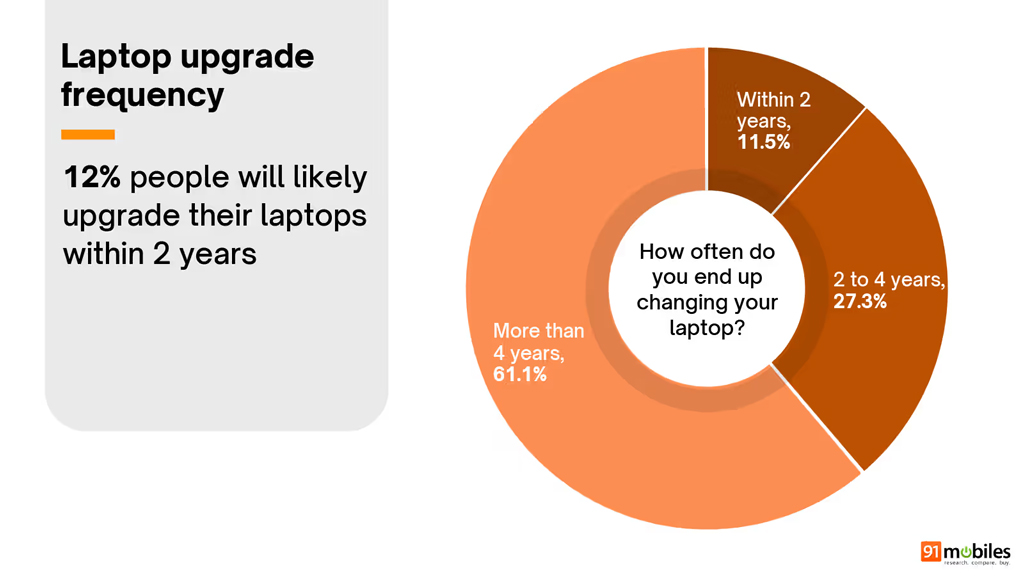
- A significant 61.1% of consumers keep their laptops for more than four years, making longer replacement cycles the most common behavior.
- Around 27.3% of users replace or upgrade their laptops every two to four years, representing just over a quarter of respondents.
- Only 11.5% of consumers change their laptops within two years, indicating relatively low demand for frequent hardware upgrades.
- Overall, 88.4% of users keep their laptops for at least two years, highlighting the comparatively long lifecycle of laptop devices.
- The data suggests that laptop buyers generally favor long-term device usage, with nearly 6 in 10 consumers waiting more than four years before replacing their laptops.
Laptop Technology and Innovation Trends
- Advanced AI PCs are forecast to capture 59% of global PC shipments in 2026, up from 39% in 2025.
- AI-PC penetration is experiencing a massive 52% year-over-year increase driven by dedicated neural processing units.
- Modern Windows AI devices mandate a neural processing unit capable of at least 40 TOPS.
- Newly introduced 2026 laptop processors achieve up to 50 NPU TOPS, featuring 16 CPU cores and 12 graphics cores.
- Select 2026 processor families push on-device AI computing capabilities further to reach a maximum of 60 TOPS.
- Enterprise-focused laptops now feature processors delivering up to 55 peak NPU TOPS for accelerated corporate workloads.
- India’s AI-notebook shipments surged by 96.1% year over year in Q1 2026, alongside a 70.1% rise in notebooks over $1,000.
- Consumer premium-notebook shipments in India spiked by 92.4% year over year, outpacing the 56.1% growth in the commercial sector.
- Latest high-performance laptop GPUs have upgraded to fourth-generation ray-tracing cores for enhanced AI-assisted rendering.
- Windows 11 version 26H1 launched on Feb. 10, 2026, with consumer support extending to March 2028 and enterprise to March 2029.
Gaming Laptop Market Statistics
- The global gaming laptop market is estimated at approximately $19.3 billion in 2026 in one current market model.
- Under that forecast, gaming laptop revenue could reach $29.4 billion by 2033, adding more than $10 billion to the market in seven years.
- The same outlook projects a 6.2% compound annual growth rate from 2026 to 2033, supported by demand for portable high-performance systems.
- A separate 2026 assessment valued gaming laptops at about $17.1 billion in 2025 and forecasts the segment to approach $28.4 billion by 2034. Differences between estimates reflect varying definitions of gaming-class hardware.
- That alternative forecast expects gaming laptop revenue to increase at roughly 5.8% annually through 2034.
- Entry pricing for laptops equipped with RTX 5060 graphics started at approximately $1,099 in May 2025, placing newer Blackwell-based gaming notebooks firmly in the premium consumer tier.
- Gaming demand remains especially strong in emerging PC markets. ASUS consumer shipments in India increased 31.9% year over year in Q1 2026, with gaming notebooks identified as an important contributor.
- Lenovo’s India consumer PC shipments rose 20.8% year over year in Q1 2026, while its e-commerce shipments increased 58%, supported partly by an expanding gaming portfolio.
- Modern thin-and-light gaming laptops increasingly combine CPU, GPU and NPU acceleration. Selected 2026 processors offer up to 77% higher gaming performance than the comparison platform used in their launch testing.
- Gaming laptops face significant pricing pressure in 2026 because high-capacity RAM, SSDs and graphics memory compete with AI infrastructure for semiconductor supply. PC average selling prices across the broader market are forecast to rise 18.3% this year, which creates particular pressure on component-heavy gaming configurations.
Education Sector Laptop Statistics
- 88% of U.S. public schools ran a 1-to-1 computing program in 2024-25.
- 89% of those 1-to-1 programs issued laptops, while 27% provided tablets.
- 46% of 1-to-1 schools allowed students to take devices home on all days.
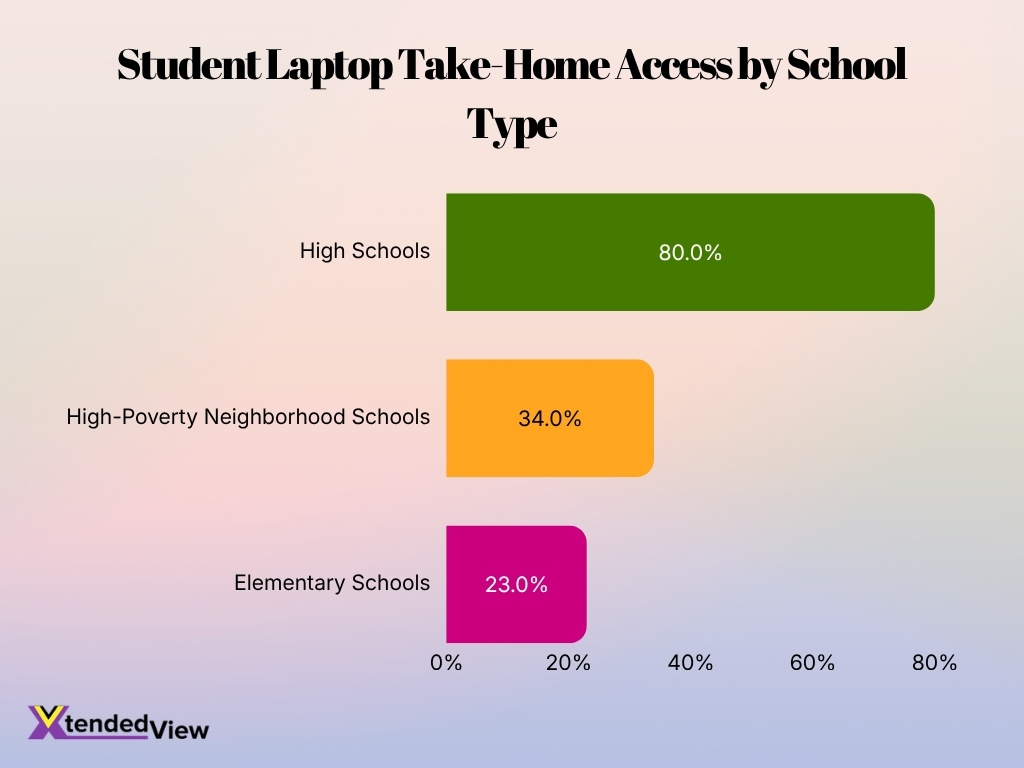
- Device take-home access hit 80% in high schools versus 23% in elementary schools.
- Large schools with 1,000+ students reported a much higher 86% take-home rate.
- Only 34% of schools in high-poverty neighborhoods permitted full device take-home access.
- High-speed internet fully covered all buildings and grounds at 77% of public schools.
- Digital literacy training was offered at 68% of schools, with 61% using a structured curriculum.
- India’s education PC segment grew by 455.2% year over year in Q1 2026.
- Global education Chromebook shipments reached 22.11 million units in 2025, capturing 60.1% of the volume.
Business and Enterprise Laptop Statistics
- U.S. PC shipmentsreached 71.5 million units in 2025, increasing 3% from 2024 due to Windows 11 replacements.
- U.S. shipmentstotaled 18.2 million PCs in Q4 2025, rising 3% year-over-year thanks to commercial upgrades.
- Windows 10 ended standard support on Oct. 14, 2025, creating a definitive replacement deadline for older business laptops.
- Enterprise PC demandin India surged 24.2% year-over-year in Q1 2026 despite rising component costs.
- Commercial PC shipments in India hit 2.8 million units in Q1 2026, driven by large institutional purchases.
- Workstation shipmentsin the same market increased 31.8% year-over-year to support computing-intensive business workloads.
- One major vendor saw 38.7% commercial shipment growth in India during Q1 2026, with enterprise sales up 37.5%.
- Another leading vendor boosted commercial shipments by 32.3% year-over-year in Q1 2026 due to strong enterprise demand.
- Premium commercial laptops over $1,000 grew 56.1% year-over-year in India as AI-capable notebooks gained share.
- Windows 11 Enterprise and Education editions offer 36 months of support, compared to 24 months for Home and Pro editions.
Laptop Market Forecast and Future Trends
- The global laptop market is forecast to reach approximately $352 billion by 2033, representing a 5.6% CAGR from 2026 through 2033 in one current market model.
- Near-term unit sales face a much harder outlook. One March 2026 forecast expects overall PC shipments to decline 11.3% for full-year 2026 as memory shortages restrict supply and push retail prices higher.
- Market conditions could deteriorate further late in the year, with Q4 2026 PC shipments projected to fall as much as 20% year over year under the same forecast.
- Another forecast expects combined DRAM and SSD prices to rise 130% by the end of 2026, compared with 2025 levels. This increase could shift laptop portfolios toward higher-margin models.
- Under that scenario, average PC prices would rise approximately 17% in 2026, while worldwide PC shipments would contract 10.4%.
- Meaningful relief from the current memory shortage may not arrive until the end of 2027, which means elevated laptop prices and configuration changes could extend beyond 2026.
- AI hardware provides a counterweight to the unit-sales downturn. AI laptops alone are estimated to become a $141.54 billion market by 2033, up from approximately $41.64 billion in 2026 under one current forecast.
- That AI-laptop forecast represents a 19.1% CAGR from 2026 through 2033, several times faster than the projected growth rate for the overall laptop market.
- Another long-range market model projects the broader laptop industry to reach $402.1 billion by 2030, although differences in market definitions produce substantially different revenue estimates between research firms.
- Asia-Pacific is expected to remain one of the strongest long-term growth regions. Meanwhile, replacement demand, AI-capable processors, gaming, hybrid work and digital education remain key structural drivers beyond the current component shortage.
Frequently Asked Questions (FAQs)
Worldwide notebook shipments reached 219.7 million units in 2025, up 7.5% year over year.
Global laptop shipments are forecast to fall 12% to about 192.2 million units in 2026.
The global laptop market is projected to reach about $240.4 billion in 2026, up from $228.8 billion in 2025.
Asia-Pacific accounted for approximately 35.2% of global laptop revenue in 2025, making it the largest regional market in that estimate.
The global laptop market is forecast to grow at a 5.6% CAGR from 2026 to 2033, reaching about $352 billion by 2033.
Conclusion
Laptop statistics show a market balancing stronger computing capabilities with tighter supply and higher costs. AI-enabled processors, gaming hardware, enterprise replacement cycles and digital education continue to support demand, while memory and storage constraints are putting pressure on shipments and prices.
The long-term outlook remains positive despite the near-term slowdown. AI PCs are becoming a larger share of shipments, and current forecasts place the overall laptop market on a path toward $352 billion by 2033. For buyers and manufacturers alike, the key challenge is balancing better performance, longer useful life and new AI capabilities against rising hardware costs.
