

Google Pixel has evolved from an Android showcase into a more established smartphone brand, with particularly notable traction in the U.S., Japan, and parts of Europe. Google now uses Pixel to compete across premium smartphones, foldables and AI-enabled devices while bringing Gemini, computational photography and new Android capabilities directly to consumers. Recent shipment gains, broader carrier availability and manufacturing expansion in India show how Google is building a larger hardware ecosystem around the Pixel lineup. However, Pixel still holds a relatively small share of the global smartphone market compared with Apple and Samsung. The following Google Pixel statistics examine its market share, sales, user adoption, pricing, demographics, AI usage, and growth prospects.
Editor’s Choice
- Google captured 3% of U.S. smartphone shipments in Q2 2026, up from 2% in Q2 2025 as Pixel gained ground in postpaid channels.
- Pixel reached 7% of U.S. shipments in Q3 2025, its strongest quarter in the five-quarter period surrounding the Pixel 10 launch.
- U.S. Pixel sell-through jumped 28% year over year in September 2025, setting a record for the brand’s single-month U.S. sales.
- Google’s share of the U.S. $600-plus smartphone segment reached 6.1% in September 2025, compared with only 0.1% three years earlier.
- Pixel shipments grew by roughly 25% during 2025, although Google remained outside the five largest smartphone vendors worldwide.
- Google shipped about 3.98 million mobile devices in Japan during fiscal 2025, securing the country’s No. 2 vendor position by total shipments.
- Google’s fiscal 2025 Japanese shipment volume increased 25.8% year over year, making Japan one of Pixel’s strongest large-country growth markets.
- In India’s smartphone market, Pixel recorded 68% year-over-year growth in the ultra-premium segment above INR 45,000 during Q2 2026.
Recent Developments
- Pixel 10 sell-through in the U.S. during its first five months was 25.2% higher than Pixel 9 sales during the equivalent post-launch period.
- In Japan, Pixel 10 sales during the first five months after launch ran 23.8% above Pixel 9’s comparable early sales period.
- Germany moved in the opposite direction: Pixel 10 first-five-month sell-through came in 24.5% below the comparable Pixel 9 period.
- U.S. Pixel 10 sales increased 14.1% month over month in July 2026, reversing declines recorded during May and June.
- Pixel 10 sales in Japan slipped 8.3% month over month in July 2026, showing that the brand’s strong generational growth has not translated into uninterrupted monthly gains.
- Germany recorded a sharp 133.2% month-over-month increase in Pixel 10 sales in May 2026, demonstrating the volatility that can occur in Pixel’s smaller European markets.
- The Pixel 10 Pro Fold added an 8-inch inner display and 6.4-inch outer display, expanding screen space while keeping the familiar book-style foldable format.
- The Pixel 10 Pro Fold can charge to 50% in 30 minutes, while Google rates normal battery life at more than 30 hours, improving two practical areas that can affect foldable adoption.
Global Smartphone Market Share and Pixel’s Position
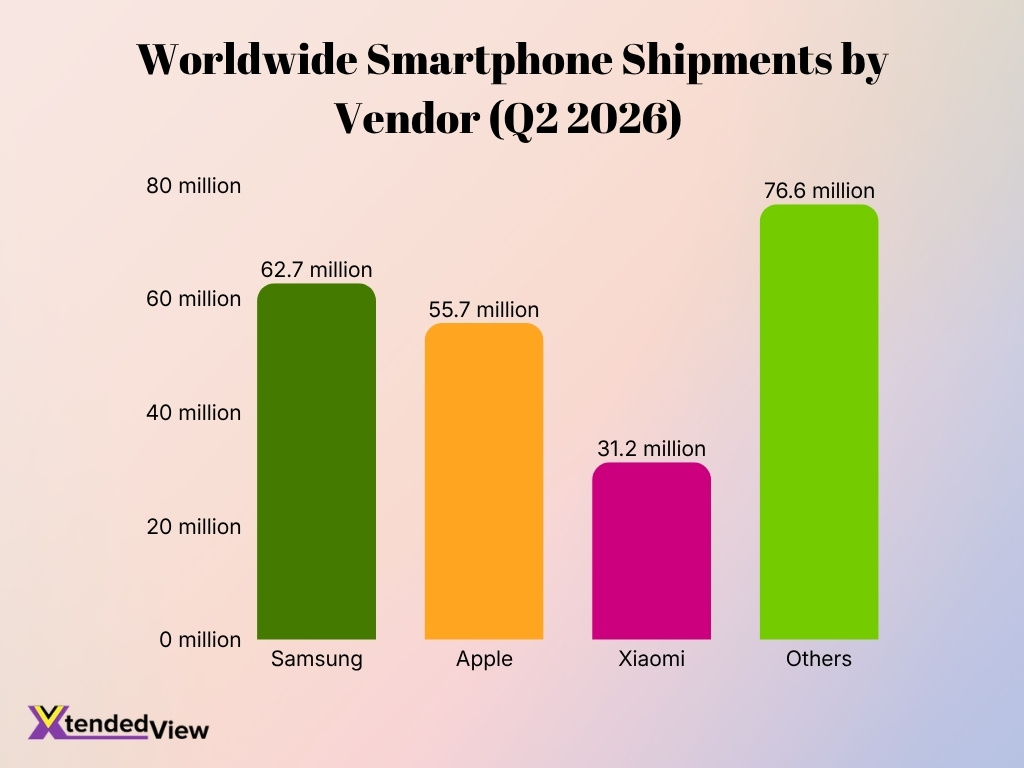
- Worldwide smartphone shipments totaled 276.3 million units in Q2 2026, down 7.4% from 298.3 million units a year earlier.
- Samsung led Q2 2026 with 62.7 million shipments and 22.7% global share, leaving Pixel far outside the industry’s leading volume tier.
- Apple shipped 55.7 million smartphones in Q2 2026 and held 20.2% of the worldwide market.
- Xiaomi remained third globally with 31.2 million Q2 2026 shipments, equal to 11.3% of the market.
- Vendors outside the five largest brands, the category that includes Google globally, accounted for 76.6 million Q2 2026 shipments and 27.7% of the market.
- Global smartphone shipments reached 293.8 million units in Q1 2026, a 2.9% decline from the same quarter of 2025.
- The full smartphone market grew 2% in 2025, meaning Pixel’s much faster shipment growth came during a year when total industry volumes expanded only modestly.
- The 2026 market outlook deteriorated sharply later in the year, with worldwide smartphone shipments forecast to fall 16.7% to just over 1 billion units as memory supply constraints raise device costs.
- Despite lower shipment volumes, worldwide smartphone market value is forecast to rise 6.3% to $613 billion in 2026, which favors vendors capable of competing in premium price tiers such as Pixel.
- The worldwide smartphone average selling price is projected to climb 27.6% to $581 in 2026, creating both an opportunity for premium Pixel models and greater price pressure on consumers.
Google Pixel Market Share by Region and Country
- Google held 12.1% of Japan’s total mobile-device shipments in calendar 2025, with approximately 3.85 million devices shipped during the year.
- During the first half of fiscal 2025 in Japan, Google’s share climbed to 16.0%, up 4.3 percentage points from the comparable period.
- Google shipped approximately 2.28 million devices in Japan during that six-month period, an increase of 46.7% year over year.
- Google moved ahead of Samsung to become Japan’s No. 2 smartphone vendor in February 2026, helped by demand for the lower-priced Pixel 9a and carrier return programs.
- In Europe, Google shipped roughly 900,000 smartphones in Q1 2025, enough to enter the region’s top five vendors for the first time.
- Those 900,000 European Pixel shipments represented about 3% of the regional share in Q1 2025.
- Google’s European smartphone shipments increased approximately 43% year over year in Q1 2025, making it one of the region’s fastest-growing Android brands.
- The U.S. remained a substantially tougher market: Google held around 4.3% share near the Pixel 10 launch in August 2025, despite being one of the brand’s primary target countries.
- In Q1 2026, Google’s U.S. shipment share stood at 3%, compared with 58% for Apple and 26% for Samsung, illustrating the scale difference Pixel still faces in its home market.
- Pixel’s 2026 growth in India concentrated higher up the price ladder, while the country’s overall smartphone market contracted 10% year over year in Q2 2026.
Google Pixel Sales and Shipment Statistics
- One industry-based estimate places 2025 Pixel shipments near 15 million units, using reported annual growth and the prior-year shipment base; Google does not publish a standalone annual Pixel unit figure.
- That estimate implies a 2024 baseline of roughly 12 million Pixel shipments, which highlights the step-up in volume associated with the Pixel 9 and Pixel 10 generations.
- Japan alone accounted for 3.85 million Google device shipments in 2025, making the country unusually important relative to Pixel’s still-limited global scale.
- Japan’s fiscal 2025 total rose further to about 3.98 million shipments, reflecting a 12-month reporting period that differs from calendar-year accounting.
- Apple’s 15.78 million Japanese shipments in calendar 2025 were still roughly four times Google’s volume, showing that Pixel’s strong No. 2 position has not closed the gap with the market leader.
- Google’s 2.28 million shipments during the first half of fiscal 2025 in Japan represented an increase of about 724,000 devices from the comparable prior-year level, based on the reported 46.7% growth rate.
- Pixel’s record-setting September 2025 U.S. sales came immediately after the Pixel 10 series reached stores on Aug. 28, 2025, showing the importance of launch-quarter demand to Google’s annual shipment profile.
- Pixel 9’s first five months in Japan produced a 58.5% sales decline versus Pixel 8 over the equivalent lifecycle window, illustrating how uneven Pixel demand can be between generations.
- The Pixel 10 then reversed that direction in Japan, demonstrating that the weaker Pixel 9 launch did not signal a permanent decline in Google’s Japanese smartphone business. Its post-launch trajectory returned to positive double-digit growth.
- Europe shipped 32.4 million smartphones overall in Q1 2025, meaning Google’s 0.9 million Pixel units represented a meaningful regional foothold but remained far behind Samsung’s 12.2 million units.
Google Pixel Revenue and Alphabet Hardware Earnings
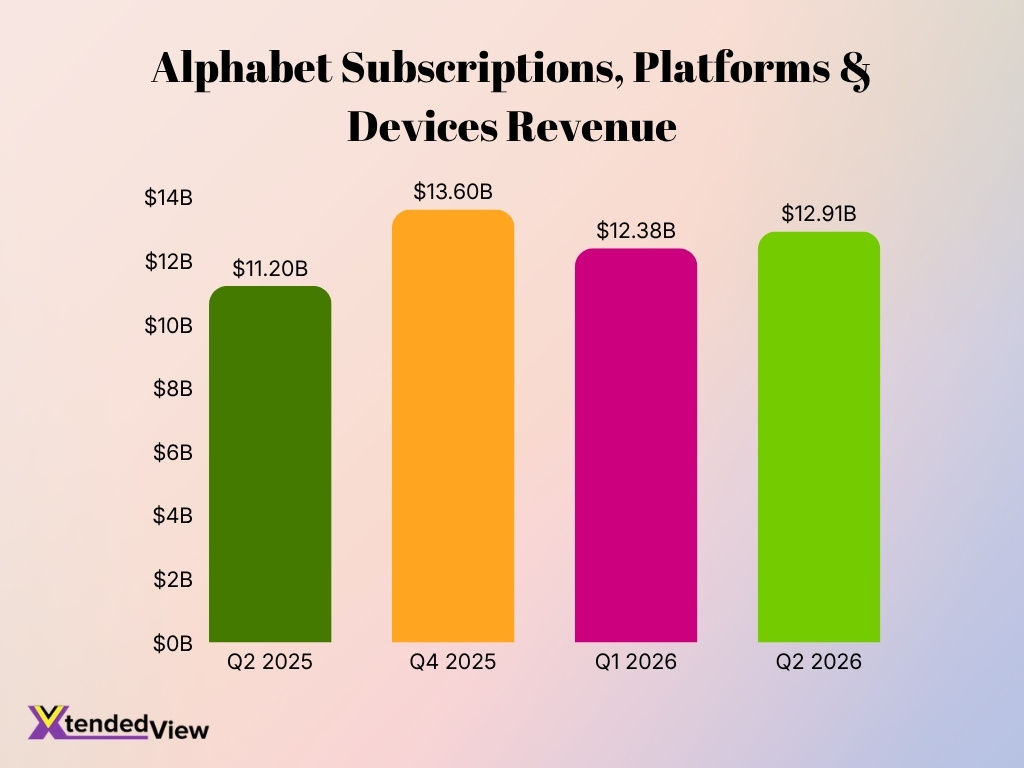
- Alphabet does not report Pixel smartphone revenue as a standalone line item. Instead, Pixel hardware sits within the broader subscriptions, platforms and devices category, which generated $12.91 billion in Q2 2026, up from $11.20 billion in Q2 2025.
- The subscriptions, platforms and devices business grew 15% year over year in Q2 2026, giving Google’s consumer hardware operation a larger revenue pool even though subscriptions also contribute significantly to the category.
- In Q1 2026, the same revenue category generated $12.38 billion, compared with $10.38 billion one year earlier, a 19% increase.
- Combined Q1 and Q2 2026 subscriptions, platforms and devices revenue reached about $25.30 billion, versus approximately $21.58 billion in the first half of 2025. That equals growth of about 17.2% based on reported quarterly figures.
- Google Services, which includes Pixel and Google’s larger consumer businesses, produced $94.54 billion in Q2 2026 revenue, up 15% year over year.
- Google Services operating income increased to $39.54 billion in Q2 2026, compared with $33.06 billion in Q2 2025. That represents growth of nearly 20%.
- In Q1 2026, Google Services generated $40.59 billion in operating income, up from $32.68 billion a year earlier, while its operating margin expanded to 45.3%.
- For comparison, subscriptions, platforms and devices revenue totaled $13.6 billion in Q4 2025, rising 17% from the prior-year quarter. Consumer subscriptions drove much of that increase, so the figure should not be treated as Pixel-only revenue.
- Q2 2025 revenue in this category had already increased 20% year over year to $11.2 billion, showing that Pixel operates inside a consumer revenue segment that entered 2026 with sustained double-digit growth.
- Pixel devices contribute through direct hardware sales, but Alphabet’s reporting structure combines those sales with consumer subscriptions, app-related platform revenue and other products. Therefore, no credible standalone Pixel revenue figure can be calculated directly from Alphabet’s public financial statements.
Google Pixel User Base and Adoption Rate
- In 2026 consumer research, roughly 10% of Japanese smartphone users reported using a Google smartphone as their primary device, the highest rate among the major markets examined.
- Canada ranked second, with about 7% of smartphone users identifying a Google smartphone as their main device in 2026.
- The equivalent 2025 survey measured Pixel usage at 9.8% in Japan, showing that the country had already approached a one-in-10 user penetration rate before 2026.
- Canada recorded 6.8% Pixel user penetration in 2025, again placing it well above most large smartphone markets.
- Pixel accounted for about 5.1% of primary smartphone users in the U.S. in 2025 under the same consumer survey methodology.
- The U.K. also recorded approximately 5.1% user share in 2025, indicating that Pixel adoption there was similar to the U.S. despite differences in carrier structure and smartphone competition.
- Spain remained a smaller Pixel market, with only about 1.7% of smartphone users reporting a Google handset as their primary phone in 2025.
- Separate U.S. brand research found that 84% of smartphone owners recognized Google Pixel in 2024, while only 9% reported owning one, revealing a wide gap between brand awareness and ownership.
- A 2026 enthusiast survey with more than 27,000 responses found that nearly 20% of respondents used a Pixel 10-series phone, compared with 15.7% on the Pixel 9 generation. The sample reflects a Pixel-focused audience rather than the general population, so it works best as an indicator of upgrade patterns.
- In that same 2026 enthusiast sample, the Pixel 10 Pro Fold reached 1.83% usage, versus 0.73% for the Pixel 9 Pro Fold and 0.61% for the original Pixel Fold, pointing to gradual adoption of Google’s foldable line among existing Pixel enthusiasts.
Google Pixel vs. iPhone and Samsung Market Share
- Google captured 3% of U.S. smartphone shipments in Q2 2026, compared with 54% for Apple and 30% for Samsung. Pixel therefore remained a much smaller U.S. vendor despite its recent gains.
- Google’s U.S. shipment share increased from 2% in Q2 2025 to 3% in Q2 2026, while Samsung gained three percentage points to 30% and Apple remained at 54%.
- During Q1 2026, Google held 3% of U.S. shipments, versus Apple’s 58% and Samsung’s 26%. That put Apple’s share at more than 19 times Google’s.
- Pixel reached 7% U.S. shipment share in Q3 2025, its strongest showing across the five-quarter period from Q2 2025 through Q2 2026. Apple held 50% and Samsung held 24% that quarter.
- Google’s share fell from 7% in Q3 2025 to 3% in Q4 2025, highlighting the seasonal boost that Pixel receives around new-model launches.
- Apple controlled 67% of U.S. shipments in Q4 2025, while Samsung held 17% and Google held 3%, creating Pixel’s widest competitive gap within the recent five-quarter comparison.
- Globally, Apple held 21.2% smartphone shipment share in Q1 2026 and Samsung held 20.8%. Google remained outside the five largest global vendors, despite its shipments growing 14% year over year during the quarter.
- Samsung moved ahead globally in Q2 2026 with about 23% shipment share, while Apple held 21%. Google’s global volume remained within the combined “others” group rather than reaching top-five scale.
- At the model level, the iPhone 17 alone represented 14% of U.S. smartphone sales in Q2 2026. The iPhone 17 Pro Max added 13% and iPhone 17 Pro another 10%, illustrating the concentration Pixel faces at the premium end of the U.S. market.
- Google performed more competitively within premium Android than its overall share suggests. Its U.S. share of smartphones priced at $600 or more reached 6.1% in September 2025, compared with just 0.1% in September 2022.
Google Pixel Model Popularity and Search Interest Trends
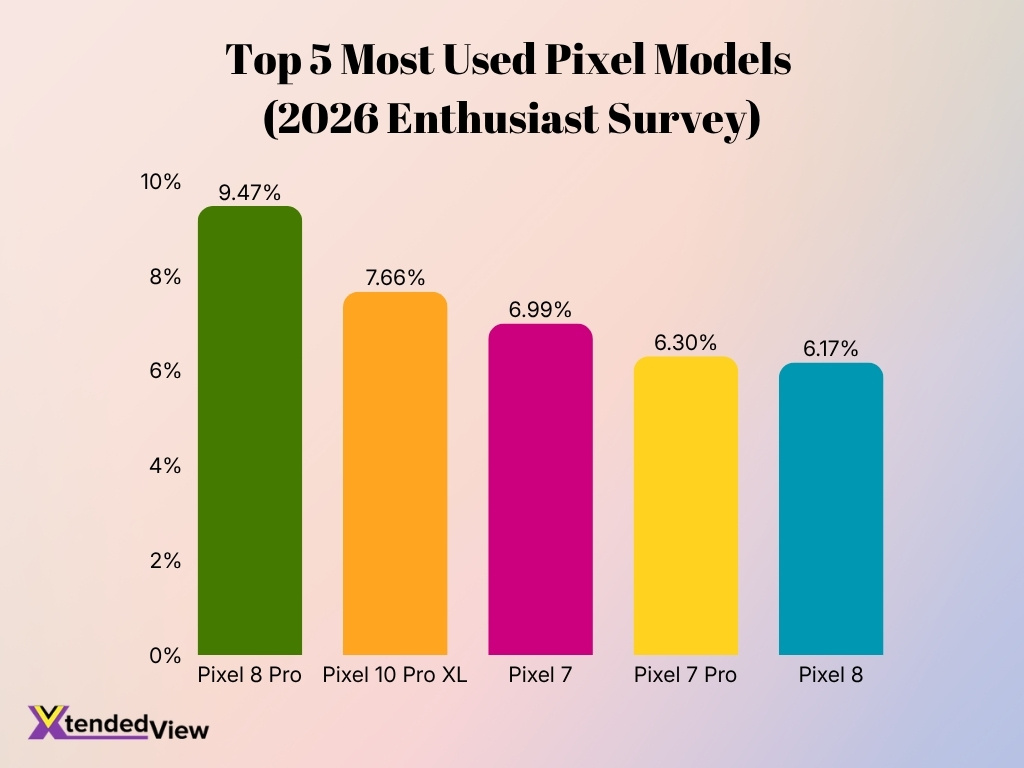
- A 2026 Pixel-user survey with more than 27,000 responses found that the Pixel 8 Pro remained the most-used individual Pixel model among respondents, despite launching in 2023.
- The Pixel 8 Pro accounted for 9.47% of devices in that 2026 enthusiast sample, down from 11.83% in the comparable 2025 survey as newer generations entered the installed base.
- The Pixel 10 Pro XL ranked second among respondents in 2026 at 7.66%, making it the highest-ranking device from the Pixel 10 generation in the survey.
- The standard Pixel 7 still accounted for 6.99% of respondents’ daily-use phones in 2026, showing that older Pixel devices retain meaningful usage several years after launch.
- The Pixel 7 Pro held 6.30% of the surveyed installed base, while the standard Pixel 8 followed at 6.17%. Together, those three older models represented almost one-fifth of surveyed daily-use devices.
- The Pixel 10 Pro represented 5.89% of respondent devices, slightly ahead of the Pixel 9 Pro XL at 5.85%.
- The lower-priced Pixel 6a still accounted for 5.18% of daily-use phones in the 2026 survey, indicating that Google’s A-series can remain active in the installed base well beyond its initial sales period.
- U.S. Pixel 10 sell-through during its first five months came in 25.2% above Pixel 9 sales during the equivalent post-launch window. That marked a sharp reversal after the previous generation’s decline.
- Pixel 9 had sold 22.3% fewer units than Pixel 8 during its first five months in the U.S., while Pixel 8 had fallen 51.4% versus Pixel 7 on the same lifecycle comparison.
- Search-interest data requires careful interpretation because Google Trends uses a normalized 0-to-100 index rather than absolute query counts. It also lets researchers compare up to five search topics, making it useful for tracking Pixel 11, Pixel 10 and competing flagship interest without treating the index as actual unit demand.
Google Pixel User Demographics
- U.S. consumer research found that 14% of Gen Z smartphone owners reported owning a Pixel, compared with 9% of Millennials, 6% of Gen X and 4% of Baby Boomers in the latest detailed generation-level dataset.
- Pixel awareness remained high across generations: 84% of Gen Z, 86% of Millennials, 81% of Gen X and 86% of Baby Boomers recognized the brand.
- Pixel popularity reached 25% among both Gen Z and Millennials, compared with 22% among Gen X and 16% among Baby Boomers. The figures indicate stronger appeal among younger consumers.
- Pixel-related media and advertising buzz was highest among Millennials at 36%, followed by Gen Z at 33%, Gen X at 26% and Baby Boomers at 23%.
- A U.S. mobile-audience dataset updated in July 2026 estimates that 49.3% of Google smartphone users are ages 35 to 44, making that group the largest segment in its observed audience.
- The same 2026 dataset places users ages 55 and older at 27.2%, followed by ages 18-24 at 12.7%, ages 45-54 at 8.4% and ages 25-34 at 2.4%. These figures describe the provider’s observed mobile audience rather than the entire U.S. Pixel population.
- Men represented 57.1% of the observed U.S. Google smartphone audience in July 2026, compared with 42.9% for women.
- About 35.4% of that observed audience had household income below $25,000, while 15.3% fell into the $100,000-$149,999 bracket.
- Consumer-value research covering 2025 found that Pixel scored especially well among U.S. Millennials, recording a 60.7 net value score among current and former customers and ranking second in that generation’s personal-technology value table.
- Among Baby Boomers, Pixel achieved a 54.0 net value score and also ranked second for perceived value among the personal-technology brands measured, indicating that lower ownership among older users does not necessarily translate into weak value perceptions among those familiar with the product.
Google Pixel Customer Satisfaction and Retention Rates
- Google’s U.S. cell phone customer satisfaction score increased from 75 in 2025 to 77 in 2026, a 3% year-over-year improvement.
- Samsung led major smartphone manufacturers in 2026 with a satisfaction score of 81, followed by Apple at 80, while Google and Motorola tied at 77.
- Google’s flagship smartphones scored 80 out of 100 for customer satisfaction in 2026, only two points below Apple’s flagship score of 82 and four points below Samsung’s 84.
- Google’s foldable phones earned a lower 72 satisfaction score in 2026, compared with 80 for Samsung foldables. This 8-point gap suggests Google’s foldable customer experience still trails its strongest Android rival.
- A 2026 survey of more than 5,000 U.S. smartphone users found that 86.8% of Google users planned to stay with the brand when upgrading, leaving 13.2% considering a switch.
- Google’s 86.8% retention figure increased 21.6 percentage points from 2021, when its measured loyalty stood at only 65.2%.
- Google’s 2026 loyalty level also exceeded its 84.0% result from 2019, suggesting that retention has fully recovered from the sharp decline recorded in 2021.
- Samsung still held a retention advantage at 90.1%, while Apple’s 96.4% loyalty rate remained nearly 10 percentage points higher than Google’s.
- Among Android users who planned to switch brands, 21.2% named Google Pixel as their likely next brand, making Pixel the third-most-selected destination after Samsung at 31.5% and Apple at 26.8%.
- Pixel also attracted 20.2% of prospective iPhone switchers in the 2026 survey, compared with 69.7% choosing Samsung and 10.1% choosing Motorola. Although iPhone switching remained rare, Pixel captured about one-fifth of that potential defector group.
Google Pixel Pricing and Average Selling Price Statistics
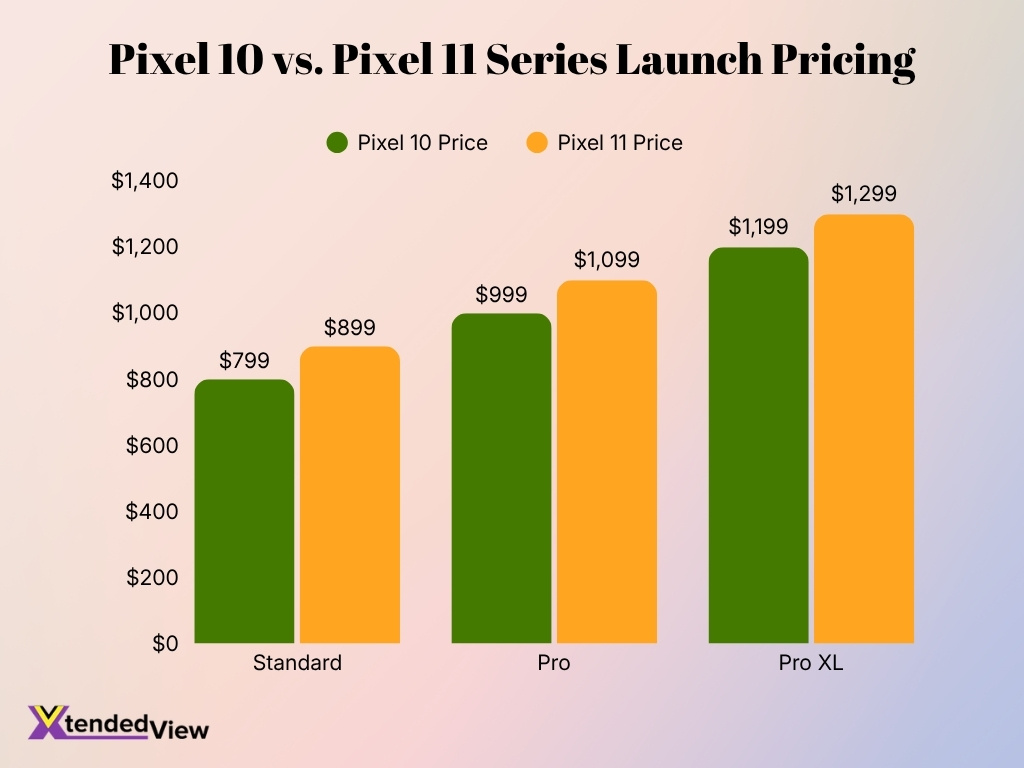
- Google raised the standard flagship entry point with the Pixel 11, which launched in the U.S. at $899 in August 2026, $100 above the Pixel 10’s $799 launch price.
- The Pixel 11 Pro launched at $1,099, also $100 above the Pixel 10 Pro’s $999 starting price.
- Pixel 11 Pro XL started at $1,299 in 2026, compared with $1,199 for the preceding Pixel 10 Pro XL.
- Google’s 2026 foldable flagship, the Pixel 11 Pro Fold, entered the U.S. market at $1,899, making it $1,000 more expensive than the standard Pixel 11.
- The Pixel 10 remained listed at a $799 regular price for 128 GB in 2026, while moving to 256 GB increased the price to $899.
- The Pixel 10 Pro started at $999 for 128 GB, with 256 GB priced from $1,099, 512 GB from $1,219 and 1 TB from $1,449. Storage therefore added as much as $450 to the base Pro price.
- Google’s move from a $799 Pixel 10 to an $899 Pixel 11 represents a 12.5% increase in flagship entry price within one generation.
- The U.S. smartphone market faced broader price pressure in 2026. Sales of sub-$100 smartphones dropped 64% year over year in Q2, while the $200-$299 segment expanded by nearly 200% as vendors adjusted prices amid higher component costs.
- Rising memory costs also created upward pressure on smartphone average selling prices during 2026. This matters for Pixel because Google’s lineup now stretches from mainstream premium pricing to nearly $1,900 for its newest foldable.
- Google’s pricing strategy has increasingly concentrated Pixel in premium tiers rather than mass-market entry pricing. The $899-$1,899 launch-price span of the Pixel 11 family gives Google a $1,000 range across its 2026 flagship portfolio.
Google Pixel Software Update Support and Longevity Statistics
- Pixel 8 and every later qualifying Pixel generation receive seven years of operating system and security updates, counted from the date each device first became available in the U.S.
- Google’s seven-year policy covers the Pixel 8, Pixel 8 Pro and Pixel 8a; the Pixel 9 family; the Pixel 10 family; and the Pixel 11 generation introduced in 2026.
- Pixel 8 and Pixel 8 Pro, released in 2023, have support scheduled through 2030, giving owners a much longer official lifecycle than earlier Pixel generations received at launch.
- Pixel 6, Pixel 6 Pro, Pixel 6a, Pixel 7, Pixel 7 Pro, Pixel 7a and the original Pixel Fold receive five years of OS and security support from their initial U.S. availability dates.
- The shift from five to seven years increased Google’s stated support window by 40%, adding two extra years to the lifecycle for Pixel 8 and later phones.
- Google also committed to maintaining replacement hardware parts for seven years for the Pixel 8 generation, aligning repair availability more closely with the software-support period.
- Pixel 11, Pixel 11 Pro and Pixel 11 Pro XL launched in 2026 with the same seven-year OS, security and Pixel Drop commitment, showing that the policy has become standard across Google’s flagship lineup rather than a one-generation promise.
- Pixel 10 also carries seven years of updates, meaning a phone first released in August 2025 should remain within its stated update window until roughly 2032, subject to Google’s support terms.
- Pixel 11’s 2026 launch extends that timeline another year: a seven-year commitment from its August 2026 availability implies support to approximately 2033.
- By contrast, Pixel 5a and earlier Pixel generations no longer receive regular Android version or security updates under the current schedule, which creates a clear support divide between older devices and Google’s newer seven-year hardware strategy.
Google Pixel Fold and Premium Model Sales Statistics
- Google’s North American foldable shipments increased 52% year over year in 2025, substantially outpacing the region’s overall 28% foldable-market growth.
- Google captured a record 5% of North American foldable shipments in 2025, establishing a measurable position in a category that Samsung had dominated for years.
- Google’s North American foldable share peaked at 18% in Q4 2025, shortly after the Pixel 10 Pro Fold entered the market.
- Samsung still controlled 51% of North American foldable shipments in 2025, while Motorola reached 44%, leaving Google’s annual share well behind the two largest vendors despite its rapid growth.
- Google also re-entered the world’s top five premium smartphone brands in H1 2025 after a five-year absence. Pixel premium-model sales roughly doubled year over year, helped by the Pixel 9 series and broader geographic availability.
- The wider premium smartphone segment expanded 8% year over year in H1 2025, twice the 4% growth rate of the total smartphone market. Premium phones also produced more than 60% of worldwide smartphone revenue.
- Premium smartphones represented a record 29% of global unit sales in H1 2026, up from 25% in H1 2025 and 20% in H1 2022. This provides a larger addressable market for Pixel Pro and Fold devices.
- Global premium-device sales grew another 5% year over year in H1 2026, even as pricing pressure affected lower smartphone tiers more heavily.
- The Pixel 11 Pro Fold launched in 2026 at $1,899, $100 above the Pixel 10 Pro Fold’s $1,799 launch price and $1,000 above the standard Pixel 11.
- Competition is set to intensify sharply: North American foldable shipments were forecast to grow 48% in 2026, while Google’s regional foldable share was projected to decline from 5% to 3% as new competitors entered the category.
Smartphone Features Influencing Consumer Purchase Decisions
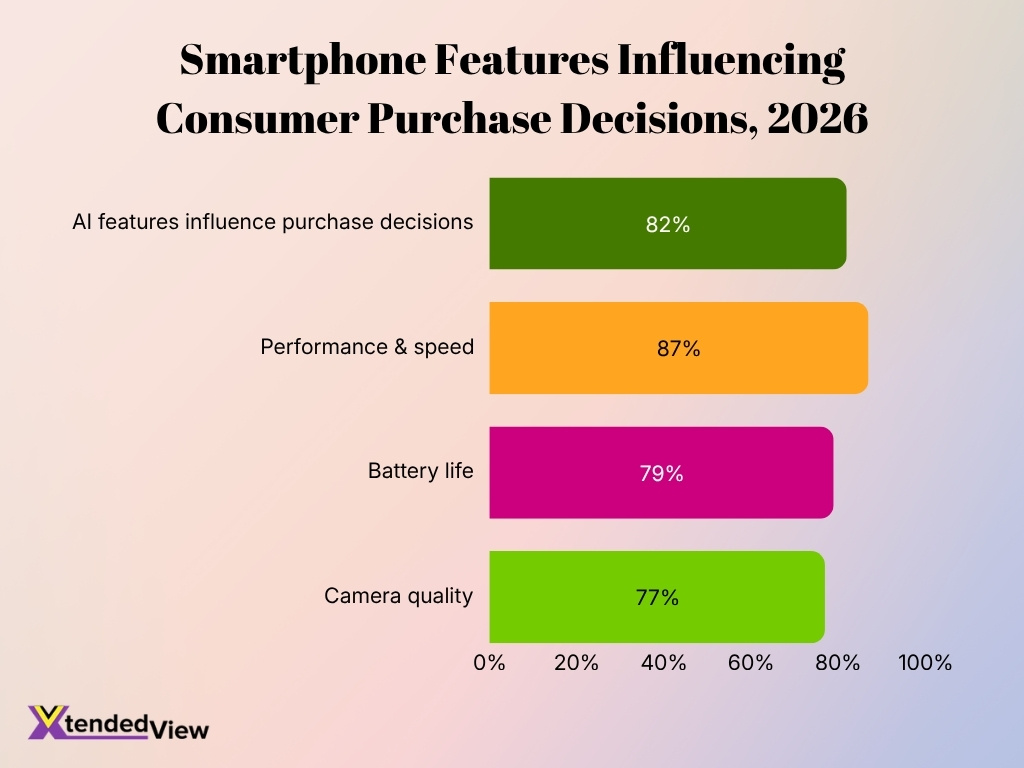
- Performance and speed rank as the strongest purchase factor, influencing 87% of consumers.
- AI features influence smartphone purchase decisions for 82% of consumers, highlighting the growing importance of AI capabilities.
- Battery life remains a major consideration, with 79% of consumers factoring it into their smartphone buying decisions.
- Camera quality influences 77% of buyers, making it another key feature in smartphone selection.
- The gap between performance and speed (87%) and camera quality (77%) is just 10 percentage points, showing that all four features carry substantial weight.
Google Pixel Carrier and Distribution Channel Statistics
- Pixel’s share of U.S. premium smartphone sales at Verizon reached 7.0% in September 2025, compared with only 0.1% three years earlier.
- At T-Mobile, Pixel’s share of devices priced at $600 or more increased from 0.1% in September 2022 to 6.5% in September 2025.
- AT&T remained Google’s weakest major U.S. carrier channel, with Pixel accounting for only 2.3% of premium sales in September 2025.
- Pixel sales increased 20% year over year across the U.S. market in Q4 2025, and Google gained share at each of the three largest postpaid carriers during the quarter.
- The three largest U.S. postpaid carriers collectively increased smartphone sales 6% year over year in Q4 2025, reinforcing the importance of carrier promotions and multi-line offers for premium-device distribution.
- In Q2 2025, smartphone sell-through increased 20% at T-Mobile, 16% at AT&T, and 12% at Verizon year over year. Promotional activity contributed to higher upgrade rates across all three channels.
- Pixel benefited from those premium channels as U.S. sales priced above the mainstream tiers grew. Overall premium-device sell-through increased 11% year over year in Q2 2025.
- Google’s U.S. smartphone shipment share increased from 2% in Q2 2025 to 3% in Q2 2026, with the brand remaining particularly aggressive in postpaid sales channels.
- Pixel 11, Pixel 11 Pro and Pixel 11 Pro XL were available directly in 23 Google Store markets in 2026, including the U.S., Canada, India, Japan, Taiwan and multiple European countries.
- The Pixel 11 Pro Fold had a narrower distribution footprint of 19 Google Store markets, showing that Google continues to distribute its foldable more selectively than its conventional flagship models.
Google Pixel Manufacturing and Retail Expansion
- Google began local Pixel manufacturing in India with the Pixel 8 generation, and the first locally manufactured Pixel 8 units started rolling off production lines in 2024.
- By early 2025, Google’s Indian manufacturing partners were producing approximately 43,000 to 45,000 Pixel phones per month for the domestic market.
- One manufacturing partner accounted for roughly 65% to 70% of India’s Pixel production during that period, while another concentrated more heavily on older models.
- Indian Pixel production later reached a peak of approximately 70,000 to 80,000 handsets per month as Google expanded local assembly.
- By September 2025, Google was working to expand local manufacturing beyond existing models and was discussing production of the Pixel 10 series alongside future exports from India.
- Google’s India retail network expanded to more than 2,000 stores by May 2025, compared with the much narrower retail footprint the company had relied on during Pixel’s earlier years in the market.
- Pixel had also reached 25-plus large-format and wireless retail partners in India, broadening availability beyond a single dominant online marketplace.
- Google installed dedicated Pixel fixtures in more than 200 Indian stores, giving consumers more opportunities to test devices before purchase.
- After-sales infrastructure expanded alongside retail: Google reported 20 same-day repair centers in India in 2025, including three exclusive service centers.
- Google also launched direct online Pixel sales in India in May 2025, adding its own e-commerce channel to existing partner-based online and offline distribution.
Future Outlook: Google Pixel Growth Projections and Market Trends
- The global foldable smartphone market was projected to expand 20% year over year in 2026, creating a larger category for the Pixel 11 Pro Fold even as competition becomes tougher.
- North American foldable shipments were forecast to rise even faster at 48% in 2026, but Google’s share was projected to decline from 5% to 3% as the market adds another major premium competitor.
- Foldables still represented only about 1.6% of worldwide smartphone sales in 2025, which means even rapid category growth starts from a small base.
- The premium smartphone segment already reached 29% of global unit volume in H1 2026, up four percentage points in one year. Continued premiumization aligns closely with Google’s Pixel Pro strategy.
- Pixel’s U.S. shipment share increased to 3% in Q2 2026 from 2% a year earlier, showing incremental market-share progress despite intense competition from Apple and Samsung.
- India’s ultra-premium Pixel shipments grew 68% year over year in Q2 2026, providing Google with a high-growth opportunity outside its established U.S. and Japanese markets.
- Google entered H1 2025 with premium Pixel sales running at roughly twice the prior-year level, suggesting that premium-market growth can matter more to Pixel than its still-small global unit share.
- Artificial intelligence should remain central to Pixel’s growth strategy. In 2026, 24% of U.S. adults reported using Gemini, giving Google an existing AI audience that reaches well beyond current Pixel ownership.
- Consumer behavior also supports continued AI integration: 51% of regular generative AI users in a 2025 U.S. survey said they used the technology daily, strengthening the case for persistent, on-device AI functions rather than occasional novelty features.
- Google’s primary challenge remains scale. Pixel has built stronger premium, foldable and carrier positions, but its 3% U.S. shipment share in Q2 2026 still leaves it far behind Apple at 54% and Samsung at 30%.
Frequently Asked Questions (FAQs)
Google Pixel held 3% of U.S. smartphone shipments in Q2 2026, up from 2% in Q2 2025.
Pixel 10 sold 25.2% more units than Pixel 9 during their comparable first five months on sale in the U.S.
Google Pixel recorded 68% year-over-year growth in India’s ultra-premium smartphone segment priced above INR 45,000.
Google Pixel reached 7% of U.S. smartphone shipments in Q3 2025, compared with 3% in both Q1 and Q2 2026.
Pixel 9 sold 22.3% fewer units than Pixel 8 during their comparable first five months after launch in the U.S.
Conclusion
Google Pixel enters late year with a stronger premium-market presence, broader international distribution and a more distinct AI-focused product strategy. Growth in the U.S., Japan and India, alongside improving performance in premium and foldable smartphones, shows that Pixel is gaining relevance beyond its traditional enthusiast audience. Google’s seven-year software-support commitment, expanding retail network and deeper integration of Gemini could also help the company improve device longevity, customer retention and upgrade demand.
However, Pixel remains considerably smaller than Apple and Samsung in global and U.S. smartphone volumes. Google’s next stage of growth will depend on converting high brand awareness and AI interest into sustained sales, while maintaining competitive pricing, carrier support and international availability. The statistics suggest that Pixel is expanding its position, but long-term market-share gains will depend on whether that momentum continues across multiple product generations and geographic markets.