



Tesla’s AI strategy has evolved from highway-focused driver assistance into a broader autonomy ecosystem covering city driving, automated lane changes, parking, ride-hailing, and large-scale neural-network training. Autopilot and FSD (Supervised) operate across millions of vehicles, while accumulated FSD mileage now runs into the billions. This growing fleet gives Tesla a substantial stream of real-world driving data to train, validate, and update its autonomous-driving software.
The company is also extending its AI program beyond privately owned vehicles. Commercial Robotaxi operations, Cybercab production, expanding AI-compute infrastructure and new international FSD approvals show how autonomy is becoming a larger part of Tesla’s business strategy. At the same time, recalls, crash investigations and regulatory reviews continue to shape how quickly these technologies can expand. The following Tesla AI and Autopilot statistics examine adoption, mileage, safety, performance, hardware, regulation, and the future direction of the company’s autonomous-driving program.
Editor’s Choice
- 11.4+ billion miles: Cumulative FSD (Supervised) mileage has moved above 11.4 billion miles.
- 4.29+ billion city miles: More than 4.29 billion FSD miles have occurred in city driving.
- 1.48 million subscriptions: Active FSD subscriptions reached 1.48 million at the end of Q2 2026.
- 56% annual subscription growth: Active subscriptions increased from 950,000 in Q2 2025 to 1.48 million in Q2 2026.
- 55%+ North American attach rate: More than half of new North American deliveries included an FSD subscription during Q2 2026.
- 205+ MW of installed Texas AI compute: Cortex 1 and Cortex 2 had listed capacities above 90 MW and 115 MW, respectively, in Q2 2026.
- More than 2x onsite compute growth: Onsite Texas compute capacity, measured in megawatts, more than doubled during the first half of 2026.
- 31 million European FSD miles: Drivers in newly approved European markets had accumulated more than 50 million kilometers, or 31 million miles, on FSD by July 2026.
Recent Developments
- Active FSD subscriptions climbed from 1.10 million at the end of Q4 2025 to 1.48 million in Q2 2026, an increase of roughly 380,000 in two quarters.
- Subscriptions rose from 1.28 million in Q1 to 1.48 million in Q2 2026, adding about 200,000 active subscriptions in one quarter.
- The company began shifting FSD toward a subscription-only model in 2026 after monthly subscriptions more than doubled during 2025.
- FSD achieved a record North American attachment rate in Q2, with more than 55% of new deliveries including subscriptions.
- FSD v14 lite began reaching AI3-equipped vehicles in the U.S. in 2026, bringing selected v14 driving behavior to older hardware.
- The v14 lite release included destination options for parking lots, streets, driveways and curbs, alongside improvements for merges, forks, pedestrians, traffic lights and vehicle cut-ins.
- By Q2 2026, the Robotaxi service was live in seven major U.S. metro areas, while unsupervised rides expanded to Miami, Orlando and Tampa in July.
- Cybercab entered production during 2026, and engineering vehicles began public-road testing during Q2. Employee rides followed at the Texas manufacturing site in July.
- Regulatory expansion also accelerated. Following approval in the Netherlands, additional FSD approvals arrived in Lithuania, Estonia, Denmark, and Belgium. Drivers in these markets had logged more than 50 million kilometers by July.
Overview of Tesla AI and Autopilot
- Autopilot centers on two core driving functions: Traffic-Aware Cruise Control and Autosteer. The first adjusts speed and following distance, while the second helps keep the vehicle within its lane.
- FSD (Supervised) uses eight external cameras to provide a 360-degree view around the vehicle.
- The FSD system processes more than 1 million pixels of visual information every millisecond, according to its current safety disclosure.
- FSD (Supervised) has accumulated more than 11.4 billion miles of real-world driving since its rollout began.
- Of that total, more than 4.29 billion miles were city miles, or roughly 38% of the cumulative mileage shown in the current safety data.
- The monthly FSD (Supervised) subscription costs $99 in the U.S. for eligible vehicles.
- Eligible vehicles need an FSD computer 3.0 or newer to subscribe through the vehicle or mobile app.
- Despite its name, FSD (Supervised) does not make a customer vehicle autonomous. The driver must remain attentive and ready to intervene while the system operates.
Tesla FSD Supervised Mileage Growth
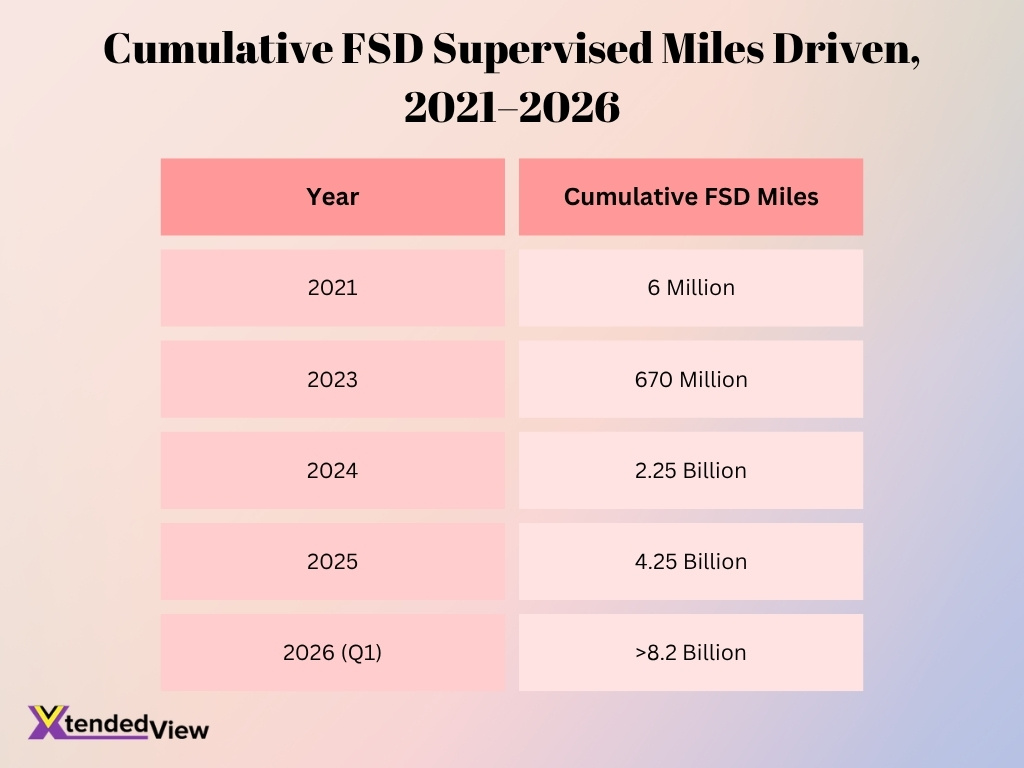
- Tesla’s cumulative FSD Supervised mileage surged from just 6 million miles in 2021 to more than 8.2 billion miles by Q1 2026.
- By 2023, cumulative FSD mileage had reached 670 million miles, marking a major expansion in real-world driving data.
- FSD Supervised mileage climbed to 2.25 billion miles in 2024, representing roughly 3.4x growth from the prior level.
- The total nearly doubled again in 2025, reaching approximately 4.25 billion cumulative miles.
- By Q1 2026, Tesla had surpassed 8.2 billion FSD Supervised miles, with the fleet reportedly accumulating more than 20 million miles per day.
- Overall, the figures show a dramatic scaling of Tesla’s real-world FSD driving dataset, rising by more than 1,300x from 2021 to Q1 2026.
How Tesla Autopilot and FSD Work
- The current vision system uses eight exterior cameras to observe the vehicle’s surroundings.
- Those cameras provide a 360-degree view around the vehicle, giving the driving system visual inputs from the front, rear, and both sides.
- FSD processes more than 1 million visual pixels per millisecond, allowing the onboard computer to update its interpretation of the driving environment in real time.
- Autosteer combines lane detection, road-edge detection, and object awareness to help maintain the vehicle’s position in a lane.
- Traffic-Aware Cruise Control adjusts vehicle speed to maintain a selected following distance from traffic ahead.
- Auto Lane Change can move the vehicle into an adjacent lane when the driver activates the turn signal while the relevant assisted-driving system is engaged.
- FSD uses inputs from front, rear, left, and right cameras to create a model of the surrounding environment; the onboard AI computer then processes neural networks to make driving decisions.
- A cabin camera supports driver-attention monitoring. The system can issue escalating warnings when it determines that the driver needs to respond.
- Over-the-air software updates allow the driving stack to change without replacing the vehicle, which has enabled newer FSD software to reach compatible vehicles after delivery.
Tesla Autopilot Adoption and Usage Statistics
- Active FSD subscriptions reached 1.48 million in Q2 2026, compared with 1.28 million in Q1.
- The Q2 subscription total represented 56% year-over-year growth from 950,000 in Q2 2025.
- Active subscriptions increased by approximately 530,000 in one year, from 950,000 to 1.48 million.
- Q4 2025 ended with 1.10 million active subscriptions, meaning the paid base expanded by about 34.5% between the end of 2025 and Q2 2026.
- More than 55% of new North American deliveries included an FSD subscription in Q2 2026.
- In a third-party sample of 1,250 drives using a March 2026 software release, FSD appeared in 25.9% of recorded drives, while 27.2% of sampled drivers used it. The sample should not be treated as representative of the entire fleet.
- Among FSD-enabled drives in that same sample, an average of 89.6% of each drive occurred with FSD engaged.
- A later 2026 software sample covering 2,362 drives recorded FSD use during 45.6% of drives, with 64.3% of sampled drivers using the system. Again, these figures describe the sampled users, not the complete fleet.
- In that later sample, FSD handled an average of 84.1% of each FSD-using drive, suggesting users who activate the system often keep it engaged for most of the trip.
Miles Driven with Autopilot and FSD Engaged
- Cumulative FSD (Supervised) driving has exceeded 11.4 billion miles since 2020.
- City driving accounts for more than 4.29 billion FSD miles, demonstrating substantial exposure to intersections, traffic controls, pedestrians, and other urban driving situations.
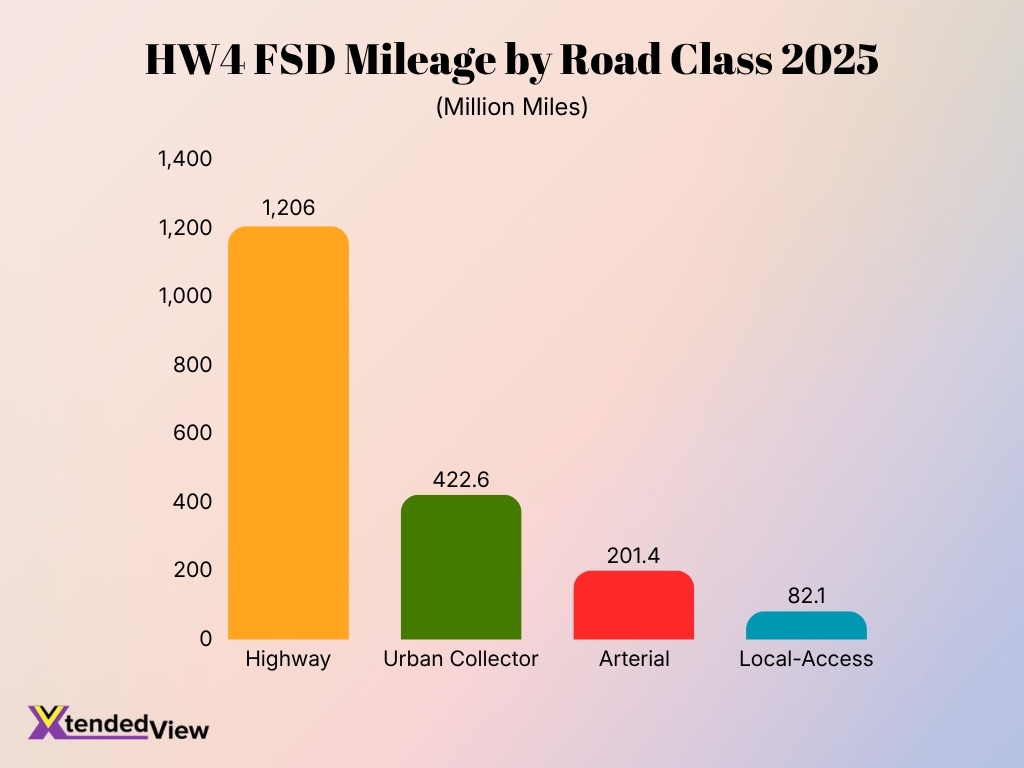
- In 2025, HW4 vehicles logged about 1.206 billion FSD highway miles in the North American road-class data.
- Highway driving accounted for 63.07% of recorded 2025 HW4 FSD mileage, far above the 45.66% highway share for manual driving with active safety features in the same dataset.
- HW4 vehicles recorded approximately 422.6 million FSD miles on urban collector roads during 2025, representing 22.1% of the measured FSD mileage.
- Another 201.4 million FSD miles occurred on arterial roads in 2025, equal to 10.53% of the HW4 FSD total in the road-class dataset.
- Local-access roads contributed about 82.1 million FSD miles in 2025, or 4.29% of the measured total.
- In Q3 2025 alone, HW4 vehicles accumulated approximately 443.8 million FSD highway miles, up from 323.1 million in Q2 and 267 million in Q1.
- By July 2026, drivers in Lithuania, Estonia, Denmark, and Belgium had collectively driven more than 50 million kilometers, or 31 million miles, with FSD following regulatory approvals in those markets.
Autopilot and FSD Safety Statistics
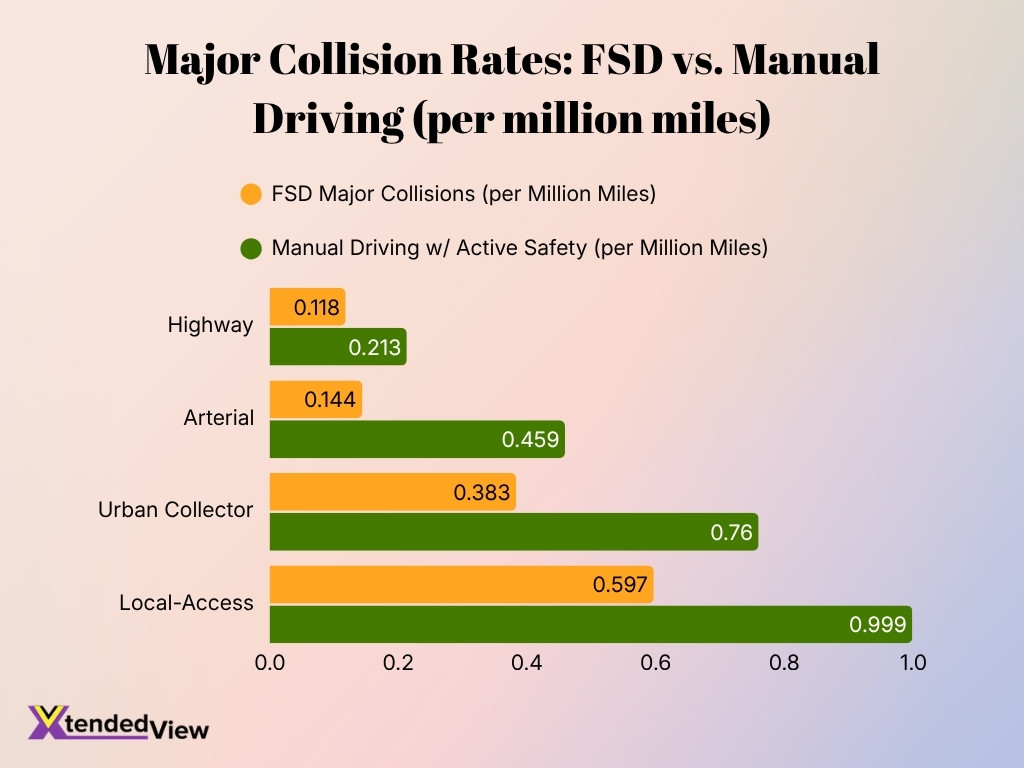
- In 2025 North American data, FSD (Supervised) recorded 0.118 major collisions per million highway miles, compared with 0.213 for manually driven Teslas using active safety features. That equates to a 45% lower reported rate.
- On arterial roads, FSD recorded 0.144 major collisions per million miles, versus 0.459 for manual driving with active safety features, a difference of about 69%.
- On urban collector roads, the reported major-collision rate was 0.383 per million FSD miles, compared with 0.760 for manual driving with active safety features.
- On local-access roads, FSD recorded 0.597 major incidents per million miles, compared with 0.999 for manually driven Teslas with active safety systems.
- During highway driving, Automatic Emergency Braking activation occurred at a reported rate of 7.593 events per million FSD miles in one analyzed dataset, compared with 112.562 per million manually driven miles with active safety features.
- FSD drivers experienced about 67% fewer detected fatigue events on North American highways than manually driving Tesla owners with active safety features. The incidence-rate ratio was 0.333, with p<0.001.
- During more than 163 million highway lane changes, FSD recorded eight near-deployment collision events, compared with 528 across about 106 million manual lane changes with active safety features.
- Across more than 214 million non-highway FSD lane changes, the dataset reported no major collisions during the study period and a minor-collision incidence rate of 0.054 compared with manual driving.
- The underlying safety dataset includes billions of real-world miles. In Q3 2025 alone, vehicles transmitted approximately 2.5 billion telemetry packages globally, excluding China.
Crash and Accident Rates with Autopilot Enabled
- FSD (Supervised) logged 142 major highway incidents across about 1.206 billion miles in the 2025 North American dataset, producing a rate of roughly 0.118 incidents per million miles.
- On arterial roads, 29 major incidents occurred over 201.38 million FSD miles, resulting in a reported rate of 0.144 per million miles.
- Urban collector roads recorded 162 major incidents across 422.59 million FSD miles, or 0.383 per million miles.
- Local-access roads recorded 49 major incidents over 82.11 million FSD miles, or 0.597 per million miles.
- Highway major-collision rates increased by a nominal 17% from 2024 to 2025 for FSD. However, the change was not statistically significant, with p=0.439.
- The 2024 highway comparison relied on 29 FSD major incidents over about 288 million miles, while the 2025 dataset expanded to 142 incidents over more than 1.2 billion miles, giving the latter estimate substantially more statistical power.
- FSD major-collision rates improved year over year across all three non-highway road classes studied: arterial, urban collector, and local-access roads.
- Minor collision rates also improved from 2024 to 2025 across all four road classes, with three of four changes statistically significant at p<0.05.
- The collision methodology counts a crash as FSD-related when FSD had been active at any point within the five seconds before the collision, even if the driver disengaged shortly before impact.
Autopilot vs Manual Driving Safety Statistics
- On highways, FSD’s major-collision incidence-rate ratio versus manual driving with active safety features was approximately 0.55, corresponding to a 45% lower rate in the 2025 dataset.
- On arterial roads, FSD showed a reported 69% lower major-collision rate than manually driven Teslas with active safety features.
- On urban collectors, the major-collision rate was approximately 50% lower under FSD than with manual driving plus active safety features.
- On local-access roads, FSD showed a reported 40% lower major-collision rate than the manual active-safety group.
- Compared with manually driven Teslas without active safety features, FSD major-collision rates were about 90% lower on arterial roads, 74% lower on urban collectors and 71% lower on local-access roads.
- During highway lane changes, FSD recorded 0.77 forward-collision warnings per 10,000 lane changes, compared with 30.55 for manual driving with active safety features.
- Highway lane-change Automatic Emergency Braking events occurred at 0.08 per 10,000 FSD lane changes, versus 0.47 under manual driving with active safety systems.
- On non-highway roads, forward-collision warnings during lane changes occurred at 3.32 per 10,000 FSD lane changes, compared with 29.33 per 10,000 manual lane changes.
- Hard positive acceleration events of at least 3 m/s² occurred at 1.073 per 1,000 FSD highway miles, versus 19.481 during manual driving with active safety features in the North American sample.
Tesla AI Training Data and Neural Network Statistics
- A full build of the self-driving neural-network stack has been described as involving 48 neural networks.
- Training a full build has required about 70,000 GPU hours, illustrating the computational load behind a single complete training cycle.
- Those networks collectively produce roughly 1,000 distinct prediction tensors at each time step, covering perception and other driving outputs.
- The neural-network architecture processes input from individual cameras for semantic segmentation, object detection and monocular depth estimation, while multi-camera networks generate a top-down representation of roads, infrastructure and 3D objects.
- By September 2025, AI training capacity had expanded to roughly 120,000 H100-equivalent GPUs, according to the company’s reported training-capacity ramp.
- Cortex alone had reached approximately 81,000 H100 equivalents by Q3 2025 as the company expanded training capacity in Texas.
- At the end of 2025, Cortex 1 had installed capacity above 100,000 H100 equivalents, while plans called for on-site Texas compute to more than double during the first half of 2026.
- By Q2 2026, Cortex 1 exceeded 90 MW of installed capacity, and Cortex 2 exceeded 115 MW, putting combined listed capacity above 205 MW.
- The training pipeline draws from a fleet of millions of vehicles, and the safety-report telemetry system processed about 2.5 billion vehicle telemetry packages in Q3 2025 alone, excluding China.
- European engineering work added nearly 1.95 million miles of manually collected “golden” training data and roughly 994,000 miles of FSD validation driving in the latest published engineering dataset.
Autopilot Feature Engagement and Disengagement Rates
- In the European fixed-route program, a test counts as a failure when a safety driver must disengage FSD to maintain safety or prevent a traffic-law violation.
- Across intersection tests, 572 of 73,230 scenarios required intervention, implying a test-failure or disengagement rate of about 0.78%.
- Crosswalk scenarios recorded 161 failures in 47,474 tests, equivalent to an intervention rate of about 0.34%.
- Traffic-light scenarios recorded 846 failures across 34,024 tests, producing an intervention rate of roughly 2.49%.
- Roundabouts produced 74 failures among 6,974 tests, or an intervention rate of approximately 1.06%.
- Stop-sign scenarios recorded 191 failures out of 2,707 tests, equivalent to roughly a 7.06% intervention rate and one of the highest rates among the listed scenario types.
- Across approximately 513 million FSD lane changes evaluated in North America, only 2.5% had a Driver Monitoring System warning during the preceding seven seconds.
- An escalation or engagement-of-driver request appeared before just 0.6% of those FSD lane changes, according to the same driver-monitoring analysis.
- More than 90% of drivers in European engineering-fleet lane changes performed at least one relevant safety check, such as looking at a side mirror, window, rearview mirror or center screen before crossing the lane line.
- The 2025 collision analysis also reported improving disengagement behavior alongside rising FSD mileage and falling non-highway collision rates, although it did not publish a single fleetwide disengagement-per-mile figure.
Full Self-Driving (FSD) Performance Metrics
- Across more than 230,000 predefined European scenario tests, the system recorded zero events classified as safety-critical during the published validation period.
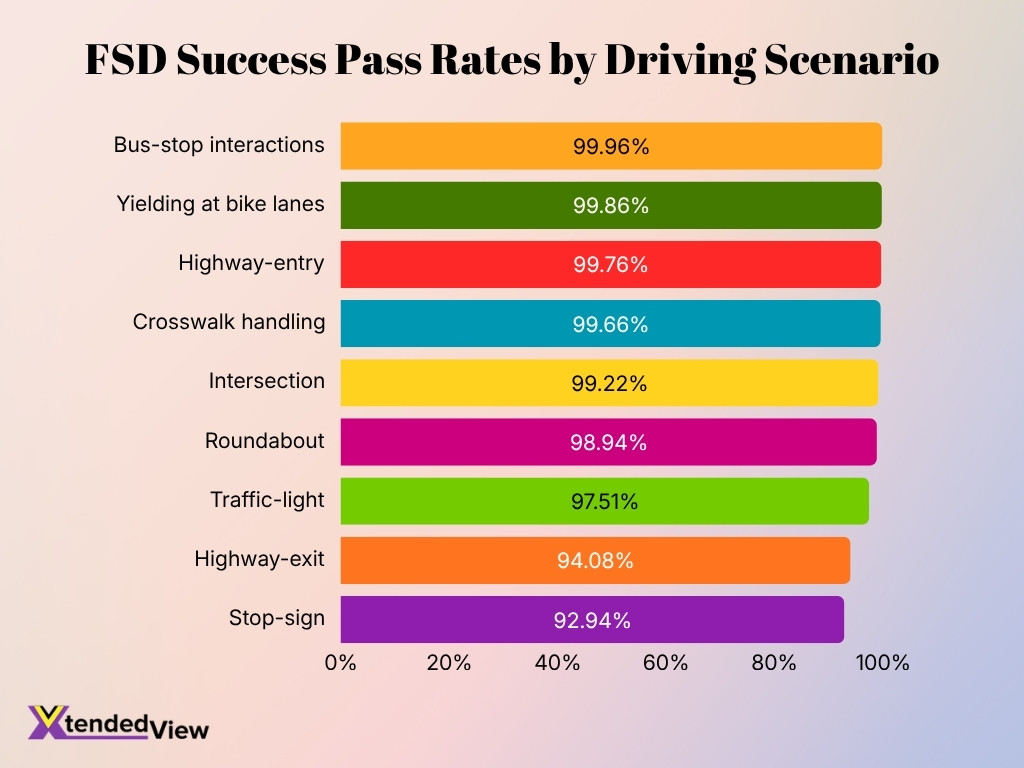
- FSD passed 72,658 of 73,230 intersection tests, producing a 99.22% pass rate.
- Crosswalk handling achieved a 99.66% pass rate, with 47,313 successful tests and 161 failures across 47,474 scenarios.
- Traffic-light scenarios recorded a 97.51% pass rate, with 33,178 passes out of 34,024 tests.
- Roundabout performance reached 98.94%, with 6,900 successful tests across 6,974 scenarios.
- Yielding at bike lanes produced a 99.86% pass rate, with 7,098 successful outcomes out of 7,108 tests.
- Stop-sign scenarios had one of the lower measured pass rates at 92.94%, based on 2,516 passes and 191 failures across 2,707 tests.
- Bus-stop interactions reached a 99.96% pass rate, with only eight failures among 18,749 tests.
- Highway-entry scenarios achieved a 99.76% pass rate, while highway-exit scenarios registered 94.08% in the aggregated test results.
- In a separate speed-behavior analysis covering 708 randomly selected European driving samples, FSD traveled at or below median surrounding-traffic speed in 98% of high-speed cases and did not exceed the fastest surrounding vehicle in 99.9% of cases.
Autopilot-Related Recalls and Regulatory Data
- The major Autopilot misuse recall covers 2,031,220 vehicles in the U.S. and addressed concerns that driver-engagement controls could prove insufficient to prevent foreseeable misuse.
- By the third quarter of 2025, 2,005,634 vehicles had received the remedy, equal to about 98.7% of the listed recall population.
- Earlier remedy counts reached 1,821,966 vehicles in Q1 2024, 1,917,593 in Q2 2024, 1,998,849 in Q1 2025 and 2,002,587 in Q2 2025.
- A follow-up recall investigation identified 20 preliminary post-remedy crashes: nine involving a frontal-plane strike, six involving yaw, spin or understeer, and five involving inadvertent steering override.
- The earlier Autopilot investigation identified at least 13 crashes involving one or more fatalities in which foreseeable driver misuse appeared to play a role.
- A separate FSD investigation opened after regulators identified four crashes in reduced-visibility conditions, including sun glare, fog or airborne dust. One involved a pedestrian fatality and another involved a reported injury.
- That reduced-visibility investigation covers FSD availability across several model years, including 2016-2024 Model S and Model X, 2017-2024 Model 3, 2020-2024 Model Y and 2023-2024 Cybertruck vehicles.
- In May 2026, the later-release 2026 Model Y became the first vehicle to pass the newly introduced federal advanced driver-assistance-system benchmark under the updated new-car testing framework.
- Crash-reporting rules require identified manufacturers and operators to report qualifying crashes involving Level 2 driver-assistance or automated-driving systems. The current public dataset covers incidents reported through July 15, 2026 under the latest reporting framework.
- On Sept. 4, 2026, regulators opened a new audit focused on the Cybercab’s self-certification and whether a vehicle without traditional human controls complies with applicable federal motor vehicle safety standards.
NHTSA Investigations and Crash Reporting Statistics
- An Engineering Analysis opened on March 18, 2026, covers an estimated 3,203,754 vehicles equipped with FSD and focuses on whether the system adequately detects degraded roadway visibility and warns drivers.
- That investigation’s failure summary lists 9 crashes, including two injury incidents and one fatal incident. The affected model years extend through 2026 across Model S, Model X, Model 3, Model Y and Cybertruck.
- Investigators said a later degradation-detection update might have affected 3 of the 9 incidents reviewed, while six additional potentially related incidents were identified for further analysis.
- A separate investigation into alleged traffic-safety violations covers an estimated 2,882,566 FSD-equipped vehicles. Its opening summary listed 58 incidents, 14 crashes and 23 reported injuries.
- Within that traffic-law investigation, regulators identified six crashes involving vehicles proceeding into intersections against red signals; four of those crashes reportedly involved one or more injuries.
- The same review identified two crash reports, 18 consumer complaints and two media reports alleging entry into opposing lanes or other wrong-way behavior while FSD was engaged.
- A reporting-compliance audit covers an estimated 2.6 million vehicles and examines crash reports that were allegedly filed months after the incidents occurred, despite reporting deadlines that in many cases required submission within one or five days.
- Under the current crash-reporting framework, qualifying Level 2 crashes must be reported when the system was engaged within 30 seconds before the crash and the event meets specified severity criteria. Public data under the current framework run through July 15, 2026.
- On May 7, 2026, the later-release 2026 Model Y became the first vehicle to pass the new federal advanced driver-assistance-system benchmark added to the New Car Assessment Program.
- On Sept. 4, 2026, regulators opened another audit after commercial driverless Cybercab deployment in Austin, examining whether the vehicle’s self-certification complies with applicable federal safety standards.
Tesla Robotaxi Fleet Composition in Texas
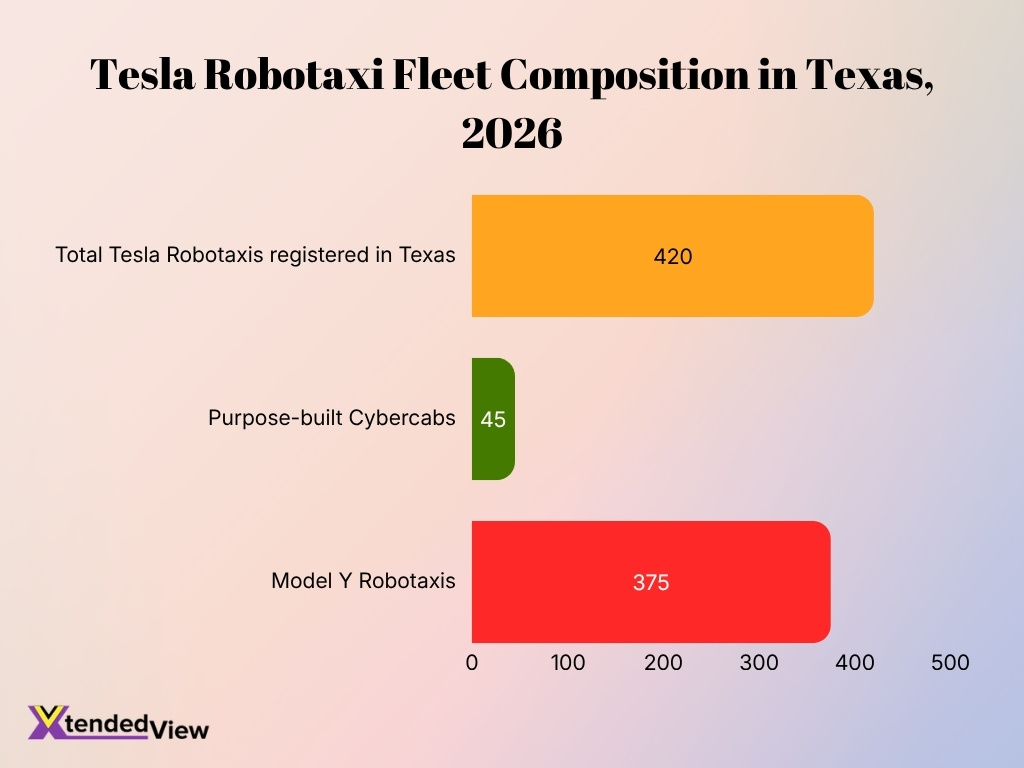
- Tesla’s registered Robotaxi fleet in Texas totals 420 vehicles in 2026.
- Model Y Robotaxis dominate the fleet with 375 vehicles, accounting for roughly 89.3% of the total.
- Purpose-built Cybercabs account for 45 vehicles, representing approximately 10.7% of the registered fleet.
- The fleet has about 8.3 Model Y Robotaxis for every Cybercab, highlighting Tesla’s continued reliance on its existing Model Y platform.
- Despite the Cybercab rollout, nearly 9 in 10 Tesla Robotaxis registered in Texas are still Model Y vehicles.
European and Global Autopilot Safety Data
- European engineering vehicles accumulated 993,940 FSD validation miles in the published safety dataset, covering real-world operation across multiple countries.
- The same engineering program collected 1,953,566 miles of manually driven training data, or almost twice as many miles as the FSD validation program.
- The engineering program reported zero major or minor collisions attributed to FSD performance across roughly 1 million validation miles. Because trained operators conducted the testing, these results should not be treated as equivalent to unrestricted consumer use.
- Structured testing covered more than 230,000 driving scenarios across six major European cities, including intersections, crosswalks, roundabouts, cyclists and traffic-control interactions.
- In European highway testing, positive longitudinal acceleration events of at least 3 m/s² occurred at 0.896 per 1,000 FSD miles, versus 17.557 per 1,000 manual miles with active safety features, a reported 94.9% reduction.
- European non-highway FSD recorded 10.926 strong-acceleration events per 1,000 miles, compared with 195.148 for the manual active-safety comparison group, a reported difference of 94.4%.
- High lateral-acceleration events occurred 74.9% less often on European highways during FSD engineering driving than during manual driving with active safety features. Non-highway testing showed a 72% difference.
- Following the Netherlands’ approval, FSD also received approvals in Lithuania, Estonia, Denmark, and Belgium during 2026.
- Customers in those newly approved European markets had accumulated more than 50 million kilometers, or 31 million miles, of FSD driving by July 2026.
- Software expansion also reached Asia: FSD v14 lite began rolling out to AI3-equipped vehicles in South Korea in July 2026, extending newer driving behavior to an additional international market.
Tesla AI Hardware Versions and Fleet Statistics
- Cumulative vehicle deliveries reached 9.7 million by Q2 2026, up from 8 million in Q2 2025. The figure also includes qualifying unsupervised Robotaxis placed into commercial operation under the company’s current reporting definition.
- Active FSD subscriptions reached 1.48 million in Q2 2026, up 56% from 950,000 one year earlier and 15.6% from 1.28 million in Q1 2026.
- FSD v14 lite was released to vehicles using AI3 hardware in the U.S. and South Korea, extending selected v14 behavior to an older compute and camera configuration.
- The AI3 version was created by distilling driving behavior from the AI4 v14 series, illustrating how the software stack can be adapted across different onboard-compute generations.
- The latest disclosed timetable calls for the internally designed AI5 inference chip to enter production in 2027 and AI6 to follow in 2028. These remain planned dates rather than completed milestones.
- The global vehicle fleet was described as capable of collecting the equivalent of more than 500 years of continuous driving data each day, providing a large potential data stream for AI development.
- Cortex 1 had installed training-compute capacity above 90 MW by Q2 2026, while Cortex 2 exceeded 115 MW, bringing their combined listed capacity above 205 MW.
- Onsite Texas AI compute capacity more than doubled during the first half of 2026, and Cortex 2 was scheduled for further expansion during the rest of the year.
- Construction and equipment procurement were also underway for an in-house semiconductor fabrication facility in Austin, intended to support future logic and memory-chip supply.
- The cumulative FSD-mileage chart had reached nearly 12 billion miles by mid-2026, with the overwhelming majority of recent growth generated by v12-and-later software.
Future Projections for Tesla Autopilot and AI
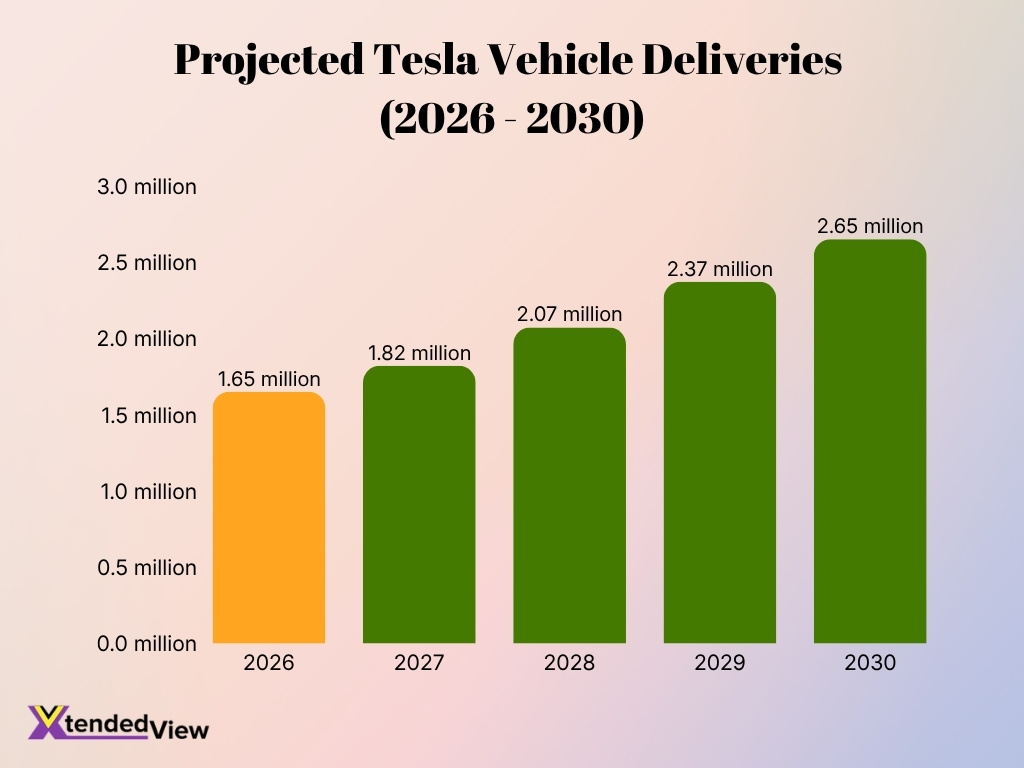
- A June 2026 compilation of 22 sell-side forecasts projected average full-year vehicle deliveries of approximately 1.65 million in 2026. The median forecast was 1.67 million.
- The same analyst compilation projected approximately 1.82 million deliveries in 2027, implying roughly 10% growth from the 2026 average forecast.
- Average delivery forecasts rise to about 2.07 million vehicles in 2028, crossing the 2 million annual threshold in the compiled estimates.
- The forecast increases further to approximately 2.37 million deliveries in 2029 and 2.65 million in 2030. That implies an annualized growth rate of about 12.5% from the 2026 forecast through 2030.
- The long-term executive performance framework includes a milestone of 10 million active FSD subscriptions, compared with 1.48 million reported in Q2 2026. The milestone is an incentive target, not formal operating guidance.
- Another performance milestone requires 1 million Robotaxis in commercial operation, measured as a daily average maintained for three consecutive months. It should likewise be viewed as a compensation milestone rather than a forecast.
- The same framework includes a 20 million cumulative vehicle-delivery milestone. With 9.7 million reported by Q2 2026, the disclosed fleet metric was still below half of that threshold.
- Cybercab already has installed annual manufacturing capacity above 125,000 units, giving the Robotaxi program a dedicated production base if commercial deployment expands. Actual production could remain below installed capacity.
- AI5 and AI6 are planned for 2027 and 2028 production, respectively, making execution of the next two onboard-compute generations a central technical milestone for the autonomy roadmap.
- Nearer-term expansion also depends on regulatory outcomes: as of September 2026, active federal reviews covered more than 3.2 million FSD-equipped vehicles in one visibility investigation, while the newly deployed Cybercab was subject to a separate certification audit.
Frequently Asked Questions (FAQs)
More than 14.3 billion miles have been driven with FSD (Supervised), according to the latest publicly displayed fleet counter.
The latest fleet statistics describe FSD (Supervised) as 7x safer than a human driver when the system is engaged.
More than 55% of new North American deliveries included an FSD subscription in Q2 2026.
Cumulative paid Robotaxi mileage reached approximately 2.4 million miles by June 2026.
The investigation covers an estimated 3,203,754 vehicles equipped with FSD and includes nine identified crashes in its investigation summary.
Conclusion
Tesla AI and Autopilot statistics show an autonomy program operating at significantly greater scale across consumer vehicles, AI infrastructure, and commercial ride-hailing. FSD has accumulated billions of supervised miles, active subscriptions reached 1.48 million, and more than half of new North American deliveries included an FSD subscription. Robotaxi operations have also expanded beyond their original launch market, while Cybercab production and more than 205 MW of listed Texas AI training capacity indicate substantial investment in the next phase of autonomous mobility.
However, scale does not mean that full autonomy has been achieved across Tesla’s consumer fleet. FSD in customer vehicles remains a supervised driver-assistance system, and drivers must stay attentive and prepared to intervene. Federal investigations involving millions of vehicles, ongoing crash-reporting requirements, and new Cybercab certification reviews demonstrate that safety performance and regulatory compliance will remain decisive factors. Tesla’s future progress will therefore depend not only on faster AI models and more driving data, but also on whether its systems can demonstrate consistent safety, regulatory acceptance and commercially viable driverless operation across a wider range of markets.