


Artificial intelligence continues to reshape how businesses operate, how consumers interact with technology, and how governments deliver services. From automating customer support and accelerating medical research to improving software development and financial forecasting, AI now influences nearly every major industry. As investment, adoption, and innovation accelerate, understanding the latest AI statistics helps organizations make informed decisions and identify emerging opportunities. Explore the data below to see how AI is transforming the global economy and everyday life.
Editor’s Choice
- The global AI market was valued at approximately $390.9 billion in 2025 and is projected to reach $539.5 billion in 2026.
- North America accounted for 35.5% of global AI revenue in 2025, maintaining its leadership position.
- The AI market is forecast to exceed $3.49 trillion by 2033, growing at a CAGR of 30.6%.
- Generative AI tools reached 53% global adoption within three years, making them one of the fastest-adopted technologies in history.
- U.S. consumers derive an estimated $172 billion in annual value from generative AI tools as of early 2026.
- Around 88% of organizations reported using AI in at least one business function by 2025.
- The global generative AI market is projected to grow from $29.6 billion in 2026 to more than $324 billion by 2033.
Recent Developments
- Global AI-related debt issuance is expected to exceed $570 billion in 2026, reflecting unprecedented infrastructure investment.
- AI-driven participation in a major quantitative finance competition reached 150,600 solo participants in 2026, doubling from 2025.
- Half of all U.S. employees now report using AI at work, a significant milestone reached in Q1 2026.
- Daily or weekly workplace AI usage among U.S. employees climbed to 28% in 2026, up sharply from 2023 levels.
- AI company Databricks secured over $4 billion in funding and achieved a valuation of $134 billion.
- Databricks reported a $4.8 billion revenue run rate in 2025, representing more than 55% year-over-year growth.
- Anthropic is targeting between $20 billion and $26 billion in annualized revenue during 2026.
- Anthropic serves more than 300,000 enterprise customers, highlighting rapid enterprise AI adoption.
- AI now represents 15.9% of NIH-funded biomedical research projects, demonstrating growing adoption in scientific research.
Global AI Market Growth Statistics
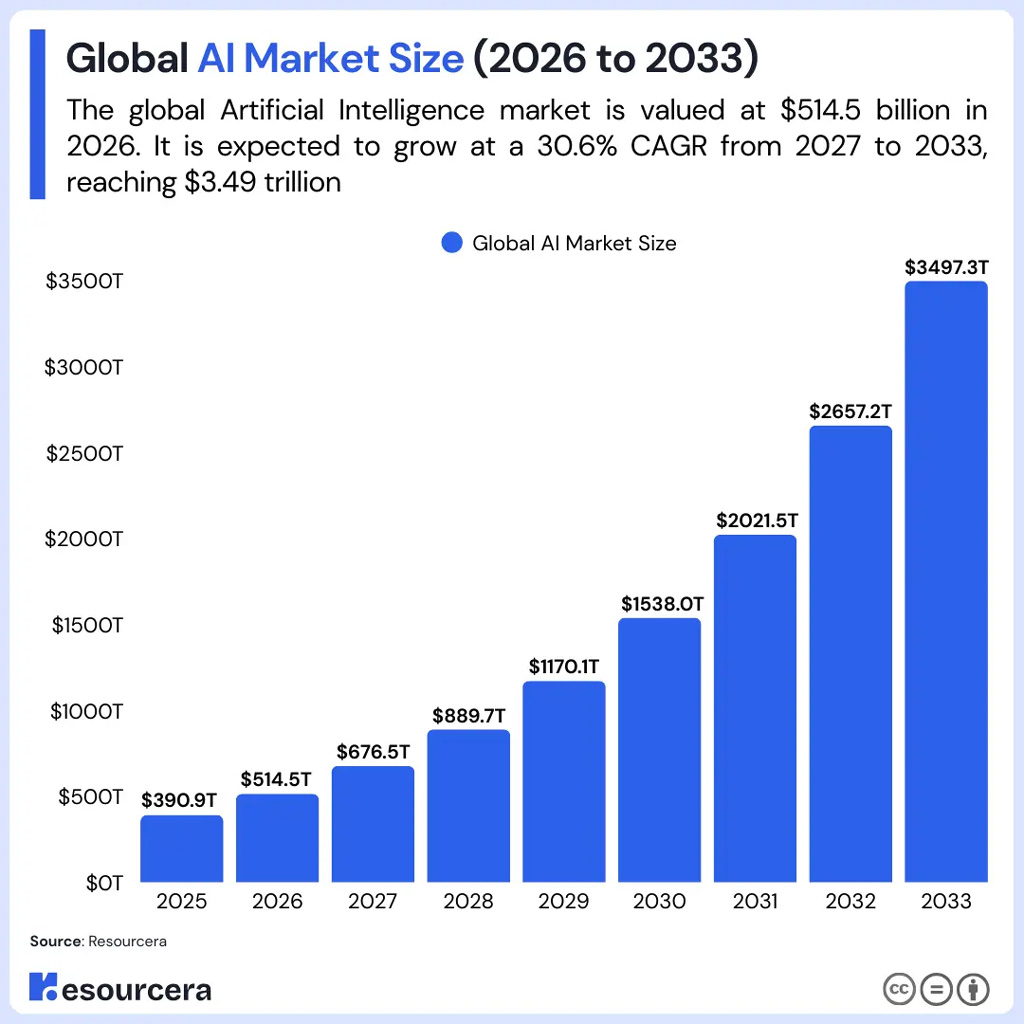
- The global AI market size is projected to grow from $514.5 billion in 2026 to $3.50 trillion by 2033, highlighting massive industry expansion.
- The AI market is forecast to achieve a strong 30.6% CAGR between 2027 and 2033.
- Market value is expected to increase from $676.5 billion in 2027 to $889.7 billion in 2028, a rise of over $213 billion.
- The global AI industry is projected to surpass $1 trillion in 2029, reaching approximately $1.17 trillion.
- By 2031, the AI market is expected to exceed $2.02 trillion, nearly quadrupling its 2026 value.
- The market is forecast to climb from $2.66 trillion in 2032 to $3.50 trillion in 2033, adding about $840 billion in one year.
- Global AI market value increased from $390.9 billion in 2025 to $514.5 billion in 2026, reflecting strong annual growth.
- Between 2025 and 2033, the AI market is projected to expand by nearly 9x, growing from $390.9 billion to $3.50 trillion.
Business AI Adoption and Integration Statistics
- More than 80% of businesses reported AI adoption by 2024.
- AI usage expanded to 88% of organizations by 2025.
- Only about one-third of companies have scaled AI beyond pilot programs.
- Roughly 50% of U.S. employees now use AI tools in their jobs.
- About 65% of employees believe AI positively impacts productivity.
- Organizations deploying AI across multiple functions report significantly higher returns than those running isolated pilots.
- AI-related projects within NIH research receive a 13.4% funding premium compared with non-AI projects.
- Among Japanese enterprises studied, AI adoption generated an average 2.4% increase in productivity.
- Younger executives were found to be 23% more likely to invest in AI technologies.
- AI-related research represented nearly one-sixth of NIH-funded projects in 2025.
Generative AI Usage Statistics
- The global generative AI market was valued at $22.2 billion in 2025.
- The market is expected to reach $29.6 billion in 2026.
- Generative AI adoption reached 53% of the global population within three years.
- Around 71% of organizations regularly use generative AI in 2026.
- Private investment in generative AI reached $33.9 billion in 2024.
- Organizations generate an average return of $3.70 for every $1 invested in generative AI.
- The U.S. generative AI market was worth $5.26 billion in 2024 and continues to expand rapidly.
- The global generative AI market could exceed $324 billion by 2033.
- Another forecast estimates the market will grow to $1.2 trillion by 2035.
- Generative AI is currently the fastest-growing segment of the broader AI industry.
AI User Demographics and Consumer Adoption
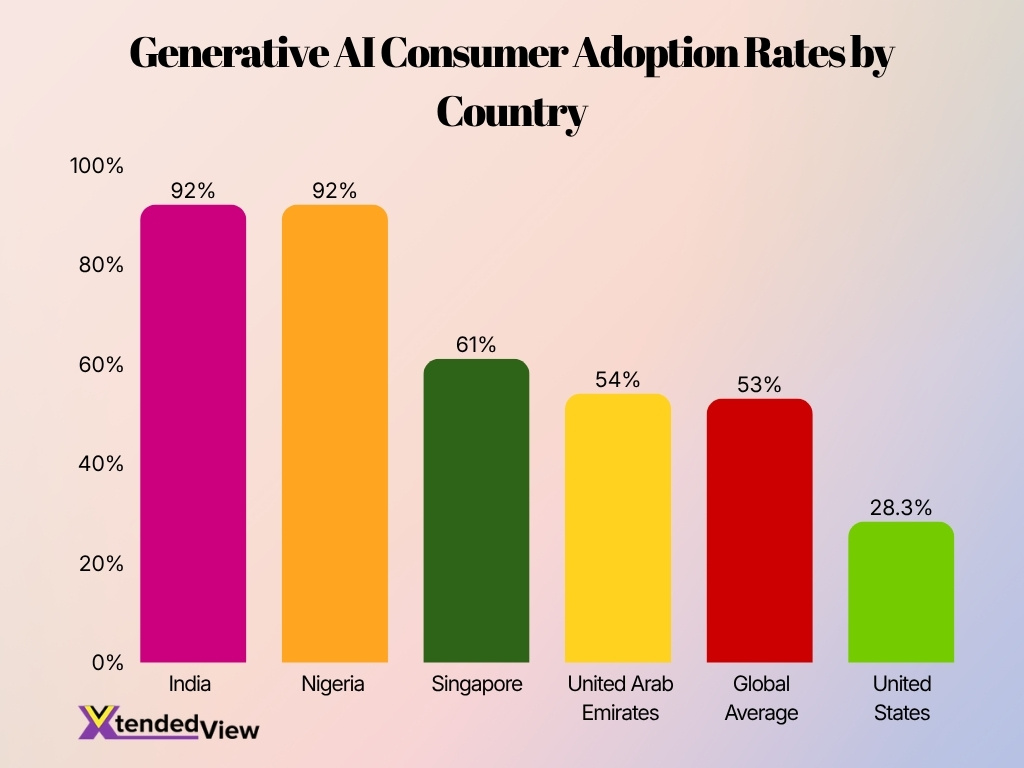
- Generative AI tools reached 53% adoption globally faster than personal computers or the internet.
- Singapore reported 61% consumer adoption of generative AI, among the highest globally.
- The United Arab Emirates recorded 54% adoption of generative AI tools.
- The United States reported 28.3% generative AI adoption among consumers.
- India and Nigeria both recorded 92% AI usage rates among consumers in recent surveys.
- Global intelligent tool users are projected to increase by 826.2 million people between 2025 and 2031.
- The number of intelligent tool users worldwide could reach 1.2 billion by 2031.
- U.S. consumers derive an estimated $172 billion in annual value from generative AI products.
- Median consumer value derived from generative AI tripled between 2025 and 2026.
- Workplace AI adoption reached a landmark level as one in two U.S. employees now use AI in their jobs.
AI Revenue Statistics
- Global AI software revenue is projected to exceed $391 billion in 2026.
- The AI market is forecast to generate more than $500 billion in annual revenue worldwide by 2027.
- Databricks reported a revenue run rate of approximately $4.8 billion entering 2026.
- Anthropic is targeting between $20 billion and $26 billion in annualized revenue by the end of 2026.
- Enterprise generative AI solutions are expected to generate over $98 billion in revenue globally during 2026.
- AI-powered software services are projected to contribute over 15% of global enterprise software revenue by 2027.
- The North American AI sector generates more revenue than any other regional market, accounting for roughly 35% of global AI sales.
- AI-driven cloud services remain the largest revenue segment within the broader AI industry.
- Generative AI applications are forecast to deliver more than $1 trillion in cumulative revenue between 2026 and 2030.
- AI-enhanced business software remains the fastest-growing enterprise software category, with annual growth rates above 25%.
AI Spending Statistics
- Worldwide spending on AI-centric systems is projected to reach $337 billion in 2026.
- Global AI spending is expected to surpass $749 billion by 2028, reflecting rapid enterprise adoption.
- Organizations increased AI budgets by an average of 30% year over year in 2025.
- More than 67% of enterprise leaders plan to increase AI investments during 2026.
- AI infrastructure spending is growing faster than software spending as organizations build computing capacity.
- U.S. companies account for the largest share of AI-related spending worldwide.
- Generative AI spending is expected to grow at a CAGR above 60% through 2028.
- Financial services organizations remain among the largest AI spenders, followed by retail and manufacturing.
- Cloud-based AI deployments receive more than 70% of enterprise AI budgets.
- AI training and workforce upskilling spending increased substantially throughout 2025 as adoption expanded.
Corporate AI Investment Distribution Statistics
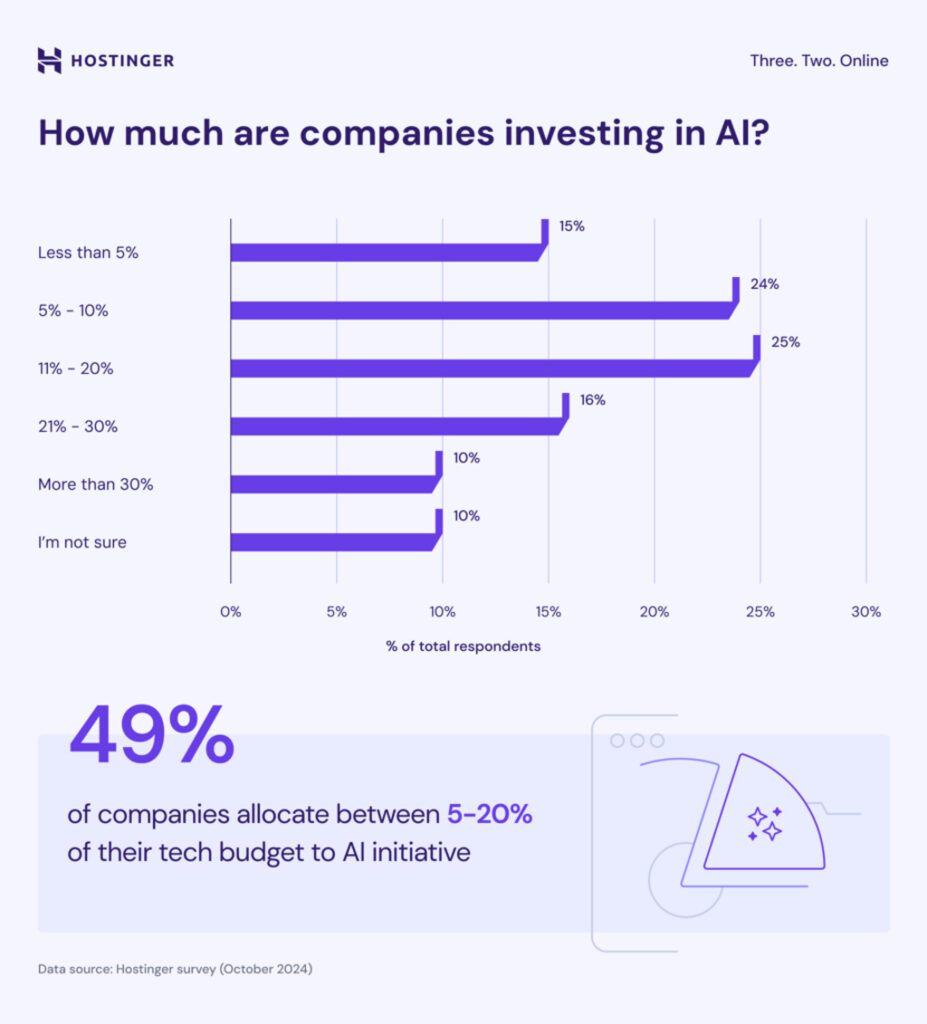
- 25% of companies allocate 11%–20% of their tech budget to AI, making it the most common investment range.
- 24% of organizations invest 5%–10% of their technology budget in AI initiatives.
- 49% of companies dedicate between 5%–20% of their total tech budget to AI projects.
- Only 15% of businesses spend less than 5% of their tech budget on AI adoption.
- 16% of respondents allocate 21%–30% of their technology spending toward AI investments.
- A notable 10% of companies invest more than 30% of their tech budget in AI programs.
- Another 10% of respondents reported they are not sure how much their company spends on AI.
AI Impact on Jobs and the Workforce
- Around 50% of U.S. employees reported using AI at work during 2026.
- Daily or weekly AI usage among workers reached 28%, the highest level recorded to date.
- Approximately 65% of employees believe AI improves their productivity.
- AI could affect up to 40% of jobs globally, according to long-term labor market estimates.
- Nearly 75 million jobs may be displaced by automation by 2030, while new technology-driven roles are expected to offset many losses.
- The World Economic Forum estimates that AI and automation could create 170 million new jobs by 2030.
- More than 80% of executives expect employees to work alongside AI systems in the coming years.
- Software development remains one of the professions most transformed by generative AI adoption.
- AI-assisted coding tools help developers complete tasks up to 55% faster in controlled studies.
- Workers who receive AI training are significantly more likely to report positive attitudes toward workplace AI adoption.
AI Productivity and Workplace Efficiency Statistics
- Employees using generative AI complete writing tasks 40% faster than non-users.
- AI-assisted professionals see work quality improve by 18% during workplace experiments.
- Developers utilizing AI coding assistants finish programming tasks 55% faster on average.
- Customer support teams using AI tools boost their issue resolution rates by 14%.
- AI-enabled knowledge workers reclaim one to three hours per week previously lost to routine tasks.
- Companies implementing AI automation experience up to a 40% increase in overall labor productivity.
- Nearly 64% of business owners believe AI will significantly improve their workplace efficiency.
- Around 54% of executives confirm that AI implementation has directly increased their productivity.
- Workers leveraging AI meeting tools save approximately 45 minutes of administrative work every day.
- AI integration successfully eliminates up to 70% of time spent on repetitive administrative duties.
AI in Marketing and Sales Statistics
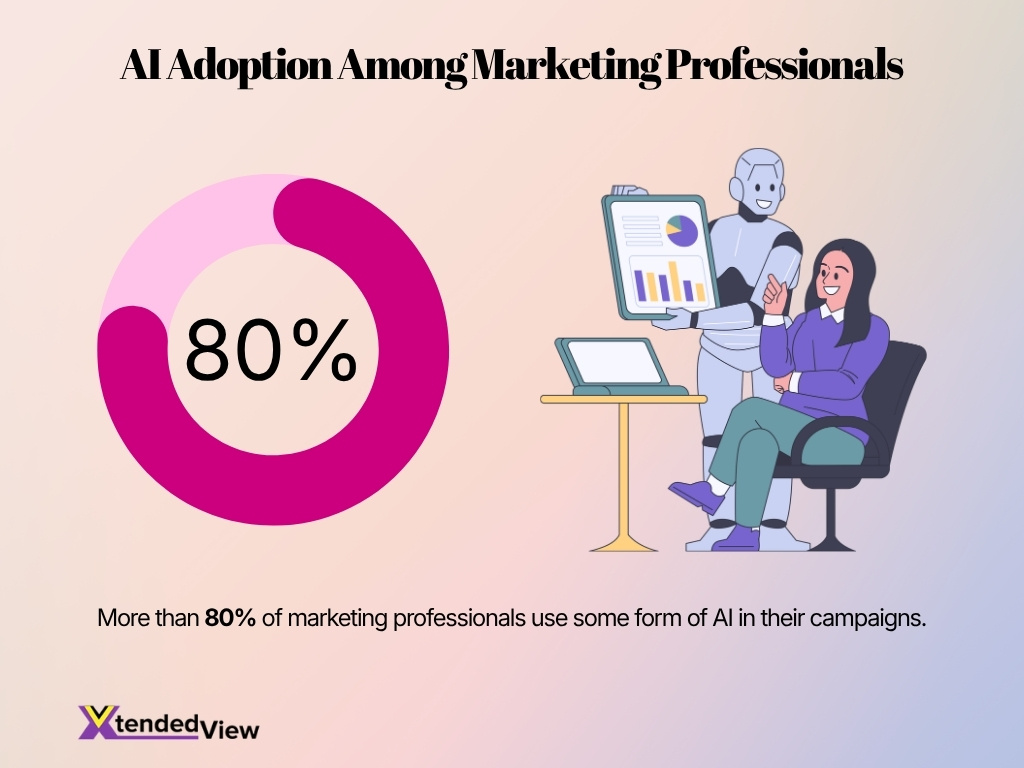
- More than 80% of marketing professionals use some form of AI in their campaigns.
- AI-driven personalization can increase marketing revenue by 5% to 15%.
- Organizations using AI in sales report productivity gains of up to 15%.
- Companies using AI-powered lead scoring generate 50% more sales-qualified leads to prioritize prospects.
- Nearly 70% of marketers use AI for content creation and optimization.
- AI chatbots now handle up to 80% of routine marketing inquiries and lead qualification processes.
- Predictive analytics tools improve sales forecasting accuracy by up to 20% compared to traditional methods.
- Campaigns using AI-powered personalization experience up to a 41% higher click-through rate from customers.
- AI-generated content is now found in 82% of high-ranking web pages as a mainstream component in 2026.
- Marketing generates measurable returns from AI adoption, with companies reporting a 35% average ROI improvement.
AI in Customer Service and Support Statistics
- AI chatbots can independently resolve up to 80% of routine customer inquiries.
- Customer support departments can reduce operational costs by up to 30% using AI.
- Teams utilizing generative AI assistants boost agent productivity by approximately 14%.
- More than 60% of modern consumers regularly interact with AI-powered support systems.
- Automated tools decrease average handling time for complex service requests by nearly 40%.
- Nearly 70% of service agents confirm that AI helps them manage higher ticket volumes.
- Approximately 85% of basic customer interactions are now successfully resolved without human agents.
- Deploying AI sentiment analysis increases overall customer satisfaction scores by an average of 25%.
AI in Healthcare and Medical Statistics
- The global AI healthcare market is projected to reach approximately $45.2 billion in 2026, up from about $32 billion in 2025.
- The healthcare AI market is expected to grow at a CAGR exceeding 35% through 2030.
- AI-assisted medical imaging systems can improve diagnostic accuracy by up to 20% in specific radiology applications.
- More than 60% of healthcare organizations worldwide are actively investing in AI initiatives.
- AI-powered drug discovery can reduce early-stage research timelines by 30% to 50%.
- Around 15.9% of NIH-funded biomedical research projects now incorporate AI technologies.
- AI-enabled clinical documentation tools reduce physician administrative workloads by several hours per week.
- Hospitals implementing AI-driven predictive analytics have reported reductions in preventable readmissions.
- AI-based pathology systems continue to improve cancer detection rates across multiple studies.
- Healthcare remains among the fastest-growing sectors for enterprise AI adoption globally.
AI Adoption Across Industries Statistics
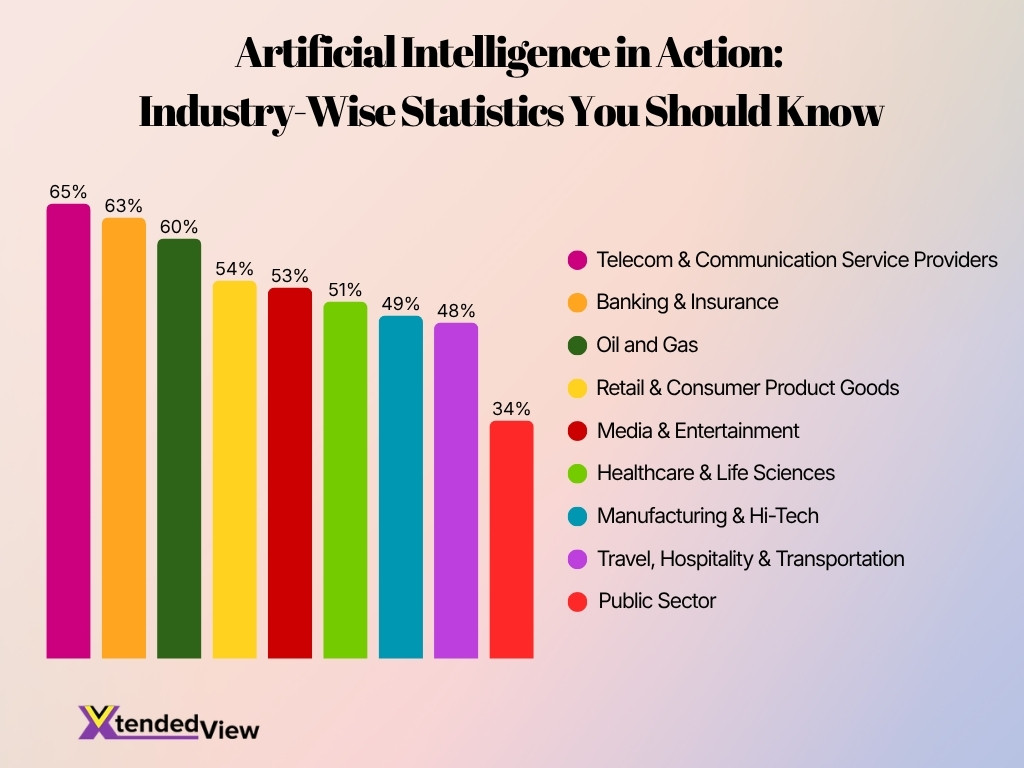
- Telecom & Communication Service Providers lead AI adoption at 65%, making them the most AI-driven industry in the comparison.
- Banking & Insurance follows closely with 63%, highlighting strong investment in AI-powered financial services.
- Oil and Gas reports 60% AI adoption, showing growing reliance on automation and predictive analytics.
- Retail & Consumer Product Goods achieves 54% adoption, leveraging AI for customer insights and operations.
- Media & Entertainment records 53%, reflecting increased use of AI in content creation and personalization.
- Healthcare & Life Sciences reaches 51%, driven by AI applications in diagnostics and patient care.
- Manufacturing & Hi Tech stands at 49%, using AI to improve efficiency and production processes.
- Travel, Hospitality & Transportation posts 48%, benefiting from AI-based customer service and logistics.
- The Public Sector has the lowest adoption at 34%, indicating significant room for future AI expansion.
AI in Finance and Accounting Statistics
- More than 75% of financial institutions are actively investing in AI technologies to enhance overall performance.
- The global AI in fintech market is officially projected to reach $41.16 billion by 2030 with a 16.5% CAGR.
- AI-powered fraud detection systems can rapidly reduce false positive alerts by over 30% in real-time.
- Banks leveraging AI-driven automation report operational cost reductions ranging from 15% to 45%.
- Algorithmic trading systems currently account for roughly 60% to 75% of the global equity trading volume.
- Rapid industry adoption is driving the global AI accounting market to a projected $10.87 billion by 2026.
- AI-based risk management tools have directly helped 71% of organizations meet or exceed ROI expectations.
- Generative AI usage for financial compliance and reporting is projected to grow to a $17.88 billion market by 2035.
- 46% of accountants use AI daily to automate manual tasks, unlocking 7 extra weeks of capacity per year.
- Active AI use in finance has doubled in two years, with 77% of firms significantly increasing their tech investments.
AI in Education Statistics
- The global AI in education market is projected to reach $11.4 billion in 2026.
- The sector is expected to grow at a CAGR of 25.9% from 2026 to 2033.
- Currently, 86% of students globally report using AI tools for their academic studies.
- In the United States, 51% of students actively use generative AI for their coursework.
- Approximately 88% of higher education students utilize generative AI specifically for assessments.
- North America dominates the global AI education sector with a 37.5% revenue share.
- Teachers who regularly use AI tools save an average of 5.9 hours per week on administrative tasks.
- Over 71% of students firmly believe that using AI directly improves their overall grades.
- The higher education segment alone accounts for over $2 billion in global AI revenue.
- Around 53% of students rely on AI-powered platforms specifically for brainstorming and information gathering.
AI Cybersecurity Risk Trends Statistics
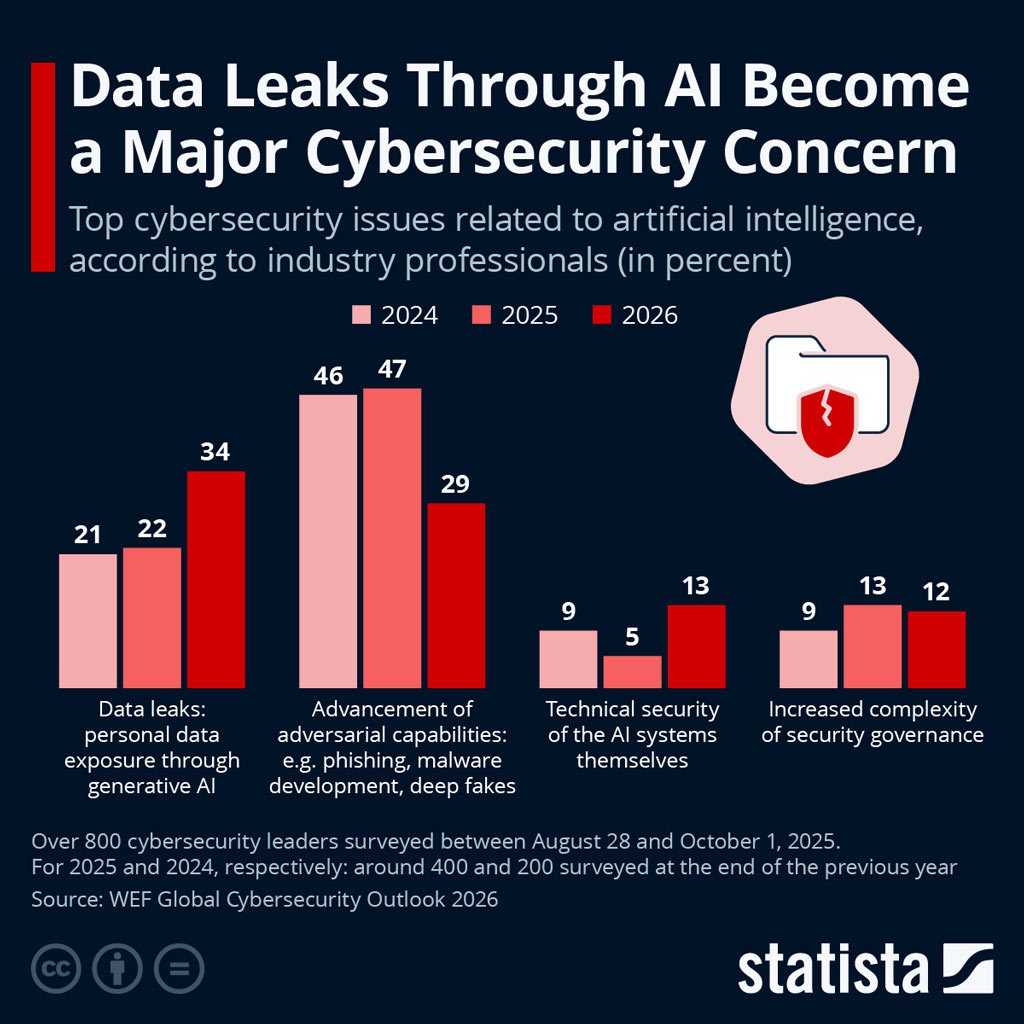
- Data leaks through generative AI emerged as the top concern in 2026 (34%), up from 22% in 2025 and 21% in 2024.
- Concern over adversarial AI capabilities dropped sharply from 47% in 2025 to 29% in 2026, despite leading previous years.
- Worries about the technical security of AI systems rose to 13% in 2026, compared to 5% in 2025 and 9% in 2024.
- Security governance complexity remained relatively stable, accounting for 12% in 2026 versus 13% in 2025.
- The share citing AI-driven data leaks increased by 12 percentage points between 2025 and 2026, the largest gain among all concerns.
- Adversarial threats were the leading AI cybersecurity issue in 2024 (46%) and 2025 (47%) before being overtaken by data leaks in 2026 (34%).
AI Voice Assistant and Search Statistics
- The number of active voice assistants worldwide is expected to reach 8.4 billion devices in 2026.
- There are approximately 1.8 billion voice searches conducted every single day across the globe.
- The global voice commerce market is projected to hit $80 billion in 2026 due to increased consumer trust.
- Approximately 42% of US households are expected to own at least one smart speaker in 2026.
- Local intent drives significant traffic, with 58% of consumers using voice to find local businesses.
- The global voice assistant application market is projected to surge to $121.08 billion by 2034.
- Mobile usage continues to rise, with 42% of all mobile searches now conducted via voice commands.
- AI voice systems are projected to save organizations over 2.5 billion working hours globally by 2027.
- Implementing AI voice agents can reduce customer service operational costs by up to 95%.
Consumer Trust and AI Ethics Statistics
- 60% of consumers globally express significant concerns regarding misinformation generated by AI systems.
- 30% of global respondents actively embrace AI innovation, whereas 35% completely reject it.
- 87% of consumers insist that businesses must explicitly disclose when AI is used during an interaction.
- 42% of US adults indicate they have little to no trust in companies to deploy AI technologies responsibly.
- Consumer trust in a brand experiences a massive drop of 144% when they suspect the company is using AI.
- 58% of executives report that implementing Responsible AI initiatives significantly improves return on investment.
- 72% of organizations have actively expanded their internal AI governance frameworks to address public trust concerns.
- 39% of consumers state they would inherently trust a brand less if it relies on AI-generated content.
- 75% of Americans report that online misinformation has substantially reduced their overall trust in digital platforms.
- 27% of consumers currently refuse to share personal data with AI agents, even for personalized experiences.
Frequently Asked Questions (FAQs)
The global AI market is projected to be $539.5 billion in 2026.
The AI market is expected to grow at a 30.6% CAGR from 2026 to 2033.
U.S. private AI investment reached $285.9 billion in 2025.
Only 39% of organizations report AI impact at the enterprise EBIT level.
Global AI-related debt issuance is projected to exceed $570 billion in 2026.
Conclusion
Artificial intelligence has evolved from a specialized technology into a core business and consumer platform. The statistics throughout this report show rapid growth in market value, investment, enterprise adoption, workforce integration, and consumer usage across virtually every major industry. Healthcare providers use AI to improve diagnostics, financial institutions deploy it for fraud detection and risk analysis, while marketers and customer service teams rely on it to increase efficiency and personalization.
Looking ahead, the coming years represent a pivotal period for AI adoption. Organizations continue increasing investment, consumers are embracing generative AI tools at record levels, and governments are expanding regulatory oversight. As AI capabilities become more advanced and accessible, businesses that combine innovation with responsible implementation will likely capture the greatest long-term value.