


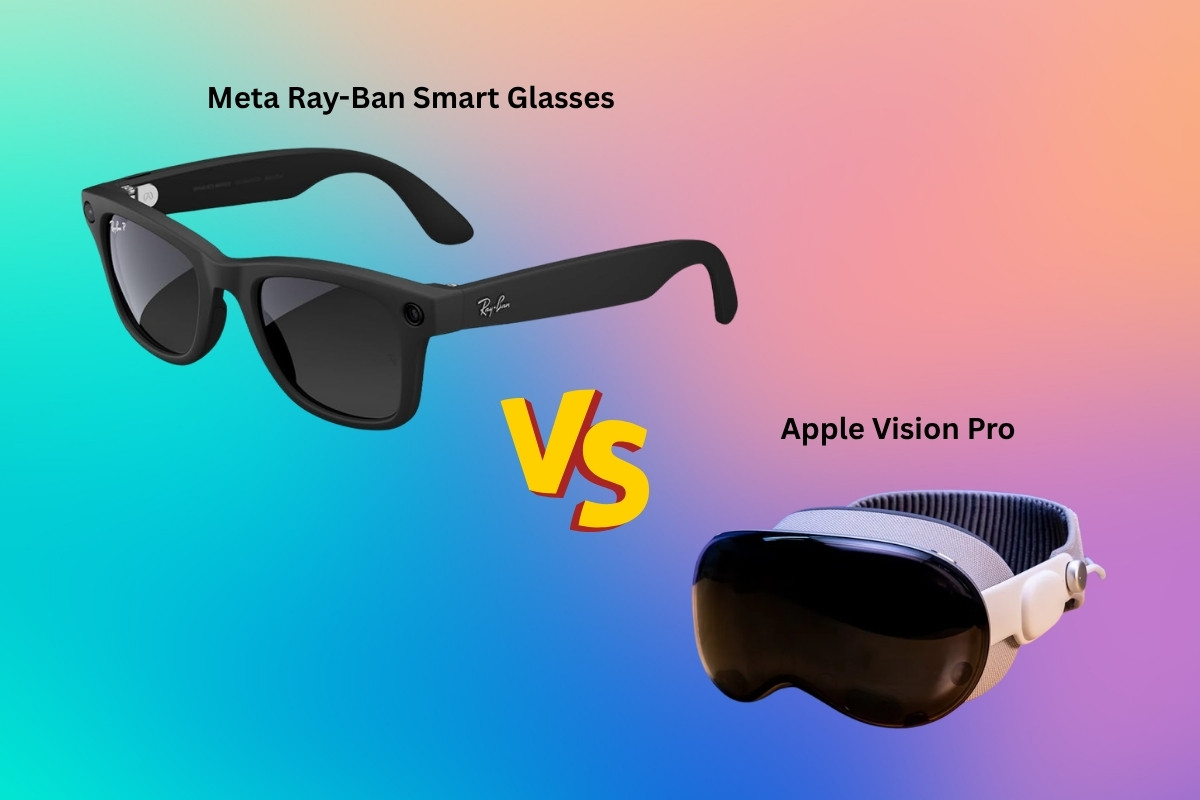
Meta Ray-Ban smart glasses and Apple Vision Pro represent two very different approaches to wearable computing. Meta focuses on lightweight AI glasses built for everyday tasks such as hands-free photography, translation, calls, music, and contextual assistance, while Apple Vision Pro combines high-resolution displays, spatial tracking, and desktop-class processing for immersive work, entertainment, and professional applications. The commercial gap is equally notable: Ray-Ban Meta (Gen 2) starts at $379, while Apple Vision Pro starts at $3,499, and Meta has captured a much larger share of the fast-growing smart-glasses market.
These differences show how the industry is dividing between mass-market AI eyewear and premium spatial computing. The statistics below compare their pricing, adoption, hardware, market performance, use cases, and future growth.
Editor’s Choice
- More than 7 million AI glasses were sold across participating EssilorLuxottica brands in 2025, up from 2 million cumulative Ray-Ban Meta units reported through the end of 2024.
- Global smart-glasses shipments increased 139% year over year during the second half of 2025.
- AI smart glasses represented 88% of global smart-glasses shipments in H2 2025, showing how quickly artificial intelligence became central to the category.
- Meta expanded to 82% of the global smart-glasses market in H2 2025, giving it a commanding lead in the category.
- Ray-Ban Meta (Gen 2) starts at $379 in the U.S., while Apple Vision Pro with M5 starts at $3,499.
- Vision Pro’s $3,499 base price is approximately 823% higher than the $379 starting price of Ray-Ban Meta (Gen 2).
- IDC had projected that the original Vision Pro would remain below 500,000 units in 2024, reflecting the limited scale of Apple’s first spatial-computing headset compared with mass-market consumer electronics.
- Apple did not lower the U.S. entry price when it upgraded Vision Pro in October 2025. The M5 version still starts at $3,499, with 256GB, 512GB and 1TB configurations available.
- The M5 Vision Pro renders 10% more pixels on its micro-OLED displays than the previous generation and can increase its refresh rate to 120Hz.
- Production capacity for Meta’s smart-glasses partnership was targeted to reach 10 million units annually by the end of 2026, demonstrating how aggressively the supply chain has scaled around AI eyewear.
Recent Developments
- Meta introduced Ray-Ban Meta (Gen 2) on Sept. 17, 2025, expanding its established smart-glasses line rather than replacing the concept with a headset-style device.
- Gen 2 increased rated battery life to as much as 8 hours, roughly twice the endurance associated with the previous generation under comparable use.
- The updated glasses added 3K Ultra HD video capture, strengthening Meta’s focus on first-person content creation rather than immersive displays.
- Meta also expanded live translation with German and Portuguese in 2025, bringing supported back-and-forth conversations to six languages under the announced expansion.
- Meanwhile, Apple unveiled the M5 Vision Pro on Oct. 15, 2025, with retail availability beginning Oct. 22.
- The M5 chip includes a 10-core CPU and 10-core GPU architecture, giving Vision Pro substantially more local computing capability than lightweight AI glasses need for their core use cases.
- Apple paired the M5 model with visionOS 26 and said users could access more than 1 million apps, thousands of games, and hundreds of 3D movies through its broader ecosystem.
- Despite the hardware update, IDC reportedly expected only 45,000 Vision Pro units to ship in the 2025 holiday quarter.
- In contrast, global smart-glasses shipments grew 139% year over year in H2 2025, indicating that lightweight AI eyewear was moving in a much stronger unit-growth direction.
- A 2026 smart-glasses research benchmark contained 2,422 real-world image-question pairs across 14 image domains and eight query categories, illustrating how researchers are already building specialized benchmarks around wearable AI use cases.
Meta Ray-Ban Smart Glasses vs Apple Vision Pro: Overview
- Ray-Ban Meta (Gen 2) starts at $379, placing it within the price range of premium eyewear and mainstream consumer electronics rather than premium spatial-computing systems.
- Apple Vision Pro starts at $3,499, so consumers can theoretically buy more than nine base-price pairs of Ray-Ban Meta (Gen 2) for the cost of one base Vision Pro.
- Meta’s product has no immersive visual display in the conventional Ray-Ban Meta line. It centers on a camera, microphones, speakers, and AI functions while retaining an eyewear-style design.
- Vision Pro takes the opposite approach. Its custom micro-OLED displays support immersive spatial computing, and the M5 update increased rendered pixels by 10% over its predecessor.
- Meta reported millions of Ray-Ban Meta units sold before the Gen 2 refresh, with 2 million cumulative units reached by the end of 2024.
- The wider Meta-connected AI-glasses portfolio then exceeded 7 million units sold during 2025, demonstrating a much larger consumer footprint than Vision Pro.
- Vision Pro’s original 2024 software ecosystem started with access to more than 1 million compatible iOS and iPadOS apps, alongside more than 600 experiences designed to take advantage of Vision Pro capabilities at U.S. launch.
- By the M5 launch in 2025, Apple described an ecosystem containing more than 1 million apps, thousands of games and hundreds of 3D movies.
- A 2025 mixed-reality study with 31 participants found Vision Pro received the highest pass-through-quality ratings among three tested devices, highlighting the technical strengths behind Apple’s premium positioning.
- Conversely, a 2026 situated-awareness benchmark used 786 videos recorded with Ray-Ban Meta (Gen 2) and more than 2,071 human-annotated question-answer pairs, demonstrating the product’s relevance to emerging egocentric AI research.
Lifetime Unit Sales by Platform
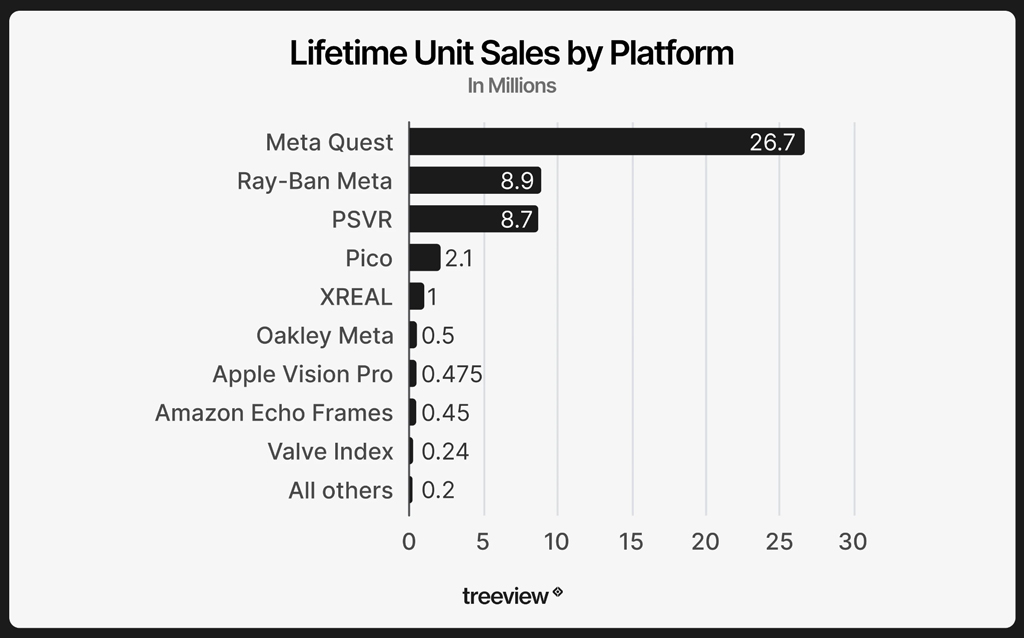
- Meta Quest dominates lifetime unit sales with 26.7 million units, nearly three times the sales recorded by Ray-Ban Meta.
- Ray-Ban Meta ranks second with 8.9 million units sold, narrowly outperforming PSVR by around 200,000 units.
- PSVR has achieved 8.7 million lifetime unit sales, making it one of the strongest-selling immersive hardware platforms in the comparison.
- Sales fall sharply after the top three, with Pico recording just 2.1 million units, less than one-fourth of Ray-Ban Meta’s total.
- XREAL reached 1 million units sold, while Oakley Meta recorded approximately 500,000 units.
- Apple Vision Pro stands at approximately 475,000 lifetime units, significantly below Ray-Ban Meta despite Apple’s presence in the premium spatial computing market.
- Ray-Ban Meta’s 8.9 million units are roughly 18.7 times Apple Vision Pro’s 475,000 units, highlighting a substantial adoption gap between the two products.
- Amazon Echo Frames recorded around 450,000 units, slightly below Apple Vision Pro’s total.
- Valve Index reached approximately 240,000 units, while the All Others category accounted for just 200,000 units.
- Overall, the data shows a highly concentrated market, with Meta Quest, Ray-Ban Meta, and PSVR accounting for the overwhelming majority of lifetime unit sales shown in the chart.
Release Date and Product Positioning
- Apple Vision Pro officially reached U.S. retail stores on Feb. 2, 2024, following preorders on Jan. 19.
- Ray-Ban Meta successfully achieved 2 million cumulative unit sales by the end of 2024.
- Meta launched the updated Ray-Ban Meta in September 2025, under two years after the previous generation.
- Apple followed with the M5 Vision Pro in October 2025, nearly 20 months after the original release.
- The 2025 Ray-Ban Meta successfully maintained its mainstream consumer entry price of exactly $379.
- The updated Apple Vision Pro officially retained its premium professional base price of $3,499.
- A 2025 pathology project utilized the headset to directly compare the top five similar patient cases.
- The Apple M5 announcement heavily emphasized immersive programming and cited hundreds of 3D movies.
Price and Total Ownership Cost
- Ray-Ban Meta (Gen 2) launched with a U.S. starting price of $379, $80 above the $299 price point commonly associated with the earlier mainstream Ray-Ban Meta generation.
- Apple Vision Pro with M5 starts at $3,499, preserving the original model’s U.S. entry price from 2024.
- The absolute entry-price difference is $3,120: $3,499 for Vision Pro versus $379 for Ray-Ban Meta (Gen 2).
- Put another way, Vision Pro costs about 9.23 times as much as the base Ray-Ban Meta (Gen 2), or roughly 823% more.
- Vision Pro buyers who need ZEISS Optical Inserts and Readers pay an additional $99, raising the hardware-and-reader total to at least $3,598.
- Prescription ZEISS Optical Inserts cost $149, putting a base M5 Vision Pro plus prescription inserts at a minimum of $3,648 before tax.
- Apple’s official Vision Pro Travel Case costs $199, which would bring a base M5 headset plus the official case to $3,698.
- A buyer combining the base M5 Vision Pro, $149 prescription inserts and $199 official travel case would spend at least $3,847 before tax.
- Apple’s Dual Knit Band costs $99 when purchased separately, although the M5 Vision Pro includes the band in its standard package.
- The price structure helps explain the products’ different addressable markets: Meta can target mainstream eyewear customers at hundreds of dollars, while Vision Pro remains a purchase measured in thousands of dollars.
Market Share Comparison
- Meta held 84% of the global display-less smart-glasses market in Q1 2026, up from 82% in the previous quarter. This measurement focuses specifically on display-less smart glasses, the category that includes Ray-Ban Meta.
- A broader smart-glasses tracker placed Meta’s Q1 2026 share at 69.2%. The difference reflects a wider category definition that includes display-equipped products from competing manufacturers.
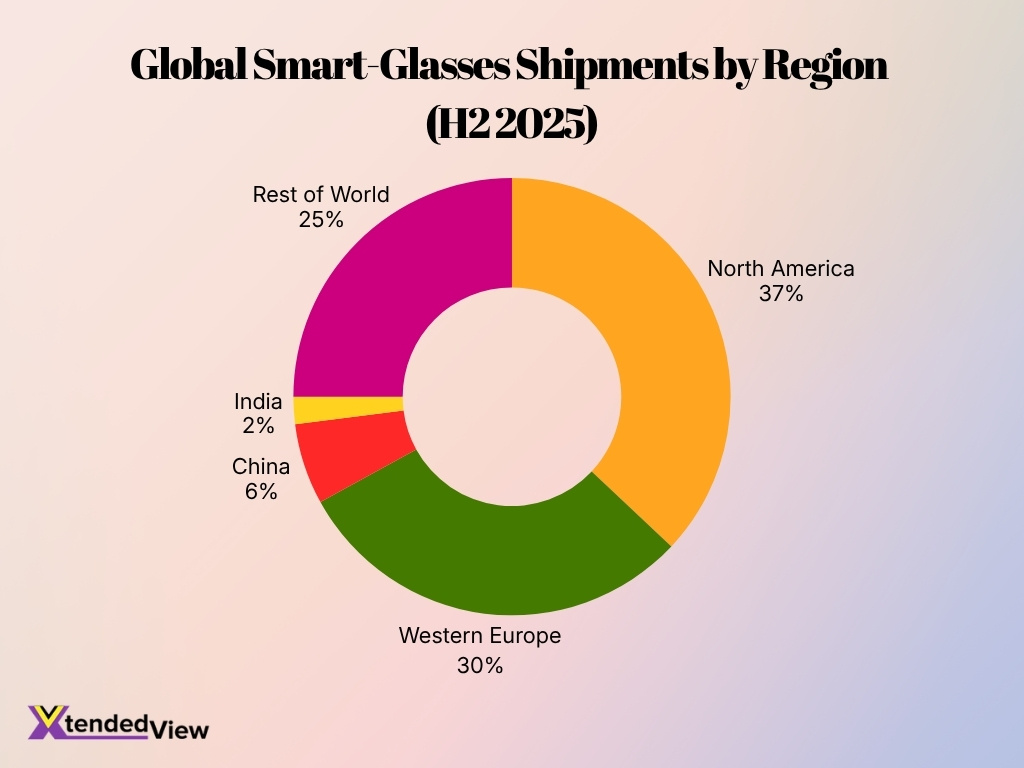
- In H2 2025, Meta captured 82% of global smart-glasses shipments, supported by Ray-Ban Meta products and an expanding portfolio of AI eyewear.
- North America accounted for 37% of global smart-glasses shipments in H2 2025, making it the largest regional market and an especially important territory for Meta’s consumer strategy.
- Western Europe represented another 30% of H2 2025 shipments, helped by broader product availability and new launches. Together, North America and Western Europe generated roughly two-thirds of global volume during the period.
- China accounted for 6% of global smart-glasses shipments in H2 2025. Although shipments increased, numerous local product launches remained relatively small in volume.
- India represented only about 2% of global volume in H2 2025, but its smart-glasses shipments increased approximately 15-fold after Ray-Ban Meta officially entered the country in May 2025.
- Apple Vision Pro does not compete directly in the display-less smart-glasses rankings because it belongs to the mixed-reality and spatial-computing headset segment. That distinction matters when interpreting Meta’s dominant smart-glasses percentage.
- The competitive gap also shows in model rankings: Meta products occupied the leading positions among global smart-glasses models during H2 2025, while Apple’s Vision Pro pursued a much smaller premium mixed-reality market.
- Meta’s sports-focused AI glasses also broadened its reach. Oakley Meta HSTN and Oakley Meta Vanguard together generated more than 30% of Meta’s Q4 2025 smart-glasses shipments, reducing its dependence on one Ray-Ban form factor.
Market Growth and Adoption Trends
- Global intelligent-eyewear shipments increased 83% year over year in Q1 2026, with AR and smart glasses driving growth while conventional VR demand weakened.
- Display-less smart-glasses shipments increased 210% year over year in Q1 2026 under one industry tracker, highlighting the rapid adoption of lightweight AI eyewear.
- Another tracker measured Q1 2026 display-less smart-glasses growth at 167% year over year, with approximately 2.25 million units shipping during the quarter. Differences arise from methodology and category definitions.
- In contrast, the VR segment declined 17% year over year in Q1 2026. The divergence suggests that consumers currently show stronger demand for lighter glasses than enclosed immersive headsets.
- Global smart-glasses shipments had already risen 139% year over year in H2 2025, establishing strong momentum before 2026 began.
- AI-enabled models represented 88% of all smart-glasses shipments in H2 2025, showing that artificial intelligence has moved from an optional feature to the category’s primary demand driver.
- Display-less smart glasses are forecast to reach approximately 13.6 million shipments in 2026 and 27.3 million in 2030. That equals an 18.9% compound annual growth rate over the forecast period.
- Revenue from display-less smart glasses is projected to reach $5.1 billion in 2026 and $6.4 billion in 2027. At the same time, the category’s average selling price is expected to decline as competition expands.
- Optical see-through display glasses represent an even faster-growing segment, with shipments forecast to rise from 3 million units in 2026 to 12.2 million in 2030, equal to a 41.9% CAGR.
- Mixed-reality devices are forecast to grow from 3.2 million units in 2026 to 10.4 million by 2030, a 34.4% unit CAGR. This keeps long-term growth potential open for immersive products, even as lightweight glasses currently expand faster in mainstream use.
Target Audience and Primary Use Cases
- The U.S. remained the largest smart-glasses market globally in Q1 2026.
- Ray-Ban Meta (Gen 2) allows creators to record hands-free footage at up to 3K resolution.
- Sports-focused glasses accounted for more than 30% of Meta’s Q4 2025 shipments.
- The Apple Vision Pro features a 23 million-pixel display system for immersive spatial tasks.
- An academic study evaluating four collaboration applications found FaceTime offered the best spatial telepresence.
- A healthcare review identified six scholarly commentaries on the potential medical roles of the Vision Pro.
- A 2025 accessibility study explored device use through a two-week diary study focused on object finding and reading.
- The same co-design study included two adults with visual impairment across 10 iterative development sessions.
Design, Weight, Portability, and Wearability
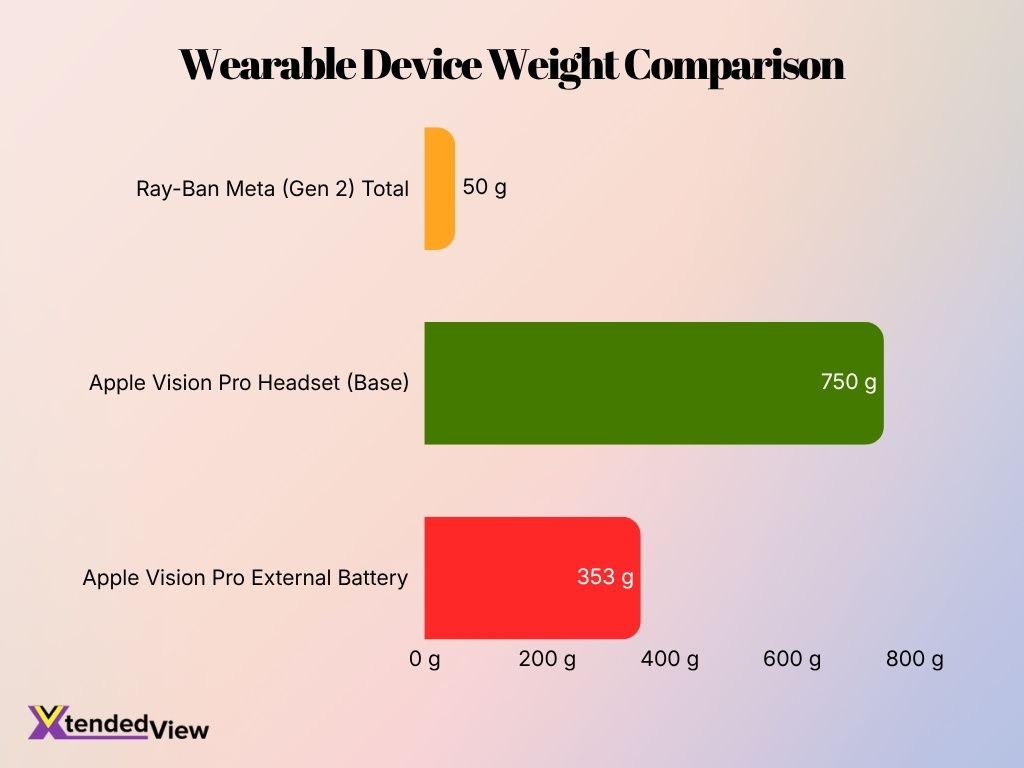
- Ray-Ban Meta (Gen 2) models weigh roughly 50 to 53 grams, depending on frame and configuration, keeping their mass close to conventional premium eyewear.
- Apple Vision Pro with M5 weighs 750 to 800 grams, including its Light Seal and Dual Knit Band but excluding its external battery.
- On that basis, the M5 Vision Pro headset itself can weigh roughly 14 to 16 times as much as a roughly 50-gram pair of Ray-Ban Meta (Gen 2) glasses.
- Vision Pro’s separate battery weighs another 353 grams, taking the combined carried mass of the headset and battery to approximately 1,103 to 1,153 grams before other accessories.
- Ray-Ban Meta (Gen 2) offers three major frame families, Wayfarer, Headliner and Skyler, giving buyers several shapes rather than one headset chassis.
- Prescription-lens availability helps Meta maintain the conventional-eyewear model. Selected Gen 2 frames support prescription configurations, allowing users to combine vision correction with smart features.
- Meta’s charging case can provide up to 48 additional hours of charging, letting users recharge the glasses without carrying a separate wired battery pack during the day.
- Vision Pro uses an external battery connected by cable. Although this moves battery mass away from the face, users must carry the 353-gram pack in a pocket or nearby while operating untethered.
- Apple’s M5 model introduced a counterbalanced Dual Knit Band, designed to distribute headset weight through upper and lower straps. Even with that change, its 750-800 gram headset mass places it in a different wearability class from conventional glasses.
- The weight difference helps explain the products’ intended usage patterns. Ray-Ban Meta can function as eyewear for extended periods, whereas Vision Pro prioritizes computational and visual capability over discreet, all-day portability.
Display, Visual Experience, and Spatial Computing Capabilities
- Standard Ray-Ban Meta (Gen 2) glasses have no integrated visual display. Users receive information primarily through audio, while the camera supplies visual context to Meta AI.
- Apple Vision Pro contains 23 million pixels across its display system, creating a fundamentally different visual experience built around digital content placed within the user’s field of view.
- Vision Pro uses micro-OLED display technology with a 7.5-micron pixel pitch. Its displays cover 92% of the DCI-P3 color space.
- The M5 model supports refresh rates of 90Hz, 96Hz, 100Hz and 120Hz, with 120Hz providing smoother motion than the 100Hz maximum of the original model.
- The M5 generation renders 10% more pixels than its predecessor, improving text clarity and visual detail even though the physical display system retains 23 million pixels.
- Vision Pro’s R1 processor streams updated images to the displays within 12 milliseconds, helping synchronize camera input and the user’s view of the physical environment.
- Its sensor system includes two high-resolution main cameras, six world-facing tracking cameras, four eye-tracking cameras, a TrueDepth camera and a LiDAR scanner. These components support room tracking and spatial placement.
- In a 2025 study involving 31 participants, Vision Pro received the highest pass-through-quality ratings among three tested mixed-reality headsets during reading and puzzle tasks.
- A separate spatial-tracking benchmark evaluated five XR devices across 16 scenarios and found up to a 2.8-fold performance difference between devices. Vision Pro achieved an R² of 0.830 when estimating relative pose error, showing strong but not unlimited tracking capability.
- Eye-tracking research measured Vision Pro accuracy at 1.11 degrees and 0.93 degrees in two experimental setups, while its System Usability Scale score reached 75.24 in the same study.
Camera, Audio, and Spatial Media
- Ray-Ban Meta (Gen 2) uses a 12-megapixel camera and can capture first-person photos and videos while the user keeps both hands free.
- Gen 2 increased maximum video quality to 3K Ultra HD, delivering more than twice as many video pixels as the previous generation’s primary recording mode.
- Its recording options range from 720p at 120 frames per second to 3K at 30 fps, giving users a choice between higher frame rates and greater resolution.
- Meta also added hyperlapse and slow-motion capture options to expand hands-free creative recording beyond standard first-person video.
- Vision Pro uses a stereoscopic 3D main camera system with an 18mm equivalent field of view, f/2.0 aperture and 6.5 stereo megapixels for spatial photo and video capture.
- Vision Pro’s R1 chip processes information from 12 cameras, five sensors and six microphones, showing how much more sensing hardware the spatial headset uses than everyday camera glasses.
- Apple’s audio system includes a six-microphone array with directional beamforming and Spatial Audio with dynamic head tracking.
- Vision Pro supports Personalized Spatial Audio and audio ray tracing, which model how sound interacts with the user’s environment so virtual audio sources can appear anchored in space.
- Apple supports video formats including HEVC, MV-HEVC, H.264 and AV1, plus HDR formats such as Dolby Vision, HDR10 and HLG. This range supports Vision Pro’s role as an immersive media device.
- The two products therefore approach media from opposite directions: Ray-Ban Meta concentrates on capturing real-world moments from the wearer’s perspective, while Vision Pro combines spatial capture with high-resolution immersive playback.
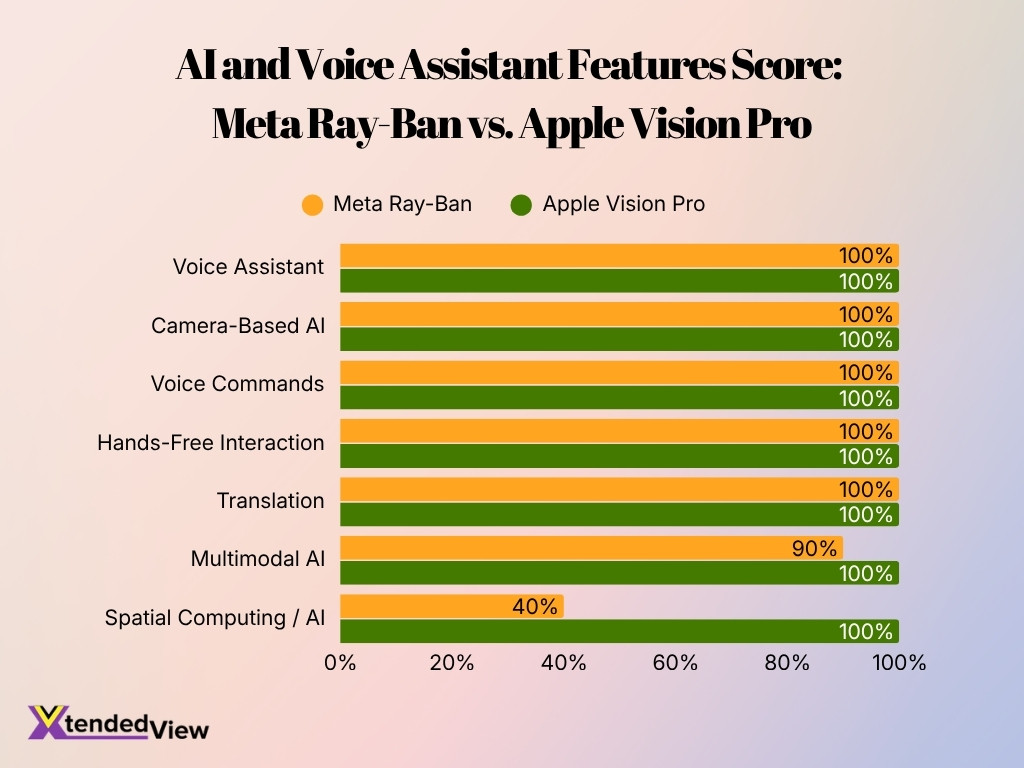
AI and Voice Assistant Features: Meta Ray-Ban vs. Apple Vision Pro
- Meta Ray-Ban and Apple Vision Pro both score 100% for voice assistant capabilities, showing strong support for AI-powered voice interaction.
- Both devices achieve 100% for camera-based AI, enabling users to combine visual input with intelligent assistance.
- Voice commands and hands-free interaction score 100% on both devices, highlighting their focus on natural, touch-free controls.
- Translation capabilities are equally strong, with Meta Ray-Ban and Apple Vision Pro both scoring 100% in this category.
- Apple Vision Pro leads slightly in multimodal AI with 100%, compared with 90% for Meta Ray-Ban.
- The biggest difference appears in spatial computing and AI, where Apple Vision Pro scores 100%, while Meta Ray-Ban reaches only 40%.
- Overall, the data suggests that the two devices are closely matched in voice and everyday AI features, but Apple Vision Pro holds a substantial advantage in spatial computing capabilities.
Battery Life, Processing Power, and Storage
- Ray-Ban Meta (Gen 2) delivers up to 8 hours of typical use on one charge, double the four-hour rating of the previous generation. Continuous audio reaches about five hours, while calling reaches roughly 5.5 hours.
- The Gen 2 charging case provides up to 48 additional hours of use, compared with 32 additional hours for the previous generation. This setup favors intermittent, all-day wear without a tethered battery.
- Ray-Ban Meta (Gen 2) includes 32GB of internal storage, enough for more than 1,000 photos or more than 100 30-second videos under the manufacturer’s stated configurations.
- Apple Vision Pro with M5 provides up to 2.5 hours of general use or three hours of video playback from its external battery. Users can continue operating the headset while the battery charges.
- Vision Pro offers three storage tiers: 256GB, 512GB and 1TB. Even its entry configuration therefore provides eight times the 32GB capacity of Ray-Ban Meta (Gen 2).
- Apple’s M5 contains a 10-core CPU, 10-core GPU and 16-core Neural Engine, along with Neural Accelerators and hardware-accelerated ray tracing. This architecture reflects Vision Pro’s role as a standalone spatial computer rather than an eyewear accessory.
- The M5 Vision Pro includes 16GB of unified memory and 153GB/s of memory bandwidth, while its dedicated R1 sensor-processing chip provides 256GB/s of bandwidth.
- The R1 chip maintains approximately 12-millisecond photon-to-photon latency, processing information from the headset’s cameras and sensors rapidly enough to support real-time video pass-through.
- The battery comparison highlights two different engineering priorities: Meta trades heavy local computing for 8-hour wearable endurance, while Apple accepts shorter untethered runtime to power dual displays, spatial tracking and desktop-class processing.
- For buyers prioritizing storage and standalone computing, Vision Pro holds the clear specification advantage. For commuters, travelers and people who expect glasses to remain wearable through much of the day, Ray-Ban Meta’s battery-and-case model provides greater practical portability.
Operating System, App Ecosystem, and Platform Compatibility
- Apple Vision Pro runs visionOS, a dedicated spatial-computing operating system that organizes apps, people and immersive environments around eye, hand, and voice input.
- By the M5 Vision Pro launch, users had access to more than 1 million apps, thousands of games and hundreds of 3D movies through the broader ecosystem.
- Vision Pro can run apps created specifically for visionOS as well as compatible iPhone and iPad apps, giving the headset a much larger software base than spatial-native app counts alone indicate.
- visionOS 26 expanded compatibility with 180-degree, 360-degree and wide-field-of-view content from cameras made by Insta360, GoPro and Canon.
- The same software generation added support for PlayStation VR2 Sense controllers, creating additional opportunities for spatial games and interactive applications.
- Ray-Ban Meta takes a companion-device approach. The glasses require a compatible iOS or Android smartphone, internet connectivity, and account registration rather than operating as a full standalone computing platform.
- Both Ray-Ban Meta generations support Bluetooth 5.3 and Wi-Fi 6, allowing the glasses to communicate with a phone and online AI services.
- In 2025, Meta merged its former glasses companion experience into the Meta AI app, creating a common interface for managing eyewear and continuing AI conversations on a phone.
- Meta opened additional development opportunities through its Wearables Device Access Toolkit in 2026, giving third-party developers resources to build experiences that connect with AI glasses, including accessibility-focused applications.
- Consequently, Vision Pro offers the deeper traditional app ecosystem, while Ray-Ban Meta centers its platform around smartphone integration, cloud-connected AI, and short hands-free interactions rather than windows and spatial applications.
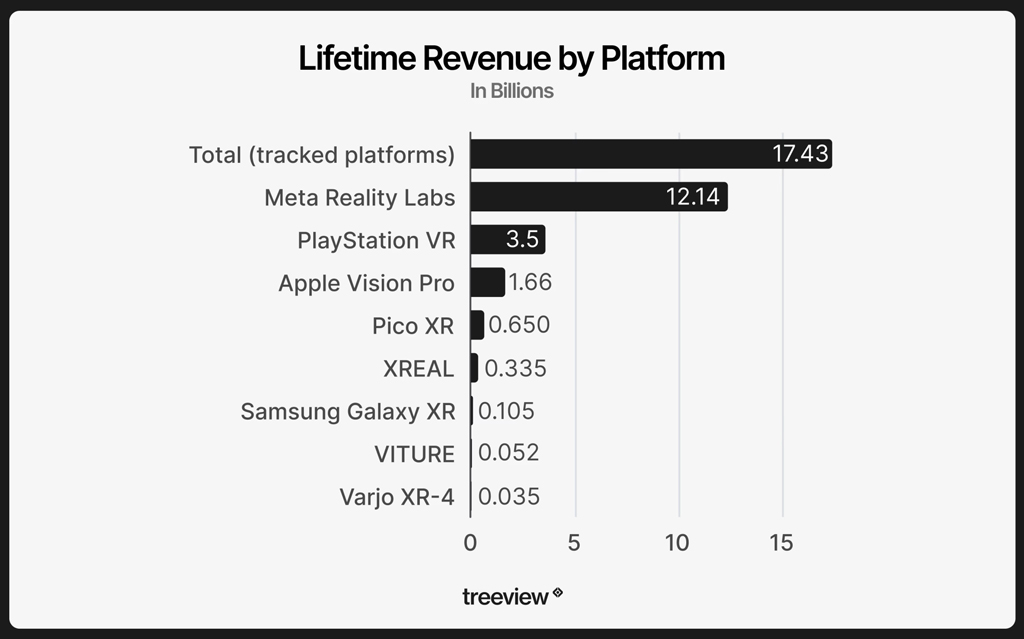
Lifetime Revenue by XR Platform
- The tracked XR platforms have generated a combined $17.43 billion in lifetime revenue, highlighting the overall scale of the market.
- Meta Reality Labs dominates with $12.14 billion, accounting for roughly 70% of the total tracked platform revenue.
- PlayStation VR ranks second with $3.50 billion, but its lifetime revenue remains less than one-third of Meta Reality Labs’ total.
- Apple Vision Pro has generated $1.66 billion, making it the third-largest individual platform in the dataset.
- Pico XR follows with $650 million, considerably below the three leading XR platforms.
- XREAL has accumulated approximately $335 million in lifetime revenue, placing it fifth among the individual platforms shown.
- Samsung Galaxy XR stands at $105 million, while VITURE has generated $52 million.
- Varjo XR-4 records the lowest lifetime revenue in the chart at $35 million.
- The top three platforms, Meta Reality Labs, PlayStation VR, and Apple Vision Pro, together account for approximately 99% of the $17.43 billion tracked total.
Privacy, Security, and Accessibility Features
- Every current Meta AI glasses model includes a white capture LED that signals when the wearer captures a photo or video for the device gallery. The light flashes briefly for photos and remains active during video recording.
- Meta says the capture LED has no off switch. Covering or disabling the indicator automatically disables the camera, linking camera operation directly to the bystander-notification mechanism.
- Photos and videos recorded for the gallery remain privately stored on the glasses until the wearer imports them. The wearer then chooses whether to share the imported content.
- The privacy issue extends beyond technical controls. By August 2026, public debate had intensified around discreet wearable cameras and nonconsensual recording, showing that social acceptance remains a measurable adoption risk even as unit sales grow.
- Apple Vision Pro uses Optic ID, an iris-based biometric system. Optic ID information remains encrypted and accessible only to the Secure Enclave processor, and it can authenticate purchases and protect app data.
- Vision Pro currently lists at least 10 named accessibility capabilities, including VoiceOver, Zoom, Color Filters, Hearing Device Support, Closed Captioning, Voice Control, Switch Control, Dwell Control, Pointer Control, and support for Made for iPhone hearing devices.
- In 2025, Vision Pro accessibility updates expanded Zoom so users with low vision could magnify their physical surroundings through the main camera, rather than limiting magnification to digital interface elements.
- Apple’s announced 2026 accessibility updates include Vehicle Motion Cues, face-gesture controls, and eye-based element selection with Dwell Control, extending alternative input methods for people with mobility-related needs.
- Meta has also targeted accessibility directly. Its 2025 Call a Volunteer expansion covered all 18 countries where the supported Meta AI service operated at that time, linking blind or low-vision users with sighted volunteers.
- The global addressable need is substantial: more than 1 billion people live with some form of disability, and wearable AI is being developed for environmental description, memory assistance and hands-free interaction.
Meta Ray-Ban Smart Glasses vs Apple Vision Pro: Key Differences
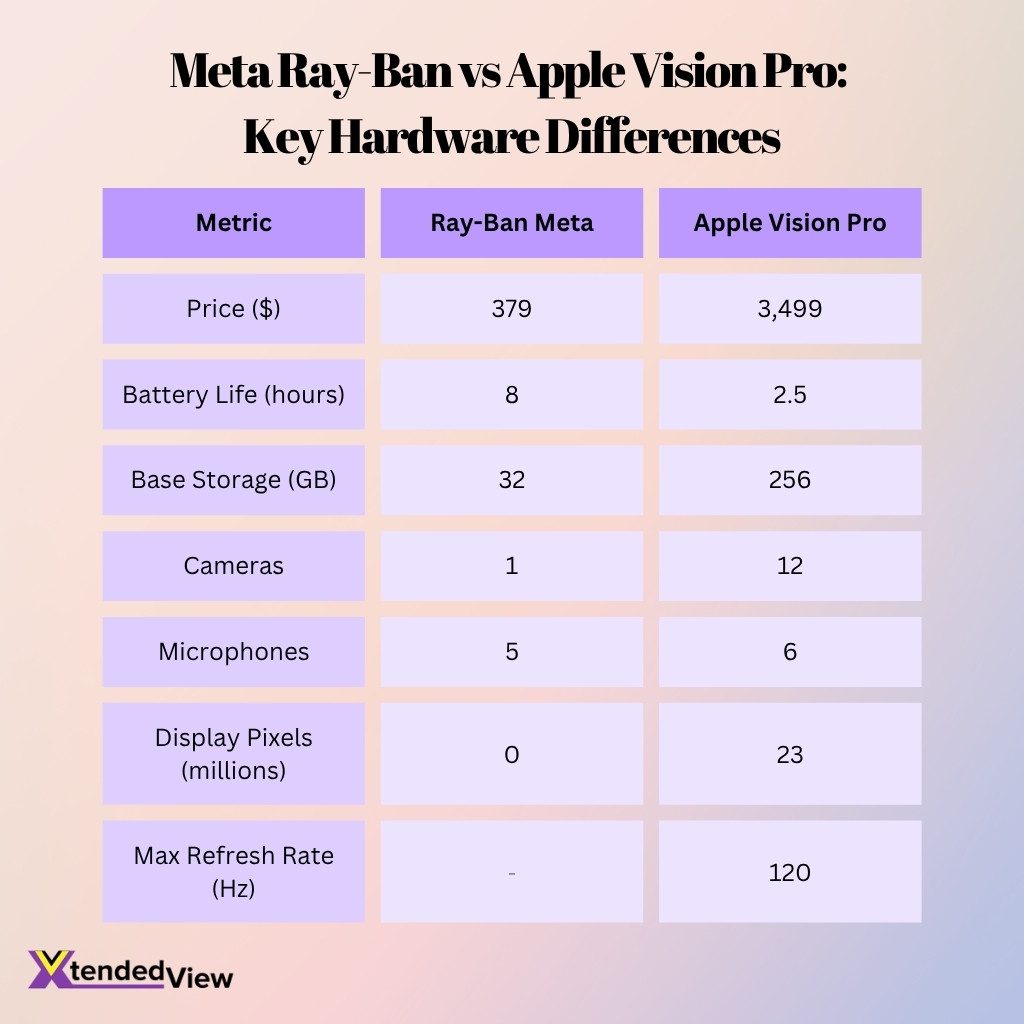
- Ray-Ban Meta starts at $379, whereas Vision Pro begins at $3,499, making Apple’s device about 9.2 times more expensive.
- Ray-Ban Meta provides up to 8 hours of typical battery life, compared with 2.5 hours for Vision Pro.
- Vision Pro offers base storage of 256GB, eight times the 32GB found in Ray-Ban Meta, scaling up to 1TB.
- Vision Pro delivers 23 million display pixels, while standard Ray-Ban Meta includes no visual display at all.
- Vision Pro incorporates 12 cameras, five sensors, and six microphones, compared with Meta’s one 12MP camera, five microphones, and two speakers.
- Vision Pro supports refresh rates up to 120Hz and renders 10% more pixels, whereas Ray-Ban Meta records video at up to 3K at 30 fps.
- Meta captured 69.2% of the global smart-glasses market share in Q1 2026.
Future Market Outlook
- Global display-less smart-glasses shipments are forecast to reach approximately 13.6 million units in 2026, establishing lightweight AI eyewear as one of the fastest-growing wearable-device categories.
- The same category is projected to reach 27.3 million annual units by 2030, representing an 18.9% compound annual growth rate from 2026.
- Display-less smart-glasses revenue is forecast at about $5.1 billion in 2026 and $6.4 billion in 2027, indicating substantial revenue growth even before the category reaches its projected 2030 unit scale.
- Average selling prices are expected to decline from roughly $376 in 2026 to $229 by 2030, a decrease of about 39%. Lower prices could broaden adoption beyond early buyers and premium eyewear customers.
- Q1 2026 already demonstrated that trajectory: global smart-glasses shipments increased 167% year over year to about 2.25 million units under one industry tracker.
- Meta entered Q1 2026 with 69.2% global smart-glasses share under the same broad definition, but growing competition from Chinese and display-focused manufacturers suggests that maintaining such dominance will become harder as the category expands.
- XR glasses more broadly were forecast to achieve a 29.3% CAGR from 2025 through 2029, reinforcing expectations that glasses-style devices will capture an increasing portion of the extended-reality market.
- Research also shows room for significant AI improvement. A 2026 benchmark containing 2,422 real-world smart-glasses image-question pairs found sizable performance gaps among 26 evaluated vision-language models, indicating that future eyewear can still improve substantially in contextual understanding.
- Vision Pro’s long-term opportunity remains tied to spatial computing rather than mass-market glasses. visionOS 26 expanded enterprise APIs, immersive-media support and controller compatibility, indicating continued investment in professional, creative and immersive applications rather than a shift toward low-cost everyday eyewear.
- Privacy may influence the pace of adoption as much as hardware. The 2026 public debate over always-available cameras shows that future smart-glasses growth will depend not only on AI performance and price, but also on bystander consent, visible recording signals and data controls.
Frequently Asked Questions (FAQs)
Meta held 69.2% of the global smart glasses market in Q1 2026, giving it a substantial lead over RayNeo at 3.4%, Xiaomi at 3.1%, Viture at 2.5% and XREAL at 2.0%.
Global display-less smart glasses shipments increased 167% year over year in Q1 2026, reaching approximately 2.25 million units, while full-year shipments are forecast to reach 13.6 million units.
More than 7 million Meta-partnered AI glasses were sold in 2025, including Ray-Ban Meta and Oakley Meta models.
Apple Vision Pro with M5 has 23 million pixels across its micro-OLED display system and supports refresh rates of up to 120Hz.
Ray-Ban Meta (Gen 2) provides up to 8 hours of battery life, while the M5 Apple Vision Pro provides up to 2.5 hours of general use or three hours of video playback.
Conclusion
Meta Ray-Ban smart glasses and Apple Vision Pro represent two distinct wearable-computing strategies. Meta currently holds the advantage in scale, price and everyday wearability, supported by a $379 starting price, up to eight hours of typical use and strong smart-glasses market share. Apple Vision Pro, meanwhile, leads in immersive display technology, processing power and spatial computing with 23 million pixels, an M5 processor and up to 1TB of storage. As display-less smart glasses move toward a projected 27.3 million annual shipments by 2030, Meta has the clearer path to mass-market adoption, while Vision Pro remains positioned for premium spatial computing, professional workflows and immersive media.
