

Perplexity AI has become one of the fastest-growing AI-powered answer engines, changing how people search for information with real-time web citations and conversational responses. Businesses use it for market research, while students, developers, and knowledge workers rely on it for faster research and content discovery. As enterprise adoption accelerates and consumer usage expands, Perplexity continues to reshape the AI search landscape. Explore the statistics below to understand its growth, usage trends, and market momentum.
Editor’s Choice
- Perplexity AI surpassed 45 million monthly active users by late 2025, nearly doubling its user base within a year.
- The platform reached an estimated $500 million annual recurring revenue (ARR) in 2026, up sharply from approximately $100 million in 2025.
- Perplexity’s valuation climbed to approximately $20 billion following its latest funding round.
- The platform now processes roughly 100 million search queries per day, reflecting explosive adoption since its 2022 launch.
- Website traffic exceeded 209 million monthly visits during March 2026, highlighting sustained user demand.
- Mobile app downloads crossed 80 million worldwide by late 2025 across Android and iOS.
- Perplexity operates in 238 countries and territories while supporting dozens of languages, giving it broad international reach.
- Estimated customer retention reached 62%, outperforming many consumer AI applications.
Recent Developments
- During 2026, Perplexity expanded beyond AI search by investing heavily in AI agents capable of completing multi-step tasks.
- The company introduced its Computer AI agent, contributing to rapid revenue growth through usage-based pricing.
- Perplexity launched the Comet browser, extending AI-powered search directly into web browsing workflows.
- Enterprise adoption increased as the company expanded premium offerings for professional users and organizations.
- The company shifted away from its earlier advertising experiment to prioritize subscription-based revenue and user trust.
- New pricing tiers combined subscriptions with usage-based billing to better support enterprise AI workloads.
- Partnerships with enterprise customers and large organizations became a major driver of recurring revenue growth during 2025 to 2026.
- Continued investments in multiple frontier AI models strengthened Perplexity’s position in the competitive AI search market.
Perplexity AI Monthly Active Users
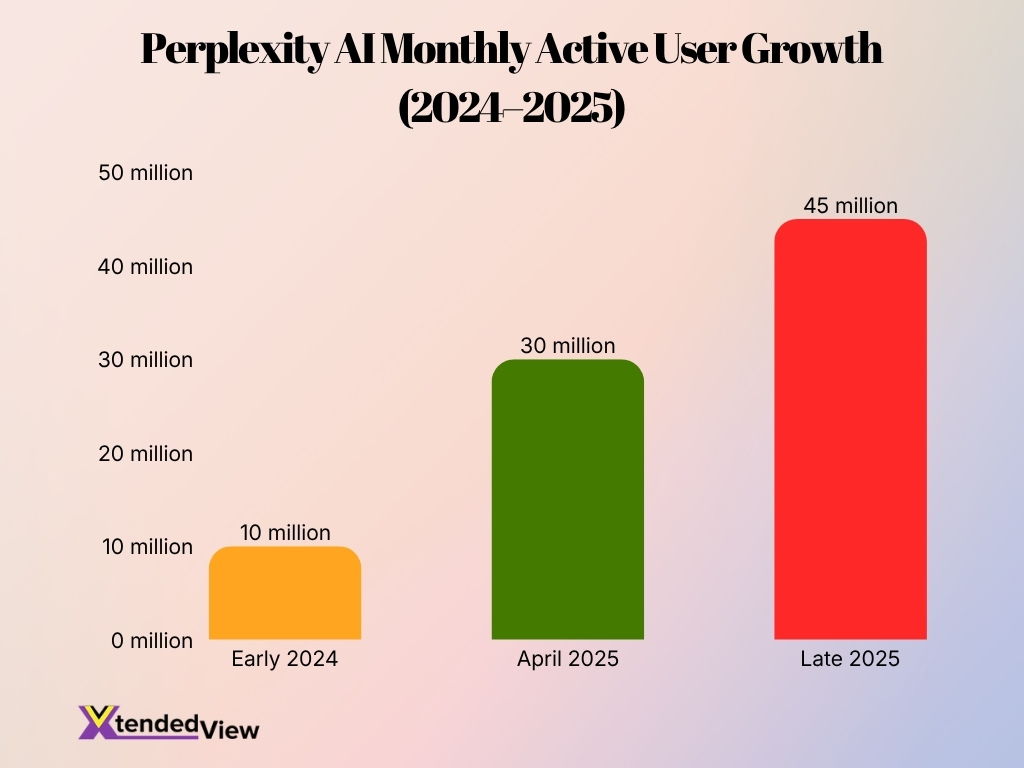
- Monthly active users reached approximately 30 million by April 2025.
- User estimates increased to roughly 45 million during the second half of 2025.
- Some 2026 industry estimates suggest the platform now serves more than 100 million monthly active users across search and AI agent products.
- Monthly active users approximately tripled between early 2024 and mid-2025.
- International expansion significantly contributed to monthly user growth throughout 2025.
- Mobile usage has become an increasingly important source of new monthly active users as app downloads accelerate.
- Enterprise deployments continue to add recurring monthly users across organizations worldwide.
- Continued feature releases and AI model improvements have supported strong monthly retention and active usage.
Perplexity AI User Statistics
- Perplexity AI grew from roughly 10 million monthly active users in early 2024 to approximately 30 million by April 2025.
- By late 2025, third-party estimates placed the platform at 45 million monthly active users.
- Enterprise customers now account for tens of thousands of organizations, reflecting growing business adoption.
- Perplexity serves users across 238 countries and territories, supporting worldwide accessibility.
- India emerged as one of Perplexity’s fastest-growing markets, with approximately 19 million monthly active users reported in early 2026.
- The platform’s audience increasingly includes students, researchers, software developers, marketers, and business professionals.
- Personal use represents about 55% of AI agent interactions, while professional use contributes roughly 30%.
- Educational use accounts for approximately 16% of AI agent queries, highlighting strong academic adoption.
Perplexity AI Growth Statistics
- Perplexity’s valuation increased from $520 million in early 2024 to approximately $20 billion by late 2025.
- Annual recurring revenue expanded to an estimated $500 million during 2026.
- ARR grew by more than 300% year over year between 2025 and 2026.
- Search volume increased from roughly 230 million monthly queries in mid-2024 to around 780 million by May 2025.
- Website traffic approached 240 million monthly visits by late 2025.
- The workforce expanded from approximately 300 employees in 2024 to about 1,400 employees in 2026.
- Total funding surpassed $1.2 billion, supporting aggressive product expansion.
- Revenue growth increasingly comes from enterprise subscriptions and AI agent services rather than advertising.
Perplexity.ai Traffic and Visitor Engagement Statistics
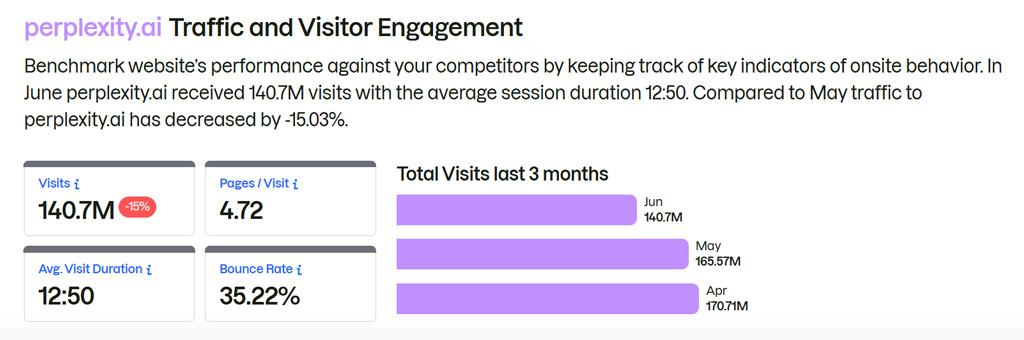
- Perplexity.ai recorded 140.7 million visits in June, representing a 15.03% month-over-month decline compared to 165.57 million visits in May.
- The platform generated an average of 4.72 pages per visit, indicating that users typically explored nearly five pages during each session.
- Visitors spent an average of 12 minutes and 50 seconds per session, reflecting strong user engagement and extended browsing activity.
- Perplexity.ai’s bounce rate stood at 35.22%, meaning that roughly one-third of visitors left the website after viewing only a single page.
- Website traffic has declined for three consecutive months, falling from 170.71 million visits in April to 165.57 million in May, and further to 140.7 million in June.
- Between April and June, Perplexity.ai lost approximately 30 million monthly visits, highlighting a notable short-term reduction in website traffic despite maintaining healthy engagement metrics.
- Despite the decline in total visits, the combination of a 12:50 average session duration, 4.72 pages per visit, and a 35.22% bounce rate suggests that users who visit the platform remain highly engaged.
Perplexity AI Search Query Statistics
- Perplexity processed about 780 million queries in May 2025, compared with 230 million per month in mid-2024. That represents roughly 239% growth in less than one year.
- The May 2025 total equaled an average of about 25.2 million queries per day, based on 31 days in the month.
- Query volume rose by approximately 550 million searches per month between the mid-2024 and May 2025 reporting points.
- By 2025, management reported that daily usage had reached roughly 30 million queries, up from only about 3,000 daily queries shortly after launch in 2022.
- That rise from 3,000 to 30 million represents an increase of about 10,000 times in daily query volume over roughly three years.
- Independent 2026 estimates place usage at 35 million to 45 million queries per day, although Perplexity has not publicly audited that range.
- The same estimate implies monthly activity of roughly 1.2 billion to 1.5 billion queries by mid-2026.
- Perplexity’s infrastructure now handles thousands of queries per second across its consumer products and API services.
Perplexity AI Usage Statistics
- A large-scale study of hundreds of millions of Comet interactions found that 55% of agent queries served personal needs.
- Professional activity accounted for approximately 30% of Comet Assistant queries, showing substantial workplace use.
- Educational use represented about 16% of agent queries, including coursework, research, and learning support. Percentages can overlap because researchers classified usage through contextual signals.
- Productivity and workflow tasks, combined with learning and research, generated 57% of all agentic queries examined in the study.
- Courses and shopping for goods formed the two largest subtopics, together accounting for 22% of queries.
- The 10 most common tasks generated 55% of activity, even though researchers identified 90 distinct tasks.
- Early adopters used the agent more heavily in digital technology, academia, finance, marketing, and entrepreneurship than users in less knowledge-intensive fields.
- Users initially repeated familiar tasks, but longer-term use shifted toward more cognitively demanding research and knowledge work.
Perplexity AI Usage by Platform
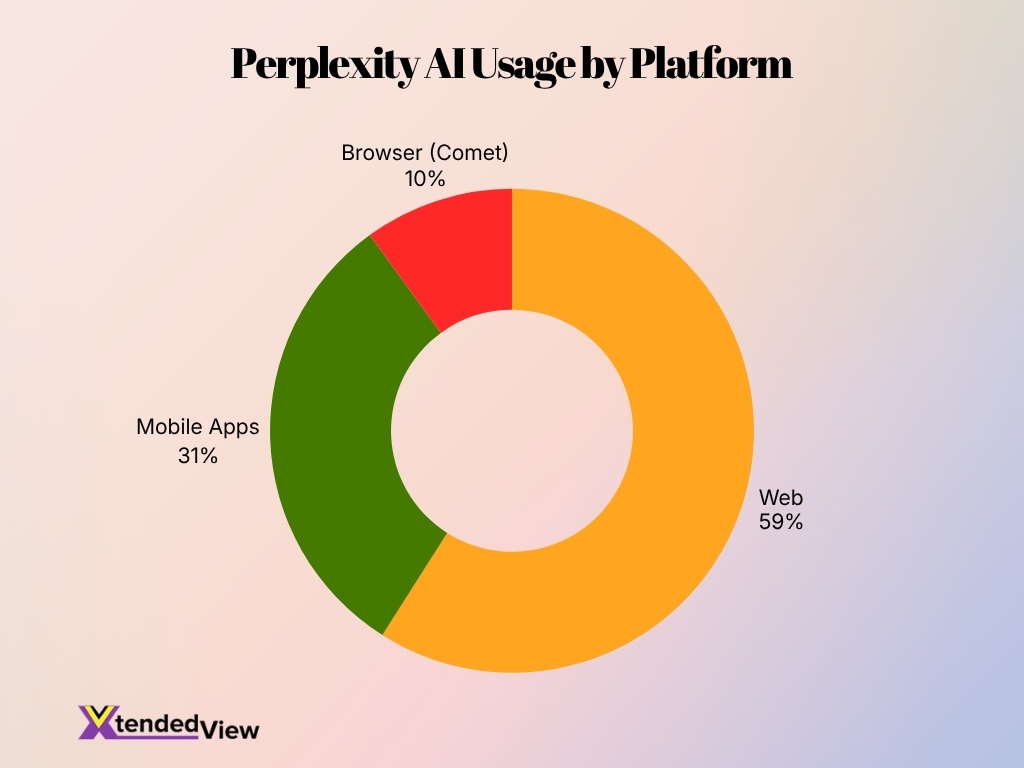
- Web remains the most popular platform for accessing Perplexity AI, accounting for 59% of total usage, indicating that a majority of users prefer using the service through desktop and mobile web browsers.
- Mobile Apps contribute 31% of Perplexity AI usage, highlighting the platform’s strong adoption among users who rely on smartphones and tablets for AI-powered search and assistance.
- The Comet Browser represents 10% of overall usage, showing that Perplexity’s dedicated browser has already established an early user base despite being newer than its web and mobile offerings.
- The combined share of Web and Mobile Apps reaches 90%, demonstrating that these two platforms dominate the Perplexity AI ecosystem and remain the primary access points for users.
- The data suggests that browser-based access continues to lead user behavior, while mobile applications play a significant supporting role in expanding accessibility across devices.
- Although currently smaller in scale, the 10% share of the Comet Browser indicates growing interest in Perplexity’s integrated AI browsing experience and potential for future platform expansion.
- Overall, the platform distribution reflects a balanced multi-platform strategy, with Web, Mobile Apps, and Comet Browser together accounting for 100% of Perplexity AI usage in 2026.
Perplexity AI Engagement Statistics
- Usage covers 90 separate task categories, with the top 10 capturing more than 50% of all interactions.
- Perplexity serves tens of thousands of enterprise clients and handled an estimated 1.2 to 1.5 billion queries per month by mid-2026.
- The platform reaches over 100 million monthly active users across all products in 2026.
- Average user session duration is 23 minutes and 10 seconds, significantly longer than traditional search platforms.
- Users view an average of 2.8 to 4.64 pages per session, exploring multiple queries at once.
- The platform maintains a high retention rate, with 85% to 90% of users revisiting within 30 days.
- Knowledge-sector professionals form a substantial part of the user base, with professional use accounting for roughly 30% of activity.
- The search API processes up to 50 query units per second to support continuous interaction.
Perplexity AI App Download Statistics
- Perplexity’s iOS app recorded an estimated 900,000 downloads during a recent monthly measurement period in the U.S. market.
- The same U.S. iOS estimate associated the app with approximately $7 million in monthly consumer revenue, linking mobile acquisition with subscription spending.
- Perplexity launched its iOS app globally on March 27, 2023, giving the mobile product more than three years to build its 2026 install base.
- The Android launch of Perplexity Assistant in January 2025 expanded the app from answer search into cross-app task completion.
- At launch, the Android assistant supported 15 languages, widening its potential download market beyond English-speaking users.
- The broader generative AI app category reached nearly 1.7 billion downloads in the first half of 2025, creating a rapidly expanding market for Perplexity’s mobile products.
- In 2024, 25 generative AI apps exceeded 10 million downloads, illustrating the scale required to rank among leading mobile AI products.
- AI-related app downloads in India rose 69% year over year during the first quarter of 2026, strengthening the mobile growth opportunity in one of Perplexity’s key expansion markets.
Perplexity AI Market Share Statistics
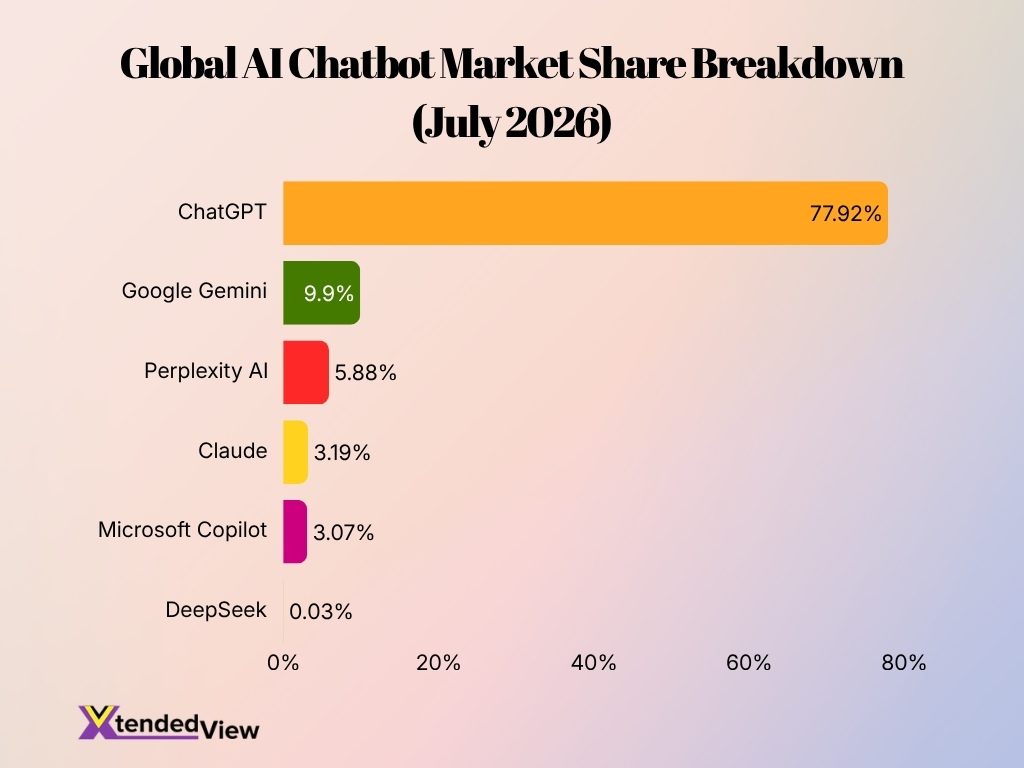
- ChatGPT dominates the global AI chatbot market with a commanding 77.92% market share, making it the clear leader and accounting for more than three quarters of total usage.
- Google Gemini ranks as the second largest AI chatbot, holding 9.90% of the market, though it remains far behind ChatGPT in overall adoption.
- Perplexity AI secures the third position with a 5.88% market share, highlighting its growing popularity as an AI-powered search and answer engine.
- Claude captures 3.19% of the global AI chatbot market, reflecting steady adoption among users seeking conversational AI and enterprise-focused capabilities.
- Microsoft Copilot closely follows Claude with a 3.07% market share, showing strong competition in the productivity-focused AI assistant segment.
- DeepSeek accounts for just 0.03% of the market, indicating a relatively limited global presence compared to the leading AI chatbot platforms.
- The combined market share of Google Gemini, Perplexity AI, Claude, Microsoft Copilot, and DeepSeek totals 22.07%, which is still significantly lower than ChatGPT’s 77.92% share alone.
- The market remains highly concentrated, with the top three AI chatbots, ChatGPT, Google Gemini, and Perplexity AI, together controlling 93.70% of the total global AI chatbot market in July 2026.
- The data highlights a substantial competitive gap, as ChatGPT leads Google Gemini by 68.02 percentage points and exceeds Perplexity AI by 72.04 percentage points, reinforcing its dominant market position.
- With only six major chatbots represented, the figures illustrate that the global AI chatbot landscape is currently led by a small group of established platforms, while smaller competitors continue to hold only a fraction of the overall market.
Perplexity AI Revenue Statistics
- Perplexity announced that it had crossed $100 million in annualized revenue in March 2025.
- A later private-company estimate placed full-year 2025 annualized revenue at approximately $232 million.
- That estimate implies an increase of roughly 132% from the $100 million level reported in March 2025.
- Annualized revenue reportedly reached about $500 million in April 2026, although the company has not released audited financial statements.
- The April 2026 estimate represented approximately 335% year-over-year growth.
- Revenue rose by an estimated $268 million between the 2025 annualized figure and the April 2026 run rate.
- New usage-based fees associated with agent products supplemented subscription revenue in 2026.
- On a simple run-rate basis, $500 million in annualized revenue equals approximately $41.7 million per month, although actual monthly revenue may fluctuate.
Perplexity AI Funding and Valuation Statistics
- Perplexity raised $500 million in 2025 in a round that valued the company at approximately $14 billion.
- A subsequent July 2025 transaction lifted the reported valuation to about $18 billion.
- In September 2025, Perplexity reportedly finalized another $200 million funding round at a $20 billion valuation.
- The September transaction increased the company’s valuation by approximately $2 billion from the July funding level.
- Perplexity’s valuation rose from around $520 million in January 2024 to $20 billion in September 2025.
- That increase represents growth of more than 38 times in roughly 20 months.
- The $200 million September round equaled about 1% of the reported post-money valuation.
- Perplexity’s unsolicited $34.5 billion offer for Chrome exceeded its own reported $20 billion valuation by $14.5 billion.
Perplexity AI Users by Age Groups
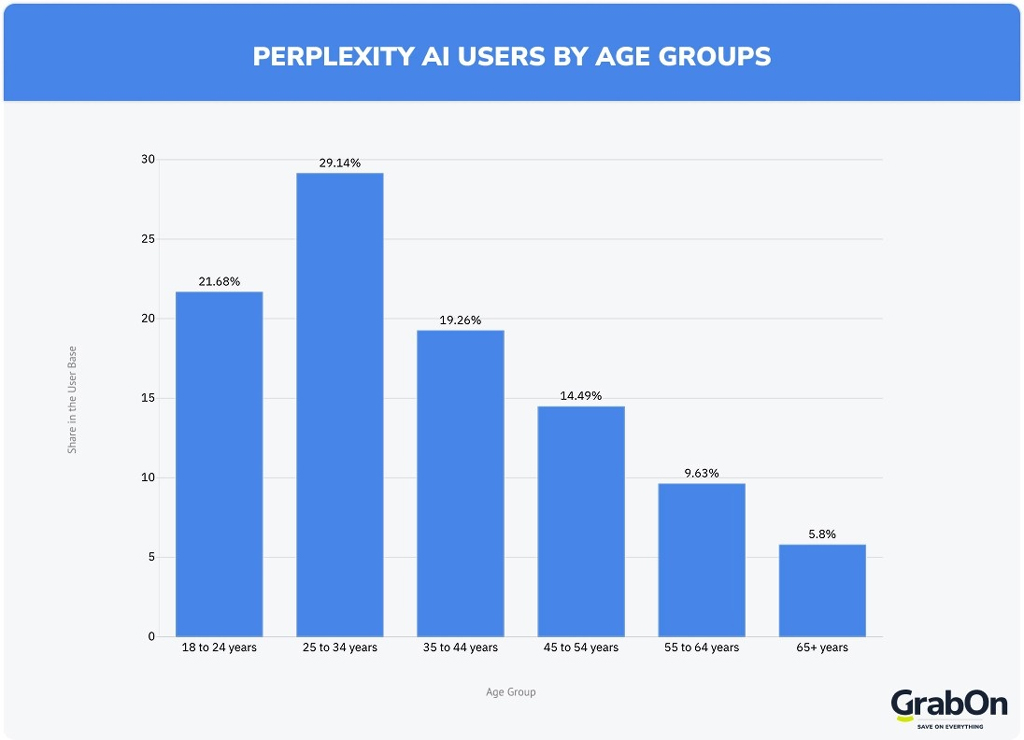
- The 25 to 34 years age group represents the largest share of Perplexity AI users at 29.14%, making it the platform’s most active demographic.
- Users aged 18 to 24 years account for 21.68% of the user base, highlighting strong adoption among younger adults and students.
- The 35 to 44 years segment contributes 19.26%, indicating significant usage among mid-career professionals.
- People in the 45 to 54 years age group make up 14.49% of Perplexity AI users, showing steady engagement from experienced professionals.
- Adults aged 55 to 64 years represent 9.63% of the platform’s users, reflecting a smaller but meaningful share of the audience.
- The 65+ years category has the lowest user share at 5.80%, suggesting lower adoption among senior users.
- Combined, users between 18 and 44 years account for 70.08% of Perplexity AI’s user base, demonstrating that the platform is primarily used by younger and middle-aged adults.
- Users aged 45 years and above collectively contribute 29.92% of total users, showing that nearly one third of the audience comes from older age groups.
- The data indicates that Perplexity AI’s strongest adoption is concentrated among working-age adults, particularly those between 25 and 44 years.
- The age distribution suggests that Perplexity AI appeals most to digitally active users who are likely using the platform for research, productivity, education, and professional tasks.
Perplexity AI Global Reach Statistics
- Perplexity operates as a worldwide service, with its search, app and browser products available to users across multiple regions.
- The U.S. generated more than 23 million visits during one recent geographic traffic measurement, making it Perplexity’s largest identified source in that dataset.
- India contributed nearly 12 million visits during the same period and showed a higher mobile share than several other leading markets.
- Another 2025 traffic dataset attributed 24.78% of users to Indonesia, 22.16% to India and 16.22% to the U.S. Differences between estimates reflect changing periods and measurement methods.
- Indonesia and India together accounted for 46.94% of users in that dataset, highlighting Perplexity’s reach beyond North America.
- The U.S., India and Indonesia collectively represented 63.16% of the audience measured in that analysis.
- South Korea recorded the strongest desktop preference among selected major markets, with 92.32% of traffic coming from computers.
- Germany, South Korea and Japan each generated more than 87% of their measured traffic from desktop devices, suggesting strong professional and research-oriented usage.
- A global AI-search study evaluated 24,000 queries across 243 countries, showing how quickly AI-generated search experiences expanded between 2024 and 2025.
- Comet adoption research found that users in countries with higher income per person and stronger educational attainment adopted AI-agent features more often.
Perplexity AI Benchmark and Accuracy Statistics
- Perplexity reported that its original Deep Research system achieved 93.9% accuracy on SimpleQA, a benchmark focused on short factual answers.
- The same system scored 21.1% on Humanity’s Last Exam, which tests expert-level knowledge and complex reasoning.
- The 72.8-point difference between the SimpleQA and Humanity’s Last Exam results shows how benchmark difficulty can sharply affect measured performance.
- Humanity’s Last Exam contains roughly 2,500 publicly released questions spanning mathematics, science, engineering, computing and the humanities.
- About 14% of Humanity’s Last Exam questions require multimodal understanding, while 24% use a multiple-choice format.
- In February 2026, Perplexity said an upgraded Deep Research system achieved leading results on two external research evaluations, although it did not publish complete numerical scores in the announcement.
- Perplexity’s 2026 DRACO benchmark includes tasks across 10 subject areas and relies on information drawn from 40 countries.
- DRACO evaluates outputs across four dimensions: factual accuracy, analytical completeness, presentation and citation quality.
- The Agent API’s strongest preset more than doubled the top Sonar score on some difficult multi-step evaluations, including BrowseComp and WideSearch.
- Independent benchmark research warns that no AI research system achieves perfect accuracy, so readers should verify citations, calculations and high-stakes claims before using them.
Why Users Choose Perplexity AI
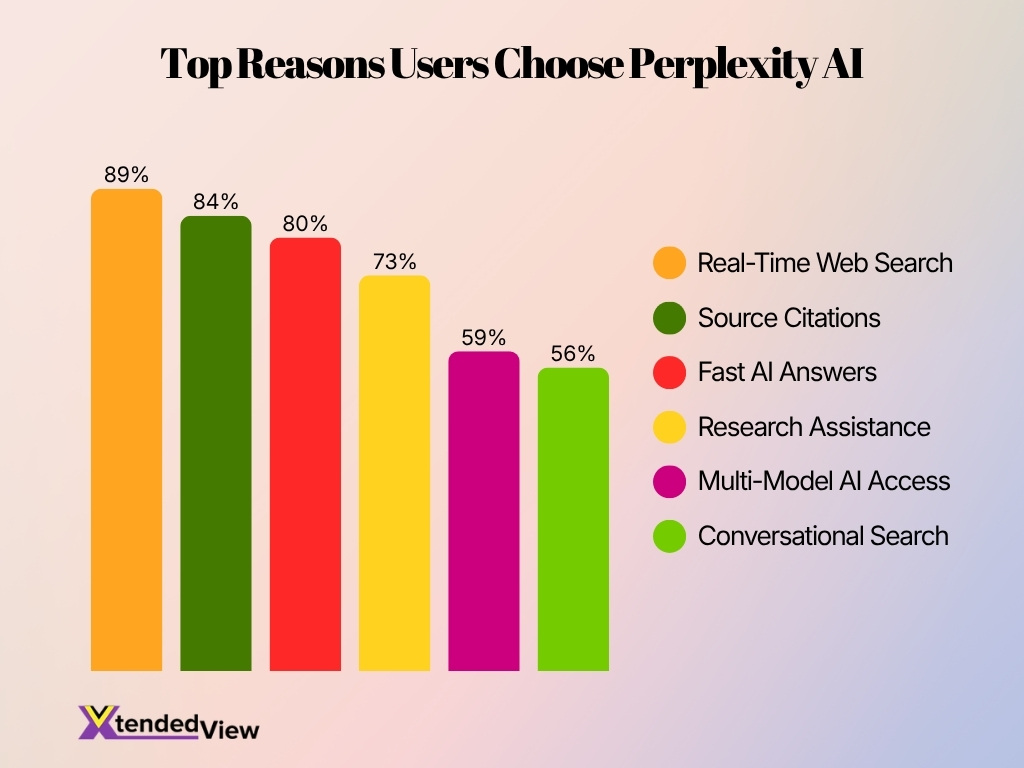
- Real-time web search is the leading reason users choose Perplexity AI, cited by 89% of users.
- Source citations rank second at 84%, highlighting the importance of transparent and verifiable AI-generated information.
- Fast AI answers attract 80% of users, showing that speed remains a major factor in AI search adoption.
- Research assistance is valued by 73% of users, positioning Perplexity AI as a useful tool for academic, professional, and general research.
- Multi-model AI access influences 59% of users, indicating growing demand for access to different AI models within one platform.
- Conversational search appeals to 56% of users, making it the least cited reason in the dataset, though it still attracts more than half of users.
- The top three reasons, real-time web search, source citations, and fast AI answers, each influence at least 80% of users.
- The gap between the most cited reason, real-time web search at 89%, and the least cited reason, conversational search at 56%, is 33 percentage points.
Perplexity AI Product Adoption Statistics
- Perplexity’s product portfolio now spans at least six major offerings: its answer engine, Pro subscription, Enterprise services, Sonar, Comet and Perplexity Assistant.
- Deep Research originally allowed free users to run up to five research queries per day, while Pro users could run as many as 500 daily queries when the feature launched in 2025.
- The Android assistant launched with support for 15 languages, widening its potential use across consumer markets.
- Comet research analyzed hundreds of millions of anonymized interactions, providing one of the largest public datasets on real-world AI-agent adoption.
- Productivity, workflow, learning, and research generated 57% of Comet’s agent queries, indicating that users often adopt the browser for practical knowledge work.
- Personal tasks represented 55% of Comet interactions, while professional and educational contexts accounted for 30% and 16%, respectively. Some classifications can overlap.
- The top 10 tasks produced 55% of all agent queries, despite researchers identifying 90 separate task categories.
- A 2025 distribution agreement offered eligible PayPal and Venmo users 12 months of Perplexity Pro, carrying a stated annual value of $200.
- Perplexity began expanding commerce adoption by letting users complete purchases within conversational search rather than leaving for a separate checkout journey.
- A publishing partnership announced in 2025 included plans to integrate Sonar into a major news organization’s website and apps for archive-based natural-language search.
Perplexity AI Future Projections
- The global AI software market could expand from $122 billion in 2024 to $467 billion by 2030, creating a larger addressable market for Perplexity’s search and agent products.
- That forecast represents a compound annual growth rate of about 25%, although Perplexity’s individual growth may differ from the broader market.
- Generative AI software could grow at a 34.5% compound annual rate through 2030, faster than the overall AI software category.
- A broader industry forecast values the AI market at $601.93 billion in 2026 and projects it could reach $3.64 trillion by 2033.
- That projection implies a 29.3% compound annual growth rate, supported by the move from small experiments to production deployments.
- AI tools produced 4.2% of total web traffic between May 2025 and April 2026, leaving substantial room for AI search and browser products to gain adoption.
- Perplexity generated approximately 2.3 billion web visits during that 12-month period, placing it among the most-visited standalone AI tools.
- AI chatbot products generated nearly 60% of 144.5 billion AI-related visits during the measured year, supporting continued competition for conversational search users.
- AI-generated search exposure expanded from seven countries in 2024 to 229 countries in 2025 in one large-scale study, signaling rapid global adoption of the broader category.
- Perplexity’s future share will depend on whether Comet, Sonar, and enterprise agents can convert rising AI-search interest into sustained paid usage.
Frequently Asked Questions (FAQs)
Perplexity AI had more than 100 million monthly active users as of March 2026.
Perplexity’s annual recurring revenue exceeded $450 million in March 2026, after monthly revenue increased 50%.
Perplexity reached a reported valuation of $20 billion after securing commitments for a $200 million funding round in September 2025.
Perplexity held 5.88% of the worldwide AI chatbot market in July 2026, ranking third behind ChatGPT and Google Gemini.
Perplexity generated approximately 2.3 billion website visits between May 2025 and April 2026.
Conclusion
Perplexity AI has evolved from a niche AI search engine into one of the fastest-growing platforms in the generative AI ecosystem. The company recorded strong growth in users, search volume, revenue, enterprise adoption and global reach while expanding its portfolio with products such as Comet, Sonar and Perplexity Assistant.
Although Perplexity continues to trail the largest AI platforms in overall market share, its rapid innovation, expanding enterprise presence and increasing global adoption position it as one of the most influential players in AI-powered search. As the broader AI market continues to grow, Perplexity appears well positioned to capitalize on rising demand for conversational search, AI agents and knowledge discovery solutions.