



Online privacy has become one of the most important aspects of the modern digital world as people increasingly rely on the internet for banking, shopping, healthcare, education, entertainment, remote work, and social networking. Every online interaction generates valuable personal data, making individuals and organizations more vulnerable to cyberattacks, identity theft, unauthorized tracking, and large-scale data breaches. At the same time, governments worldwide continue introducing stricter privacy regulations while businesses invest in stronger security measures and transparent data practices to meet growing consumer expectations.
As artificial intelligence, connected devices, mobile applications, and cloud-based services continue to expand, protecting personal information has become both a technological and regulatory priority. Consumers are becoming more aware of how their data is collected, shared, and monetized, leading to greater demand for privacy controls, consent management, and secure digital experiences. The latest online privacy statistics provide valuable insights into data breaches, privacy laws, consumer attitudes, government surveillance, mobile app privacy, VPN adoption, identity theft, and other key trends shaping the future of digital privacy across the United States and around the world.
Editor’s Choice
- 3,322 data compromises were reported in the United States during 2025, up from 3,152 in 2024.
- About 278.8 million victim notices were issued following U.S. data compromises in 2025, compared with more than 1.36 billion in 2024.
- 73% of U.S. adults say they have experienced at least one online scam or cyberattack, highlighting widespread digital privacy risks.
- 71% of Americans report they are concerned about how the government uses the personal data it collects, up from 64% in 2019.
- Around 60% of U.S. adults say they are willing to pay more for products or services that offer stronger protection of personal data.
- As of early 2025, 53.22% of free iOS apps disclosed collecting user privacy data.
- 36% of internet users worldwide exercised their Data Subject Access Request (DSAR) rights during 2024, reflecting growing awareness of privacy regulations.
Recent Developments
- The United States recorded 3,322 reported data compromises in 2025, marking another record year for breach activity.
- Even though breach incidents increased in 2025, the number of affected individuals declined sharply from 1.37 billion in 2024 to 278.8 million.
- One of the largest publicly disclosed privacy incidents in 2024 involved the National Public Data breach, exposing billions of personal records.
- During the second quarter of 2025, nearly 94 million data records were exposed worldwide through reported breaches.
- Privacy regulations continue expanding worldwide, with organizations facing increased enforcement under existing and newly introduced data protection laws.
- Organizations increasingly invest in privacy programs as AI adoption expands and regulators place greater emphasis on responsible data governance.
- Consumer demand for transparency continues to rise, leading more companies to simplify privacy notices and strengthen consent management.
- Data Subject Access Requests continued growing through 2024, showing that more consumers actively exercise their privacy rights than in previous years.
Online Privacy Overview
- Online privacy refers to protecting personal information collected through websites, apps, connected devices, and digital services.
- More than 70% of Americans express concern about how governments use their personal information online.
- 60% of U.S. consumers indicate they are willing to spend more with organizations that demonstrate stronger data protection practices.
- 36% of global internet users exercised at least one formal privacy right under data protection regulations during 2024.
- Free mobile applications continue to collect significant amounts of user information, with 53.22% of free iOS apps reporting data collection in 2025.
- Privacy concerns now extend beyond websites to wearable devices, connected vehicles, smart home products, and AI-powered services.
- Organizations increasingly view privacy as a competitive advantage because consumers reward brands that clearly explain how they collect and use personal data.
- Privacy expectations continue rising as more users demand transparency, easier consent controls, and faster responses to privacy requests.
Data Breaches
- The United States recorded 3,322 data compromises during 2025, an increase from 3,152 in 2024.
- Approximately 278.8 million individuals were impacted and received breach notifications in 2025.
- Around 80% of data breaches were the direct result of malicious cyberattacks.
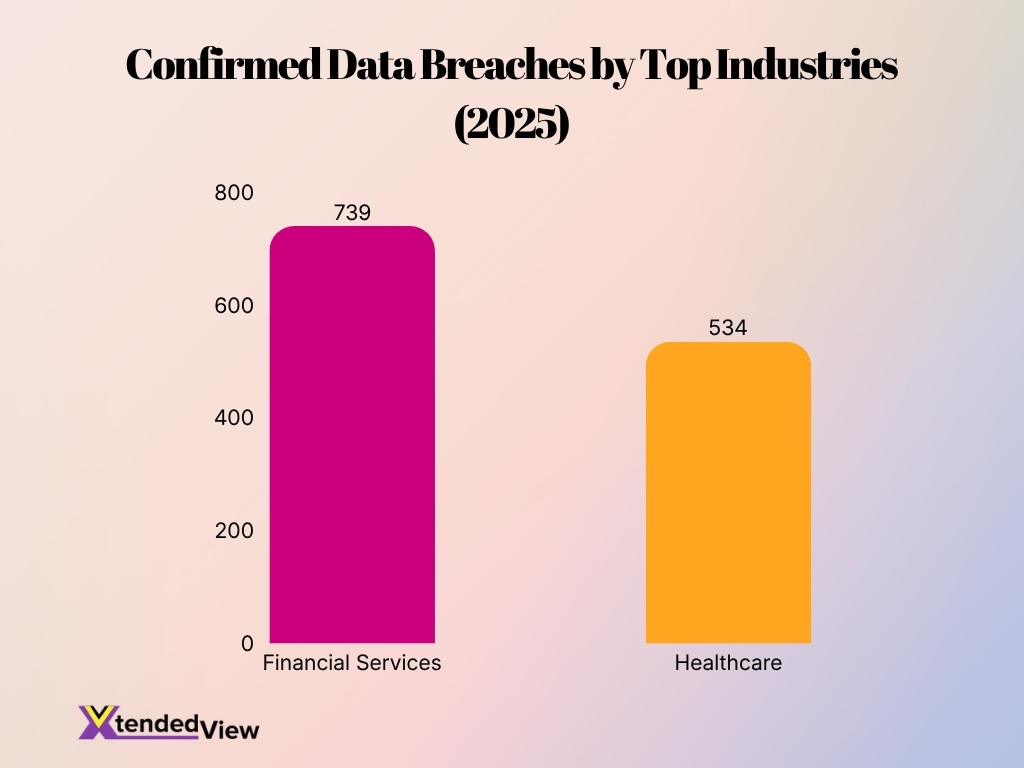
- The financial services sector reported the highest volume with 739 confirmed compromises.
- The healthcare industry ranked second highest by reporting 534 data breaches last year.
- Supply chain attacks involving third-party vendors accounted for 30% of all breaches.
- Social Security numbers were exposed in two-thirds of all reported breach incidents.
- An estimated 80% of consumers received at least one data breach notice over the past year.
Data Collection and Tracking
- 53.22% of free iOS applications disclosed collecting user privacy data as of January 2025.
- Organizations experienced a 43% year-over-year surge in Data Subject Access Requests globally during 2024.
- Approximately 78% of organizations had adopted automation technology to manage data access and deletion requests by 2025.
- Consumer data access requests under the CCPA surged by a massive 246% between 2021 and 2024.
- Exactly 36% of internet users worldwide stated they exercised their right to access personal data in 2024.
- Over 53% of global consumers reported being actively aware of their country’s data privacy laws in 2024.
- Direct-to-consumer brands received around 1,577 privacy requests per million identities due to extensive tracking.
- Around 68% of global consumers remain significantly concerned about their online data privacy and tracking.
Privacy Settings and User Behavior
- 76.9% of internet users took at least one action to protect their personal data online in 2025, up from 73.2% in 2023.
- 58.8% refused to allow their personal information to be used for advertising purposes in 2025, reflecting stronger privacy awareness.
- 56.2% restricted access to their geographic location while using websites or mobile apps in 2025.
- 46% limited access to their social media profiles or online storage accounts to reduce unwanted exposure.
- 39% checked whether a website used a secure connection before sharing personal information in 2025.
- 37.6% read privacy policy statements before providing personal data, showing gradual improvement in privacy-conscious behavior.
- Around 34.5% of internet users worldwide reject website cookies at least occasionally, while nearly two-thirds still accept them automatically.
- Research published in 2026 found that user trust and perceived control over privacy settings strongly influence whether people share personal information on social platforms.
Privacy Attitudes and Awareness
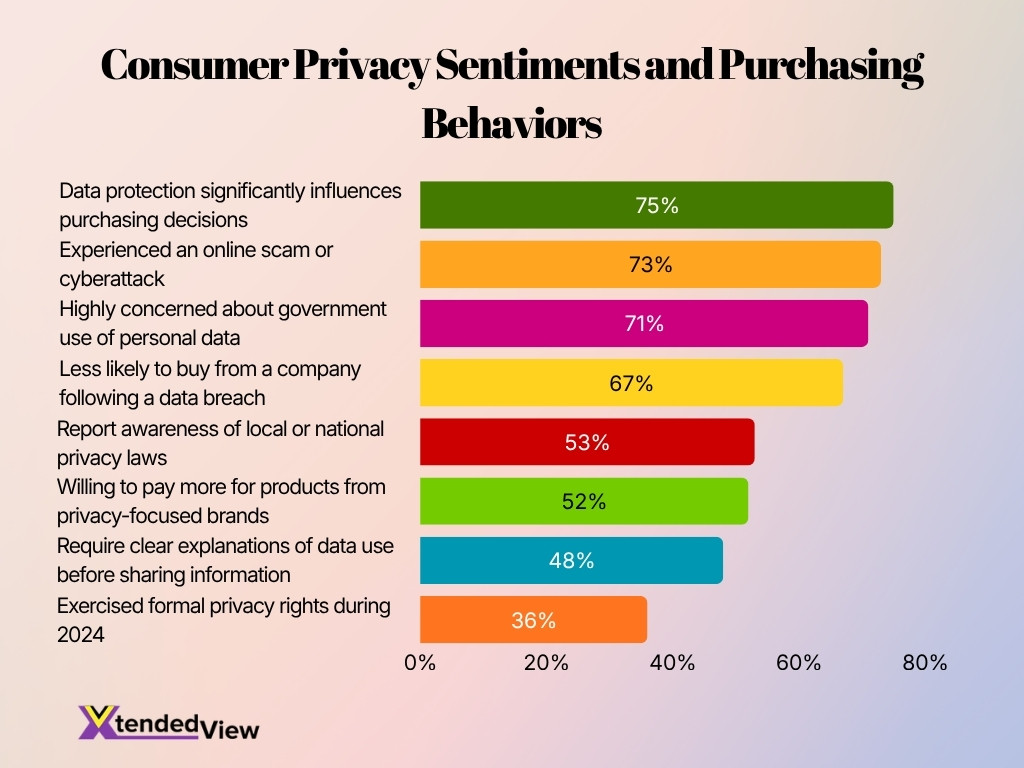
- 73% of Americans report experiencing an online scam or cyberattack.
- 71% of U.S. adults are highly concerned about government use of personal data.
- 52% of consumers are willing to pay more for products from privacy-focused brands.
- 36% of internet users worldwide exercised formal privacy rights during 2024.
- 48% of users require clear explanations of data use before sharing information.
- 67% of customers are less likely to buy from a company following a data breach.
- 53% of global consumers report awareness of their local or national privacy laws.
- 75% of consumers state that data protection significantly influences purchasing decisions.
Online Privacy Laws and Regulations
- 20 U.S. states now have comprehensive data privacy laws in effect, extending protections well beyond California.
- A total of 2,679 fines have been issued under the GDPR across the EU/EEA, amounting to €7.1 billion in cumulative fines as of January 2026.
- 82% of internet users are concerned about how companies collect and use their personal data.
- The NIST Privacy Framework is used as a foundation by many organizations handling personal information under various global regulations.
- 33% of consumers have deleted an online account in the past year due to privacy concerns.
- 172 countries had enacted data protection or privacy legislation by 2025, covering 79% of the world’s nations.
- According to a recent global survey, 56% of compliance and risk professionals ranked data privacy, protection, and security as their most important compliance issues.
Privacy Compliance Challenges
- Only 46% of privacy professionals are very or completely confident that their organizations can comply with new privacy laws.
- Just 31% say privacy obligations are easy to understand despite growing regulatory guidance.
- 20% of organizations still report difficulty understanding privacy requirements, although that figure declined from 24% in 2025.
- 58% of organizations frequently apply privacy by design when developing new applications or services, down from 62% in 2025.
- Privacy teams continue facing staffing pressure even as regulatory obligations expand across jurisdictions.
- More organizations now use AI to automate privacy-related tasks, while the share with no AI adoption plans has continued to decline.
- Organizations operating across multiple countries face additional complexity because privacy requirements differ between jurisdictions.
- Consent management, vendor oversight, and responding to consumer privacy requests remain among the most resource-intensive compliance activities.
Consumer Trust and AI Governance Insights
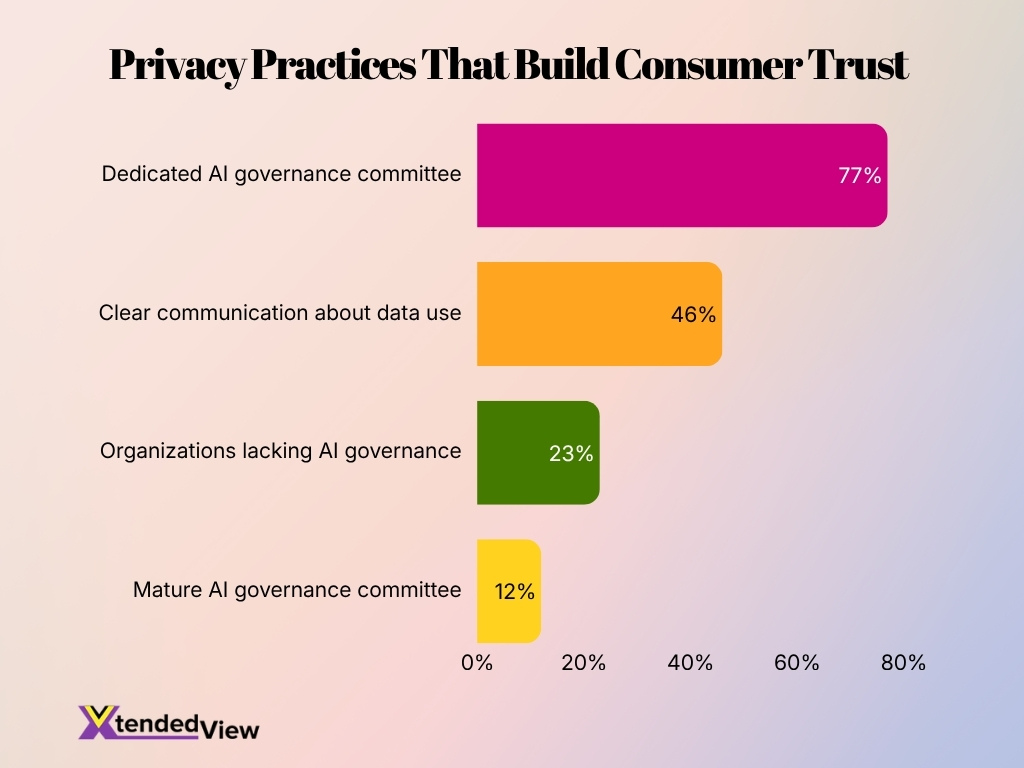
- A strong 77% of organizations have established a dedicated AI governance committee, making it the most widely adopted trust-building practice.
- Clear communication about data use is prioritized by 46% of organizations, highlighting the importance of transparency in strengthening consumer confidence.
- Nearly 23% of organizations still lack formal AI governance, exposing a significant gap in accountability, oversight, and responsible data management.
- Only 12% of organizations report having a mature AI governance committee, suggesting that most governance programs are still in the early stages of development.
- The 65-percentage-point gap between organizations with a dedicated committee and those with mature governance shows that forming a committee does not automatically ensure effective implementation.
- Organizations can build stronger consumer trust by combining clear data-use communication with mature governance policies, regular audits, and defined accountability structures.
Cookies and Cross-Site Tracking
- Only 34.5% of global internet users reject cookies at least occasionally.
- Approximately 58.8% of users refused permission for advertising data usage.
- More than 55% of tested websites failed to honor user privacy preferences.
- Nearly 83% of corporate websites actively rely on third-party cookies for tracking.
- Over 70% of consumers feel concerned about their privacy regarding cross-site tracking.
- Approximately 65% of all active websites utilize a cookie consent banner.
- Digital advertisers report a 40% reduction in ad performance from cookie deprecation.
- Almost 42% of internet users globally utilize ad-blocking software to stop tracking.
Identity Theft and Online Fraud
- Over 1 million cases of identity theft are reported annually by consumers.
- Global cybercrime costs are projected to reach $10.5 trillion annually.
- Account takeover fraud resulted in over $11 billion in financial losses.
- More than 90% of all cyberattacks originate from a phishing email.
- The average cost of a corporate data breach is approximately $4.45 million.
- Victims spend an average of 600 hours resolving severe identity theft issues.
- Millennials account for more than 30% of all reported fraud cases.
- Over 8 billion personal records were exposed globally through data breaches.
- Roughly 33% of adults have experienced identity theft at least once in their lifetime.
Negative Effects of Personal Data Exposure
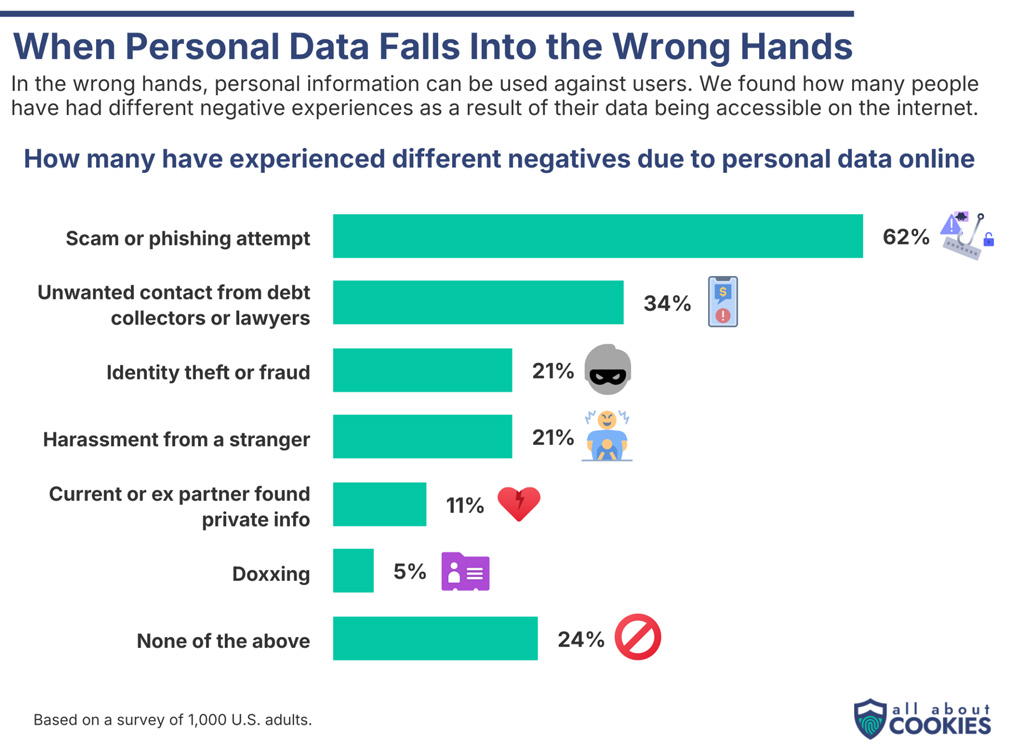
- Scam or phishing attempts were the most common negative experience, affecting 62% of U.S. adults surveyed.
- 34% of respondents reported receiving unwanted contact from debt collectors or lawyers after their personal information became accessible online.
- Identity theft or fraud affected 21% of adults, highlighting the financial and security risks associated with exposed personal data.
- Another 21% of respondents experienced harassment from a stranger, showing how online data exposure can also create personal safety concerns.
- 11% of adults said a current or former partner found private information about them online.
- Doxxing was reported by 5% of respondents, making it the least common negative experience measured in the survey.
- Only 24% of U.S. adults selected none of the above, meaning roughly three-quarters experienced at least one listed consequence.
- The findings are based on a survey of 1,000 U.S. adults, offering insight into the widespread risks of personal information being available online.
Mobile App Privacy
- 53.22% of free iOS apps disclosed collecting user privacy data in 2025, illustrating the scale of mobile data collection.
- 96% of smartphone users say they are concerned about how mobile apps use their personal information.
- 78% report becoming more cautious about granting app permissions since the rise of AI-powered applications.
- 74% have revoked at least one app permission after believing an app misused their data.
- 71% have deleted an application because of concerns about privacy or data handling.
- 51% actively try to minimize the amount of personal information they share with mobile apps.
- A global review of nearly 900 child-focused websites and apps found 59% required an email address for full functionality, while 46% requested geolocation data.
- Academic research continues to identify mobile applications that collect sensitive identifiers, browsing activity, and location data beyond what many users expect.
Social Media Privacy
- 71% of internet users limited access to their personal information by changing privacy settings, blocking advertisers, or restricting profile visibility in 2025.
- 46.0% of internet users restricted access to their social media profiles or online storage accounts in 2025, up from 41.0% in 2023.
- 82% of surveyed users actively opt out of data collection whenever possible, compared with 75% a year earlier.
- 71% use ad blockers to reduce online tracking, increasing from 69% in the previous year.
- 49% of respondents reported stopping their use of TikTok because of privacy concerns.
- 44% have stopped using Instagram due to concerns about personal data handling.
- 37% no longer use Facebook because they distrust how the platform handles personal information.
- Privacy expectations continue rising as social platforms integrate more AI-driven personalization, facial recognition, and behavioral advertising features.
Willingness to Pay for Greater Social Media Privacy
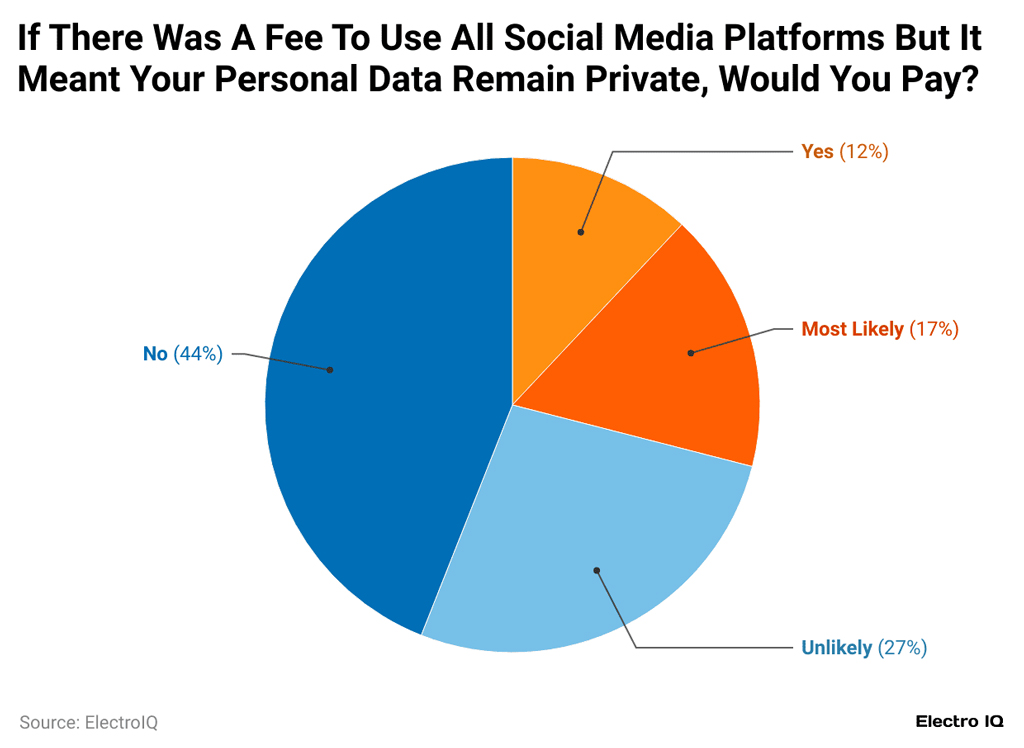
- 44% of respondents said they would not pay a fee to use social media platforms while keeping their personal data private.
- Another 27% considered paying unlikely, indicating that more than one-quarter of users remain hesitant about subscription-based privacy.
- Only 17% said they would most likely pay, showing moderate interest in a paid, privacy-focused social media model.
- Just 12% answered yes, representing the smallest group of users fully willing to pay for stronger personal data protection.
- Combined, 71% of respondents were unwilling or unlikely to pay, highlighting strong resistance to additional social media fees.
- In comparison, only 29% expressed a positive willingness to pay, including respondents who selected “Yes” or “Most Likely.”
VPN and Privacy Tools
- Around 75 million Americans used a VPN during 2025 to improve online privacy and security.
- 32% of U.S. adults reported using a VPN in 2025, down from 46% in 2023.
- 37% of VPN users primarily used the service to reduce tracking by search engines and social media platforms.
- 28% of VPN users relied on free VPN services despite potential privacy and security risks.
- 40% of adults aged 18–29 reported regular VPN usage, making them the largest user group in the United States.
- 46% of surveyed users reported using a VPN in 2026, up from 42% the previous year.
- 76% of respondents now use multi-factor authentication to secure online accounts, compared with 69% a year earlier.
- 54% of Americans still do not use VPNs, mainly because they are unaware of the technology or do not believe they need it.
Privacy Policies and Consent
- 37.6% of internet users read privacy policies before sharing personal data in 2025.
- 48% of surveyed consumers reported reviewing privacy policies in 2026.
- Over 60% of users rejected tracking cookies when offered a simple “Reject All” option.
- Nearly 90% of visitors accepted cookies when rejection required multiple clicks.
- Only 9% of consumers state they always read privacy policies before agreeing to terms.
- Approximately 79% of adults are concerned about how organizations use their digital data.
- Roughly 81% of consumers feel they have little to no control over their personal information.
- More than 70% of mobile apps share personal data without requiring explicit user consent.
- About 68% of users experience consent fatigue and blindly accept cookie pop-ups.
Online Privacy Concerns Among Consumers
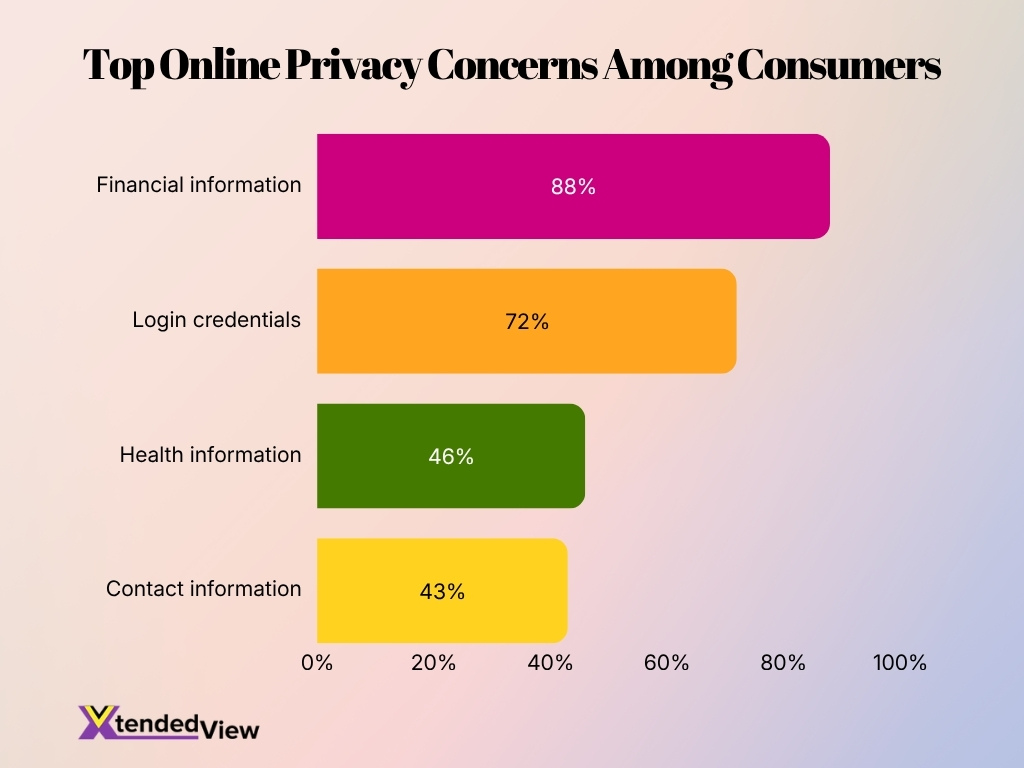
- Financial information is the leading online privacy concern, cited by 88% of consumers, highlighting widespread anxiety about fraud, payment theft, and unauthorized account access.
- Login credentials rank second at 72%, showing that consumers are highly concerned about compromised passwords and account takeovers.
- Health information worries 46% of consumers, reflecting growing sensitivity around how personal medical data is collected, stored, and shared online.
- Contact information is a concern for 43% of consumers, indicating continued unease about spam, phishing attempts, and unwanted third-party communication.
- The gap between financial information and contact information is 45 percentage points, demonstrating that consumers place significantly greater importance on protecting financial data.
- Overall, the figures show that consumers are most concerned about information that could lead to financial loss, identity theft, or unauthorized access.
Privacy Fines and Enforcement
- U.S. state regulators significantly expanded privacy enforcement actions throughout 2025, with California and Texas leading major investigations.
- California reached a $1.35 million privacy settlement involving Tractor Supply during 2025 enforcement activities.
- American Honda agreed to a $632,500 settlement over alleged privacy law violations during 2025.
- Texas secured a $1.374 billion settlement involving Google under state privacy enforcement efforts.
- HoYoverse agreed to a $20 million settlement related to children’s privacy enforcement.
- Between 2022 and 2026, major technology companies received approximately $3.5 billion in AI-related privacy fines tied to unauthorized use of personal data.
- In 2026, India’s Central Consumer Protection Authority fined two digital companies for using dark patterns that undermined informed user consent.
- Regulators increasingly target AI training practices, biometric data collection, location tracking, and deceptive consent mechanisms as enforcement priorities.
Frequently Asked Questions (FAQs)
The United States recorded 3,322 reported data compromises in 2025, setting another annual record.
About 76.9% of internet users took at least one measure to protect their personal data online in 2025.
Approximately 58.8% of internet users chose not to allow their personal data to be used for advertising in 2025.
Around 90% of consumers say protecting their personal data is important, while only 55% feel confident about protecting it online.
About 82% of organizations use a recognized privacy framework or law to manage their privacy programs.
Conclusion
Online privacy continues to evolve as organizations collect more data, artificial intelligence becomes more deeply integrated into digital services, and governments strengthen privacy regulations and enforcement. The latest statistics show that consumers are taking a more proactive approach to protecting their personal information by enabling stronger security features, adjusting privacy settings, using VPNs, and exercising their legal privacy rights. At the same time, organizations face increasing pressure to improve transparency, minimize unnecessary data collection, strengthen cybersecurity, and comply with a growing number of privacy laws.
Looking ahead, online privacy will remain a critical factor in building consumer trust and supporting long-term business success. Organizations that prioritize responsible data governance, clear consent practices, and robust security measures will be better positioned to meet evolving regulatory requirements while maintaining customer confidence in an increasingly data-driven digital economy.
