



Data privacy now shapes how businesses build products, market services, and manage risk. From healthcare systems protecting patient records to e-commerce platforms securing payment data, organizations face constant pressure to safeguard sensitive information while maintaining user trust. As regulations tighten and cyber threats evolve, data privacy has become both a compliance requirement and a competitive advantage. The statistics in this article highlight how privacy trends are reshaping industries and what they mean for the future of digital interactions.
Editor’s Choice
- 83% of consumers say they are concerned about how companies use their personal data.
- The global average cost of a data breach reached $4.45 million in 2023, up 15% in three years.
- 75% of the world’s population is expected to have their personal data covered under modern privacy laws by 2025.
- In 2024, over 2,800 publicly reported data breaches occurred in the U.S. alone.
- 64% of consumers say they would stop buying from a company after a data breach.
- Organizations using AI-driven security tools saved an average of $1.76 million per breach.
- 79% of Americans report being concerned about how companies collect and use their data.
- Nearly 60% of companies say privacy regulations increased their operational costs in 2024.
Recent Developments
- In 2025, multiple U.S. states expanded privacy laws, bringing the total to over 15 state-level data privacy regulations.
- The European Union continued enforcement under GDPR, issuing €1.6 billion+ in fines in 2023 alone.
- AI-related privacy concerns surged, with over 70% of organizations reviewing data governance policies in 2024.
- Global cross-border data transfer rules tightened, impacting more than 60% of multinational companies.
- The adoption of privacy-enhancing technologies increased by over 25% year-over-year.
- In 2024, regulators increased scrutiny on big tech, leading to record-breaking privacy settlements exceeding $5 billion globally.
- Data localization requirements expanded across Asia and the Middle East, affecting over 40 countries.
- Over 50% of enterprises updated their consent management platforms in response to new regulations.
- Privacy audits became standard practice, with 68% of companies conducting annual data privacy assessments.
Data Privacy Statistics Overview
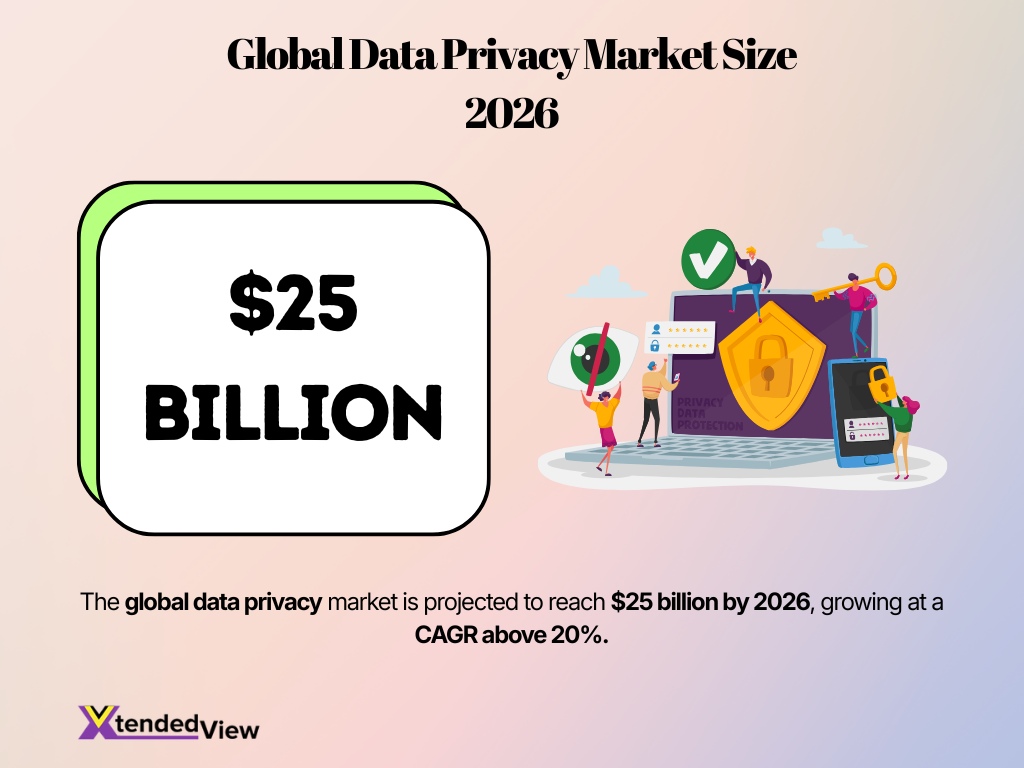
- The global data privacy market is projected to reach $25 billion by 2026, growing at a CAGR above 20%.
- 92% of organizations consider data privacy a top business priority in 2025.
- Around 67% of global consumers say they do not understand how companies use their data.
- 81% of users feel they have little control over their personal data online.
- Companies that invest in privacy programs report ROI exceeding 1.8x on average.
- 70% of enterprises increased privacy budgets in 2024 compared to 2023.
- More than 50% of organizations have a dedicated Chief Privacy Officer role.
- 88% of consumers say transparency is a key factor in trusting a brand.
- Data privacy concerns influence purchasing decisions for over 60% of global consumers.
- By 2025, over 180 countries will have enacted or proposed data protection laws.
Data Privacy Breach Statistics
- In 2024, the U.S. recorded over 3,200 data breaches, a record high.
- The average time to identify and contain a breach is 277 days globally.
- 83% of organizations experienced more than one data breach in their lifetime.
- Phishing remains the leading cause, responsible for over 35% of breaches.
- Stolen or compromised credentials account for 19% of all breaches.
- Healthcare breaches exposed over 100 million records in 2023.
- 45% of breaches occur in cloud-based environments.
- Ransomware attacks increased by over 70% year-over-year in 2024.
- Insider threats contribute to around 20% of data breaches.
- Small businesses account for over 40% of breach victims globally.
Data Breach Cost Statistics
- The global average cost of a data breach reached $4.45 million in 2023, up from $4.35 million in 2022.
- In the U.S., the average breach cost climbed to $9.48 million, the highest worldwide.
- Breaches involving critical infrastructure cost organizations $5.04 million on average.
- Companies using AI and automation reduced breach costs by up to $1.76 million compared to those without.
- The average cost of a ransomware attack exceeded $5.13 million in 2024, excluding ransom payments.
- Lost business accounts for 38% of total breach costs, including churn and reputational damage.
- Detection and escalation costs make up nearly 30% of total breach expenses.
- Organizations with incident response teams saved an average of $2.66 million per breach.
- Breaches caused by compromised credentials cost $4.62 million on average, among the most expensive attack vectors.
- Data breaches in highly regulated industries cost over 20% more than the global average.
Consumer Privacy Concern Statistics
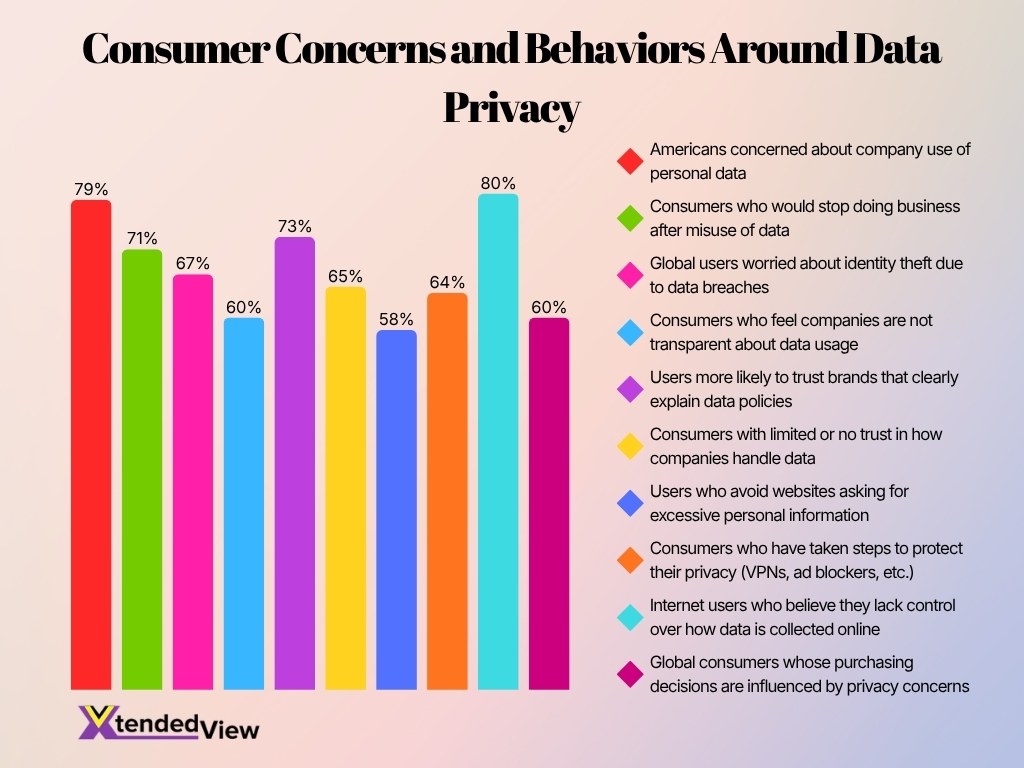
- 79% of Americans report being concerned about how companies use their personal data.
- Around 71% of consumers say they would stop doing business with a company after a misuse of their data.
- 67% of global users worry about identity theft due to data breaches.
- Nearly 60% of consumers feel companies are not transparent about data usage.
- 73% of users say they are more likely to trust brands that clearly explain data policies.
- Over 65% of consumers have limited or no trust in how companies handle their data.
- 58% of users actively avoid websites that ask for excessive personal information.
- About 64% of consumers have taken steps to protect their privacy, such as using VPNs or ad blockers.
- 80% of internet users believe they lack control over how their data is collected online.
- Privacy concerns influence purchasing decisions for over 60% of consumers globally.
Data Privacy Trust Statistics
- 73% of consumers say they are more likely to trust companies that are transparent about how their data is used.
- Around 68% of users report that trust in a brand increases when clear privacy policies are provided.
- Only 21% of consumers fully trust companies to keep their personal data secure.
- 84% of customers consider data privacy a key factor when deciding whether to engage with a brand.
- Businesses that prioritize transparency see up to 30% higher customer retention rates.
- 62% of users say they actively check privacy policies before sharing sensitive information.
- Nearly 70% of consumers believe companies prioritize profit over data protection.
- 55% of users have abandoned a purchase due to privacy concerns.
- Organizations with strong privacy practices report up to 25% higher brand loyalty.
Data Privacy Law Statistics
- By 2025, 75% of the global population’s data is expected to be protected under privacy regulations.
- The U.S. now has 15+ state-level privacy laws, including California, Virginia, and Colorado.
- Over 160 countries worldwide have enacted data protection legislation.
- 60% of companies report increased compliance costs due to new privacy laws.
- 45% of organizations have hired additional compliance staff in response to regulations.
- Data localization requirements now affect more than 40 countries globally.
- 70% of businesses say regulatory complexity has increased in the past two years.
- Companies spend an average of $2.7 million annually on privacy compliance.
- 65% of enterprises conduct regular compliance audits to meet legal requirements.
Data Privacy and Artificial Intelligence Statistics
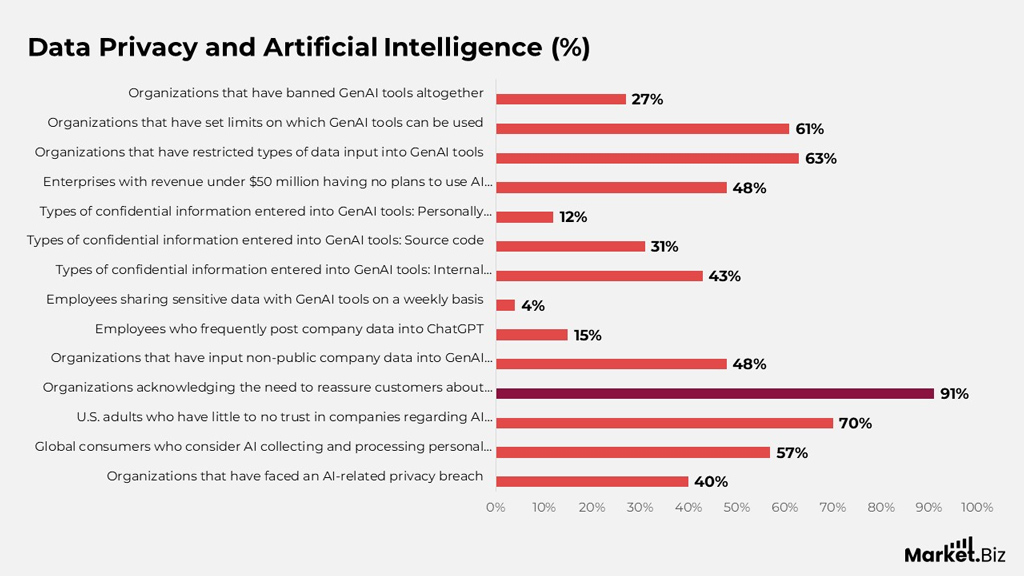
- 91% of organizations acknowledge the need to reassure customers about how AI handles and protects their data.
- 70% of U.S. adults have little to no trust in companies regarding the use of AI and personal information.
- 63% of organizations have restricted the types of data employees can enter into GenAI tools.
- 61% of organizations have set limits on which GenAI tools employees are allowed to use.
- 57% of global consumers believe AI collects and processes personal data, highlighting growing privacy concerns.
- 48% of enterprises with less than $50 million in revenue have no plans to adopt AI.
- 48% of organizations admit they have entered non-public company data into GenAI tools.
- 43% of confidential information entered into GenAI tools consists of internal business information.
- 40% of organizations have experienced an AI-related privacy breach, underscoring emerging security risks.
- 31% of confidential data entered into GenAI tools includes source code, exposing valuable intellectual property.
- 27% of organizations have completely banned GenAI tools due to privacy and security concerns.
- 15% of employees frequently upload company data into ChatGPT, increasing the risk of sensitive data exposure.
- 12% of confidential information shared with GenAI tools contains personally identifiable information (PII).
- Only 4% of employees report sharing sensitive data with GenAI tools weekly, though the practice still presents compliance risks.
GDPR Statistics
- Since its implementation, GDPR has generated over €4 billion in fines.
- In 2023 alone, GDPR fines exceeded €1.6 billion, marking a record year.
- Over 1,000 fines have been issued under GDPR enforcement.
- The largest single GDPR fine reached €1.2 billion against a major tech company.
- 70% of European companies report improved data management practices due to GDPR.
- 65% of organizations outside the EU have adjusted policies to comply with GDPR requirements.
- GDPR-related complaints exceeded 150,000 cases annually across EU member states.
- Over 80% of companies report increased awareness of data privacy risks post-GDPR.
- Compliance costs for large enterprises often exceed $10 million annually.
Privacy Fine Statistics
- Global privacy fines surpassed $2.5 billion in 2023, reflecting stricter enforcement.
- The average privacy fine increased by over 40% year-over-year.
- The technology sector accounts for over 60% of total privacy fines globally.
- The top 10 fines globally account for more than 70% of total penalties issued.
- Financial services firms represent 15% of major privacy penalties.
- Over 500 privacy-related penalties were issued worldwide in 2024.
- Repeat offenders face fines that are 2–3 times higher than first-time violations.
- Non-compliance with consent requirements accounts for over 25% of fines.
- Cross-border data violations contribute to 30% of major penalties.
Data Privacy Concern Statistics by Generation
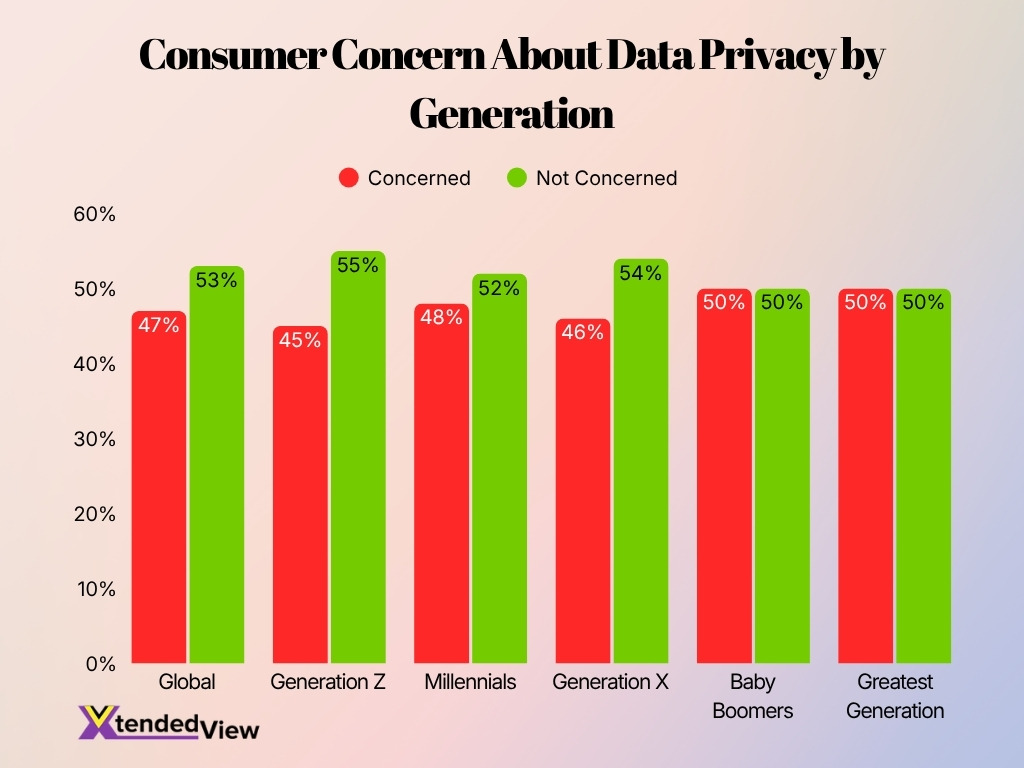
- 47% of global consumers are concerned about their data privacy, while 53% are not.
- Generation Z reports the lowest level of concern, with only 45% worried about data privacy.
- 55% of Gen Z consumers are not concerned about their personal data privacy, the highest share among all groups.
- Millennials show a slightly higher level of concern, with 48% expressing worries about data privacy.
- 52% of Millennials say they are not concerned about how their personal data is handled.
- 46% of Generation X consumers are concerned about data privacy, compared to 54% who are not.
- Both Baby Boomers and the Greatest Generation are evenly divided, with 50% concerned and 50% not concerned.
- Older generations demonstrate greater privacy awareness than Generation Z, with concern levels reaching 50%.
- The gap between the most concerned and least concerned generations is 5 percentage points, highlighting relatively consistent attitudes across age groups.
- The findings suggest that younger consumers, particularly Gen Z, are less likely to express concerns about data privacy than older generations.
Cookie Tracking Statistics
- Over 75% of websites use cookies to track user behavior.
- Third-party cookies account for over 40% of all tracking technologies online.
- 68% of internet users are aware of cookie tracking practices.
- Google plans to phase out third-party cookies, impacting millions of advertisers globally.
- 55% of users regularly reject non-essential cookies when given the option.
- Mobile devices generate over 60% of cookie-related tracking data.
- 72% of consumers express concerns about cross-site tracking.
- Privacy-focused browsers now hold over 15% market share globally.
- Cookie consent banners reduce tracking data collection by 20–30% on average.
Privacy Rights Awareness Statistics
- 65% of consumers are aware of their data privacy rights under existing laws.
- Awareness of GDPR rights in Europe exceeds 70% among internet users.
- In the U.S., only 40% of consumers fully understand their privacy rights.
- 58% of users have exercised at least one privacy right, such as data access or deletion.
- Requests for data deletion increased by over 30% in 2024.
- 50% of consumers are unaware of how to file a data privacy complaint.
- Younger users, ages 18–34, show higher awareness levels at 72%.
- 60% of organizations report an increase in user data requests year-over-year.
- Privacy awareness campaigns have improved user engagement by up to 25%.
Most Trusted Industries for Protecting Data Privacy Statistics
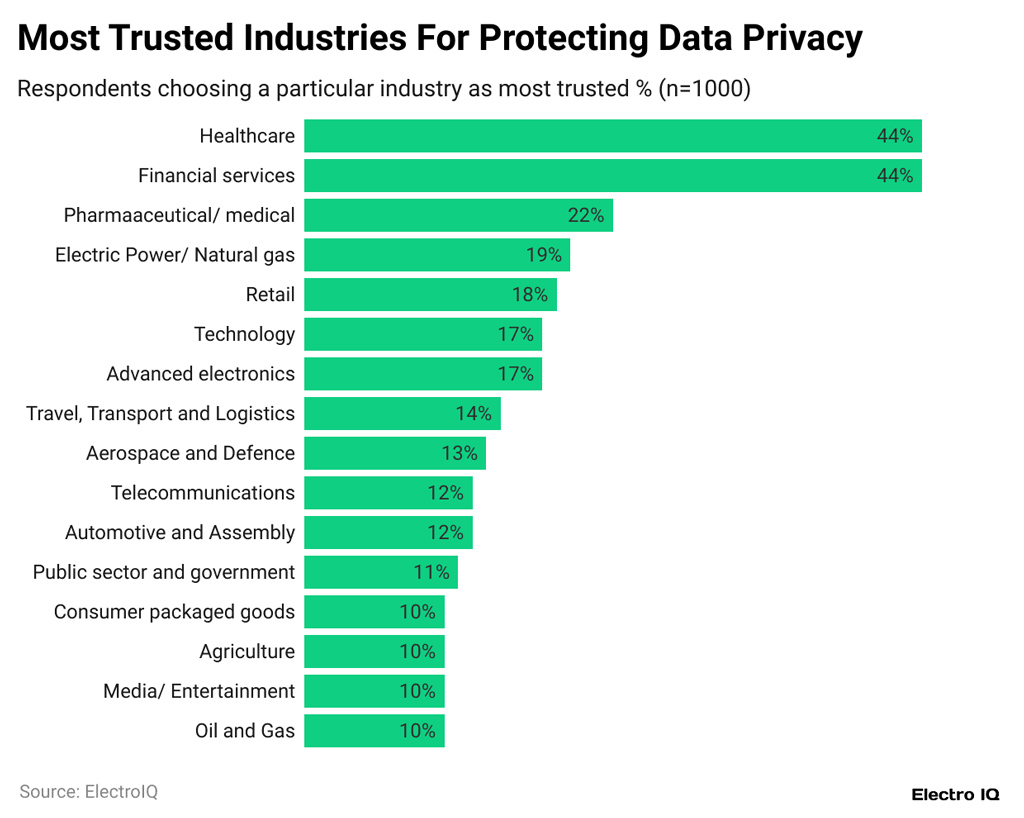
- Healthcare and Financial Services ranked as the most trusted industries, with 44% of respondents selecting each for protecting data privacy.
- Pharmaceutical and Medical companies secured 22%, making them the third most trusted sector for safeguarding personal data.
- Electric Power and Natural Gas providers earned the trust of 19% of respondents for their data privacy practices.
- Retail was considered a trusted industry by 18% of respondents, reflecting growing confidence in customer data protection.
- Technology and Advanced Electronics each received 17%, indicating moderate public trust in handling sensitive information.
- Travel, Transport, and Logistics were trusted by 14% of respondents for protecting consumer data.
- Aerospace and Defence achieved 13%, showing relatively strong confidence in its cybersecurity and privacy measures.
- Telecommunications, Automotive, and Assembly each received 12%, placing them in the middle tier for privacy trust.
- The Public Sector and Government were trusted by only 11% of respondents to protect personal data.
- Consumer Packaged Goods, Agriculture, Media and Entertainment, and Oil and Gas tied for the lowest trust level at 10% each regarding data privacy protection.
Healthcare Privacy Statistics
- Healthcare data breaches exposed over 133 million records in 2023, the highest among all industries.
- The average cost of a healthcare data breach reached $10.93 million, nearly double the global average.
- Over 60% of healthcare organizations experienced a ransomware attack in 2024.
- Patient data sells for up to 10 times more than financial data on the dark web.
- 45% of healthcare breaches involve unauthorized access or disclosure.
- Cloud-based systems account for over 50% of healthcare data storage, increasing exposure risks.
- 70% of healthcare providers report increased investment in cybersecurity and privacy tools.
- Insider threats contribute to over 25% of healthcare data incidents.
- Telehealth adoption led to a 20% increase in privacy-related vulnerabilities since 2022.
Third-Party Data Sharing Statistics
- 63% of data breaches are linked to third-party vendors or supply chain vulnerabilities.
- Organizations share data with an average of 730 third-party vendors globally.
- 58% of companies report lacking full visibility into third-party data usage.
- Third-party breaches increased by over 25% year-over-year in 2024.
- 70% of enterprises consider vendor risk management a top priority.
- Data sharing agreements have increased compliance costs by over 15% annually.
- 40% of organizations experienced a privacy incident caused by a vendor.
- Only 34% of companies conduct regular third-party privacy audits.
- Third-party data exposure accounts for over 30% of large-scale breaches.
Key Privacy Challenges Organizations Face
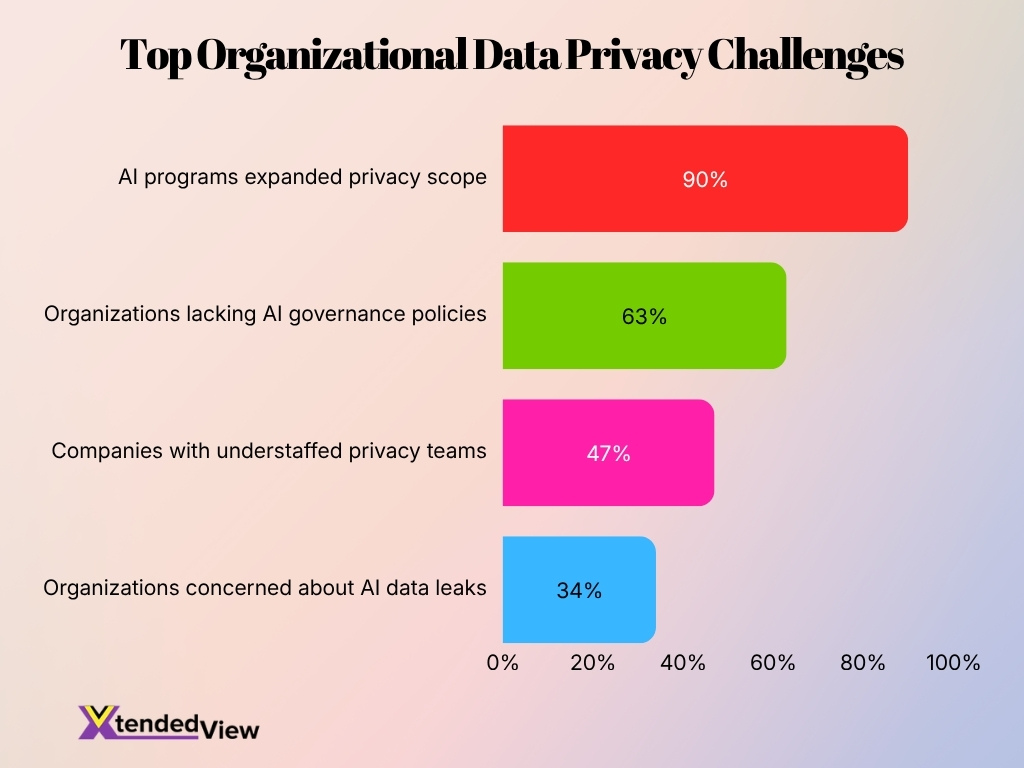
- 90% of organizations report that AI programs have expanded the scope of privacy challenges, making data governance more complex.
- 63% of organizations lack formal AI governance policies, highlighting a significant gap in responsible AI oversight.
- Nearly 47% of companies say their privacy teams are understaffed, limiting their ability to manage growing compliance demands.
- Around 34% of organizations are concerned about AI-related data leaks, reflecting ongoing worries about sensitive information exposure.
- The findings suggest that AI adoption is advancing faster than privacy readiness, leaving many organizations struggling to keep pace.
- Strengthening AI governance frameworks, increasing privacy staffing, and improving data protection strategies are becoming top priorities for businesses.
Privacy Compliance Statistics
- 70% of organizations increased their privacy compliance budgets in 2024.
- Companies spend an average of $2.7 million annually on privacy compliance efforts.
- 65% of businesses conduct regular data protection impact assessments.
- Organizations with mature compliance programs reduce breach risks by up to 40%.
- 55% of companies report difficulty keeping up with changing regulations.
- Automation tools improve compliance efficiency by over 30%.
- 80% of enterprises now maintain formal data governance frameworks.
- Compliance failures contribute to over 25% of regulatory fines globally.
- 60% of organizations plan to increase compliance investments in 2025.
Frequently Asked Questions (FAQs)
The global average cost of a data breach was $4.4 million in 2025, down about 9% from the previous year due to faster breach detection and containment.
As of early 2025, 144 countries have enacted data and consumer privacy laws, covering approximately 79% of the global population.
Around 75% of consumers say they will not purchase from organizations they do not trust with their personal data.
According to the 2026 benchmark study, 38% of organizations spent $5 million or more on privacy initiatives during the past year, up from 14% in early 2025.
About 90% of organizations report that AI has expanded the scope of their data privacy programs, reflecting growing governance and compliance requirements.
Conclusion
Data privacy continues to evolve as a defining factor in how organizations operate and compete. Rising breach costs, stricter regulations, and growing consumer awareness have pushed privacy from a technical concern to a boardroom priority. At the same time, emerging technologies like AI and increased third-party data sharing introduce new layers of complexity that demand proactive strategies.
The data shows a clear shift: companies that invest in transparency, compliance, and advanced security tools not only reduce risk but also strengthen customer trust and long-term value. As privacy expectations rise globally, businesses that treat data protection as a core capability, not just a requirement, will be better positioned to adapt and grow.
