



Zoom enters the year as a broader workplace and communications platform rather than a video-meeting-only product. Businesses now use its tools for hybrid collaboration, enterprise calling, customer service, virtual events and AI-assisted workflows, while sectors such as health care, financial services and education continue to rely on the platform for day-to-day communication. This broader product mix has become increasingly important as growth in traditional online meetings has slowed and Enterprise customers contribute a larger share of total revenue.
The company’s latest financial results show that Enterprise revenue is expanding faster than overall company revenue, while adoption of AI-powered features is rising sharply across Zoom Workplace, Zoom Phone and customer experience products. Large organizations are also deploying Zoom at greater scale, including six-figure phone-seat installations and multi-product contracts that combine meetings, calling, contact center and AI capabilities.
At the same time, Zoom remains closely tied to broader workplace trends. Hybrid work continues to shape meeting frequency, mobile usage, collaboration technology spending and demand for integrated communications platforms. The statistics in this article examine Zoom’s financial performance, customer base, user activity, market position, mobile reach, enterprise adoption, AI growth, security posture and future outlook to provide a detailed view of where the company stands.
Editor’s Choice
- $4.87 billion: Zoom’s fiscal 2026 revenue increased 4.4% year over year, compared with 3.1% growth in fiscal 2025.
- $1.277 billion: Fiscal Q2 2027 revenue increased 4.9% from the corresponding quarter a year earlier.
- $787.5 million: Enterprise revenue grew 7.8% year over year in fiscal Q2 2027, faster than Zoom’s companywide revenue growth.
- 4,625: The number of customers producing more than $100,000 in trailing 12-month revenue increased 8.2% year over year by July 2026.
- 125%: Licensed monthly active users of AI features in Zoom Workplace increased by this rate year over year in fiscal Q2 2027.
- 1.5 million+: My Notes reached this monthly-active-user milestone, excluding trials, only four months after launch.
- 99%: Zoom’s trailing 12-month net dollar expansion rate among Enterprise customers reached 99% in fiscal Q2 2027, compared with 98% a year earlier.
- 75.6%: Online customers with at least 16 months of continual service accounted for this share of Online monthly recurring revenue in fiscal Q2 2027, up 70 basis points year over year.
Recent Developments
- Zoom launched ZoomMate on June 1, 2026, connecting conversational context with agentic search, content generation and workflow execution across business applications.
- In June 2026, Zoom retired the AI Companion name for its built-in meeting summaries, transcription, chat composition and related AI capabilities, while keeping those features within Zoom Workplace.
- Zoom expanded ZoomMate with AI agents in June 2026 to automate follow-up, information retrieval and actions across enterprise systems.
- Earlier in 2026, AI Companion monthly active users had more than tripled year over year in fiscal Q4 2026 as adoption spread beyond meeting summaries.
- By fiscal Q1 2027, paid monthly active users of Zoom’s AI capabilities had increased 184% year over year.
- My Notes crossed 1.5 million monthly active users, excluding trial users, just four months after launch. The feature can capture context from Zoom, third-party platforms and in-person conversations.
- By fiscal Q2 2027, licensed monthly active users of AI features in Zoom Workplace were 125% higher year over year, showing that AI engagement continued to expand in 2026.
- Zoom Virtual Agent customer count increased 256% year over year in fiscal Q2 2027, providing another indicator of adoption outside the company’s traditional meetings business.
- In July 2026, Zoom made a standalone Zoom Virtual Agent Receptionist plan available with a dedicated U.S. or Canadian local or toll-free number, extending its AI receptionist product beyond customers using Zoom Phone or Zoom Contact Center.
Zoom Overview and Market Position
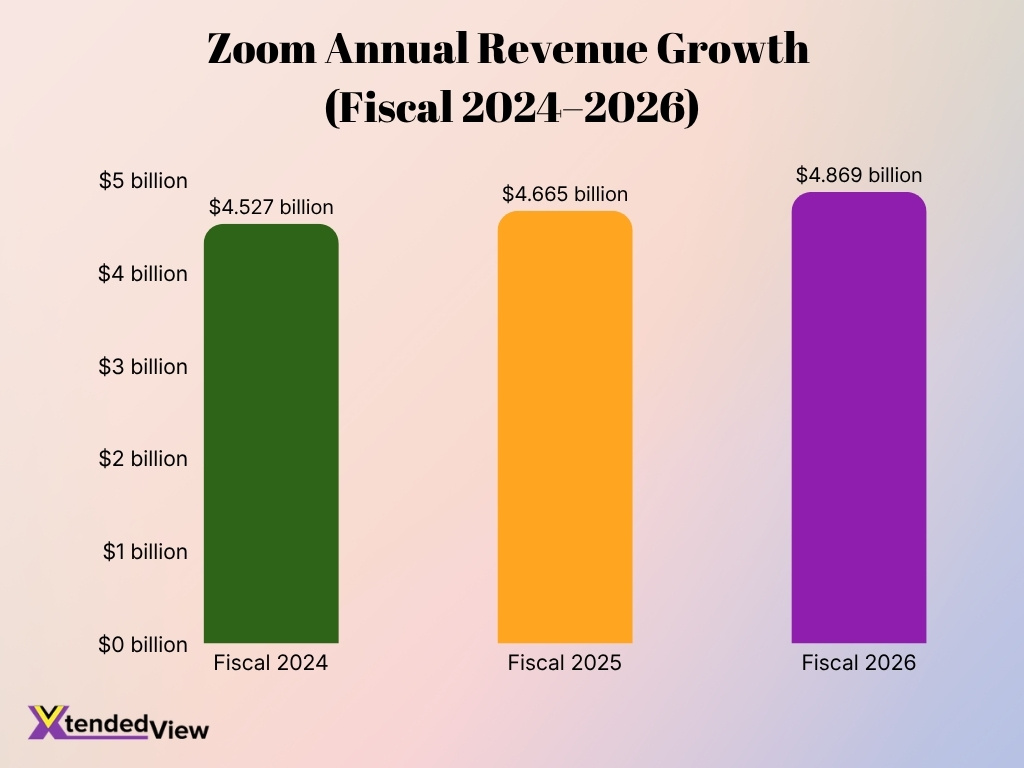
- Zoom generated $4.869 billion in fiscal 2026 revenue, compared with $4.665 billion in fiscal 2025 and $4.527 billion in fiscal 2024.
- Revenue growth accelerated to 4.4% in fiscal 2026, compared with 3.1% in fiscal 2025.
- Enterprise customers produced 60.3% of fiscal 2026 revenue, versus 59% in fiscal 2025.
- Customers spending more than $100,000 annually accounted for 32.8% of fiscal 2026 revenue, compared with 31% in fiscal 2025 and 29.2% in fiscal 2024.
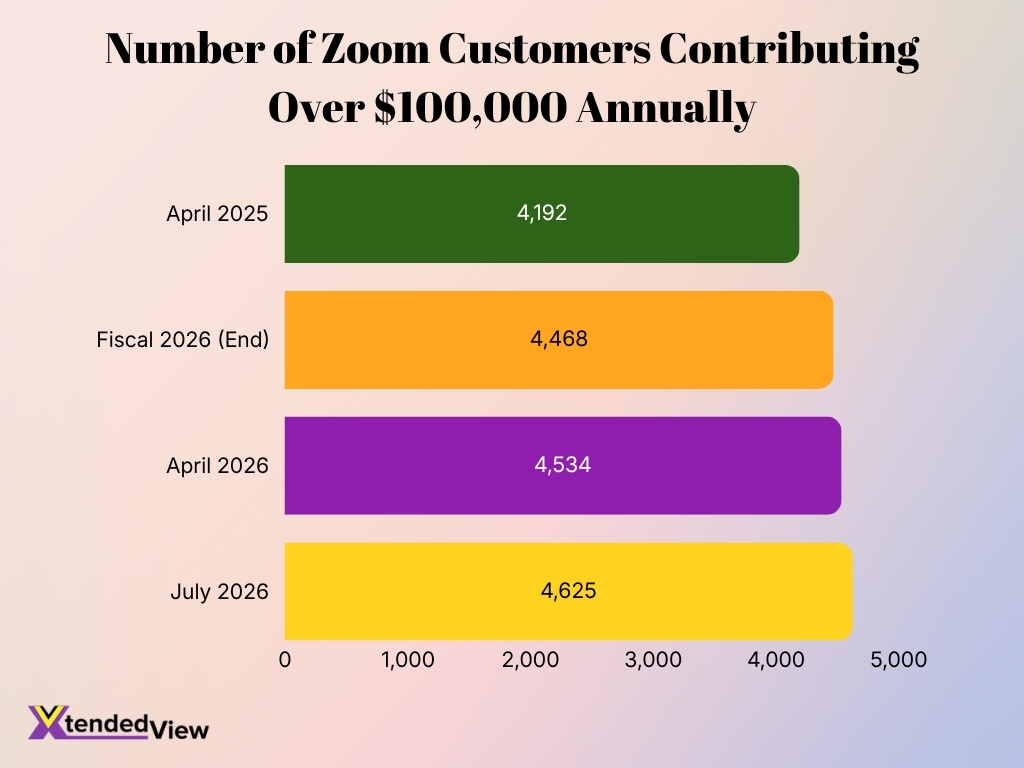
- The number of customers exceeding $100,000 in trailing 12-month revenue rose from 3,810 in fiscal 2024 to 4,088 in fiscal 2025 and 4,468 in fiscal 2026.
- That large-customer count increased further to 4,534 by April 30, 2026, compared with 4,192 a year earlier.
- By July 31, 2026, the figure had climbed again to 4,625, an 8.2% year-over-year increase.
- Zoom reported $7.2 billion in cash, cash equivalents and marketable securities, excluding restricted cash, at the end of fiscal Q2 2027.
- Zoom’s trailing 12-month Enterprise net dollar expansion rate reached 99% in fiscal Q2 2027. The figure indicates that revenue from the comparable Enterprise customer base remained close to fully replacing contractions before accounting for new Enterprise customers.
Zoom User and Participant Statistics
- Zoom reported 10 million peak daily meeting participants in December 2019, providing the pre-pandemic baseline for its subsequent growth.
- By March 2020, Zoom averaged 200 million daily meeting participants, a 20-fold increase from the December 2019 peak figure.
- In April 2020, the platform averaged 300 million daily meeting participants, roughly 30 times its December 2019 level.
- Those historical numbers measure meeting participants rather than unique people. A single person who attends several meetings can contribute multiple participant instances, so the figure should not be described as 300 million unique daily users.
- Zoom’s current reporting API gives paid account administrators daily counts for meetings, participants, new users and meeting minutes, rather than publishing one comparable global participant total.
- In fiscal Q1 2027, My Notes had already exceeded 1.5 million monthly active users, excluding trial accounts.
- Paid monthly active usage of Zoom’s AI capabilities increased 184% year over year in fiscal Q1 2027.
- By fiscal Q2 2027, licensed monthly active users of AI features in Zoom Workplace were up 125% year over year, demonstrating continued growth in a measurable subset of Zoom users.
- Zoom’s 2026 Workplace Dashboard measures organizational active-user trends over a rolling 28-day window, giving administrators a current measure of adoption even though Zoom does not release the aggregate global total publicly.
Zoom Daily and Monthly Active Users
- The latest current disclosures reviewed for this article do not provide an absolute 2026 companywide Zoom daily active user count; therefore, pandemic-era participant totals should not be presented as current 2026 DAUs.
- Zoom’s best-known historical daily usage benchmark remains 300 million daily meeting participants in April 2020, but this metric measured meeting participation rather than unique active accounts.
- In fiscal Q4 2026, monthly active users of Zoom’s then-branded AI Companion features more than tripled year over year.
- During that same fiscal Q4 period, monthly active users interacting with AI through the side panel more than doubled quarter over quarter.
- Monthly active users of AI features within Zoom Phone increased 35% sequentially in fiscal Q4 2026.
- In fiscal Q1 2027, paid monthly active users of Zoom’s AI functionality grew 184% year over year.
- My Notes surpassed 1.5 million monthly active users, excluding trials, during fiscal Q1 2027, giving Zoom one of its clearest absolute product-level MAU disclosures for 2026.
- In fiscal Q2 2027, licensed monthly active users of AI features in Zoom Workplace grew 125% year over year, although this newer metric is not directly interchangeable with the paid-AI MAU metric reported for the previous quarter.
- For enterprise administrators, Zoom’s Workplace Dashboard calculates monthly active-user trends using the first 28 days of each month and can display a one-year history of unique active users inside an organization.
Zoom Enterprise Customer Statistics
- Enterprise customers contributed 60.3% of total fiscal 2026 revenue, up from 59% in fiscal 2025 and 57.9% in fiscal 2024.
- Zoom generated $2.934 billion in Enterprise revenue during fiscal 2026, an increase of 6.5% year over year.
- Fiscal Q4 2026 Enterprise revenue reached $757.3 million, increasing 7.1% from the year-earlier quarter.
- Zoom ended fiscal 2026 with 4,468 customers generating more than $100,000 in trailing 12-month revenue, up approximately 9.3% year over year.
- By April 30, 2026, that large-customer group had increased to 4,534, versus 4,192 in April 2025.
- By July 31, 2026, the count reached 4,625, representing 8.2% year-over-year growth.
- Enterprise revenue climbed to $787.5 million in fiscal Q2 2027, up 7.8% year over year and representing the strongest Enterprise growth rate Zoom had reported in three years.
- The Enterprise trailing 12-month net dollar expansion rate improved to 99% in fiscal Q2 2027 from 98% a year earlier.
- Zoom also reported that 15 of its top 20 wins in fiscal Q1 2027 included Zoom Workplace or Zoom Phone, indicating that major contracts increasingly involve products beyond standalone video meetings.
- In one notable enterprise deployment disclosed during fiscal 2026, a Fortune 10 customer selected 140,000 Zoom Phone seats, while a global bank added almost 50,000 seats to bring its deployment to roughly 150,000.
Zoom Revenue and Financial Performance
- Zoom generated $4.87 billion in fiscal 2026 revenue, up 4.4% from $4.67 billion in fiscal 2025. Fiscal 2025 revenue had grown 3.1% from the prior year.
- Enterprise revenue reached $2.93 billion in fiscal 2026, increasing 6.5% year over year and accounting for roughly three-fifths of company revenue.
- Fiscal Q2 2027 revenue, for the quarter ended July 31, 2026, rose to $1.277 billion, a 4.9% year-over-year increase. Constant-currency growth came in at 4.7%.
- Enterprise revenue increased 7.8% to $787.5 million in fiscal Q2 2027, while Online revenue increased just 0.6% to $489.7 million. The figures show where Zoom currently gets most of its incremental growth.
- Zoom reported $314.3 million in GAAP operating income for fiscal Q2 2027, producing a 24.6% operating margin. Non-GAAP operating income reached $510.3 million, with a 40% margin.
- GAAP net income reached $1.54 billion in fiscal Q2 2027, compared with $358.6 million a year earlier. The unusually large increase included gains on strategic investments.
- Zoom generated $494.8 million in operating cash flow during fiscal Q2 2027 and $472.4 million in free cash flow. A year earlier, those figures were $515.9 million and $508 million, respectively.
- The company finished July 2026 with approximately $7.2 billion in cash, cash equivalents and marketable securities, excluding restricted cash.
- For the first six months of fiscal 2027, Zoom produced $2.516 billion in revenue, up 5.2% year over year from $2.392 billion.
- Zoom’s fiscal Q2 2026 revenue, reported in August 2025, was $1.217 billion. That quarter included $730.7 million in Enterprise revenue and $486.6 million in Online revenue, providing a useful year-over-year benchmark for the 2026 results.
Zoom Usage by Industry and Sector
- More than 140,000 health care customers worldwide use Zoom, according to current health care product data based on the 2025 calendar year.
- Zoom held an estimated 36% share of the telehealth technology market measured in the cited health care dataset, making medicine one of its strongest vertical markets.
- More than 300 health care organizations were already using Zoom’s customer-experience products when an Epic integration was announced for general availability in April 2026.
- In financial services, a Fortune 10 organization selected 140,000 Zoom Phone seats in fiscal Q4 2026 as part of a competitive replacement of an existing calling platform.
- A leading global bank added nearly 50,000 Zoom Phone seats during the same quarter, taking its total deployment to approximately 150,000 seats.
- Zoom also reported wins with two major U.S. financial institutions for combinations of Zoom Workplace and Zoom Phone during fiscal Q4 2026.
- In education, one global school network uses Zoom to connect 9,500 students and 2,500 staff members across 130 campuses in 20 countries, illustrating how video collaboration remains relevant outside corporate offices.
- A U.S. school district integrated Zoom into a learning platform that supported 1.4 million Zoom sessions and served more than 110,000 students. The deployment produced a reported 97% login rate for its digital learning system.
- One education technology organization reported that Zoom-powered process automation saved approximately 300 staff hours per month while supporting events for as many as 3,000 attendees.
- In higher education, one institution had deployed Zoom Rooms in 75 classrooms and meeting spaces and planned to expand to 90 by the end of 2025. Its migration of 2,000 phone lines also reduced on-site communications hardware by 84%.
Zoom Market Share and Competitor Comparison
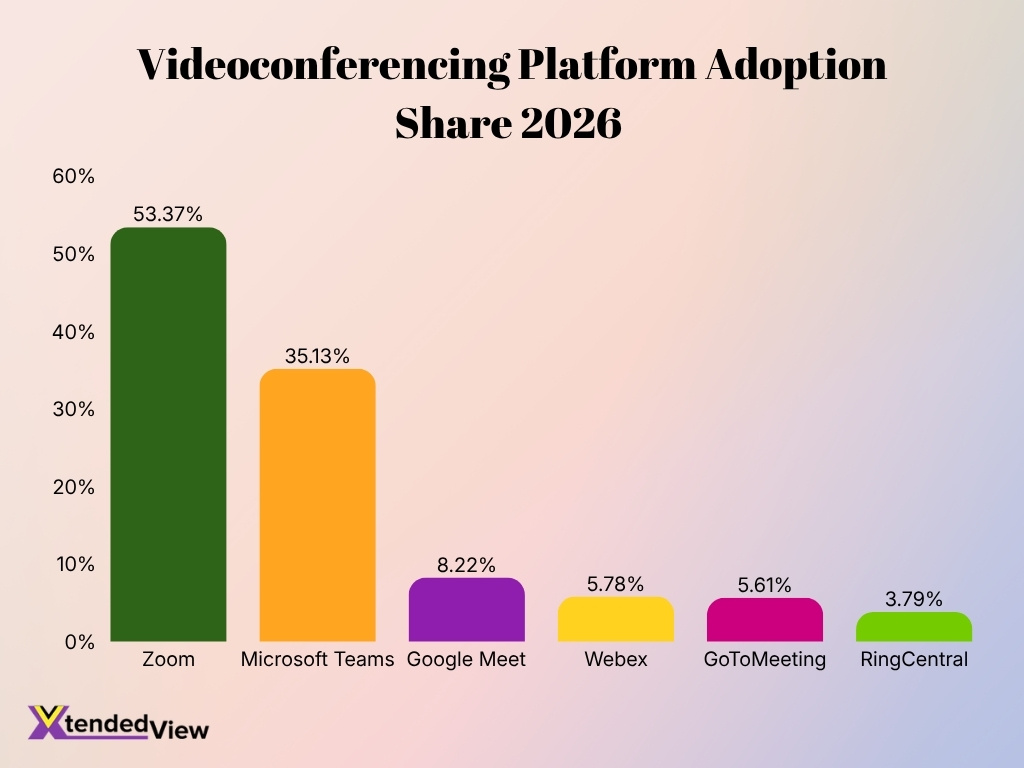
- Zoom held 53.37% adoption among surveyed videoconferencing and remote-meeting users in 2026, keeping it in first place within the financial advisory sample.
- Microsoft Teams ranked second with 35.13% adoption, leaving Zoom about 18 percentage points ahead within the same survey population.
- Google Meet recorded 8.22% adoption in the 2026 survey, ranking third among the major platforms measured.
- Webex accounted for 5.78% of surveyed adoption, down from 7.33% in 2025.
- GoToMeeting held a 5.61% share in the same 2026 cohort, compared with 6.67% in 2025.
- RingCentral reached 3.79% adoption, down from 5.45% a year earlier among the survey participants.
- Zoom’s 2026 average user rating reached 8.73 out of 10, compared with 7.88 for Microsoft Teams and 7.64 for Google Meet in the same study.
- Zoom’s measured adoption declined slightly from 54.65% in 2025 to 53.37% in 2026, while it maintained the largest lead in the category.
- Total measured penetration for videoconferencing products among respondents was 66.61% in 2026, versus 68.09% in 2025. The underlying report cautions that the individual product figures provide a better competitive comparison than the overall category penetration figure.
Zoom Geographic and Regional Usage Statistics
- The Americas generated $3.51 billion in fiscal 2026 revenue, or 72.1% of Zoom’s worldwide total.
- APAC generated $590.7 million, representing 12.1% of fiscal 2026 revenue.
- EMEA contributed $769.9 million, equivalent to 15.8% of fiscal 2026 revenue.
- Combined APAC and EMEA revenue represented 27.9% of Zoom’s fiscal 2026 total, compared with 28.2% in fiscal 2025 and 28.7% in fiscal 2024.
- In fiscal Q2 2027, the Americas generated $923.5 million, up from $874 million in the same quarter of 2025. The region represented 72.3% of quarterly revenue.
- APAC generated $154.6 million in fiscal Q2 2027, compared with $148.3 million one year earlier, and maintained a 12.1% revenue share.
- EMEA revenue reached $199.1 million in the July 2026 quarter, up from $194.9 million in the comparable 2025 period.
- During the first six months of fiscal 2027, the Americas produced $1.817 billion, while APAC generated $305.1 million and EMEA generated $394.1 million.
- Zoom operated 20 co-located data centers worldwide as of Jan. 31, 2026, supporting its geographically distributed communications infrastructure.
- Revenue outside the Americas has remained close to 28% of total revenue for three consecutive fiscal years, showing that Zoom has a sizable international business even though North and South America remain its dominant revenue base.
Zoom Mobile App Downloads and Usage
- Zoom Workplace had surpassed 1 billion Android downloads by 2026, placing its official install range between 1 billion and 5 billion.
- The Android version generated an estimated 8 million worldwide downloads in the most recent measured month in mid-2026.
- The iOS version recorded an estimated 3 million worldwide downloads during the latest measured month in 2026.
- Taken together, those platform estimates imply roughly 11 million monthly mobile downloads across Android and iOS during the respective measurement period, although the figures remain third-party estimates rather than company-reported installs.
- Zoom Workplace carried an Android rating of approximately 4.1 stars from 4.58 million reviews in the latest 2026 listing.
- The U.S. iOS listing showed a 4.7-star rating from roughly 3.2 million ratings, indicating a substantial long-term review base on Apple devices.
- Zoom Workplace ranked No. 3 in the Business category on the U.S. iOS store at the time the current listing was captured.
- The iOS app supports 17 listed languages, counting English plus 16 additional languages, reflecting its international mobile reach.
- Current mobile intelligence identifies the U.S., Japan and India among the app’s leading markets, which aligns with Zoom’s established presence across the Americas and APAC.
- The Android application received an update on July 22, 2026, while the corresponding iOS version was updated July 21, showing that both mobile platforms remained under active development during 2026.
Zoom Meeting Length Statistics
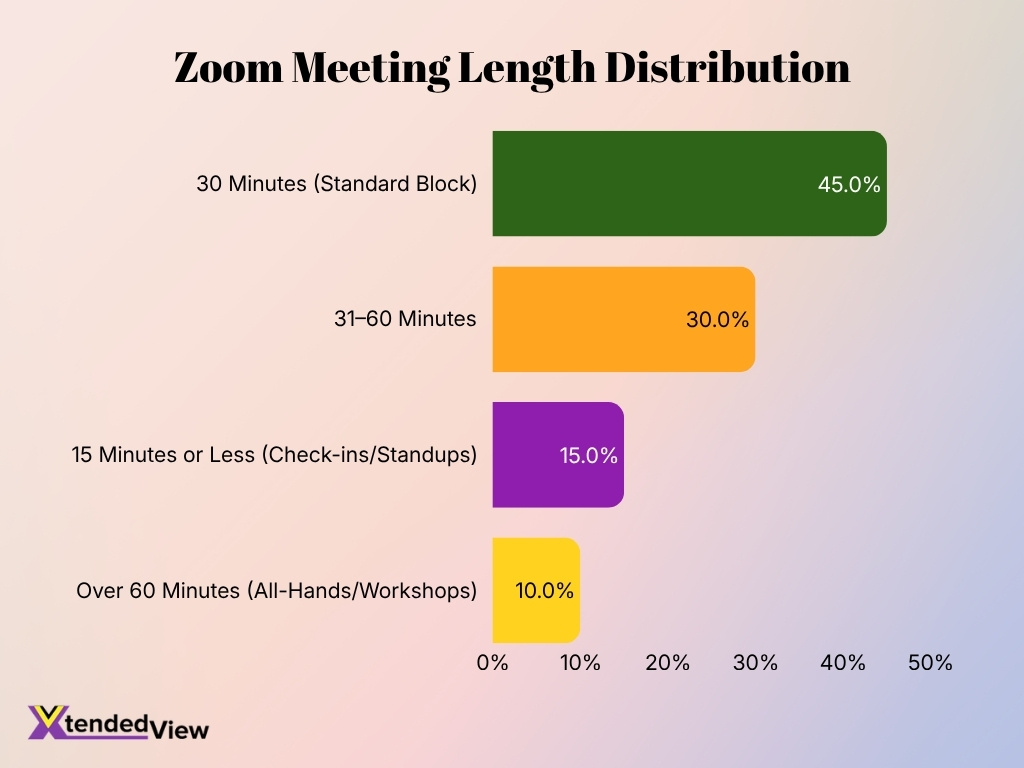
- 30-minute meetings are the most common Zoom format, accounting for 45.0% of all meetings, making the standard half-hour block the dominant meeting length.
- Meetings lasting 31 to 60 minutes represent 30.0% of Zoom meetings, showing that nearly one-third require longer discussion or collaboration.
- Short meetings of 15 minutes or less account for 15.0% of the total, commonly supporting quick check-ins, standups, and status updates.
- Longer sessions of over 60 minutes make up just 10.0% of meetings, indicating that extended all-hands meetings and workshops are relatively less common.
- Combined, meetings lasting 60 minutes or less account for 90.0% of all Zoom meetings, highlighting a strong preference for sessions contained within an hour.
Zoom Workplace and Hybrid Work Adoption
- 64% of employees in a global workplace study said their organizations operated on a hybrid model. The research covered more than 600 IT and C-suite leaders and nearly 1,900 knowledge workers worldwide.
- 75% of business leaders expected their workplace model to change by 2026, indicating that workplace policy remained fluid rather than settled.
- Among leaders pursuing flexible work, 84% cited higher productivity as a motivation, while 62% pointed to improved talent recruitment.
- 75% of employees said the technology, software and tools available at their companies needed improvement. Separately, 72% said employers needed to invest in new technology to support remote work.
- In 2025 labor-market data, 31% of new senior-level job postings were hybrid and another 14% were remote. Mid-level roles were 25% hybrid and 12% remote, while entry-level roles were 18% hybrid and 10% remote.
- 60% of workers whose jobs could support remote work said they preferred a hybrid arrangement. About one-third preferred fully remote work, while fewer than 10% favored working fully on-site.
- Another workplace benchmark found that 90% of hybrid employees considered themselves as productive or more productive than when working in an office.
- 62% of managers in the same body of flexible-work research said their teams were more productive under hybrid or remote arrangements.
- U.S. federal employment illustrates that hybrid adoption differs sharply by sector: fewer than 18.2% of federal employees worked remotely in April 2025, down from 31.3% one year earlier.
- Zoom’s broader employee-experience business also expanded during fiscal 2026: the number of Workvivo customers generating more than $100,000 in ARR increased 58% during the year.
Zoom AI and Product Feature Adoption Statistics
- Monthly active users of Zoom’s AI Companion more than tripled year over year in fiscal Q4 2026.
- AI Side Panel engagement saw monthly active users double quarter over quarter during fiscal Q4 2026.
- Zoom Phone AI engagement grew 35% sequentially among monthly active users in fiscal Q4 2026.
- Paid monthly active users for Zoom AI capabilities surged 184% year over year by fiscal Q1 2027.
- My Notes surpassed 1.5 million monthly active users within just four months of launch in 2026.
- 15 of Zoom’s 20 largest wins in fiscal Q1 2027 included platform deals like Zoom Workplace or Zoom Phone.
- Zoom Revenue Accelerator successfully increased its customer count by 50% throughout fiscal 2026.
- All 10 of Zoom’s largest Customer Experience deals in fiscal Q4 2026 featured paid AI capabilities.
- Zoom Virtual Agent experienced a 256% year over year customer growth by fiscal Q2 2027.
- Paid AI appeared in nine of Zoom’s top 10 Customer Experience deals during fiscal Q2 2027.
Zoom Customer Satisfaction and Ratings
- Zoom Workplace held an overall rating of 4.6 out of 5 across 14,667 moderated user reviews as of Aug. 26, 2026.
- Its ease-of-use score was 4.6 out of 5 within the same current review dataset.
- Customer service received a 4.4 out of 5 rating in that 2026 dataset.
- A separate enterprise software review dataset gave Zoom Workplace an 8.5 out of 10 overall score based on 5,940 reviews and ratings.
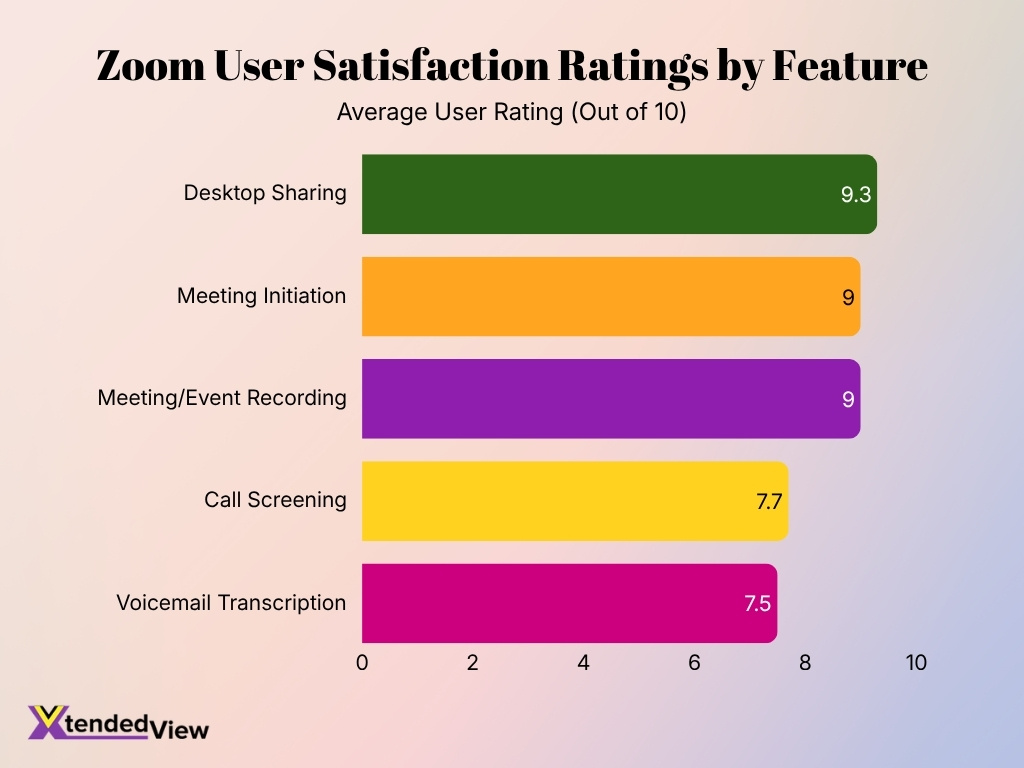
- Desktop sharing scored 9.3 out of 10, compared with a category benchmark of 9.2, making it one of Zoom Workplace’s highest-rated individual capabilities.
- Meeting initiation received 9.0 out of 10, slightly ahead of the 8.9 category average.
- Meeting and event recording also earned 9.0 out of 10, versus an 8.9 category benchmark.
- A third enterprise-review dataset showed Zoom Workplace at 4.5 out of 5 from 175 ratings in May 2026.
- Lower-scoring telephony functions show where users see room for improvement: call screening scored 7.7 out of 10, compared with an 8.4 category average.
- Voicemail transcription received 7.5 out of 10, below its 8.1 category benchmark, showing that satisfaction varies materially between Zoom’s core meeting features and some calling functions.
Zoom Security and Privacy Statistics
- Zoom operates 20 co-located data centers worldwide to support its infrastructure.
- Real-time audio and video content are secured using 256-bit AES-GCM encryption.
- Contact Center client communications are protected with 256-bit AES-GCM encryption.
- Web connections mandate secure data transit using TLS 1.2 or TLS 1.3 protocols.
- The latest ISO 27001 certification encompasses 37 products and service groups.
- Security compliance is validated through an active 12-month SOC 2 Type II report.
- Payment security standards comply with the PCI DSS v4.0.1 framework.
- Cloud security authorization is certified at TX-RAMP Level 2, upgraded from Level 1.
- End-to-end encryption (E2EE) is accessible across both free and paid accounts.
- 0% of customer communications content is used to train proprietary or third-party AI models.
Zoom Phone and Contact Center Statistics
- Zoom Phone passed 10 million paid seats in early fiscal Q3 2026, more than doubling its seat base within three years.
- Zoom Phone ARR grew at a mid-teens percentage rate in each quarter of fiscal 2026, according to the company’s annual disclosures.
- A Fortune 10 company selected 140,000 Zoom Phone seats in fiscal Q4 2026 as part of a competitive replacement of an incumbent calling platform.
- A global bank added almost 50,000 seats in a single quarter, taking its Zoom Phone deployment to approximately 150,000 seats.
- Zoom Customer Experience crossed $100 million in annual recurring revenue during fiscal Q1 2026 and then recorded high-double-digit growth in every quarter of that fiscal year.
- Four of Zoom’s top 10 Customer Experience deals in fiscal Q4 2026 included Zoom Virtual Agent Voice, despite the voice product having been in market for only part of the year.
- One Zoom Virtual Agent contract signed with a major U.S. retailer approached $1 million in ARR and covered more than 1,100 locations.
- In fiscal Q2 2027, Zoom Customer Experience ARR continued to grow at a high-double-digit year-over-year rate, while the company recorded its highest-ever number of seven-figure ARR deals for the portfolio.
- Zoom Virtual Agent’s customer base increased by more than 250% year over year in fiscal Q2 2027 as organizations adopted it both with Zoom Contact Center and as a standalone product.
- One 2026 enterprise deployment combined Zoom Phone and Contact Center across roughly 8,000 employees, illustrating how customers increasingly consolidate unified communications and customer service on the same platform.
Zoom Future Growth and Market Projections
- Zoom now expects $5.085 billion to $5.095 billion in fiscal 2027 revenue, representing roughly 4.5% year-over-year growth at the midpoint.
- That guidance increased from the $5.080 billion to $5.090 billion range issued after fiscal Q1 2027.
- Constant-currency fiscal 2027 revenue is projected at $5.071 billion to $5.081 billion under the August 2026 outlook.
- Full-year non-GAAP operating income is expected to land between $2.065 billion and $2.075 billion, equal to roughly a 40.7% margin at the midpoint.
- Zoom lifted its fiscal 2027 non-GAAP diluted EPS outlook to $6.08 to $6.12, compared with $5.96 to $6.00 after the previous quarter.
- Full-year free cash flow guidance increased to $1.78 billion to $1.82 billion, up from the earlier $1.70 billion to $1.74 billion forecast.
- For fiscal Q3 2027, Zoom expects revenue of $1.275 billion to $1.280 billion and non-GAAP operating income between $510 million and $515 million.
- Management’s fiscal 2027 outlook assumes Enterprise revenue grows faster than previously expected, partly offset by approximately flat Online growth. That mix makes large organizations the main near-term growth driver.
- Enterprise revenue already expanded 7.8% year over year in fiscal Q2 2027, its fastest growth rate in three years, providing a current benchmark for the segment management expects to lead future growth.
- The company had approximately $1.3 billion of authorized share repurchases remaining as of July 31, 2026, giving it additional flexibility to offset dilution while continuing to fund AI development and acquisitions.
Frequently Asked Questions (FAQs)
Zoom generated $4.87 billion in fiscal 2026 revenue, up 4.4% year over year from $4.67 billion.
Zoom generated $2.93 billion in Enterprise revenue, up 6.5% year over year, representing about 60.3% of total fiscal 2026 revenue.
Zoom ended fiscal 2026 with 4,468 customers contributing more than $100,000 in trailing 12-month revenue, an increase of approximately 9.3% year over year.
Zoom reported a 99% trailing 12-month net dollar expansion rate for Enterprise customers in fiscal Q1 2027, up from 98% in the comparable prior-year period.
Zoom reported $1.90 billion in GAAP net income for fiscal 2026, up from $1.01 billion in fiscal 2025, while its GAAP operating margin reached 23.1%.
Conclusion
Zoom’s statistics show a company moving beyond its identity as a video conferencing provider. Meetings remain central to the platform, but the strongest current growth indicators come from Enterprise accounts, Zoom Phone, Customer Experience and AI-powered workflows. Hybrid work continues to sustain demand for collaboration software, while AI adoption gives Zoom new ways to monetize the conversations and business data already moving through its products.
The financial outlook remains measured rather than explosive. Zoom expects roughly mid-single-digit companywide revenue growth, while Enterprise revenue is expanding faster and the Online business remains comparatively flat. At the same time, rising AI usage, a Phone base above 10 million paid seats and high-double-digit Customer Experience growth indicate that its addressable market now extends well beyond virtual meetings. For businesses evaluating Zoom, the key question is increasingly not how many video calls it can host, but how effectively its wider communications and AI platform can connect meetings with the work that follows.
