


Meetings remain a core part of how organizations make decisions, coordinate projects, share information, and manage distributed teams. However, the challenge is no longer simply whether companies should hold meetings, but how often they should occur, how long they should last, and which formats produce the best results. Hybrid work, remote collaboration and AI-powered meeting tools have changed scheduling habits, while employees continue to report concerns about meeting fatigue, lost focus time and unnecessary attendance.
These trends matter across industries. Technology teams rely on meetings for product development and cross-functional coordination, while health care, professional services and global enterprises use them for handoffs, client communication and operational decisions. At the same time, poorly structured meetings can consume valuable work hours and increase labor costs. The statistics in this article examine meeting frequency, duration, productivity, costs, employee preferences, virtual collaboration and emerging meeting-management technology to show how workplace meetings are evolving.
Editor’s Choice
- U.S. knowledge workers spend an estimated $1 trillion worth of time in meetings each year. This figure measures the economic value of meeting time, not the amount lost specifically to ineffective meetings.
- In a 2026 survey of 1,002 employees, workers estimated that 46% of meeting time was unnecessary or unproductive.
- The same survey calculated that the average employee loses 146 working hours a year to unnecessary meetings.
- Those wasted hours represented about $6,280 in annual salary per employee, based on respondents’ meeting patterns and compensation.
- Tech workers recorded an even larger burden, losing an estimated 169 hours annually to meetings they considered unnecessary.
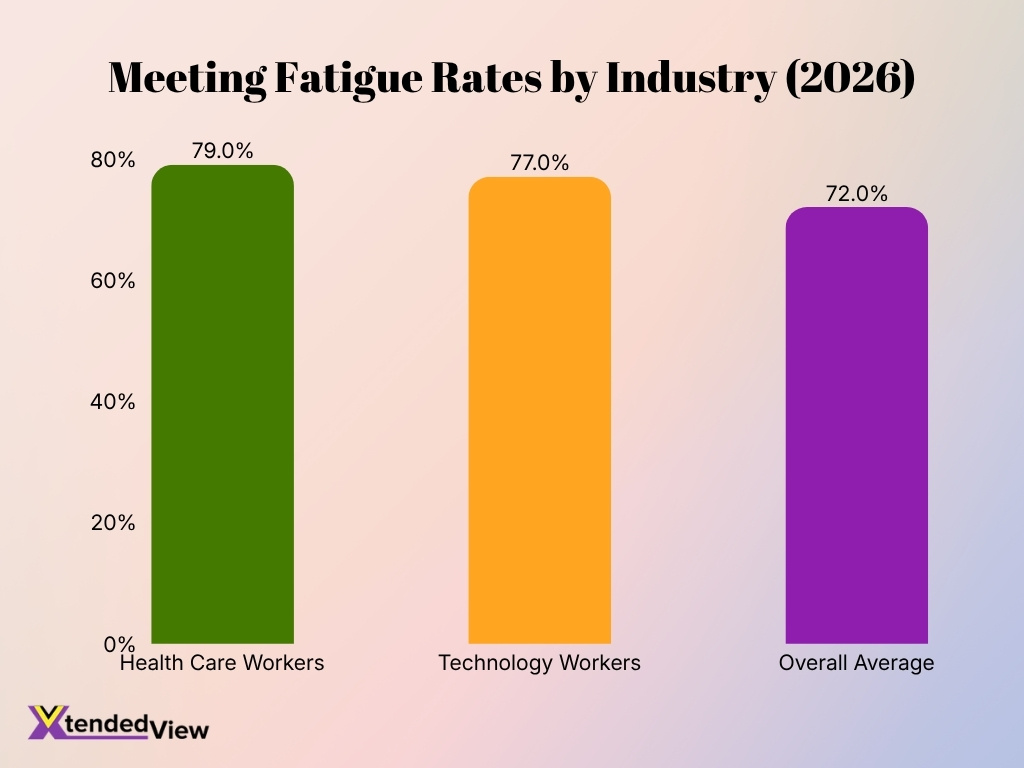
- Meeting fatigue affected 72% of surveyed employees in 2026, rising to 79% among health care employees and 77% among technology workers.
- A large-scale analysis released for 2026 found that 46% of meetings include an external participant, indicating how much collaboration now extends beyond internal teams.
- Friday continues to lose ground as a meeting day: only 16% of weekly meetings now occur on Friday.
- Separately, research covering professionals in the U.S. estimated that unproductive meetings can impose about $259 billion in annual costs.
Recent Developments
- Meeting duration reached an average of 47 minutes in 2025, four minutes shorter than the 51-minute average recorded in 2023.
- The percentage of users who reduced their meeting count by more than 5% climbed to 34% in 2025, compared with 21% in 2024.
- At the same time, 60% still increased their meeting volume by more than 5% in 2025, suggesting that meeting reduction remains uneven across organizations.
- External collaboration has expanded enough that 46% of meetings now include at least one participant from outside the organization.
- Nearly one-quarter of meetings now take the form of one-on-one conversations, indicating continued demand for direct manager, mentoring, and decision-making interactions.
- Early data from July through November 2025 found that 69% of AI-assisted meetings generated an actionable artifact, such as a draft or follow-up output.
- In 2025 workplace telemetry, 60% of meetings were ad hoc rather than scheduled, which increased the number of interruptions employees encountered during the day.
- Late-night collaboration also grew: meetings beginning after 8 p.m. increased 16% year over year in 2025.
- Cross-time-zone meetings accounted for 30% of meetings in the same workplace dataset, up 8 percentage points compared with 2021.
- Employees also made 122% more presentation edits during the final 10 minutes before a meeting, highlighting how meeting preparation can compress work into short pre-meeting windows.
Global Meeting Volume and Frequency
- The average employee attends 5 meetings each week.
- Roughly 16% of employees attend at least 10 meetings weekly.
- Millennials and Gen X average 5 meetings weekly, while Gen Z averages 4.
- About 17% of Gen X and millennials join 10 or more meetings per week, versus 11% of Gen Z.
- A global workplace dataset recorded 50.9 million meeting hours in total.
- Sync and check-in sessions led all categories at 6.2 million meetings.
- Standups represented approximately 3 million meetings worldwide.
- All-hands and town halls totaled 1.3 million meetings, while one-on-ones reached 1.2 million.
- Sprint and Agile sessions accounted for 885,000 meetings, with interviews adding 661,000.
- Tuesday is the peak day, capturing 21% of all weekly meetings.
Average Meeting Duration and Time Investment
- Average meeting duration declined to 47 minutes in 2025, compared with 51 minutes two years earlier.
- Meetings lasting longer than an hour fell to 37% of total sessions in 2025, from 43% in 2023.
- Employees surveyed in 2026 reported spending an average of six hours per week in meetings.
- Almost one in five employees, or 19%, spend at least 10 hours per week attending meetings.
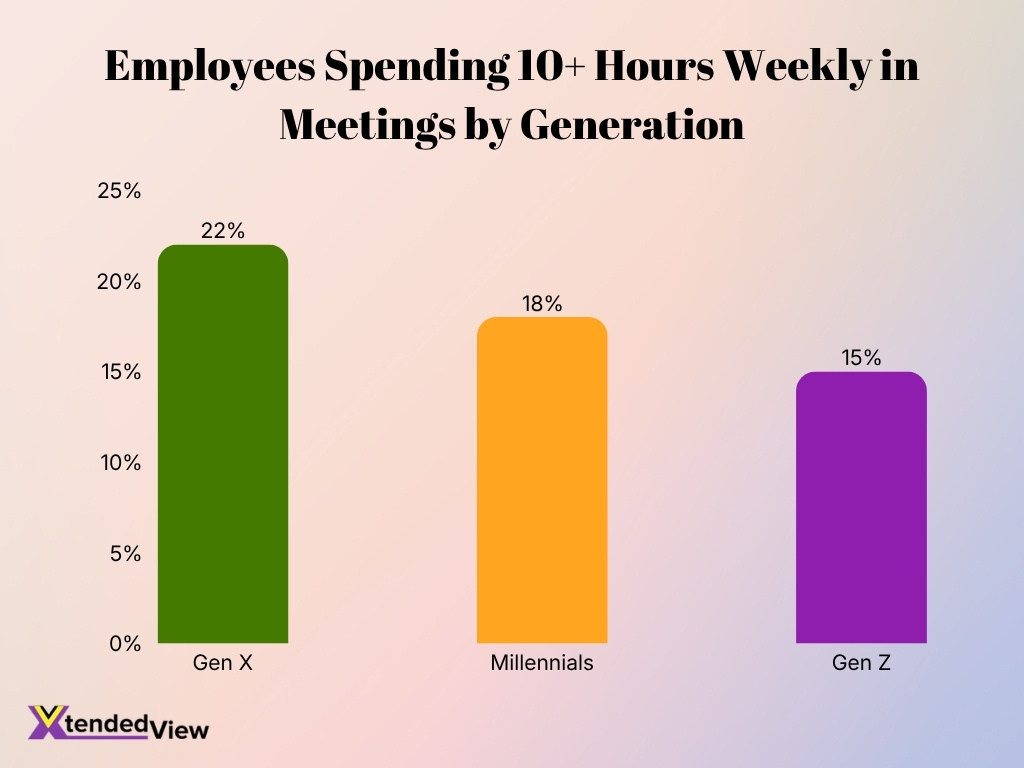
- Gen X employees have one of the heaviest schedules: 22% report spending 10 or more hours per week in meetings.
- Among millennials, 18% spend at least 10 hours per week in meetings, while the corresponding share for Gen Z is 15%.
- Gen Z employees average approximately five meeting hours per week, one hour below the overall six-hour average.
- Earlier global workforce research identified two meeting hours per day as a key threshold: above that level, most desk workers reported that their meeting load felt excessive.
- That same research found that workers considered roughly four hours of uninterrupted focus time per day ideal, illustrating the competition between meetings and individual work.
- An organizational survey found employees attended an average of eight meetings during a five-day week, with a mean duration of 54 minutes and an estimated 344 meeting hours per person annually.
Time Wasted in Unproductive Meetings
- Employees in a 2026 survey judged 46% of their meeting time unnecessary or unproductive.
- That translated to an average of 146 wasted meeting hours per employee each year.
- Tech workers reported an even higher annual loss of 169 hours to meetings they considered unnecessary.
- Status updates ranked as the most commonly identified unnecessary meeting type, cited by 53% of employees.
- All-hands and town hall sessions followed at 46%, while brainstorming sessions accounted for 29% of meetings employees viewed as unnecessary.
- Nearly 65% of employees said they had attended a meeting simply to appear engaged.
- Another 63% said social or workplace political expectations had prompted them to attend meetings they did not necessarily need.
- In earlier research involving 5,000 knowledge workers, 77% said they frequently attended meetings that ended with a decision to schedule another meeting.
- The same research found that 54% frequently left meetings without clear next steps or task ownership.
- In organizations with weak meeting cultures, employees spent 50% more time in unnecessary meetings than they spent advancing high-priority work.
Meeting Costs to Businesses and Economy
- U.S. knowledge workers spend an estimated $1 trillion in labor time on meetings each year. This figure represents the value of all meeting time rather than a claim that the full amount is wasted.
- More than 50 million analyzed meeting hours represented approximately $17.3 billion in attendee-time value when calculated at an average $48 per hour.
- A separate U.S. estimate placed the annual cost of specifically unproductive professional meetings at approximately $259 billion.
- The same economic analysis estimated that a large organization with 2,500 employees could lose as much as $9.6 million per year to unproductive meetings.
- Current 2026 survey data estimates that unnecessary meetings consume $6,280 worth of salary per employee per year, on average.
- Technology employees showed the highest measured cost in that survey, with unnecessary meeting time worth an estimated $9,825 per employee annually.
- Those technology workers lost about 169 hours annually, compared with the 146-hour average across all surveyed employees.
- The financial effect extends beyond direct meeting time: 63% of employees said overloaded calendars interfere with focus, while 62% said meeting density reduces productivity.
- In research covering Fortune 500 organizations, ineffective collaboration was associated with an estimated 25 billion lost work hours per year; excessive and unnecessary meetings formed one component of that broader collaboration problem.
- That research also found that 93% of surveyed Fortune 500 executives believed teams could achieve similar outcomes in half the time if collaboration improved, underscoring the financial opportunity tied to better meeting and information-sharing practices.
Meeting Attendance and Participation Statistics
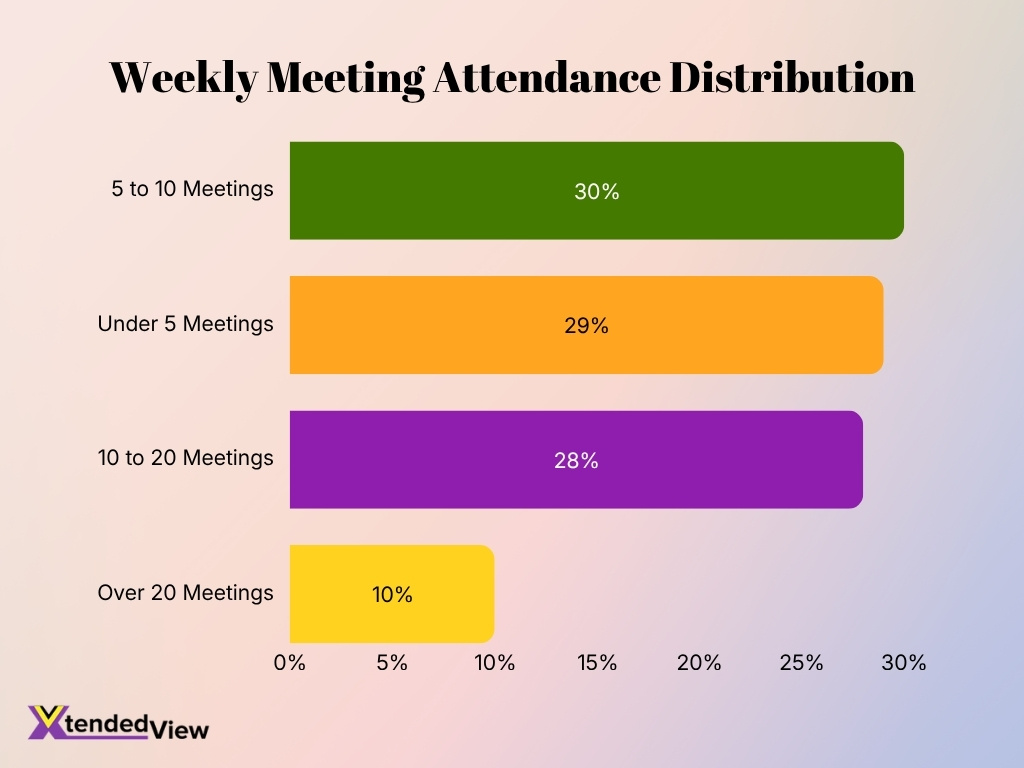
- A 2026 workplace study found that 29% of participants attended fewer than five meetings per week, while 30% attended five to 10.
- Another 28% attended between 10 and 20 meetings weekly, while 10% attended more than 20.
- About 72% of respondents in that study organized or led at least some workplace meetings themselves.
- Remote meetings represented the most common meeting format for 57% of participants in the 2026 study.
- Earlier workforce research found that 52% of employees multitasked often or always during virtual meetings with at least two attendees.
- By comparison, 35% reported multitasking very often or always during in-person meetings, suggesting that physical presence still increases visible attention.
- Younger employees showed especially high acceptance of divided attention: 76% of Gen Z workers considered using a phone for work-related tasks acceptable during an in-person meeting.
- A 2026 hybrid-meeting study found that roughly half of remote participants reported being excluded or talked over when colleagues gathered together in a physical room.
- Hybrid meetings experienced at least one technical issue in about three-quarters of sessions in the same 2026 research, creating further barriers to equal participation.
Meeting Fatigue and Employee Burnout
- In a 2026 survey of more than 1,000 employees, 72% reported meeting fatigue at work.
- Employees estimated that 46% of their meeting time was unnecessary or unproductive, increasing the mental cost of already crowded calendars.
- The same survey estimated that employees lose 146 working hours per year to unnecessary meetings.
- In 2026 research from India, 90% of employees reported some level of meeting dread.
- Those Indian workers averaged 8.8 hours of meetings per week, illustrating how fatigue can rise in high-meeting environments.
- A 2025 study of 2,448 regular virtual-meeting users specifically identified virtual meeting fatigue as a measurable psychological factor that shapes the features workers want from meeting platforms.
- Broader 2025 workforce research found that 80% of employees and leaders said they lacked enough time or energy to complete their work.
- Nearly half of employees, 48%, said their work felt chaotic and fragmented; the figure rose to 52% among leaders.
- Employees using common workplace collaboration tools experienced an interruption from a meeting, message, or email roughly every two minutes during core working hours.
- Meetings after 8 p.m. increased 16% year over year in 2025, extending meeting pressure beyond conventional working hours.
Virtual vs In-Person Meeting Adoption Rates
- U.S. workers reported an average of five virtual or hybrid meetings per week in 2025.
- The same workers also averaged five face-to-face meetings per week, showing an almost even split between digital and in-person collaboration.
- Among U.S. employees in remote-capable jobs, 52% worked hybrid as of May 2026.
- Another 26% of remote-capable U.S. employees worked exclusively remotely in May 2026, while 22% worked entirely on-site.
- Hybrid work remained highly stable between February and May 2026, holding at 52% of remote-capable workers in both periods.
- In 2025, 77% of surveyed U.S. workers said they had lost meeting time because of technical difficulties, showing that hybrid adoption does not always translate into a smooth experience.
- Workers lost an average of more than six minutes simply getting hybrid meetings started in 2025.
- More than one-quarter, 27%, said hybrid meeting setup problems cost them at least 10 minutes per meeting.
- About 67% said they had attempted to use conference-room video technology but eventually abandoned it and continued on a laptop.
Meeting-Free Days and Their Benefits
- The study analyzed 76 large companies operating across more than 50 countries.
- About 47% of companies added two meeting-free days, dropping total meetings by 40%.
- Another 35% of organizations implemented three meeting-free days, and 11% adopted four.
- Only 7% of participating companies completely eliminated all recurring meeting days.
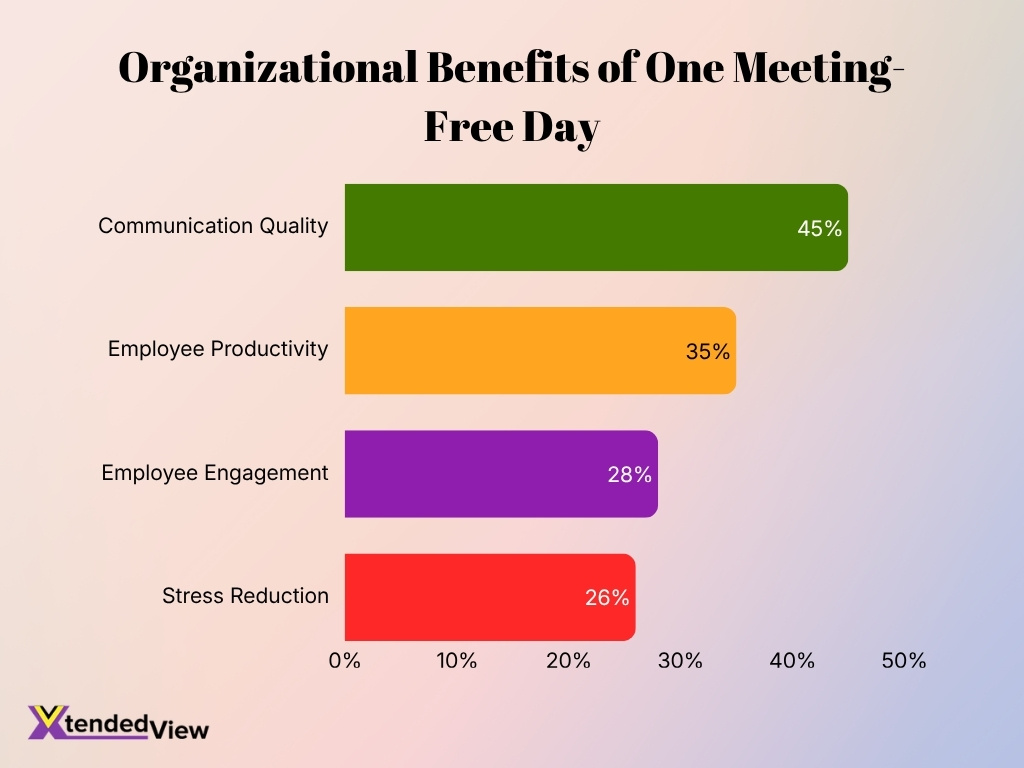
- Adding one meeting-free day boosted measured employee productivity by 35%.
- A single meeting-free day increased communication quality by 45% and engagement by 28%.
- Reported employee stress fell by 26% after introducing one meeting-free day.
- Overall positive organizational benefits peaked at three meeting-free days per week.
- Median coding time rose from 72 to 154 minutes with two meeting-free days.
Remote Work and Meeting Trends
- As of May 2026, 52% of U.S. employees in remote-capable jobs worked hybrid, making hybrid work the dominant arrangement for this group.
- Another 26% worked exclusively remotely, while 22% worked fully on-site.
- In the broader U.S. workforce, 39% of workers reported working from home at least some of the time in 2025.
- Of those workers, 17% worked entirely from home, and 23% worked from home for only part of the time.
- Hybrid employees spent about 46% of their workweek in the office in 2025, equivalent to roughly 2.3 days.
- In technology roles, 47% of remote-capable employees worked fully remotely in 2025, while 45% worked hybrid and only 9% worked entirely on-site.
- About 30% of meetings spanned multiple time zones in 2025, up 8 percentage points from 2021.
- Meetings starting after 8 p.m. rose 16% year over year, with global and flexible teams driving much of the increase.
- After-hours chats increased 15% year over year, with employees receiving an average of 58 messages outside standard 9-to-5 hours.
- U.S. job postings in Q4 2025 remained 24% hybrid and 11% fully remote, compared with 65% fully on-site, confirming that flexible work continues to represent a substantial share of new professional opportunities.
Impact of Meetings on Productivity
- In 2026 survey data, 62% of employees said meeting-heavy calendars reduced their productivity.
- Another 63% said crowded meeting schedules interfered with their ability to focus on work.
- Workers estimated that nearly half, 46%, of all meeting time delivered little productive value.
- The resulting average loss reached 146 hours per employee annually, equivalent to more than three standard 40-hour workweeks.
- In 2025 workforce telemetry, 57% of meetings occurred as ad hoc calls without a calendar invitation, making workdays harder to plan around uninterrupted tasks.
- One in 10 scheduled meetings was booked at the last minute, adding another source of calendar disruption.
- Presentation edits jumped 122% during the final 10 minutes before meetings, suggesting that scheduled meetings can compress preparation work into narrow windows.
- The same data identified 11 a.m. as one of the most overloaded points in the workday, with 54% of users active in messaging while meetings and other work competed for attention.
- About 53% of leaders said productivity needed to increase in 2025, even as 80% of the workforce reported insufficient time or energy to complete existing work.
Global Video Conferencing Market Share
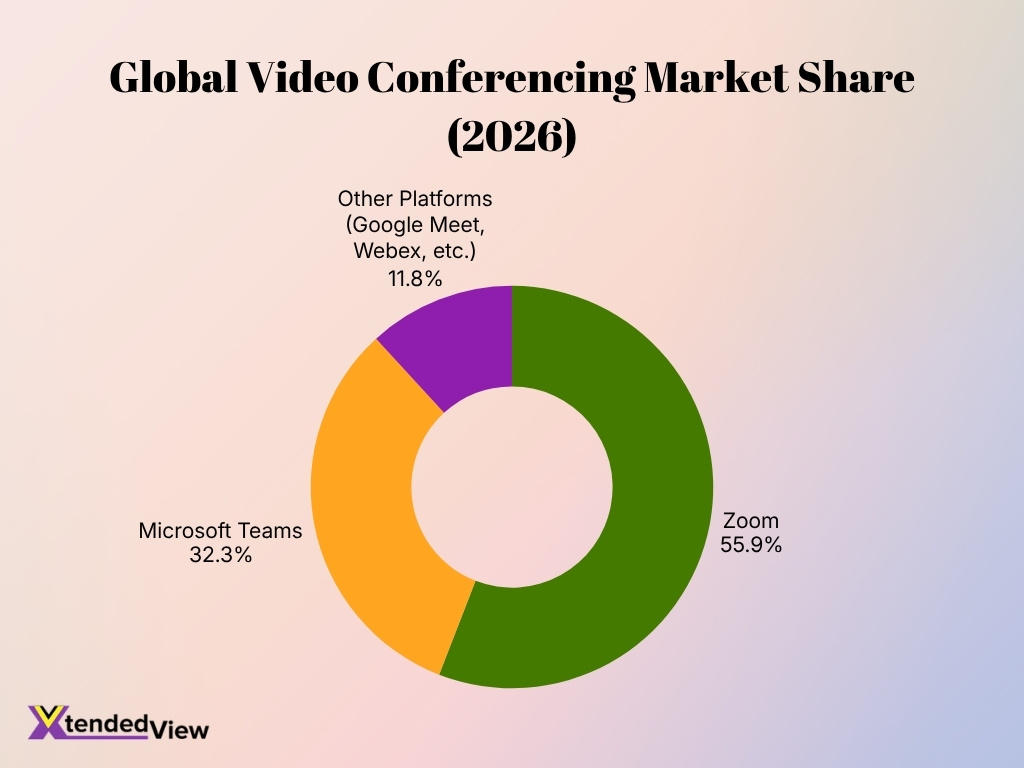
- Zoom dominates the global video conferencing market in 2026, accounting for 55.9% of the total market share.
- Microsoft Teams ranks second with a substantial 32.3% market share, making it Zoom’s closest major competitor.
- Together, Zoom and Microsoft Teams control 88.2% of the global video conferencing market, highlighting strong market concentration.
- Other platforms, including Google Meet, Webex, and competing services, collectively represent just 11.8% of the market.
- Zoom’s 55.9% share is 23.6 percentage points higher than Microsoft Teams’ 32.3%, demonstrating its considerable market lead.
- Zoom alone holds a market share nearly 4.7 times larger than the combined 11.8% share of other video conferencing platforms.
Meeting Scheduling and Timing Patterns
- Tuesday represents 21% of weekly meetings as the most active scheduling day.
- Friday holds just 16% of weekly meetings to preserve end-of-week focused work.
- Nearly 30% of global meetings take place after 6 p.m. UTC for distributed teams.
- Another 12% of collaboration sessions fall outside normal hours by starting before 9 a.m.
- Exactly 9% of analyzed meetings share the most common global start time of 2 p.m. UTC.
- About 36% of employees find afternoon meetings more disruptive than mornings (28%).
- Roughly 40% of workers rank Monday as their absolute most productive workday.
- Around 43% of healthcare professionals rarely take meetings outside standard daytime hours.
- Merely 8% of healthcare staff attend out-of-hours meetings on a daily basis.
Industries with Highest Meeting Loads
- In 2026, health care workers reported the highest meeting-fatigue rate at 79%.
- Technology employees followed closely, with 77% experiencing meeting fatigue.
- The overall average for meeting fatigue across all surveyed industries was 72%.
- Technology workers lost an estimated 169 hours per year to unnecessary meetings.
- Redundant meetings cost $9,825 in annual salary per technology employee.
- Across the overall workforce, unnecessary meetings represented $6,280 in wasted salary.
- Health care employees estimated that 48% of their meeting time was entirely unproductive.
- Across industries, 47% of workers spent an average of three hours daily in two to three meetings.
- Health care employees still managed to record 4 hours and 47 minutes of daily focus time in 2025.
Meeting Preparation and Follow-Up Statistics
- 54% of knowledge workers frequently leave meetings without a clear understanding of the next steps or who owns each task.
- Another 77% frequently attend meetings whose main outcome is simply a decision to schedule another meeting.
- About 48% of employees say clearer agendas would improve their organization’s meeting culture.
- Shorter meetings rank even higher as a desired improvement, cited by 59% of employees, suggesting that preparation should also involve tighter scope and clearer objectives.
- In a 2025 poll of 554 health care respondents, 44% selected clearer agendas and takeaways as the change that would most improve meetings.
- Another 42% of those respondents favored removing redundant meetings, while 8% wanted more front-line input and 6% favored better use of digital tools.
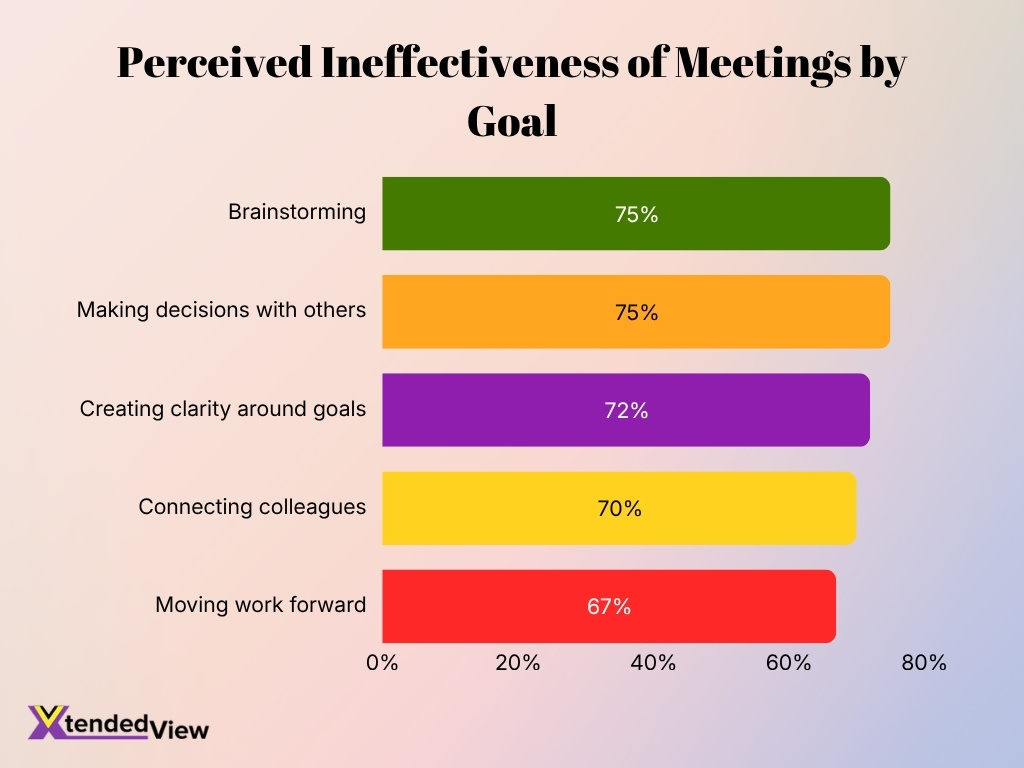
- A broad workplace study found that 70% of employees considered meetings ineffective for connecting colleagues, while 75% said meetings were ineffective for brainstorming.
- Another 75% said meetings were ineffective for making decisions with others, and 67% said they did not effectively move work forward.
- About 72% of workers said meetings failed to create sufficient clarity around goals, reinforcing the value of distributing objectives beforehand and documenting decisions afterward.
- In health care advisory-board research, 78.3% of respondents answered a survey question about whether they wanted updates explaining how organizers had used their input, highlighting strong interest in post-meeting feedback and follow-through.
Employee Preferences for Meeting Types
- A 2025 study found that 47.49% of workplace meetings were held face-to-face.
- Virtual meetings accounted for 33.48% of sessions, while hybrid formats represented 14.82%.
- Around 38% of global health professionals stated they would always prefer hybrid scientific meetings.
- Only 25.2% always prefer in-person meetings, and just 14.1% exclusively favor fully virtual meetings.
- Just 7.8% would never choose hybrid meetings, compared to 23.3% who would never select virtual sessions.
- About 69.5% of respondents valued flexible scheduling as a top advantage of virtual meetings.
- Roughly 64.1% prioritized lower costs, while 58% highlighted reduced travel and environmental impact.
- A significant 76% of healthcare professionals preferred a future approach with some virtual component.
- In contrast, only 24% of that same group preferred in-person meetings strictly.
- Preferences for hybrid advisory-board meetings nearly doubled from 14.3% in 2022 to 27.3% in 2023.
Technology and Tools for Meeting Management
- By the second quarter of 2026, 47% of U.S. employees said their organization had integrated AI tools to improve productivity, efficiency, or work quality, up from 41% one quarter earlier.
- More than half of U.S. workers, 52%, reported using AI in their jobs in 2026, while 30% used it several times per week or more.
- Daily workplace AI use reached 15% in 2026, creating a larger potential user base for automated scheduling, transcription, and meeting-summary features.
- Among organizations that already provide AI tools, 67% of leaders use AI frequently, compared with 52% of managers and 46% of individual contributors.
- Global enterprise research found that 45.8% of surveyed companies already allowed AI virtual assistants within workplace collaboration suites entering 2025.
- Another 20.8% planned to adopt such assistants by the end of 2025, while 23% were evaluating them, meaning almost nine in 10 organizations were using, planning, or assessing the technology.
- A July 2026 U.S. survey found that 33.4% of employed adults had encountered an AI notetaker or transcription bot in a work meeting.
- Another 22.4% could not say whether an AI notetaker had recorded or transcribed one of their meetings, highlighting a growing transparency issue.
- Among workers who had encountered AI meeting tools, only 34.7% said they were always asked for permission before recording or transcription began; 25.1% said they were never asked.
- AI adoption has also reached event planning: more than 90% of surveyed meeting professionals said they were using AI in some way to plan business events in research published in 2025.
Frequently Asked Questions (FAQs)
The latest large-scale meeting analysis puts the average meeting duration at 47 minutes, down from 51 minutes in 2023.
About 46% of meetings now include at least one external participant.
Workplace telemetry shows that approximately 60% of meetings are unscheduled or ad hoc among the highest-volume meeting users measured.
Around 30% of meetings span multiple time zones, up 8 percentage points since 2021.
As of May 2026, 52% of U.S. employees with remote-capable jobs worked hybrid, compared with 26% fully remote and 22% fully on-site.
Conclusion
Meeting statistics show that workplace collaboration remains essential, but organizations are becoming more selective about how they use meeting time. Employees continue to spend several hours each week in meetings, and a significant share of that time is still viewed as unnecessary or unproductive. Meeting fatigue, fragmented schedules and unclear follow-up can reduce focus and increase labor costs, particularly in meeting-heavy industries such as technology and health care.
At the same time, the data shows clear signs of change. Meetings are becoming shorter, hybrid and remote formats remain widely used, meeting-free periods are gaining attention, and AI tools are increasingly supporting transcription, summaries, scheduling and follow-up. The strongest pattern across the research is that better meeting design matters more than simply increasing or decreasing meeting volume. Shorter sessions, clearer agendas, fewer unnecessary attendees, defined action items, and stronger follow-up can help organizations protect focus time while preserving the collaboration employees and businesses still need.