



Social media continues to shape how people communicate, discover products, consume news, and interact with brands. Businesses rely on social platforms to drive customer acquisition and advertising performance, while governments, healthcare organizations, and educators increasingly use them for public awareness and community engagement. As user behavior evolves and platforms introduce AI-powered experiences, understanding the latest statistics helps marketers, business leaders, and researchers make better decisions. Explore the data below to see how social media usage continues to change across the United States and worldwide.
Editor’s Choice
- Global social media user identities reached 5.24 billion in early 2025, representing an annual increase of 4.1%, or roughly 206 million new user identities.
- Social media user identities now account for more than 63% of the world’s population, highlighting the maturity of digital connectivity.
- Internet users worldwide spent an average of 141 minutes per day on social media in 2025, down slightly from 143 minutes in 2024.
- Worldwide social media advertising spending is projected to reach approximately $276.7 billion during 2025, reflecting continued double-digit annual growth.
- Advertisers are expected to allocate 61.3% of social network advertising budgets to social video formats in 2025.
- Facebook remained the largest social platform in 2025 with roughly 3.07 billion monthly active users, followed by Instagram with around 3 billion users.
- Global social media adoption continues to expand despite slower growth rates, indicating that future gains will increasingly come from emerging markets rather than mature economies.
Recent Developments
- Artificial intelligence features have become a major competitive focus across leading social media platforms throughout 2025, influencing content recommendations, search, and advertising.
- Social video continues to attract a larger share of advertising budgets than its share of user time, underscoring marketers’ confidence in video-based campaigns.
- Marketers ranked generative AI, connected TV integration, and short-form social video among the leading consumer trends in 2025.
- More than four in five marketers reported increased brand exposure as a primary benefit of social media marketing during 2025.
- Facebook and Instagram continued delivering the highest reported marketing ROI among major social platforms in 2025.
- Social platforms increasingly expanded commerce, creator monetization, and AI-assisted content creation features throughout the past year.
- Global adoption growth slowed compared with previous years because social media penetration has already exceeded 60% of the world’s population.
- Advertisers continued shifting budgets toward social media despite relatively stable user time, reflecting confidence in measurable performance and targeting capabilities.
Global Social Media User Growth and Penetration Statistics
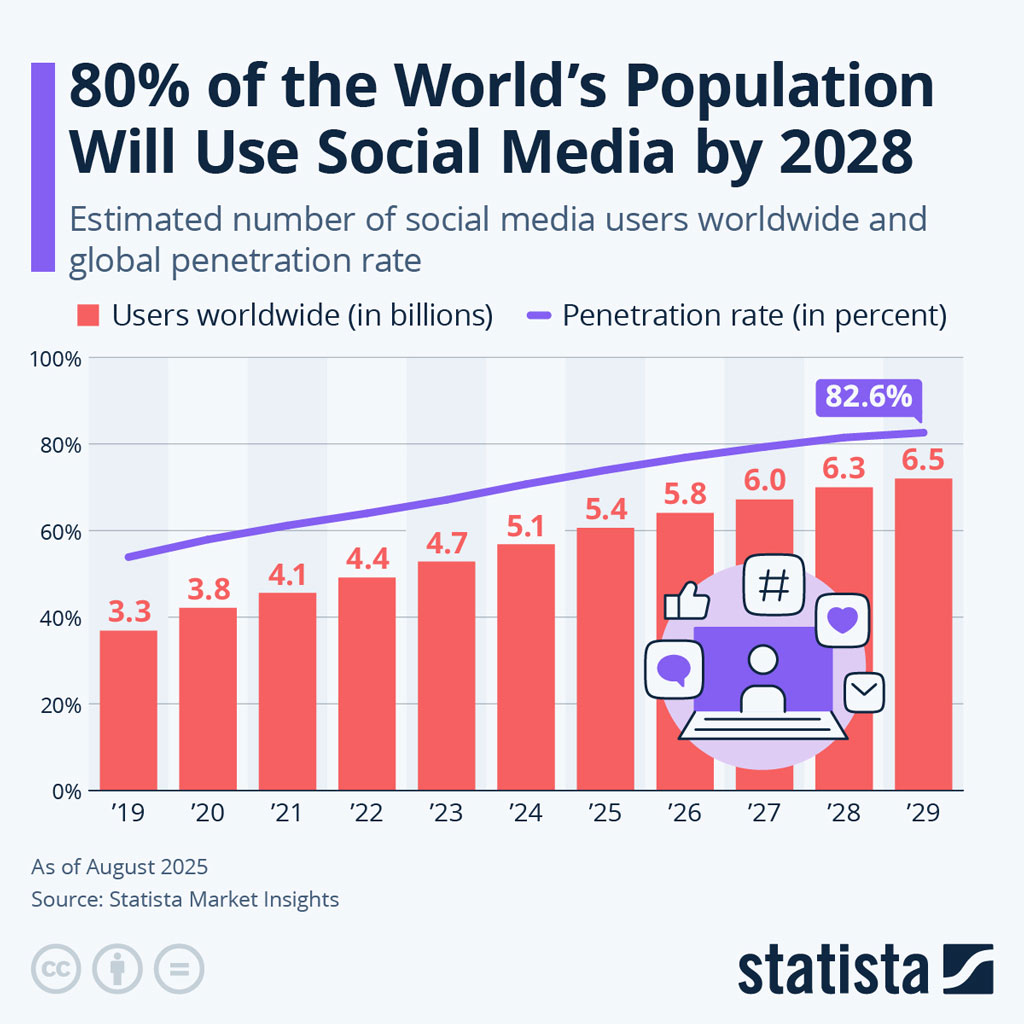
- The global number of social media users increased from 3.3 billion in 2019 to 5.4 billion in 2025, reflecting the rapid expansion of social networking worldwide.
- Social media users are projected to reach 5.8 billion in 2026, adding around 400 million users compared with 2025.
- By 2027, the worldwide social media audience is expected to hit 6.0 billion users, marking another major milestone in global adoption.
- Global social media users are forecast to rise further to 6.3 billion in 2028 and 6.5 billion by 2029.
- The global social media penetration rate has climbed steadily alongside user growth, increasing from approximately 54% in 2019 to around 74% in 2025.
- By 2028, social media penetration is projected to surpass 80% of the global population, showing how widespread these platforms are becoming.
- The penetration rate is forecast to reach 82.6% by 2029, meaning more than 8 in 10 people worldwide could be using social media.
- Overall, social media’s global user base is projected to nearly double from 3.3 billion in 2019 to 6.5 billion in 2029, representing an increase of about 3.2 billion users over the decade.
Global Social Media User Statistics
- Worldwide active social media user identities reached 5.79 billion at the beginning of 2026.
- More than 69.9% of the total global population now actively uses at least one social platform.
- An impressive 94.7% of all global internet users engage with social networks on a regular basis.
- Facebookmaintained its top position globally with over 3.07 billion monthly active users.
- Instagramand WhatsApp closely followed by each reaching 3.00 billion active users.
- YouTubesustained massive engagement with 2.58 billion users accessing the video-based network.
- TikTokcontinued its rapid growth by securing roughly 1.99 billion active users globally.
- The average global user spends 2 hours and 21 minutes daily across 6.8 different platforms.
- Global advertising spend across all social platforms surpassed a staggering $317.33 billion in 2026.
Social Media Penetration Rates Worldwide
- Approximately 69.9% of the total global population actively uses at least one social media platform in 2026.
- Northern Europeand North America consistently lead regional adoption with penetration rates exceeding 80%.
- Rapid internet adoption in emerging markets drove a 5.4% annual growth, adding 294 million new users.
- Expanding mobile ownership helped the total global social media user base reach exactly 5.79 billion.
- Social network users now officially outnumber global non-users by a ratio of more than two to one.
- Increased mobile broadband access means 94.7% of all worldwide internet users engage on social networks.
- Mature digital consumers average 2 hours and 21 minutes of daily engagement across 6.8 different platforms.
- Demographic shifts show that 94.5% of the global adult population aged 18 and older now uses social media.
Social Media Market Share by Platform Worldwide
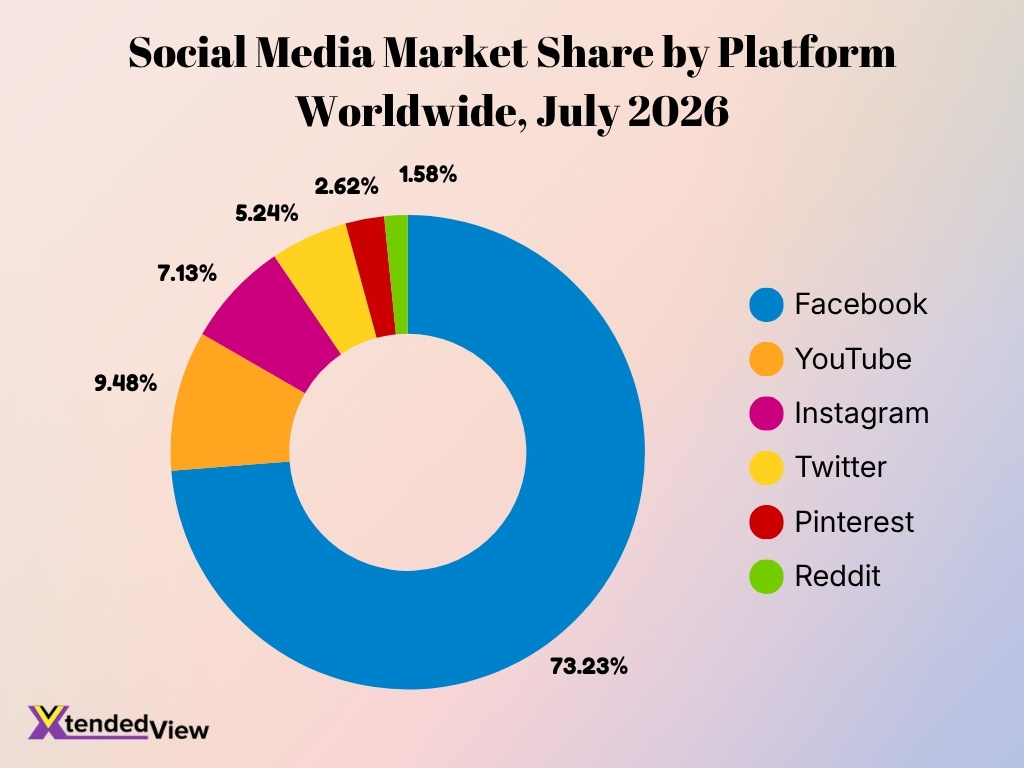
- Facebook overwhelmingly dominates the social media market, accounting for 73.23% of worldwide platform market share in July 2026.
- YouTube ranks second with a 9.48% market share, although its share remains significantly lower than Facebook’s.
- Instagram holds 7.13% of the global social media market, making it the third-largest platform among those measured.
- Twitter accounts for 5.24% of worldwide social media market share, placing it fourth in the platform ranking.
- Pinterest represents 2.62% of the market, less than half of Instagram’s 7.13% share.
- Reddit has the smallest share among the six platforms shown, accounting for 1.58% of the worldwide market.
- Combined, YouTube, Instagram, Twitter, Pinterest, and Reddit hold 26.05%, while Facebook alone controls nearly three-quarters of the market.
- The figures reveal a highly concentrated landscape, with Facebook’s 73.23% share exceeding the combined market share of all five other platforms by more than 47 percentage points.
Average Time Spent on Social Media Daily
- Global internet users spend an average of 141 to 151 minutes per day on social media in 2026.
- Gen Zusers dedicate an astonishing 4 hours daily to consuming social platforms.
- Brazilleads global social media engagement with an average daily usage of 3 hours and 49 minutes.
- TikTokdominates platform attention as users spend an average of 95 minutes per day scrolling.
- Mobile devicesnow account for a massive 88% of all daily social media usage globally.
- The average user dedicates roughly 18 hours and 36 minutes per week to social and video feeds.
- Over 70% of active users check their social media accounts within 10 minutes of waking up.
- U.S. adults aged 18 to 24 lead regional usage with an average of 186 minutes spent daily.
- The total social media audience has reached 5.79 billion users representing 69.9% of the global population.
Social Media Usage by Age Group
- Adults aged 18–29 continue to record the highest social media adoption rates in the U.S., with roughly 84% using at least one social platform.
- About 81% of Americans aged 30–49 actively use social media, demonstrating strong engagement beyond younger audiences.
- Approximately 73% of adults aged 50–64 report using social networking platforms regularly.
- Social media adoption among adults aged 65 and older has grown to roughly 45%, reflecting continued digital inclusion.
- Gen Z remains the most active demographic across short-form video platforms, spending more time per day than any other generation.
- Millennials continue to represent one of the largest groups of social commerce buyers, combining high engagement with strong purchasing activity.
- Nearly half of global internet users say they use social media primarily to stay connected with friends and family, regardless of age.
- Video content, messaging, and creator-led communities remain the most popular features among users under 35.
Social Media Usage by Gender
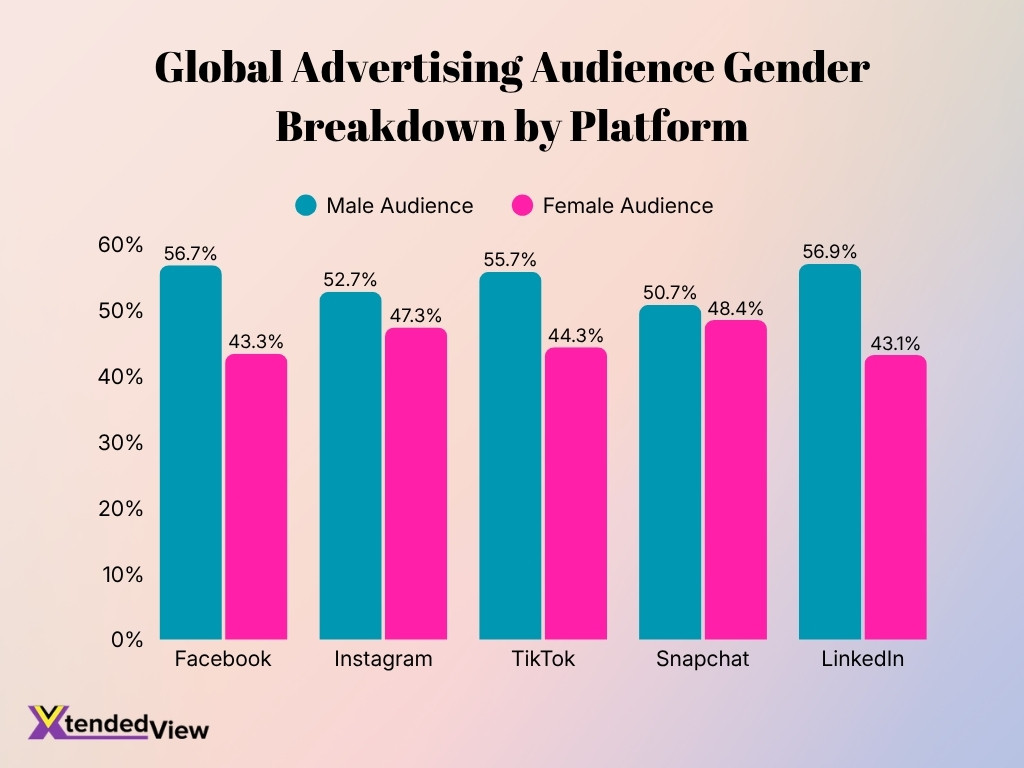
- Global advertising audience data from early 2025 shows Facebook’s audience was approximately 56.7% male and 43.3% female.
- Instagram’s global advertising audience consisted of about 52.7% male and 47.3% female users in 2025.
- TikTok’s global audience was estimated at 55.7% male and 44.3% female.
- Snapchat maintained one of the most balanced user bases, with roughly 50.7% male and 48.4% female users.
- LinkedIn’s worldwide audience was about 56.9% male and 43.1% female.
- X recorded the largest gender imbalance among major platforms, with approximately 63.7% male users globally.
- Gender composition varies significantly by country because internet access, workforce participation, and smartphone ownership differ across regions.
- Marketers increasingly tailor creative content and advertising campaigns to platform-specific gender demographics rather than relying on broad audience assumptions.
Social Media Users by Country and Region
- Indiaremained the world’s largest social media market with approximately 500 million unique users.
- The United States ranked among the largest mature markets with over 250 million users across major platforms.
- Chinamaintained a massive social media ecosystem of 1.3 billion users led by domestic platforms like WeChat.
- Indonesiabecame one of the fastest-growing markets with 180 million users driven by expanding smartphone adoption.
- Latin Americareported the highest daily usage worldwide with audiences averaging over 3 hours on social media.
- North Americamaintained one of the highest global penetration rates with 61% of the population connected via mobile.
- Asia-Pacificaccounted for the largest global share with regions like Eastern Asia reaching a 75% penetration rate.
- Emerging markets across Africa recorded rapid first-time adoption with countries like Nigeria hitting 47.8 million users.
Mobile vs Desktop Social Media Access Statistics
- Over 98.9% of active social media users access platforms using smartphones.
- Mobile devices generate 66.1% of overall global web traffic compared to 45.6% for desktop.
- Short-form vertical video formats like Shorts receive 94% of their daily views on mobile devices.
- Desktop usage contributes to 68% to 83% of traffic on professional and B2B websites.
- Global consumer in-app spending on mobile commerce reached $167 billion.
- Daily app engagement reached 3.6 hours per user, driven by push notifications and integrated mobile tools.
- 83%of total social media advertising budgets are spent on mobile-first campaigns.
- Global 5G subscriptions driving mobile video bandwidth hit 6.4 billion connected users.
Top Social Media Platforms by Active Users
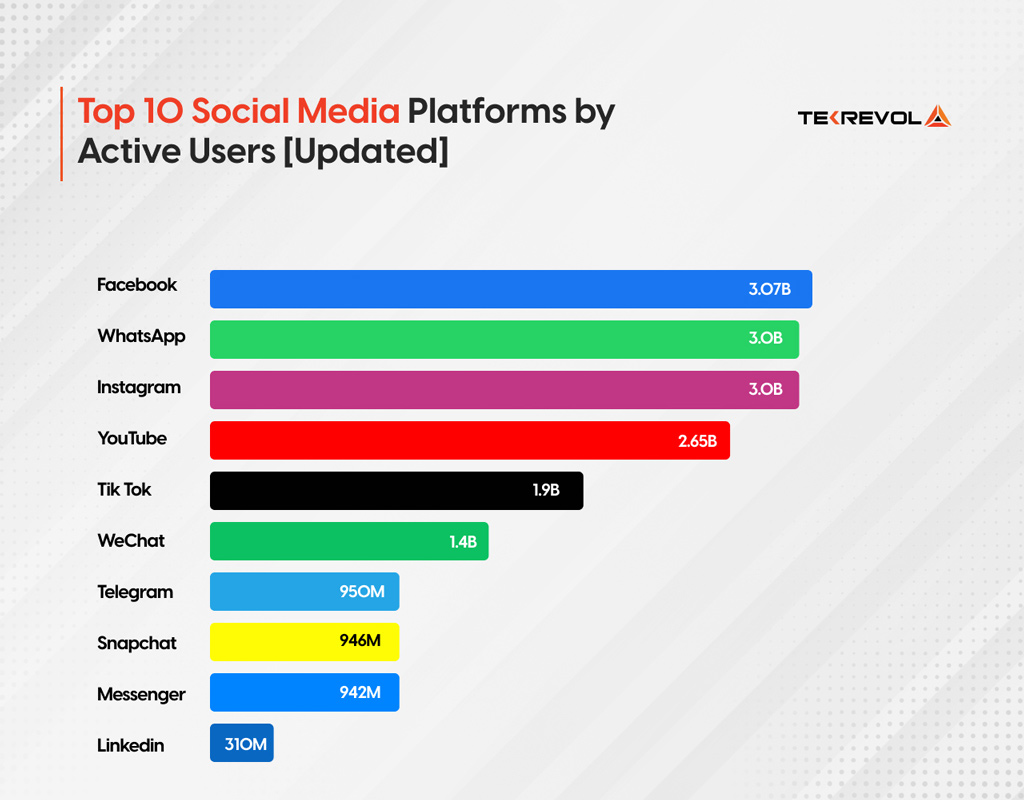
- Facebook leads the ranking with 3.07 billion active users, making it the largest social media platform in the dataset.
- WhatsApp and Instagram are tied at 3.0 billion active users each, placing both platforms just behind Facebook.
- YouTube ranks fourth with 2.65 billion active users, maintaining a massive global audience for video-based content.
- TikTok has reached 1.9 billion active users, highlighting the enormous scale of short-form video consumption worldwide.
- WeChat records 1.4 billion active users, securing sixth place and remaining one of the world’s largest social and messaging platforms.
- Telegram has approximately 950 million active users, narrowly outperforming Snapchat and Messenger in the ranking.
- Snapchat follows closely with 946 million active users, only 4 million fewer than Telegram.
- Messenger has 942 million active users, putting it just 8 million behind Telegram and 4 million behind Snapchat.
- LinkedIn ranks tenth with 310 million active users, substantially below the other platforms included in the top 10.
- The top three platforms, Facebook, WhatsApp, and Instagram, each have at least 3 billion active users, demonstrating the exceptional scale of the largest social networks.
Social Media Engagement Rates by Platform
- TikTokleads the social media landscape with an impressive average engagement rate of 4.25%.
- Short-form video platforms deliver significantly higher interactions, with TikTok generating 2.3 times more engagement than average networks.
- Instagram Reels generate 67% more engagement than standard videos, establishing them as the top format for organic reach.
- LinkedIn maintains a strong average engagement rate of 3.4%, while top B2B technology accounts reach up to 8.1%.
- Facebook’s traditional feed engagement has dropped to just 0.15%, shifting the interaction focus toward Groups and video content.
- Authentic user-generated content (UGC) produces 6.9 times more engagement across social media than highly polished brand campaigns.
- Algorithmic recommendation engines actively boost discoverability, helping nano-influencers achieve exceptional engagement rates up to 12.3%.
- Modern engagement algorithms prioritize actions like saves and watch time, pushing educational video engagement as high as 7.36%.
Social Media Advertising Spend and Growth Statistics
- The global social media market size is projected to reach $234.34 billion during 2026.
- Social media advertisinginvestment is forecast to experience an 11.4% growth rate worldwide.
- Meta’s total advertising revenueis projected to hit approximately $166.2 billion in 2026.
- Digital advertising will represent 68.7% of the total global advertising investment in 2026.
- Algorithm-driven advertising is forecast to represent 71.6% of total global ad spend by 2026.
- Online video advertising is expected to see a significant growth rate of 11.5% in 2026.
- Programmatic advertising is anticipated to account for more than 80% of total digital investment.
- Technology sector advertising driven by AI product launches is forecast to grow by 10.3%.
Social Media Influence on Consumer Shopping Behaviour
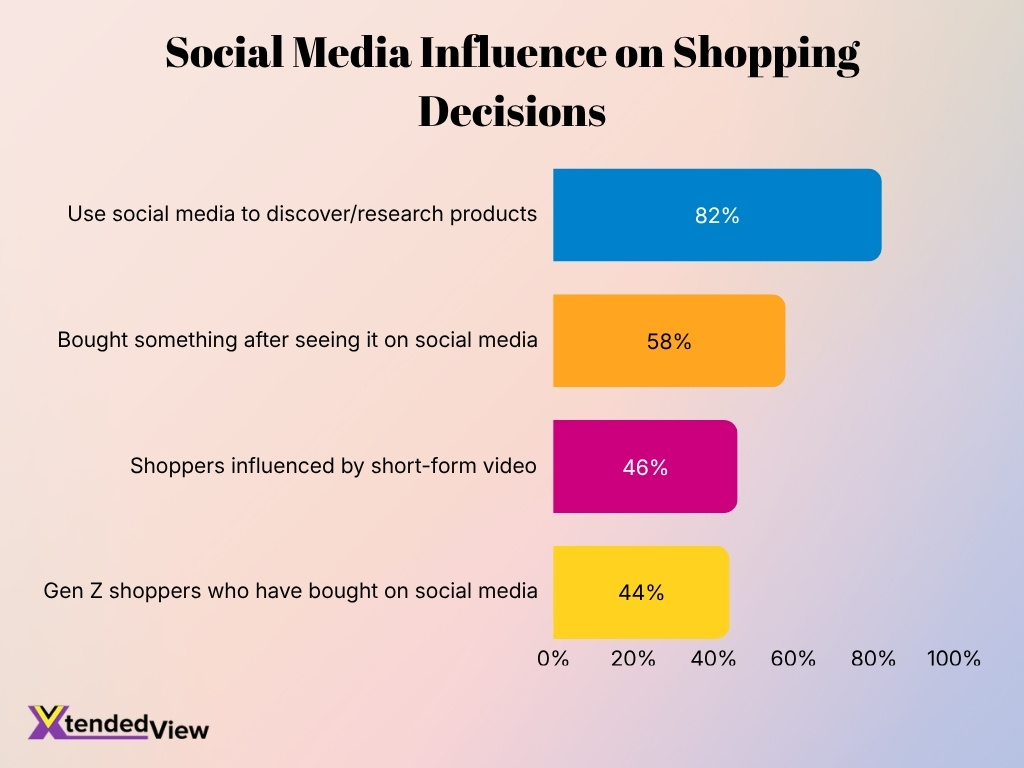
- 82% of shoppers use social media to discover or research products, highlighting its major role at the beginning of the buying journey.
- 58% of consumers have purchased something after seeing it on social media, showing how product exposure can translate into actual sales.
- 46% of shoppers are influenced by short-form video content, underscoring the growing impact of quick, visual formats on purchase decisions.
- Among Gen Z shoppers, 44% have bought products through social media, demonstrating strong adoption of social shopping among younger consumers.
- Overall, the figures show that social media has evolved beyond product awareness, becoming an important channel for discovery, purchase influence, and direct shopping.
Influencer Marketing and Creator Economy Statistics
- The global influencer marketing industry reached an estimated $32.55 billion in 2025.
- Roughly 86% of marketers report that influencer campaigns drive positive business outcomes.
- Micro-influencers achieve engagement rates 3x to 8x higher than celebrity influencers.
- Instagram Reels lead brand partnerships by comprising 78% of all influencer content.
- About 73% of brand teams leverage AI-powered tools to optimize their creator workflows.
- Affiliate marketing links from creators convert at 1.8%, outpacing standard display ads.
- Nearly 67% of brands plan to increase budgets for long-term creator partnerships.
- 71% of consumers show stronger trust in creator recommendations than traditional advertising.
- High-quality influencer campaigns deliver up to 11x the ROI compared to traditional digital advertising.
Social Media Impact on Mental Health and Well-being
- Up to 95% of youth aged 13 to 17 report using a social media platform, with a third using it almost constantly.
- Adolescents who spend more than 3 hours a day on social media face double the risk of depression and anxiety.
- Teenagers currently spend an average of 3.5 hours per day engaging with various social media platforms.
- Approximately 46% of adolescents state that social media makes them feel worse about their body image.
- On the positive side, 58% of adolescents report that social media actually helps them feel more accepted.
- A significant 80% of teens feel more connected to their friends’ lives due to online social interactions.
- Fully 71% of parents express concern that their children might be spending too much time on screens.
- Nearly 80% of parents report actively taking steps to manage and limit their kids’ daily screen time.
Main Reasons People Use Social Media
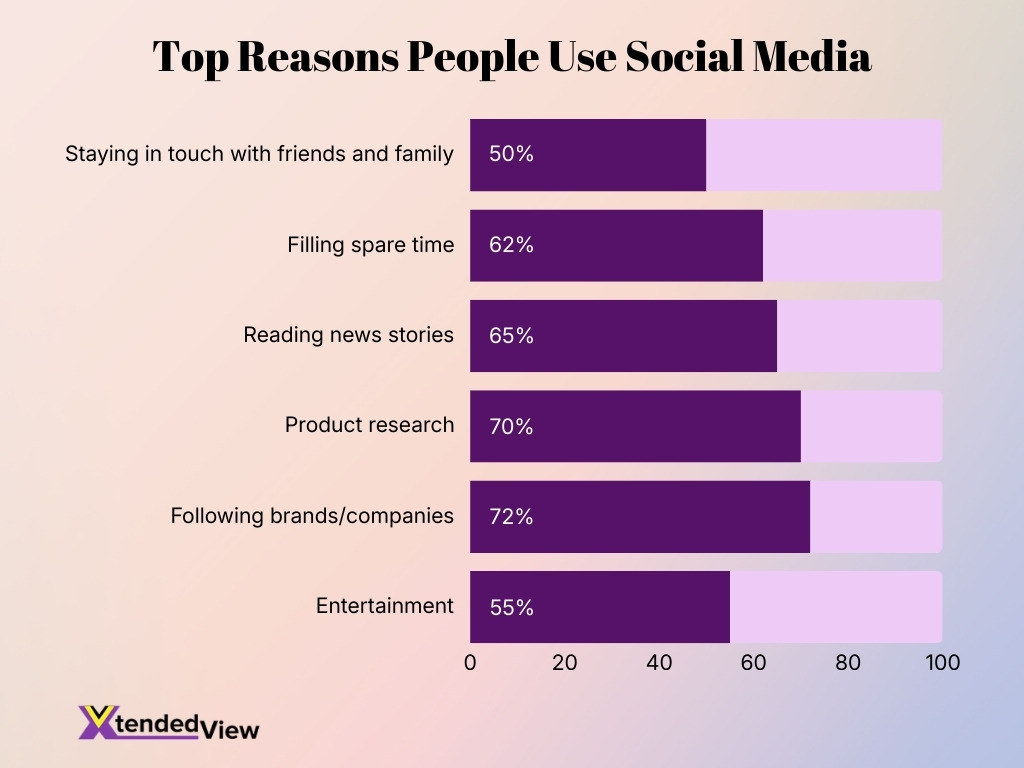
- The top global reason is staying in touch with friends and family, cited by over 50% of users.
- Approximately 38% use social media to fill their spare time.
- Around 35% use platforms to read news stories.
- Nearly 30% use social media for product research before making a purchase.
- About 28% follow brands and companies to stay informed about products.
- Entertainment drives engagement for more than 45% of global users.
- Professional networking remains a key motivator on LinkedIn, with over 1 billion registered users globally.
- Community-building and niche interest groups continue expanding across platforms.
Emerging Social Media Platforms and Trends
- AI-generated content reached an estimated 52% of all social media posts in 2025 and is projected to hit 90% by 2026.
- Decentralized platforms like Bluesky surged to over 42.3 million registered users in 2026, marking a massive 320% user growth.
- Short-form video ad spending is projected to hit $100 billion by 2025, accounting for roughly 82% of all internet traffic.
- About 40% of Gen Z consumers now treat TikTok as a search engine instead of traditional options for product discovery.
- Nearly 81% of marketing professionals deploy AI automation daily, driving operational cost reductions for creators and publishers.
- Exactly 72% of Gen Z users have bought a product directly through a social app, proving the success of unified social commerce.
- A staggering 79% of all visual content across major platforms like Instagram and TikTok is now produced using AI-generated image tools.
- Over 50% of Gen Z now feel a stronger personal connection to social media creators than to traditional television personalities.
Future Projections for Social Media User Growth
- Global social media users have officially reached 5.79 billion active identities by early 2026.
- Worldwide social media penetration now captures 94.7% of all internet users, representing over two-thirds of the global population.
- Annual user growth rates maintain a steady 5.4%, translating to approximately 9.3 new users every single second.
- The average person spends 2 hours and 26 minutes daily on platforms, contributing to 15 billion hours of global daily consumption.
- The global social commerce market is currently valued at $2.11 trillion in 2026 and projected to reach $7.55 trillion by 2031.
- Over 82% of modern consumers now utilize social networks for product discovery instead of traditional search engines.
- The creator economy market boasts a valuation of roughly $313 billion in 2026 and is expected to approach $480 billion by 2027.
- Video content continues to dominate user attention, with the average individual actively engaging across 6.5 different social platforms monthly.
Frequently Asked Questions (FAQs)
As of April 2026, there were approximately 5.79 billion social media user identities worldwide.
The global social media penetration rate reached 63.9% in 2025.
Internet users worldwide spent an average of 141 minutes per day on social media in 2025.
Global social media advertising spending reached an estimated $276 billion in 2025.
Facebook had more than 3 billion monthly active users worldwide in 2025, making it the largest social media platform.
Conclusion
Social media continues to evolve from a communication platform into a comprehensive digital ecosystem that powers marketing, commerce, entertainment, customer engagement, and online communities. As the industry moves, global user growth remains steady while artificial intelligence, creator-driven content, short-form video, and social commerce continue to redefine how people interact with brands and each other. At the same time, businesses are increasing their investments in social advertising and personalized customer experiences, while policymakers and technology companies place greater emphasis on privacy, transparency, and user well-being.
Although user growth is beginning to stabilize in mature markets, significant opportunities remain in emerging economies where internet connectivity and smartphone adoption continue to expand. Understanding these evolving trends and statistics enables businesses, marketers, creators, and researchers to make informed decisions, identify new opportunities, and adapt their strategies in an increasingly competitive digital landscape.
