


Podcasting now sits at the intersection of audio, video, advertising, and the creator economy. In the U.S., brands use podcasts to reach high-intent audiences through host-read campaigns, while publishers and independent creators increasingly use video podcasts to expand distribution across connected TVs and social platforms. Businesses also use podcasts for customer education, thought leadership, recruitment, and branded storytelling. The statistics below show how quickly podcast consumption and the commercial market are changing.
Editor’s Choice
- 167 million Americans age 12+ consumed a podcast during the previous month in 2026, equal to 58% of that population.
- About 130 million Americans consumed podcasts weekly in 2026, up from 115 million in 2025.
- Podcast reach reached a record 80% of Americans age 12+ in 2026 when measuring people who had ever listened to or watched one.
- U.S. podcast advertising revenue reached $2.86 billion in 2025, rising 17.6% year over year from approximately $2.43 billion.
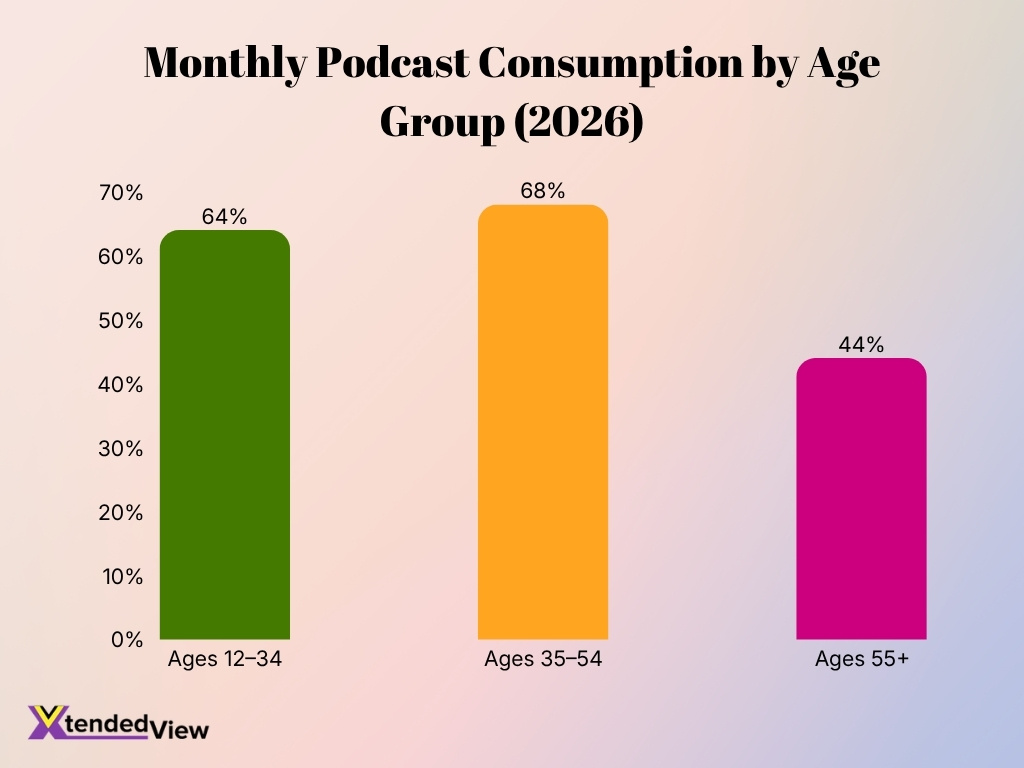
- Monthly podcast consumption among Americans ages 35–54 reached 68% in 2026, making this the highest-consuming age group in the survey.
- Monthly consumption among Americans age 55+ climbed to 44% in 2026, compared with 38% in 2025.
- Video podcasting reached a major crossover point in Q3 2025: 82% of weekly podcast consumers watched video, while 78% consumed audio-only podcasts.
Recent Developments
- U.S. monthly podcast consumption moved from 55% in 2025 to 58% in 2026, adding roughly 9 million monthly consumers in one year.
- Weekly podcast consumption grew even faster, rising from 40% to 45% of Americans age 12+ between 2025 and 2026.
- The number of Americans who had ever consumed a podcast rose from about 210 million in 2025 to 230 million in 2026, a gain of approximately 20 million people.
- In 2026, 57% of Americans age 12+ had both listened to and watched podcasts, showing how audiences increasingly move between audio and video formats.
- In 2025, 51% of Americans age 12+ had watched a podcast at least once, while 48% had both listened to and watched podcasts.
- Video consumption overtook audio-only podcast consumption among weekly consumers in Q3 2025, reaching 82% versus 78%, respectively. In 2023, the corresponding figures were 73% for video and 89% for audio-only.
- U.S. podcast advertising revenue increased 17.6% year over year in 2025, reaching $2.862 billion after generating $2.433 billion in 2024.
- Total time spent with podcasts among Americans age 13+ reached 773 million hours per week in 2025, representing a 355% increase from 2015.
Global Podcast Industry Statistics
- One market model valued the global podcasting industry at $30.7 billion in 2024 and estimated that it would reach $50.8 billion in 2026.
- Under the same model, global podcasting revenue could reach approximately $131.1 billion by 2030, reflecting a 27% compound annual growth rate from 2025 through 2030.
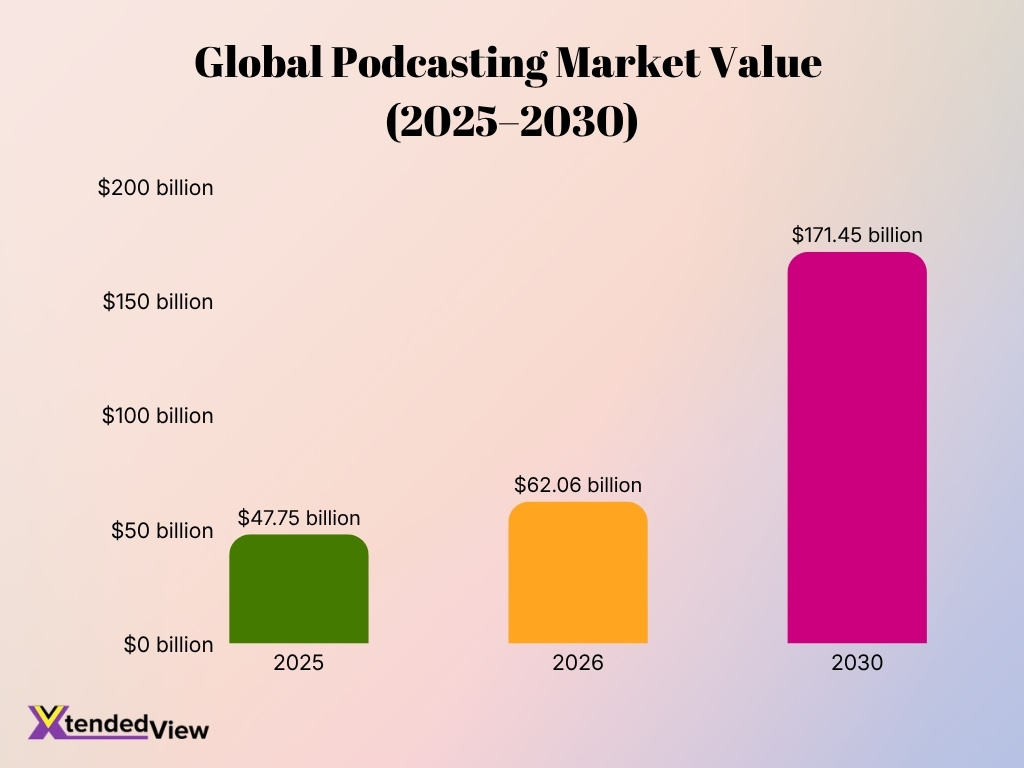
- A separate 2026 analysis estimated the market at $47.75 billion in 2025 and projected $62.06 billion in 2026, illustrating how definitions can materially change industry valuations.
- That analysis forecasts the global podcasting market reaching $171.45 billion by 2030, with an estimated 28.9% compound annual growth rate from 2026 through 2030.
- Another forecast placed the industry at $30.43 billion in 2025 and $32.65 billion in 2026, with a projected value of $81.32 billion by 2031.
- North America accounted for approximately 38% of global podcasting revenue in 2024 under one industry estimate, showing the region’s continued commercial weight.
- India had approximately 177 million monthly podcast listeners in 2024, up from 154 million in 2023. That audience is projected to reach 267 million by 2029.
- India’s podcast audience is projected to expand at an 8.5% compound annual growth rate through 2029, while podcast advertising revenue is expected to rise from just over $39 million in 2024 to more than $57 million in 2029.
- The global podcast advertising market was estimated at $23.9 billion in 2025 under a broader market definition, with a 2026 estimate of $28.5 billion.
- Within that global advertising estimate, North America represented 35.3% of 2025 revenue, while the Middle East and Africa were forecast to post the highest regional growth rate through 2033 at 9.1% annually.
Podcast Listener Statistics
- In 2026, 58% of Americans age 12+ consumed a podcast during the previous month, representing roughly 167 million people.
- Weekly podcast consumption reached 45% of Americans age 12+, or an estimated 130 million people, in 2026.
- By comparison, 2025 recorded approximately 158 million monthly podcast consumers and 115 million weekly consumers in the U.S.
- About 230 million Americans age 12+ had ever listened to or watched a podcast by 2026, giving the medium an 80% lifetime reach.
- In 2025, 70% of Americans age 12+ had listened to a podcast, while 51% had watched one.
- The combined audio-or-video definition placed lifetime podcast consumption at 73% in 2025, representing approximately 210 million Americans.
- In 2025, 37% of Americans age 12+ watched a video podcast monthly, while 26% watched one during the previous week.
- Daily podcast consumers devoted 36% of their total daily audio time to podcasts in early 2026 and 51% of their ad-supported audio time to the format.
- Podcast audiences also consume more audio overall. Daily podcast consumers averaged 5 hours and 11 minutes of total audio per day, 74 minutes more than the 3 hours and 57 minutes recorded across the broader U.S. population age 13+.
Podcast Listenership Growth Trends
- U.S. monthly podcast consumption increased by 3 percentage points between 2025 and 2026, moving from 55% to 58% of people age 12+.
- The estimated U.S. monthly audience expanded from 158 million to 167 million over the same period, adding about 9 million consumers.
- Weekly podcast consumption increased by 5 percentage points year over year, from 40% in 2025 to 45% in 2026.
- The estimated weekly U.S. podcast audience grew by approximately 15 million people, from 115 million in 2025 to 130 million in 2026.
- Podcast lifetime consumption increased from 73% of Americans age 12+ in 2025 to 80% in 2026, although the latest benchmark includes both listening and viewing.
- The U.S. monthly podcast audience more than tripled over a decade, rising from about 46 million people in 2015 to 158 million in 2025.
- Weekly podcast consumption grew even faster over that period, increasing from approximately 27 million Americans in 2015 to 115 million in 2025.
- Total weekly time spent with podcasts among Americans age 13+ increased 355% between 2015 and 2025, reaching approximately 773 million hours per week.
- Female monthly podcast consumption illustrates the medium’s long-term expansion: the rate rose from 16% in 2015 to 45% in 2025, nearly tripling over 10 years.
- Older audiences represent another major growth opportunity. Monthly podcast consumption among Americans age 55+ increased from 38% in 2025 to 44% in 2026, narrowing a demographic gap that once defined podcasting.
Podcast Audience Demographics
- Americans ages 35–54 recorded the highest monthly podcast consumption rate in 2026 at 68%, overtaking the 12–34 age group.
- Monthly consumption among Americans ages 12–34 stood at 64% in 2026, compared with 66% in 2025.
- Among adults age 55+, monthly podcast consumption reached 44% in 2026, up from 38% in 2025 and 21% in 2023.
- Monthly podcast consumption among men age 12+ reached 62% in 2026, compared with 54% among women.
- In 2025, the corresponding monthly rates were 57% for men and 52% for women, showing continued expansion among both groups.
- Female monthly podcast listening rose from 16% in 2015 to 45% in 2025, highlighting one of the strongest long-term demographic shifts in podcast adoption.
- Around 66% of Black Americans consumed podcasts monthly in 2026, putting consumption above the overall U.S. benchmark of 58%.
- Monthly consumption among Latino Americans reached approximately 60% in 2026, also exceeding the overall national rate.
- In the U.K., podcast consumption also spans generations: 61% of people ages 16–24, 56% of those ages 35–54, and 38% of adults age 55+ were monthly consumers in 2025.
Podcast Listening Frequency and Time Statistics
- Americans age 13+ spent approximately 812 million hours per week with podcasts in 2026, up from 167 million weekly hours in 2016. That represents growth of about 386% over 10 years.
- In 2025, Americans age 13+ spent 773 million hours per week listening to podcasts, meaning weekly consumption added roughly 39 million hours between the 2025 and 2026 measurements.
- Podcasts accounted for 10% of total daily audio time among Americans age 13+ during Q3 2025.
- The largest share of daily podcast listening occurred between 10 a.m. and 2 p.m., which accounted for 29% of total podcast listening time in Q3 2025.
- Morning listening between 6 a.m. and 10 a.m. represented 24% of daily podcast consumption, while the 2 p.m. to 6 p.m. period accounted for another 21%.
- Late-night listening remains meaningful: 11% of podcast consumption occurred between 10 p.m. and 2 a.m., while another 3% occurred between 2 a.m. and 6 a.m.
- Podcasts captured 40% of all time spent with spoken-word audio among Americans age 13+ in 2026, narrowly exceeding AM/FM radio’s 39% share.
- Among Americans ages 13–34, podcasts accounted for 53% of spoken-word listening time, compared with 23% for AM/FM radio.
- At-home listening continues to dominate podcast consumption. About 63% of weekly U.S. podcast consumers said they listened most often at home in the latest measurement, up from 48% in 2019 and 58% in 2020.
Podcast Consumption by Country and Region
- In the U.S., 58% of people age 12+ consumed a podcast during the previous month in 2026, while 45% consumed one during the previous week.
- In the U.K., 51% of people age 16+ consumed podcasts monthly in 2025, while 33% were weekly consumers and 71% had consumed a podcast at least once.
- Australia’s monthly audio-or-video podcast consumption reached 52% in 2025, putting the market close to U.S. and U.K. mainstream adoption levels.
- Among Australians ages 18–34, 72% consumed podcasts monthly in 2025. The rate fell to 55% for ages 35–54 and 25% among people age 55+.
- Canada reached nearly 16 million monthly adult podcast listeners in 2025, equivalent to about 46% of adults age 18+. Monthly consumption increased roughly 7% during the year.
- In 2024, 36% of Canadian adults listened to podcasts weekly. Weekly listening reached 49% among adults ages 18–34 and 44% among those ages 35–49.
- India recorded approximately 177 million monthly podcast listeners in 2024, up from 154 million in 2023, representing an increase of about 23 million listeners in one year.
- India’s monthly podcast audience is projected to reach 267 million by 2029, representing an estimated 8.5% compound annual growth rate.
- Across one large podcast-hosting dataset in July 2026, the U.S. generated 46.2% of downloads, followed by Japan at 6.6%, the U.K. at 5.3%, Canada at 4.1%, Australia at 3.9%, and Germany at 2.7%.
Podcast Download and Audience Engagement Statistics
- One major hosting dataset recorded approximately 88.0 million podcast downloads in July 2026 across 112,701 active podcasts and 145,848 newly published episodes.
- In January 2026, the same dataset recorded 96.6 million monthly downloads, 154,446 new episodes, and 117,929 active podcasts.
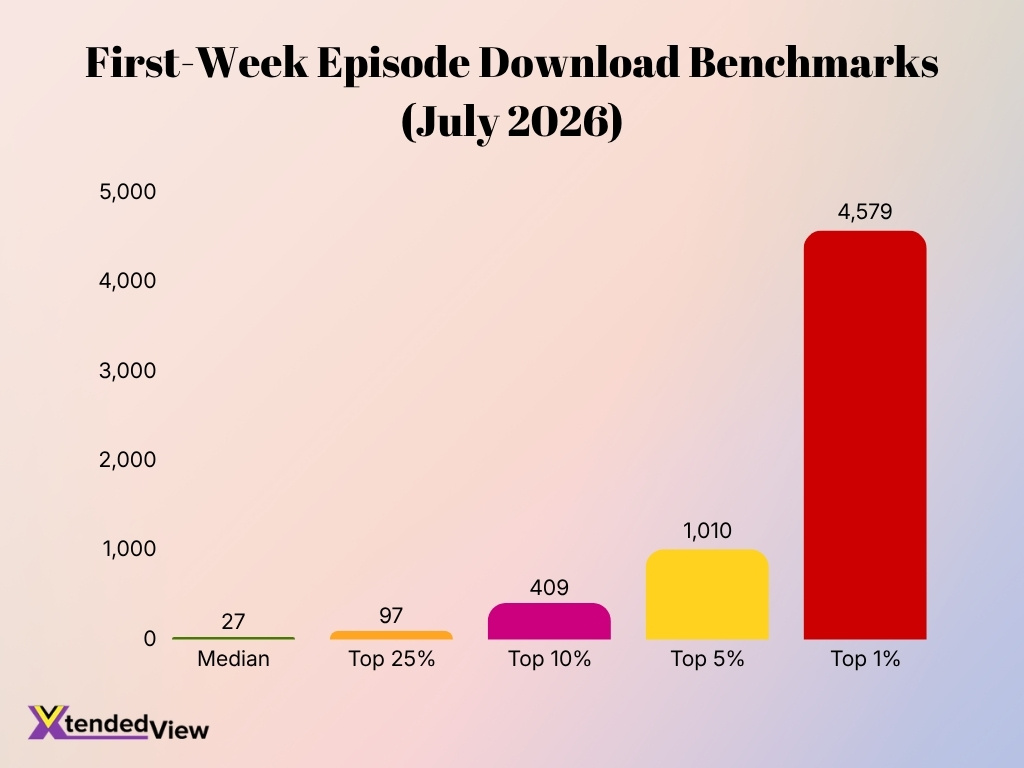
- A median podcast episode received 27 downloads during its first seven days in July 2026. An episode needed roughly 97 first-week downloads to rank in the top 25%.
- Reaching the top 10% required approximately 409 downloads within seven days in July 2026, while the top 5% threshold stood at 1,010 downloads.
- An episode needed approximately 4,579 first-week downloads to rank in the top 1% during July 2026.
- By comparison, the January 2025 top-10% threshold was 469 seven-day downloads, while the median stood at 28 and the top-1% threshold at 4,719.
- Episode length remains concentrated in the middle: 30% of episodes ran 20–40 minutes in July 2026, while 19% ran 40–60 minutes and 13% exceeded one hour.
- Publishing frequency also shows a clear pattern. In July 2026, 38% of active shows released episodes every eight to 14 days, while 34% published every three to seven days.
- Video can increase cross-format engagement. Among newer podcast consumers, 72% said they had started listening to an audio-only version after first discovering the podcast through video; the corresponding rate among long-time listeners was 68%.
- Podcast advertising also prompts measurable audience action: 76% of U.S. weekly podcast consumers reported taking at least one action after hearing a podcast advertisement in 2026.
Podcast Genre and Category Statistics
- Comedy maintains the leading position as the largest podcast genre by U.S. weekly reach.
- Society and culture historically occupies the No. 2 position by weekly audience reach.
- True crime reaches 22% of U.S. weekly podcast listeners who are age 13+.
- An estimated 119 million people, or 42% of Americans age 13+, have listened to true crime.
- A massive 89% of weekly consumers have binge-listened to true crime podcasts.
- 57% of true crime listeners are attracted by story fascination, while 50% seek suspense.
- Active video consumption for news, sports, and history podcasts grew by over 200% in 2025.
- Comedy podcasts generated nearly 6 million comments and 1.25 million replies during 2025.
Podcast Discovery Statistics
- Among Gen Z monthly podcast consumers, 28% discover podcasts most often by searching on YouTube, making it the leading discovery method for that age group.
- Social media posts rank second for Gen Z discovery, with 26% identifying social content as their most common route to new podcasts.
- Friends and family remain important, accounting for the primary podcast discovery method for 19% of Gen Z consumers.
- Discovery differs within Gen Z itself. Among people ages 18–24, 32% primarily discover podcasts through YouTube searches, compared with 25% of listeners ages 13–17.
- Social media drives discovery for 27% of podcast consumers ages 18–24 and 23% of those ages 13–17.
- Younger teenagers rely more heavily on personal recommendations: 27% of consumers ages 13–17 primarily discover podcasts through friends or family, compared with only 14% among ages 18–24.
- Traditional internet search remains relevant but secondary, accounting for the main discovery path for 14% of ages 13–17 and 16% of ages 18–24.
- Among Gen Z sports podcast listeners, 85% use social media to find sports podcasts, while 83% of Millennial sports podcast listeners do the same.
- Short video promotion can materially improve discovery. Podcast clips on one major platform were 33% more effective than standard previews at converting people browsing content into potential listeners in early measurements.
Podcast Listening Platform and Device Statistics
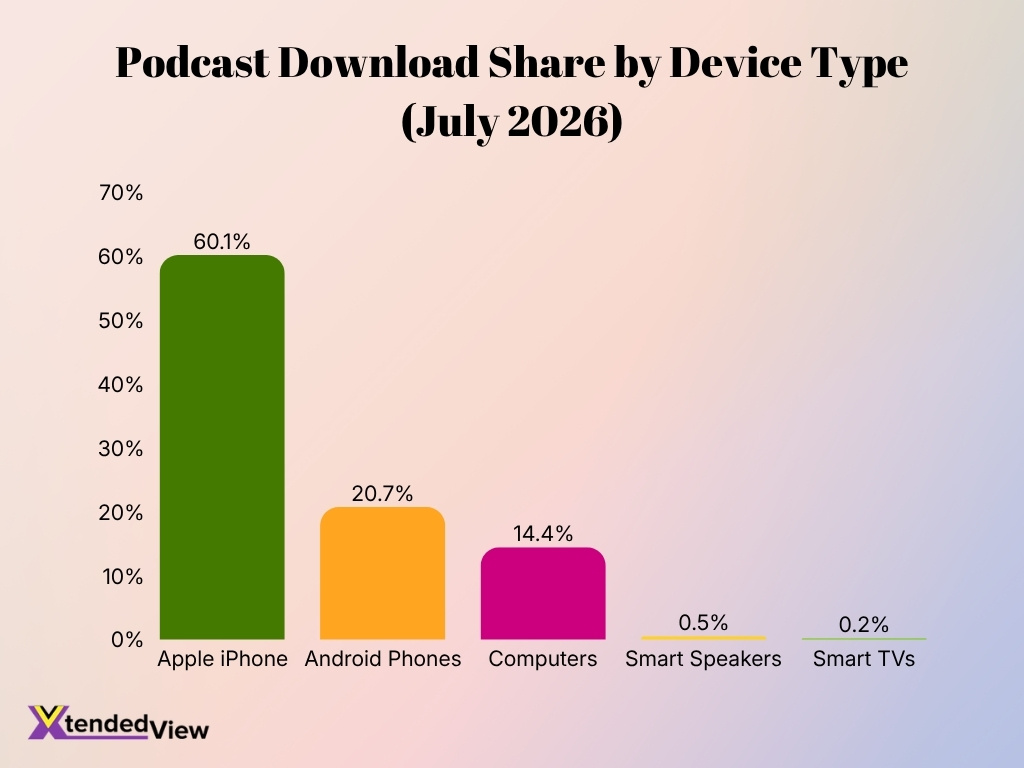
- In July 2026, 81.6% of downloads in one large hosting dataset came from mobile devices, while computers accounted for 14.4%.
- Apple iPhone represented 60.1% of device-level downloads in July 2026, while Android phones accounted for 20.7%.
- In June 2026, mobile devices represented 86.8% of podcast downloads, including 64.6% from Apple iPhone and 21.4% from Android phones.
- Device usage can fluctuate meaningfully month to month. In April 2026, computers generated 22.3% of downloads, compared with 74.4% from mobile devices.
- Smart speakers generated only about 0.5% of downloads in July 2026, while smart TVs accounted for roughly 0.2% in the same dataset.
- However, survey-based consumption shows stronger TV growth than download logs alone capture. The share of U.S. podcast consumers who used a smart TV most often increased from 1% in 2021 to 9% in the latest study.
- In the U.K., 66% of weekly podcast consumers listened most often on a smartphone in 2025.
- Smart TV use in the U.K. doubled in two years: 8% of weekly podcast consumers used a smart TV most often in Q1 2025, compared with 4% in Q1 2023.
- Australian podcast consumption remains heavily mobile, with smartphones responsible for approximately 95.4% of measured podcast consumption in 2025.
- At-home behavior helps explain the rise of larger screens: approximately 63% of weekly U.S. podcast consumers now consume podcasts most often at home.
Spotify, Apple Podcasts, and YouTube Podcast Statistics
- YouTube reported more than 1 billion monthly active viewers of podcast content as of January 2025.
- Podcast viewing on YouTube living-room devices exceeded 700 million hours in October 2025, up from about 400 million monthly hours a year earlier.
- YouTube became the most-used podcast service among 29% of weekly U.K. podcast consumers in 2026, narrowly ahead of Spotify at 28%.
- Among Gen Z weekly podcast listeners in the U.S., 36% used YouTube most often for podcasts in 2025, while 35% used Spotify most often.
- Spotify now hosts more than 430,000 shows with video, while about 350 million people streamed a video podcast on the service during the previous year.
- Time spent with video content on Spotify more than doubled year over year in 2025, with video podcast consumption providing most of that growth.
- Earlier platform data showed more than 250 million users had watched a podcast on Spotify by late 2024, while the number of users consuming video podcasts had increased 88% in one year.
- Apple Podcasts produced approximately 31.8 million downloads across one large hosting network in July 2026, compared with 23.3 million for Spotify and 12.5 million through web browsers.
- In January 2026, Apple Podcasts generated about 36.2 million downloads, versus 26.9 million through Spotify. This illustrates why app-use surveys and server-side download measurements can produce different platform rankings.
- In the U.K. during 2025, Spotify reached 37% of podcast listeners each week, YouTube reached 34%, and Apple Podcasts reached 16%, highlighting substantial multi-platform consumption.
Video and Audio Podcast Statistics
- Among first-year podcast consumers, 77% actively watch video podcasts, compared with 75% who consume audio-only podcasts. This suggests video plays an especially important role in attracting newer audiences.
- First-year listeners represent about 20% of U.S. weekly podcast consumers, while people who have listened for at least five years account for 25%. The difference creates a sizable audience whose habits developed during the rise of video podcasting.
- In a 2025 survey, 42% of video podcast consumers said they expected to increase the amount of time they spend with podcasts during the following year, compared with 28% of audio-only listeners.
- Adding audio and video podcast placements to an existing cable TV advertising plan produced 11% incremental reach in a 2025 U.S. consumer study.
- Combining podcast audio and video with radio advertising generated 10% additional reach, while the incremental reach measured against social media campaigns was 7%.
- Video podcast viewers use a wider range of screens. 61% of weekly video podcast consumers had consumed podcasts on a TV, compared with 49% of weekly audio-only podcast consumers.
- Computers also play a larger role for video-oriented audiences: 71% of active video viewers had used a computer for podcasts, compared with 64% of audio-only listeners.
- Among new podcast consumers, 72% said discovering a show through video later led them to its audio version. Among long-term podcast consumers, the corresponding figure was 68%, showing that video can feed rather than replace audio listening.
- More than 500 million users had streamed a video podcast on one major audio platform by May 2026, an increase of nearly 50% year over year.
- Video podcasts are moving further into the living room. One large video platform reported that podcast viewing on TV devices rose from about 400 million monthly hours in 2024 to more than 700 million hours in October 2025.
Podcast Production and Artificial Intelligence Statistics
- A Q2 2026 survey of independent podcasters found that 56% were already using or experimenting with AI for their shows. This included 28% who used AI regularly and another 28% who were testing it.
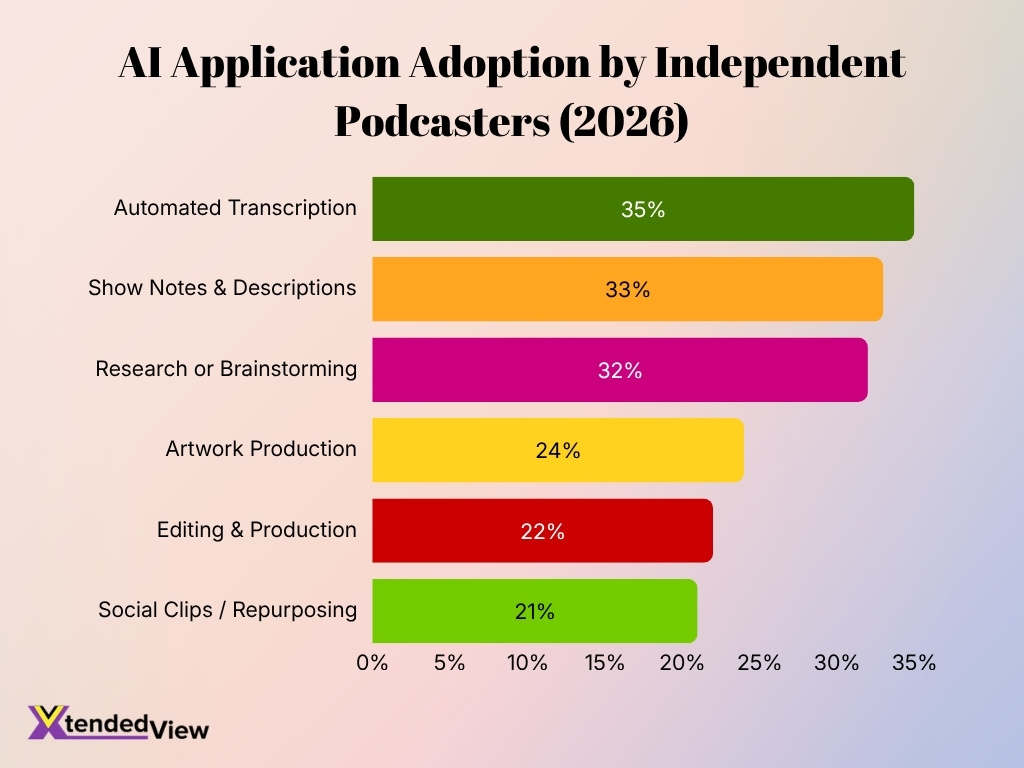
- Automated transcription ranked as the most common AI application in that 2026 survey, used by 35% of respondents.
- AI-generated show notes and episode descriptions were used by 33% of surveyed podcasters, making metadata creation another major automation use case.
- About 32% used AI for research or brainstorming, indicating that the technology increasingly enters the workflow before recording begins.
- Generative tools supported artwork production for 24% of respondents, including podcast covers and individual episode graphics.
- AI-assisted editing and production tools were used by 22% of podcasters, while 21% used AI to create social clips or repurpose existing episodes.
- In a separate 2025 survey of 558 independent creators, 38% used AI-generated transcripts, while 30% used AI for research, ideas, or episode planning.
- That 2025 study found 27% used AI-assisted editing or sound enhancement, while 21% applied AI to podcast marketing tasks.
- Synthetic hosts remain a niche application. Only 3% of independent podcasters in the 2025 study reported using AI voice cloning or synthetic hosting technology.
- Podcast production still requires meaningful creator investment. In 2026, 72% of surveyed podcasters paid for podcast-related tools or services, while 27% specifically paid for AI tools.
Podcast Monetization and Revenue Statistics
- In a 2026 independent podcaster survey, only 39% of respondents were currently monetizing their podcasts, while 61% reported no podcast revenue.
- Among creators who had not monetized, 28% said they wanted to prioritize audience growth first, indicating that scale often comes before revenue generation.
- Another 17% of nonmonetizing podcasters said they did not know how to monetize, while 13% were unsure which monetization options were available to them.
- In a 2025 study of independent creators who had tried monetization, 65% had used sponsorships or advertising, making it the most commonly attempted revenue stream.
- Paid memberships and subscriptions had been used by 48% of monetizing creators, placing recurring listener payments second among the measured revenue models.
- Listener donations or crowdfunding had been tried by 31% of monetizing podcasters, while 29% had generated revenue through consulting, coaching, or mentorship.
- Merchandise and creator-owned products each had been used by 27% of monetizing respondents, showing that some podcasters treat their shows as customer-acquisition channels for a wider business.
- Live events had been used as a revenue stream by only 12% of surveyed creators, making them substantially less common than ads, subscriptions, or direct listener support.
- When creators identified their single most profitable revenue stream, 41% selected sponsorships or advertising, while 23% chose paid subscriptions.
- Consulting, coaching, or mentorship ranked as the most profitable podcast-linked revenue source for 15% of monetizing creators, compared with 5% for listener donations and 4% each for merchandise and product sales.
Podcast Advertising and Sponsorship Statistics
- Host-read advertising accounted for 62.4% of global podcast advertising revenue in one 2025 market analysis, giving creator-delivered messages the largest share among measured ad types.
- Direct-response campaigns represented 65.2% of the podcast advertising market in 2025, highlighting the medium’s continued importance for performance-oriented advertisers.
- Typical host-read pricing in the same market analysis ranged from $21 to $24 CPM for a 30-second placement and $25 to $28 CPM for a 60-second placement.
- Dynamically supplied podcast ads are forecast to expand at an annual rate of more than 11% through 2033, supported by scalable targeting and insertion across multiple episodes.
- In a 2025 cross-media study, 86% of near-daily podcast users recalled hearing advertising during the previous week, the highest recall among the ad-supported media measured.
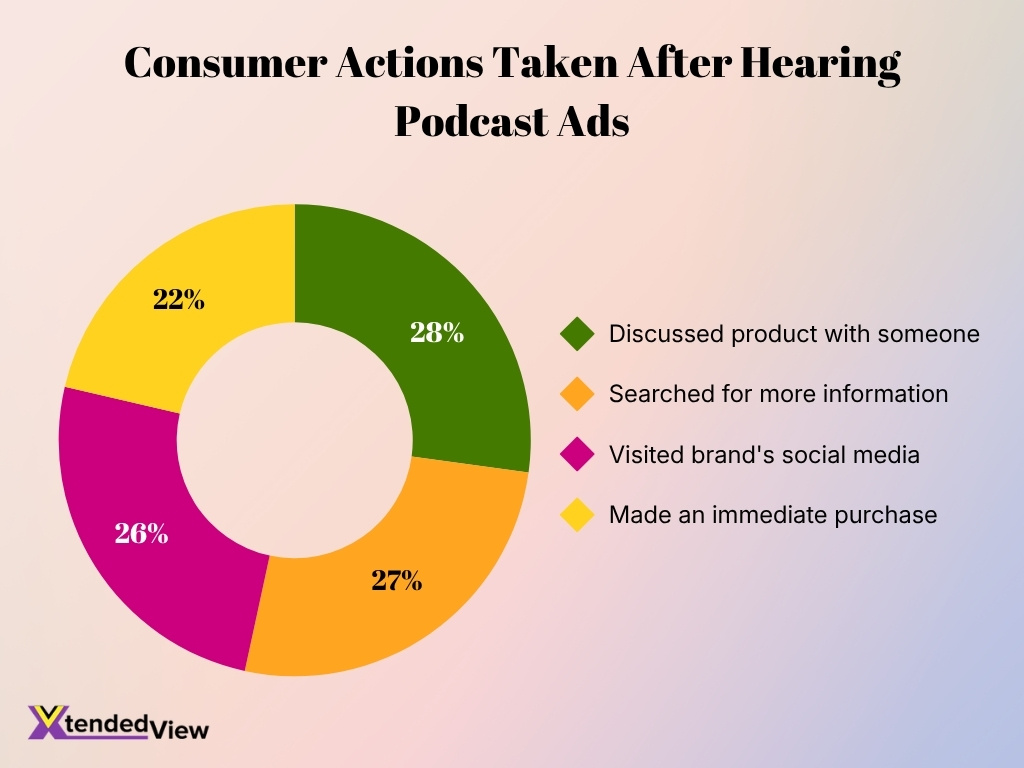
- About 28% of heavy podcast users said they had discussed a product with someone else after hearing it advertised on a podcast. Another 27% searched for more information about an advertised brand.
- Podcast ads sent 26% of heavy users to a brand’s social media presence, while 22% reported making an immediate purchase after exposure to a podcast ad.
- Recent brand-lift benchmarks found podcast ad exposure produced an average 11.6-point lift in purchase intent, alongside an 8.8-point increase in consideration.
- The same benchmark data recorded an average 11.4-point improvement in brand rating and a 2.6-point gain in brand familiarity among consumers exposed to podcast advertising.
- A 2025 academic study examined 512 podcast consumers exposed to branded content and found that attitudes toward the podcaster, brand integration, and the listener-host relationship influenced brand attitudes, recall, and behavioral intentions.
Podcast Industry Future Trends
- One 2026 market forecast expects the global podcast advertising sector to reach $43.8 billion by 2033, representing a 6.3% compound annual growth rate from 2026 onward.
- The Middle East and Africa are projected to record the fastest regional podcast advertising expansion, with an estimated 9.1% annual growth rate through 2033.
- A broader podcast-industry model expects the U.S. market to grow at more than 19% annually through 2030, supported by streaming, smart devices, and personalized content.
- Asia-Pacific is expected to become the fastest-growing podcasting region through 2030 under that broader market model, while North America remains the largest established commercial market.
- Video adoption appears likely to continue among creators. A 2025 independent podcaster study found 32% of creators who were not producing video were considering adding it, while only 19% had ruled video out.
- Among podcasters already publishing video in a 2026 creator survey, 63% said video had helped grow their audience, giving creators a measurable reason to maintain dual-format production.
- Production frequency is already high: 62% of surveyed podcasters published weekly or more often in 2026, suggesting workflow automation could become increasingly important as creators add video and social assets.
- Audience growth remains the central operational problem. 70% of podcasters in the same 2026 survey selected audience growth as one of their biggest challenges, and 46% named growth as their primary current goal.
- The wider creator advertising economy is projected to reach $44 billion in U.S. spending in 2026, creating a larger commercial market in which podcast hosts increasingly compete alongside video and social creators for brand budgets.
- Future podcast distribution will also spread across more screens. By 2026, one major podcast catalog supported transcripts for more than 125 million episodes in 13 languages, while its new video infrastructure expanded podcasts across phones, tablets, computers, headsets, the web, and connected TVs.
Frequently Asked Questions (FAQs)
About 167 million Americans age 12+, or 58%, consumed a podcast in the previous month in 2026.
Around 130 million Americans age 12+, equal to 45% of the population, consumed podcasts weekly in 2026.
U.S. podcast advertising revenue reached approximately $2.86 billion in 2025, up 17.6% year over year from $2.43 billion in 2024.
YouTube has more than 1 billion monthly active podcast viewers, while Premium users alone watched over 800 million podcast hours in April 2026.
In Q3 2025, 82% of weekly podcast consumers actively watched video podcasts, compared with 78% who consumed audio-only podcasts.
Conclusion
Podcast statistics show a medium that now spans long-form audio, video, connected TVs, AI-assisted production, subscriptions, advertising, and social discovery. Video is expanding reach without replacing audio, while creators increasingly rely on mixed revenue models and multiformat distribution. The strongest podcast strategies now combine audio accessibility, visual distribution, searchable content, audience trust, and diversified revenue. Overall, the data points toward continued growth, with future success depending on how effectively creators help audiences discover, consume, and financially support their content.
