


Smart TVs have evolved from simple internet-connected displays into central entertainment hubs for modern households. Consumers now use them for streaming movies and live sports, accessing free ad-supported channels, gaming, video apps, and voice-enabled controls without relying on multiple external devices. At the same time, manufacturers are competing through larger screens, 4K and premium display technologies, while advertisers and streaming platforms are using connected TV interfaces to reach audiences directly on the biggest screen in the home. These shifts make smart TV adoption, usage, shipments, operating systems, and advertising trends increasingly important indicators of how television consumption is changing
Editor’s Choice
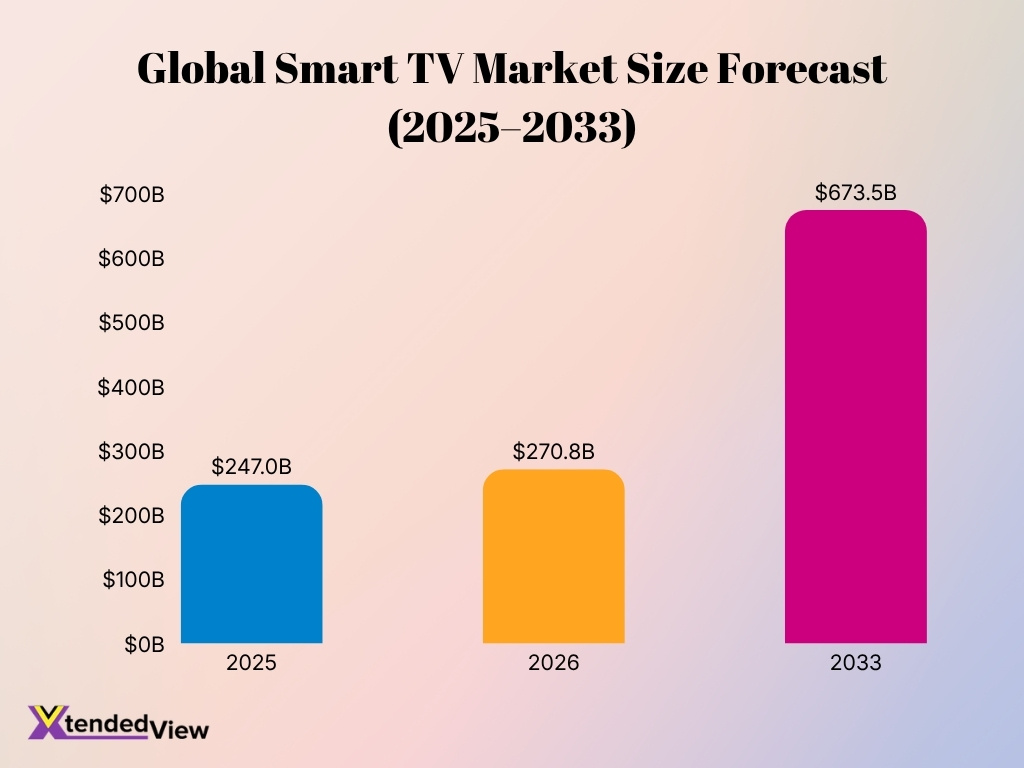
- The worldwide smart TV market reached approximately $247.0 billion in 2025.
- The market is estimated to reach $270.8 billion in 2026, an increase of roughly $23.8 billion from the 2025 estimate.
- Global smart TV revenue could reach $673.5 billion by 2033 under one current industry forecast.
- That forecast represents a 13.9% CAGR from 2026 through 2033.
- Asia-Pacific generated 40.0% of worldwide smart TV revenue in 2025, making it the largest regional market in that dataset.
- 4K UHD TVs represented 56.0% of smart TV market revenue by resolution in 2025 in one current market assessment.
- India offered one of 2026’s clearest signs of premiumization: TVs measuring 55 inches and above represented nearly one-third of Q1 2026 smart TV shipments.
Recent Developments
- Global TV shipments increased 1% year over year in Q4 2025, indicating modest hardware growth as the industry entered 2026.
- In December 2025 alone, worldwide TV shipments were up 0.3% year over year.
- China moved in the opposite direction: TV shipments fell 18% year over year in December 2025 and declined 12% across the full year.
- India’s smart TV shipments ended 2025 broadly unchanged from a year earlier, but Q4 shipments grew 10% year over year as festive-season demand improved.
- Indian QLED smart TV shipments nearly doubled year over year in 2025, reflecting buyers’ shift toward more advanced displays.
- The trend accelerated in early 2026: QLED models captured about 30% of India’s smart TV shipments in Q1 2026.
- MiniLED was an even faster-growing niche in India, with shipments increasing more than 13 times year over year in Q1 2026, although they started from a small base.
- India’s overall smart TV shipments nevertheless fell 3% year over year in Q1 2026, as weaker entry-level demand offset premium-segment momentum.
- Globally, OLED TV panel shipments increased 14% quarter over quarter in Q4 2025 but remained 3% below the corresponding quarter a year earlier.
Global Smart TV Market Size and Growth
- One current assessment values the global smart TV market at $270.75 billion in 2026.
- Under that model, revenue is forecast to reach $308.31 billion by 2031.
- That more conservative forecast translates to a 2.63% CAGR through 2031, illustrating how market-size methodologies can generate substantially different growth outlooks.
- By comparison, another 2026 forecast expects smart TV revenue to grow at 13.9% annually through 2033.
- Based on the latter forecast, the market expands by approximately $402.7 billion between 2026 and 2033, from $270.8 billion to $673.5 billion.
- Online distribution accounted for 58.0% of smart TV market revenue in 2025 in one global assessment, emphasizing the importance of e-commerce in television purchases.
- LED technology represented 50.0% of global smart TV revenue in 2025 in the same dataset.
- The 46- to 55-inch category generated 36.0% of 2025 smart TV revenue by screen size, making it the leading screen-size segment in that analysis.
- A separate market model placed LED/LCD technology at 81.22% of 2025 smart TV revenue, further demonstrating how segmentation definitions affect market-share estimates.
Smart TV Market Share by Region
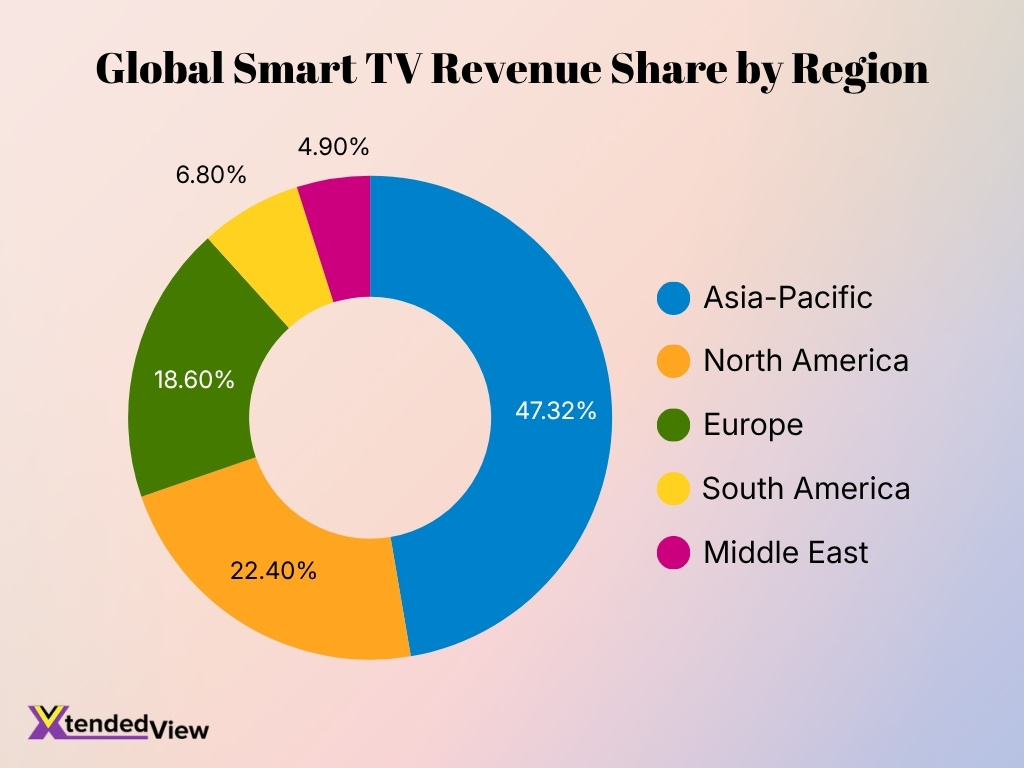
- Asia-Pacific accounted for 47.32% of 2025 smart TV revenue under one market model, the largest regional share reported in that dataset.
- North America accounted for 22.4% of global smart TV revenue in the same 2025 regional analysis.
- Europe represented another 18.6% of worldwide smart TV revenue in 2025.
- South America contributed approximately 6.8% of the 2025 smart TV market.
- The Middle East represented about 4.9% of smart TV revenue in 2025 under the same methodology.
- Africa is forecast to record a 3.12% CAGR through 2031, making it the fastest-growing geography in that particular market forecast.
- A separate global assessment placed Asia-Pacific at 40.0% of 2025 smart TV revenue and projected regional growth of more than 16% annually from 2026 through 2033.
- North America represented more than 29% of global smart TV revenue in 2025 under that alternative methodology, showing the impact of differing market definitions on regional estimates.
Smart TV Adoption Rates by Country
- In England, 76% of adults owned and used a smart TV at home in 2024/25, putting smart TVs well ahead of laptops, which reached 68% ownership.
- UK household smart TV penetration stood at approximately 69% in 2025, compared with 76% in 2024 in the referenced survey series.
- Australia recorded smart TV use among 64% of adults in 2025, 3 percentage points above the previous year.
- Separately, 74% of Australian adults lived in households with only a smart TV rather than a standard TV in 2025, up from 40% in 2020.
- Mexico’s smart TV penetration was estimated at roughly 75% to 80% of TV-owning households in a 2026 regional market assessment.
- In India, smart TV shipments fell 4% year over year in Q2 2025, showing that rising adoption does not automatically translate into uninterrupted shipment growth.
- However, India’s Q4 2025 smart TV shipments rebounded 10% year over year, offsetting the weaker first half and leaving full-year shipments broadly flat.
- India’s QLED segment continued gaining adoption in early 2026, with shipments in the INR 20,000-INR 30,000 price range tripling during Q1 compared with a year earlier.
- China remained the largest individual smart TV market by revenue in one global 2025 assessment, while Asia-Pacific overall generated 40% of worldwide revenue.
Smart TV Penetration in Households
- Approximately three-quarters of adults in England owned and used a smart TV at home in 2024/25, making connected televisions one of the most widely owned smart devices.
- The most common smart-device count among English households was one to three devices, reported by 47%, while another 30% had four to six smart devices.
- In the UK, 61% of adults aged 16-24 in the 2025 technology survey reported using streaming services through a smart TV, compared with 52% across the overall survey population.
- Among the oldest group shown in the same UK dataset, smart TV streaming use fell to 41%, illustrating an age-related gap in connected-TV behavior.
- Streaming boxes or sticks reached 22% of surveyed UK adults in 2025, substantially below the 52% who streamed directly through a smart TV.
- Australian households have undergone a particularly sharp transition: smart-TV-only household ownership increased from 40% in 2020 to 74% in 2025, a gain of 34 percentage points in five years.
- At the same time, standard-TV-only Australian households fell to 12% in 2025, underscoring the shrinking role of televisions without connected functionality.
- Across Australia, 95% of adults watched video content on a device at home in 2025, giving smart TVs a large addressable audience for streaming and connected entertainment.
- In the UK, the country had 29.0 million households in 2025; applying the separate 69% smart TV penetration estimate illustrates the substantial scale of the connected-TV household base, although the two figures come from different statistical datasets and should not be treated as a single survey result.
Smart TV Shipments and Sales Statistics
- Global TV shipments reached 93.74 million units in the first half of 2026, up 1.3% year over year and marking the strongest first-half volume since the COVID-19 pandemic began.
- Full-year global TV shipments are forecast at 194.65 million units in 2026, representing a 0.8% annual decline.
- Global TV shipments totaled approximately 61.5 million units in Q4 2025, remaining broadly flat from the same quarter in 2024.
- North American TV shipments increased 4.7% year over year in Q4 2025, despite softer-than-expected holiday sell-through.
- Western European shipments grew 3.2% during Q4 2025.
- Latin America and the Caribbean recorded a stronger 12.5% increase in Q4 2025 TV shipments.
- Middle East and Africa shipments increased 9.4% year over year in Q4 2025, helping offset weaker Chinese demand.
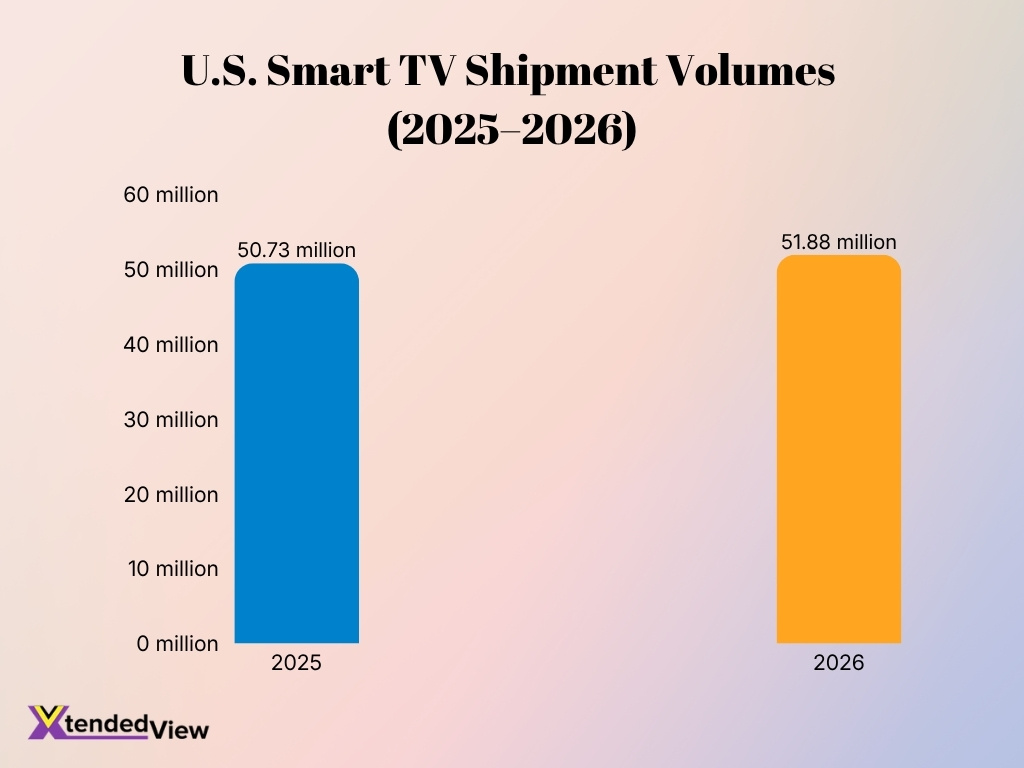
- The U.S. smart TV market represented an estimated 50.73 million units in 2025 and is projected to reach 51.88 million units in 2026.
- India’s smart TV shipments remained broadly unchanged during 2025, although Q4 shipments grew 10% year over year as seasonal purchases strengthened.
- In December 2025, worldwide TV shipments increased 1.6% year over year, while full-year shipments slipped about 0.13%.
Smart TV Revenue and Forecast Trends
- One August 2026 market estimate places worldwide smart TV revenue at $253.88 billion in 2025.
- Under the same model, global smart TV revenue is expected to reach $275.51 billion in 2026.
- The market could expand to $461.94 billion by 2032, adding more than $186 billion from the 2026 level.
- That forecast represents an 8.92% compound annual growth rate from 2026 through 2032.
- U.S. smart TV revenue is estimated at approximately $64.97 billion for 2025 under a separate current market model.
- U.S. revenue is projected to rise to about $69.05 billion in 2026.
- The same forecast puts U.S. smart TV revenue at $140.04 billion by 2033, more than double its estimated 2026 level.
- U.S. smart TV market revenue is forecast to increase at a 10.6% CAGR from 2026 through 2033.
- India’s smart TV market was valued at approximately $2.78 billion in 2025 and is forecast to reach close to $5.99 billion by 2032.
- The Indian market is projected to grow at an 11.62% CAGR, highlighting stronger long-term expansion potential in a less saturated market.
Smart TV User Demographics
- 83% of U.S. adults reported watching streaming services in a 2025 survey, giving smart TVs and other connected-TV devices a broad addressable audience.
- Approximately nine in 10 U.S. adults under age 50 reported watching streaming programming in 2025.
- By comparison, only 36% of U.S. adults said they currently subscribed to cable or satellite television at home.
- Among Australian adults ages 35-44, 68% used a smart TV to stream video at home in 2025, up from 62% in 2024.
- Smart TV streaming use among Australians aged 55-64 reached 71% in 2025, compared with 64% a year earlier.
- Among Australian men, 63% streamed video through a smart TV in 2025, an increase from 57% in 2024.
- Smart TV streaming among adults living in Australian metropolitan areas reached 62%, up from 57% the previous year.
- Australians aged 75 and older remained more attached to older hardware: 22% lived in homes with only a standard TV in 2025, a higher rate than among younger age groups.
- Higher-income U.S. adults remained the most likely demographic to stream in 2025, although roughly three-quarters or more of middle- and lower-income adults also watched streaming services.
Smart TV Operating System Market Share
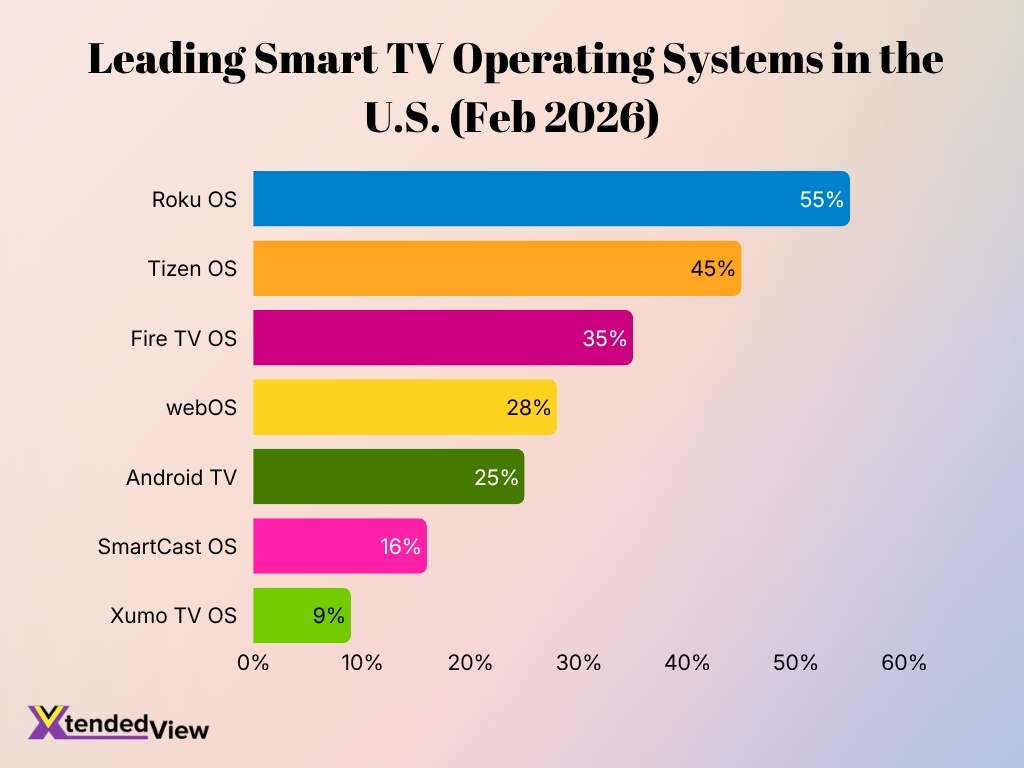
- In a February 2026 U.S. survey of households that streamed through smart TVs or streaming media players, Roku OS was used by 55% of respondents.
- Tizen OS reached 45% of respondents, ranking second in the same U.S. survey.
- Fire TV OS was used by 35% of surveyed streaming households.
- webOS reached 28% of respondents in February 2026.
- Android TV appeared in 25% of surveyed U.S. households using smart TVs or streaming media players.
- SmartCast OS accounted for 16% of respondents in the same survey.
- Xumo TV OS had reached 9% of respondents, giving the newer platform measurable U.S. penetration by early 2026.
- On a global shipment basis, Android-based TV platforms represented approximately 42% of smart TV OS shipments in 2025, although that figure includes several Android variants.
- Tizen represented about 17% of global TV OS shipments in 2025 and is projected to hold roughly 16% in 2029.
- Vidaa is forecast to increase from 6% of global shipments in 2025 to nearly 8% in 2029, making it one of the faster-growing TV operating systems.
Smart TV Usage Patterns and Viewing Time
- Streaming represented 48.6% of total U.S. TV watch time in May 2026, setting a new high at the time.
- In June 2026, streaming remained at approximately 48.5% of TV viewing, despite increased broadcast viewing tied to major live sports.
- YouTube reached a platform-record 13.8% of U.S. TV watch time in May 2026, highlighting the increasing role of internet video on television screens.
- Netflix accounted for 8.0% of total TV viewing in May 2026.
- Prime Video reached a platform-best 4.5% of U.S. TV watch time in May 2026.
- The Roku Channel generated 3.1% of television viewing during May 2026.
- Tubi represented another 2.3% of total TV viewing, demonstrating the growing role of free ad-supported streaming.
- Earlier, streaming accounted for 47.0% of U.S. television usage in January 2026, while streaming time increased 2.7% from December.
- Streaming reached 47.5% of total television viewing in December 2025, then a record daily volume of 55.1 billion streaming minutes occurred on Christmas Day.
- In June 2025, children and teens ages 6-17 devoted 66% of their total TV time to streaming, illustrating how strongly younger viewers favor connected content.
Most Popular Smart TV Brands
- Samsung led worldwide TV shipments in Q1 2026 with a 17% share, maintaining the top global position.
- TCL ranked second with 14% of Q1 2026 global shipments, narrowing the gap with the market leader.
- Hisense captured 13% of worldwide TV shipments during Q1 2026.
- LG accounted for 9% of global shipments in Q1 2026 and maintained essentially the same quarterly share throughout 2025.
- Across full-year 2025, Samsung retained first place with approximately 15% of global unit shipments.
- TCL briefly moved into first place in December 2025 with a 16% global shipment share, following 10% year-over-year shipment growth that month.
- Samsung generated 29.1% of global TV revenue in 2025, reflecting its stronger positioning in higher-priced products than its unit share alone suggests.
- Samsung captured 54.3% of the premium TV market priced above $2,500 in 2025.
- Hisense accounted for 57.1% of worldwide shipments of TVs measuring 100 inches and above in 2025, highlighting its strength in ultra-large displays.
- The five largest brands collectively controlled about 62% of global smart TV unit shipments in 2025, indicating a moderately concentrated market.
Smart TV Screen Size Market Share
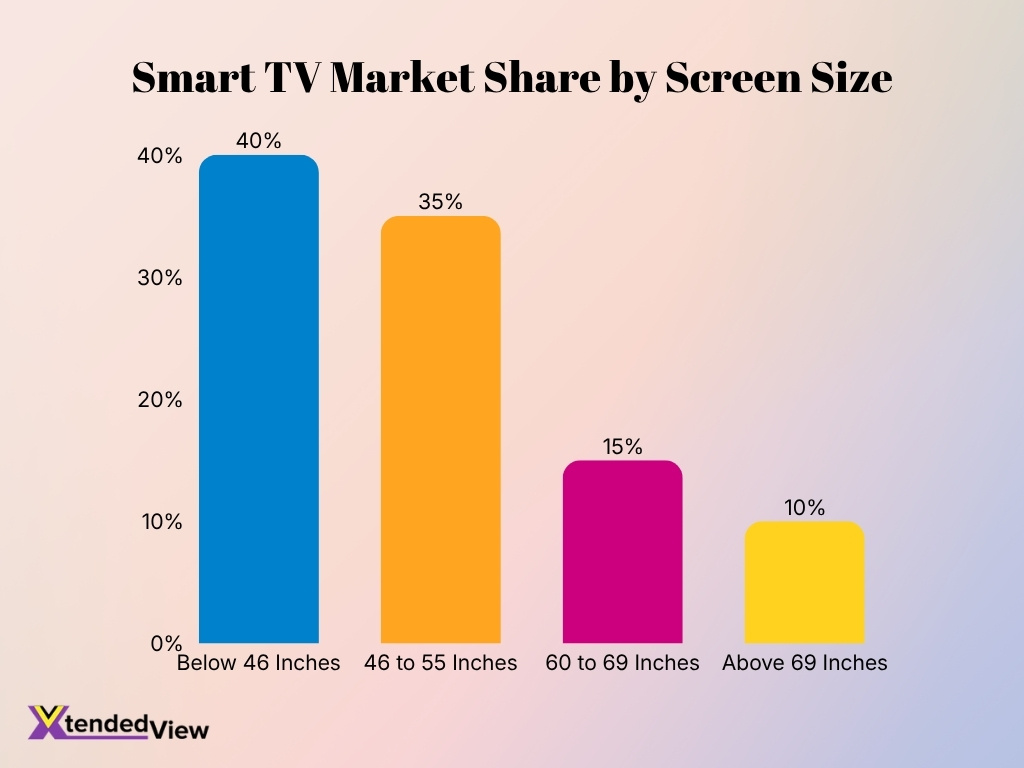
- Smart TVs below 46 inches lead the market with approximately 40% share, driven largely by first-time buyers and demand for TVs in bedrooms and secondary rooms.
- The 46-to-55-inch category accounts for 35% of the market, making it a mainstream choice for living rooms due to its favorable price-to-screen-size balance.
- Larger 60-to-69-inch Smart TVs represent 15% of the market, with demand concentrated among consumers seeking premium home theater and gaming experiences.
- Smart TVs above 69 inches hold roughly 10% market share, reflecting a smaller but notable ultra-premium segment focused on large-screen entertainment.
- Combined, Smart TVs 55 inches and below capture about 75% of the market, indicating that mainstream and compact screen sizes continue to dominate consumer demand.
Smart TV Streaming App Usage Statistics
- Streaming captured 48.6% of total U.S. TV viewing time in May 2026, up from 44.8% in May 2025.
- YouTube represented a record 13.8% of U.S. TV watch time in May 2026, making it the largest individual media distributor measured that month.
- Netflix accounted for 8.0% of total U.S. TV viewing in May 2026.
- Disney streaming properties collectively represented 4.9% of TV watch time during May 2026.
- Prime Video reached a record 4.5% share of U.S. television usage in May 2026.
- The Roku Channel accounted for 3.1% of total U.S. TV viewing in May 2026, showing that free ad-supported apps now compete for meaningful television time.
- Tubi generated 2.3% of U.S. television watch time in May 2026.
- Paramount streaming services also held 2.3% of TV usage, while Peacock accounted for 1.8% in May 2026.
- During December 2025, Netflix reached 9.0% of all TV viewing, Prime Video reached 4.3%, and The Roku Channel reached 3.0%, platform records for each at the time.
- Christmas Day 2025 generated 55.1 billion streaming minutes in the U.S., 8% above the previous single-day record of 51.2 billion minutes set a year earlier.
Smart TV Gaming and Voice Assistant Adoption
- One major smart TV gaming platform offered access to more than 3,000 console, standalone, and cloud games in 2025, including titles delivered through Xbox and NVIDIA GeForce NOW.
- Compatible 4K and 8K televisions from four model years, 2022 through 2025, supported that integrated gaming platform by 2025.
- Another smart TV gaming portal reported access to more than 4,000 cloud-streamed titles globally by late 2025.
- The same platform also offered about 600 free single- and multiplayer games, demonstrating growth beyond subscription-based cloud gaming.
- In Brazil, more than 4.6 million connected smart TVs from one manufacturer were used for gaming between February and July 2025.
- Those gaming TVs represented approximately 19% of the manufacturer’s active connected-TV base in Brazil during the measured period.
- Game-app usage across that Brazilian TV base increased 21% between February and July 2025, while use of the integrated gaming hub increased 14%.
- By comparison, nongaming app usage rose only 6%, meaning game-app growth was more than three times as fast in that dataset.
- A 2025 U.S. study of more than 2,900 consumers ages 14 and older found continued engagement with digital assistants across smartphones, connected-home products and other devices.
- A separate U.S. consumer survey found 81% of respondents used voice assistants in everyday life, illustrating the large potential audience for voice-enabled smart TV controls.
Smart TV vs Traditional TV Usage
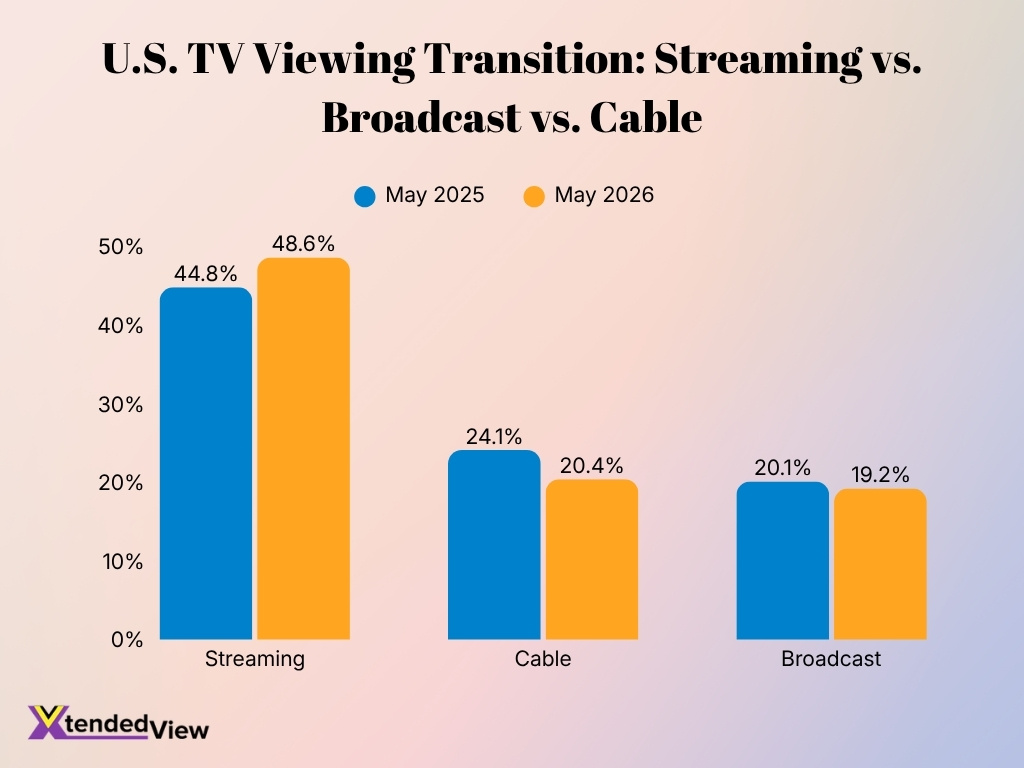
- Streaming represented 44.8% of U.S. TV viewing in May 2025, surpassing broadcast and cable combined for the first time.
- Broadcast accounted for 20.1% of May 2025 viewing, while cable represented 24.1%, producing a combined traditional share of 44.2%.
- Between May 2021 and May 2025, U.S. streaming usage increased 71%.
- Over the same four-year period, broadcast viewing declined 21%, while cable usage dropped 39%.
- By February 2026, streaming represented approximately 48% of U.S. television and video usage, compared with 21.7% for broadcast and 20% for cable.
- In May 2026, streaming climbed further to 48.6% of TV watch time, while cable accounted for 20.4% and broadcast for 19.2%.
- Smart TV data from Q1 2026 showed streaming representing 58.6% of viewing time across the measured TV base, compared with 57.7% one year earlier.
- Average streaming consumption in that Q1 2026 measurement reached 13.1 hours per week, 0.9 hours more than a year earlier.
- U.S. consumer adoption tells a similar story: 83% of adults watched streaming services in 2025, while only 36% subscribed to cable or satellite television at home.
- Free ad-supported services also gained ground. Three major FAST platforms collectively generated 5.7% of U.S. TV viewing in May 2025.
Smart TV Security and Privacy Concerns
- Smart TVs represented 21.3% of vulnerable IoT devices identified in a 2025 connected-home security dataset, making televisions the second-largest category behind streaming devices at 25.9%.
- The average connected household in that research contained 22 connected devices in 2025.
- Those households faced an average of 29 attacks per day in 2025, compared with 10 per day in 2024.
- Approximately 99.4% of observed IoT exploits targeted vulnerabilities that were already known and had fixes available.
- A separate 2025 security analysis identified 91,788 internet-exposed smart TVs running two major television operating systems.
- South Korea accounted for 49,920 exposed devices in that analysis, while 6,081 were identified in the U.S.
- A 2025 U.S. smart-home security study surveyed 401 users across five connected-device categories and found voice assistants raised the greatest security and privacy concerns among the categories studied.
- In a 2026 technical test of 10 smart TVs, one smart monitor and four external streaming devices, researchers found identifiable ACR-related network traffic on several major TV platforms.
- Regulators reached separate agreements in 2026 requiring two major television manufacturers to obtain clearer consumer consent before collecting certain ACR viewing data.
- Longer product lifespans add to the security issue: smart TVs commonly remain in homes for approximately five to eight years, potentially outlasting active security-patch support.
Smart TV Advertising and Revenue Models
- U.S. digital video advertising generated $78.0 billion in revenue during 2025, an increase of $15.8 billion from the prior year.
- Digital video ad spending is projected to exceed $80 billion in 2026, representing approximately 11% annual growth.
- Connected TV advertising alone is forecast at approximately $29.3 billion in 2026 under one current industry methodology, an 11% increase from 2025.
- A broader market definition estimates U.S. connected TV ad spending at approximately $37.95 billion in 2026, up about 15% from roughly $33.4 billion in 2025.
- Social video is forecast at $31.9 billion in 2026, surpassing the narrower CTV advertising category for the first time under that industry segmentation.
- Online video advertising outside the CTV and social categories is projected to reach $20.7 billion in 2026, up 10% year over year.
- Digital video is expected to account for more than 60% of total U.S. TV and video advertising spending in 2026 for the first time.
- Free ad-supported streaming television generated an estimated $3.9 billion in U.S. advertising revenue during 2025. Two leading FAST services accounted for nearly two-thirds of that revenue.
- During Q4 2025, 74.2% of total TV viewing was ad-supported, the highest quarterly level of the year.
- Streaming captured 45.6% of all ad-supported TV viewing in Q4 2025, compared with 29.6% for broadcast and 24.8% for cable.
Frequently Asked Questions (FAQs)
The global smart TV market is estimated at $270.8 billion in 2026, up from $247.0 billion in 2025.
The market is projected to expand at a 13.9% CAGR from 2026 to 2033, potentially reaching $673.5 billion by 2033.
Android TV held the largest global smart TV OS revenue share at 43% in 2025, while Roku OS was used by 55% of surveyed U.S. smart TV/streaming-player households in February 2026.
Samsung ranked No. 1 with 17% of global TV shipments in Q1 2026, followed by TCL at 14% and Hisense at 13%.
Streaming accounted for 48.6% of total U.S. TV watch time in May 2026, while YouTube alone represented 13.8%.
Conclusion
Smart TV statistics show that the television market is moving well beyond hardware sales. Streaming now accounts for a major share of TV viewing, while larger screens, premium display technologies, cloud gaming, voice features and smart TV operating systems are becoming more important parts of the user experience. At the same time, connected TV advertising and free ad-supported streaming are creating new revenue opportunities for manufacturers, platforms and media companies.
The market is also becoming more complex as competition shifts toward software, content discovery, advertising ecosystems and data practices. Privacy, security and long-term software support are therefore becoming just as relevant as picture quality and screen size. Overall, smart TVs are increasingly functioning as full digital entertainment platforms, and their role in household media consumption is likely to become even more significant as streaming and connected services continue to expand.