


Fair trade continues to shape global supply chains as consumers and businesses place greater focus on ethical sourcing, sustainable agriculture, and worker welfare. From coffee retailers in the US to cocoa sourcing programs across Europe, fair trade standards now influence purchasing decisions in supermarkets, restaurants, and multinational procurement networks. At the same time, rising climate risks and commodity price volatility have pushed more producers toward certified trade systems that offer minimum pricing and premium support.
This article explores the latest fair trade statistics, including market growth, producer participation, consumer demand, and regional trends.
Editor’s Choice
- Nearly 1.87 million farmers and workers participated in Fairtrade-certified supply chains in 2024 across about 70 countries.
- Fairtrade-certified producer organizations generated approximately €201.6 million in Fairtrade Premium funds during 2024.
- Around 1,824 producer organizations were Fairtrade-certified worldwide in 2024.
- The global fairtrade food and beverages market reached $334.87 million in 2024 and is projected to more than double by 2032.
- Coffee represented the largest Fairtrade product category, accounting for 38.5% of global Fairtrade food and beverage revenue in 2024.
- Germany’s fair trade product sales climbed 13% year over year to nearly €2.9 billion in 2024.
- GlobeScan research in 2025 found that three out of four global shoppers recognize the Fairtrade Mark, while 83% trust the label.
- About 90% of Fairtrade participants are smallholder farmers, reinforcing the sector’s agricultural focus.
- Cocoa companies increased sourcing volumes tied to Living Income Reference Prices by 60% during the 2024-2025 season.
- Fairtrade-certified coffee production reached roughly 578,000 tonnes in 2023, making it one of the world’s largest ethical coffee certification systems.
Recent Developments
- Fairtrade International introduced a new minimum cocoa price of $3,500 per metric tonne for non-regulated markets beginning in October 2025.
- The Fairtrade system operated 58 active global projects in 2024, focusing on climate resilience, digital traceability, and producer empowerment.
- Fairtrade organizations reported nearly 32,000 metric tonnes of cocoa sourced under Living Income Reference Pricing during the 2024-2025 season.
- Fairtrade Germany recorded a 6% increase in product sales volume during the first half of 2025.
- Banana sales carrying Fairtrade certification in Germany rose 10% year over year in 2025.
- Coffee sales with Fairtrade certification in Germany increased by nearly 7% in 2025.
- Fairtrade evidence mapping released in 2025 analyzed more than 120 independent studies measuring sustainability and economic outcomes linked to certification.
- More than 19,430 farmers and workers participated in Fairtrade climate education and resilience programs by late 2024 in selected initiatives.
- Fairtrade’s annual reporting highlighted stronger investment in digital supply-chain tracking tools during 2024 to improve sourcing transparency.
- Asia-Pacific emerged as the fastest-growing regional fairtrade market heading into 2026, with projected annual growth above 9%.
Global Overview of Fair Trade
- Fairtrade-certified products are now sold in more than 140 countries worldwide.
- Approximately 2 million farmers and workers participate in Fairtrade supply chains globally.
- Fairtrade-certified producer organizations operate across 70 producing countries.
- The Fairtrade system focuses heavily on agricultural commodities, including coffee, cocoa, bananas, tea, sugar, and cotton.
- Europe remains the largest regional market for Fairtrade consumption, led by Germany, the UK, and Switzerland.
- North America accounted for roughly 78% of the Fairtrade food and beverage market share within the region during 2024.
- Fairtrade monitoring reports show that producer organizations earned over €211.5 million in Fairtrade Premium funds in 2023 before slightly declining in 2024.
- Women represented around 23% of Fairtrade farmers and 40% of Fairtrade workers in 2024.
- Cereals had the highest female farmer participation rate at 64%, while tea recorded the highest female worker share at 55%.
- Independent research from 2021 to 2024 linked Fairtrade certification with improved sustainability outcomes, stronger farmer organization capacity, and more resilient incomes.
Fair Trade Certified Market Size
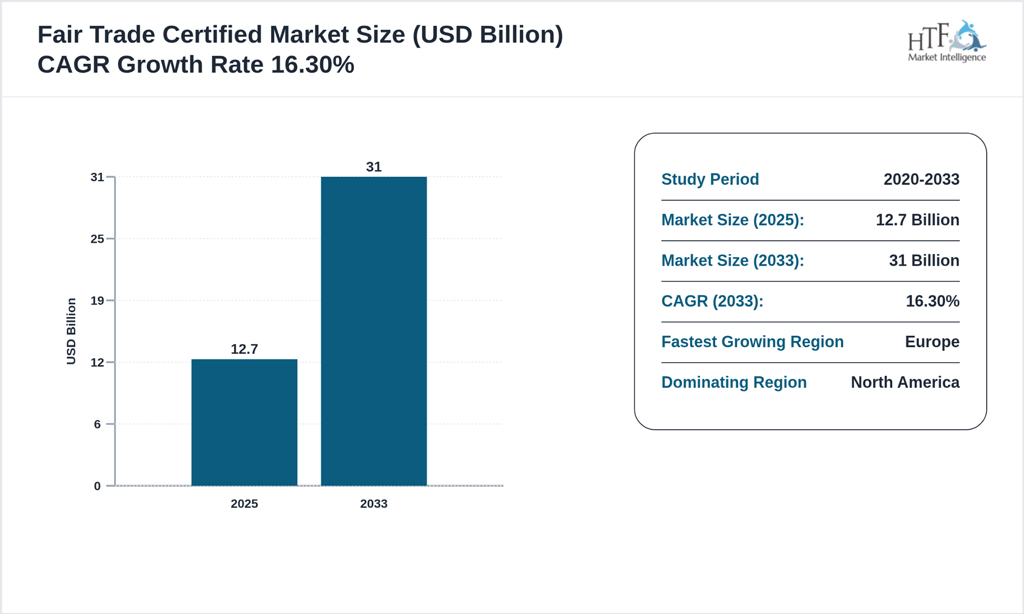
- The Fair Trade Certified market is valued at $12.7 billion in 2025, showing strong global demand for ethically sourced products.
- The market is projected to reach $31 billion by 2033, indicating significant long-term growth potential.
- From 2025 to 2033, the market is expected to grow by $18.3 billion in total value.
- The market is forecast to expand at a strong CAGR of 16.30%, reflecting rising consumer preference for sustainable and fair-trade products.
- North America is the dominating region, suggesting higher adoption of Fair Trade Certified products among consumers and retailers.
- Europe is identified as the fastest-growing region, supported by increasing awareness of ethical sourcing and sustainability.
- The study period covers 2020–2033, giving a long-term view of Fair Trade Certified market development.
- The market size is expected to grow by nearly 2.4 times, rising from $12.7 billion in 2025 to $31 billion by 2033.
Growth Trends in Fair Trade Markets
- The global fairtrade food and beverages market is projected to grow at a 9.8% CAGR from 2025 to 2032, reaching about $707.46 million.
- Coffee commands roughly 38.5% of the fair trade food and beverage revenue share in 2024, making it the leading product category.
- The chocolate segment is expected to record the fastest growth at around 22% CAGR between 2025 and 2032, driven by ethical cocoa demand.
- North America holds about 39.17% of global fair trade food and beverage revenue in 2024, reflecting strong US and Canadian ethical consumption.
- The Asia‑Pacific fair trade market is forecast to grow at approximately 9.14% CAGR from 2025 to 2032, the fastest regional rate.
- Online channels are projected to expand at a roughly 24% CAGR for fair trade food and beverages from 2025 to 2032, powered by e‑commerce and subscription models.
- Germany posted its strongest fair trade sales increase in four years during 2024, with growth exceeding 8% year‑on‑year in key retail categories.
- Fairtrade‑certified cocoa sourcing programs now cover over 800,000 farmers globally, helping counter poverty and climate‑linked crop risks.
- Gen Z and millennial consumers account for nearly 65% of new fair trade purchases in 2024–2025, prioritizing traceability and ethical sourcing.
- Global fair trade coffee volumes increased by about 12% year‑on‑year in 2024, supported by specialty cafés and premium retailers.
Number of Fair Trade Producers and Workers
- Fairtrade-certified supply chains included approximately 1.87 million farmers and workers across 70 countries in 2024.
- Around 90% of Fairtrade participants were smallholder farmers, highlighting the system’s focus on family-based agriculture.
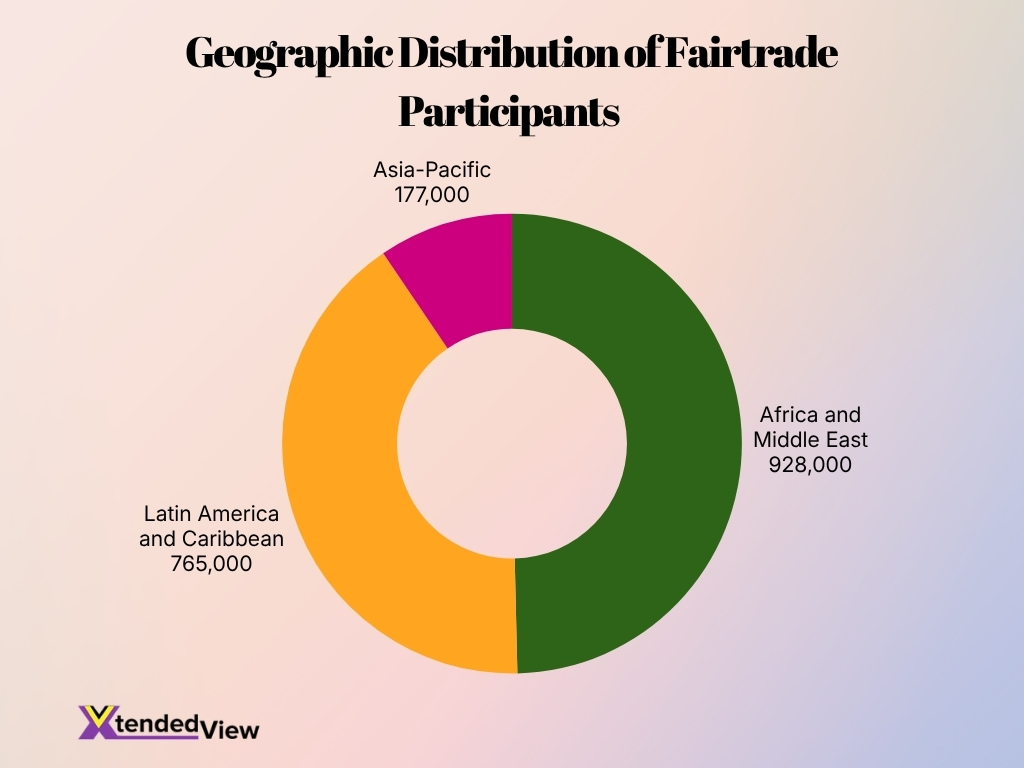
- Fairtrade reported roughly 928,000 hired workers and farmers in Africa and the Middle East, making it the largest producer region by participation.
- Latin America and the Caribbean accounted for more than 765,000 Fairtrade farmers and workers in 2024.
- Asia-Pacific regions represented approximately 177,000 Fairtrade participants across certified organizations.
- Women made up around 40% of all Fairtrade workers globally in 2024.
- About 23% of Fairtrade farmers were women, showing gradual progress in female agricultural participation.
- Tea plantations recorded one of the highest female worker participation rates at approximately 55%.
- More than 1,824 producer organizations held active Fairtrade certification in 2024.
- Cooperative farming remains dominant, with most Fairtrade smallholders operating through organized producer associations and cooperatives.
Fair Trade Statistics by Region
- Europe accounts for over 60% of global fair trade product sales, making it the largest consumption region.
- Germany alone generated roughly €2.9 billion in fair trade product sales revenue during 2024.
- North America held 39.17% of the global fair trade food and beverages market share in 2024.
- The Asia‑Pacific fair trade food and beverages market is projected to grow at a CAGR of 9.14% through 2032.
- China commanded the biggest share of the Asia‑Pacific fair trade food and beverages market in 2024.
- Japan’s fair trade‑certified product sales reached over 21 billion yen in 2023, reflecting consistent annual growth.
- 83% of Canadian consumers trust the Fairtrade Mark, one of the highest confidence levels in North America.
- Fairtrade‑certified producer groups across Latin America, Africa, and Asia collectively earned over €200 million in Fairtrade Premium during 2024.
- Africa and Latin America together account for more than 90% of global fair trade coffee and cocoa exports.
- Asia‑Pacific producer organisations represent about 15% of all Fairtrade‑certified organisations worldwide as of 2024.
Geographic Distribution of Fair Trade Producers
- Africa and the Middle East hosted nearly 50% of all Fairtrade-certified producers and workers in 2024.
- Latin America accounted for over 60% of global Fairtrade-certified coffee production in 2024.
- Côte d’Ivoire and Ghana together produced about 75% of Fairtrade-certified cocoa entering 2026.
- Kenya represented approximately 15% of worldwide Fairtrade tea production in 2024.
- Peru exported more than 25,000 metric tons of Fairtrade bananas and coffee during 2024.
- More than 70 producing countries participated in Fairtrade-certified agriculture and commodity exports in 2024.
- Uganda’s Fairtrade coffee farmer enrollment grew by about 30% in 2024–2025 due to climate resilience projects.
- India supplied over 100,000 metric tons of Fairtrade cotton and tea to global markets in 2024.
- Dominican Republic cooperatives exported around 18,000 metric tons of Fairtrade cocoa and bananas in 2024.
- Ethiopia’s Fairtrade coffee production increased by roughly 20% as specialty demand rose in North America and Europe.
Most Sold Fair Trade Products Worldwide
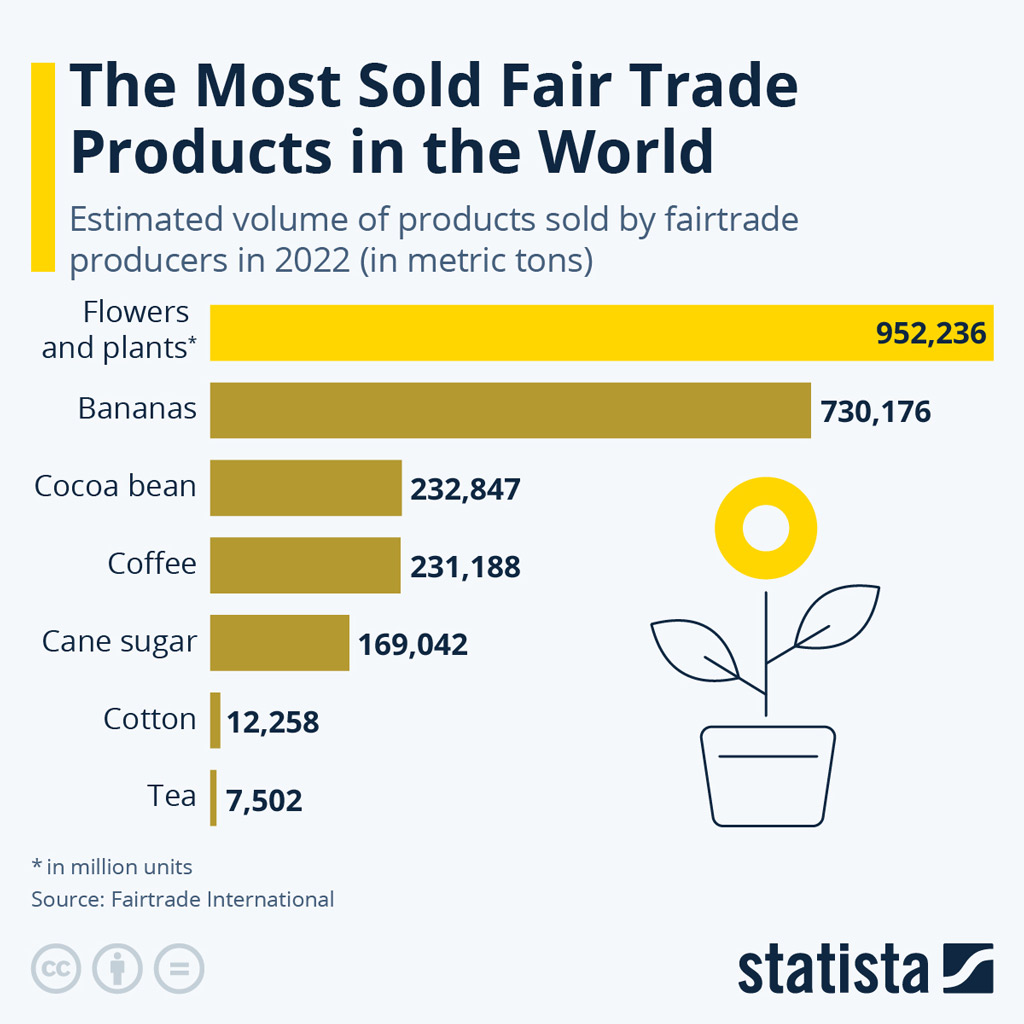
- Flowers and plants were the top-selling fair trade product category, with an estimated 952,236 million units sold in 2022.
- Bananas ranked second, reaching 730,176 metric tons, making them the highest-volume fair trade food product in the chart.
- Cocoa beans and coffee had almost equal fair trade sales volumes, at 232,847 metric tons and 231,188 metric tons, respectively.
- Cane sugar recorded a strong fair trade sales volume of 169,042 metric tons, showing continued demand for ethically sourced sugar.
- Cotton had a much smaller fair trade sales volume, with 12,258 metric tons sold.
- Tea recorded the lowest volume among the listed products, at 7,502 metric tons.
- The data shows that fair trade sales are heavily concentrated in a few product categories, especially flowers and plants, bananas, cocoa, and coffee.
- The gap between the top category and the smallest category is significant: flowers and plants far exceeded tea in volume, highlighting major differences in product demand and measurement units.
Fair Trade in Specific Sectors
- The coffee sector had 775,709 Fairtrade-certified farmers globally in 2024, representing the largest concentration of Fairtrade farmers worldwide.
- Fairtrade cocoa produced 711,000 metric tonnes in 2023, with 398 certified producer organizations supporting almost 500,000 cocoa farmers globally.
- Approximately 1,100 tonnes of Fairtrade-certified seed cotton were purchased in 2024 by apparel companies meeting ESG and ethical sourcing targets.
- 1,283 kg of Fairtrade gold were exported in 2024, with 18% global growth as ethical jewelry demand pushed miners into certification.
- By 2022, 502 Fairtrade producer organizations had created climate adaptation plans, with tea estates implementing initiatives to protect yields from drought.
- Fairtrade bananas reached +1.5 million metric tonnes produced in 2023, with 37,111 farmers and workers in producer organizations across the US and European retail.
- Fairtrade-certified cosmetic ingredients increased 35% year-over-year, benefiting 50,000 farmers sourcing shea butter, coconut oil, and sugar derivatives.
- Fairtrade sports balls provide 10% Fairtrade Premium per ball for worker welfare initiatives in South Asia manufacturing hubs, supporting stitched ball production.
- 74% of consumers trust the Fair Trade Certified label, while 36% are more likely to buy products with certification as hospitality brands strengthen procurement.
- €28 million in Fairtrade premiums were generated for farmers in the UK in 2023 from foodservice coffee and tea in workplace and university catering programs.
Fair Trade Premium Volumes and Use
- Fairtrade-certified producer organizations earned approximately €201.6 million in Fairtrade Premium funds during 2024.
- Nearly 2 million farmers and workers participated in deciding how premium funds were spent across 1,910 producer organizations.
- 24 percent of cooperatives’ premium funds were directed toward environmental and climate-related areas in 2024.
- Coffee producers received one of the largest shares of Fairtrade Premium distributions, with coffee dominating 38.5% of the Fairtrade food and beverages market.
- 35 percent of Fairtrade Premium in cooperatives was invested into quality education (SDG4), including school construction and scholarships.
- Banana workers earned more than $38 million in Fairtrade Premium in 2024, funding housing, transportation, and healthcare initiatives.
- Over $9 million in total Fairtrade Premium was earned by banana farmers and workers in the U.S. market alone during 2024.
- More than €1 billion in Fairtrade Premium has been earned by farmers and workers over the past five years for community investment.
Income and Livelihood Impacts for Producers
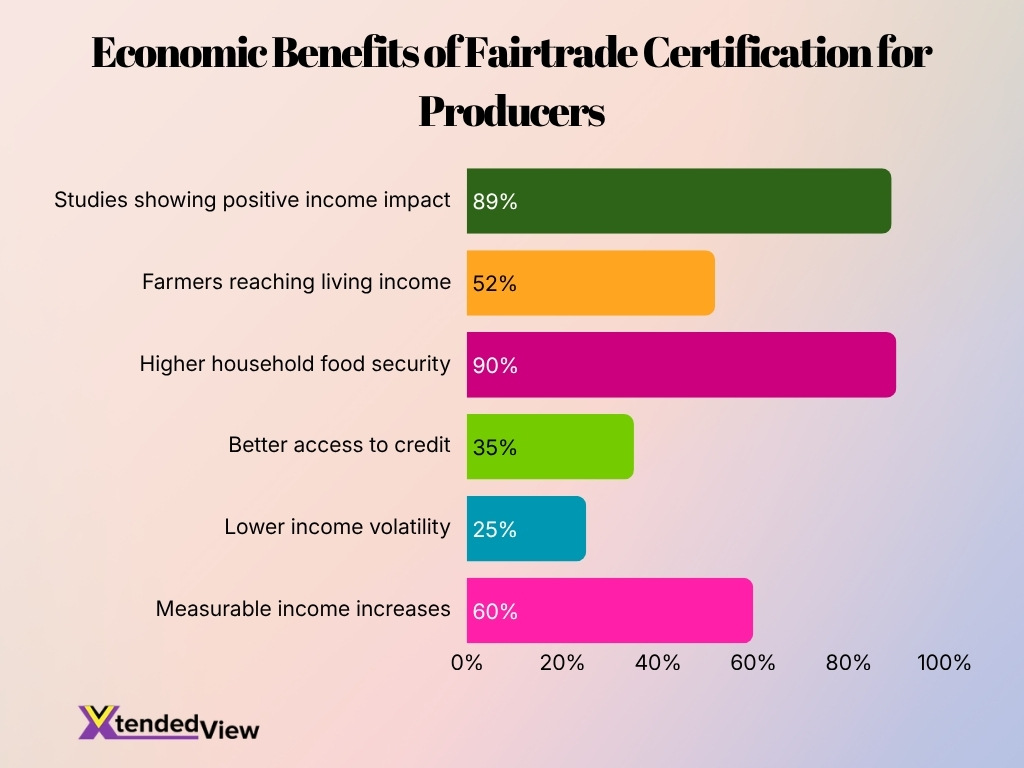
- At least 89% of recent Fairtrade‑linked studies report some positive income impact for smallholder producers compared with conventional markets.
- In a 2024–2025 living‑income pilot, 52% of farmers in one certified cocoa supply chain reached a living income for a typical five‑member household.
- Collective Fairtrade‑linked programs show that smallholder incomes increased by an average of over 50% where productivity and market‑access interventions were combined.
- Across multiple crops, Fairtrade‑participating producers reported up to 20–30% higher net returns on average than non‑Fairtrade peers in similar regions.
- In 2024–2025, living‑income reference prices were rolled out or expanded for over 80% of Fairtrade‑certified cocoa and banana producer organizations in key producing countries.
- Nearly 90% of long‑term economic‑impact studies found Fairtrade contributed to higher household food security and more stable income streams for participants.
- In several women‑led producer groups, Fairtrade gender‑equity programs helped raise women’s share of decision‑making roles to over 40% in participating cooperatives.
- Fairtrade‑certified smallholders reported up to 35% better access to credit and formal financing than non‑certified farmers in the same areas.
- During periods of high global inflation, Fairtrade‑linked farmers experienced roughly 25% lower income volatility than comparable conventional producers.
- Across coffee, cocoa, banana, and tea sectors, over 60% of documented Fairtrade interventions led to measurable increases in producer cash‑income per hectare.
Price and Income Stability for Farmers
- Fairtrade raised the minimum cocoa price to $3,500 per metric tonne for non-regulated markets starting late 2025.
- Living Income Reference Price sourcing commitments expanded by 60% year over year during the 2024-2025 cocoa season.
- The Fairtrade Minimum Price for washed Arabica coffee increased to $1.80 per pound (up 29%) from August 2023.
- Fairtrade certification increased the average resilience score for farmers by 10% when comparing similar households.
- Almost 90% of studies examining Fairtrade economic gains found positive contributions, including higher incomes and stability.
- In 2024, producers earned over £28 million in Fairtrade Premium from UK sales alone for community investments.
- New Premium rules require 40% of funds to be paid directly in cash to farmer members starting October 2025.
- Global net farm income fell 19.5% from 2022 to 2023, dropping from $182 billion to $146.5 billion.
Consumer Purchasing Behavior for Fair Trade Products
- Around 70% of UK consumers purchased Fairtrade‑certified products at least once in 2024, despite ongoing inflationary pressure on household budgets.
- Approximately 47% of consumers globally stated they are willing to pay a higher price for products bearing a Fair Trade Certified label.
- Consumer spending on Fairtrade‑certified food and beverages reached about $334.87 million in 2024, with a projected rise to $707.46 million by 2032.
- In North America, coffee accounted for roughly one‑third of all Fairtrade product sales, making it the most frequently purchased Fairtrade‑certified category.
- In Germany, Fairtrade banana volumes increased by about 10% in 2025, reflecting stronger demand for ethics‑driven fresh produce.
- Gen Z shoppers showed a willingness to pay more for sustainable goods, with over 60% across multiple surveys indicating they would pay a premium for ethically sourced products.
- About two‑thirds of global consumers say they prefer products combining Fairtrade and organic certifications rather than single‑label ethical claims.
- Online channels for Fairtrade‑certified groceries are projected to grow at around 24% CAGR from 2025 to 2032, driven by subscription models and direct‑to‑consumer brands.
- In the UK, Fairtrade coffee sales volumes rose by 5% in 2024, equivalent to an additional 87 million cups of Fairtrade coffee purchased annually.
- About 60–70% of consumer surveys indicate that ethical sourcing and sustainability rank among the top drivers influencing Fairtrade product purchases in 2025.
Consumer Awareness of Fair Trade Labels
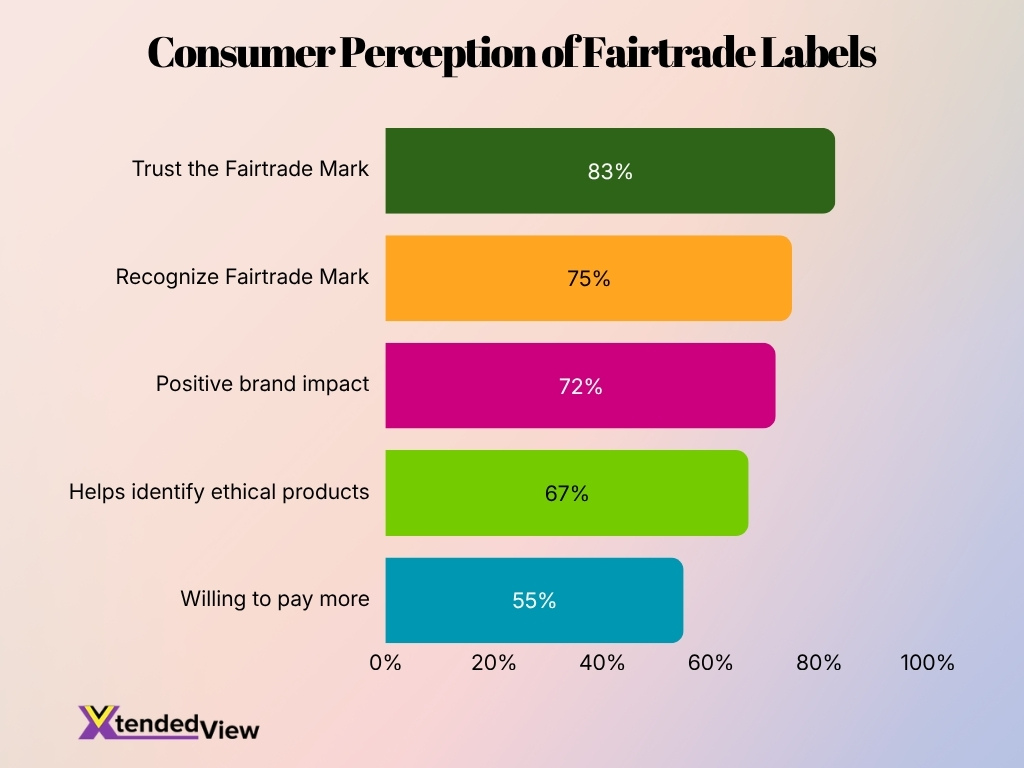
- 75% of shoppers surveyed in 2025 recognize the Fairtrade Mark.
- 83% of people who recognize the label trust it.
- Fairtrade is the most globally recognized ethical label, with recognition higher than other ethical or sustainability marks.
- More than two-thirds of consumers say the Fairtrade label helps them identify ethical products while shopping.
- 72% say the Fairtrade Mark has a positive impact on the brands that carry it.
- 55% of regular Fairtrade buyers are willing to pay more for Fairtrade products.
- In Canada, 50% of consumers know the Fairtrade Mark, up 14 points since 2019.
- 81% of Canadian consumers who trust the Mark say they trust it.
- In the UK, 23% of people heard about Fairtrade Fortnight in 2024, up from 12% in 2023.
- Of those who heard about Fairtrade Fortnight, 83% went on to buy a Fairtrade product.
Certification and Compliance Statistics
- More than 1,824 producer organizations held Fairtrade certification globally in 2024.
- These organizations represented around 1.87 million farmers and workers across 67 countries.
- Fairtrade‑certified groups earned approximately €201.6 million in Fairtrade Premium in 2024.
- Roughly 21% of Fairtrade farmers and 45% of Fairtrade workers were women, reflecting growing gender inclusion in certified schemes.
- Over 37,000 products bearing the Fairtrade Mark were sold in 140 countries in 2024.
- Around 502 Fairtrade producer organizations reported having developed formal climate‑adaptation plans by 2024.
- Nearly 72,647 tons of Fairtrade ingredients were sold in the US market alone in 2024.
- Audits showed that over 87% of surveyed producer organizations reported being satisfied with Fairtrade’s support and compliance services in 2024.
- Fairtrade Premium from US sales reached more than $9 million in 2024, highlighting the scale of certified‑product compliance.
- Globally, annual Fairtrade‑labeled product sales surpassed $1 billion in the US market, underlining the commercial impact of certification and compliance.
Supply Chain and Trade Volume Data
- Fairtrade-certified coffee production volumes reached approximately 578,000 tonnes globally in 2023.
- Cocoa sourcing under Living Income Reference Pricing increased by 60% year over year during the 2024-2025 season.
- Fairtrade supply chains span more than 140 consumer markets worldwide.
- Germany’s Fairtrade product sales volumes increased by roughly 6% in the first half of 2025.
- Ethical coffee sourcing agreements expanded among specialty cafés and multinational beverage companies during 2024 and 2025.
- Fairtrade-certified bananas remained one of the highest-volume traded fresh produce categories in Europe.
- Digital traceability tools gained broader adoption to help track certified commodities from farm to retail shelf.
- Retailers increased direct sourcing partnerships with producer cooperatives to stabilize supply amid global commodity volatility.
- Fairtrade cocoa trade volumes benefited from rising demand for ethically sourced chocolate in North America and Europe.
- Supply-chain transparency became a key competitive factor for consumer brands entering 2026.
Key Challenges Limiting Fair Trade Growth
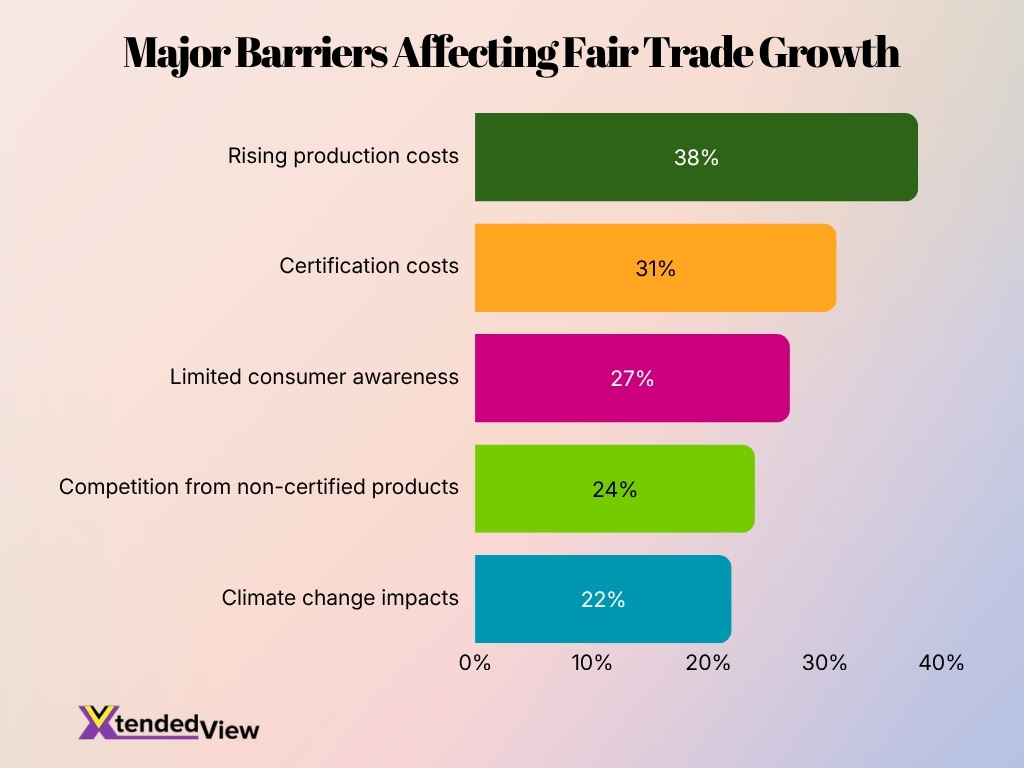
- Rising production costs are the biggest challenge facing fair trade, affecting 38% of the market.
- Certification costs rank second, with 31% share, showing that compliance and certification expenses remain a major burden for producers.
- Limited consumer awareness affects 27%, indicating that many buyers may still not fully understand fair trade labels or their impact.
- Competition from non-certified products accounts for 24%, making it harder for fair trade goods to compete on price and visibility.
- Climate change impacts represent 22%, highlighting growing risks for fair trade farmers and supply chains.
- The data shows that cost-related challenges are the strongest barriers, with rising production costs and certification costs together making up the top two issues.
- Fair trade growth depends heavily on improving affordability, awareness, certification access, and climate resilience for producers.
Environmental Outcomes Linked to Fair Trade
- Fairtrade environmental standards helped reduce chemical pesticide use on over 1.2 million hectares of certified farmland by 2024.
- More than 19,000 farmers and workers participated in climate resilience projects supported by Fairtrade‑linked initiatives in 2024.
- Fairtrade producer organizations allocated on average 6% of Fairtrade Premium to renewable energy, water systems, and reforestation between 2021 and 2024.
- Agroforestry and shade‑grown coffee projects expanded across over 70 Fairtrade cooperatives in Latin America and East Africa during 2024 and 2025.
- Fairtrade cocoa cooperatives launched more than 240 climate adaptation programs by 2025 to address rising temperatures and crop disease risks.
- Environmental compliance standards now require biodiversity and water management plans on over 90% of Fairtrade‑certified plantations that meet core criteria.
- Fairtrade‑linked carbon reduction and regenerative agriculture pilots engaged over 45,000 smallholder farmers in 2025.
- Sustainable farming practices under Fairtrade certification improved soil productivity on over 80% of sampled coffee and tea farms versus non‑certified peers.
- Retailers and food brands sourcing via Fairtrade contributed to reducing supply‑chain emissions by up to 12% on average for key commodities by 2025.
- Environmental sustainability now drives over 40% of ethical purchasing decisions among consumers who actively choose Fairtrade‑labelled products, entering 2026.
Frequently Asked Questions (FAQs)
The global fairtrade food and beverages market is projected to grow at a 9.8% CAGR from 2025 to 2032.
Around 2 million farmers and workers participate in Fairtrade-certified supply chains worldwide.
Fairtrade-certified producers earned approximately €201.6 million in Fairtrade Premium funds during 2024.
Coffee accounted for about 38.5% of the global fairtrade food and beverage market revenue in 2024.
Research in 2025 found that 75% of global consumers recognize the Fairtrade Mark.
Conclusion
Fair trade continues to expand beyond a niche ethical movement into a mainstream part of global retail and sourcing strategies. The sector reflects growing consumer demand for transparency, fair pricing, environmental responsibility, and better labor standards across international supply chains. Coffee, cocoa, bananas, tea, and cotton remain the largest Fairtrade-certified categories, while newer sectors such as beauty products and ethical gold are gaining traction.
At the same time, Fairtrade organizations and producer cooperatives face ongoing challenges linked to climate change, inflation, commodity price volatility, and supply-chain disruptions. However, rising consumer awareness, stronger ESG commitments from brands, and broader retailer participation continue driving market growth worldwide. As businesses and shoppers increasingly prioritize ethical sourcing, Fairtrade certification is expected to remain a major influence on global agriculture, food retail, and sustainable trade practices throughout the rest of the decade.