



Retail remains one of the world’s largest and most influential industries, shaping consumer spending, employment, supply chains, and economic growth. As digital technologies continue to evolve, retailers are combining physical stores with e-commerce, mobile shopping, artificial intelligence (AI), and omnichannel strategies to deliver faster, more personalized customer experiences. These innovations are transforming industries such as grocery, fashion, consumer electronics, healthcare, and home improvement while helping businesses improve inventory management, streamline operations, and strengthen customer loyalty.
At the same time, changing consumer preferences, economic conditions, and emerging technologies continue to reshape the competitive landscape. The latest retail statistics highlight key trends in market size, sales growth, employment, digital commerce, customer behavior, and AI adoption across the United States and globally. Explore the data below to gain a comprehensive understanding of where the retail industry stands and the trends expected to drive its future.
Editor’s Choice
- Global retail sales are expected to exceed $32 trillion in 2026, reflecting continued expansion across both physical and digital channels.
- The National Retail Federation forecasts 4.4% U.S. retail sales growth in 2026, bringing total retail sales to approximately $5.6 trillion.
- U.S. retail e-commerce sales reached $326.7 billion in Q1 2026, increasing 9.8% year over year.
- Online retail represented 16.9% of total U.S. retail sales during the first quarter of 2026.
- Total U.S. retail sales in Q1 2026 reached $1.929 trillion, up 3.9% from the same quarter in 2025.
- Consumer spending continues to support retail despite economic uncertainty, with spending remaining stronger than long-term historical averages.
- Retailers continue investing heavily in AI, automation, and digital commerce to improve customer experiences and supply chain efficiency throughout 2026.
Recent Developments
- The National Retail Federation introduced a new forecasting model developed with Oxford Economics for its 2026 retail outlook.
- U.S. retail sales increased 0.6% in February 2026, marking the strongest monthly gain in seven months.
- March 2026 retail sales climbed 1.7% month over month, the largest monthly increase in about three years.
- E-commerce sales outpaced total retail growth during Q1 2026, rising 9.8% versus 3.9% for overall retail sales.
- AI shopping assistants, conversational commerce, and intelligent product discovery became major themes at leading retail technology events in 2026.
- Retailers accelerated investments in automation to improve inventory visibility, labor productivity, and checkout efficiency during 2025 and 2026.
- Higher-income households continued to account for a disproportionate share of discretionary retail spending entering 2026.
- Digital shopping events generated record online spending, with Prime Day-related purchases exceeding $26.4 billion across U.S. retailers in June 2026.
Global Retail Market Statistics
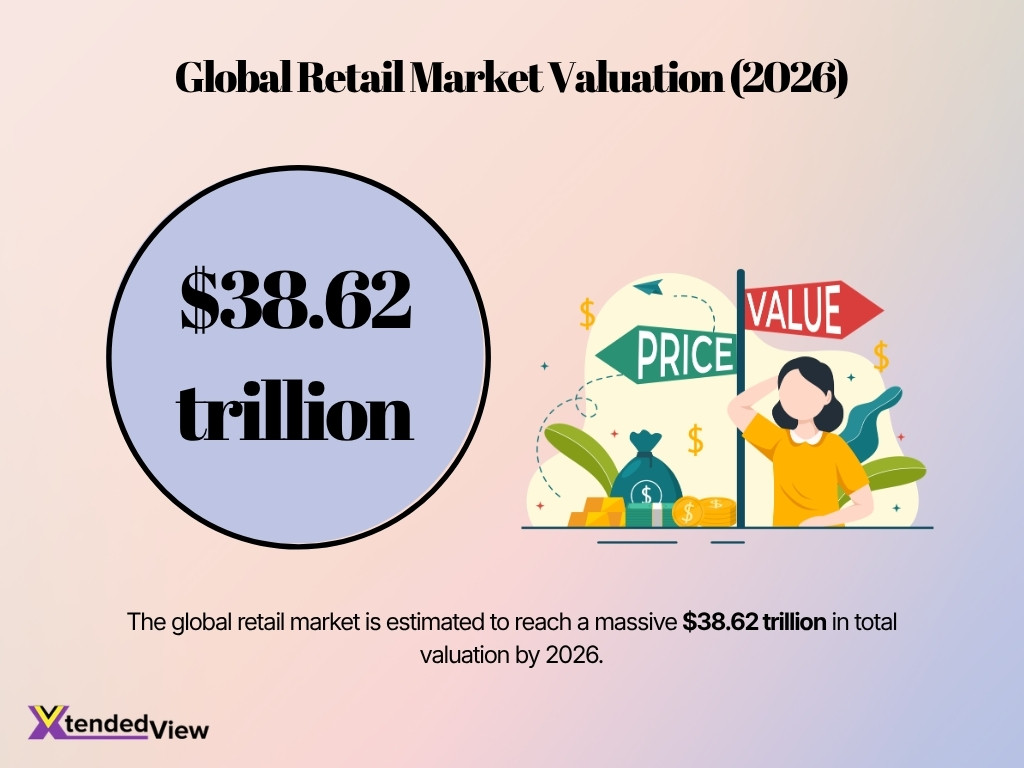
- The global retail market is estimated to reach a massive $38.62 trillion in total valuation by 2026.
- Asia-Pacificleads worldwide retail expansion, with consumers spending nearly $2 trillion on online purchases in 2025.
- Worldwide e-commerce sales are projected to hit $6.86 trillion by the end of 2025, representing over 20% of all retail transactions.
- The cross-border e-commerce market is expected to surge to $1.74 trillion in 2026 with an 18.6% annual growth rate.
- The global AI e-commerce sector is anticipated to approach $51 billion by 2033 as retailers invest heavily in personalization.
- The essential food and grocery segment remains the dominant retail category and is projected to grow at a steady 7.1% annual rate.
- Mobile devices continue to drive digital retail growth by accounting for an overwhelming 71% of all e-commerce site traffic globally.
- Approximately 55% of modern distribution centers will adopt automation technologies by 2026 to improve supply chain transparency.
U.S. Retail Market Statistics
- U.S. retail sales are projected to reach approximately $5.6 trillion in 2026.
- Retail sales are expected to grow 4.4% in 2026, exceeding the pre-pandemic 10-year average annual growth rate of 3.6%.
- Total U.S. retail sales reached $1.929 trillion during the first quarter of 2026.
- Retail e-commerce represented 16.9% of total U.S. retail sales in Q1 2026.
- Online retail sales increased 9.8% year over year in Q1 2026, significantly faster than overall retail growth.
- February 2026 retail sales were 3.7% higher than February 2025 despite persistent inflation concerns.
- Strong wage growth and a resilient labor market continue supporting consumer spending across most retail categories.
- Value-oriented shopping remains a defining consumer trend as households increasingly compare prices across digital and physical stores.
Retail Sales and Growth Statistics
- U.S. retail sales increased 3.9% year over year during the first quarter of 2026.
- Retail e-commerce expanded 9.8% year over year, more than double the pace of total retail sales.
- First-quarter 2026 online retail sales totaled $326.7 billion.
- Total first-quarter retail sales reached $1.929 trillion across all retail channels.
- March 2026 posted a 1.7% monthly increase, reflecting stronger seasonal demand and higher fuel prices.
- February 2026 retail sales rose 0.6% month over month, supported by stronger vehicle and discretionary purchases.
- Retail growth in 2026 remains above the long-term average despite inflation and geopolitical uncertainty.
- Digital channels continue contributing a growing share of incremental retail sales as consumers adopt omnichannel shopping habits.
Retail Industry Contribution to GDP
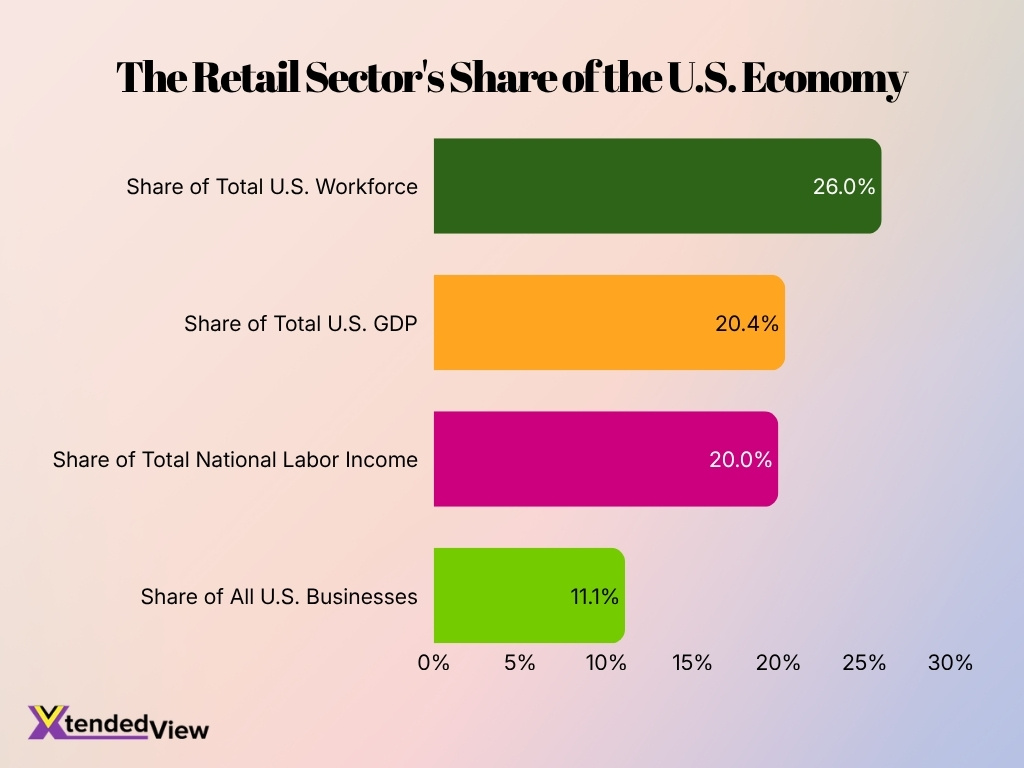
- The U.S. retail industry contributes an immense $5.3 trillion to the annual national GDP.
- Overall retail economic activity accounts for approximately 20.4% of the total U.S. GDP.
- The sector directly and indirectly supports 55 million full-time and part-time jobs nationwide.
- Retail employment makes up over 26% of the total workforce, representing one in four U.S. jobs.
- The industry generates $3 trillion in labor income, which equals 20% of total national labor income.
- Nearly 4.6 million retail establishments operate nationwide, comprising 11.1% of all U.S. businesses.
- Small retail businesses with fewer than 50 employees provide 40.1% of all retail sector jobs.
- Total U.S. retail sales volume reached roughly $7.26 trillion in the year 2024.
- Foreign direct investment into the American retail market successfully hit $198.6 billion in 2023.
Retail Store and Business Statistics
- The U.S. retail industry is projected to reach $5.6 trillion in sales during 2026.
- Retail businesses support over 55 million U.S. jobs, accounting for 26% of total national employment.
- Convenience stores maintain the largest physical footprint with 152,255 locations nationwide.
- U.S. grocery store sales are expected to surpass $1.1 trillion in consumer spending during 2026.
- Buy online, pick up in store (BOPIS)sales are projected to reach $177.9 billion in 2026.
- Approximately 68% of U.S. consumers regularly use in-store pickup for online retail purchases.
- The global AI-driven checkout market is forecasted to grow to $5.05 billion in 2026.
- Nearly 98.6% of all U.S. retail firms operate as small businesses with fewer than 50 employees.
Retail Employment Statistics
- U.S. retail employment reached 15.46 million workers in June 2026 on a seasonally adjusted basis.
- Production and nonsupervisory retail employees totaled 13.35 million in June 2026.
- Retail employment increased from 15.44 million in March 2026 to approximately 15.46 million in June 2026, indicating steady hiring.
- Retail remains the largest private-sector employer in the United States, supporting over 55 million direct and indirect jobs.
- Warehousing, fulfillment, logistics, and last-mile delivery roles continue expanding alongside e-commerce growth.
- Retail employers continue investing in AI-assisted workforce scheduling and labor optimization tools to improve productivity.
- Seasonal hiring remains strongest during major shopping periods, particularly the holiday season and promotional events.
- Digital skills, data analysis, and omnichannel operations have become increasingly important competencies for retail employees entering 2026.
Retail Sales by Sector
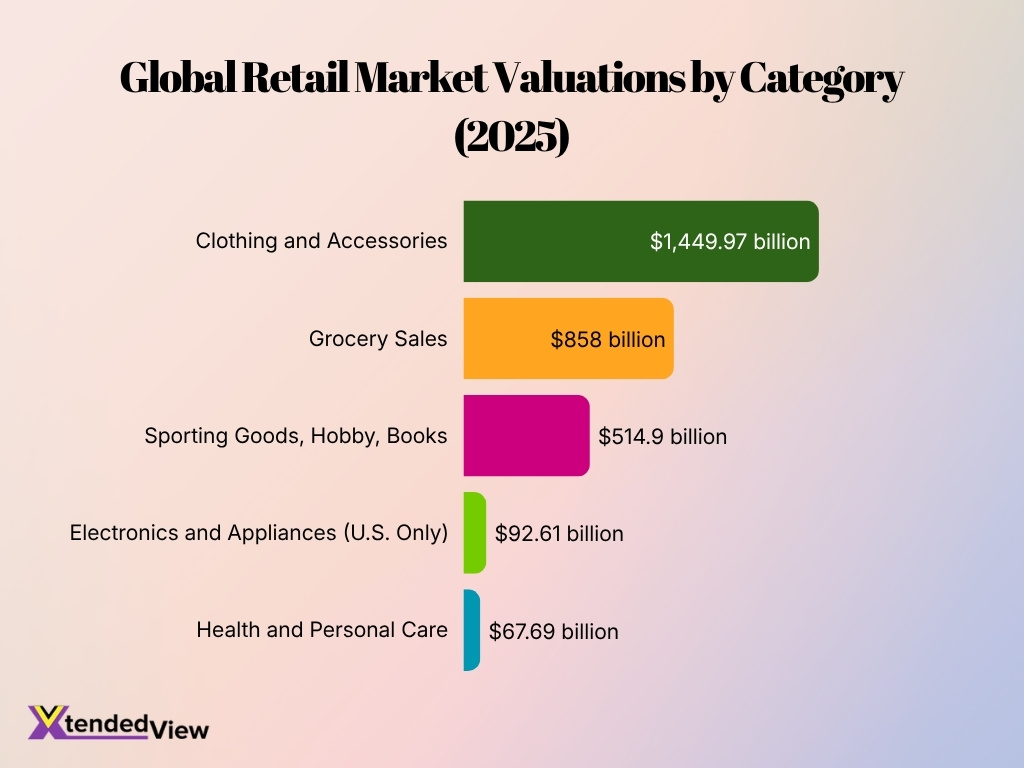
- Food and beverage stores account for roughly 12% of total retail sales, with grocery sales alone surpassing $858 billion recently.
- Motor vehicle and parts dealers represent the largest retail category by capturing 20% to 22% of overall consumer spending.
- Health and personal care stores saw their global market size reach $67.69 billion in 2025 and are projected to hit $85.07 billion by 2030.
- General merchandise retailers consistently maintain a strong market presence by generating 10% to 13% of total U.S. retail sales.
- Building materials and garden equipment dealers contribute significantly to the sector by accounting for 6% of total U.S. retail sales.
- Clothing and clothing accessories stores reached a massive global valuation of $1,449.97 billion in 2025 with an expected 6.6% annual growth rate.
- Electronics and appliance stores in the U.S. were valued at $92.61 billion in 2025 and are forecast to reach $114.15 billion by 2031.
- Sporting goods, hobby, musical instrument, and book stores reached a substantial global market valuation of $514.9 billion in 2025.
E-Commerce Retail Statistics
- U.S. retail e-commerce sales reached $326.7 billion during Q1 2026.
- E-commerce sales increased 9.8% year over year in Q1 2026, significantly outpacing overall retail growth.
- Online purchases represented 16.9% of total U.S. retail sales during the first quarter of 2026.
- Total U.S. retail sales grew 3.9% year over year, demonstrating that digital commerce continued expanding faster than traditional retail.
- E-commerce sales increased 2.7% compared with Q4 2025, despite seasonal declines following the holiday shopping period.
- Online retail has now outperformed total retail growth for multiple consecutive quarters.
- Retailers continue investing in AI-powered product recommendations, conversational shopping, and automated fulfillment to support digital growth.
- Cross-channel shopping continues increasing as consumers move seamlessly between websites, apps, marketplaces, and physical stores before completing purchases.
Online and Offline Retail Sales Statistics
- Total U.S. retail sales reached $1.929 trillion during the first quarter of 2026.
- Online sales accounted for 16.9% of the total retail market spending.
- Physical stores dominated the market by generating over 83% of total consumer spending.
- U.S. retail e-commerce sales successfully reached $326.7 billion in Q1 2026.
- First-quarter e-commerce sales saw a 9.8% increase compared to the first quarter of 2025.
- Total overall retail sales experienced a 3.9% year-over-year growth in Q1 2026.
- Global e-commerce sales are projected to hit $7.41 trillion by the end of 2026.
- Online sales are expected to comprise 22.6% of total global retail purchases by 2027.
- More than 34% of online shoppers make a digital purchase at least once a week.
- A massive 83% of consumers thoroughly research products online before visiting a physical store.
Retailers’ Store Fulfillment Capabilities
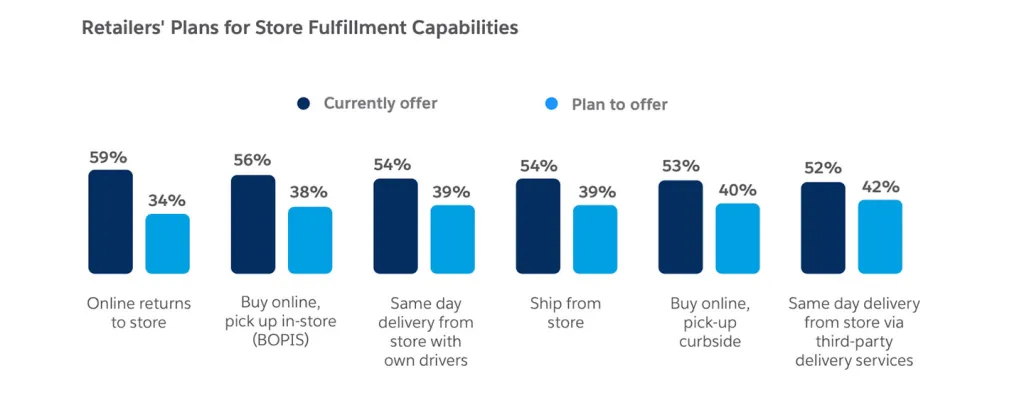
- Online returns to store is the most widely available fulfillment capability, currently offered by 59% of retailers, while another 34% plan to introduce it.
- Buy online, pick up in-store (BOPIS) is currently offered by 56%, with an additional 38% planning to offer the service.
- Same-day delivery using retailers’ own drivers is available from 54% of retailers, while 39% plan to add this capability.
- Ship-from-store fulfillment is currently supported by 54% of retailers, with another 39% planning implementation.
- Curbside pickup is offered by 53% of retailers, while 40% plan to introduce the option.
- Same-day delivery through third-party services has the lowest current adoption at 52%, but it has the highest planned adoption rate at 42%.
- Across all six fulfillment capabilities, current adoption remains above 50%, highlighting the widespread integration of stores into omnichannel retail operations.
- Planned adoption ranges from 34% to 42%, suggesting retailers are continuing to expand flexible pickup, returns, shipping, and delivery options.
Mobile and Social Commerce Statistics
- Mobile devices drive 72% of all e-commerce traffic but only capture 42% of actual revenue.
- The average global cart abandonment rate is 70.22%, with mobile devices hitting 80.02% versus desktop’s 66.41%.
- Streamlining mobile checkout flows can yield a 35.26% increase in conversion rates, recovering $260 billion in lost orders.
- The global social commerce market is projected to reach $2.21 billion in 2026 and grow at a 37.04% CAGR.
- Global live commerce is estimated to hit $230.3 billion in 2026, expanding rapidly at a 41.0% compound annual growth rate.
- Social media platforms dominate the live shopping sector by capturing the largest revenue share at 42.1%.
- Approximately 13% of mobile shoppers will abandon a transaction if their preferred digital payment method is unavailable.
- AI-powered pre-abandonment tools can intercept exit intent to successfully recover 30% to 38% of abandoned carts.
- Forcing users to re-enter credit card information causes 30% of mobile shoppers to immediately leave the checkout process.
Retail Customer Demographics
- Gen Z shoppers now drive over 40% of all consumer spending in the apparel and beauty sectors.
- Households earning over $100,000 annually account for 73% of discretionary retail growth in 2026.
- Over 85% of Millennials utilize at least three different shopping channels before completing a purchase.
- Online grocery adoption among consumers aged 65 and older has surged by 35% year-over-year.
- Approximately 78% of all shoppers actively compare prices across multiple retailers before buying.
- Families with children spend an average of 30% more on seasonal and home merchandise than smaller households.
- Utilizing personalized loyalty rewards increases customer repeat purchase rates by up to 60% across demographics.
- Urban consumers are 2.5 times more likely to utilize same-day delivery services compared to rural shoppers.
Largest Retail Companies and Market Share Statistics
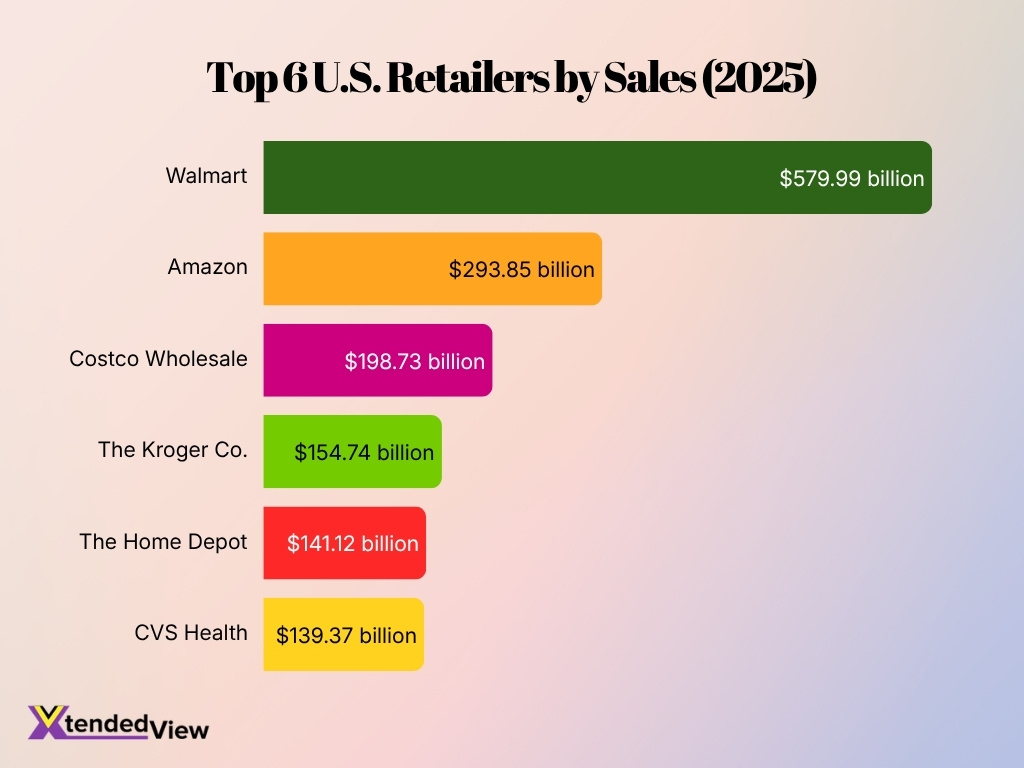
- Walmart ranked as the largest U.S. retailer in the 2026 rankings with $579.99 billion in 2025 U.S. retail sales and 4.2% annual growth.
- Amazon remained the second-largest retailer with $293.85 billion in U.S. retail sales, growing 7.3% year over year.
- Costco Wholesale ranked third with $198.73 billion in U.S. retail sales and 8.7% annual growth.
- The Kroger Co. ranked fourth, generating $154.74 billion in U.S. retail sales during 2025.
- The Home Depot completed the top five with $141.12 billion in U.S. retail sales.
- CVS Health ranked sixth after reporting $139.37 billion in U.S. retail sales and 11.9% annual growth.
- Regional grocery retailers continued strengthening their market positions through steady expansion and customer loyalty.
- The largest retailers continue investing heavily in automation, AI, omnichannel commerce, and supply chain modernization to defend and expand market share.
Retail Omnichannel Statistics
- Omnichannel shoppers have a 90% higher customer retention rate compared to single-channel buyers.
- Customers shopping across multiple channels spend 4% more in-store and 10% more online.
- Buy online, pick up in store (BOPIS) options are utilized by over 65% of adult consumers.
- Shoppers engaging across all channels generate a 250% higher purchase frequency than single-channel users.
- Over 70% of consumers use their mobile devices inside physical stores to compare prices and products.
- Nearly 80% of modern buyers expect accurate, real-time inventory visibility before visiting a retail location.
- Retailers with strong omnichannel capabilities see a 9.5% year-over-year increase in their annual revenue.
- Approximately 60% of shoppers report that a unified loyalty program heavily influences their brand loyalty.
Artificial Intelligence and Automation in Retail Statistics
- 91% of retail organizations are either using or evaluating AI technologies, according to Nvidia’s 2026 State of AI in Retail report.
- 90% of retailers plan to increase AI investments during 2026 as adoption accelerates across operations.
- 95% of AI users report that AI helps reduce operational costs across retail businesses.
- 89% of retailers using AI say it has contributed to higher revenue through personalization and operational improvements.
- 51% of retailers identify supply chain optimization as a leading AI use case.
- Nearly half of retailers are exploring or deploying agentic AI to automate inventory planning, pricing, and vendor management.
- AI-powered shopping assistants continue improving product discovery, customer service, and personalized recommendations throughout digital commerce.
- Automation technologies, including robotics and intelligent checkout systems, continue reducing manual workloads in stores and distribution centers.
AI’s Growing Role in the Shopping Journey
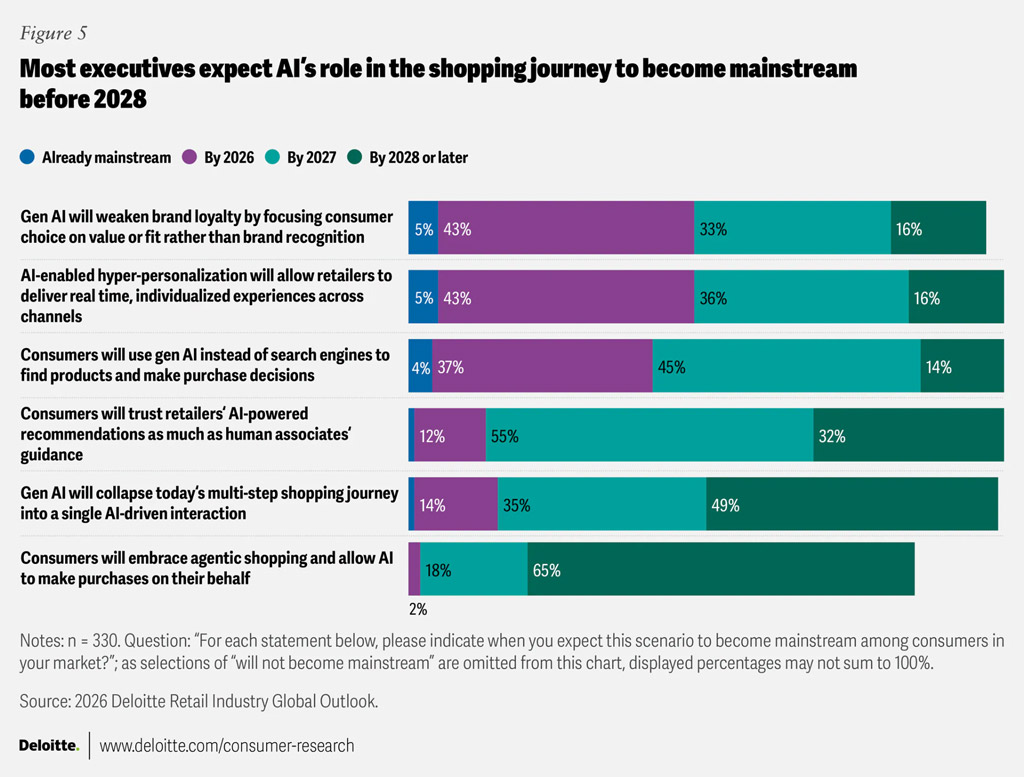
- 43% of executives expect generative AI to weaken brand loyalty by 2026, as consumers increasingly prioritize value and product fit over brand recognition.
- Another 33% expect AI-driven changes to brand loyalty to become mainstream by 2027, while 5% say this shift is already mainstream.
- 43% of executives expect AI-enabled hyper-personalization to become mainstream by 2026, enabling retailers to deliver more individualized shopping experiences.
- By 2027, 36% expect real-time AI-powered personalization across retail channels to reach mainstream adoption.
- 45% of executives expect consumers to use generative AI instead of traditional search engines for product discovery and purchase decisions by 2027.
- Retailers’ AI-powered recommendations could gain significant consumer trust, with 55% expecting them to become as trusted as human associates’ guidance by 2027.
- The transition toward a single AI-driven shopping interaction may take longer, with 49% expecting it to become mainstream in 2028 or later.
- Agentic shopping appears to have the longest adoption timeline, with 65% of executives expecting consumers allowing AI to make purchases on their behalf to become mainstream only in 2028 or later.
- Overall, the data suggests that AI-assisted discovery and personalization are expected to mature faster than fully autonomous AI-powered purchasing.
Retail Supply Chain and Inventory Statistics
- The global supply chain management market reached $35.30 billion in 2025.
- Retailers using AI in supply chains report 35% lower inventory and 65% higher service levels.
- U.S. retailers held $827.2 billion in inventory against $655.9 billion in sales in early 2026.
- Implementing real-time inventory tracking improves overall stock accuracy by 35%.
- AI-powered demand forecasting reduces stockouts by 15% and cuts carrying costs by 20%.
- Supply chain cyberattacks nearly doubled leading into 2025, reaching a global cost of $53.2 billion.
- The broader global logistics market expanded to a valuation of $11.23 trillion in 2025.
- Currently, 58% of retail brands operate with below 80% inventory accuracy without automated solutions.
- Approximately 46% of companies are actively integrating AI into their inventory systems.
Consumer Shopping Behavior Statistics
- In 2026, 72% of consumers remain highly concerned about everyday prices, prompting 67% to actively switch to cheaper brand alternatives to maximize value.
- Despite economic pressures tightening overall budgets, over 60% of millennial and higher-income shoppers continue making discretionary retail purchases at least once a week.
- Approximately 67% of retail buyers regularly participate in webrooming, carefully comparing prices and researching online before completing purchases in physical stores.
- The U.S. buy online, pick up in store (BOPIS) market is projected to hit $177.9 billion in 2026, and offering flexible curbside pickup boosts digital conversion rates by 25.8%.
- Over 64% of modern consumers utilize AI shopping tools for product discovery, heavily relying on personalized recommendations to influence their final buying decisions.
- Brands delivering highly personalized, fast, and consistent omnichannel experiences successfully retain 89% of their customer base compared to single-channel competitors.
- Valued for its unmatched convenience, mobile commerce now accounts for 59% of total global digital retail sales and is projected to exceed $2.41 trillion in 2026.
- A staggering 91% of retail consumers are now omnichannel shoppers, interacting with an average of six distinct digital and physical touchpoints prior to a final purchase.
Frequently Asked Questions (FAQs)
U.S. retail sales are forecast to reach approximately $5.6 trillion in 2026, representing 4.4% annual growth over 2025.
E-commerce accounted for 16.9% of total U.S. retail sales in the first quarter of 2026.
U.S. retail e-commerce sales reached $326.7 billion in Q1 2026, up 9.8% year over year.
U.S. retail sales are projected to grow by 4.4% in 2026, exceeding the pre-pandemic 10-year average annual growth rate of 3.6%.
Total U.S. retail sales were estimated at $1.929 trillion in the first quarter of 2026, an increase of 3.9% from the same quarter in 2025.
Conclusion
The retail industry continues to evolve rapidly as businesses adapt to changing consumer expectations, digital transformation, and economic conditions. While brick-and-mortar stores remain the foundation of retail sales, e-commerce, mobile commerce, and omnichannel shopping continue to expand their influence across every major retail category. At the same time, retailers are investing heavily in AI, automation, data analytics, and supply chain modernization to improve operational efficiency, reduce costs, and deliver more personalized shopping experiences.
The statistics presented throughout this report demonstrate that innovation, customer convenience, and technology-driven decision-making are becoming essential competitive advantages. As retail continues to evolve, organizations that successfully combine digital capabilities with strong in-store experiences and efficient operations will be better positioned for sustainable growth and long-term success.
