



Artificial intelligence is reshaping how retailers sell, forecast demand, manage inventory, and engage customers. From AI-powered product recommendations in e-commerce stores to computer vision systems that automate checkout, retailers now use AI to improve efficiency and drive revenue growth. As investments accelerate across the United States and globally, the latest statistics reveal how AI is changing retail operations at every level. Explore the data below to understand the scale, adoption, and business impact of AI in retail.
Editor’s Choice
- The global AI in retail market is projected to reach $16.5 billion to $18.6 billion in 2026, depending on methodology, after surpassing $12 billion to $14 billion in 2025.
- AI in retail is forecast to grow at a CAGR ranging from 23% to 35% over the next decade, making it one of the fastest-growing retail technology segments.
- More than 80% of retail and consumer goods companies are already using or piloting generative AI initiatives.
- 82% of retailers report conducting generative AI pilots focused on customer service transformation.
- North America accounted for 33.4% of the global AI retail market in 2024, maintaining its leadership position entering 2026.
- 92% of U.S. retailers planned to increase AI spending by 2025, highlighting strong investment momentum.
- AI-driven traffic from generative AI tools to retail websites increased by 4,700% year over year by mid-2025.
- 75% of retail executives view generative AI as essential for future revenue growth.
- Around 70% of retailers have already piloted or partially implemented agentic AI solutions.
- Retailers deploying AI-driven personalization have reported conversion improvements of up to 23% in selected implementations.
Recent Developments
- The AI in the retail market expanded from approximately $14.2 billion in 2025 to $18.6 billion in 2026, reflecting accelerating enterprise deployment.
- Generative AI in retail grew from about $1.02 billion in 2025 to $1.39 billion in 2026.
- Retail organizations are increasingly moving beyond experimentation, with 36% already scaling generative AI customer service solutions.
- 64% of retail leaders have conducted generative AI pilots across internal operations and value chains.
- Retailers increasingly deploy AI agents for inventory management, supply chain optimization, and customer service automation.
- AI-powered shopping assistants and conversational commerce tools gained mainstream adoption throughout 2025.
- Retail executives shifted AI priorities from experimentation toward measurable ROI and operational efficiency.
- Nearly 90% of retailers recognize AI as critical for maintaining competitiveness in their markets.
- AI-enhanced recommendation engines, virtual stylists, and product discovery tools became major investment categories during 2025–2026.
- Retailers increasingly adopted AI governance frameworks as concerns around transparency, privacy, and compliance grew.
AI in Retail Market Growth Statistics
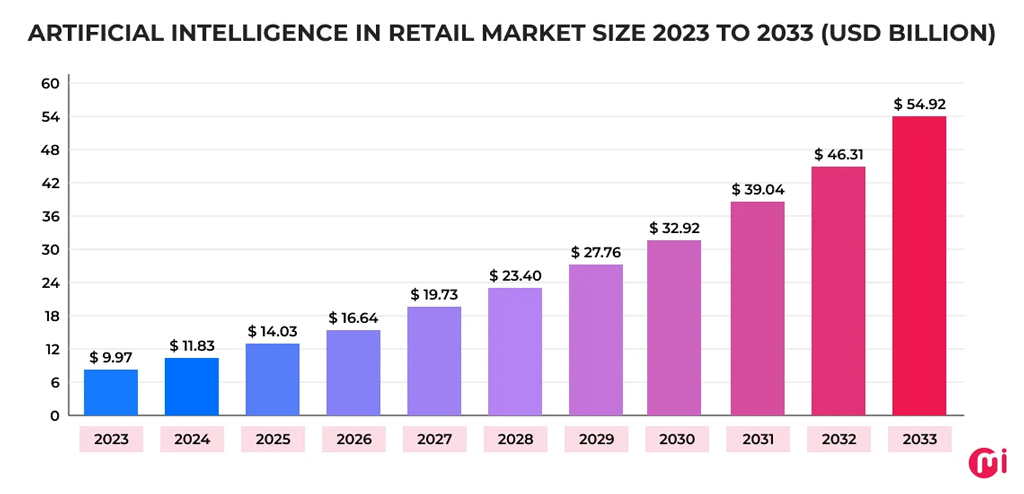
- The AI in the retail market is projected to grow from $9.97 billion in 2023 to $54.92 billion by 2033, reflecting rapid industry expansion.
- Market value is expected to rise from $11.83 billion in 2024 to $14.03 billion in 2025, showing strong early growth momentum.
- The industry is forecast to surpass $19.73 billion in 2027, nearly doubling its 2023 market size.
- By 2029, the global AI in retail market is projected to reach $27.76 billion, highlighting accelerating adoption.
- The market is expected to exceed $32.92 billion in 2030, crossing the $30 billion milestone.
- AI in retail is forecast to reach $39.04 billion in 2031, adding more than $6 billion in a single year.
- Between 2031 and 2032, market value is projected to increase from $39.04 billion to $46.31 billion, a gain of $7.27 billion.
- The market is expected to add approximately $44.95 billion in value between 2023 and 2033.
- By 2033, the AI in the retail market is projected to be over 5.5 times larger than its 2023 valuation.
- The largest annual market size recorded in the forecast period is $54.92 billion in 2033.
AI Adoption Rates and Investment Trends Among Retailers
- More than 80% of retailers and consumer goods companies are using or piloting generative AI projects.
- 82% of retailers have tested generative AI in customer service functions.
- 64% of retail leaders have piloted generative AI within internal business processes.
- 36% of retailers are already scaling generative AI customer-service deployments.
- 92% of U.S. retailers planned to increase AI spending by 2025.
- 70% of retailers have piloted or partially implemented agentic AI systems.
- 88% of retailers believe AI is necessary to remain competitive.
- 61% of retailers now maintain dedicated AI leadership teams.
- 90% of retailers are actively exploring autonomous AI agents for future operations.
- Nearly 99% of retailers report having AI expertise somewhere within their organization.
Global vs. Regional AI in Retail Market Statistics
- North America dominated the global AI retail market with an estimated 39.4% share in 2026.
- The U.S. AI retail market is rapidly growing and projected to reach $17.76 billion by 2032.
- Asia-Pacific represents the fastest-growing regional market, tracking a massive 36.09% CAGR through 2031.
- Europe is heavily digitizing its retail sector and is estimated to capture over a 15% revenue share by 2032.
- The global AI retail market size is officially forecast to surge to a massive $105.88 billion by 2034.
- Cloud-based AI deployments account for 70% to 75% of the global market share, democratizing regional access.
- Omnichannel retail operators globally captured a significant 45.73% of the AI market share in 2025.
- Operations-focused AI functions are anticipated to hold a dominant 64.81% market share globally in 2026.
Key AI Use Cases in Retail Statistics
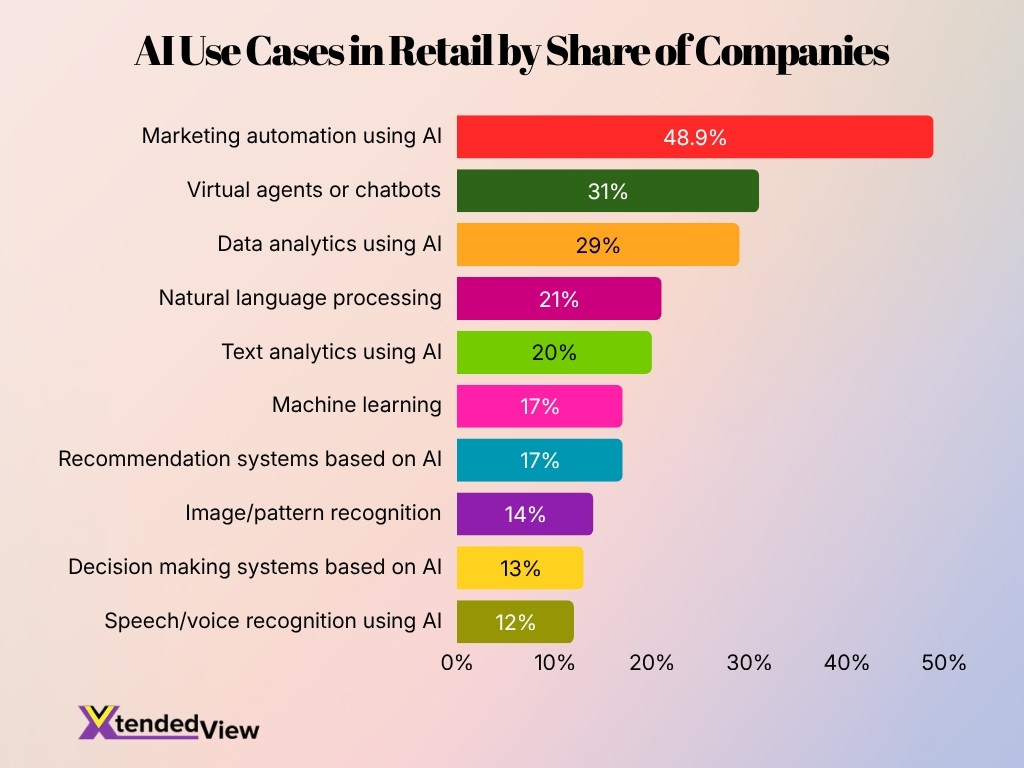
- Marketing automation is the leading retail AI application, used by 48.9% of companies to streamline campaigns and customer engagement.
- Virtual agents and chatbots are adopted by 31% of retailers, making them the second most common AI use case.
- Data analytics using AI is leveraged by 29% of companies to improve decision-making and business insights.
- Natural language processing (NLP) is utilized by 21% of retailers to better understand and respond to customer interactions.
- Text analytics is implemented by 20% of companies to extract valuable insights from customer feedback and content.
- Machine learning powers operations for 17% of retailers, helping optimize processes and forecasting.
- AI recommendation systems are used by 17% of companies to personalize product suggestions and boost sales.
- Image and pattern recognition technologies are adopted by 14% of retailers for visual search, monitoring, and automation.
- AI-based decision-making systems support business operations at 13% of retail companies.
- Speech and voice recognition tools are used by 12% of retailers, making them the least adopted AI application in the dataset.
ROI, Revenue, and Cost Reduction Statistics
- 75% of retail executives say generative AI is essential for revenue growth.
- AI-driven retail implementations have delivered conversion-rate improvements of up to 23% in reported deployments.
- AI-powered customer service tools have reduced response times by approximately 50% in some retail deployments.
- Large-scale field experiments found that generative AI increased retail sales by up to 16.3%, depending on the use case.
- Researchers estimated an annual incremental value of roughly $5 per consumer from successful retail GenAI implementations.
- 71% of retailers expect agentic AI to improve operational efficiency within the near term.
- AI-driven traffic to retail sites increased 4,700% year over year, creating new customer acquisition opportunities.
- Retailers increasingly use AI to optimize pricing, inventory allocation, and promotions in real time, reducing operational waste.
- AI-powered forecasting systems help retailers reduce overstocks and stockouts while improving inventory productivity.
- Companies deploying AI-enhanced personalization continue to report measurable gains in customer engagement and purchase conversion.
AI in E-Commerce and Digital Shopping Statistics
- Traffic from generative AI tools to retail websites increased by 4,700% year over year in 2025.
- Adobe reported a 1,300% increase in AI-assisted shopping traffic during the 2024 holiday season compared with the previous year.
- Retail visitors arriving through AI-powered interfaces spend more time browsing products than traditional visitors.
- Approximately 80% of e-commerce businesses already use some form of AI technology in marketing, merchandising, or customer support.
- AI-driven product recommendations account for up to 35% of e-commerce revenue for some major online retailers.
- AI-powered search technologies improve product discovery and reduce search abandonment rates across online stores.
- Nearly 69% of retailers use AI to optimize digital merchandising strategies.
- Conversational commerce powered by AI continues to gain traction as shoppers increasingly use natural-language queries.
- AI-generated product descriptions help retailers accelerate content production while maintaining catalog consistency.
- Retailers deploying AI-powered search and recommendation systems often report measurable increases in average order value.
Consumer Sentiment and Behavior Towards Retail AI
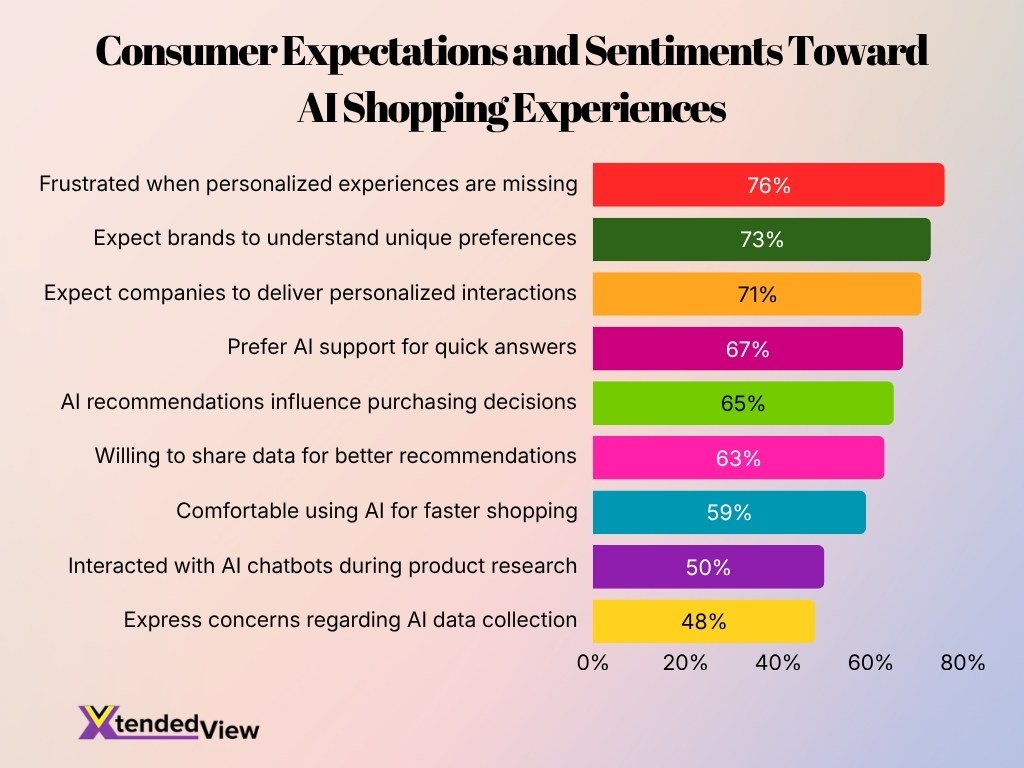
- 59% of consumers are comfortable using AI while shopping when it helps them find products faster and improves convenience.
- Around 71% of shoppers expect companies to deliver personalized interactions, a key driver behind retail AI investments.
- 76% of consumers report frustration when personalized experiences are missing during their shopping journey.
- Nearly 63% of consumers are willing to share data if it results in better shopping recommendations and improved customer experiences.
- More than 50% of online shoppers have already interacted with AI-powered chatbots or virtual assistants during product research.
- Approximately 73% of consumers expect brands to understand their unique preferences and expectations.
- About 65% of consumers say AI-powered recommendations influence their purchasing decisions.
- Nearly 48% of shoppers express concerns regarding how retailers collect and use AI-related customer data.
- 67% of consumers prefer AI support when seeking quick answers, but still want human assistance for complex issues.
- GenAI-assisted shopping sessions generated higher engagement rates than traditional search-based shopping experiences in 2025.
AI for Personalization and Customer Experience Statistics
- Companies excelling at personalization generate 40% more revenue from those activities than average performers.
- Effective personalization can reduce customer acquisition costs by up to 50%.
- Personalization initiatives can increase revenues by 5% to 15%, depending on industry and execution.
- AI-powered recommendation engines can influence up to 35% of purchases on large e-commerce platforms.
- Roughly 78% of consumers are more likely to repurchase from brands that personalize experiences effectively.
- 62% of consumers expect businesses to anticipate their needs and preferences.
- AI-powered customer service solutions can operate continuously, enabling retailers to provide support 24/7.
- Retailers using AI-based customer segmentation often improve campaign performance through more relevant targeting.
- AI-driven personalization can increase conversion rates by more than 20% in selected retail deployments.
- Personalized product recommendations remain one of the highest-ROI applications of retail AI.
In-Store AI, Computer Vision, and Smart Checkout Statistics
- The global retail computer vision market is expected to expand at a CAGR of 22.6% through 2030.
- The worldwide smart retail market is projected to reach a massive $637.01 billion by 2034.
- Implementing AI in demand forecasting effectively reduces critical inventory and stockout errors by 20% to 50%.
- The global self-checkout retail market is forecast to grow at a steady 14.10% CAGR from 2026 to 2035.
- Utilizing AI-enabled store management successfully reduces excess inventory levels by 20% to 30% without impacting service.
- Physical hardware solutions still account for a dominant 58% of the overall smart retail market share.
- Contactless and smart payment systems currently represent approximately 37% of the total smart retail ecosystem.
- North America clearly dominates the global smart retail landscape with an impressive revenue share of 34.1%.
Most Valuable Generative AI Use Cases in Retail
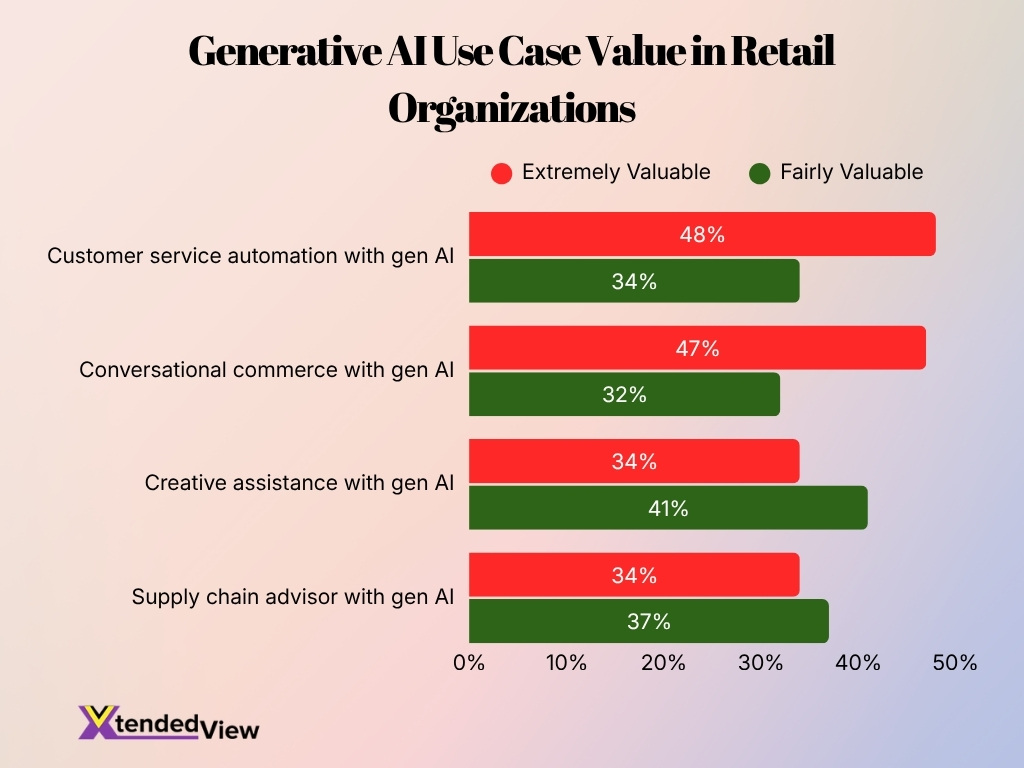
- Customer service automation with gen AI ranks highest, with 48% rating it extremely valuable and 82% considering it valuable overall.
- Conversational commerce with gen AI follows closely, with 47% calling it extremely valuable and 79% viewing it as valuable overall.
- Creative assistance with gen AI is seen as valuable by 75% of respondents, including 34% who rate it extremely valuable.
- Supply chain advisor with gen AI achieves 71% total value recognition, with 34% considering it extremely valuable.
- Creative assistance leads in the fairly valuable category, with 41% of organizations selecting this response.
- More than 7 in 10 retailers consider every listed gen AI use case to be either extremely or fairly valuable.
- Customer-facing applications such as service automation and conversational commerce receive the strongest value ratings among retail AI use cases.
- The gap between the top and bottom use cases is only 11 percentage points in total value, indicating broad confidence in gen AI adoption across retail functions.
Supply Chain, Inventory, and Demand Forecasting AI Statistics
- AI-powered forecasting can reduce supply chain forecasting errors by 20% to 50%.
- Retailers using AI forecasting have reduced inventory-related costs by up to 10%.
- AI-based inventory optimization can lower stock levels by 20% to 30%.
- Implementing AI reduces lost sales by up to 65% due to better stock availability.
- AI-driven demand forecasting reduces supply chain administration costs by up to 40%.
- Machine learning algorithms improve demand prediction accuracy by up to 85%.
- Companies integrating AI see a 15% average increase in logistics efficiency.
- Predictive analytics can cut overall transportation and freight costs by 5% to 10%.
- AI adoption in inventory management cuts stockout incidents by an average of 30%.
Dynamic Pricing and Sales Optimization Statistics
- AI-powered dynamic pricing solutions can increase gross margins by 2% to 5% in retail environments.
- Around 61% of retailers currently utilize some form of dynamic pricing strategy to stay competitive.
- Approximately 55% of businesses plan to pilot AI-based dynamic pricing within the next year.
- Implementing AI-based pricing algorithms can successfully increase total turnover by up to 3%.
- Advanced dynamic pricing models have the proven potential to drive profit margins by up to 10%.
- Automated spend optimization and real-time adjustments consistently improve marketing returns by 14%.
- Modern AI sales optimization platforms can drive a 38% increase in targeted account pipelines.
- AI pricing systems can reduce manual pricing compliance and review time by up to 70%.
AI Resistance in Clothing Shopping Statistics
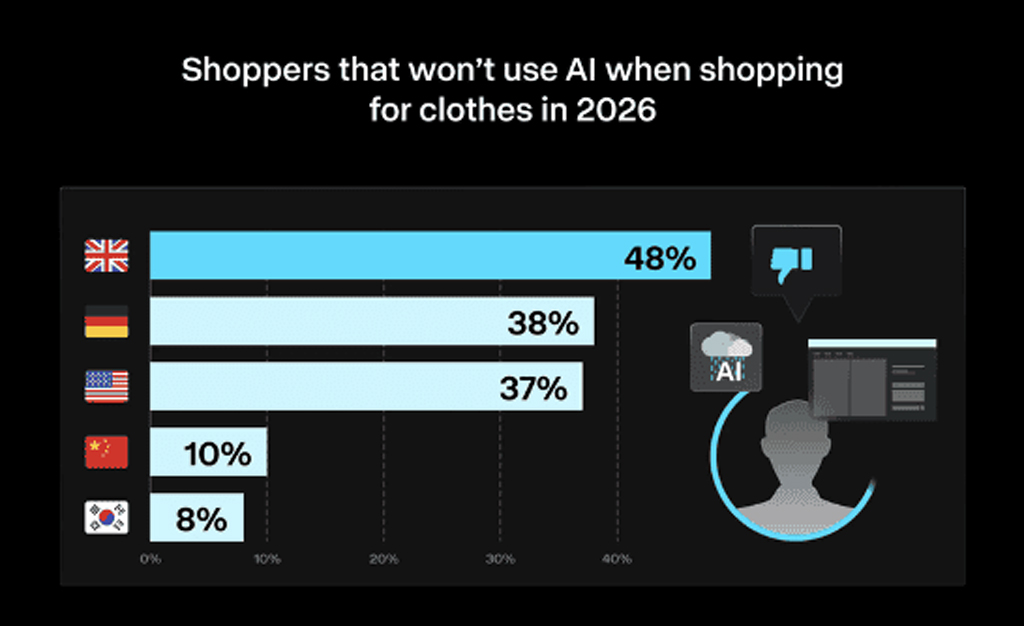
- Nearly half (48%) of UK shoppers say they won’t use AI when shopping for clothes in 2026, the highest share among surveyed countries.
- Germany ranks second at 38%, showing strong consumer reluctance toward AI-powered fashion shopping.
- 37% of U.S. shoppers also reject AI assistance, placing the country close to Germany in resistance levels.
- China reports just 10% of shoppers are unwilling to use AI, indicating significantly higher acceptance of AI-driven retail experiences.
- South Korea has the lowest resistance at 8%, highlighting strong consumer openness to AI shopping technologies.
- The gap between the UK (48%) and South Korea (8%) reaches 40 percentage points, revealing major regional differences in AI adoption.
- Western markets show substantially higher skepticism toward AI in fashion retail compared with Asian markets.
- Combined resistance in the UK, Germany, and the U.S. remains above one-third of shoppers, signaling ongoing trust and privacy concerns around AI.
Retail Loss Prevention and Fraud Detection AI Statistics
- The global AI-based loss prevention market is projected to reach $19.6 billion by 2034.
- Retail shrinkage costs the global industry over $112 billion annually, driving urgent AI surveillance adoption.
- Over 35% of new loss prevention deployments now feature AI computer vision for real-time video analytics.
- Retailers deploying AI behavioral analysis report shrinkage reductions of 30% to 45% in their first year.
- Nearly 87% of retail and financial institutions currently utilize AI-driven fraud detection systems to secure transactions.
- Self-checkout theft rates of 3.5% have prompted a massive industry surge in AI checkout monitoring.
- Returns fraud creates an $86 billion annual deficit that retailers are actively mitigating using predictive AI scoring.
- Approximately 69% of retailers face increased organized retail crime, drastically accelerating their predictive analytics investments.
Workforce, Automation, and Operational Efficiency Statistics
- AI-driven automation can improve workforce productivity by 20% to 40%, depending on retail functions and deployment scale.
- Generative AI could contribute up to $660 billion annually in productivity gains across the retail and consumer packaged goods industries.
- Approximately 71% of retailers expect AI agents to improve operational efficiency within the next few years.
- AI scheduling systems help retailers align staffing levels with customer demand patterns.
- Automated inventory management reduces repetitive administrative work for store associates.
- Retailers increasingly deploy AI copilots to support employee training and knowledge retrieval.
- AI-assisted customer service tools reduce agent workload while maintaining service availability.
- Intelligent workforce analytics help retailers identify productivity bottlenecks and operational inefficiencies.
- AI-powered automation enables faster reporting, forecasting, and business planning cycles.
- Nearly 70% of retailers have already tested agentic AI technologies capable of performing multi-step operational tasks.
AI-Driven Growth in U.S. Retail Traffic
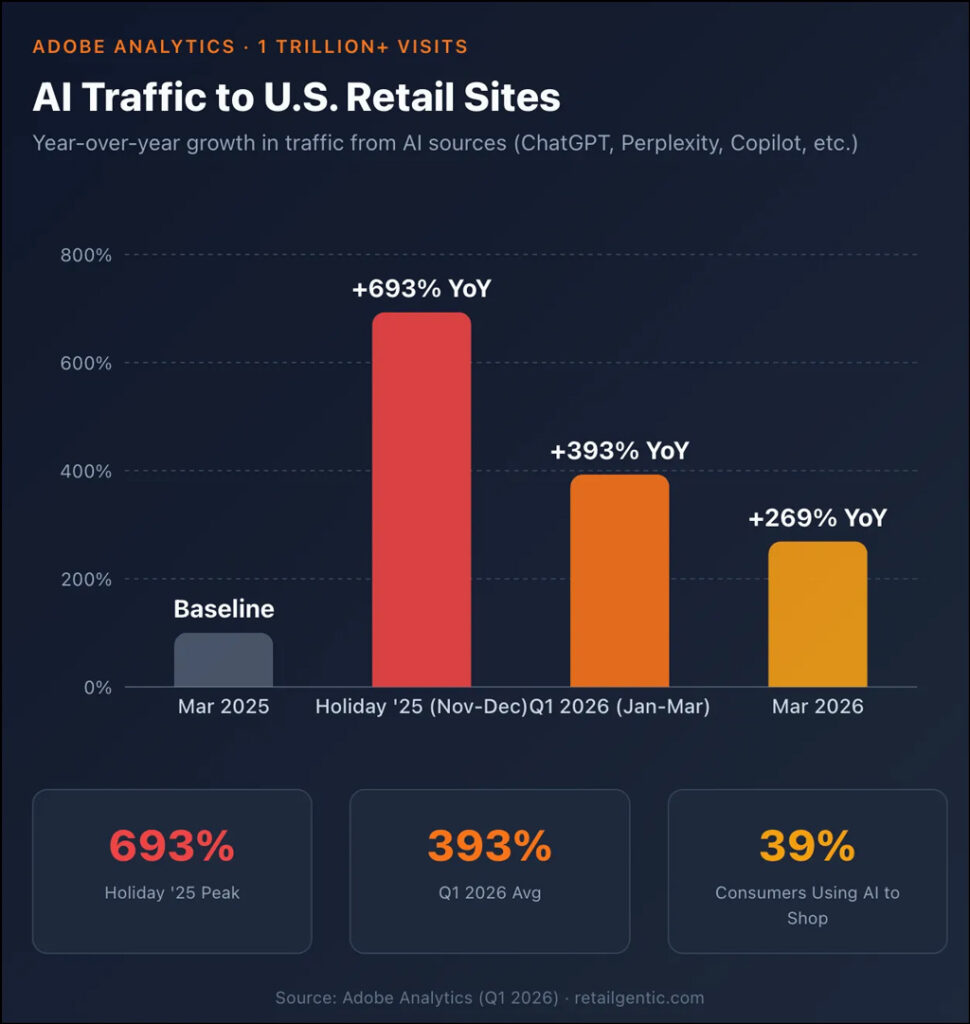
- AI-driven traffic to U.S. retail sites surged 693% YoY during the Holiday 2025 shopping season.
- Q1 2026 maintained strong momentum, with AI-sourced retail traffic rising 393% YoY.
- By March 2026, AI-generated retail traffic remained elevated at 269% YoY compared to the previous year.
- The Holiday 2025 peak of 693% was the highest AI traffic growth period recorded in the dataset.
- Nearly 39% of consumers reported using AI tools to shop, highlighting growing adoption in retail discovery.
- AI platforms such as ChatGPT, Perplexity, and Copilot are becoming major traffic drivers for online retailers.
- The decline from 693% to 393% after the holiday season suggests AI traffic is stabilizing at a significantly higher baseline.
- Even after peak shopping periods, AI referrals continued delivering more than 2.5× annual growth in retail traffic.
AI Shopping Assistant Statistics
- The global AI shopping assistant market is projected to reach $6.9 billion in 2026.
- Nearly half of all consumers (49%) utilized AI-powered shopping tools during 2025.
- Shoppers complete their purchases 47% faster when assisted by an AI shopping assistant.
- Engaging with an AI-powered chat increases e-commerce conversion rates by 4X.
- Approximately 64% of AI-assisted sales are generated directly by first-time shoppers.
- Nearly 64% of consumers actively plan to use AI chatbots for product discovery in 2026.
- Proactive AI chat interventions have successfully recovered up to 35% of abandoned shopping carts.
- About 73% of consumers cite personalized product recommendations as the primary benefit of AI shopping.
- Implementing conversational AI can decrease overall customer service operational costs by up to 30%.
- E-commerce platforms leveraging AI assistants report a 4,700% year-over-year increase in conversational traffic.
Omnichannel Retail AI Statistics
- Omnichannel shoppers spend 30% more over time than single-channel shoppers, driving AI-integrated strategic priorities.
- Integrating AI for inventory management helps 45% of retailers seamlessly synchronize visibility and reduce stockouts.
- AI-powered demand forecasting improves predictive accuracy by 10% to 20% across multiple customer touchpoints.
- AI adoption in retail supply chains delivers a 15% increase in logistics efficiency for digital and physical fulfillment.
- Companies with strong omnichannel personalization retain 89% of customers, compared to just 33% for weak strategies.
- Retailers investing in AI-driven customer data platforms see a 10% to 30% increase in online conversion rates.
- Omnichannel marketing campaigns utilizing real-time analytics achieve a 287% higher overall purchase rate.
- 85% of BOPIS (buy online, pick up in-store) shoppers make additional purchases driven by intelligent inventory allocation.
- Retailers deploying advanced omnichannel analytics witness a 10% to 15% improvement in customer engagement and retention.
- Global omnichannel retail AI applications remain a top priority and are projected to save the industry $340 billion annually by 2027.
Barriers, Privacy Concerns, and Challenges to AI Adoption
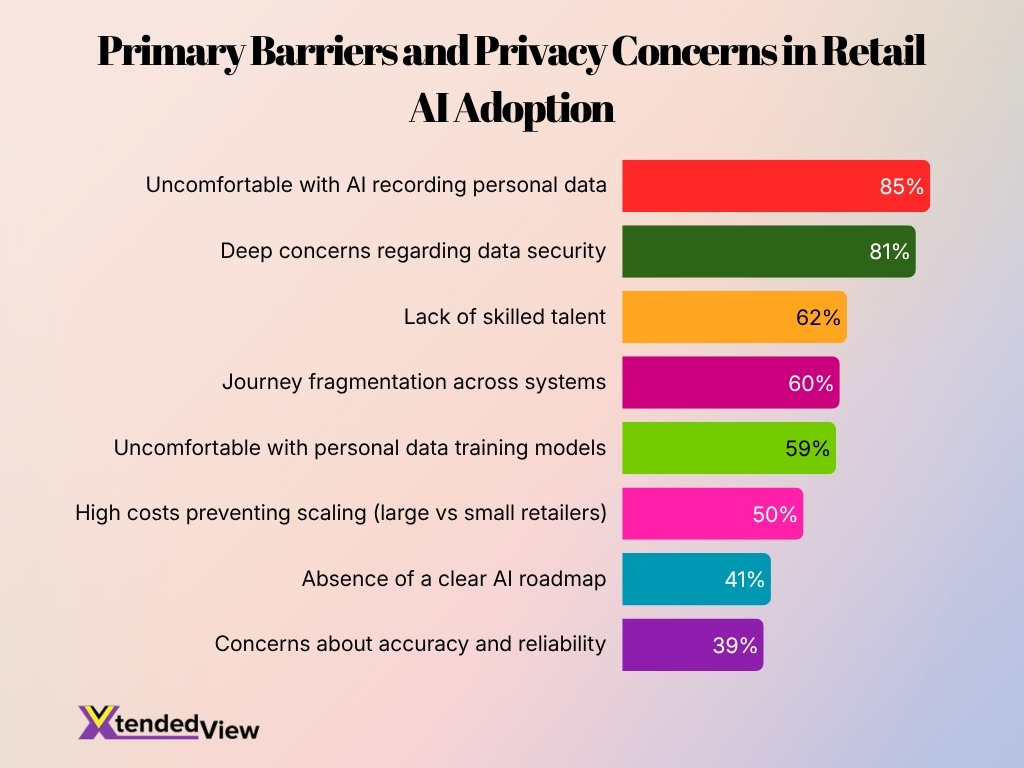
- 85% of consumers are uncomfortable with AI agents recording personal data without explicit consent.
- 62% of retail executives cite a lack of skilled talent as the primary barrier to AI adoption.
- 59% of shoppers remain highly uncomfortable with their personal data being used to train AI models.
- 41% of retailers state the absence of a clear AI roadmap is their most significant implementation challenge.
- 81% of consumers express deep concerns regarding data security in AI-powered retail environments.
- 39% of businesses identify concerns about the accuracy and reliability of AI as a major deployment obstacle.
- 50% of large enterprises have scaled AI compared to less than 30% of smaller retailers due to high costs.
- 60% of retail leaders view journey fragmentation across systems as the greatest barrier to AI effectiveness.
Future Predictions and Long-Term Projections for AI in Retail
- The global AI in retail market could exceed $105.8 billion by 2034.
- Another forecast projects the market reaching $82.7 billion by 2031.
- AI in retail is expected to maintain annual growth rates exceeding 20% throughout the decade.
- The generative AI retail market is forecast to surpass $21 billion by 2035.
- Agentic AI is expected to become a mainstream operational technology across large retail organizations.
- Autonomous inventory management systems are projected to reduce manual intervention significantly over the next decade.
- AI-driven personalization will likely become a standard expectation rather than a competitive differentiator.
- Retailers are expected to expand investments in multimodal AI, combining text, image, voice, and video intelligence.
- AI shopping assistants are forecast to become a major product discovery channel globally.
- Industry analysts expect AI to influence nearly every major retail function, including merchandising, logistics, marketing, and customer experience, by the early 2030s.
Frequently Asked Questions (FAQs)
The global AI in retail market is projected to reach $16.54 billion in 2026, with forecasts suggesting growth to $105.88 billion by 2034 at a 26.1% CAGR.
About 90% of retailers are now adopting or piloting AI technologies, with improved decision-making cited by 43% and enhanced employee productivity by 42% of respondents.
Approximately 82% of retailers have conducted generative AI pilots for customer service, while 36% are already scaling those solutions across their operations.
The AI in the retail market is expected to grow at a 34.7% CAGR from 2026 to 2031, increasing from $18.64 billion in 2026 to $82.72 billion by 2031.
According to recent retail research, 75% of retailers say AI agents will be essential to remain competitive, while 88% acknowledge AI’s strategic role in future retail success.
Conclusion
AI has moved beyond experimentation and is now becoming a core component of modern retail strategy. The data shows strong growth in market size, adoption rates, personalization initiatives, supply chain optimization, and generative AI deployments. Retailers are increasingly using AI to improve customer experiences, automate operations, reduce losses, and support better decision-making.
Looking ahead, investment momentum remains strong as organizations expand AI capabilities across physical stores, e-commerce platforms, and omnichannel ecosystems. While challenges related to privacy, governance, talent, and implementation costs remain, the long-term outlook suggests that AI will continue reshaping retail operations and customer engagement throughout the next decade.