


Battery recycling has become a critical part of the clean energy transition as electric vehicles, renewable energy storage systems, and consumer electronics continue to expand. It helps recover valuable materials such as lithium, cobalt, nickel, and lead while reducing mining demand and hazardous waste. In the United States, battery recycling supports domestic critical mineral supply chains and strengthens manufacturing resilience. Explore the latest battery recycling statistics to understand how the industry is evolving.
Editor’s Choice
- The global battery recycling market was valued at approximately $3.4 billion in 2025 and is projected to reach $4.7 billion in 2026, driven by rapid EV adoption.
- Lithium-ion battery deployment increased more than sixfold between 2020 and 2025, creating a much larger future recycling stream.
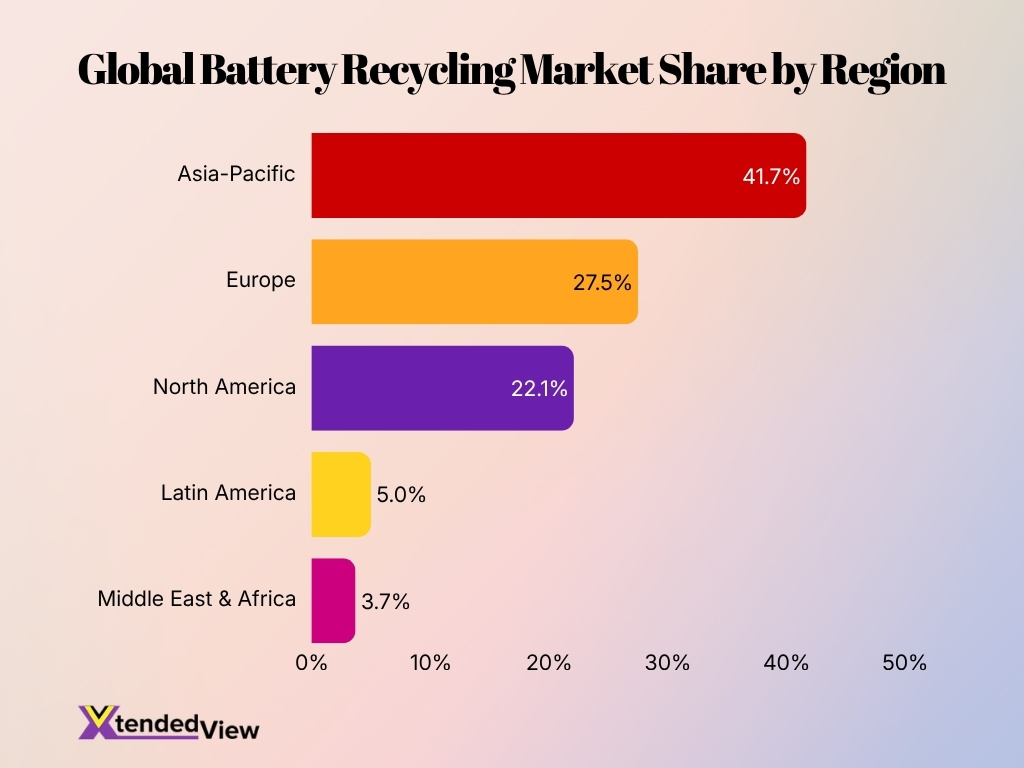
- Asia-Pacific accounted for 41.7% of global battery recycling revenue in 2025, making it the largest regional market.
- Lead-acid batteries represented 77.5% of the battery recycling market by revenue in 2025, although lithium-ion recycling continues to grow faster.
- More than one in four vehicles sold globally in 2025 was an electric vehicle, increasing long-term demand for battery recycling infrastructure.
- Recycling remains a key future source of lithium, nickel, cobalt, and graphite, although recycled materials currently satisfy only a small share of global mineral demand.
- Governments continued expanding battery recycling regulations and domestic supply chain initiatives throughout 2025 and 2026 to improve critical mineral security.
Recent Developments
- In July 2026, the U.S. announced new measures allowing restrictions on exports of battery-rich electronic waste to strengthen domestic recycling capacity.
- New European calculation rules for recycling efficiency and material recovery officially entered into force during 2025, creating standardized reporting across recyclers.
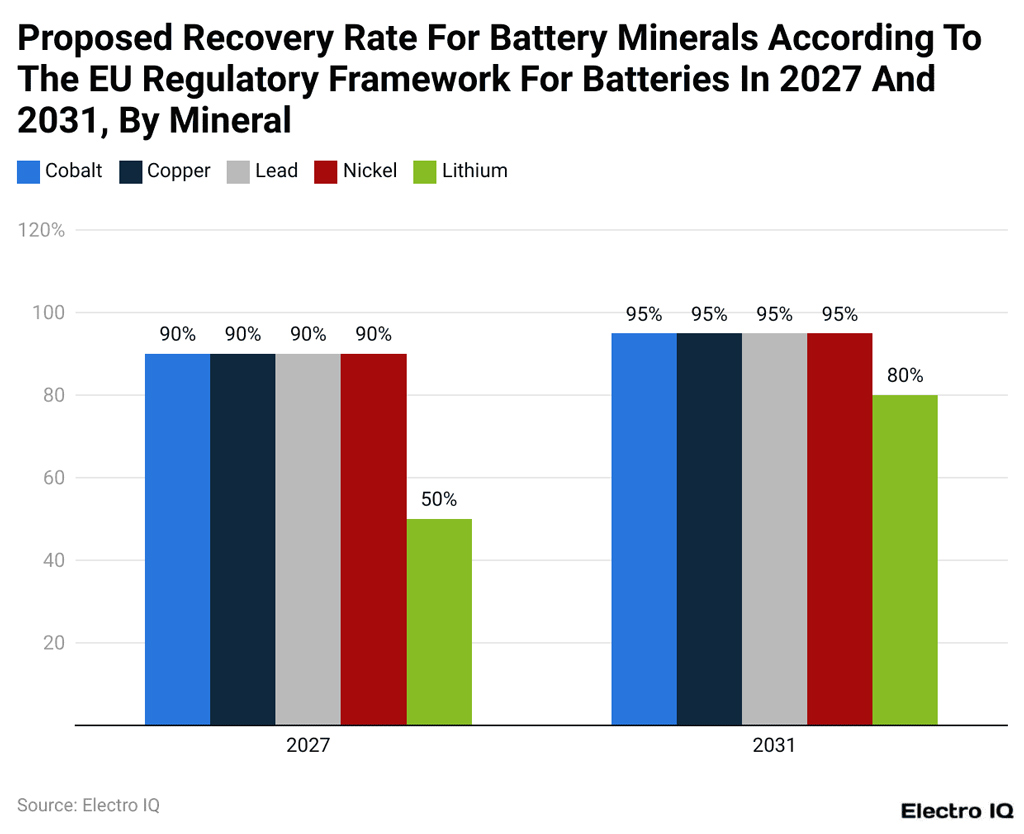
- Material recovery targets in Europe require recyclers to recover 90% of cobalt, copper, lead, and nickel by 2027, with stricter targets planned for 2031.
- Recycling operations today primarily process manufacturing scrap, while end-of-life EV batteries will become a much larger feedstock over the next decade.
- Patent activity related to battery circularity continued to accelerate as governments and companies invested in next-generation recycling technologies.
- Several new lithium-ion battery recycling facilities entered commercial operation during 2025, expanding regional processing capacity for EV batteries.
- Researchers continued improving direct recycling, hydrometallurgical, and regeneration technologies to recover more battery materials with lower energy use.
- Industry analysts expect recycling to become increasingly important as millions of EV batteries begin reaching end-of-life during the 2030s.
Battery Recycling Market Size
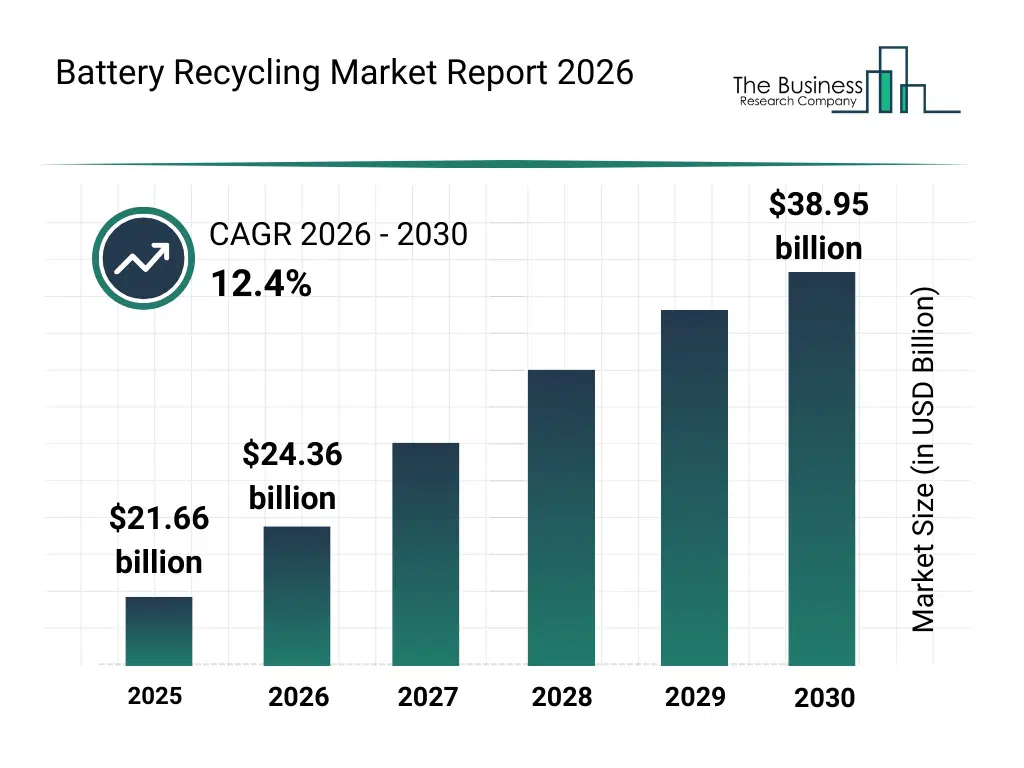
- The global battery recycling market is projected to grow from $21.66 billion in 2025 to $38.95 billion by 2030.
- The market is expected to expand by approximately $17.29 billion between 2025 and 2030.
- Battery recycling revenue is forecast to rise by nearly 80% over the five-year period.
- The market is estimated to reach $24.36 billion in 2026, an increase of $2.70 billion from 2025.
- From 2026 to 2030, the industry is projected to register a strong 12.4% CAGR.
- The market could surpass $30 billion by 2028, reflecting accelerating demand for recycled battery materials.
- By 2029, the battery recycling market is estimated to approach $34.63 billion.
- The upward trend highlights growing investment in battery collection, material recovery, and recycling infrastructure.
Battery Recycling Market Growth
- Battery recycling remains one of the fastest-growing segments within the broader circular economy, supported by EV sales and clean energy investments.
- Global lithium-ion battery deployment increased more than sixfold between 2020 and 2025, creating sustained growth opportunities for recyclers.
- Demand for lithium, nickel, cobalt, and graphite continues rising as battery manufacturing expands globally.
- Grid-scale energy storage has emerged as a significant new source of battery demand alongside electric vehicles.
- Battery recycling growth increasingly depends on recovering production scrap while waiting for larger volumes of retired EV batteries.
- Policy support across North America, Europe, and Asia accelerated investment in domestic recycling facilities throughout 2025 and 2026.
- Improvements in recycling technologies continue increasing material recovery efficiency while lowering environmental impacts.
- Analysts expect battery recycling to become a strategic industry for reducing dependence on imported critical minerals.
Battery Recycling Rates
- Lead-acid batteries remain the most successfully recycled battery chemistry worldwide because of mature collection systems.
- European regulations require recyclers to achieve 75% recycling efficiency for lead-acid batteries by the end of 2025.
- Lithium-based batteries must achieve 65% recycling efficiency by the end of 2025 under European rules.
- The recycling efficiency target for lithium batteries increases to 70% by 2030.
- Lead-acid battery recycling efficiency targets increase to 80% by 2030.
- Recovery targets require 90% recovery of cobalt, copper, lead, and nickel beginning in 2027.
- Lithium recovery targets reach 50% by 2027 and increase to 80% by 2031.
- Industry researchers continue developing advanced recycling methods to improve recovery rates while reducing energy consumption and processing costs.
Battery Recycling Market Insights by Battery Type
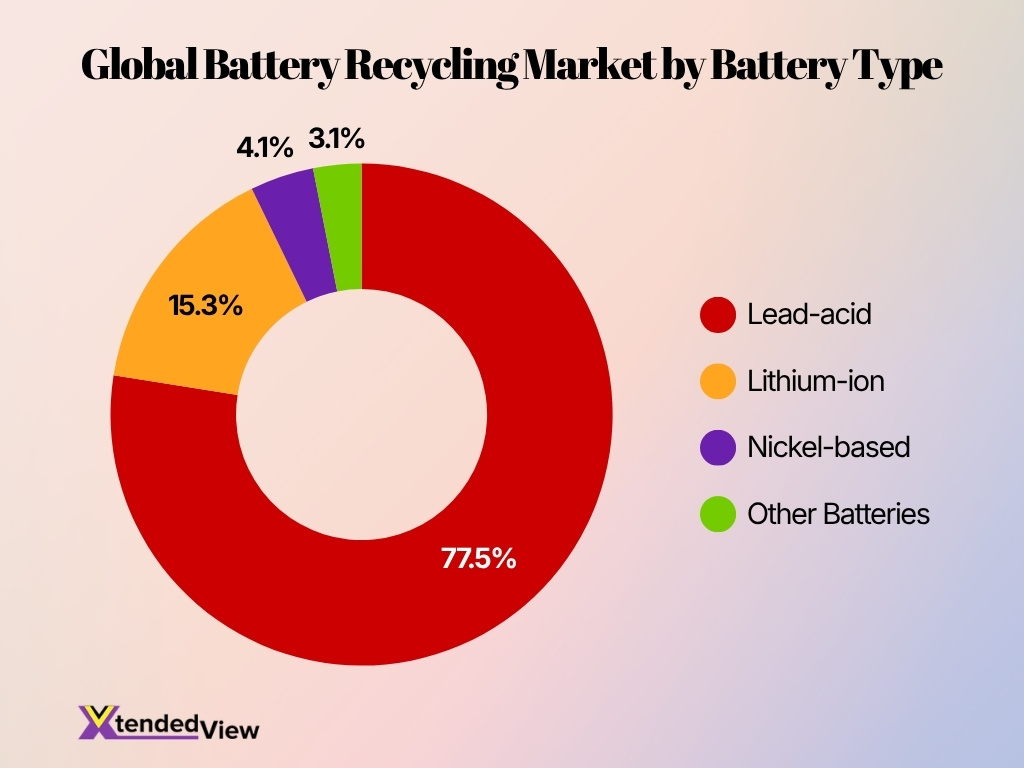
- Lead-acid batteries dominate the global battery recycling market with a 77.5% share, largely because they have mature collection systems, high recycling efficiency, and widespread use in automotive and industrial applications.
- Lithium-ion batteries account for 15.3% of the market, making them the second-largest battery type as demand grows across electric vehicles, consumer electronics, and energy storage systems.
- Nickel-based batteries represent 4.1% of the global recycling market, reflecting their more limited usage compared with lead-acid and lithium-ion batteries in modern applications.
- Other battery types contribute just 3.1% of the market, indicating that recycling activity remains heavily concentrated among the leading battery chemistries.
- Combined, lead-acid and lithium-ion batteries make up 92.8% of the total market, showing that these two battery categories drive nearly all global battery recycling activity.
- The market share of lead-acid batteries is more than five times higher than lithium-ion batteries, highlighting the continued strength of established lead-acid recycling infrastructure.
- Although lithium-ion batteries currently hold a smaller share, their 15.3% market position is expected to become increasingly important as electric vehicle adoption and battery storage deployment continue to expand.
Lithium-ion Battery Recycling Statistics
- Lithium-ion batteries are the fastest-growing battery recycling segment because of expanding EV production.
- Total lithium-ion battery deployment increased by more than six times between 2020 and 2025.
- Electric vehicles and stationary energy storage together account for around 90% of today’s lithium-ion battery market.
- Current recycling volumes remain relatively small because most EV batteries have not yet reached end-of-life.
- Reuse and second-life applications can extend battery life before final recycling, reducing environmental impacts.
- Researchers continue advancing hydrometallurgical, pyrometallurgical, direct recycling, and regeneration methods to improve lithium-ion battery recovery.
- The rapid expansion of EV manufacturing has increased production scrap, making it an important feedstock for recyclers today.
- Battery recycling is expected to play a much larger role in supplying critical minerals once larger volumes of EV batteries retire during the next decade.
Lead-acid Battery Recycling Statistics
- Lead-acid batteries accounted for 77.5% of global battery recycling revenue in 2025, making them the largest battery type processed by recyclers.
- The United States continues to recycle more than 99% of lead-acid batteries, making them one of the most successfully recycled consumer products.
- European regulations require recyclers to achieve a minimum 75% recycling efficiency for lead-acid batteries by the end of 2025.
- The recycling efficiency target for lead-acid batteries increases to 80% by 2030 under updated European rules.
- Material recovery targets require recyclers to recover 90% of lead by 2027, increasing to 95% by 2031.
- Most recycled lead returns to battery manufacturing, creating one of the world’s most mature circular supply chains.
- Automotive starter batteries remain the primary source of recyclable lead-acid batteries globally.
- In 2025, European recycling programs exceeded regulatory recycling requirements for lead-acid starter batteries.
Battery Collection Rates
- In the United States, lead-acid batteries achieve a remarkable 99% collection and recycling rate.
- In stark contrast, lithium-ion batteries currently struggle with a less than 15% recycling rate.
- Over 160 million lead batteries are successfully collected and kept out of U.S. landfills each year.
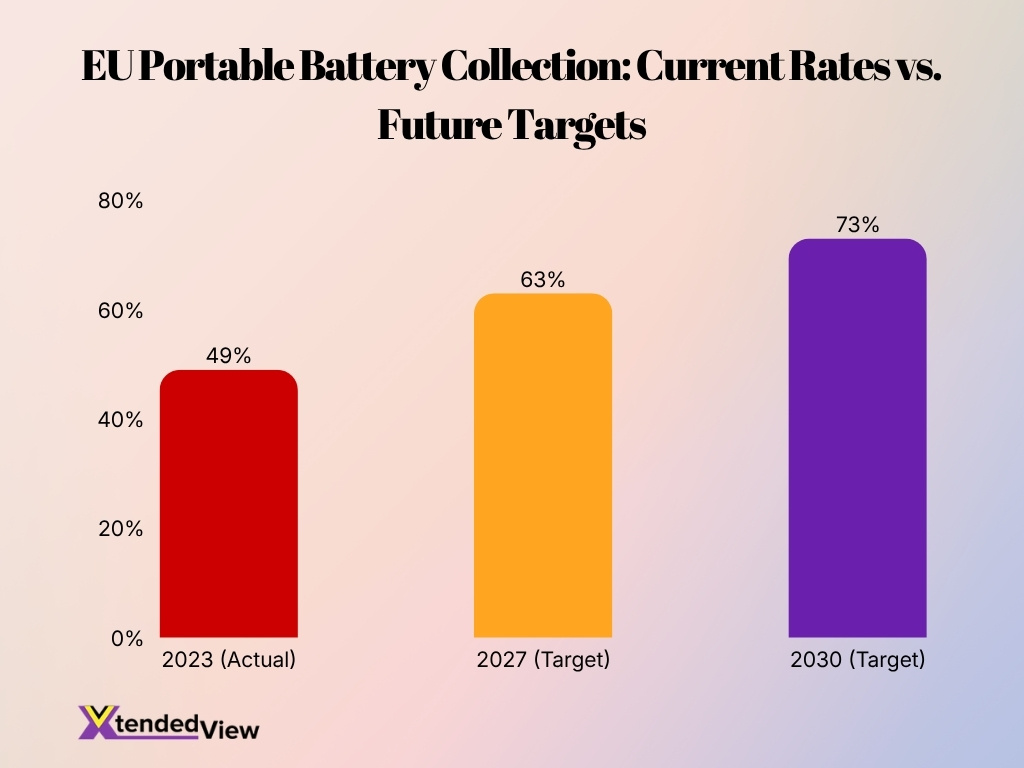
- The European Union successfully collected 49% of all portable batteries sold for recycling in 2023.
- Out of 231,000 tonnes of portable batteries sold in the EU during 2023, approximately 117,000 tonnes were collected.
- New regulations mandate that EU producers must achieve 63% collection rates by 2027 and 73% by 2030.
- The global battery recycling market was valued at $18.0 billion in 2025 and is projected to reach $32.9 billion by 2034.
- Recycling collected lead batteries consumes 90% less energy and reduces greenhouse gas emissions by 90%.
Battery Waste Generation
- The global battery market is projected to expand from $139.9 billion in 2024 to $672.5 billion by 2034.
- The world is expected to generate approximately 1.5 million metric tons of battery waste by 2025.
- Global demand for lithium-ion batteries is projected to soar to around 4.7 terawatt-hours by 2030.
- Battery recycling can reduce lifecycle carbon emissions by up to 70 kilograms of carbon dioxide per kilowatt-hour.
- Advanced recycling technologies have achieved recovery efficiencies of up to 99% for selected battery materials.
- The global battery recycling market is forecast to reach a value of $56.9 billion by the year 2032.
- By 2030, electric vehicles will surpass portable electronics as the leading source of global battery waste.
- Approximately 280,000 tons of lithium-ion battery waste is currently generated on an annual basis globally.
- A single improperly disposed lead-acid battery can contaminate up to 25 tons of municipal solid waste.
End-of-Life Battery Volumes
- Most electric vehicle batteries sold during the past decade are still in service, limiting today’s end-of-life recycling volumes while creating a large future pipeline.
- Industry forecasts suggest India could recycle more than 1.2 million EV batteries annually by 2030.
- That annual volume could exceed 14 million EV batteries by 2040 as the country’s electric vehicle fleet matures.
- In the United Kingdom, more than 23,000 used EV and energy storage batteries were reportedly being stored because recycling capacity has lagged demand.
- Analysts estimate up to 90% of those stored batteries have not yet been recycled or reused.
- Manufacturing scrap currently contributes a larger share of lithium-ion recycling feedstock than retired EV batteries.
- As EV adoption accelerates, end-of-life battery volumes are expected to increase sharply during the 2030s.
- Second-life applications for EV batteries can delay recycling while extending battery service in stationary energy storage.
Regional Battery Recycling Market Share
- Asia-Pacific leads the global battery recycling market with a 41.7% share, supported by high battery production, rising electric vehicle adoption, and expanding recycling capacity.
- Europe accounts for 27.5% of the market, driven by strict environmental regulations, battery collection targets, and growing investment in circular economy initiatives.
- North America holds a 22.1% market share, reflecting increasing demand for lithium-ion battery recycling and the expansion of domestic recycling infrastructure.
- Latin America represents 5.0% of the global market, indicating an emerging recycling industry with significant room for future investment and capacity growth.
- The Middle East and Africa contribute 3.7%, making them the smallest regional market but offering long-term opportunities as battery usage and waste volumes increase.
- Combined, Asia-Pacific, Europe, and North America control 91.3% of the global battery recycling market, highlighting the strong concentration of recycling activity in major industrial regions.
Battery Recycling Capacity
- A major North American facility processes 60,000 metric tons of battery waste annually.
- This operation successfully recovers 95% of valuable battery metals like lithium.
- India launched a 10,000 metric ton capacity lithium-ion recycling facility in 2026.
- There were 520 registered battery recyclers operating in India as of March 2026.
- These registered recyclers managed 69.37 lakh metric tons of battery waste nationally.
- The global battery recycling market is forecast to reach USD 51.22 billion by 2033.
- India’s current estimated recycling capacity spans 60,000 to 80,000 tonnes annually.
- The lithium-ion recycling sector anticipates a massive 30.9% CAGR through 2033.
Material Recovery Rates
- European regulations require 90% recovery of cobalt, copper, lead, and nickel by 2027.
- Lithium recovery targets start at 50% in 2027 and increase to 80% by 2031.
- The recovery mandate for cobalt, copper, lead, and nickel scales up to 95% by 2031.
- Advanced recycling technologies can reach up to 99% material recovery under ideal conditions.
- Hydrometallurgical extraction methods can yield lithium purity levels up to 99.5%.
- Producers must achieve a 63% collection rate for portable waste batteries by 2027.
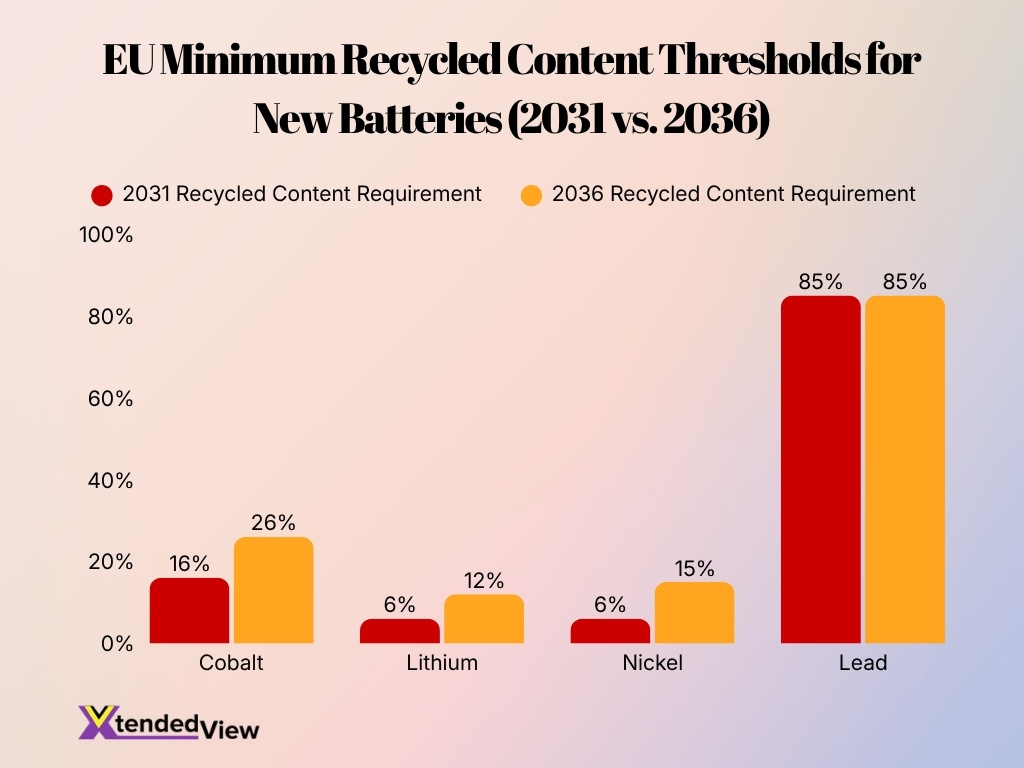
- New batteries must include 16% recycled cobalt and 6% recycled lithium by 2031.
- Hydrometallurgical processing reduces energy consumption by up to 30% versus thermal methods.
- Modern cobalt processing plants can successfully recycle up to 95% of their water usage.
Proposed EU Battery Mineral Recovery Rates
- Cobalt, copper, lead, and nickel are each targeted to reach a 90% recovery rate by 2027.
- By 2031, the recovery target for these four minerals rises to 95%, representing a 5 percentage point increase.
- Lithium has the lowest proposed recovery target in 2027 at 50%.
- The lithium recovery target increases sharply to 80% by 2031, a gain of 30 percentage points.
- Lithium records the largest planned improvement, with its target rising by 60% relative to the 2027 level.
- Even after the increase, lithium’s 80% recovery target remains 15 percentage points below the 95% target set for the other minerals in 2031.
- The framework places the strongest recovery requirements on cobalt, copper, lead, and nickel, reflecting their high reuse potential in battery recycling.
- Overall, the proposed targets indicate a major EU push toward higher material recovery, reduced mineral waste, and a more circular battery supply chain.
Battery Recycling Technologies
- Pyrometallurgical recycling typically heats battery materials to 1,000 to 1,500 degrees Celsius, allowing processors to handle mixed chemistries but increasing energy use.
- Hydrometallurgical recycling usually follows four stages: pretreatment, leaching, purification, and material regeneration. This approach can recover lithium alongside nickel, cobalt, and manganese.
- A 2025 techno-economic review estimated an ideal hydrometallurgical operating cost of about $1,803 per metric ton of battery packs.
- Economic analyses indicate that lithium-ion recycling may need to produce roughly $2 to $6 in value per kilogram to compete with newly mined materials under different commodity-price conditions.
- Direct recycling preserves cathode structures rather than breaking materials into individual metals. As a result, it can reduce the number of chemical and manufacturing steps needed to make new cathodes.
- One demonstrated direct-upcycling process increased cathode energy density by more than 10% and retained over 94% of capacity after 500 cycles in pouch cells.
- Aluminum and copper current collectors represent more than 15% of a lithium-ion battery’s weight, which makes their direct recovery an additional recycling opportunity.
- Lithium iron phosphate batteries present a growing technical and economic challenge because they contain less cobalt and nickel than many other lithium-ion chemistries. Consequently, recyclers must recover lithium, graphite, and other lower-value materials efficiently.
- Technology selection increasingly depends on battery chemistry. Pyrometallurgy can process mixed feedstock, while hydrometallurgy and direct recycling often require more precise sorting and cathode identification.
Battery Recycling Investment
- The United States opened a funding opportunity of up to $500 million in March 2026 for critical mineral processing, battery manufacturing, and recycling projects.
- Federal battery materials programs received $3 billion in authorized funding, including $600 million annually for fiscal years 2022 through 2026.
- The 2026 funding round supports commercial facilities that process cathode materials, anode materials, electrolytes, and other battery supply-chain inputs.
- A major U.S. battery recycler raised $350 million in October 2025 to expand recycling, materials production, and energy storage operations.
- That investment round expanded to $425 million by January 2026, lifting the company’s reported valuation above $6 billion.
- The European Union and India launched a €15.2 million joint initiative in May 2026 to advance electric vehicle battery recycling technologies and circular supply chains.
- India approved a ₹15 billion critical-mineral recycling incentive program covering lithium-ion battery scrap, electronic waste, and end-of-life vehicle materials. The six-year program runs from fiscal 2026 through fiscal 2031.
- U.S. officials expected one 2025 funding opportunity to support as many as 14 grants, with project periods ranging from two to five years.
- Recycling infrastructure can reduce battery manufacturing costs by an estimated 22% and lower environmental impacts by as much as 7% when companies place facilities strategically.
Battery Recycling Regulations
- European rules set minimum 2025 recycling efficiencies of 75% for lead-acid batteries, 65% for lithium-based batteries, 80% for nickel-cadmium batteries, and 50% for other batteries.
- By the end of 2027, recyclers must recover at least 90% of cobalt, copper, lead, and nickel from covered waste batteries.
- The corresponding lithium recovery requirement reaches 50% by the end of 2027.
- By the end of 2031, required recovery rises to 95% for cobalt, copper, lead, and nickel and 80% for lithium.
- From August 2031, covered batteries must contain at least 16% recycled cobalt, 6% recycled lithium, 6% recycled nickel, and 85% recycled lead in their active materials.
- From August 2036, the recycled-content thresholds increase to 26% for cobalt, 12% for lithium, and 15% for nickel, while the lead requirement remains at 85%.
- European rules require consumers to be able to remove and replace portable batteries incorporated into appliances by 2027, subject to defined exemptions.
- A digital battery passport becomes mandatory for specified electric vehicle, industrial, and light-transport batteries in February 2027, improving access to composition and lifecycle information.
- U.S. regulators reported in 2025 that most discarded lithium-ion batteries likely qualify as hazardous waste because damaged units can ignite or react dangerously.
Consumer Battery Recycling Behavior
- A national network collected over 175 million pounds of batteries cumulatively by 2025.
- Consumers accessed more than 20,000 battery drop-off locations across the network in 2025.
- The U.S. lead-acid battery recycling rate achieved an industry-reported 99.3%.
- The estimated U.S. recycling rate for alkaline batteries currently stands at a mere 4%.
- Authorities caution against using the outdated 5% lithium-ion recycling rate from European data.
- A 2025 behavioral study successfully analyzed data from 657 resident questionnaires.
- The study identified 3 main factors positively correlating with consumer recycling intentions.
Battery Recycling Challenges
- U.S. and Canadian material-recovery capacity stood at just 5,150 metric tons in 2021.
- U.S. and Canadian capacity is projected to surge to 1.18 million metric tons by 2030.
- India’s recycling capacity exceeded 80,000 metric tons for only 15,000 metric tons of battery supply in 2025.
- India’s announced capacity could hit 115,000 metric tons by 2030 against an estimated 60,000 metric tons of available batteries.
- Lithium-ion batteries triggered over 240 reported fires across 64 U.S. waste facilities between 2013 and 2020.
- One local fire department reported at least 13 battery fires within six to eight months prior to March 2025.
- Specialized collection containers for shipping damaged batteries face strict weight limits of 66 pounds per box.
Frequently Asked Questions (FAQs)
The global battery recycling market is projected to reach $4.7 billion in 2026, up from $3.4 billion in 2025.
The global battery recycling market is forecast to grow at a 37.7% CAGR between 2026 and 2033.
Lead-acid batteries represented 77.5% of the global battery recycling market by revenue in 2025.
Asia-Pacific accounted for 41.7% of the global battery recycling market revenue in 2025.
Global lithium-ion battery deployment increased by more than sixfold between 2020 and 2025.
Conclusion
Battery recycling entered the year with stronger investment, clearer recovery requirements, and growing demand from electric vehicles and energy storage. Lead-acid batteries continue to set the benchmark for collection, while lithium-ion recycling faces gaps in consumer participation, sorting, transportation, and feedstock supply. As more EV batteries reach retirement, efficient recovery systems will play a larger role in critical mineral security, domestic manufacturing, and waste reduction.
