


Wind energy continues to reshape the global electricity market as utilities, governments, and corporations invest heavily in renewable infrastructure. In the US, wind farms across states like Texas and Iowa now supply large portions of grid electricity, while offshore wind projects support coastal energy diversification and manufacturing growth. At the same time, global industries such as data centers, electric vehicle production, and green hydrogen increasingly rely on wind-generated electricity to meet sustainability goals.
As technology improves and investment accelerates, wind power remains one of the fastest-growing clean energy sources worldwide. Explore the latest figures, market shifts, and deployment trends in this detailed Wind Energy Statistics report.
Editor’s Choice
- Global installed wind power capacity exceeded 1,346 GW in 2025, up from around 1,174 GW in 2024.
- The world added a record 169 GW of new wind capacity in 2025, representing roughly 35% growth over 2024 installations.
- Wind energy generated close to 3,000 TWh of electricity globally in 2025, supplying more than 11% of the world’s electricity demand.
- Global wind installations reached 117 GW in 2024, marking the strongest annual deployment on record at that time.
- China installed approximately 130 GW of wind capacity in 2025, accounting for nearly 77% of the global market.
- Offshore wind capacity worldwide surpassed 83 GW by the end of 2024.
- Wind energy now contributes roughly 8% of global electricity generation, compared with less than 1% two decades ago.
- More than 138 countries now generate electricity from wind energy projects.
- Global wind turbine manufacturers installed about 23,098 turbine units in 2024.
Recent Developments
- Global wind capacity additions climbed from 117 GW in 2024 to approximately 169 GW in 2025, signaling a sharp acceleration in deployment activity.
- China commissioned more than 120 GW of new wind capacity in 2025, driven by aggressive provincial renewable targets and grid expansion projects.
- Global onshore wind installations rose by roughly 42% year over year in 2025, reaching more than 155 GW.
- Offshore wind additions increased by approximately 18% in 2025, despite supply-chain and financing pressures affecting several Western markets.
- Wind turbine order intake reached 91.2 GW in the first half of 2024, reflecting a 23% increase from the same period in 2023.
- Floating offshore wind installations totaled around 278 MW globally by the end of 2024, with Norway and the UK leading deployments.
- Wind and solar projects together added at least 240 GW of utility-scale renewable capacity in 2024, increasing global operating capacity by around 14%.
- Global renewable capacity additions are expected to approach 935 GW annually by 2030, with solar and wind accounting for nearly 95% of growth.
- Wind manufacturing capacity constraints remain a concern, as global onshore manufacturing output may only reach 145 GW by 2030.
Global Overview of Wind Energy
- Global wind power capacity crossed the 1 TW milestone in 2024 for the first time in industry history.
- Total worldwide wind capacity expanded to approximately 1,299 GW by the end of 2025.
- Wind power generated nearly 3,000 TWh globally in 2025, enough to exceed the annual electricity consumption of many major economies combined.
- Around 80 countries now operate more than 100 MW of installed wind capacity.
- Asia remains the largest regional wind market, led by China and India, which together dominated global installations in 2025.
- Europe commissioned approximately 19 GW of new wind projects in 2025, making it the second-largest installation region after Asia.
- Global wind capacity grew at an annual rate of roughly 14.3% in 2025, the strongest expansion pace since 2020.
- Offshore wind represented more than 83 GW of cumulative installed capacity worldwide by the end of 2024.
- The global wind industry now supports electricity systems across 138 nations, reflecting broader adoption in emerging economies.
Wind Energy Market Growth Highlights
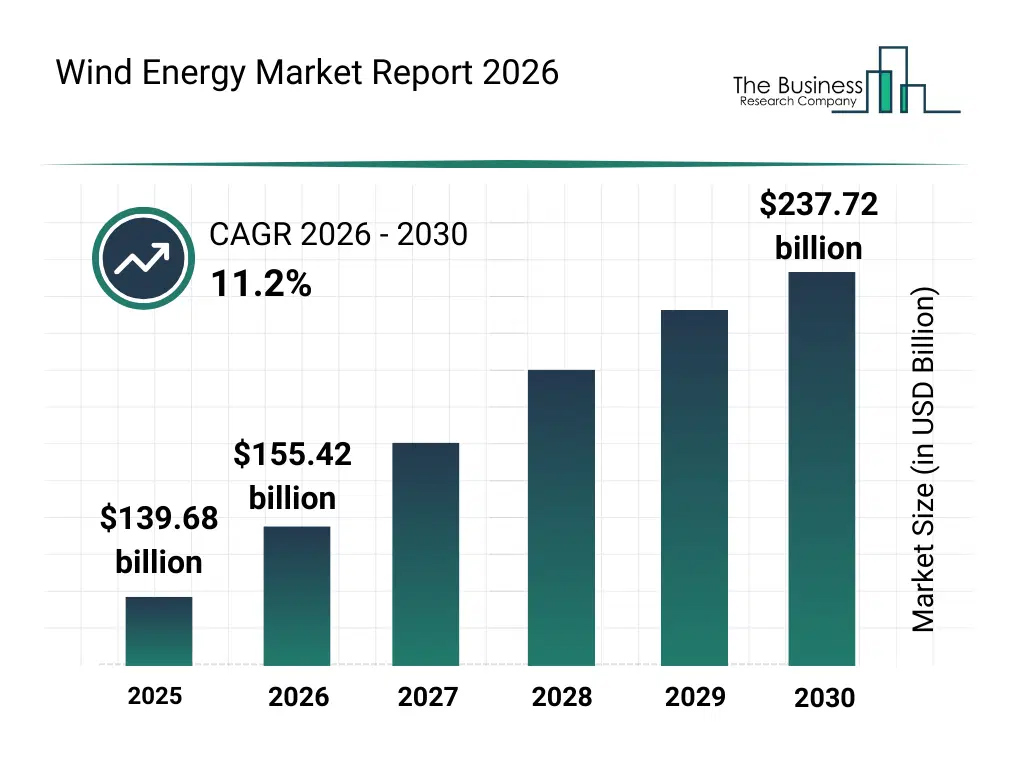
- The global wind energy market is projected to grow strongly from $139.68 billion in 2025 to $237.72 billion by 2030.
- The market is expected to expand at a CAGR of 11.2% from 2026 to 2030, showing steady long-term growth.
- In 2026, the wind energy market size is estimated at $155.42 billion, up from $139.68 billion in 2025.
- The market is expected to add nearly $98.04 billion in value between 2025 and 2030.
- By 2028, the market is projected to cross $190 billion, reaching around $192.18 billion.
- The highest projected market value in the chart is $237.72 billion in 2030, indicating strong investment and adoption momentum.
- The consistent yearly increase highlights rising demand for renewable electricity, clean energy infrastructure, and wind power projects worldwide.
Historical Growth of Global Wind Capacity
- Global cumulative wind capacity stood below 20 GW in 2000 but surpassed 1,000 GW by 2024.
- The wind industry needed more than 40 years to reach its first terawatt of installed capacity globally.
- Global wind installations expanded from around 742 GW in 2020 to over 1,173 GW in 2024.
- Worldwide wind capacity grew by approximately 153 GW between 2024 and 2025 alone.
- Annual wind additions increased from roughly 54 GW in 2015 to 117 GW in 2024.
- Offshore wind expanded from under 5 GW globally in 2013 to more than 83 GW by 2024.
- China became the world’s largest wind market during the 2010s and maintained its lead through 2025.
- Global wind power growth accelerated significantly after the Paris Agreement, supported by tax credits, auctions, and renewable mandates.
- Wind capacity growth rates recovered in 2025, reaching the highest annual expansion pace since 2020.
Annual Wind Power Additions Worldwide
- The world installed approximately 117 GW of new wind power capacity in 2024, setting a record at the time.
- Annual wind installations increased further to around 169 GW in 2025.
- China contributed about 75 GW of new installations in 2024, or nearly 65% of global additions.
- China added more than 120 GW in 2025, reinforcing its dominance in the global wind market.
- Global onshore wind installations reached about 106 GW in 2024.
- Offshore wind installations totaled around 10.8 GW in 2024, despite delays in several projects.
- The first half of 2024 alone delivered approximately 45.2 GW of new global wind installations.
- Wind turbine suppliers delivered around 127 GW of turbine volume in 2024, exceeding previous manufacturing records.
- Global wind installations must nearly triple to 320 GW annually by 2030 to remain aligned with COP28 renewable energy goals.
Top U.S. States Generating Wind Electricity
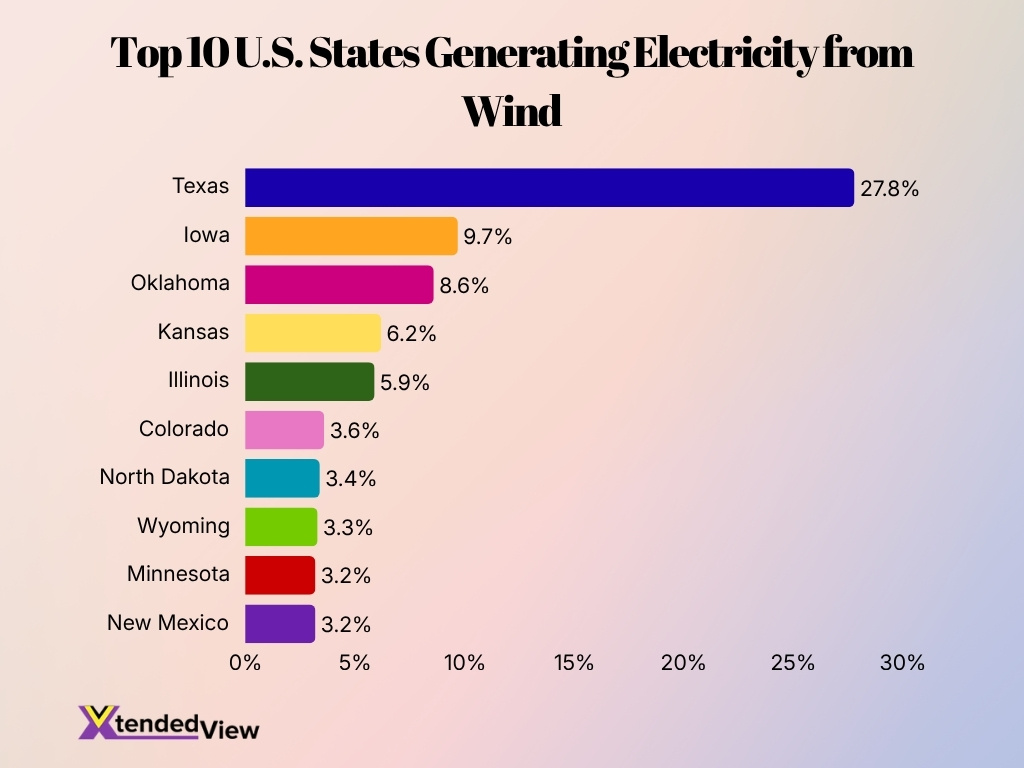
- Texas leads the U.S. in wind electricity generation, producing 11,021 units in February 2026.
- Texas alone accounts for 27.8% of total U.S. wind energy generation, making it the dominant wind power state.
- Iowa ranks second with 3,866 units of wind energy production, contributing 9.7% of the national total.
- Oklahoma follows closely in third place, generating 3,397 units and representing 8.6% of total U.S. wind output.
- The top three states, Texas, Iowa, and Oklahoma, together contribute 46.1% of total U.S. wind energy generation.
- Kansas and Illinois also play major roles, producing 2,463 and 2,331 units, respectively.
- Kansas contributes 6.2%, while Illinois accounts for 5.9% of total U.S. wind energy generation.
- Midwestern and Great Plains states dominate the ranking, showing the importance of strong wind resources in this region.
- States ranked sixth to tenth, Colorado, North Dakota, Wyoming, Minnesota, and New Mexico, each contribute between 3.2% and 3.6%.
- New Mexico ranks tenth with 1,275 units of wind energy production, accounting for 3.2% of total U.S. wind generation.
- The top 10 states together represent about 74.9% of total U.S. wind energy generation, highlighting a strong regional concentration.
Onshore vs Offshore Wind Capacity
- Global installed wind power capacity reached approximately 1,136 GW in 2024, including 1,052.3 GW from onshore projects and 83.2 GW from offshore installations.
- Onshore wind represented nearly 93% of total global wind capacity in 2024 due to lower installation and maintenance costs.
- Offshore wind capacity surpassed 83 GW globally by late 2024 and continued expanding through 2025.
- The world added around 108 GW of onshore wind capacity during 2024, setting a new annual record for land-based installations.
- Offshore wind additions totaled approximately 5.18 GW in 2024, reflecting slower project commissioning cycles compared with onshore markets.
- In 2025, global onshore wind installations climbed further to about 155 GW, crossing the 150 GW milestone for the first time.
- Offshore wind accounted for roughly 10 GW of global new installations in 2025, supported by projects in China, Europe, and Taiwan.
- China maintained the world’s largest offshore wind fleet in 2025, ahead of the UK and Germany.
- Floating offshore wind installations reached nearly 278 MW worldwide by the end of 2024, with Norway and the UK leading deployment activity.
- More than 90% of planned future wind projects globally remain onshore developments, although offshore contributes over 40% of future planned capacity by size.
Wind Energy Share in Global Electricity Mix
- Wind power supplied roughly 8% of global electricity generation in 2024, up from less than 1% in the early 2000s.
- Global wind energy generation reached approximately 2,307 TWh in 2023, compared with 2,101 TWh in 2022.
- Wind energy contributed nearly 12% of the worldwide electricity supply in 2025, according to industry projections.
- Denmark remained the global leader in wind penetration, generating about 58% of its electricity from wind power in 2023.
- Wind became Britain’s largest electricity source in 2024, accounting for around 30% of total electricity generation.
- Offshore wind contributed approximately 5% of Germany’s electricity mix in early 2025.
- Renewable energy sources generated more electricity than coal globally for the first time during the first half of 2025, with renewables supplying 34% of world electricity.
- Wind power output in Scotland exceeded the country’s monthly electricity demand during several peak production periods in recent years.
- Several US states, including Iowa, South Dakota, and Kansas, regularly generate over 40% of their electricity from wind energy.
- Wind and solar together now account for nearly 20% of total global electricity generation capacity additions annually.
Top Countries by Installed Wind Capacity
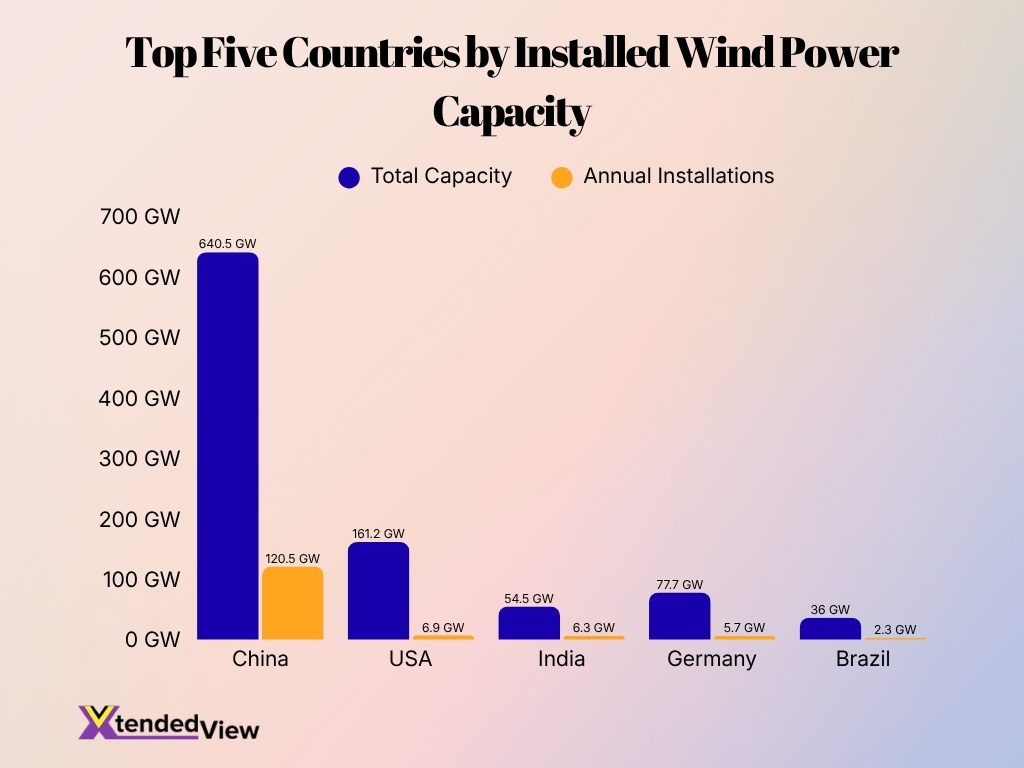
- China leads the global wind power market with 640.5 GW of total installed capacity, far ahead of all other countries.
- China also recorded the highest annual additions, installing 120.5 GW of new wind capacity.
- The USA ranks second with 161.2 GW of total wind capacity, but its annual installations were much lower at 6.9 GW.
- India added 6.3 GW of new wind capacity, bringing its total installed capacity to 54.5 GW.
- Germany has a strong total wind capacity of 77.7 GW, supported by 5.7 GW in annual installations.
- Brazil ranks fifth among the listed countries, with 36.0 GW of total installed wind capacity and 2.3 GW in annual additions.
- China’s total installed wind capacity is nearly 4 times larger than the USA’s 161.2 GW, showing its strong dominance in the global wind energy sector.
- Among the top five countries, China alone accounts for the largest growth momentum, with annual installations far exceeding the combined additions of the USA, India, Germany, and Brazil.
Wind Power Generation and Output Statistics
- Global wind electricity generation reached nearly 3,000 TWh in 2025, supplying over 11% of world demand.
- Wind power added 169 GW in 2025, a 35% jump from 2024.
- Britain’s wind farms produced 83 TWh in 2024, equal to about 31% of electricity use.
- Denmark’s wind share hit 59.3% of total electricity generation in 2024, the highest in the world.
- Scotland’s wind power accounted for 56.9% of generation in 2024, its highest share on record.
- U.S. wind generation in 2023 totaled 425,235 GWh, while the fleet’s capacity factor averaged 33.5%.
- The West North Central U.S. region reached a 38% wind capacity factor in 2024, reflecting stronger resource quality.
- Offshore wind typically delivers 45%–60% capacity factors, versus about 25%–45% for onshore projects.
- Global wind capacity passed 1,346 GW in 2025, showing continued expansion of the fleet.
- China alone has more than 225,000 turbines supplying over 1,000 TWh of electricity.
Wind Turbine Installations and Fleet Size
- Around 23,098 wind turbines were installed globally during 2024.
- Global turbine installations increased to nearly 28,395 units in 2025, according to industry estimates.
- China alone installed more than 130 GW of new wind capacity in 2025, representing the world’s largest turbine deployment market.
- The average turbine rating for new offshore projects exceeded 10 MW in several European markets during 2025.
- Modern offshore turbines now commonly feature rotor diameters above 220 meters, improving electricity output efficiency.
- Germany approved more than 4 GW of new onshore wind capacity during the first quarter of 2025 alone.
- The UK achieved a record wind generation peak of 22.5 GW in December 2024, supplying over 68% of national electricity demand during peak production periods.
- Floating offshore turbine pilot projects expanded across Norway, Japan, and South Korea during 2025.
- The world’s cumulative wind turbine fleet exceeded 1.29 TW of installed capacity in 2025.
- Wind turbine manufacturers continued scaling up blade sizes and hub heights to improve capacity factors and reduce operating costs globally.
One New Wind Turbine Can Power Hundreds of Homes
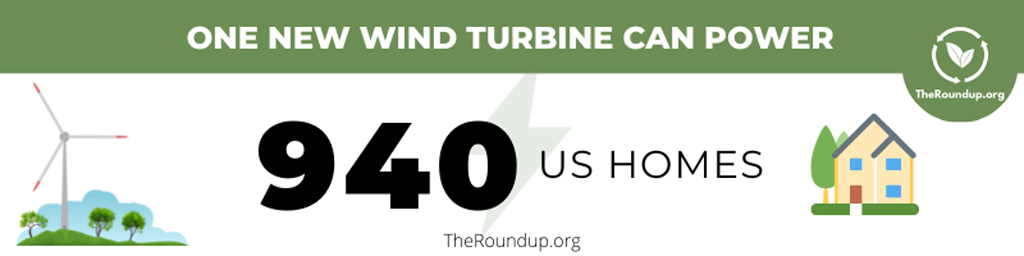
- A single new wind turbine can generate enough electricity to power around 940 U.S. homes.
- This figure highlights the strong energy output potential of modern wind turbine technology.
- Wind turbines can support large-scale residential electricity needs, helping reduce dependence on fossil fuels.
- The ability to power 940 homes from one turbine shows how wind energy can contribute to cleaner and more sustainable communities.
- This data reinforces the growing importance of wind power in expanding renewable energy capacity across the United States.
Cost Trends and Levelized Cost of Wind Energy
- The global weighted-average levelized cost of electricity (LCOE) for onshore wind declined by approximately 70% between 2010 and 2024.
- Onshore wind projects commissioned in 2024 delivered electricity at an average cost of around $0.033 per kWh globally.
- Offshore wind LCOE averaged approximately $0.075 per kWh in 2024, reflecting continued turbine scaling and efficiency gains.
- Wind energy remained one of the cheapest new sources of utility-scale electricity generation in most global markets during 2025.
- Larger turbine sizes and higher hub heights improved wind farm capacity factors and lowered operating costs across Europe and Asia.
- The average offshore turbine rating exceeded 10 MW in 2025, helping developers reduce installation costs per megawatt.
- US onshore wind power purchase agreement prices remained below many fossil-fuel alternatives in 2025.
- Supply-chain inflation and higher borrowing costs temporarily increased turbine manufacturing expenses between 2022 and 2024.
- Floating offshore wind projects still carried higher costs than fixed-bottom installations in 2025 due to early-stage commercialization.
- Wind farm operating lifespans increasingly exceeded 25 to 30 years, improving long-term project economics.
Investment and Financing Trends in Wind Energy
- Global renewable investment reached $728 billion in 2024, with wind included among the largest clean-energy capital flows.
- 91.2 GW of wind turbine orders were placed globally in the first half of 2024, up 23% year on year.
- China accounted for about 70 GW of those H1 2024 turbine orders, reinforcing its dominance in wind equipment demand.
- Offshore wind projects reaching final investment decision rose to 7.6 GW in 2025, up from just under 5 GW in 2024.
- Offshore wind final investment decisions totaled 16.2 GW in 2025 across global projects, showing resilient financing activity.
- Wind investments reached roughly $217 billion in 2023, showing the scale of capital already moving into the sector before 2024.
- In the United States, the IRA helped drive billions of dollars in wind supply-chain funding and stronger near-term deployment forecasts.
- Offshore wind project costs can be highly sensitive to financing: a 4% WACC can cut total project costs by about 30% versus 8% WACC.
- In 2024, 2 trillion dollars-plus flowed into the broader energy transition, showing how renewables remained a core investment theme.
- Global wind power capacity surpassed 1.34 million MW in 2025, underscoring why institutional capital kept targeting wind assets for long-term contracted revenue.
Emerging Wind Power Markets
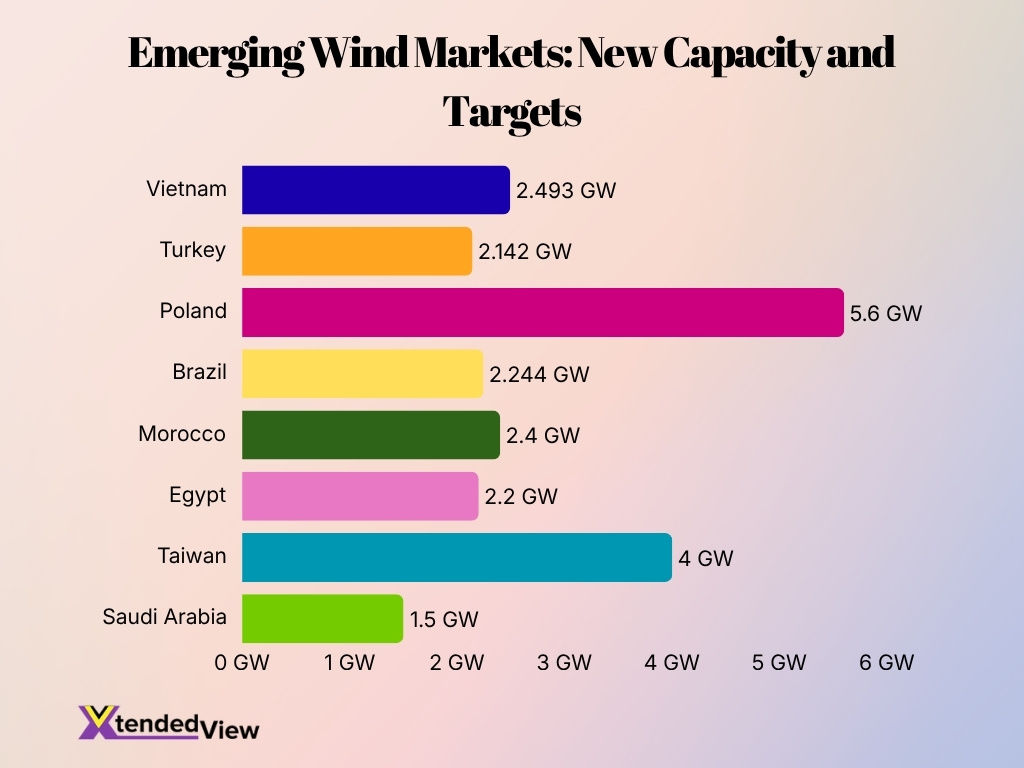
- Vietnam added about 2.493 GW of wind capacity in 2025, ranking among the fastest-growing markets.
- Turkey installed 2.142 GW of new wind power in 2025, making it Europe’s second-largest installer.
- Poland’s offshore wind market reached 5.6 GW financed in 2025, after major FID milestones.
- Brazil was among the top 7 global markets for new wind additions in 2025, with 2.244 GW installed.
- Africa remained smaller but active, with regional leaders like Morocco at 2.4 GW and Egypt at 2.2 GW total capacity in 2024.
- Taiwan has more than 4 GW of wind capacity and aims for 10.9 GW of offshore wind by 2030.
- Saudi Arabia set a 1.5 GW wind farm low-price record in 2025, showing faster renewable diversification.
- Kazakhstan approved 1,810 MW of renewable capacity for auction in 2025, including 4 wind projects.
- Uzbekistan advanced a 300 MW wind project in 2025, with a 25-year competitive-tender PPA.
- 138 countries now operate wind power, showing broad adoption across emerging economies.
Government Targets and Policy-Driven Capacity Goals
- 130+ countries have national renewable targets that include wind deployment objectives.
- COP28 called for tripling global renewable capacity by 2030, implying a major scale-up in annual wind additions.
- Wind deployment needs to reach about 320 GW/year by 2030 to align with international climate pathways.
- The US Inflation Reduction Act sustained long-term tax credits supporting wind investment and deployment through multi-year incentives.
- China’s provincial targets helped drive over 120 GW of wind installations in 2025.
- The EU introduced offshore permitting reforms and expanded auctions in 2025 to accelerate wind project delivery.
- India set a 500 GW non-fossil capacity by 2030 target with wind as a major contributor to utility-scale additions.
- The UK planned an offshore leasing round targeting around 6 GW of new capacity in the next lease cycle.
- Brazil increased renewable auctions and grid investments to integrate additional GW-scale wind capacity in national plans.
- Multiple Middle Eastern countries started formal wind procurement programs in 2025–2026 to diversify from oil and gas.
Offshore Wind Energy Capacity and Growth
- Global offshore wind capacity exceeded 83 GW by the end of 2024.
- Offshore wind additions totaled approximately 10 GW globally in 2025.
- China remained the world’s largest offshore wind market in 2025, ahead of the UK and Germany.
- The UK operated nearly 15 GW of offshore wind capacity during 2025.
- Europe approved record offshore wind auction volumes in 2025 to strengthen regional energy independence.
- Floating offshore wind installations worldwide approached 278 MW by late 2024.
- Offshore turbines increasingly exceeded 15 MW prototype capacity ratings during 2025 development programs.
- Taiwan, South Korea, Japan, and Poland expanded offshore wind procurement pipelines through 2025.
- Offshore wind capacity worldwide could surpass 441 GW by 2034 under current project pipelines and policy targets.
- Transmission infrastructure, permitting delays, and financing costs remained major challenges for offshore deployment globally.
Top Drivers of Wind Energy Adoption
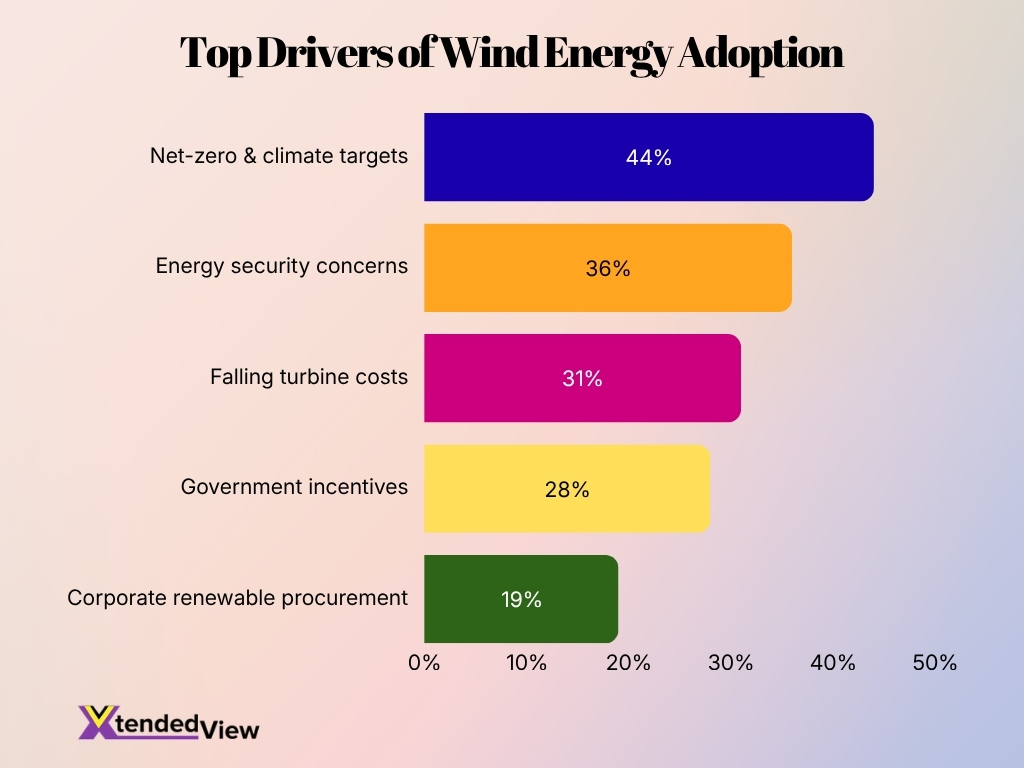
- Net-zero & climate targets are the leading driver of wind energy adoption, accounting for 44% of the total share.
- Energy security concerns rank second at 36%, showing that countries and companies are turning to wind power to reduce dependence on imported fossil fuels.
- Falling turbine costs contribute 31%, making wind energy more affordable and commercially attractive.
- Government incentives represent 28%, highlighting the importance of policy support, tax credits, subsidies, and renewable energy targets.
- Corporate renewable procurement accounts for 19%, as more businesses sign clean power agreements to meet sustainability goals.
- Overall, the data shows that wind energy adoption is mainly driven by a mix of climate commitments, energy independence, lower technology costs, and policy support.
Jobs and Employment in the Wind Energy Sector
- Global wind energy employment reached nearly 1.7 million jobs in 2023, up by about 8% year‑on‑year.
- By 2028, the world will need around 532,000 wind technicians to install and maintain onshore and offshore wind farms.
- Europe’s wind sector supported roughly 442,800 jobs in 2024, including 210,700 direct and 232,100 indirect roles.
- The US land‑based wind industry supported about 126,000 jobs in 2023, underscoring its strong domestic employment base.
- Employment for wind turbine technicians in the US is projected to grow by around 50% from 2024 to 2034.
- China hosts the largest share of the global wind workforce, with over 40% of the world’s wind technicians expected to be based there by 2028.
- Offshore wind expansion in Europe and Asia is creating an estimated 50,000–70,000 additional maritime and heavy‑lift vessel jobs by 2030.
- Brazil’s wind sector generated roughly 50,000–60,000 new construction and manufacturing jobs in high‑wind northeast regions in 2023–2024.
- Over 40% of the 532,000 technicians needed by 2028 will be new entrants, highlighting a major skills gap challenge.
- Around tens of thousands of rural jobs and billions in local tax revenue have been created by wind projects in US farming communities since 2020.
Forecasts for Global Wind Capacity to 2030
- Global renewable electricity additions between 2025 and 2030 are projected to total around 4,600 GW, with wind contributing a significant portion.
- Worldwide wind power capacity could exceed 2 TW before 2030 under current policy trajectories.
- Annual wind installations must nearly triple to around 320 GW per year by 2030 to align with international climate goals.
- Offshore wind capacity may surpass 441 GW globally by 2034, supported by large project pipelines in Europe and Asia.
- China is expected to remain the world’s largest wind market through 2030 because of continued grid expansion and renewable mandates.
- India, Brazil, Vietnam, and several African markets are projected to accelerate wind deployment during the second half of the decade.
- Floating offshore wind could become commercially competitive in several global markets before 2030.
- Grid modernization and energy storage investments will play a critical role in integrating higher levels of wind electricity worldwide.
- Wind and solar are projected to dominate future electricity capacity additions globally through the end of the decade.
- The global clean energy transition is expected to increase electricity demand from data centers, electric vehicles, and hydrogen production, further boosting wind deployment needs.
Frequently Asked Questions (FAQs)
Global installed wind energy capacity exceeded 1,346 GW in 2025, after adding a record 169 GW during the year.
Wind power generated close to 3,000 TWh of electricity globally in 2025, supplying more than 11% of global electricity demand.
China remained the largest wind energy market with nearly 692 GW of installed wind capacity by the end of 2025.
Wind energy accounted for approximately 8% to 12% of global electricity generation between 2024 and 2025, depending on the reporting methodology.
The global wind industry added a record 165 GW to 169 GW of new wind power capacity in 2025, representing roughly 35% to 40% annual growth over 2024.
Conclusion
Wind energy entered the year with record-breaking installation levels, expanding offshore projects, and stronger policy support across major economies. Countries such as China, the United States, Germany, India, and Brazil continue driving global deployment, while emerging markets accelerate investments to strengthen energy security and reduce emissions. At the same time, falling technology costs, larger turbines, and improved financing models are making wind power more competitive across both developed and developing regions.
Looking ahead, the industry faces several challenges, including transmission bottlenecks, supply-chain pressures, and workforce shortages. However, long-term forecasts still point toward rapid growth as governments pursue climate targets and utilities increase renewable electricity generation. Wind energy remains central to the global transition toward cleaner, more resilient power systems.
