



Web hosting powers nearly every website, application, and online store on the internet. As businesses continue to digitize operations, demand for scalable hosting infrastructure, cloud platforms, and managed services keeps rising across the U.S. and worldwide. From supporting e-commerce transactions to enabling AI-powered applications, hosting providers play a critical role in online performance, security, and reliability. Explore the latest web hosting statistics for 2026 to understand how the industry is evolving and where growth opportunities are emerging.
Editor’s Choice
- The global web hosting market is valued at $182.28 billion in 2026 and is projected to reach $300.21 billion by 2031, growing at a CAGR of 10.49%.
- The global web hosting services market was worth $149.3 billion in 2025 and is forecast to reach $178.76 billion in 2026.
- North America accounts for approximately 43% of the global web hosting market, maintaining the largest regional share.
- AWS remains the largest hosting provider globally with an estimated 5.2% market share among hosted websites.
- Shopify controls roughly 4.8% of the hosting market, making it one of the largest hosting ecosystems globally.
- The web hosting services market is expected to add $145.7 billion in value between 2024 and 2029.
- Cloud hosting remains the fastest-growing hosting segment due to increasing demand for scalability, AI workloads, and flexible infrastructure.
- The global market could exceed $389.5 billion by 2034, reflecting sustained long-term demand for hosting services.
Recent Developments
- Generative AI adoption is accelerating demand for GPU-enabled hosting environments and edge infrastructure in 2026.
- AI-driven search visibility has become a major customer acquisition channel for hosting companies, reshaping marketing strategies.
- Hostinger recorded more than 1.6 million AI-search interactions, outperforming several larger hosting competitors in AI discovery channels.
- Hostinger reported a 57% year-over-year revenue increase as it achieved profitability, highlighting strong demand for affordable hosting services.
- Hosting providers increasingly bundle AI website builders, AI content tools, and AI support assistants into standard plans.
- Modern hosting platforms are expanding global infrastructure footprints to reduce latency and improve regional performance.
- Managed cloud hosting continues gaining adoption among small and midsize businesses seeking easier infrastructure management.
- Enterprise hosting demand is increasingly tied to cybersecurity, compliance, and high-availability requirements.
- Several major providers now offer automated scaling, AI monitoring, and integrated security features as standard capabilities.
Global Web Hosting Market Growth Highlights
- The global web hosting market size increased from $65.8 billion in 2021 to $178.8 billion in 2026, reflecting strong industry expansion.
- The market is projected to reach $355.8 billion by 2029, more than 5.4 times larger than its 2021 value.
- Between 2029 and 2030, the web hosting industry is expected to grow from $355.8 billion to $362.0 billion.
- The market is forecast to surpass $500 billion, reaching $527.1 billion by 2032.
- By 2034, the global web hosting market is expected to hit $661.0 billion, marking the highest value in the forecast period.
- From 2025 to 2034, the market size is projected to rise from $149.3 billion to $661.0 billion, adding over $511.7 billion in value.
- The industry is expected to grow by approximately 267% between 2026 and 2034, highlighting sustained long-term demand.
- The chart shows a consistent upward growth trend across all forecast years, indicating a rapidly expanding web hosting market.

Regional Web Hosting Statistics and Demographics
- North America dominated the global web hosting market with a commanding share of 41.00% in 2025.
- The Asia-Pacific region is poised to be the fastest-growing market with a 10.93% CAGR through 2031.
- The United States accounts for approximately 89% of the web hosting market growth in North America.
- Small and medium-sized enterprises represent the largest demographic, holding 51.93% of hosting revenue in 2025.
- Over 1 billion websites currently utilize web hosting services, with rapid expansion in Asia and Latin America.
- The global web hosting services market size is projected to reach $320.62 billion by 2030.
- Public cloud deployment accounted for 45.58% of regional hosting expenditures in 2025.
- Shared hosting remains the most popular choice for small regional businesses, controlling 37.28% of global revenue.
Website and Domain Hosting Statistics
- The global web hosting market is projected to reach $355.81 billion by 2029, growing at a CAGR of 23.6%.
- There are over 1.5 billion websites online today, supported by more than 330,000 hosting companies globally.
- North America leads the global web hosting industry, capturing a 39% market share as of 2025.
- The shared hosting market continues to be a popular choice and is expected to hit $70.6 billion by 2026.
- Global domain registrations reached roughly 386.9 million across all top-level domains by the end of 2025.
- The .com extension maintains its clear dominance with over 157.2 million total registrations worldwide.
- The dedicated server hosting market is expanding rapidly and is forecasted to hit $29.6 billion by 2026.
- The aftermarket domain industry is steadily gaining momentum and is projected to reach $1.17 billion by 2033.
Global Domain Market Share Statistics
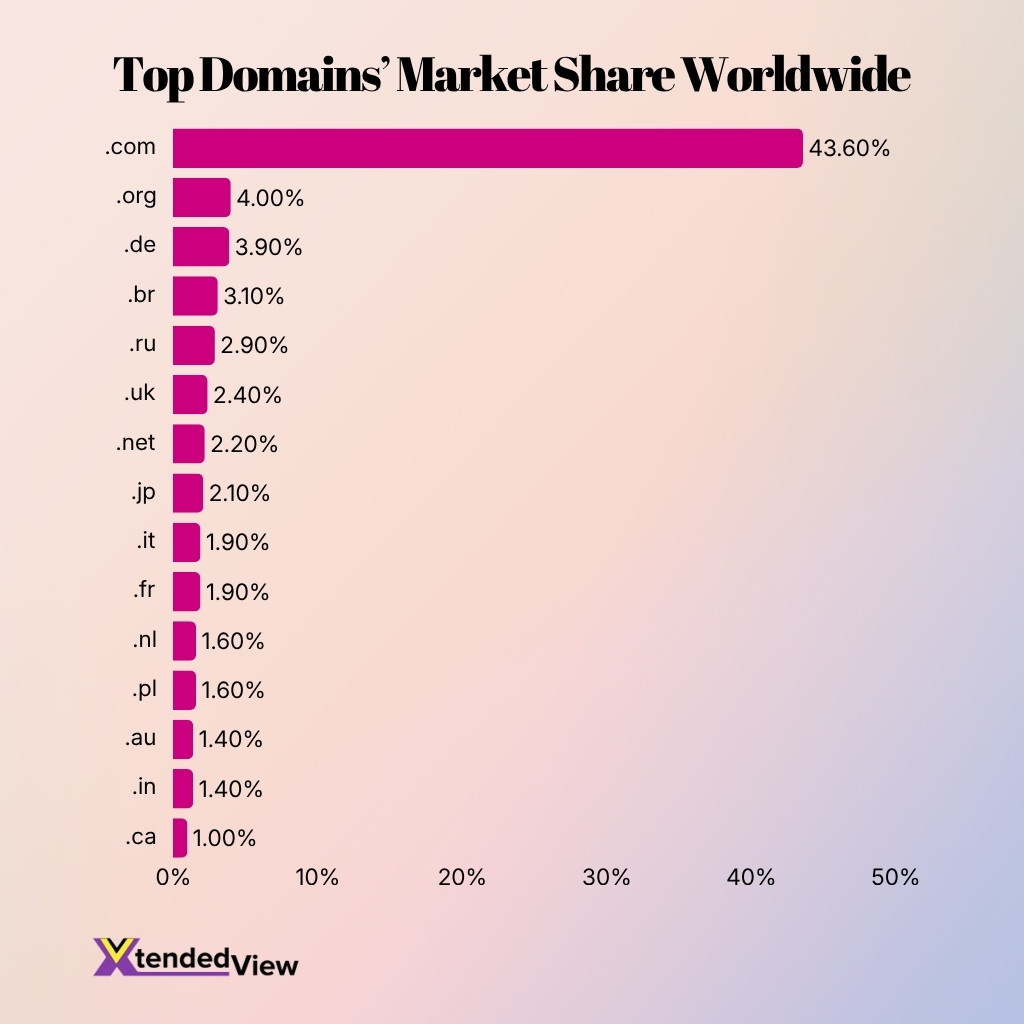
- .com remains the dominant domain extension globally, accounting for 43.6% of all registered domains, far ahead of every other TLD.
- .org is the second most popular extension with a 4.0% market share, highlighting its continued use by nonprofits and organizations.
- Germany’s .de domain ranks third worldwide, capturing 3.9% of the global domain market.
- Brazil’s .br extension holds 3.1%, making it one of the strongest country code TLDs globally.
- Russia’s .ru domain represents 2.9% of worldwide registrations, reflecting strong local adoption.
- The United Kingdom’s .uk domain accounts for 2.4% of the global domain landscape.
- .net maintains a 2.2% market share, remaining one of the most widely used generic TLDs after .com and .org.
- Japan’s .jp domain contributes 2.1% to the global domain market, ranking among the top country code extensions.
- Both .it and .fr hold 1.9% each, showing comparable domain adoption levels in Italy and France.
- The Netherlands’ .nl and Poland’s .pl domains each command 1.6% of global registrations.
- Australia’s .au and India’s .in domains both account for 1.4% of the worldwide domain market share.
- Canada’s .ca domain rounds out the top 15 list with a 1.0% share of global domain registrations.
- Collectively, country code domains such as .de, .br, .ru, .uk, .jp, .in, and .ca demonstrate the strong influence of regional internet markets worldwide.
- The gap between .com (43.6%) and the second largest extension .org (4.0%) underscores the overwhelming dominance of the .com ecosystem.
Shared Web Hosting Statistics
- The global shared hosting market is projected to reach $72.2 billion by 2026.
- Shared hosting currently holds 37.64% of the global web hosting market share.
- More than 18.5 million websites use shared hosting services worldwide.
- The shared hosting industry is expected to grow at a 15.4% CAGR through 2030.
- Entry-level shared hosting plans typically average between $2.50 and $3.72 per month.
- More than 70% of first-time website owners choose shared hosting as their initial platform.
- Up to 40% of users abandon or cancel their shared hosting plans within the first year.
- The average shared hosting account consumes less than 1 GB of storage and under 10 GB of bandwidth.
- Shared hosting remains the dominant choice for websites receiving fewer than 10,000 monthly visitors.
- Linux-based servers account for more than 75% of all shared hosting deployments globally.
Cloud Web Hosting Statistics
- The global cloud hosting market is projected to exceed $250 billion by 2030, supported by enterprise cloud migration initiatives.
- More than 94% of enterprises now use cloud services in some capacity.
- Approximately 60% of corporate workloads run in cloud environments as of 2026.
- Public cloud spending is forecast to surpass $723 billion in 2025, continuing upward through 2026.
- Cloud hosting allows businesses to scale resources instantly without purchasing physical hardware.
- Multi-cloud strategies are used by over 85% of medium and large enterprises worldwide.
- Cloud-based hosting environments typically deliver uptime commitments of 99.95% to 99.99%.
- Demand for AI applications has accelerated investments in cloud infrastructure and GPU-powered hosting services.
- Cloud hosting reduces infrastructure deployment time from weeks to minutes for many organizations.
- The cloud hosting segment remains the fastest-growing category within the broader web hosting market.
Web Hosting Market Share Statistics by Provider
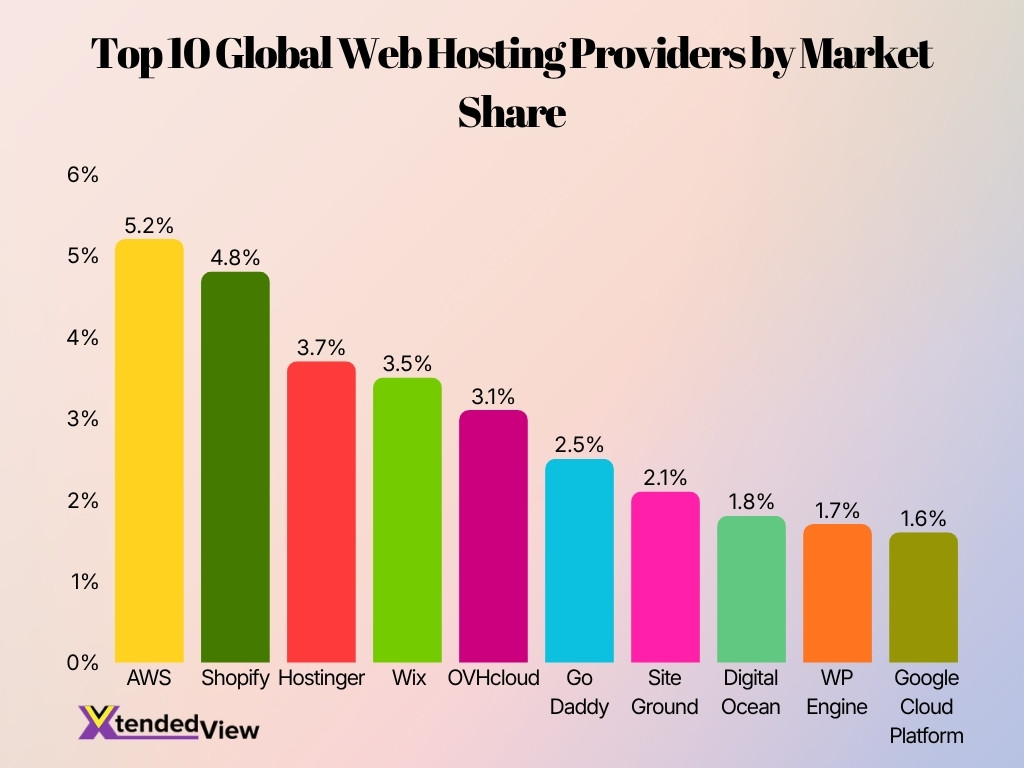
- AWS holds approximately 5.2% of the global hosting market.
- Shopify ranks second with around 4.8% market share.
- Hostinger controls roughly 3.7% of hosted websites globally.
- Wix accounts for approximately 3.5% of the hosting market.
- OVHcloud holds about 3.1% market share.
- GoDaddy maintains around 2.5% of the global hosting market share.
- SiteGround represents approximately 2.1% of hosted websites.
- DigitalOcean controls roughly 1.8% of the market.
- WP Engine accounts for approximately 1.7% market share.
- Google Cloud Platform powers roughly 1.6% of hosted websites.
VPS and Dedicated Server Web Hosting Statistics
- VPS hosting plans typically cost between $10 and $80 per month based on resource allocation.
- Dedicated server environments for enterprise use generally range from $80 to $500+ monthly.
- Migrating to VPS hosting yields 30% to 50% performance improvements over standard shared hosting.
- Over 40% of growing businesses upgrade from shared environments to VPS hosting as traffic increases.
- The global VPS hosting market is projected to exceed $8 billion in total valuation by 2026.
- Dedicated server hosting investments are expected to grow at a consistent 5.6% CAGR through 2028.
- Approximately 10.3% of all active websites rely on dedicated servers to manage heavy traffic loads.
- Premium VPS platforms utilizing NVMe storage deliver data access speeds up to 10x faster than traditional SSDs.
CMS and WordPress Web Hosting Statistics
- WordPress powers approximately 43% of all websites on the internet in 2026.
- Among websites using a known CMS, WordPress controls roughly 61% market share.
- More than 500 new WordPress websites are created daily worldwide.
- WooCommerce powers approximately 20% of online stores built on content management systems.
- Managed WordPress hosting remains one of the fastest-growing managed hosting categories.
- Over 70,000 plugins are available in the WordPress ecosystem.
- More than 30,000 themes support WordPress website development.
- WordPress websites receive strong support from nearly every major hosting provider worldwide.
- AI-powered WordPress tools for content creation, SEO, and website management saw significant adoption growth during 2025 and 2026.
- Managed WordPress hosting customers typically report faster deployment times and simplified maintenance workflows.
Key Factors Influencing Web Hosting Purchases
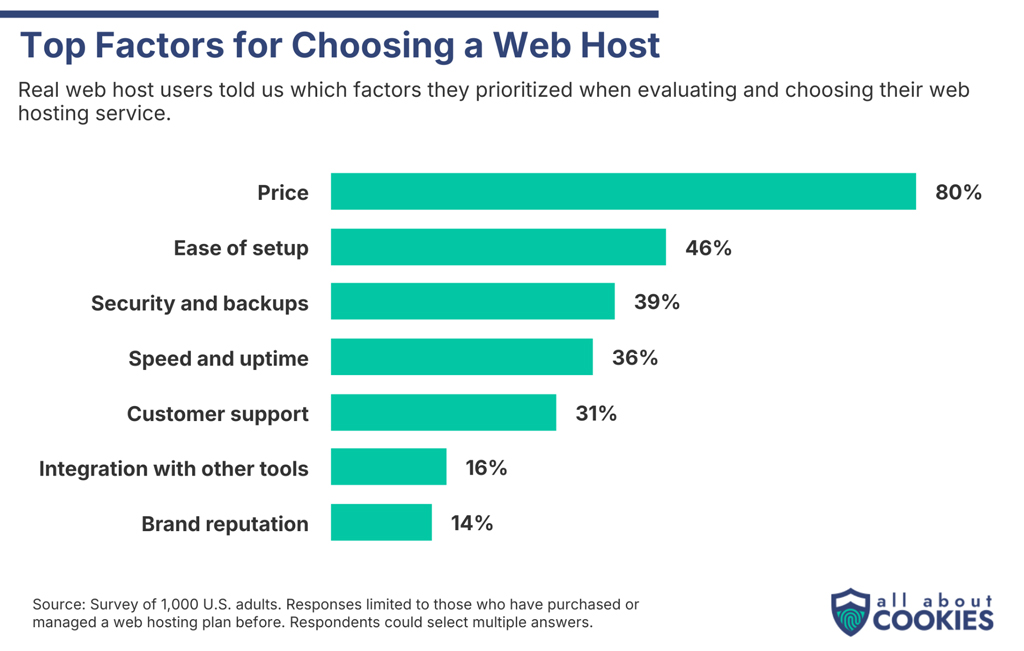
- Price is the most important factor, with 80% of web hosting users considering it when choosing a provider.
- Ease of setup ranks second, as 46% of users prioritize a simple and quick onboarding process.
- Security and backups influence 39% of purchasing decisions, highlighting the importance of data protection.
- Speed and uptime are critical for 36% of users, reflecting the need for reliable website performance.
- Customer support is a deciding factor for 31% of respondents when evaluating hosting services.
- Only 16% of users consider integration with other tools a key factor in their hosting selection.
- Brand reputation ranks lowest, with just 14% of users citing it as an important consideration.
- The gap between price (80%) and ease of setup (46%) shows that affordability outweighs convenience for most buyers.
- More users prioritize security and backups (39%) than customer support (31%), emphasizing proactive protection over reactive assistance.
- Technical performance factors, including speed, uptime, security, and backups, collectively remain major considerations for web hosting customers.
E-commerce Web Hosting Statistics
- Global e-commerce sales are projected to exceed $7 trillion by 2026.
- More than 28 million e-commerce websites operate worldwide.
- Online stores increasingly prioritize hosting providers offering uptime guarantees above 99.9%.
- A one-second delay in page load time can reduce conversion rates significantly, making hosting performance critical for online retailers.
- Shopify powers roughly 4.8% of all hosted websites globally.
- More than 70% of consumers expect online stores to load within a few seconds.
- Mobile commerce now accounts for over 57% of global e-commerce sales.
- PCI compliance remains a core hosting requirement for businesses processing online payments.
- Managed e-commerce hosting services continue expanding due to increasing cybersecurity and performance demands.
- AI-powered personalization tools are driving additional infrastructure requirements for online retailers.
Web Hosting Revenue Statistics
- The global web hosting industry is expected to generate approximately $182.28 billion in revenue during 2026.
- Industry revenue is projected to surpass $300 billion by 2031.
- Another forecast estimates market revenue could reach $389.5 billion by 2034.
- The market is expected to add $145.7 billion in new revenue between 2024 and 2029.
- Subscription-based recurring revenue remains the dominant business model across hosting providers.
- Domain registration, SSL certificates, and email hosting contribute significant ancillary revenue streams.
- Managed hosting services generate higher average revenue per customer than shared hosting plans.
- Cloud hosting services account for a growing share of overall industry revenue each year.
- Enterprise customers typically produce the highest customer lifetime value within the hosting sector.
- AI services and premium infrastructure offerings are emerging as important new revenue drivers for hosting companies.
Web Hosting Costs and Pricing Statistics
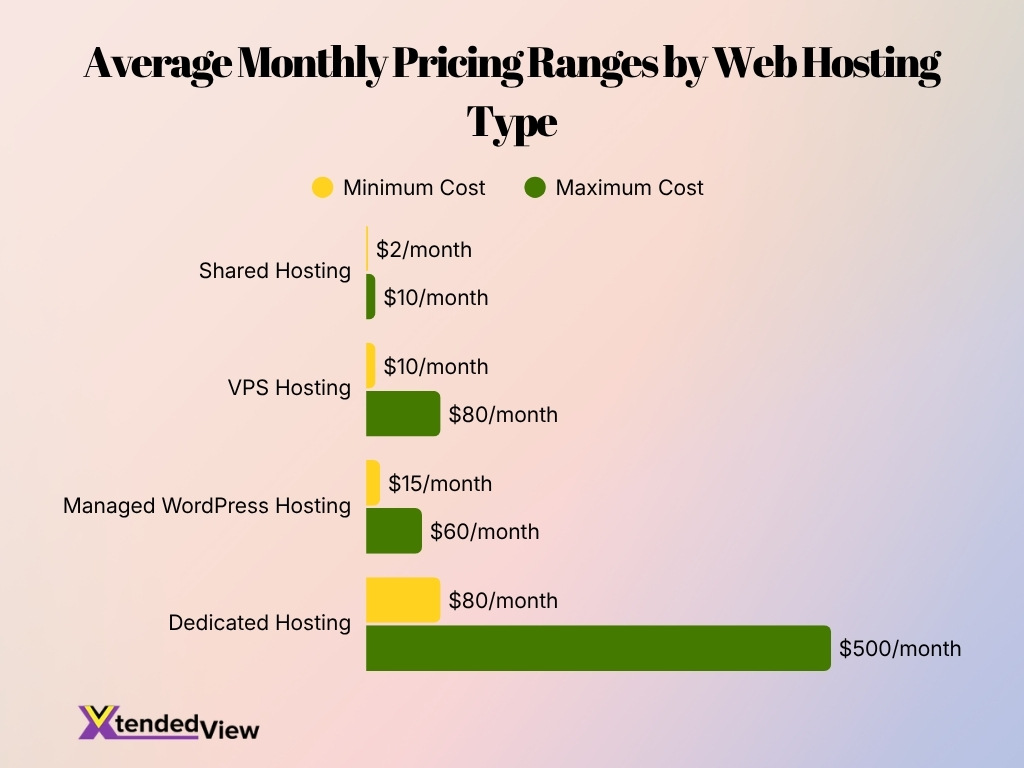
- Shared hosting plans generally cost between $2 and $10 per month for entry-level websites.
- VPS hosting typically ranges from $10 to $80 monthly, depending on resources and management services.
- Dedicated hosting plans often start around $80 per month and can exceed $500 monthly for enterprise deployments.
- Managed WordPress hosting commonly costs between $15 and $60 per month.
- Premium enterprise cloud hosting environments can cost thousands of dollars monthly based on usage requirements.
- SSL certificates remain free on many hosting plans, although premium certificates may cost $50 to $300 annually.
- Domain registrations generally cost between $10 and $20 annually for standard extensions.
- Managed hosting services often command 20% to 50% higher pricing than unmanaged alternatives.
- Cloud hosting’s pay-as-you-go model continues gaining popularity because businesses only pay for consumed resources.
- Hosting providers increasingly bundle security, CDN, and AI tools into plans to increase customer value.
Web Hosting Performance and Speed Statistics
- Websites loading within one second achieve conversion rates up to three times higher.
- Nearly 53% of mobile users abandon pages taking longer than three seconds to load.
- A one-second delay in page load time reduces customer satisfaction by approximately 16%.
- Utilizing content delivery networks reduces average page load times by 50% or more globally.
- Premium hosting providers currently guarantee network uptime between 99.9% and 99.99%.
- The average page load time for a top-ranking desktop website is 1.65 seconds.
- Pages taking five seconds to load experience a 38% bounce rate compared to faster sites.
- Optimizing images and utilizing browser caching improves server response times by over 40%.
Web Hosting Security and Uptime Statistics
- More than 30,000 websites are hacked every day worldwide, making hosting security a top priority for businesses.
- Cybercrime damages are projected to exceed $10.5 trillion annually, increasing demand for secure hosting environments.
- Around 43% of cyberattacks target small businesses, many of which rely on web hosting providers for security protection.
- Most premium hosting providers offer uptime guarantees ranging from 99.9% to 99.99%.
- A 99.9% uptime SLA still allows approximately 8.76 hours of downtime annually.
- SSL adoption continues rising, with over 95% of page loads in Chrome now occurring over HTTPS connections.
- Distributed denial-of-service attacks exceeded 20 million incidents globally in recent annual reporting periods.
- Automated malware scanning and web application firewalls are now standard features in many hosting plans.
- Multi-factor authentication adoption among hosting providers increased significantly throughout 2025 and 2026.
- AI-powered threat detection systems are helping hosting companies identify suspicious activity in real time.
Key Hosting Industry Trends
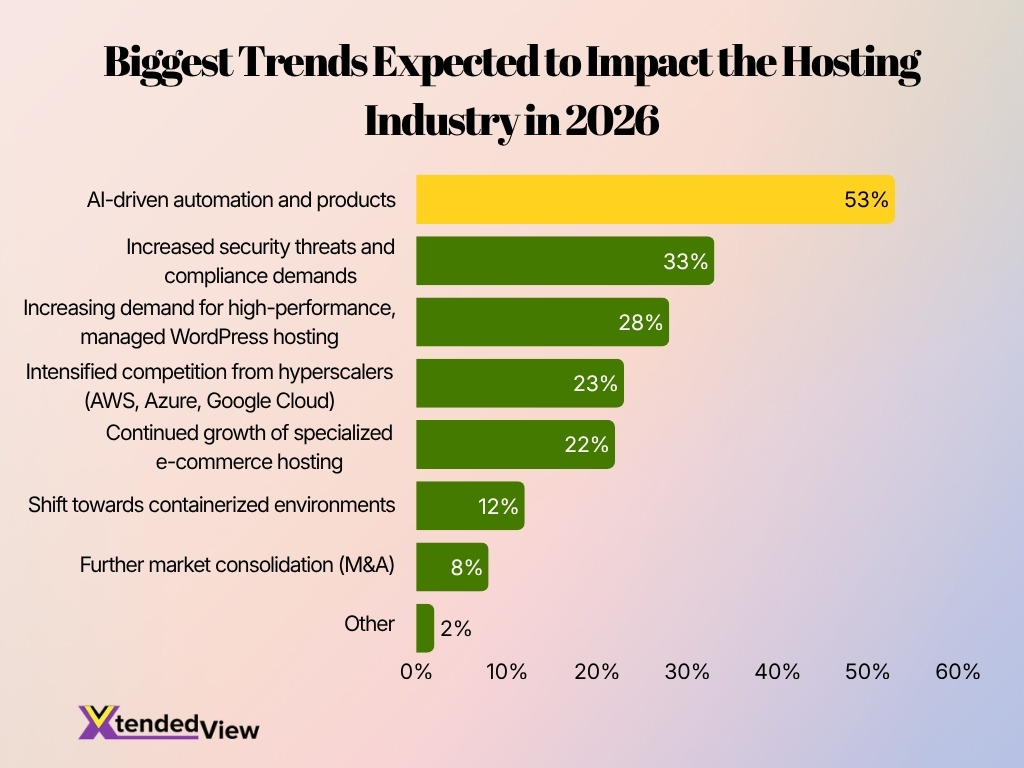
- AI-driven automation and products lead industry expectations, with 53% of respondents identifying them as the biggest factor shaping web hosting in 2026.
- 33% of respondents believe security threats and compliance requirements will have the most significant impact on hosting providers.
- The demand for high-performance managed WordPress hosting remains strong, cited by 28% of industry participants.
- 23% expect growing competition from major hyperscalers such as AWS, Azure, and Google Cloud to influence the hosting market.
- The expansion of specialized e-commerce hosting is a key trend, highlighted by 22% of respondents.
- The shift toward containerized environments is gaining traction, with 12% identifying it as a major industry driver.
- Only 8% see further market consolidation and mergers & acquisitions (M&A) as the leading trend for 2026.
- Just 2% of respondents selected other factors, indicating that the market is largely focused on a few dominant trends.
- The gap between AI adoption (53%) and the second-ranked trend, security and compliance (33%), is a substantial 20 percentage points.
- Combined, AI, security, and managed WordPress hosting account for 114% cumulative mentions, showing where industry priorities are most concentrated.
Data Center and Infrastructure Statistics
- As of 2026, more than 11,800 data centers are operating globally.
- The United States leads the world by hosting over 5,420 data centers within its borders.
- Global data center electricity consumption is projected to surge by 26% to reach 565 TWh in 2026.
- The total count of active hyperscale data centers worldwide has officially surpassed 1,189 facilities.
- AI-optimized servers will account for 31% of total data center power consumption in 2026.
- The global data center market size is actively expanding to a massive valuation of $335 billion.
- Tech giants have committed over $200 billion toward new data center capacity and AI infrastructure.
- Energy utilized by cooling systems and infrastructure is forecast to jump 22.6% to 195 TWh this year.
- North America currently dominates the hyperscale data center market with a 41.8% global share.
- Worldwide data center IT power demand is projected to increase by 27% to reach 132 GW in 2026.
AI and Automation in Web Hosting Statistics
- More than 72% of organizations globally use AI integration in at least one business function.
- Around 30% of hosting providers utilize AI for automated server monitoring and performance optimization.
- AI-powered chatbots now handle 70% to 85% of Tier 1 hosting customer support requests.
- 48% of hosting providers prioritize predictive analytics to identify server failures before outages occur.
- AI-assisted cybersecurity tools achieve a 92% threat detection rate, reducing incident response times significantly.
- 32% of hosting providers now offer automated website builders powered by AI as standard customer tools.
- AI-driven resource allocation helps platforms achieve 85% infrastructure efficiency compared to traditional hosting.
- Over 70% of AI model hosting is deployed on GPU platforms due to increased generative AI demand.
- 53% of hosting providers cite AI-driven automation as their top competitive advantage for lowering operational costs.
Green Web Hosting Statistics and Future Trends
- Data centers currently account for roughly 1% to 1.5% of global electricity consumption.
- Several major hosting providers now operate using 100% renewable energy matching programs.
- Green data center investments reached billions of dollars annually during the mid-2020s.
- Advanced cooling systems can reduce data center energy consumption by 20% to 40%.
- Global data center electricity consumption is forecast to jump 26% to 565 terawatt-hours in 2026.
- The global web hosting market is projected to hit $178.76 billion in 2026.
- Utilizing a Content Delivery Network (CDN) can cut website energy consumption by up to 30%.
- AI-optimized servers will account for an estimated 31% of total data center power consumption by 2026.
- Transitioning to green web hosting can reduce a website’s overall carbon footprint by over 50%.
- Over 73% of consumers strongly prefer digital brands that demonstrate environmental responsibility.
Frequently Asked Questions (FAQs)
The global web hosting market is estimated at $182.28 billion in 2026 and is projected to reach $300.21 billion by 2031.
The global web hosting market is forecast to grow at a 10.49% CAGR between 2026 and 2031.
WordPress powers approximately 41.9% to 43.2% of all websites worldwide in 2026.
The global web hosting services market is projected to reach $389.52 billion by 2034, growing at a 12.25% CAGR.
North America accounted for approximately 41% of the global web hosting services market share in 2025, remaining the leading regional market.
Conclusion
The web hosting industry continues to expand as businesses, creators, and enterprises depend on reliable digital infrastructure. Market growth remains strong, driven by cloud adoption, AI-powered applications, e-commerce expansion, and increasing demand for secure online experiences. At the same time, hosting providers are investing heavily in automation, cybersecurity, performance optimization, and sustainable infrastructure.
Looking ahead, cloud-native platforms, AI-driven operations, and green hosting initiatives will shape the next phase of industry growth. Organizations that prioritize speed, uptime, security, scalability, and environmental responsibility will be best positioned to meet evolving customer expectations.
