



Generative AI has become a core technology for businesses, software developers, healthcare providers, and financial institutions. Organizations now use it to automate customer support, accelerate software development, generate marketing content, and improve decision-making with AI-powered assistants. As investment and adoption continue to grow across the US and worldwide, the latest statistics reveal how quickly this market is evolving. Explore the data below to understand where generative AI stands and where it is heading next.
Editor’s Choice
- The global generative AI market is projected to reach approximately $161 billion in 2026, up from $103.6 billion in 2025, reflecting rapid enterprise adoption and commercial deployment.
- Generative AI could contribute between $2.6 trillion and $4.4 trillion in annual economic value across industries through productivity improvements and new business models.
- Worldwide spending related to AI technologies exceeded $640 billion during 2025, representing year-over-year growth of more than 76%.
- North America accounted for nearly 49% of the global generative AI market revenue in 2025, maintaining its leadership through cloud infrastructure investments and enterprise adoption.
- The generative AI market is expected to surpass $1.26 trillion by 2034, highlighting sustained long-term investment across software, healthcare, manufacturing, and financial services.
- According to enterprise surveys, 65% of organizations now use generative AI in at least one business function, roughly doubling adoption compared with the previous year.
- AI could add up to $15.7 trillion to the global economy by 2030 through higher productivity and increased consumer demand, with generative AI serving as one of the primary growth drivers.
Recent Developments
- Throughout 2025 and early 2026, enterprises shifted their focus from AI experimentation to measurable business outcomes, placing greater emphasis on ROI, governance, and deployment quality.
- Around 30% of generative AI projects were abandoned after proof-of-concept because of poor data quality, weak governance, or unclear business value.
- Enterprise buyers have become more selective, extending AI software purchasing cycles from roughly two to six months as legal, compliance, and finance teams play a larger role in procurement.
- Companies successfully deploying AI often concentrate investments on three or fewer high-impact business areas, enabling faster returns than organizations pursuing broad rollouts.
- AI infrastructure investment continues to accelerate as leading technology companies collectively commit hundreds of billions of dollars to AI data centers, networking, and semiconductor capacity.
- AI agents have emerged as one of the fastest-growing enterprise technologies, with analysts forecasting 40% of enterprise applications to include task-specific AI agents by the end of 2026.
- Software engineering has become one of the largest enterprise use cases, with practitioners reporting shorter development cycles, higher productivity, and broader institutional adoption despite ongoing concerns around security and hallucinations.
- Organizations increasingly recognize that high-quality data infrastructure is a prerequisite for successful generative AI deployments, making data governance a top investment priority.
Generative AI Market Size Growth
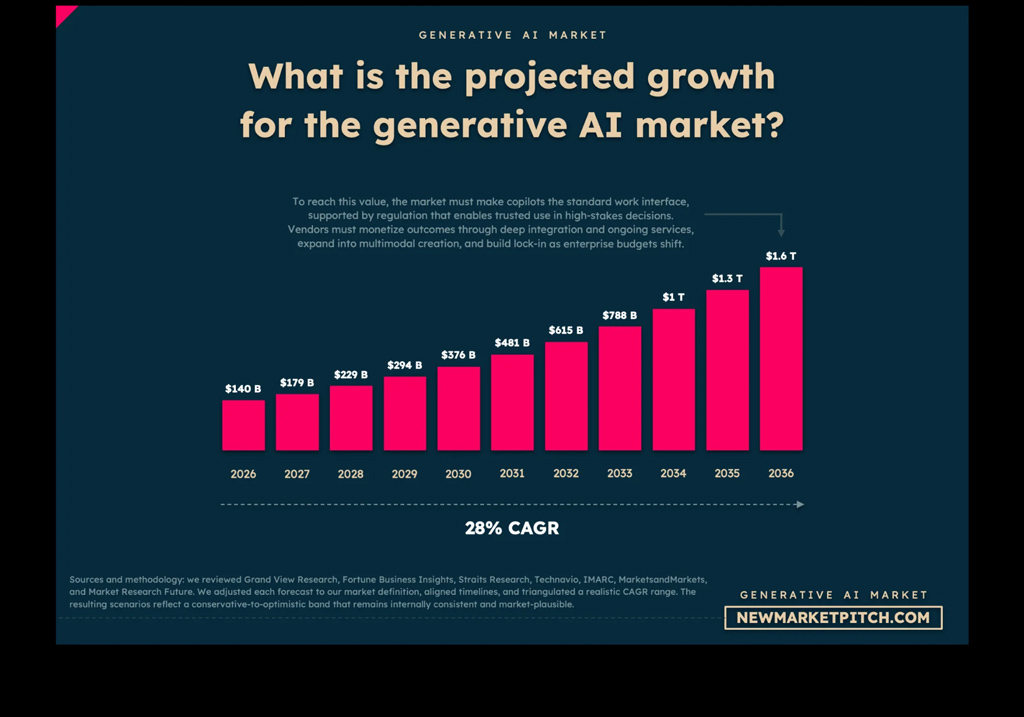
- The generative AI market is projected to grow from $140 billion in 2026 to $1.6 trillion by 2036.
- The market is expected to expand at a strong 28% CAGR during the forecast period.
- By 2030, the market could reach $376 billion, more than doubling from its 2026 level.
- The industry is projected to cross the $500 billion mark between 2031 and 2032.
- Generative AI is expected to reach $1 trillion in market size by 2034.
- From 2026 to 2036, the market could grow by nearly 11.4 times.
- The forecast shows consistent annual growth, rising from $615 billion in 2032 to $788 billion in 2033.
- By 2035, the market is projected to hit $1.3 trillion, before climbing to $1.6 trillion in 2036.
- The data suggests generative AI will shift from a fast-growing tech segment to a trillion-dollar global market.
- Enterprise adoption, AI copilots, multimodal tools, and regulation-ready systems may drive this long-term growth.
Generative AI Growth Rate and Forecast Statistics
- The global generative AI market is projected to grow at a compound annual growth rate (CAGR) of approximately 46.5% between 2025 and 2034, making it one of the fastest-growing enterprise software markets.
- Another industry forecast estimates a 36.97% CAGR from 2025 to 2035, reflecting continued expansion across cloud platforms, AI models, and enterprise applications.
- Global spending on AI-centric systems is expected to exceed $640 billion in 2025, representing a 76.4% increase over the previous year.
- Analysts project the generative AI market will surpass $1 trillion before 2035, supported by growing investments in foundation models, AI infrastructure, and enterprise software.
- McKinsey estimates generative AI could generate $2.6 trillion to $4.4 trillion in annual economic value by improving productivity, customer experiences, and knowledge work.
- PwC forecasts AI technologies, including generative AI, could contribute up to $15.7 trillion to the global economy by 2030, with productivity accounting for the majority of that impact.
- IDC expects enterprise AI spending to maintain double-digit annual growth through the decade as organizations expand production deployments instead of pilot projects.
- Bloomberg Intelligence projects the generative AI industry could approach $1.3 trillion by 2032, driven by software, infrastructure, digital advertising, and AI-assisted services.
- AI server shipments are forecast to continue rising through 2026, fueled by demand for GPU clusters and specialized accelerators supporting large language models.
Generative AI Investment and Funding Statistics
- Venture capital investment in generative AI startups exceeded $56 billion during 2025, marking another record year for private funding.
- According to PitchBook, AI startups captured more than one-third of global venture funding during several quarters of 2025, highlighting investor confidence in the sector.
- Microsoft announced AI-related capital expenditures exceeding $80 billion for fiscal year 2025 to expand cloud infrastructure and AI data centers.
- Alphabet increased AI infrastructure spending, with capital expenditures reaching more than $75 billion as it expanded Gemini and Google Cloud AI capabilities.
- Meta Platforms raised its projected 2025 capital expenditure to approximately $64 billion to $72 billion, with most investments supporting AI infrastructure and data centers.
- Amazon continues to invest tens of billions of dollars annually in AWS infrastructure to meet growing demand for generative AI training and inference workloads.
- NVIDIA became one of the world’s most valuable companies during 2025 as demand for AI GPUs pushed annual revenue to record levels exceeding $130 billion.
- OpenAI secured one of the largest private funding rounds in history, raising $40 billion in 2025 to accelerate research, product development, and computing infrastructure.
- Sovereign governments across the US, Europe, the Middle East, and Asia announced multi-billion-dollar national AI investment programs during 2025 and early 2026 to strengthen domestic AI capabilities.
Generative AI Use by Business Function
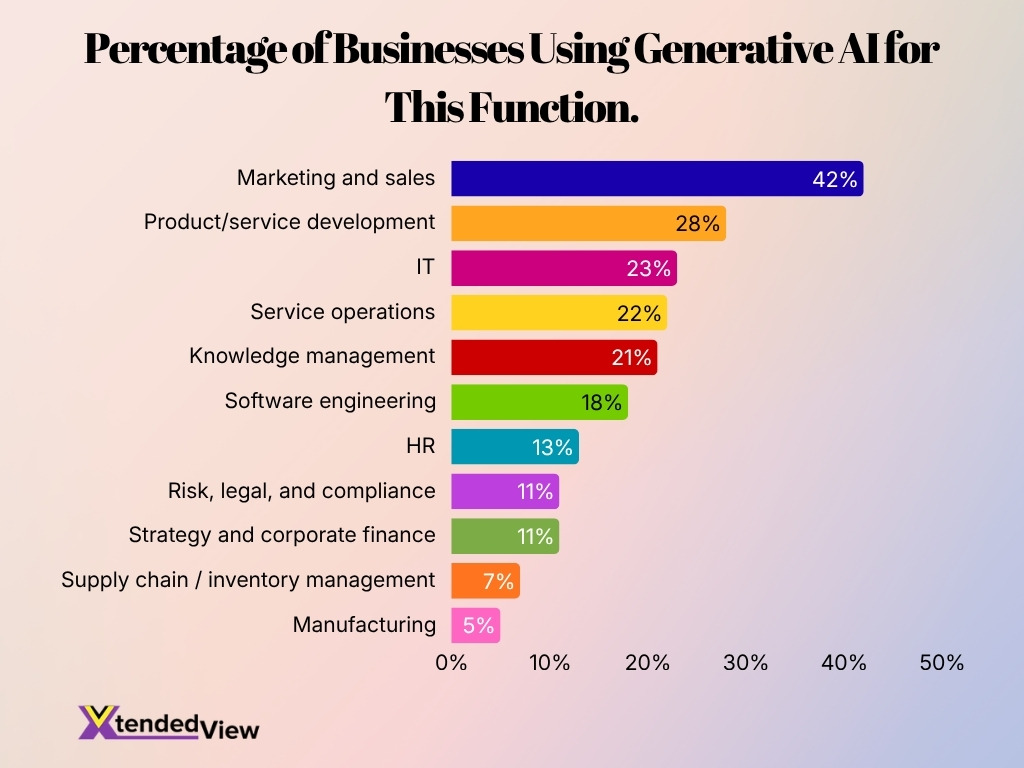
- Marketing and sales lead generative AI adoption, with 42% of businesses using it for this function.
- Product/service development ranks second, with 28% adoption among businesses.
- IT is the third-highest function, with 23% of businesses using generative AI.
- Service operations follows closely at 22%, showing strong use in operational workflows.
- Knowledge management accounts for 21%, highlighting AI’s role in organizing business information.
- Software engineering sees 18% adoption, mainly for coding, debugging, and development support.
- HR has a lower adoption rate at 13%, showing moderate use in workforce-related tasks.
- Risk, legal, and compliance record 11%, indicating cautious adoption in regulated functions.
- Strategy and corporate finance also stand at 11%, showing limited but growing AI use in planning.
- Supply chain and inventory management has 7% adoption, suggesting early-stage implementation.
- Manufacturing has the lowest adoption rate at 5%, making it the least-used function in the dataset.
Generative AI Adoption Statistics by Businesses
- Over 70% of enterprises have moved beyond experimentation and are actively scaling at least one generative AI initiative.
- Approximately 88% of organizations now regularly use artificial intelligence in at least one core business function.
- Companies deploying generative AI report an average return on investment of 3.7x for every dollar invested.
- By 2026, more than 80% of enterprises will deploy generative AI models or applications into production environments.
- The global generative AI market is projected to grow to approximately $1.2 trillion by 2035 due to widespread enterprise adoption.
- Around 34% of companies utilizing these technologies have reported significant and measurable productivity increases.
- As of 2025, 52% of financial institutions leverage generative AI for reporting, document processing, and customer engagement.
- About 67% of organizations are significantly increasing their investments in generative AI applications compared to the previous year.
- Small and midsize businesses are rapidly adopting generative AI, with usage soaring from 23% in 2023 to 58% in 2025.
Generative AI Adoption Statistics by Region
- North America accounted for nearly 49% of global generative AI revenue in 2025.
- The United States leads the enterprise AI market, driving over $109.1 billion in private AI investments.
- Asia-Pacific remains the fastest-growing AI market, projected to surge at a 27.6% CAGR over the next decade.
- European enterprise AI adoption has reached an average of 20%, primarily led by the financial and healthcare sectors.
- Over 75% of jobs in Greater London are highly exposed to generative AI across major professional industries.
- Middle Eastern governments are heavily expanding their AI strategies by investing billions of dollars into sovereign AI models.
- In India, 89% of IT companies pilot generative AI, while 33% actively deploy production workloads.
- Latin America is rapidly accelerating its AI adoption, with over 60% of organizations utilizing managed cloud services.
- Global enterprise AI usage has climbed to 88%, increasingly dependent on local data center capacity and cloud availability.
Generative AI User Demographics and Usage Frequency Statistics
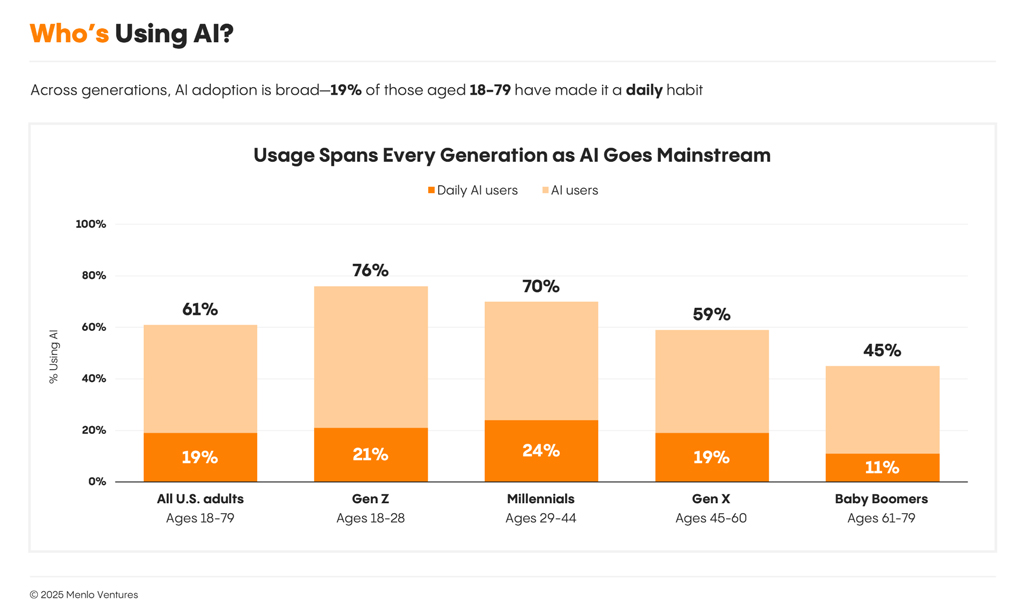
- AI adoption is mainstream, with 61% of U.S. adults aged 18–79 using AI in some form.
- Daily AI use has reached 19% among all U.S. adults, showing AI is becoming a regular habit.
- Gen Z leads overall AI adoption, with 76% using AI, the highest among all generations.
- Millennials have the highest daily AI usage, with 24% using AI every day.
- Gen Z daily AI usage stands at 21%, slightly above the overall adult average.
- Gen X shows broad AI adoption, with 59% using AI and 19% using it daily.
- Baby Boomers have the lowest AI adoption, with 45% using AI and 11% using it daily.
- The data shows that AI use spans every generation, not just younger users.
- Younger groups show stronger AI engagement, with Gen Z at 76% and Millennials at 70% overall usage.
- The gap between Gen Z users at 76% and Baby Boomers at 45% highlights a 31 percentage point generational divide.
Generative AI Usage Statistics by Function and Use Case
- Enterprise customer service agents using AI assistants have successfully resolved 14% more issues per hour.
- Over 60% of marketing leaders utilize generative AI to significantly reduce digital content creation time.
- Generative AI tools reduce software development time by up to 55% during early enterprise deployments.
- Approximately 59% of HR departments actively use AI tools for recruiting, screening, and administrative tasks.
- Legal teams adopting generative AI have successfully reduced their overall compliance and legal costs by up to 17%.
- Over 53% of finance departments leverage generative AI for complex financial reporting and investment research.
- Implementing generative AI in research and development can increase the success rate of innovation by 50% to 70%.
- Around 19% of enterprises have prioritized generative AI adoption for seamless internal knowledge management.
- Currently, 21% of organizations have fundamentally redesigned their core workflows to focus AI on high-impact, measurable business value.
Generative AI Tool Usage Statistics
- 88% of organizations now use AI in at least one business function.
- ChatGPT reached 900 million weekly active users as of early 2026.
- 92% of Fortune 500 companies have integrated ChatGPT into their workflows.
- Global adoption of generative AI tools has reached 16.3% of the world’s population.
- ChatGPT currently processes over 2.5 billion prompts per day globally.
- 70% of Gen Z professionals use AI tools for more than half their daily duties.
- 40% of enterprise applications are projected to include task-specific AI agents by the end of 2026.
- The United Arab Emirates leads global usage with 64.0% of its working-age population using AI.
- 63% of organizations incorporating AI technology focus primarily on generating text.
- The global generative AI market reached a valuation of $59.01 billion in 2025.
Generative AI Tool Adoption Trends
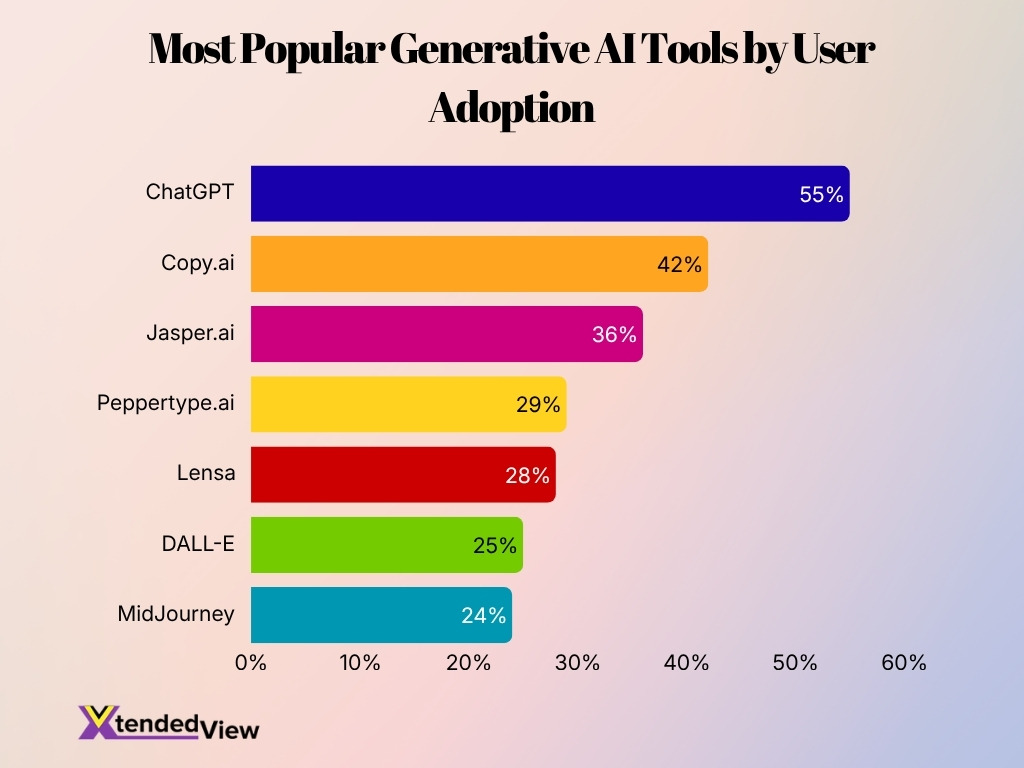
- ChatGPT leads the market with the highest user adoption at 55%.
- Copy.ai ranks second, used by 42% of users.
- Jasper.ai holds third place with 36% user adoption.
- Peppertype.ai records 29% adoption, placing it fourth.
- Lensa follows closely with 28% user adoption.
- DALL-E is used by 25% of users.
- MidJourney has the lowest adoption among the listed tools at 24%.
- The data shows that text-based AI tools have higher adoption than image-generation tools.
- The adoption gap between ChatGPT and MidJourney is 31 percentage points.
- The top three tools, ChatGPT, Copy.ai, and Jasper.ai, all have adoption rates above 35%.
Enterprise AI Infrastructure and Platform Adoption Statistics
- Enterprise AI adoption is projected to reach 40% by 2026, increasing from 22% in 2025.
- Major technology companies are investing $650 billion annually in AI infrastructure.
- Cloud spending driven by AI workloads is expected to surpass $500 billion by 2026.
- The AI infrastructure security market is projected to grow from $12.01 billion in 2025 to $28.66 billion by 2030.
- Cloud-based deployments accounted for a 58% revenue share in the enterprise AI market in 2025.
- Large enterprises captured a 60% revenue share in the global enterprise AI market in 2025.
- The US AI servers market was estimated to be worth $67.99 billion in 2025.
- Generative AI is expected to be adopted by 58% of organizations within the next three years.
- Approximately 56% of enterprises plan to implement agentic AI or autonomous agents in the near future.
- The North American region held the largest AI servers market share at 39.2% in 2025.
Revenue and ROI Impact Statistics of Generative AI
- Generative AI could add $2.6 trillion to $4.4 trillion in annual economic value across 60 use cases.
- Companies tracking AI costs are five times more likely to report measurable ROI than others.
- A massive 79% of business leaders plan to maintain or increase AI investments long-term.
- High-performing organizations report generative AI contributes more than 10% of EBIT post-deployment.
- The generative AI sector is projected to reach $1.3 trillion in total revenue by the year 2032.
- Widespread adoption is projected to boost global GDP by 7%, equating to roughly $7 trillion in growth.
- Businesses leveraging generative AI in sales operations experience a 10% to 20% boost in sales revenue.
- Implementing generative tools in customer service yields a 14% increase in issue resolution productivity.
Generative AI Tools Are Improving Workplace Productivity
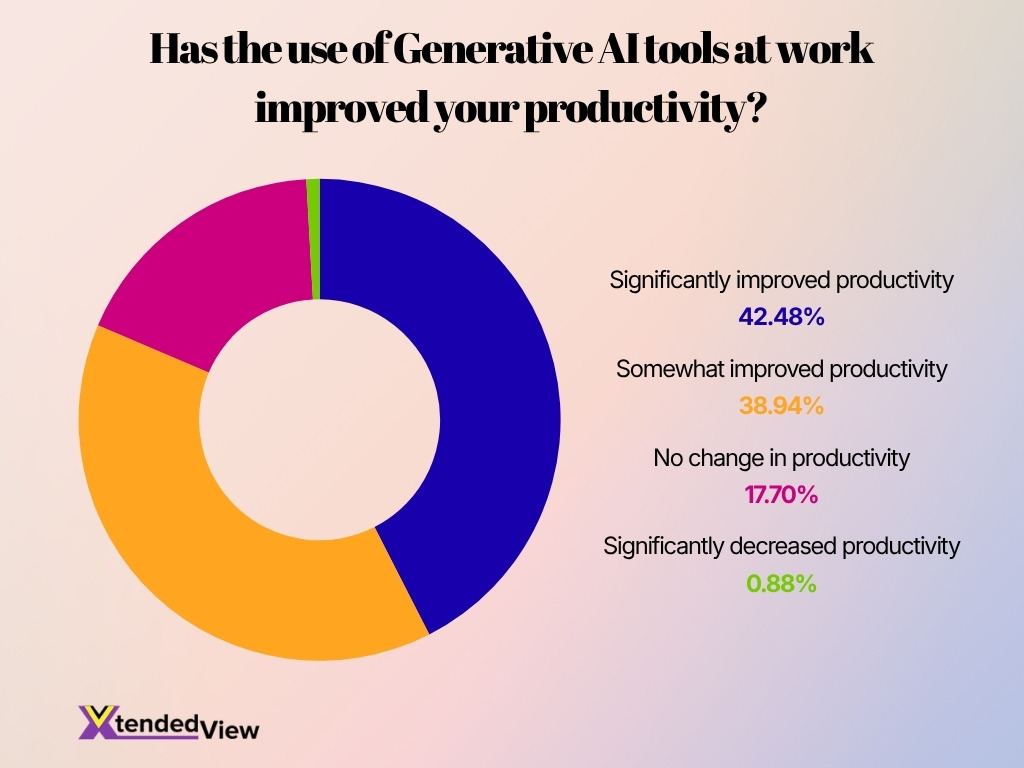
- 81.42% of workers said Generative AI tools improved productivity at work.
- 42.48% reported their productivity significantly improved after using Generative AI tools.
- 38.94% said Generative AI tools somewhat improved their workplace productivity.
- 17.70% of respondents saw no change in productivity from using Generative AI tools.
- Only 0.88% said Generative AI tools significantly decreased productivity.
- The data shows a strong positive impact, with improved productivity outweighing negative responses by a wide margin.
Data Privacy, Security, and Governance Statistics around Generative AI
- 74% of organizations identify model inaccuracy as a major AI risk, while 72% cite cybersecurity as one of their greatest concerns.
- Nearly half of organizations still lack enterprise-wide AI governance frameworks, creating challenges for large-scale deployment.
- IBM projects spending on AI ethics and governance to increase from 4.6% of AI spending in 2024 to 5.4% in 2025, reflecting growing investment in responsible AI.
- The global AI governance market reached approximately $839 million in 2025 and is projected to exceed $1.1 billion in 2026.
- Organizations increasingly deploy retrieval-augmented generation (RAG), access controls, and private AI environments to reduce data leakage risks in enterprise applications.
- Shadow AI has emerged as a growing enterprise concern as employees use personal AI accounts without organizational approval, increasing compliance and security risks.
- AI-related data breaches involving unauthorized AI usage can significantly increase incident costs when sensitive business or customer information is exposed.
- Organizations increasingly require AI governance programs covering model monitoring, audit trails, human oversight, and regulatory compliance before scaling production deployments.
- Governments worldwide continue strengthening AI governance requirements as enterprise adoption accelerates across regulated industries.
Workforce Disruption and Job Impact Statistics of Generative AI
- Generative AI can automate tasks consuming 60% to 70% of an employee’s daily working time.
- About 80% of companies deploying autonomous AI agents have experienced targeted headcount reductions.
- Over 30% of workers might see at least 50% of their routine tasks disrupted by new AI models.
- Full adoption of generative AI is expected to raise global labor productivity by approximately 15%.
- Professionals demonstrating advanced AI skills currently command a significant 56% wage premium.
- AI adoption is projected to create 170 million new jobs globally by 2030 despite short-term disruptions.
- Roughly 75% of active knowledge workers are already leveraging generative AI tools for daily tasks.
- Nearly 80% of the global engineering workforce will require major upskilling before the year 2027.
Generative AI’s Expected Workforce Impact Over the Next Three Years
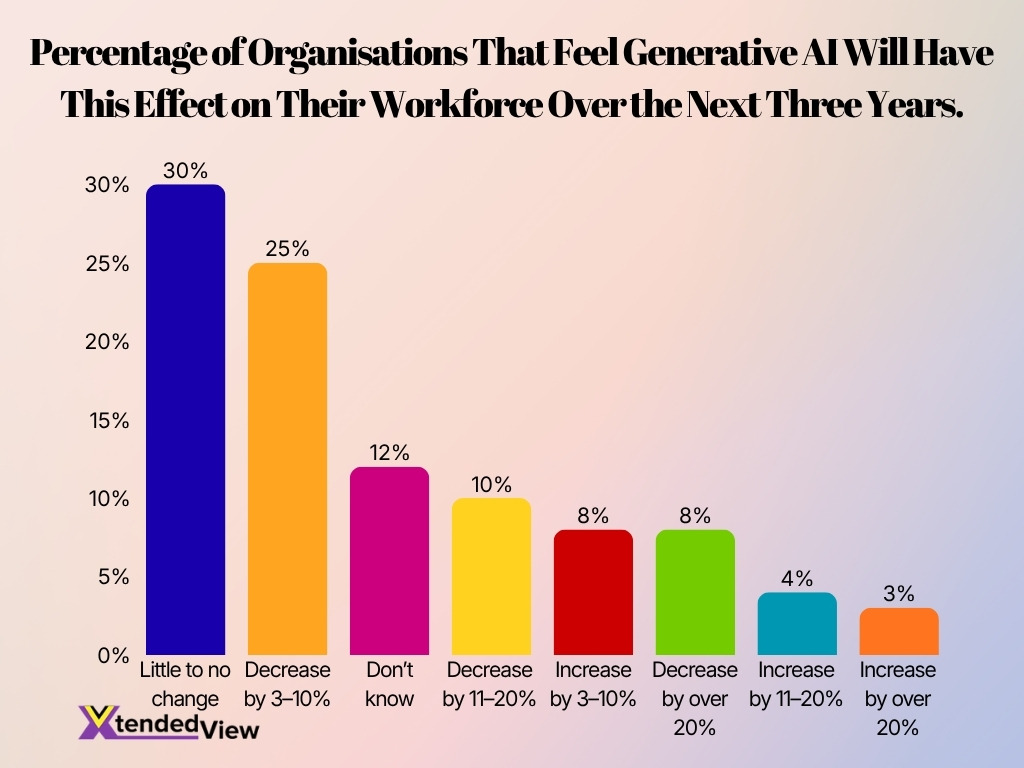
- 30% of organizations expect little to no change in workforce size due to generative AI.
- 25% of organizations expect their workforce to decrease by 3–10%.
- 10% of organizations predict a workforce decrease of 11–20%.
- 8% of organizations expect a decrease of over 20%.
- 8% of organizations expect generative AI to increase workforce size by 3–10%.
- Only 4% of organizations expect a workforce increase of 11–20%.
- Just 3% of organizations expect workforce size to increase by over 20%.
- 12% of organizations said they don’t know how generative AI will affect workforce size.
- Overall, more organizations expect workforce reductions than workforce growth from generative AI.
- The data suggests generative AI may drive efficiency gains without causing major workforce expansion.
Trust, Ethical, and Regulatory Perspective Statistics on Generative AI
- Only about one-third of organizations successfully scale AI beyond pilot projects due to trust barriers.
- Research shows 60% of executives use AI for decisions, but only 5% significantly improve data trust.
- Reports indicate 35 of 36 member countries (97%) use AI in at least one area of government operations.
- Nearly 60% of executives state that Responsible AI boosts both ROI and organizational efficiency.
- Around 55% of leaders indicate that Responsible AI enhances customer experience and drives innovation.
- Approximately 51% of executives cite improved cybersecurity and data protection as benefits of AI governance.
- About 61% of organizations have actively integrated Responsible AI into their core operations and decision-making.
- Exactly 50% of executives cite translating AI principles into operational processes as their biggest barrier.
- Roughly 78% of organizations in the strategic stage are highly effective at communicating AI priorities.
- Currently, 22% of IT and engineering teams lead Responsible AI initiatives across enterprise functions.
Generative AI Roadmap and Future Trend Statistics
- Total AI procurement spend is projected to reach $2.59 trillion in 2026, marking a 47% year-over-year growth.
- Global AI infrastructure spending is forecast to hit $487 billion in 2026, reflecting a 53% increase from the previous year.
- Investments in agentic AI software are expected to surge 139% to reach $206.5 billion in 2026.
- The global generative AI market size is projected to expand from $161 billion in 2026 to $1.26 trillion by 2034.
- Approximately 42% of organizations currently find it difficult or impossible to measure the ROI of their AI investments.
- Almost 40% of enterprises report that establishing trusted AI governance is their top technology priority for 2026.
- The software segment dominates the generative AI ecosystem, accounting for over 64% of total market revenue.
- Enterprise data volume driven by agentic AI is expected to reach 17.1 petabytes per second by 2029.
Frequently Asked Questions (FAQs)
The global generative AI market is projected to reach $161 billion in 2026, up from $103.58 billion in 2025.
The global generative AI market is forecast to grow at a 29.3% CAGR between 2026 and 2034.
According to the latest global survey, 88% of organizations use AI in at least one business function, while 71% regularly use generative AI.
Generative AI could generate $2.6 trillion to $4.4 trillion in annual economic value across industries through productivity and business transformation.
North America accounted for 48.7% of the global generative AI market in 2025, making it the leading regional market.
Conclusion
Generative AI has moved beyond experimentation and is now driving measurable change across business operations, software development, healthcare, finance, manufacturing, and public services. The latest shows rapid market expansion, growing enterprise adoption, and continued investment in AI infrastructure, while organizations increasingly focus on governance, security, and measurable ROI. Looking ahead, businesses that combine responsible AI practices with strong data foundations, workforce upskilling, and scalable deployment strategies will be best positioned to capture the long-term value of generative AI.
