



Artificial intelligence adoption accelerated across nearly every industry. Businesses now use AI to automate customer support, improve software development, detect fraud, personalize shopping experiences, and streamline enterprise operations. Meanwhile, healthcare providers rely on AI for diagnostics, and financial institutions use it to strengthen risk management and fraud detection.
The rapid growth of generative AI tools, enterprise copilots, and AI-driven automation continues to reshape how organizations operate and compete. As investment levels rise and workplace adoption expands, the data behind AI implementation reveals where businesses see measurable value and where challenges still remain. Explore the latest statistics and trends driving artificial intelligence adoption.
Editor’s Choice
- 88% of organizations now use AI in at least one business function, up from 78% a year earlier.
- 71% of companies regularly use generative AI in at least one business function in 2026.
- The estimated annual value of generative AI tools to U.S. consumers reached $172 billion by early 2026.
- 92% of Fortune 500 companies reportedly use OpenAI-powered technologies in some capacity.
- Organizations investing in generative AI report an average return of $3.70 for every $1 spent.
- AI-related job postings remain 134% above pre-pandemic levels in the United States.
- 76% of surveyed enterprises now have a Chief AI Officer or similar executive AI leadership role, compared to 26% in 2025.
- 67% of organizations increased their generative AI investments compared to last year.
- AI adoption reached 53% of the global population within three years, making it faster than internet and PC adoption.
Recent Developments
- Anthropic expanded its enterprise partnership initiatives in 2026, while PwC plans to train 30,000 U.S. employees on Claude-based AI systems.
- Insurance underwriting workflows powered by AI reportedly reduced processing timelines from 10 weeks to 10 days in some enterprise deployments.
- Enterprise AI adoption continues to rise despite project failures, with 92% of firms investing in AI during the past year.
- 83% of organizations plan to increase AI spending in 2026, even as many projects remain stuck in pilot phases.
- Around 57% of companies admitted they adopted AI largely because of competitive pressure rather than long-term planning.
- 44% of businesses increased employee training budgets to improve AI readiness and workforce adaptation.
- AI-focused consulting transformation accelerated in 2026, with major firms restructuring around smaller AI-enabled project teams.
- Enterprises deploying AI governance programs through executive leadership reported significantly better business outcomes than companies leaving governance to technical teams alone.
- 34% of organizations now use AI to redesign products, services, or core business models instead of limiting AI to operational efficiency.
Global Artificial Intelligence Adoption Overview
- Global AI adoption across businesses climbed from roughly 55% in 2023 to 88% in 2025-2026.
- Generative AI adoption jumped from 33% to 71% among enterprises within two years.
- North America leads enterprise AI maturity, with 31% of companies classified as AI leaders.
- Singapore reported 61% population-level generative AI adoption, ranking among the highest globally.
- The United Arab Emirates recorded 54% AI adoption penetration, outperforming many developed economies.
- The United States ranked 24th globally in consumer generative AI adoption at 28.3%.
- Private investment in generative AI reached $33.9 billion in 2024, representing a 19% annual increase.
- Total global private AI investment climbed to $252 billion in recent reporting periods.
- The global generative AI market reached $59.01 billion in 2025 and could exceed $400 billion by 2031.
- Sectors with high AI exposure achieved 4.8x greater labor productivity growth than average industries.
AI Adoption by Company Size
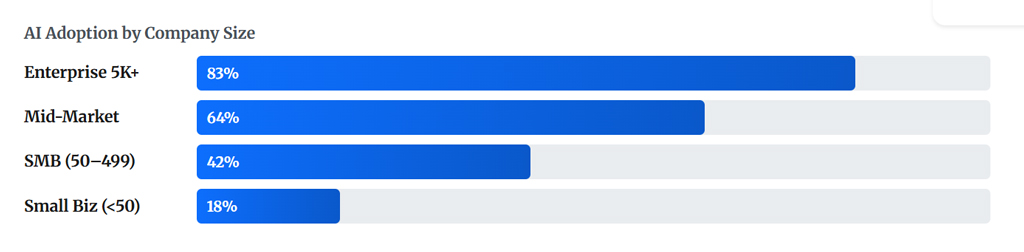
- Enterprise companies with 5,000+ employees lead AI adoption, with 83% reporting AI usage, showing that large organizations are moving fastest in AI integration.
- Mid-market companies show strong adoption at 64%, indicating that AI is no longer limited to only the biggest enterprises.
- SMBs with 50–499 employees have a 42% AI adoption rate, suggesting that smaller companies are increasingly using AI but still lag behind larger firms.
- Small businesses with fewer than 50 employees have the lowest adoption rate at 18%, likely due to limited budgets, technical resources, or implementation capacity.
- There is a clear size-based adoption gap, with enterprise AI adoption at 83% compared to just 18% among small businesses.
- The data shows that larger companies are more than 4.6 times more likely to adopt AI than small businesses.
- Overall, AI adoption appears to scale with company size, as businesses with more employees tend to have greater access to funding, data infrastructure, and technical talent.
Country-Wise Artificial Intelligence Adoption
- Singapore recorded 61% AI adoption, placing it among the world’s top adopters of AI.
- The United Arab Emirates reached 64% AI use among the working-age population at the end of 2025.
- The UAE was #1 globally in AI diffusion, ahead of Singapore by more than 3 percentage points.
- Singapore was #2 globally with 60.9% AI adoption, showing strong national AI penetration.
- The United States ranked 28th globally, with 41% AI adoption in 2025.
- North America had 22% average AI adoption, while Europe averaged about 27% across high-income economies.
- 92% of Fortune 500 companies were estimated to use OpenAI products or APIs in some form by mid-2025.
- U.S. AI-related job postings hit 35,445 in Q1 2025, up 25.2% year over year.
- In 2025, the EU27 enterprise AI adoption rate reached 20.0%, up from 13.5% in 2024.
Regional Artificial Intelligence Adoption Trends
- North America leads enterprise AI deployment, with 80%+ of large enterprises using AI tools in at least one department.
- Asia-Pacific is the fastest-growing market, with AI and GenAI spending projected to reach $175 billion by 2028.
- Europe is scaling AI governance fast, with public AI commitments rising 28% year over year in 2024.
- Latin American businesses using AI in customer service reported a 21% average boost in operational efficiency.
- Middle Eastern enterprises are accelerating sovereign AI adoption, with 17% of firms in the UAE and Saudi Arabia deeply committed to sovereign AI.
- African fintech firms are expanding AI fraud prevention, with AI transaction-monitoring deployments growing 35% annually.
- Japan is pushing AI in robotics and manufacturing, with enterprise gen AI usage at 43.4% of companies in 2026.
- Australia saw generative AI adoption rise from 38% in 2024 to 49% usage in recent regional reporting.
- India is seeing rapid AI hiring, with AI-related job postings more than doubling to 6.5% of all vacancies across South Asia.
- Southeast Asia is boosting public-sector AI spending, with governments investing more heavily in digital transport, healthcare, and citizen services.
Organizations’ Current Level of AI Adoption
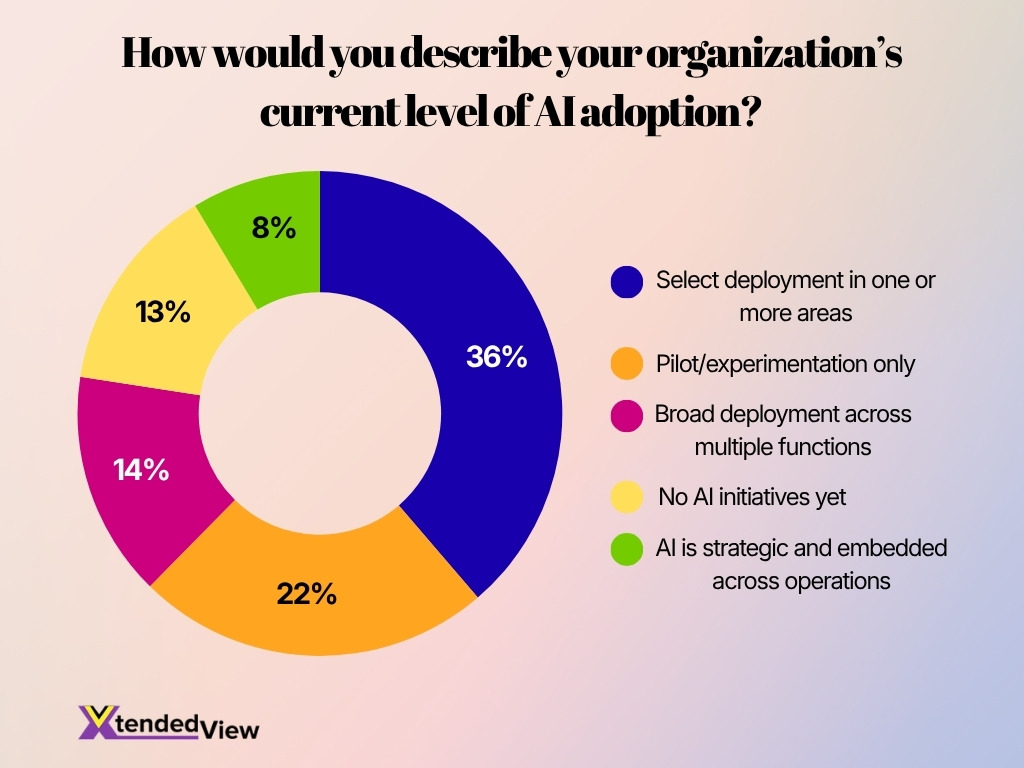
- The largest share of organizations, 36%, report selective deployment of AI in one or more areas, showing that AI adoption is moving beyond early testing but is not yet fully enterprise-wide.
- Around 22% of organizations are still in the pilot or experimentation stage, meaning nearly 1 in 5 businesses are testing AI before scaling it further.
- Only 14% of organizations have achieved broad AI deployment across multiple functions, suggesting that cross-functional AI integration is still limited.
- About 13% of organizations have no AI initiatives yet, indicating that a notable portion of businesses have not started their AI adoption journey.
- Just 8% say AI is strategic and embedded across operations, highlighting that fully mature AI adoption remains relatively rare.
- Combined, 58% of organizations are either using AI in selected areas or experimenting with it, showing strong momentum toward wider AI implementation.
- The data suggests that most companies are in the early-to-mid stages of AI adoption, with only a small percentage reaching advanced, organization-wide AI maturity.
Workplace Artificial Intelligence Adoption Trends
- Around 75% of knowledge workers now use AI tools in some form during their workweek.
- Employees using generative AI tools save an estimated 1.75 hours daily on repetitive tasks.
- AI-powered meeting summarization became one of the fastest-growing workplace AI applications in 2025 and 2026.
- 68% of workers say AI helps them focus on more strategic tasks rather than administrative work.
- Workplace AI adoption increased fastest among employees under age 35, particularly in marketing and engineering roles.
- Companies deploying AI copilots reported noticeable productivity improvements in customer support and sales teams.
- Roughly 52% of employees worry AI could eventually replace portions of their current responsibilities.
- AI literacy programs became more common in enterprises, with 44% of organizations expanding workforce AI training.
- Hybrid work environments accelerated AI adoption because teams increasingly rely on automated collaboration tools.
- Enterprises integrating AI assistants into workflow software reported improved employee satisfaction and reduced burnout rates.
Knowledge Worker Artificial Intelligence Adoption
- 78% of AI users brought their own AI tools to work instead of relying only on employer-approved systems.
- Knowledge workers spend 57% of their workday communicating through meetings, email, and chat.
- Global knowledge workers now spend about 28% of the workweek on email alone, or roughly 11.2 hours.
- Copilot users were 29% faster across tasks such as searching, writing, and summarizing.
- 70% of Copilot users said they were more productive after adopting the tool.
- AI-powered knowledge management can cut information-search time by up to 35%.
- 52% of enterprises already have formal generative AI governance policies in place.
- 76% of people said they would be comfortable using AI for administrative tasks.
- AI users saved an average of 5.4% of their work hours, equal to more than 2 hours per week.
- AI use at work reached 89% of workers in at least some capacity, with 38% using it daily.
Industry-Wise Artificial Intelligence Adoption
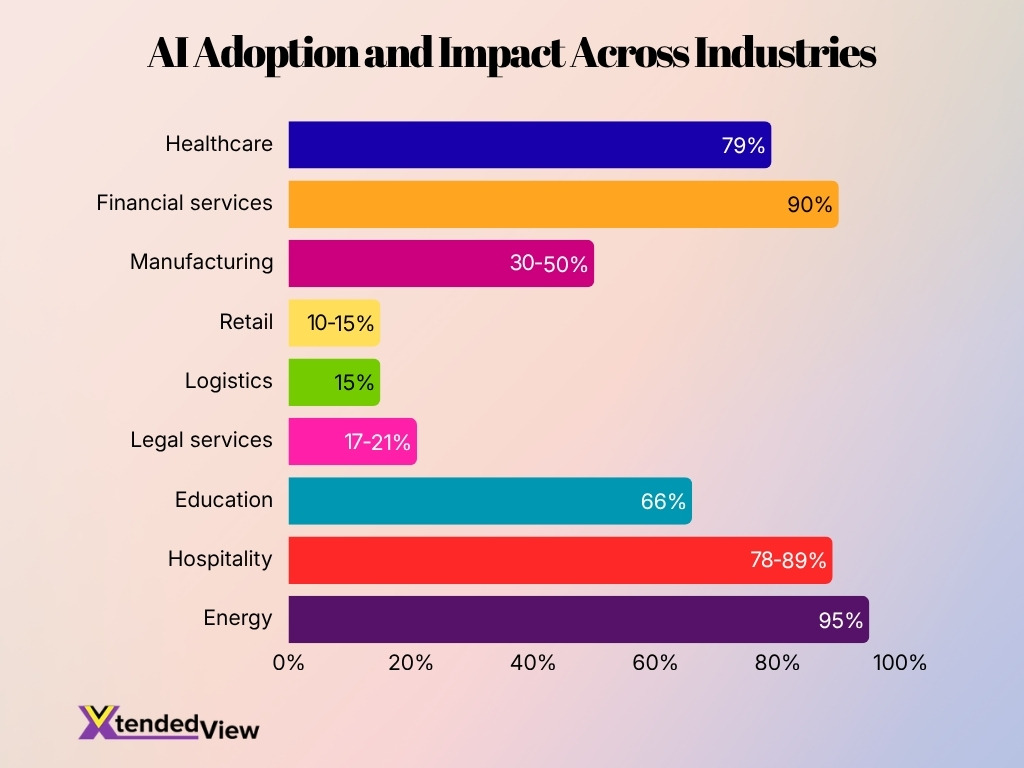
- Healthcare: 79% of organizations reported using ambient speech AI, and most deployments in 2025 were still limited to lower-risk operational workflows.
- Financial services: 90% of financial institutions use AI for fraud detection, with banks relying on it for real-time investigations and scam spotting.
- Manufacturing: AI-driven predictive maintenance typically reduces unplanned downtime by 30%–50%.
- Retail: AI personalization can lift conversion rates by about 10%–15%, with some personalized storefronts reporting even higher gains.
- Logistics: AI route optimization can cut fuel costs by around 15% while improving delivery efficiency.
- Legal services: 17% of large companies were already using AI-powered contract review software, with another 21% actively evaluating it.
- Education: In 2025, 66% of primary and secondary teachers were using AI at school, showing broad classroom adoption.
- Hospitality: 78% of hotel chains already deploy AI systems, and 89% plan to expand them within 12 to 24 months.
- Energy: Some AI demand-prediction systems have reached 95% accuracy in grid and load forecasting use cases.
Developer Artificial Intelligence Adoption Statistics
- Around 76% of developers now use or plan to use AI coding assistants regularly.
- Developers using GitHub Copilot completed coding tasks up to 55% faster in controlled testing environments.
- Stack Overflow surveys show that over 80% of developers experimented with generative AI coding tools during the past year.
- AI-assisted debugging tools reduced software troubleshooting time by approximately 30%.
- Enterprise software teams increasingly use AI for automated documentation generation and code explanation.
- Developers remain cautious about AI-generated security vulnerabilities, especially in production applications.
- AI-generated code now accounts for nearly 25% of newly written enterprise code in some organizations.
- Open-source AI tooling adoption accelerated significantly among startup engineering teams throughout 2025 and 2026.
- Companies integrating AI into software engineering workflows report shorter release cycles and faster feature delivery.
- AI pair-programming tools became especially popular among junior developers and non-technical creators building low-code applications.
Artificial Intelligence Adoption in Software Development
- 84% of developers now use or plan to use AI tools in their development process, up from 76% in 2024, and showing how fast AI has moved into everyday software work.
- Teams using AI report 30%–40% faster completion on routine coding tasks, especially boilerplate and repetitive implementation.
- 85% of developers regularly use AI tools for coding and software design, while 62% rely on at least one AI coding assistant or agent in their workflow.
- 59% of developers rate automated test generation as an effective agentic AI task, which helps explain the sharp rise in AI-assisted testing and debugging.
- More than 75% of teams using traditional test automation frameworks had adopted AI testing tools for test writing and maintenance by late 2025.
- AI anomaly detection can surface issues 20–40 minutes before customer-facing impact, improving incident response in DevOps monitoring.
- AI documentation tools have cut onboarding time by 80%, reducing some new-hire ramp-up cycles from 4 weeks to just 3 days.
- AI-powered DevOps and maintenance workflows are helping teams automate up to 80% of routine security tasks, freeing engineers for higher-value work.
- AI-native startups are projected to launch MVPs in 4–6 weeks instead of 16–24 weeks, which lowers engineering cost and speeds product validation.
- The generative AI design sector is forecast to grow from $741 million to $13.9 billion over the next decade, reflecting rising AI use in UI and UX generation.
Marketer Artificial Intelligence Adoption Trends
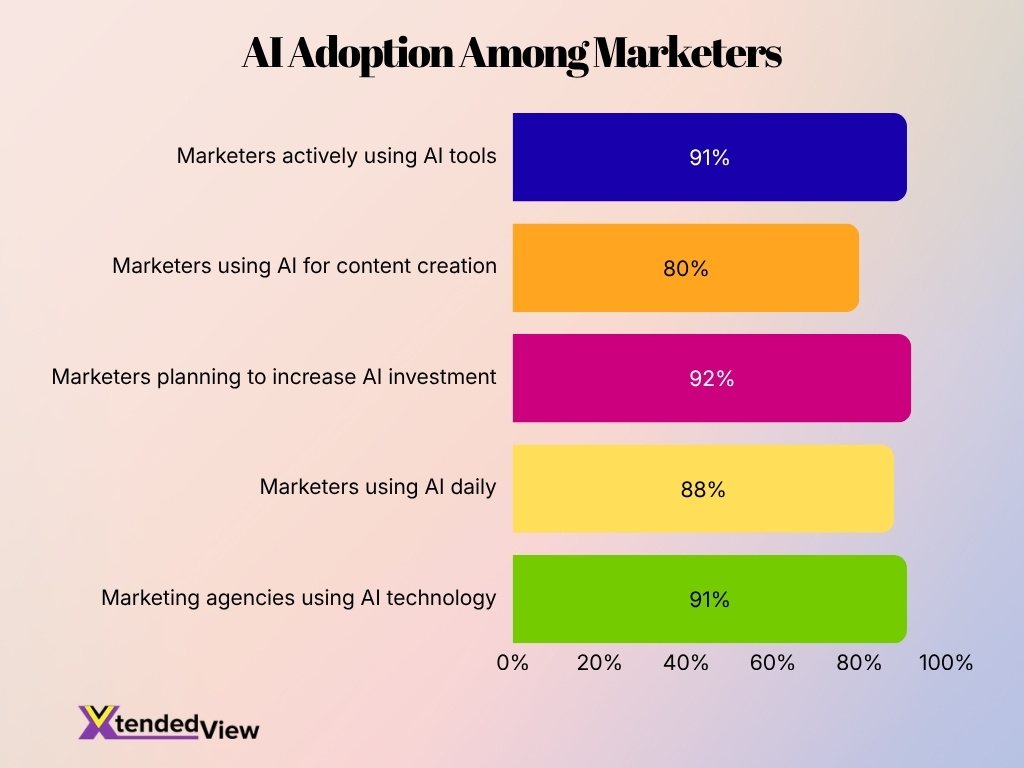
- AI adoption is now mainstream in marketing, with 91% of marketers actively using AI tools in their work.
- Content creation is one of the leading AI use cases, as 80% of marketers use AI for content creation.
- Investment in AI is expected to grow, with 92% of marketers planning to increase AI investment.
- Daily AI usage is also high, with 88% of marketers using AI tools every day, showing that AI has become part of regular marketing workflows.
- Marketing agencies are strongly adopting AI technology, with 91% of agencies using AI in their operations.
- The data suggests that AI is no longer an experimental tool for marketers. It is becoming a core part of marketing strategy, content production, and agency operations.
- The highest figure is 92%, representing marketers who plan to increase AI investment, which indicates continued growth in AI adoption across the marketing industry.
- Even the lowest figure, 80% for AI-powered content creation, shows a strong level of adoption and highlights how widely AI is being used to support creative marketing tasks.
Artificial Intelligence Adoption in Finance
- Financial institutions using AI-powered fraud detection systems reduced fraudulent transaction losses by up to 40%.
- Around 91% of financial firms now invest in AI for risk assessment, fraud prevention, or customer analytics.
- Banks deploying AI chatbots and virtual assistants lowered customer service costs by nearly 30%.
- AI-powered credit scoring systems improved loan approval speed while reducing manual underwriting workloads.
- Hedge funds increasingly use AI-driven predictive analytics for market forecasting and portfolio management.
- Generative AI adoption among global banks accelerated in 2025 and 2026 because of compliance automation and document summarization needs.
- AI-enabled anti-money laundering systems reduced false-positive alerts by approximately 20% to 30%.
- Insurance providers increasingly use AI for underwriting automation and claims processing optimization.
- Financial firms remain cautious about generative AI governance because of data privacy and regulatory compliance concerns.
- AI-powered robo-advisors continue expanding in wealth management, especially among younger investors seeking low-cost investment services.
Consumer Artificial Intelligence Adoption Statistics
- 53%+ of consumers globally had already adopted generative AI within three years of mainstream availability.
- U.S. consumer surplus from generative AI reached $172 billion annually, showing unusually large welfare gains from everyday use.
- Around 65% of consumers interact with AI-powered recommendation systems daily through shopping, streaming, or social apps.
- Global generative AI adoption reached 16.3% of the world’s population by the end of 2025, up from 15.1% in the first half of the year.
- Roughly 1.8 billion people used consumer AI globally, including about 500 million to 600 million daily users.
- 77% of Gen Z consumers reported using AI tools, making younger users the strongest adopters.
- About half of 14- to 29-year-olds said they use generative AI at least weekly, with 22% using it daily.
- Half of consumers now intentionally seek out AI-powered search, and about 50% of Google searches already show AI summaries.
- 60% of Americans ranked deepfakes as their top AI-related concern, reflecting rising mistrust around misinformation.
- AI customer service adoption is already mainstream, with 80% of companies using or planning to adopt AI chatbots, and telecom reporting 95% adoption.
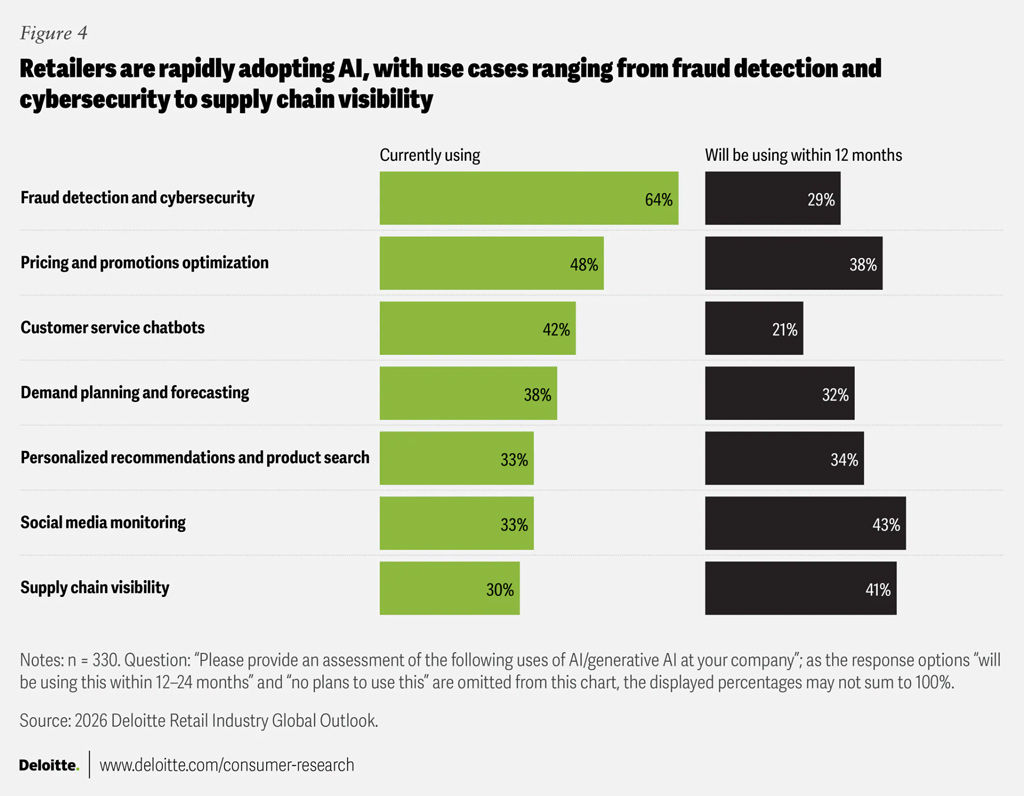
Retailers Are Accelerating AI Adoption Across Core Business Functions
- Fraud detection and cybersecurity are the leading AI use cases among retailers, with 64% currently using AI for this purpose.
- An additional 29% of retailers plan to use AI for fraud detection and cybersecurity within the next 12 months, showing continued investment in risk prevention.
- Pricing and promotions optimization is already used by 48% of retailers, making it the second-most adopted AI application in the chart.
- Around 38% of retailers plan to adopt AI for pricing and promotions optimization within the next 12 months, highlighting its growing role in revenue and margin improvement.
- Customer service chatbots are currently used by 42% of retailers, showing that AI-powered support tools are becoming mainstream in retail operations.
- Demand planning and forecasting has a current AI adoption rate of 38%, with another 32% planning adoption within the next 12 months.
- Personalized recommendations and product search show balanced adoption, with 33% currently using AI and 34% planning to use it soon.
- Social media monitoring is expected to see strong future growth, with 43% of retailers planning to adopt AI within the next 12 months, compared with 33% currently using it.
- Supply chain visibility has the lowest current adoption rate at 30%, but future interest is high, with 41% of retailers planning to adopt AI in this area.
- The data suggests that retailers are moving beyond customer-facing AI tools and increasingly using AI for security, pricing, forecasting, marketing intelligence, and supply chain operations.
Generative Artificial Intelligence Tool Adoption
- Around 71% of organizations now use generative AI in at least one business function.
- The global generative AI market is valued at $67 billion in 2026, up from $37.89 billion in 2025.
- Roughly 65% of enterprises have adopted generative AI in at least one business process as of Q1 2026.
- About 38% of knowledge workers use generative AI tools daily at work, up from 11% in 2024.
- Enterprises report average productivity gains of 15–30% in knowledge‑intensive workflows using generative AI.
- Nearly 41% of Microsoft 365 enterprise customers had adopted AI copilots by Q1 2026.
- Around 52% of enterprises have formal generative AI governance and usage policies in place.
- AI‑augmented workers saw up to 40% higher performance on complex tasks compared with non‑AI users.
- Generative AI‑driven image and video tools are now used in over 60% of large advertising and media firms for content creation.
- About 80% of organizations expect to increase their generative AI budgets by at least 20% year‑over‑year by 2026.
Artificial Intelligence Spending and Investment Trends
- Global AI spending is projected to reach $2.52 trillion in 2026, up roughly 44% year‑over‑year.
- AI infrastructure alone will account for about $1.36 trillion of that total in 2026.
- Big Tech (Meta, Microsoft, Alphabet, Amazon) is on track to invest over $650 billion in AI‑related projects in 2026.
- Private AI investment in the United States reached approximately $286 billion in 2025, far exceeding China’s $12.4 billion.
- Generative AI startups attracted around $150 billion in 2025, representing more than 40% of global venture capital directed to AI.
- AI data‑center systems spending is forecast to hit roughly $788 billion in 2026, up nearly 56% from 2025.
- Top AI startups such as OpenAI, Anthropic, and xAI now hold combined valuations exceeding $1.2 trillion.
- Median pre‑money valuations for Series B AI startups have climbed to about $143 million, up sharply from earlier stages.
- National governments have committed tens of billions of dollars in sovereign AI funds, with AI‑specific R&D spending growing by over 20% annually in leading economies.
- Enterprises that allocate at least 15% of their IT budgets to AI report more than double the adoption success rates compared to those investing below 5%.
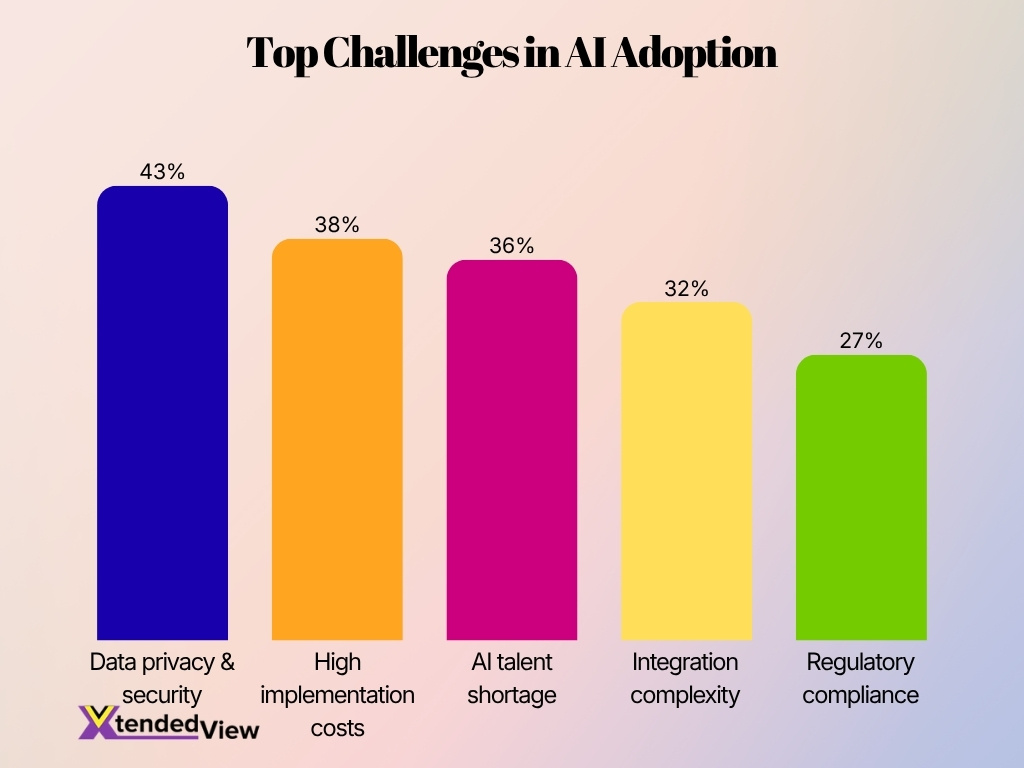
Top Challenges in AI Adoption
- Data privacy & security is the leading challenge, cited by 43% of respondents, showing that organizations remain highly concerned about protecting sensitive data while using AI.
- High implementation costs rank second at 38%, indicating that budget constraints and the expense of deploying AI systems are major barriers to adoption.
- AI talent shortage affects 36% of organizations, suggesting that many companies struggle to find skilled professionals who can build, manage, and optimize AI solutions.
- Integration complexity is reported by 32%, highlighting the difficulty of connecting AI tools with existing systems, workflows, and legacy infrastructure.
- Regulatory compliance is a concern for 27% of respondents, reflecting the growing need to align AI use with evolving legal, ethical, and industry standards.
- Overall, the data shows that AI adoption is limited not only by technology but also by security risks, cost pressures, skills gaps, integration issues, and compliance requirements.
Frequently Asked Questions (FAQs)
Around 88% of organizations now use AI in at least one business function.
More than 81.2% of online adults worldwide used at least one AI tool within the past month.
Generative AI tools generate an estimated $172 billion annually for U.S. consumers.
About 92% of firms across major English-speaking markets invested in AI in the past year.
Generative AI achieved 53% population adoption within three years, faster than the internet or personal computers.
Conclusion
Artificial intelligence adoption accelerated dramatically across industries, regions, and enterprise sizes. Businesses increasingly rely on AI to improve productivity, automate workflows, strengthen customer experiences, and support decision-making. At the same time, consumers now interact with AI systems daily through search engines, recommendation platforms, virtual assistants, and generative AI tools.
Enterprise investment continues rising despite governance, security, and implementation challenges. Organizations that combine AI deployment with workforce training, executive leadership, and responsible governance frameworks consistently report stronger operational outcomes. Meanwhile, generative AI continues to reshape software development, marketing, finance, retail, and workplace collaboration at scale.
As AI technologies mature, adoption patterns will likely shift from experimentation to measurable business transformation. The next phase of AI growth will depend heavily on trust, regulation, infrastructure investment, and the ability of organizations to integrate AI into real-world workflows effectively.
