


The competition between Microsoft’s Visual Studio Code and JetBrains IntelliJ IDEA shapes how millions of developers build software. From cloud-native applications and AI-powered coding environments to enterprise Java systems and startup web products, these tools influence productivity across nearly every software industry. Their adoption trends also help organizations decide which platforms to standardize for hiring, training, and software delivery. Explore the latest statistics to understand how VS Code and IntelliJ IDEA compare.
Editor’s Choice
- Visual Studio Code remained the world’s most-used development environment in 2025, with 73.6% of developers reporting usage.
- IntelliJ IDEA ranked among the top three IDEs globally and surpassed several traditional editors in professional usage.
- JetBrains estimated the global professional developer population at 20.8 million in 2025, creating a larger addressable market for IDE vendors.
- More than 24,500 developers participated in the 2025 JetBrains Developer Ecosystem survey, making it one of the industry’s largest developer studies.
- 72% of Java developers used IntelliJ IDEA in 2025, maintaining its dominant position in Java development.
- VS Code has held the title of the most-used IDE for five consecutive years, according to annual developer surveys.
- Around 85% of developers globally now use AI tools for coding, increasing demand for AI-enabled IDE capabilities in both VS Code and IntelliJ IDEA.
Recent Developments
- Microsoft continued expanding GitHub Copilot integration across VS Code throughout 2025, turning the editor into a full AI-assisted development environment.
- JetBrains introduced deeper AI Assistant capabilities and expanded agent-based workflows across IntelliJ products during 2025 and early 2026.
- 62% of developers now rely on at least one coding assistant or AI editor, directly influencing IDE feature roadmaps.
- JetBrains announced the discontinuation of its Fleet IDE in December 2025 to focus resources on IntelliJ-based products.
- Fleet technologies have already been incorporated into JetBrains’ flagship IDEs, including IntelliJ IDEA.
- Approximately 80% of companies permit third-party AI tools for developers, accelerating AI integration inside modern IDEs.
- AI-generated code now accounts for roughly 24% of production code in some organizations, increasing demand for smarter code review and debugging features.
- JetBrains reported that 18% of developers already integrate AI capabilities directly into their products, creating new use cases for advanced IDE tooling.
- The industry has shifted toward “agentic development,” where developers delegate tasks such as refactoring and testing to AI agents within IDEs.
Overview of VS Code and IntelliJ IDEA
- Visual Studio Code launched in 2015 and has become the dominant editor for web, cloud, and cross-platform development.
- IntelliJ IDEA, introduced by JetBrains in 2001, remains one of the most widely used enterprise IDEs, particularly for Java development.
- VS Code is free and open source, which has contributed significantly to its global adoption.
- IntelliJ IDEA follows a dual licensing model with Community and Ultimate editions serving both individual developers and enterprises.
- JetBrains employs between 1,000 and 5,000 people globally, reflecting its substantial investment in development tools.
- VS Code supports hundreds of programming languages through extensions, making it one of the most flexible development platforms available.
- IntelliJ IDEA is the foundation for several JetBrains products, including Android Studio and many language-specific IDEs.
- JetBrains created the Kotlin programming language in 2011, strengthening IntelliJ IDEA’s ecosystem among Android and JVM developers.
- Both IDEs increasingly position themselves as AI development platforms rather than traditional code editors.
Year-Over-Year Java IDE Usage Statistics (2024 vs. 2025)
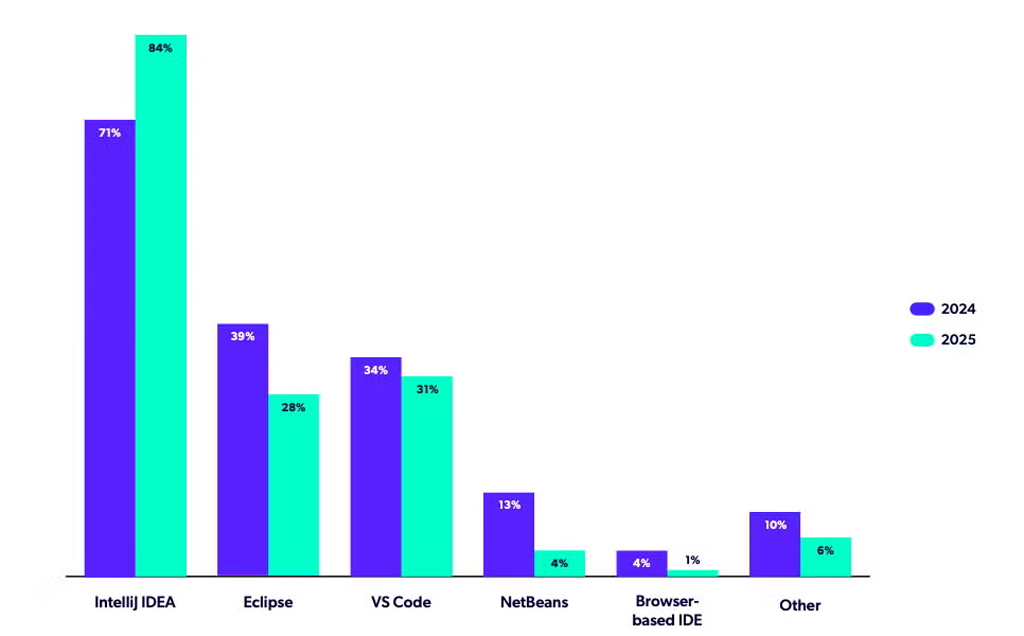
- IntelliJ IDEA strengthened its leadership, with usage increasing from 71% in 2024 to 84% in 2025, a gain of 13 percentage points.
- Eclipse experienced a notable decline, dropping from 39% in 2024 to 28% in 2025.
- VS Code remained a widely used Java IDE, though its adoption slipped slightly from 34% to 31% year over year.
- NetBeans saw one of the steepest declines, falling from 13% in 2024 to just 4% in 2025.
- Browser-based IDEs recorded the lowest adoption, decreasing from 4% to 1% over the same period.
- The “Other” IDE category also declined, moving from 10% in 2024 to 6% in 2025.
- IntelliJ IDEA was the only major IDE to post significant growth between 2024 and 2025.
- Eclipse, VS Code, NetBeans, Browser-based IDEs, and Other all recorded lower usage in 2025 compared to the previous year.
- The data indicates a strong shift toward IntelliJ IDEA, suggesting increased preference among Java developers.
- Since respondents could select more than one IDE, the percentages represent multi-select usage rather than exclusive market share.
Adoption and Popularity Trends
- 73.6% of developers used Visual Studio Code in 2025, keeping it ahead of every competing IDE.
- IntelliJ IDEA maintained one of the strongest satisfaction and loyalty rates among professional developers.
- The global developer population increased to approximately 20.8 million professionals in 2025, expanding the total IDE market.
- More than 85% of developers use AI coding tools, and IDE adoption increasingly depends on AI features.
- TypeScript and Kotlin remained among the fastest-growing languages in the JetBrains ecosystem, benefiting both VS Code and IntelliJ IDEA.
- JetBrains surveyed developers from 171 countries and regions in its 2024 ecosystem report, demonstrating broad global adoption of modern IDEs.
- Enterprise developers continue to prefer feature-rich IDEs like IntelliJ IDEA for large-scale projects, while startups often favor lightweight editors such as VS Code.
- Demand for integrated AI assistants has become one of the leading factors affecting IDE switching decisions in 2025 and 2026.
- Developer communities increasingly value extensibility and ecosystem support, areas where both products continue investing heavily.
Market Share Among Professional Developers
- Nearly 3 out of 4 professional developers currently use VS Code across various workloads.
- The professional developer market expanded from 19.6 million in 2024 to 20.8 million in 2025.
- An industry ecosystem report collected massive data samples from 24,534 developers in 2025.
- IntelliJ IDEA holds a dominant 72% market share among JVM-based enterprise developers.
- Approximately 84% of developers actively use AI integration for intelligent coding features.
- Over 66% of developers prioritize advanced productivity features over simple text editing.
- About 51% of professionals utilize their IDEs’ intelligent AI tools on a daily basis.
- A staggering 95% of developers report major productivity boosts from specialized development environments.
Developer Usage Statistics by Language
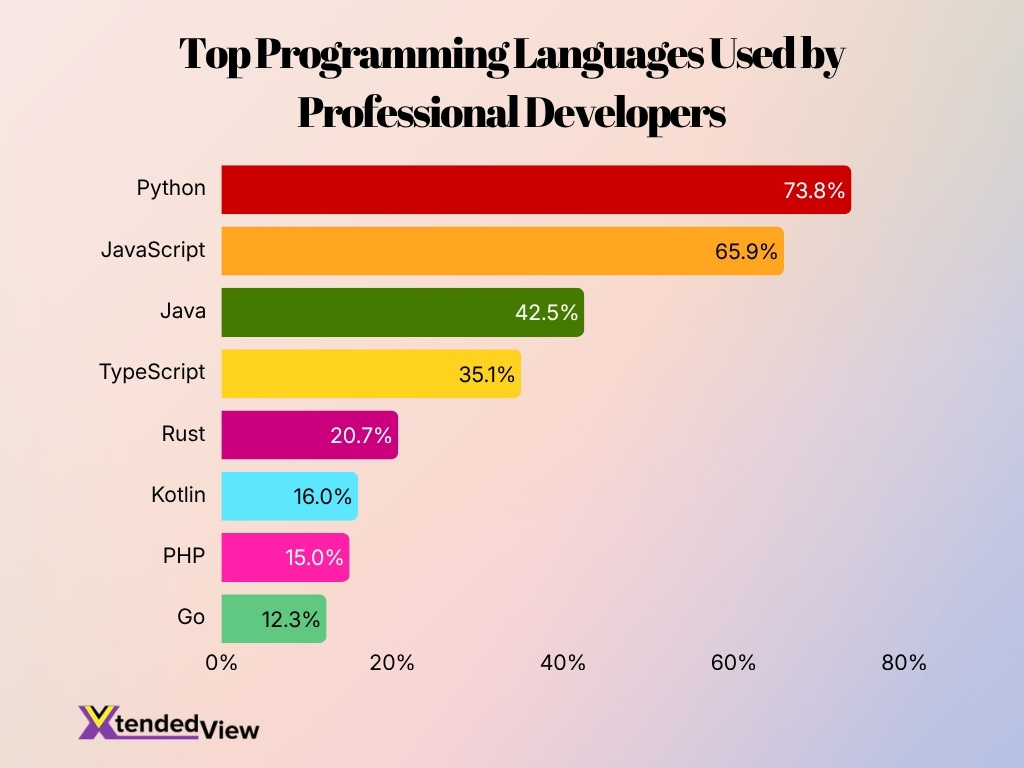
- 73.8% of professional developers consistently use Python for various programming tasks.
- 65.9% of software developers rely on JavaScript as their primary web development language.
- 42.5% of enterprise developers actively utilize Java for large-scale backend applications.
- 35.1% of developers have adopted TypeScript to enhance their front-end type safety.
- 20.7% of programmers now use Rust to improve performance and memory security.
- 16% of mobile developers strongly prefer Kotlin for modern Android application development.
- 15% of developers continue to build applications using PHP for legacy web systems.
- 12.3% of backend engineers choose Go for building scalable and concurrent APIs.
Adoption in Enterprise vs Startups
- Over 84% of large enterprises standardize on IntelliJ IDEA for Java-centric development.
- Nearly 76% of startups globally adopt VS Code because its licensing costs are effectively zero.
- Organizations with more than 5,000 employees show an 80% rate of providing paid IDE subscriptions.
- Around 70% of organizations support remote environments, driving demand for cloud-connected editors.
- More than 80% of companies allow AI-assisted coding tools, accelerating enterprise IDE modernization.
- IntelliJ IDEA retains 84% dominance in enterprise Java due to seamless integration with frameworks like Spring.
- Over 75% of cloud-native startups prefer VS Code due to its Kubernetes and remote development capabilities.
- Exactly 42% of enterprise organizations adopt multiple IDE standards to meet varied project requirements.
- Around 68% of mature companies simultaneously use IntelliJ IDEA for backend and VS Code for frontend workloads.
IDE Preference by Experience Level
- According to developer surveys, 73.6% of all developers use Visual Studio Code, making it the preferred editor across nearly every experience bracket.
- Senior developers with more than 10 years of experience are more likely to prefer feature-rich IDEs such as IntelliJ IDEA than newer developers.
- More than 44% of professional developers worldwide have over 10 years of coding experience, a demographic that strongly influences enterprise IDE adoption.
- Developers with less than five years of experience show the highest adoption rates for VS Code due to its free licensing and lower hardware requirements.
- Around 30% of developers globally are still learning or have less than five years of professional experience, supporting continued growth in VS Code adoption.
- Developers with extensive experience often prioritize advanced refactoring, navigation, and debugging features, which favor IntelliJ IDEA.
- More than 60% of developers under age 35 regularly use AI coding tools, increasing demand for lightweight, AI-enabled editors such as VS Code.
- Professional developers working in large organizations tend to adopt multiple IDEs depending on language specialization rather than relying on a single editor.
- Developers with advanced JVM expertise overwhelmingly continue using IntelliJ IDEA because of its integrated tooling and mature ecosystem.
Developer IDE Preferences
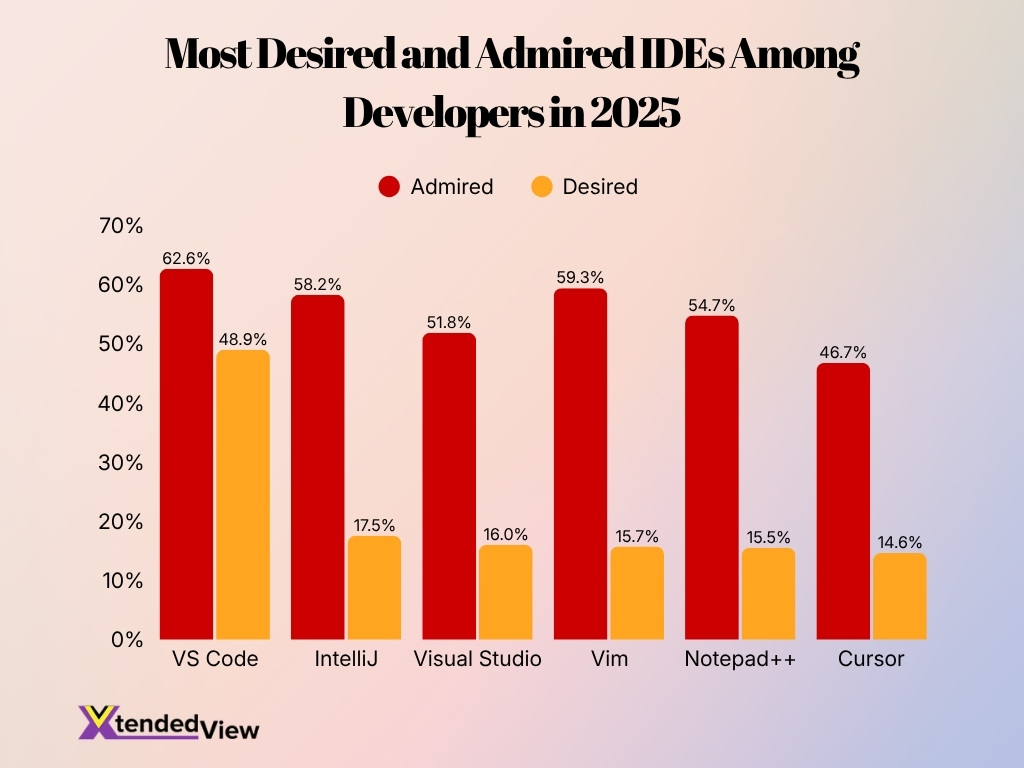
- VS Code is the most desired IDE, with 48.9% of developers wanting to use it.
- VS Code also ranks as the most admired IDE, earning 62.6% admiration among developers.
- Vim holds the second-highest admiration score at 59.3%, despite only 15.7% desire.
- IntelliJ records an admiration rate of 58.2%, while 17.5% of developers list it as their desired IDE.
- Notepad++ achieves a strong 54.7% admiration rating, with 15.5% developer interest.
- Visual Studio is desired by 16.0% of developers and admired by 51.8%.
- Cursor has the lowest admiration score among the listed IDEs at 46.7%.
- Cursor is also the least desired IDE, with 14.6% of developers expressing interest.
- Every IDE shown has a higher admiration percentage than desire percentage, indicating broad respect even among non-users.
- VS Code leads both metrics by a significant margin, reinforcing its position as the top developer IDE in 2025.
Usage Statistics for Web and JavaScript Development
- JavaScript maintains its position as the most popular language, used by 62.3% of developers globally.
- Over 73% of web developers choose Visual Studio Code as their primary code editor.
- TypeScript adoption continues to accelerate, with 67% of respondents writing it more than JavaScript.
- React remains the dominant frontend framework, securing an 81.1% usage rate among developers.
- Node.js leads as the top backend web technology, actively utilized by 40.8% of professionals.
- A massive 98% of professionals apply JavaScript specifically for frontend web development.
- Vite has rapidly gained traction, reaching a 78.1% adoption rate for web tooling.
- Single-Page Applications (SPAs) remain the most common pattern, used by 90% of developers.
- Over 59% of developers now incorporate Server-Side Rendering (SSR) into their web applications.
Usage Statistics for Data Science and Python
- Python dominates as the #1 most-used programming language globally with an 18.96% market share.
- Approximately 51% of developers regularly utilize Python for data exploration and processing tasks.
- The VS Code Python extension has officially surpassed 191 million installations worldwide.
- Over 34% of software engineers explicitly identify Python as their primary programming language.
- Jupyter Notebook repositories experienced a massive 75% increase, growing to 2.42 million projects.
- A staggering 80% of enterprises are deploying generative AI models using Python infrastructure in 2026.
- The global AI cloud market, driving Python adoption, is projected to reach $267 billion by 2030.
- Exactly 582,196 new AI repositories relying on Python were created, marking a 50.7% annual growth.
Developer Attitudes Toward AI in Society
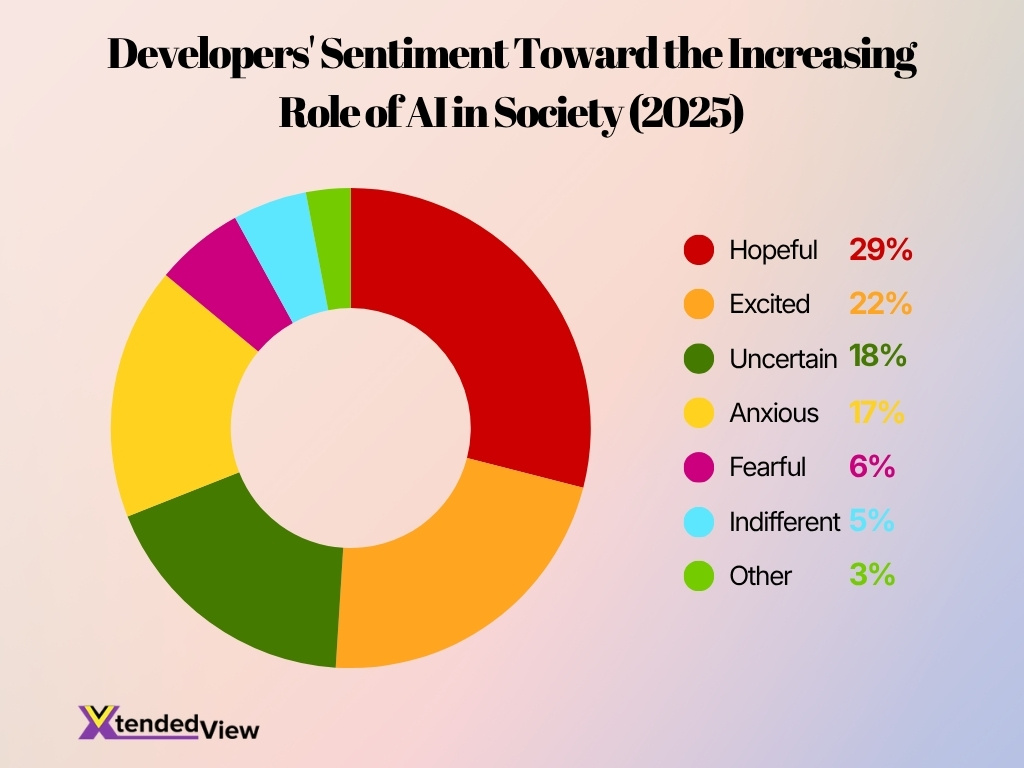
- Hopeful is the leading sentiment, with 29% of developers expressing optimism about AI’s growing role in society.
- 22% of developers feel excited, highlighting strong enthusiasm for AI-driven innovation and opportunities.
- Nearly 1 in 5 developers (18%) remain uncertain, reflecting mixed expectations about AI’s long-term impact.
- 17% of respondents feel anxious, indicating ongoing concerns about AI-related risks and challenges.
- Only 6% of developers reported feeling fearful, making it one of the least common responses.
- 5% of developers are indifferent, suggesting that relatively few are unaffected by AI’s expansion.
- Just 3% selected other emotions, showing that most developers’ opinions fall into the primary sentiment categories.
- Overall, positive sentiment (51%), combining hopeful and excited responses, significantly outweighs negative or neutral attitudes.
- The findings indicate that while AI optimism dominates, a substantial 35% of developers remain uncertain or anxious, underscoring the need for responsible AI development and governance.
Plugin and Extension Ecosystem Metrics
- Visual Studio Marketplace currently hosts over 6,500 extensions, with overall downloads peaking at 50 million.
- The Python extension for VS Code has accumulated more than 224 million installs globally.
- JetBrains Marketplace offers over 11,500 plugins created by an active community of 10,000+ authors.
- More than 80% of developers actively customize their development environments with various extensions or plugins.
- Third-party plugins on the JetBrains Marketplace receive over 3 million monthly unique downloads.
- Community-contributed extensions on the Visual Studio Marketplace account for more than 4,200 individual items.
- The top 10 productivity extensions are downloaded a combined 10 million times every single month.
- AI-powered tools like IntelliCode are heavily adopted, showing up in 65% of all Visual Studio sessions.
- Visual Studio and its vast extension ecosystem are utilized by over 70% of Fortune 100 companies.
Code Completion and Refactoring Productivity Metrics
- GitHub reported that developers using GitHub Copilot completed coding tasks up to 55% faster than developers who did not use AI-assisted coding tools.
- A survey found that 88% of developers felt more productive while using AI coding assistants integrated into editors such as VS Code.
- Around 74% of developers reported being able to focus on more satisfying work after adopting AI-assisted coding tools.
- More than 60% of developers use AI code completion tools weekly, increasing reliance on intelligent IDE features.
- IntelliJ IDEA’s advanced refactoring engine remains one of its most-cited productivity advantages among Java developers.
- Developers using AI assistance primarily employ it for code generation, documentation, and refactoring tasks.
- More than 80% of developers say code completion saves measurable development time.
- Enterprise teams increasingly use IntelliJ IDEA because automated refactoring reduces the risk of introducing bugs into large codebases.
- VS Code’s integration with GitHub Copilot and third-party AI assistants has dramatically improved its productivity capabilities since 2023.
Performance and Resource Usage Benchmarks
- VS Code typically launches in 1-2 seconds while IntelliJ IDEA requires 10-20 seconds to start up.
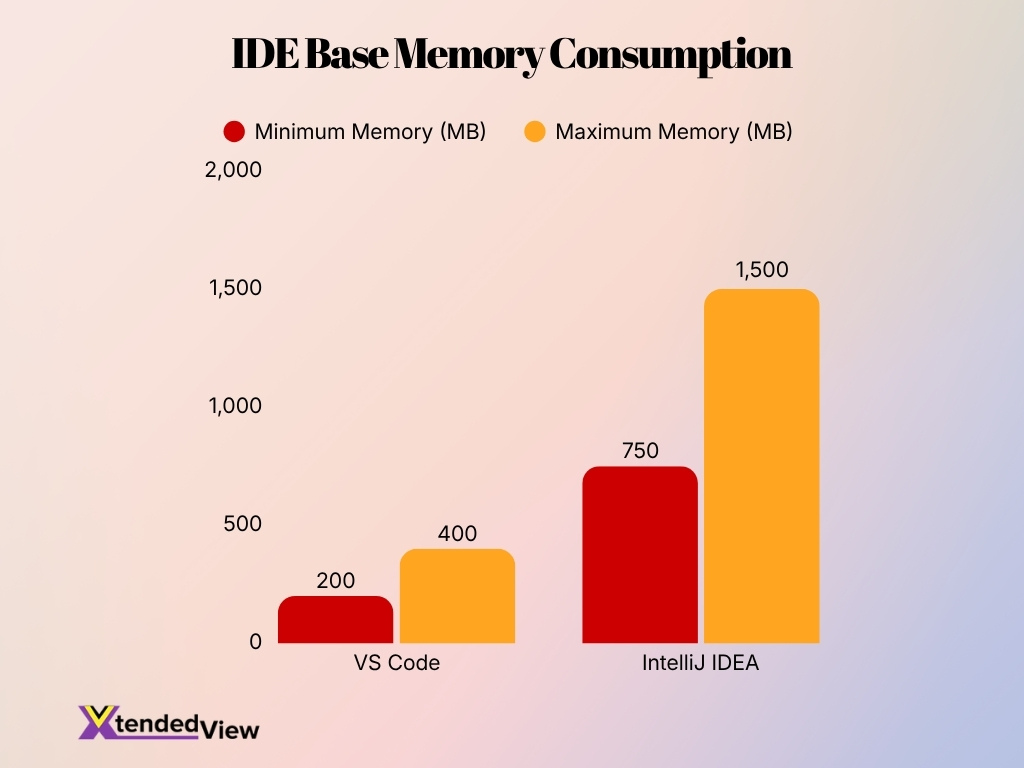
- Base memory usage for VS Code is 200-400MB compared to the 750MB-1.5GB required by IntelliJ.
- Energy consumption tests indicate that VS Code is 15.03% more energy-efficient than IntelliJ IDEA.
- Developers experience an average input latency of 8-12ms in VS Code versus 15-20ms in IntelliJ.
- IntelliJ users log an average of 85.7 hours per user compared to 30.6 hours for VS Code users.
- Initial project indexing in IntelliJ can take an additional 10 seconds before development can begin.
- Real-world performance testing shows that JetBrains IDEs offer 20% faster code refactoring speeds.
- Mean energy consumption for VS Code is roughly 38.1 million joules during benchmark testing tasks.
- IntelliJ IDEA requires a minimum of 8GB RAM, with 16GB+ RAM recommended for larger projects.
Debugging and Testing Usage Statistics
- Debugging and troubleshooting remain among the top daily activities for more than 80% of developers.
- Developers spend nearly 50% of their time understanding and fixing existing code rather than writing new code.
- IntelliJ IDEA offers integrated debugging, profiling, and testing tools that continue to drive enterprise adoption.
- More than 70% of professional developers perform automated testing regularly, increasing demand for IDE-integrated testing frameworks.
- VS Code has become increasingly popular for debugging JavaScript, TypeScript, and Node.js applications because of its built-in debugging capabilities.
- JetBrains products provide native support for JUnit, TestNG, and numerous testing frameworks used in enterprise Java applications.
- Around 62% of developers use AI to help identify and fix bugs.
- Developers increasingly rely on IDE-integrated testing tools because continuous integration pipelines require faster feedback cycles.
- Modern IDEs increasingly include debugging tools for containers, cloud services, and remote environments, areas where VS Code has expanded rapidly.
Integration and Tooling Adoption Rates
- More than 90% of developers use Git or another version control system daily, making source control integration a core IDE requirement.
- VS Code includes built-in Git integration and remains one of the most widely used editors for Git workflows.
- IntelliJ IDEA offers deep integrations with Maven, Gradle, Docker, Kubernetes, and enterprise build systems.
- Approximately 70% of developers now use cloud services in their daily workflows, increasing demand for cloud-native tooling.
- More than 60% of organizations have adopted DevOps practices, driving IDE demand for container and CI/CD integrations.
- Developers increasingly prefer environments that integrate coding, testing, and deployment in one workflow.
- VS Code’s Remote Development extension family has become one of its fastest-growing feature categories.
- Remote development services continue gaining adoption among enterprises working with large codebases and secure environments.
- AI-powered workflow integrations have become a major differentiator in IDE selection decisions during 2025 and 2026.
IntelliJ IDEA vs Visual Studio Code Comparison Statistics
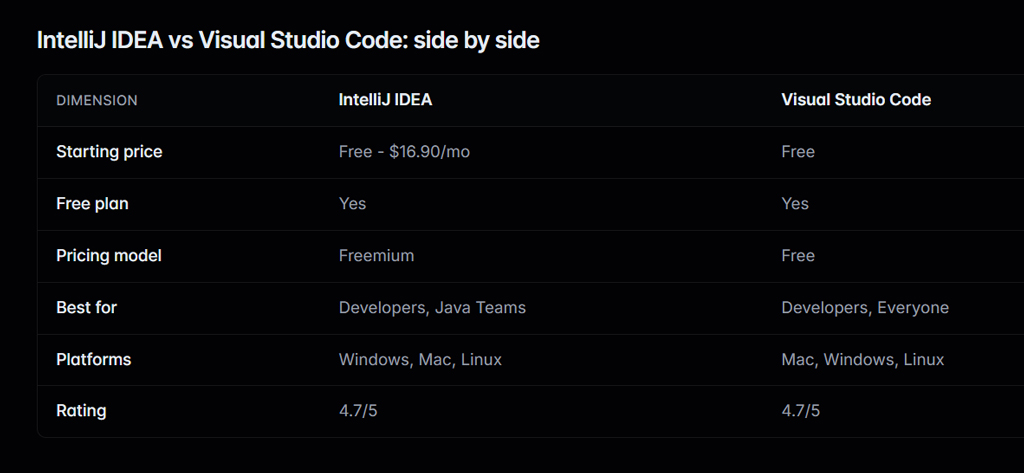
- Both IntelliJ IDEA and Visual Studio Code have a 4.7/5 rating, indicating equally strong user satisfaction.
- Visual Studio Code is completely free, while IntelliJ IDEA offers a free version with paid plans starting at $16.90/month.
- Both IDEs provide a free plan, making them accessible to individual developers and teams.
- IntelliJ IDEA follows a freemium pricing model, whereas Visual Studio Code is 100% free.
- IntelliJ IDEA is best suited for developers and Java teams, reflecting its focus on enterprise Java development.
- Visual Studio Code is designed for developers of all skill levels, making it suitable for a broader audience.
- Both IDEs support the three major desktop platforms, including Windows, macOS, and Linux.
- Visual Studio Code offers a fully free development environment, making it a popular choice for budget-conscious developers.
- IntelliJ IDEA combines a free Community Edition with premium features available through its paid subscription.
- The comparison shows that both IDEs deliver cross-platform compatibility and high user ratings, with the main difference being their pricing model and target audience.
Migration Trends Between VS Code and IntelliJ IDEA
- Exactly 42% of developers report using more than one IDE in their regular workflow.
- Around 68% of professionals using IntelliJ IDEA also rely on VS Code as a secondary editor.
- An overwhelming 84% of developers are currently adopting AI tools to evaluate new development workflows.
- VS Code has reached a record 75.9% usage rate by attracting developers seeking a lightweight and free editor.
- IntelliJ IDEA dominates the enterprise ecosystem with 84% adoption among Java developers as legacy platforms decline.
- Modern teams are standardizing environments, yet 31% of Java engineers still adopt VS Code for diverse project needs.
- More than 81.4% of developers activate AI extensions on their first day to modernize conventional coding strategies.
- Up to 78% of developers using advanced editors focus heavily on backend systems alongside remote capabilities.
- Over 95% of Java developers report improved productivity using IntelliJ IDEA for its integrated AI and remote features.
Frequently Asked Questions (FAQs)
Visual Studio Code is used by 75.9% of developers globally, making it the most-used development environment for the fifth consecutive year.
IntelliJ IDEA is used by 72% of Java developers in 2025, maintaining its leadership position in Java development.
The 2025 JetBrains Developer Ecosystem Report gathered insights from more than 24,000 developers across 194 countries.
Approximately 85% of developers worldwide use AI tools for coding, while 62% rely on at least one coding assistant regularly.
Among Go developers surveyed in 2025, 37% selected Visual Studio Code as their preferred editor, ahead of GoLand at 28%.
Conclusion
The numbers clearly show that Visual Studio Code and IntelliJ IDEA serve different segments of the developer market while increasingly overlapping in features. VS Code dominates overall usage with more than 73% developer adoption, thanks to its free licensing, vast extension marketplace, and strong support for web, cloud, and AI-driven development. Meanwhile, IntelliJ IDEA remains the leader in Java development with roughly 72% market share among Java developers, driven by advanced refactoring, code intelligence, and enterprise tooling.
The next phase of competition will likely center on AI-assisted development, remote workflows, and integrated cloud services rather than traditional editor features alone. As organizations continue adopting hybrid development environments, many developers will use both tools depending on project requirements rather than choosing a single IDE.
