


Social media has become a daily habit for billions of people, but growing evidence shows that excessive use can affect productivity, mental well-being, and relationships. Healthcare providers now screen for problematic social media use, while schools and employers increasingly introduce digital wellness programs to reduce screen dependence. This article explores the latest social media addiction statistics, highlighting global trends, usage patterns, and emerging developments to help readers understand the scale of this growing issue.
Editor’s Choice
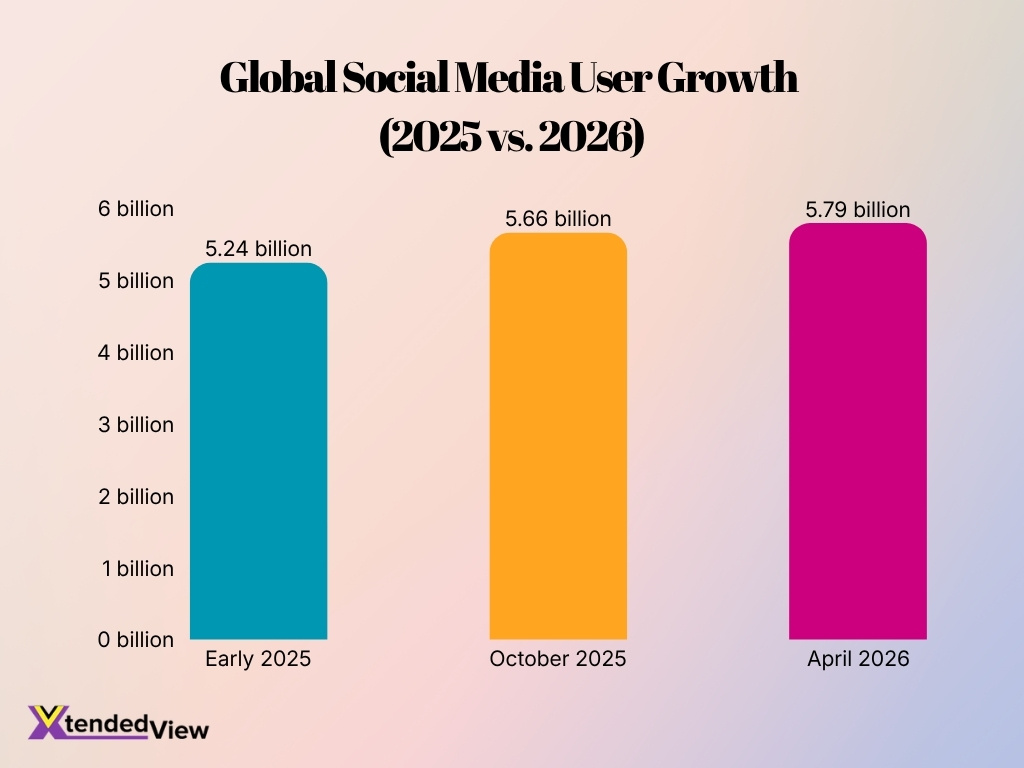
- 5.79 billion social media user identities were recorded worldwide as of April 2026, representing more than two-thirds of the global population.
- Global social media user identities increased by 294 million year over year between 2025 and 2026, reflecting 5.4% annual growth.
- At the start of October 2025, social media reached 5.66 billion user identities, equal to 68.7% of the world’s population.
- 94.7% of internet users worldwide use at least one social media platform each month.
- A large international meta-analysis estimated that about 24% of social media users show signs of problematic social media use rather than healthy engagement.
- Global social media users now increase by roughly 9.3 new users every second, illustrating the continued expansion of digital platforms.
- More than 2 in every 3 people worldwide now use social media every month, making social platforms one of the most widely adopted digital services globally.
Recent Developments
- Several governments expanded discussions around age verification and youth protection policies during 2025 and 2026 as concerns about excessive social media use continued to grow.
- New global digital reports show social media users increased from 5.24 billion in early 2025 to 5.79 billion by April 2026, highlighting continued market expansion.
- Updated research continues to distinguish problematic social media use from general high usage, encouraging researchers to rely on validated behavioral assessment tools rather than screen time alone.
- Researchers increasingly evaluate addiction risk using standardized scales such as the Bergen Social Media Addiction Scale (BSMAS) across multiple countries.
- Digital well-being features, including screen-time dashboards, app timers, and notification controls, continue to expand across major smartphone operating systems to reduce compulsive usage.
- New international research reported that algorithm-driven platforms may have a stronger association with lower well-being than messaging-focused platforms when usage becomes excessive.
- Policymakers increasingly focus on children and teenagers as smartphone ownership and social media participation continue to rise globally.
- Researchers now emphasize measuring behavioral symptoms, including loss of control, withdrawal, and compulsive checking, instead of relying solely on daily screen-time metrics.
Global Social Media Addiction Overview
- More than 5.79 billion social media user identities are active worldwide in 2026.
- Global adoption continues to grow despite already reaching a supermajority of the world’s population.
- Approximately 24% of users may experience problematic social media use according to pooled international research.
- More than 94% of internet users engage with social media every month, making digital platforms a routine part of everyday life.
- Most online adults report using multiple social media platforms, increasing total exposure to digital content.
- Younger age groups remain the most frequent users, increasing their likelihood of prolonged daily engagement.
- Researchers increasingly classify problematic social media use as a behavioral health concern requiring separate assessment from ordinary digital activity.
- Governments, schools, and healthcare organizations continue expanding digital wellness initiatives to address excessive social media use.
Global Prevalence of Social Media Addiction
- International meta-analyses estimate that roughly 1 in 4 social media users demonstrates problematic usage patterns.
- Researchers note that prevalence estimates vary because countries apply different diagnostic tools and screening thresholds.
- Studies consistently find higher prevalence among adolescents and young adults than among older adults.
- Increasing smartphone ownership has expanded access to social media across nearly every region.
- Social media adoption continues rising even as annual growth rates gradually moderate in mature markets.
- Researchers increasingly distinguish heavy users from those showing compulsive behavioral symptoms such as withdrawal or loss of control.
- Expanding internet access across developing economies continues increasing the number of people potentially exposed to problematic use.
- Continued research aims to establish more consistent international definitions of social media addiction for future prevalence reporting.
Global Average Time Spent on Social Media
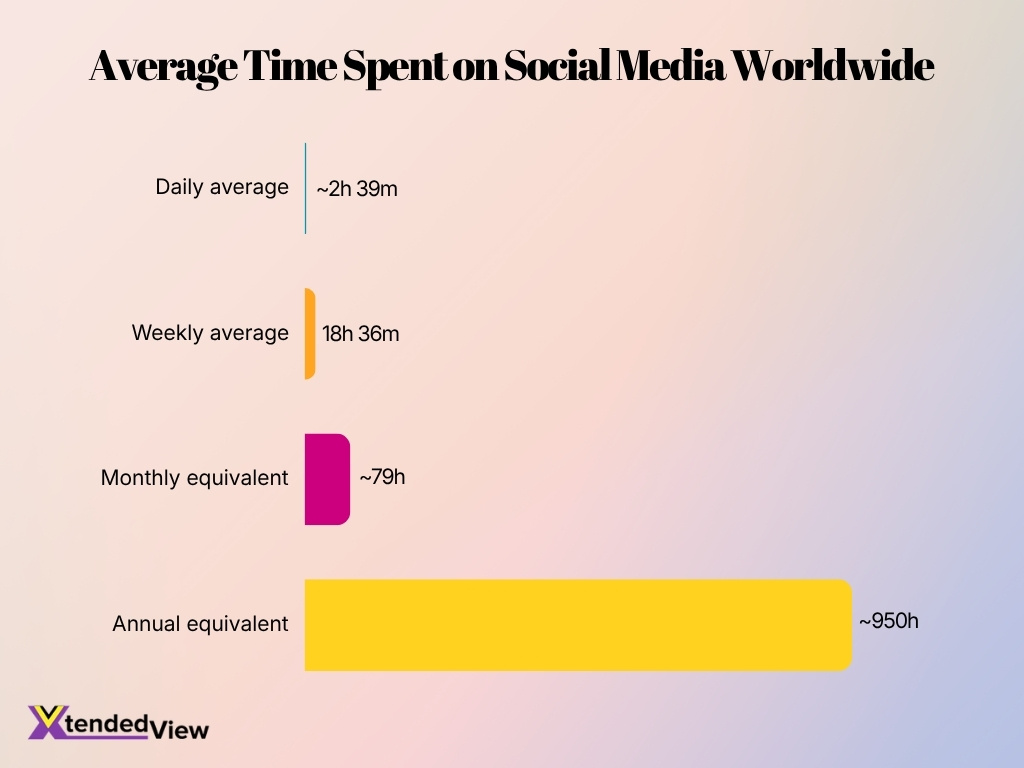
- Globally, people spend an average of around 2 hours and 39 minutes per day on social media.
- Over a full week, average social media usage reaches approximately 18 hours and 36 minutes.
- Monthly social media consumption adds up to roughly 79 hours per user.
- On an annual basis, users spend approximately 950 hours engaging with social media platforms.
- The annual figure is equivalent to nearly 40 full days spent on social media.
- These figures highlight how social media has become a significant part of everyday digital activity worldwide.
Social Media Addiction by Region and Country
- Around 210 million people globally are affected by social media addiction, representing approximately 4-5% of total users.
- Global internet users spent an average of 141 minutes per day on social media platforms in 2025.
- Africa currently reports the highest regional social media addiction rate at 37%, followed closely by Asia at 31%.
- Western and Northern Europe maintain some of the lowest social media addiction rates globally at just 8%.
- Brazil leads global daily usage with users spending an average of 3 hours and 49 minutes on social media.
- Users in Japan record the lowest engagement globally, spending just 3 hours and 3 minutes per week on social networks.
- More than 1 in 3 young people in India reportedly struggle with social media platform addiction.
- Approximately 82% of adult Gen Z users worldwide acknowledge experiencing feelings of addiction related to their social media habits.
Social Media Addiction in the United States
- The United States had 254 million active social media user identities at the end of 2025, representing 73.0% of the total population.
- Social media user identities in the U.S. increased by 1 million (+0.4%) between late 2024 and late 2025.
- Around 222 million adults (18+) in the U.S. used at least one social media platform by the end of 2025, equivalent to 80.8% of the adult population.
- Approximately 78.4% of U.S. internet users used at least one social media platform during October 2025.
- Women represented 50.9% of U.S. social media user identities, while men accounted for 49.1%.
- Nearly half of U.S. teens report being online almost constantly, highlighting persistent high engagement among younger users.
- Digital wellness initiatives and parental monitoring tools have expanded across the U.S. as concerns about excessive social media use continue to grow.
- U.S. researchers increasingly distinguish problematic social media use from simply spending many hours online, emphasizing behavioral symptoms instead of screen time alone.
Social Media Addiction by Age and Generation
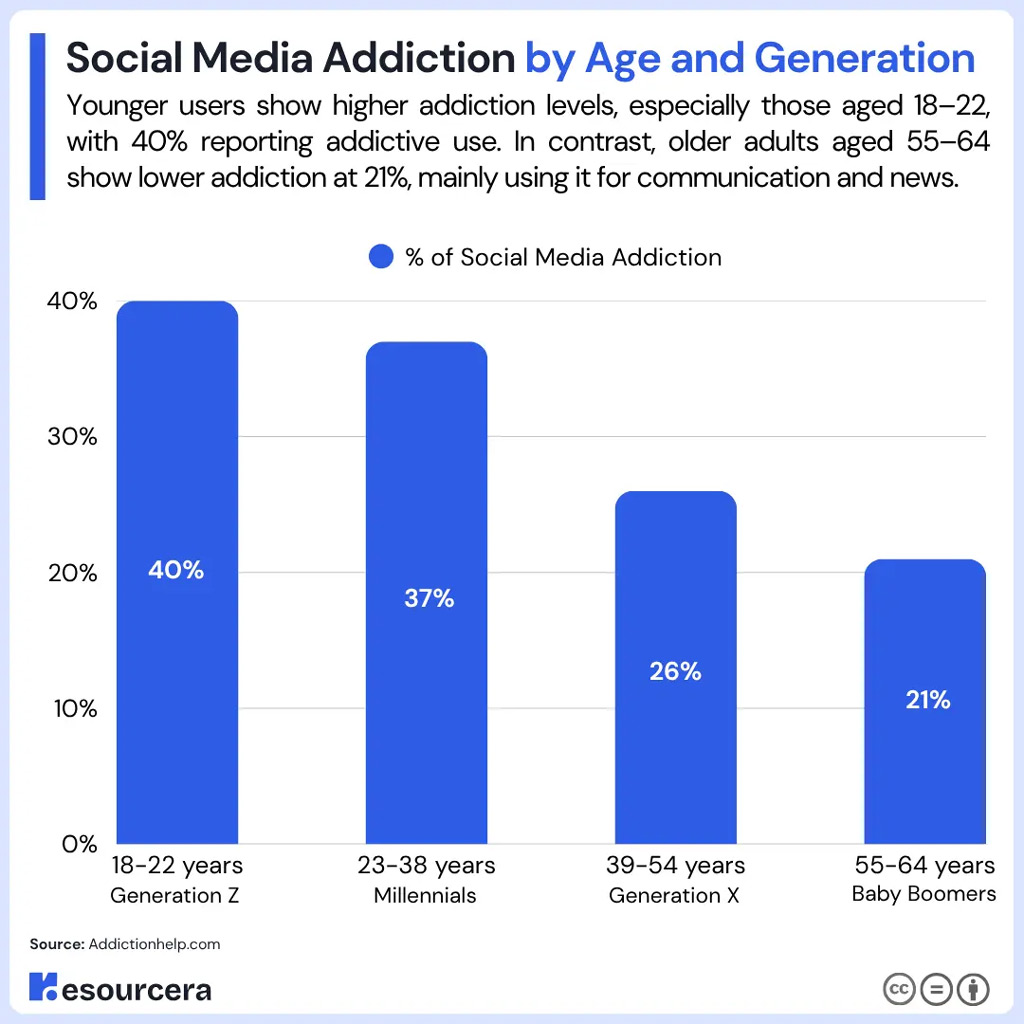
- Generation Z adults aged 18–22 have the highest reported social media addiction rate at 40%.
- Millennials aged 23–38 follow closely, with 37% reporting addictive social media use.
- Social media addiction falls to 26% among Generation X adults aged 39–54.
- Baby Boomers aged 55–64 record the lowest addiction rate at 21%.
- The addiction rate drops by 19 percentage points between the youngest and oldest age groups.
- The data shows a clear age-related decline, with younger generations reporting substantially higher levels of social media addiction.
- The relatively small 3-percentage-point gap between Generation Z and Millennials suggests that problematic social media use is particularly concentrated among younger adults.
Social Media Addiction by Gender
- In the United States, 50.9% of social media user identities are female, and 49.1% are male.
- Women report higher usage of Facebook (78%) than men (63%).
- 55% of women use Instagram compared with 44% of men.
- 42% of women report using TikTok versus 30% of men.
- Teen girls are more likely than boys to report that social media negatively affects their mental health.
- 25% of teen girls say social media has hurt their mental health compared with 14% of boys.
- 50% of girls report that social media hurts their sleep, compared with 40% of boys.
- Researchers continue finding that gender differences appear more strongly in emotional impacts than in overall time spent using social media.
Social Media Addiction Among Teenagers and Children
- Nearly 50% of U.S. teens say they are online almost constantly.
- 90% of American teenagers use YouTube, making it the most popular platform among teens.
- 63% of U.S. teens use TikTok, while 55% use Snapchat.
- About 48% of teens believe social media has a mostly negative effect on people their age, up from 32% in 2022.
- 45% of teenagers say they spend too much time on social media.
- 34% of teens say they sometimes use social media to find mental health information.
- Teen girls are more likely than boys to report that social media hurts their confidence, sleep, and overall mental health.
- Governments worldwide continue proposing stronger age-verification requirements and youth protections in response to concerns about excessive social media use.
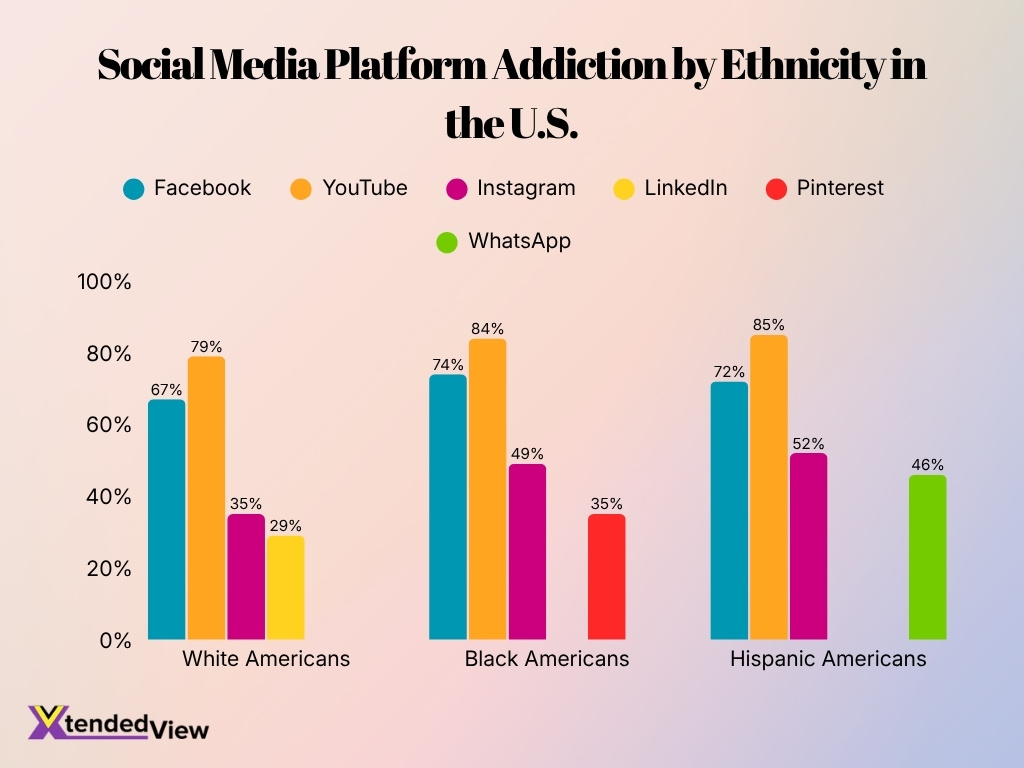
Social Media Addiction by Ethnicity in the U.S.
- YouTube leads across all three groups, used by 85% of Hispanic Americans, 84% of Black Americans, and 79% of White Americans.
- Facebook usage is highest among Black Americans at 74%, followed by Hispanic Americans at 72% and White Americans at 67%.
- Instagram shows a wider demographic gap, reaching 52% of Hispanic Americans, 49% of Black Americans, and 35% of White Americans.
- Among White Americans, LinkedIn ranks fourth at 29%, behind YouTube, Facebook, and Instagram.
- Pinterest reaches 35% of Black Americans, placing it among their four most-used platforms in the provided data.
- WhatsApp reaches 46% of Hispanic Americans, making it one of the group’s four leading social platforms.
- Hispanic Americans report the highest usage rates for both YouTube (85%) and Instagram (52%) among the three groups.
- Overall, the figures show that platform preferences vary by ethnicity, particularly beyond dominant platforms such as YouTube and Facebook.
Social Media Addiction Among College and University Students
- Approximately 27% of college students meet the clinical criteria for severe social media addiction.
- University students spend an average of 3 to 4 hours daily actively scrolling through social platforms.
- Over 60% of undergraduates admit to checking their feeds multiple times during academic lectures.
- Heavy social media usage is directly correlated with a 0.3 to 0.5 point drop in overall student GPA.
- Nearly 70% of university students report experiencing increased procrastination driven by social media habits.
- Students with compulsive usage patterns are two times more likely to report high stress and anxiety.
- Around 45% of college students experience significant daytime fatigue strictly due to late-night scrolling.
- Over 80% of students keep their smartphones within reach 24/7, which drives compulsive checking behaviors.
Most Addictive Social Media Platforms
- Over 17%of the global population is currently considered at risk for social media addiction.
- TikTok users spend an average of 1 hour and 37 minutes daily due to its highly engaging algorithm.
- 16% of U.S. teens report interacting with TikTok almost constantly throughout their day.
- Adolescents spend an average of 4.8 hours daily on platforms like YouTube and Instagram.
- 15% of teenagers report that they consume content on YouTube almost constantly.
- Teen social media addiction rates have rapidly surged globally from 7% to 11% in just four years.
- 12.5% of platform users suffer from compulsive usage that interferes with sleep and work.
- 13% of teens self-report checking their Snapchat accounts almost constantly.
- Over 51% of teenagers dedicate a minimum of four hours a day strictly to social media apps.
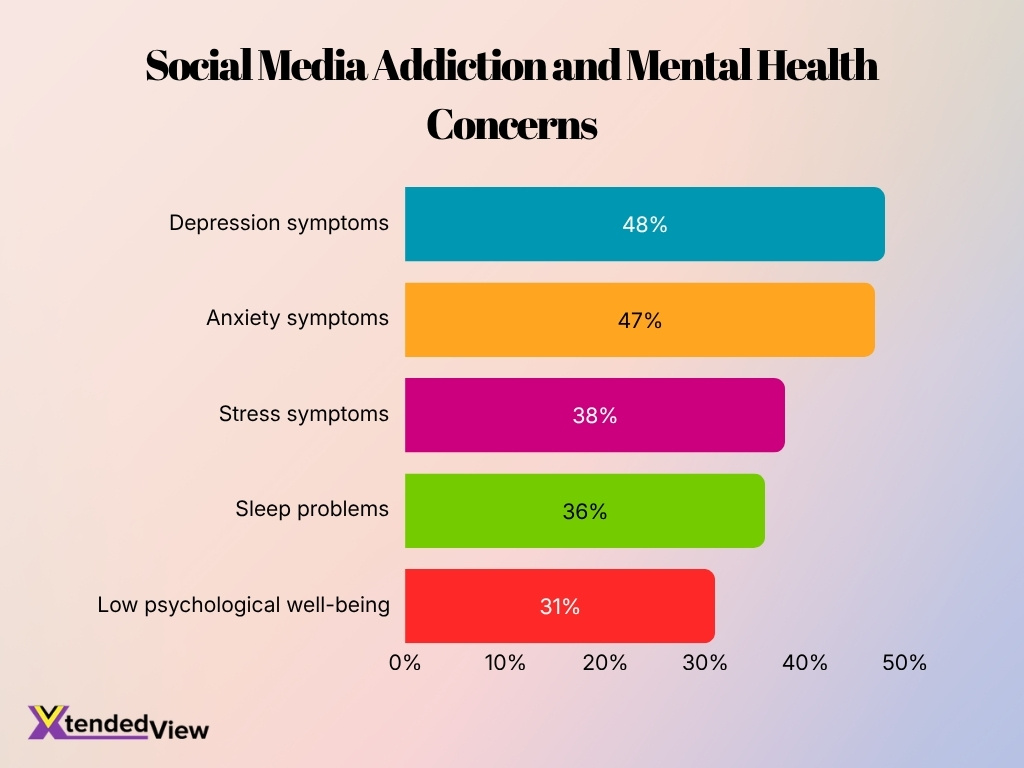
Social Media Addiction and Mental Health Concerns
- Depression symptoms are the most prevalent mental health concern in the data, affecting 48% of individuals.
- Anxiety symptoms follow closely at 47%, just 1 percentage point below depression symptoms.
- Stress symptoms are reported by 38%, indicating that more than one-third experience elevated stress.
- Sleep problems affect 36%, highlighting a notable association between problematic social media use and disrupted sleep.
- Low psychological well-being is reported by 31%, representing nearly one-third of the group studied.
- Overall, every measured mental health indicator affects at least 31% of individuals, with depression and anxiety showing the highest percentages.
Problematic vs Normal Social Media Use
- Around 5% to 10% of users meet clinical criteria for problematic social media use.
- Over 70% of problematic users experience severe sleep disruption from compulsive nighttime checking.
- Problematic users average over 5 hours daily alongside noticeable everyday functional impairment.
- Approximately 27% of teenagers report a complete loss of control over their screen time.
- Nearly 60% of users attempting to reduce usage experience a relapse within the first week.
- Problematic users are three times more likely to suffer from severe psychological distress.
- Workers with problematic habits report up to a 30% decrease in overall workplace productivity.
- Around 50% of dependent users suffer withdrawal symptoms when disconnected for just 24 hours.
Social Media Addiction and Sleep Problems
- 78% of people use social media before bed, which leads to disrupted sleep patterns.
- Blue light exposure from screens reduces melatonin production by 55%.
- Heavy social media users sleep 1 hour less per night than those who limit screen time.
- Late-night doom scrolling increases the risk of insomnia by 45%.
- Approximately 70% of people report using social media after getting into bed.
- Almost 21% of adults wake up in the middle of the night to check their phone.
- Problematic social media use increases the odds of poor sleep health indicators by up to 3.24 times.
- Globally, 19% of 13- to 15-year-olds are actively using apps between midnight and 5:00 a.m.
Social Media Addiction and Workplace Productivity
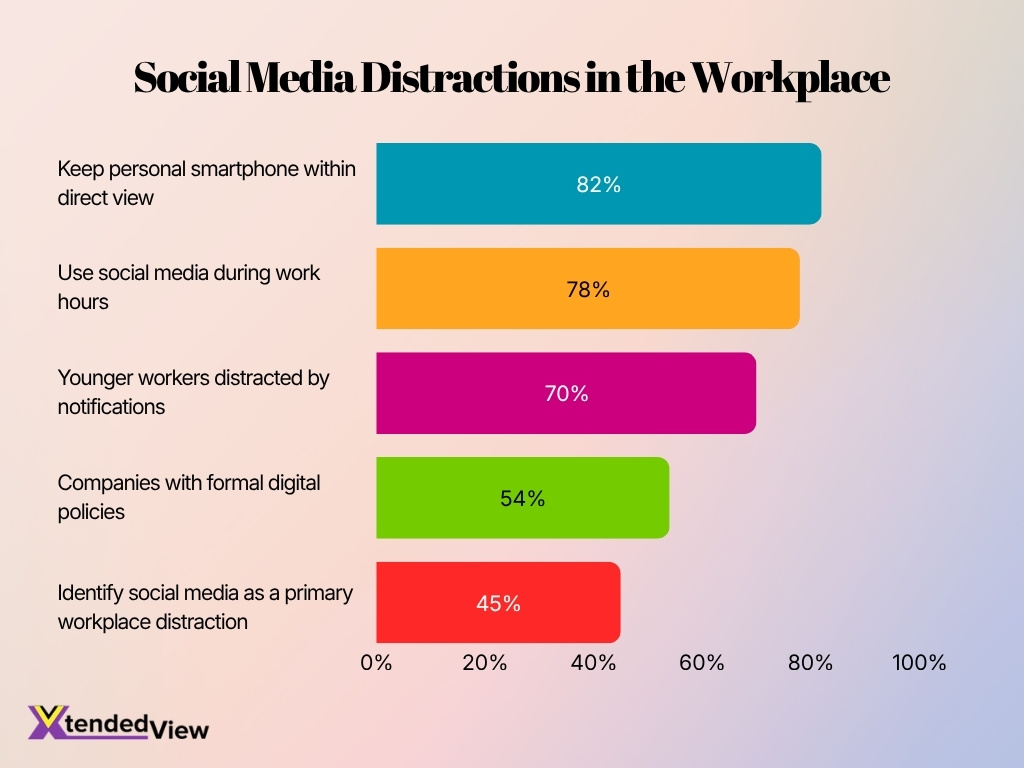
- Approximately 78% of employees use social media during work hours, spending an average of 1.9 hours daily on these platforms.
- 45% of workers identify social media as a primary workplace distraction, ranking just behind general internet browsing.
- Researchers show that it takes an average of 23 minutes and 15 seconds to fully regain deep focus after a single digital interruption.
- Roughly 70% of younger workers admit to frequent distractions from social media notifications during core working hours.
- Workplace distractions and continuous task-switching cost the United States economy approximately $650 billion annually in lost productivity.
- About 54% of companies have implemented formal digital policies to help employees manage personal device use on the job.
- Over 82% of employees keep their personal smartphones within direct view while working, leading to continuous micro-interruptions.
- Multitasking and constant notification checks waste between 20% and 40% of an employee’s total productive work time.
Social Media Addiction and Academic Performance
- A 2025 global meta-analysis revealed a negative correlation of -0.172 between social media addiction and academic achievement.
- A synthesis of 63 studies covering 124,166 students across 28 countries confirmed that technology addictions negatively affect grades.
- Approximately 97% of university students actively use social apps, yet only 1% utilize them strictly for academic purposes.
- Surveys show that 57% of students admit to being addicted to social media, directly disrupting their overall study time.
- About 66% of students report feeling more strongly attracted to social media platforms than to their academic coursework.
- Social media addiction accounts for a massive 57.6% of the variance in declining academic performance among affected student groups.
- More than 52% of students explicitly acknowledge that excessive social media scrolling has negatively affected their learning activities.
- Research indicates that social media addiction is 52.5% higher in developed countries, significantly lowering student academic engagement.
- Roughly 63% of surveyed students exhibit moderate academic procrastination that is strongly linked to heavy social media use.
Risk Factors for Social Media Addiction
- Globally, an estimated 210 million people currently suffer from social media addiction.
- Roughly 27% of adolescents exhibit clear signs of problematic social media use.
- Users diagnosed with depression and anxiety are 2.5 times more likely to develop compulsive habits.
- More than 70% of young adults report severe Fear of Missing Out (FoMO) driving their online engagement.
- Enabling push notifications increases a user’s daily platform checking by an average of 88%.
- Adolescents with unrestricted smartphone access average 4.8 hours daily exclusively on social apps.
- Individuals displaying high impulsivity are 40% more susceptible to habitual and uncontrolled scrolling.
- Highly lonely individuals spend up to 3 times longer on social networks seeking emotional support.
- The implementation of recommendation algorithms increases average user session lengths by up to 50%.
Frequently Asked Questions (FAQs)
Around 5.79 billion social media user identities were active worldwide as of April 2026, representing more than two-thirds of the global population.
A large international meta-analysis estimates that approximately 24% of social media users exhibit signs of problematic or addictive social media use.
45% of U.S. teenagers say they spend too much time on social media, up from 27% in 2023 and 36% in 2022.
36% of U.S. teens report using at least one major social media platform almost constantly.
YouTube ranks first, with 90% of U.S. teens using the platform, followed by TikTok (63%), Instagram (61%), and Snapchat (55%).
Conclusion
Social media continues to transform how people communicate, learn, work, and consume information, making it one of the most influential technologies in modern life. At the same time, research increasingly shows that excessive and compulsive social media use can contribute to challenges such as poor mental health, disrupted sleep, lower academic performance, reduced workplace productivity, and unhealthy digital habits. While social media offers valuable opportunities for connection, education, business, and entertainment, maintaining a healthy balance has become more important than ever.
As governments, educators, healthcare professionals, and technology companies continue investing in digital wellness initiatives, understanding the latest statistics can help individuals, families, and organizations make informed decisions and promote healthier, more responsible social media use in the years ahead.
