



Mobile EdTech apps continue to reshape how people learn, train, and build new skills. From K-12 classrooms using interactive learning platforms to enterprises delivering workforce training through smartphones, mobile-first education has become a core part of modern learning ecosystems. As smartphone adoption rises and AI-powered personalization becomes more common, educational apps are reaching learners across age groups and regions. Explore the latest data and trends that define the mobile EdTech app industry.
Editor’s Choice
- The global EdTech market reached $279.8 billion in 2025 and is projected to grow to $760 billion by 2034, reflecting sustained demand for digital learning solutions.
- The global education technology market was valued at $187.01 billion in 2025 and is forecast to reach $437.54 billion by 2033.
- Education apps recorded more than 1 billion downloads in 2025, highlighting strong consumer demand for mobile learning.
- The global education apps market reached $7.6 billion in 2025 and is expected to grow at a 21.3% CAGR through 2034.
- Mobile EdTech apps generated a market value of $7.5 billion in 2024 and are projected to reach $83.8 billion by 2034.
- Education apps were used by approximately 709 million people worldwide in 2023, with usage continuing to rise through 2025.
- North America accounted for more than 38.7% of the global EdTech market revenue in 2025, making it the largest regional market.
Recent Developments
- AI-powered tutoring and personalized learning systems emerged as one of the fastest-growing segments of EdTech during 2025 and 2026.
- Education app providers increasingly integrated gamification features to improve lesson completion and retention rates in 2025.
- The education apps market is expected to expand by $6.81 billion between 2026 and 2030.
- North America contributed approximately 32.9% of the projected market growth in the education apps sector.
- Immersive learning technologies such as AR and VR are increasingly appearing in educational mobile applications.
- Mobile learning spending exceeded $184 billion globally in 2024, supported by rising demand for flexible learning experiences.
- AI-driven adaptive assessments and intelligent tutoring systems became major growth drivers across educational platforms in 2025.
- Personalized learning technologies remain one of the primary reasons institutions continue investing in mobile EdTech solutions.
- More institutions are adopting blended learning models, with 58% using educational apps to support hybrid education.
U.S. Mobile EdTech Apps Market Growth Statistics
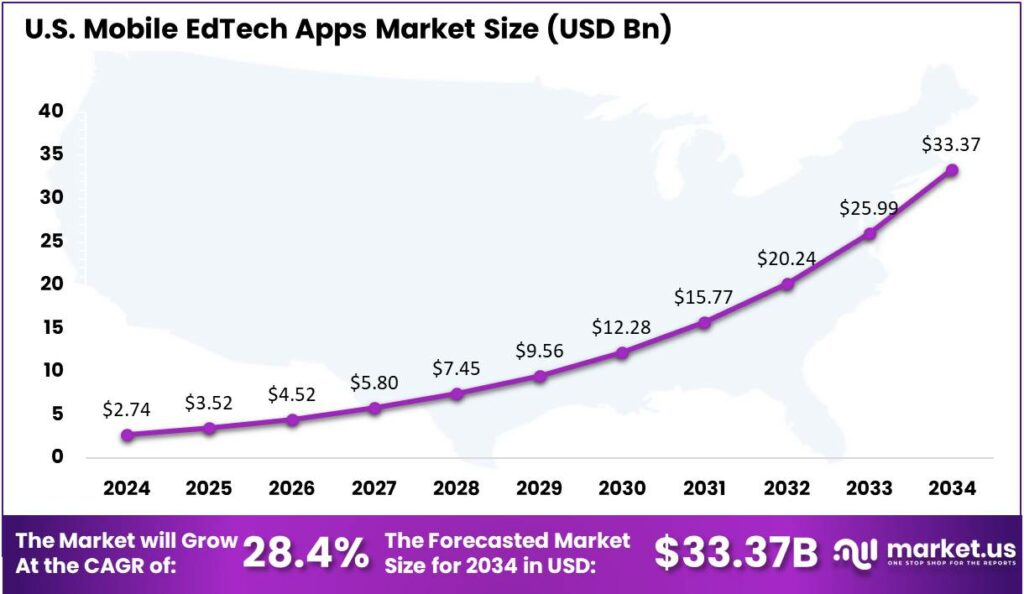
- The U.S. Mobile EdTech Apps market is projected to grow from $2.74 billion in 2024 to $33.37 billion by 2034.
- The market is expected to expand at a strong 28.4% CAGR between 2024 and 2034.
- Market size is forecast to increase from $3.52 billion in 2025 to $4.52 billion in 2026, crossing the $4 billion mark.
- The industry is projected to reach $5.80 billion in 2027, more than doubling its 2024 value.
- By 2028, the U.S. Mobile EdTech Apps market is expected to surpass $7.45 billion.
- Market revenue is forecast to exceed $9.56 billion in 2029, approaching the $10 billion milestone.
- The sector is expected to cross $12.28 billion in 2030, reflecting accelerating adoption of mobile learning platforms.
- Revenue is projected to reach $15.77 billion in 2031, nearly 6 times higher than in 2024.
- The market is forecast to exceed $20.24 billion in 2032, marking a major growth milestone.
- By 2033, the industry is expected to reach $25.99 billion, adding more than $5 billion in annual market value.
- The 2034 forecast of $33.37 billion represents an overall growth of approximately 12.2× compared to 2024.
Educational App Download and Usage Statistics
- Educational applications surpassed 1 billion downloads globally in 2025.
- Education apps generated approximately 939 million downloads in 2023, demonstrating strong year-over-year growth.
- Around 709 million users worldwide actively used education apps in 2023.
- Educational app downloads increased by 41% between 2021 and 2024.
- The most downloaded educational app recorded 172 million downloads during 2025.
- Smartphone-based learning continues to expand as mobile traffic accounted for 60.5% of internet traffic in 2025.
- Users spent 5.3 trillion hours in mobile apps during 2025, creating a favorable environment for educational app engagement.
- Average mobile phone usage reached 3.6 hours per day in 2025, increasing opportunities for mobile learning sessions.
- Educational apps remain among the fastest-growing app categories due to remote learning, professional development, and language learning demand.
Mobile EdTech App Demographics and User Profiles
- Approximately 70% of fourth-grade students in OECD countries own a smartphone by around age 10.
- Most teenagers in developed economies access digital learning content through mobile devices.
- Asia-Pacific accounted for 37% of the education app market, supported by a large student population.
- Smartphone penetration across Asia-Pacific reached 76%, expanding the potential user base for mobile learning apps.
- Digital literacy in Asia-Pacific increased from 55% to 63% within three years, encouraging greater adoption of learning apps.
- Language learning remains one of the largest consumer-focused educational app categories globally.
- Professional learners and working adults represent a rapidly expanding segment due to upskilling and reskilling demand.
- Educational apps increasingly serve lifelong learners rather than only school-age students.
- Personalized learning features are attracting learners across multiple age groups, from early childhood education to corporate training.
K-12 and Early Childhood Mobile Learning Statistics
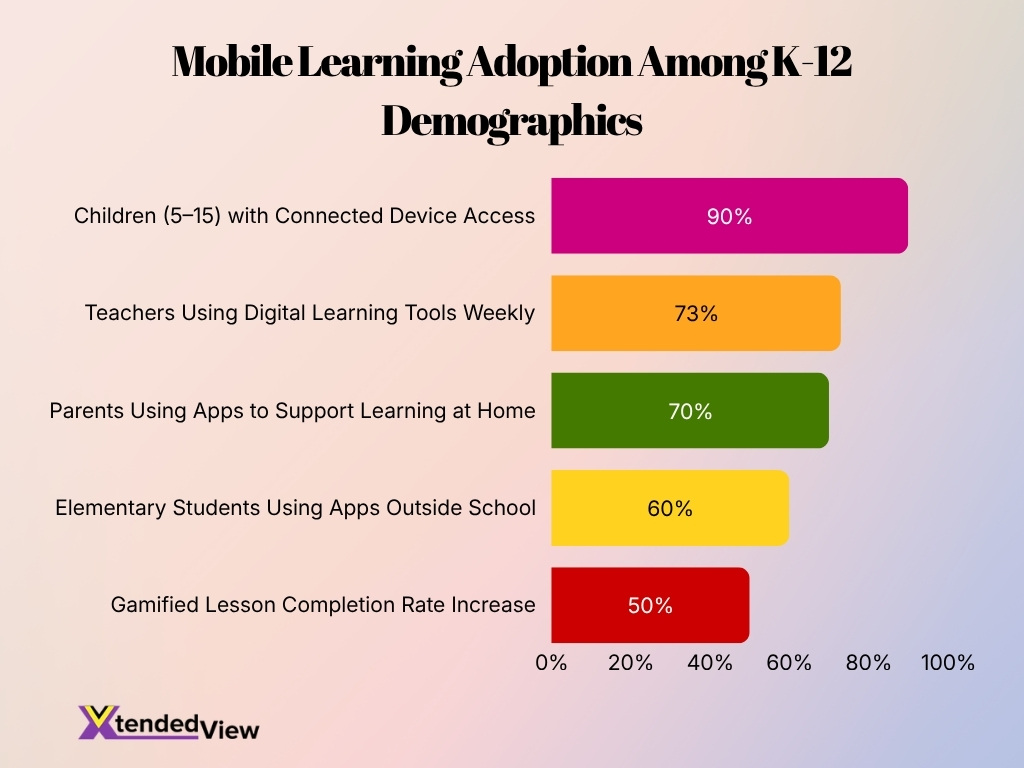
- More than 73% of K-12 teachers report using digital learning tools at least weekly as part of classroom instruction.
- U.S. schools spent over $35 billion on educational technology and digital learning resources between 2020 and 2025, with mobile learning platforms receiving a significant share.
- Approximately 90% of children aged 5–15 in developed markets have access to an internet-connected device at home.
- Early childhood educational apps represent one of the fastest-growing categories within children’s digital content markets, with annual growth exceeding 15% in several regions.
- More than 60% of elementary school students use educational apps for homework, reading practice, or skill reinforcement outside school hours.
- Reading-focused mobile apps have demonstrated literacy improvements ranging from 10% to 30% among early learners in controlled studies.
- Interactive learning applications using gamified lessons can increase lesson completion rates by up to 50% compared with traditional digital content.
- Nearly 70% of parents report using educational mobile apps to support their children’s learning at home.
- Schools implementing personalized mobile learning programs report measurable improvements in student engagement, attendance, and assignment completion.
Mobile Learning Adoption Statistics
- The global mobile learning market size is projected to grow from $109.64 billion in 2025 to $441.11 billion by 2030.
- Over 70% of employees use their smartphones to access mobile learning content for corporate training.
- The U.S. online education market is estimated to generate up to $99.8 billion in revenue during 2025.
- Mobile learning applications can increase employee productivity by 45% and reduce training time by 60%.
- Between 58% and 68% of employees prefer learning at their own pace using mobile platforms.
- North America dominates the global mobile learning market by holding a major share of over 40%.
- Mobile-first learning models have enabled the corporate sector to capture over 35% of the global market share.
- Integrating AI-driven personalization in mobile learning yields 57% efficiency gains and up to 30% cost-savings.
- In the Asia-Pacific region, approximately 60% of online education is now delivered via smartphone devices.
- Completion rates for mobile learning are 45% higher compared to traditional e-learning methods.
Higher Education and University App Statistics
- More than 220 million students worldwide are enrolled in tertiary education, creating a large addressable market for university-focused mobile learning applications.
- Approximately 80% of university students regularly access learning materials through mobile devices.
- Mobile learning platforms became a standard component of digital campus ecosystems across North America, Europe, and Asia during 2024 and 2025.
- Over 70% of college students prefer accessing course content through mobile-friendly platforms rather than desktop-only systems.
- Universities using mobile learning tools report higher engagement rates among remote and hybrid learners.
- Mobile apps are now commonly used for attendance tracking, assessments, collaboration, and academic advising across universities worldwide.
- More than 60% of students expect real-time academic notifications through university mobile applications.
- Learning management systems with dedicated mobile apps report stronger daily usage rates than web-only platforms.
- AI-assisted tutoring and personalized recommendations are increasingly integrated into university learning apps, particularly in STEM programs.
Most Popular Types of Mobile EdTech Apps Statistics
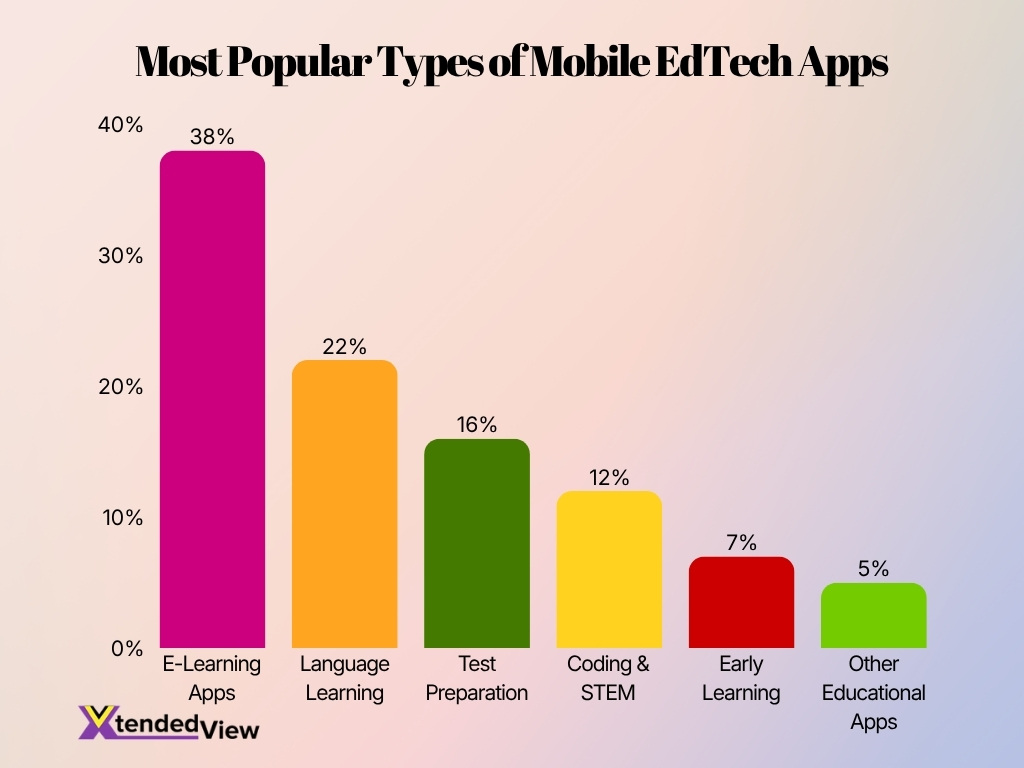
- E-Learning Apps dominate the market, accounting for 38% of all mobile EdTech app categories.
- Language Learning Apps hold a significant 22% share, making them the second most popular segment.
- Test Preparation Apps represent 16% of the market, highlighting strong demand for exam-focused learning.
- Coding & STEM Apps capture 12% of the market, reflecting growing interest in technology skills.
- Early Learning Apps contribute 7%, driven by increasing adoption of digital education for young children.
- Other Educational Apps make up the remaining 5% of the market across niche learning categories.
- The combined share of E-Learning and Language Learning Apps reaches 60%, showing dominance in mobile education.
- Core academic learning categories, including E-Learning, Language Learning, and Test Preparation, account for 76% of the total market.
- Specialized learning segments such as Coding & STEM and Early Learning together represent 19% of mobile EdTech apps.
- E-Learning Apps are more than 7 times larger than the Other Educational Apps category by market share.
Corporate E-Learning and Workplace Training Statistics
- The global corporate e-learning market exceeded $120 billion in 2025 and continues expanding as organizations invest in workforce upskilling.
- Around 90% of organizations now offer some form of digital learning or online training program.
- Companies using mobile learning solutions report learning completion rates that are up to 45% higher than traditional training approaches.
- Employees are more likely to complete training when lessons are delivered in short, mobile-friendly formats lasting under 10 minutes.
- Mobile learning can improve knowledge retention by 20% to 30% compared with conventional classroom-only training models.
- More than 70% of employees prefer learning at their own pace through mobile devices.
- Organizations adopting digital learning programs report lower training costs and faster onboarding processes.
- Microlearning-based mobile platforms have become one of the most widely adopted workplace training formats since 2024.
- AI-powered coaching tools are increasingly embedded into employee training apps to personalize learning pathways.
Mobile Learning Engagement and User Preference Statistics
- Microlearning and short-form mobile lessons improve knowledge retention by 17% and are completed 45% faster.
- Educational apps that incorporate gamification features experience a massive user engagement increase of up to 48%.
- Utilizing personalized reminders and notifications can increase mobile app retention rates by up to 190%.
- Mobile and video-based courseware dominate the industry, accounting for over 35% of the global market share.
- Implementing AI-driven personalization in mobile learning can boost overall learning efficiency by approximately 57%.
- Mobile learners achieve 45% higher knowledge retention when utilizing interactive quizzes and progress tracking.
- AI-enabled gamification and personalized performance tracking drive a 47% increase in user interaction frequency.
- Learners prefer short mobile sessions throughout the day, effectively cutting overall study time by up to 60%.
- Integrating social learning features and app-based community support can skyrocket course completion rates to 85%.
- 70% of mobile learners report feeling significantly more motivated when accessing training on a smartphone.
Top Educational Apps and Market Share Statistics
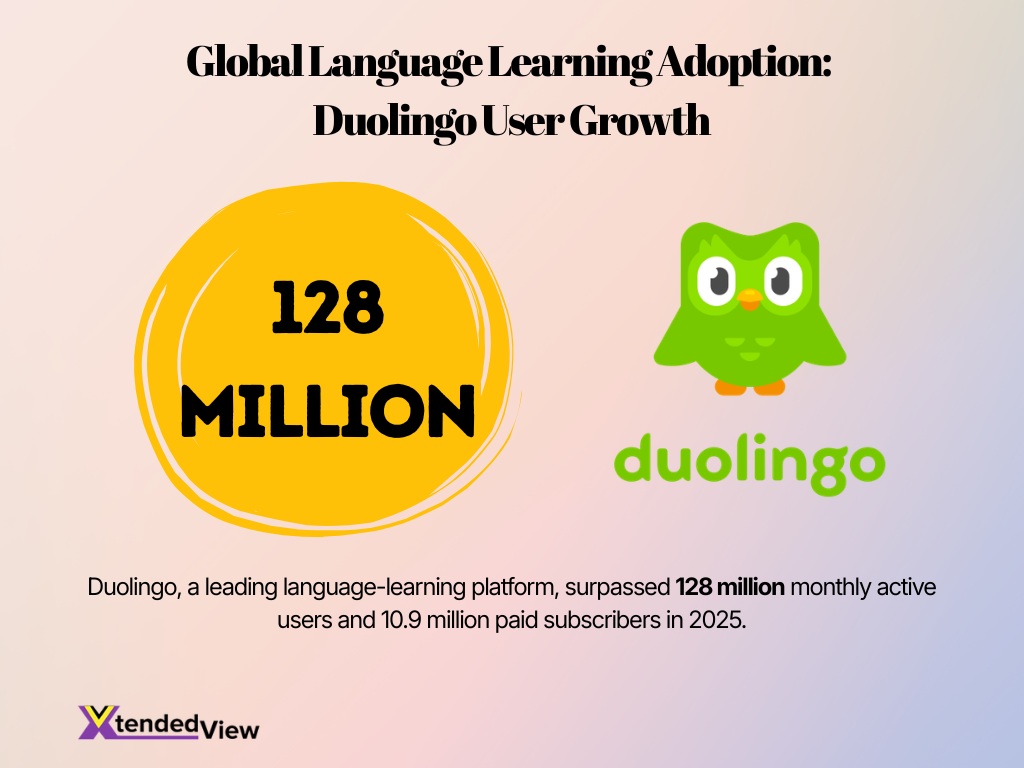
- Duolingo, a leading language-learning platform, surpassed 128 million monthly active users and 10.9 million paid subscribers in 2025.
- With over 5.5 million daily downloads globally, leading education apps surpassed 1 billion cumulative downloads in 2025 across platforms.
- Holding a 28.6% market share in 2025, language learning remains a massive category with top platforms generating $1 billion in annual revenue.
- Fast-growing segments like E-learning and STEM apps accounted for a 38.2% market share in 2025, fueled by a 47% increase in demand.
- Approximately 43% of active education apps integrated AI features in 2025, driving a 33% rise in AI-powered learning usage globally.
- Educational games and apps serving K-12 learners captured a 21.4% market share in 2025 and are projected to grow at a 17.8% CAGR.
- The subscription revenue model accounted for a dominant 41.3% share of total education industry revenue in 2025.
- Top individual apps now exceed 52.7 million daily active users, with the Android platform holding a 52.7% share of total educational app usage.
- Driven by a 47% surge in demand, over 68% of digital learners now actively seek customized, personalized learning platforms.
Education App Revenue Statistics
- The global education apps market generated approximately $7.6 billion in revenue during 2025.
- The market is expected to exceed $43 billion by 2034 under current growth projections.
- Subscription revenue remains the largest model, with global user spend surpassing $6.4 billion.
- Premium educational content and online courses account for over one-third of total app revenue.
- Mobile learning apps achieved over 1 billion downloads with highly profitable recurring revenue in 2025.
- Language learning applications dominate the sector, with top platforms generating $1 billion annually.
- In-app purchases and premium feature upgrades boost overall educational business income by 42%.
- Enterprise licensing agreements drive growth as corporate e-learning targets a $90 billion valuation by 2026.
- AI-powered learning platforms command higher revenue by successfully improving student test scores by 15%.
Business Benefits and ROI of Mobile EdTech
- Organizations utilizing mobile learning platforms report a 43% increase in overall employee productivity.
- Employees typically complete training modules 45% faster on mobile devices compared to desktop computers.
- Implementing mobile learning strategies improves long-term knowledge retention rates by up to 45%.
- Companies that adopt digital and mobile learning solutions report 26% higher revenue per employee.
- Learners are consistently 70% more motivated to complete corporate training when delivered via smartphones.
- Adopting mobile training solutions can effectively reduce overall training time by up to 60%.
- Over 70% of major global enterprises actively offer mobile learning programs for continuous talent development.
- Businesses investing in comprehensive mobile training initiatives achieve up to 24% higher profit margins.
- Mobile learning directly drives a 72% increase in user engagement by offering interactive and flexible access.
Education Apps Market Share by Region
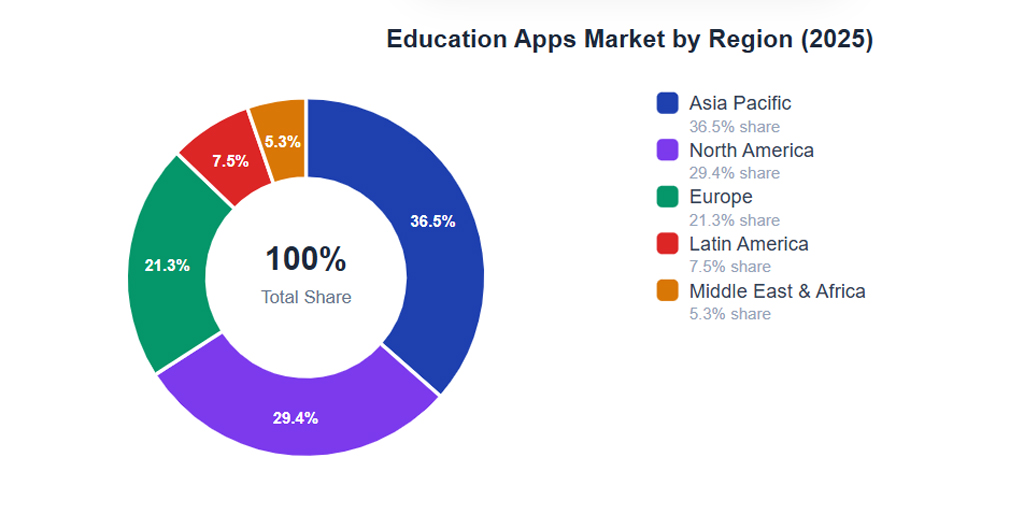
- Asia Pacific led the education apps market with a 36.5% share, making it the largest regional market in 2025.
- North America accounted for 29.4% of the market, ranking as the second-largest region globally.
- Europe captured a 21.3% share, representing more than one-fifth of the global education apps market.
- Latin America held 7.5% of the market, showing steady adoption of education apps across the region.
- Middle East & Africa contributed 5.3%, the smallest regional share among the surveyed markets.
- The combined market share of Asia Pacific and North America reached 65.9%, highlighting their dominance in the sector.
- Asia Pacific’s 36.5% share was nearly 7 percentage points higher than North America’s 29.4%.
- The top three regions, Asia Pacific, North America, and Europe, collectively represented 87.2% of the global market.
India Mobile EdTech App Statistics
- India remains one of the world’s largest EdTech markets, supported by more than 250 million school-age students.
- The Indian EdTech market is projected to exceed $29 billion by 2030, driven by digital learning demand.
- Smartphone users in India surpassed 1 billion connections in 2025, expanding the potential audience for educational applications.
- Educational apps consistently rank among the most downloaded app categories in India.
- India’s online education market continues to grow at double-digit annual rates, fueled by exam preparation and professional learning applications.
- Tier-2 and Tier-3 cities account for a growing share of educational app adoption as internet accessibility improves.
- English-language learning applications remain one of the most popular educational app categories among Indian users.
- Mobile learning platforms serving competitive examination candidates attract millions of active users annually.
- AI-powered tutoring and adaptive learning tools have seen substantial adoption growth across Indian EdTech platforms since 2024.
Subscription and Monetization Statistics
- Over 60% of leading education apps utilize recurring subscriptions as their primary revenue stream.
- The global education app market generated more than $6.4 billion in revenue during recent tracking periods.
- Around 63.5% of education platforms rely exclusively on subscription-only models to monetize their content.
- Premium online courses and certifications account for over 33% of the total revenue in the education app sector.
- The freemium strategy drives high conversions, with top-performing apps converting 10.4% of free users.
- Microtransactions and in-app purchases make up 10.7% of total revenue in blended monetization models.
- Enterprise licensing and B2B agreements yield up to a 10-20x higher lifetime value than standard consumer subscriptions.
- AI-powered features and personalized learning are expected to push total market revenue beyond $8.81 billion in 2026.
- The median yearly revenue per paying user has reached $32 in North America due to career-focused investments.
Why Users Stop Using Education Apps
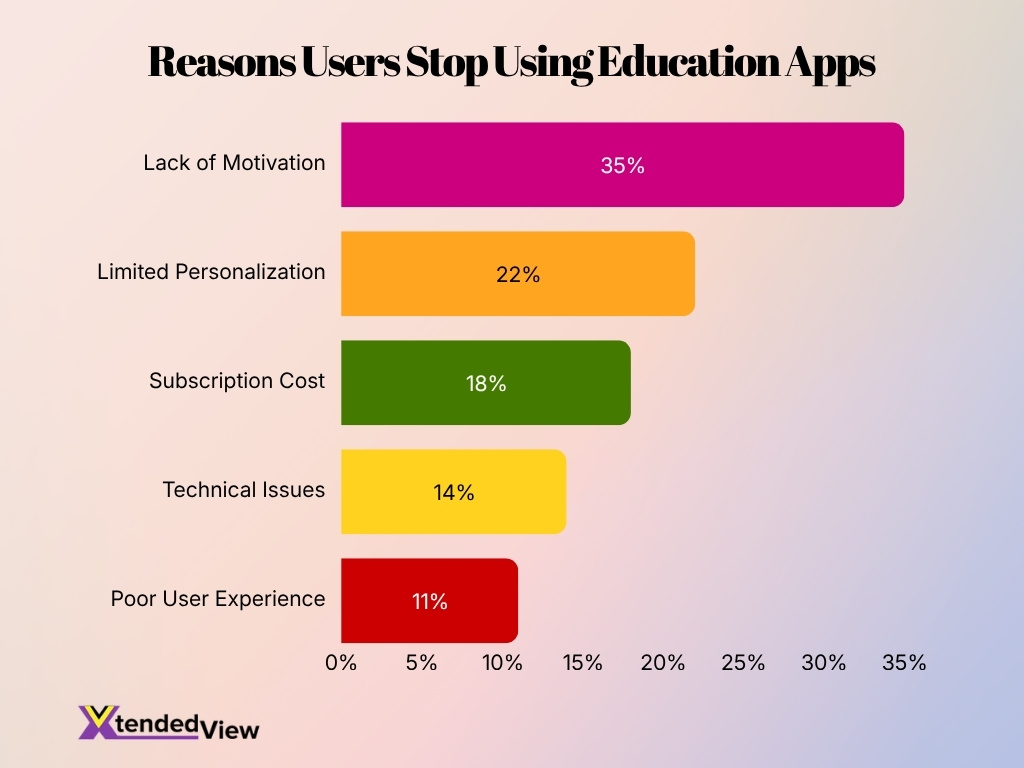
- 35% of users stop using education apps due to lack of motivation, making it the leading reason for churn.
- Limited personalization affects 22% of users, highlighting the demand for more tailored learning experiences.
- 18% of users discontinue education apps because of subscription costs and pricing concerns.
- Technical issues such as bugs, crashes, and performance problems drive away 14% of users.
- 11% of users cite poor user experience as the primary reason for abandoning education apps.
- The gap between lack of motivation (35%) and limited personalization (22%) is 13 percentage points.
- User engagement-related factors, including motivation and personalization, account for 57% of all reasons users leave education apps.
- Cost-related concerns represent nearly 1 in 5 users (18%), showing pricing remains a significant barrier.
- Combined technical issues and poor user experience contribute to 25% of education app abandonment.
- The data suggests that improving engagement, personalization, and usability could significantly reduce user churn.
Emerging Trends: AI, Gamification, and Microlearning Statistics
- The global AI in education market is projected to surge to $57.2 billion by 2033 with a steady CAGR of 25.9%.
- Over 71% of educators report significant increases in student motivation and engagement following the adoption of gamified learning methods.
- Implementing microlearning can improve knowledge retention by 25-60% when compared to traditional long-form training approaches.
- The gamification in the education market is forecast to experience rapid growth at a CAGR of 26.06%, potentially reaching $9.47 billion by 2035.
- Approximately 65% of gamification platforms currently integrate AI and data analytics, generating a 38% rise in learner retention.
- Delivering content through microlearning courses results in impressive 80-90% completion rates versus roughly 30% for conventional eLearning.
- Interactive VR and simulation-based trainees absorb educational material 4 times faster and demonstrate 275% greater confidence.
- A staggering 93% of modern organizations consider microlearning essential for effectively scaling their employee training programs.
- Active learners engaging with gamification and hands-on activities retain up to 93.5% of learned information over a one-month period.
- The higher education sector currently dominates the AI in education market, accounting for roughly 44.3% of the total revenue share.
Future Trends in Mobile EdTech Apps
- The global mobile EdTech apps market is projected to grow from $7.5 billion in 2024 to $83.8 billion by 2034.
- Mobile devices now account for approximately 74% of the total time spent on digital learning platforms globally.
- Roughly 43% of all commercial education apps incorporated AI-driven features by 2025.
- The average daily active usage per education app user has increased significantly to 34 minutes globally.
- Mobile-first design in educational applications has boosted session completion rates to approximately 67%.
- Over 1.9 billion active 5G connections are driving the expansion of high-bandwidth AR and VR learning experiences.
- The corporate mobile learning segment is expanding rapidly to meet the 70% global demand for AI upskilling.
- AI-powered educational platforms have demonstrated up to a 31% improvement in student knowledge retention metrics.
- The global installed base of smartphones has exceeded 6.9 billion devices, fueling educational app distribution in developing economies.
- The Android operating system currently holds a dominant 68.7% share of the overall mobile EdTech apps market.
Frequently Asked Questions (FAQs)
The mobile EdTech apps market was valued at $7.5 billion in 2024 and is projected to reach $83.8 billion by 2034, growing at a 27.3% CAGR.
Education apps generated $6.4 billion in 2025, up 6.7% from the previous year.
The education apps market is forecast to grow by $6.81 billion from 2026 to 2030 at a 14.5% CAGR.
North America held 45.7% of the global mobile EdTech apps market in 2024, generating $3.4 billion in revenue.
The global education technology market is projected to reach $213.2 billion in 2026 and grow to $437.5 billion by 2033.
Conclusion
Mobile EdTech apps have evolved from supplementary learning tools into essential platforms for education, workforce development, and lifelong learning. The industry continues to benefit from rising smartphone adoption, expanding internet access, AI-powered personalization, and growing demand for flexible learning experiences. From K-12 classrooms and universities to corporate training programs, mobile learning solutions are delivering measurable improvements in accessibility, engagement, and learning outcomes.
Looking ahead, artificial intelligence, gamification, microlearning, and immersive technologies will continue shaping the next generation of educational applications. As the market moves toward deeper personalization and mobile-first learning experiences, the global Mobile EdTech ecosystem appears well-positioned for sustained growth throughout the remainder of the decade.