

Artificial intelligence is reshaping education at every level, from K-12 classrooms to research universities. Schools now use AI to personalize lessons, automate administrative tasks, support tutoring, and help educators identify learning gaps faster. Meanwhile, students increasingly rely on generative AI tools for research, writing support, and study assistance. As adoption accelerates across the United States and globally, understanding the latest AI in education statistics helps educators, policymakers, institutions, and technology providers make informed decisions. Explore the latest data, trends, and market insights shaping AI-powered education.
Editor’s Choice
- 92% of students reported using AI tools in 2025, up from 86% in 2024, highlighting near-universal adoption in higher education environments.
- Student AI usage increased from 66% in 2024 to 92% in 2025, one of the fastest adoption rates recorded in educational technology.
- The global AI in education market reached approximately $8.3 billion in 2025.
- The market is projected to grow to $11.4 billion in 2026, reflecting strong institutional demand.
- 83% of K-12 teachers report using generative AI tools in some capacity.
- 88% of students used generative AI specifically for assessments during 2025, compared with 53% in 2024.
- Two-thirds of higher education institutions have either implemented or are developing AI guidance frameworks.
Recent Developments
- UNESCO reported in 2025 that 19% of higher education institutions already maintain formal AI policies.
- Another 42% of institutions are actively developing AI governance frameworks.
- UNESCO found that roughly 61% of surveyed institutions either have AI policies or are creating them.
- Gallup and Walton Family Foundation research in 2026 found that 80% of teachers receive little or no formal AI guidance.
- AI business adoption across industries rose from 55% in 2023 to 78% in 2024, helping accelerate educational AI deployment.
- Global private investment in generative AI reached $33.9 billion in 2024, supporting rapid innovation in education technologies.
- Pearson reported measurable improvements in student outcomes through AI-enhanced educational products during 2025.
- Multiple universities have begun redesigning assessments because 92% of students now use AI tools in academic work.
- UNESCO updated its guidance on generative AI in education in 2026 to support ethical and responsible implementation.
AI in Higher Education Market Statistics
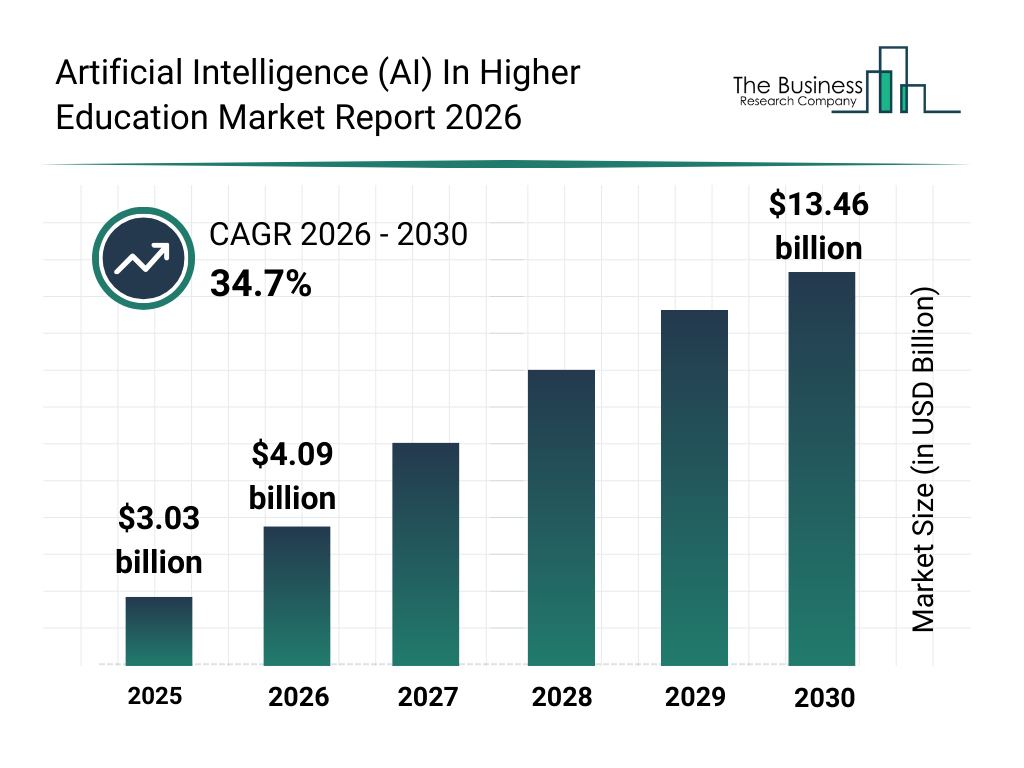
- The AI in Higher Education market is projected to grow from $4.09 billion in 2026 to $13.46 billion by 2030, highlighting rapid industry expansion.
- The market is expected to achieve a strong 34.7% CAGR between 2026 and 2030, signaling accelerated AI adoption across educational institutions.
- Global market value stood at $3.03 billion in 2025, providing a foundation for sustained growth over the forecast period.
- By 2030, the market size is forecast to be more than 4.4 times larger than its 2025 value of $3.03 billion.
- The industry is set to add approximately $10.43 billion in market value between 2025 and 2030, reflecting significant investment and demand growth.
Global AI Adoption Rates in Education
- Student AI adoption reached 92% globally in 2025, compared with 86% in 2024.
- Only 8% of students reported not using AI tools in 2025.
- UNESCO research found that 92.5% of higher education professionals report AI activity within their institutions.
- More than 80% of students at a selective U.S. college reported academic AI use within two years of ChatGPT’s release.
- AI adoption among U.S. students increased by 26% year over year during the 2024-25 school year.
- Educator AI adoption increased by 21% year over year during the same period.
- A quarter of students reported using AI directly alongside teachers for learning activities.
- 51% of students reported using AI primarily for homework support.
- Research indicates AI implementation reached 47% of academic institutions in high-income countries, compared with 8% in lower-income environments.
Student Usage Statistics and Demographics
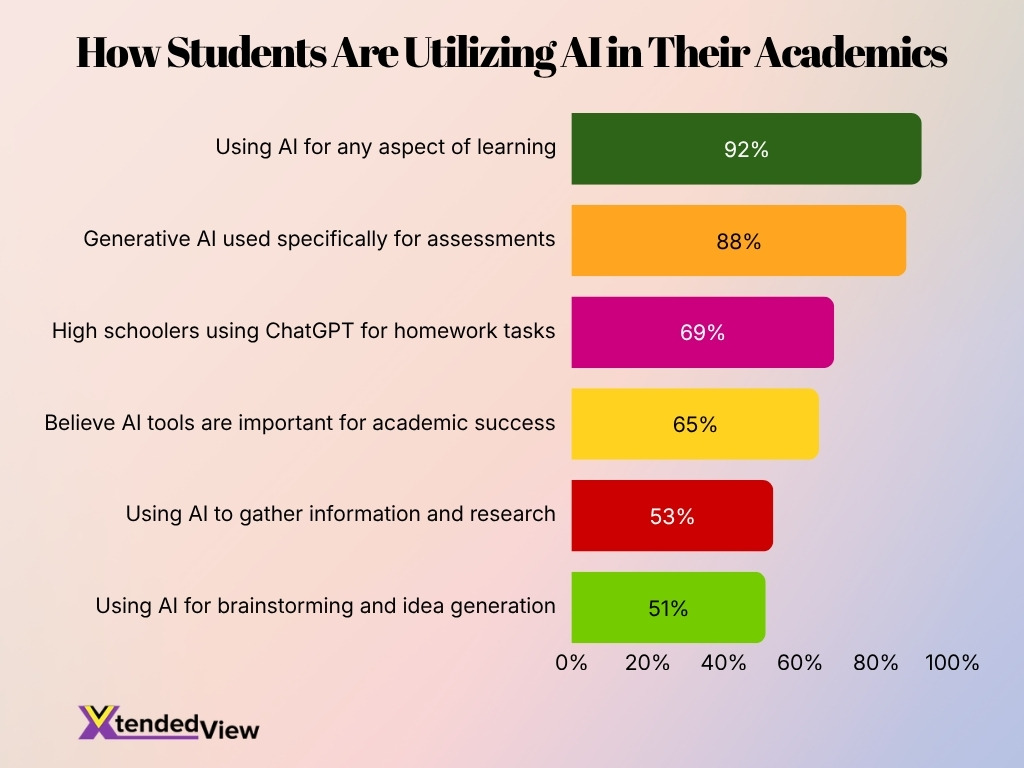
- 92% of students now use AI tools for some aspect of learning.
- Student AI adoption climbed from 66% in 2024 to 92% in 2025.
- 88% of students reported using generative AI for assessments in 2025.
- 65% of students believe AI tools are important for academic success.
- 53% of students use AI to gather information and research material.
- 51% of students use AI for brainstorming and idea generation.
- Among high school students, 69% use ChatGPT for homework-related tasks.
- High school generative AI usage increased from 79% to 84% during 2025.
- Research from a higher education study found that students most frequently use AI for concept explanations, feedback, and learning support rather than full content generation.
Generative AI in Education Statistics
- 88% of students reported using generative AI tools for assessments in 2025, up sharply from 53% in 2024.
- 92% of university students globally now use at least one AI-powered tool in their studies.
- Around 54% of students use generative AI on a weekly basis for coursework and research support.
- 73% of students say AI helps them understand difficult concepts faster than traditional online searches.
- Nearly 67% of higher education students use AI for brainstorming assignments and project ideas.
- 58% of students use generative AI to summarize academic articles and learning materials.
- About 45% of students use AI for coding assistance and programming-related coursework.
- 61% of educators believe generative AI can improve learning outcomes when used appropriately.
- More than 70% of higher education institutions have started reviewing policies related to generative AI use.
Personalized Learning and Student Engagement Statistics
- Students receiving AI-powered personalized learning support achieved learning gains 30% faster than peers using standard digital learning tools.
- AI-driven adaptive learning systems improved course completion rates by up to 25% in multiple studies.
- 72% of students report greater engagement when lessons are tailored to their learning pace.
- Personalized AI recommendations increased student participation rates by 18% in online learning environments.
- Schools implementing adaptive learning platforms reported a 20% reduction in learning gaps among struggling students.
- AI-based learning analytics helped identify at-risk students with accuracy rates exceeding 80%.
- Students using adaptive AI systems completed assignments 22% faster than traditional cohorts.
- 69% of educators believe personalized learning represents the most valuable educational use case for AI.
- AI-powered recommendation engines increased content consumption by 28% in higher education platforms.
How Educators Are Using AI in Their Daily Work
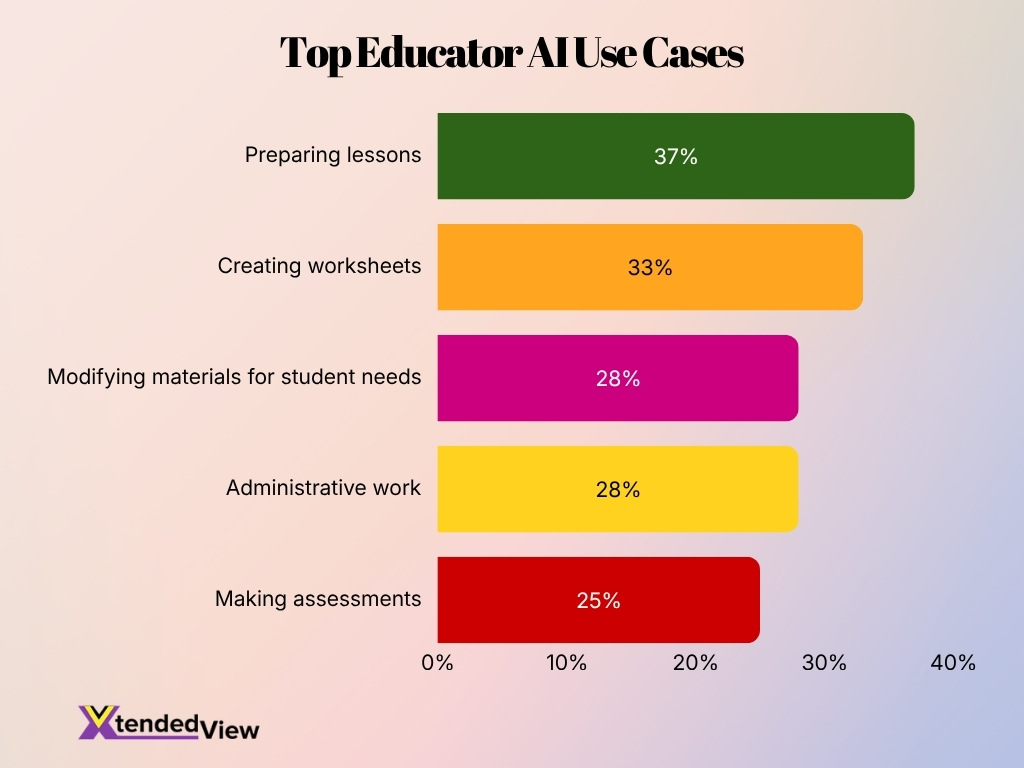
- Lesson preparation is the top AI use case among educators, with 37% using AI to streamline planning and instructional content creation.
- 33% of educators use AI for creating worksheets, making it the second most common classroom application.
- AI helps 28% of educators modify learning materials to better meet diverse student needs and learning styles.
- Another 28% leverage AI for administrative work, reducing time spent on routine operational tasks.
- 25% of educators use AI for assessment creation, supporting faster quiz, test, and evaluation development.
AI-Powered Tutoring Statistics
- Students using AI tutoring platforms improved performance scores by an average of 15% to 30%.
- AI tutoring systems provide instant feedback, unlike teacher responses taking hours or days.
- 65% of students report that AI tutors help them study more independently.
- AI tutoring is available 24/7, significantly increasing accessibility for remote learners.
- AI tutoring can improve mathematics achievement by approximately 0.37 standard deviations.
- Schools using AI tutoring reported homework completion improvements of 20% or more.
- AI language tutoring increased vocabulary acquisition rates by approximately 25%.
- Intelligent tutoring systems remain the fastest-growing category within educational AI software.
- Over 50% of students would continue using AI tools even with human tutoring available.
AI Impact on Academic Performance and Test Scores
- Students using AI-supported learning environments recorded test score improvements ranging from 10% to 20% across multiple studies.
- A large-scale study found AI-assisted tutoring generated learning gains comparable to several months of additional instruction.
- AI-powered adaptive systems improved mathematics outcomes by up to 27% in selected K-12 implementations.
- Students using AI writing assistants produced higher-quality drafts and revisions than control groups.
- Personalized AI feedback reduced assignment revision cycles by approximately 35%.
- AI-enhanced learning platforms increased student retention rates by 15% to 25%.
- Universities using predictive analytics identified struggling students earlier, helping improve pass rates by up to 12%.
- AI-supported language learning programs improved reading comprehension scores by approximately 20% in several pilot projects.
- Students receiving adaptive AI support demonstrated stronger long-term knowledge retention than students using static learning materials.
AI in Education Market Growth by Region
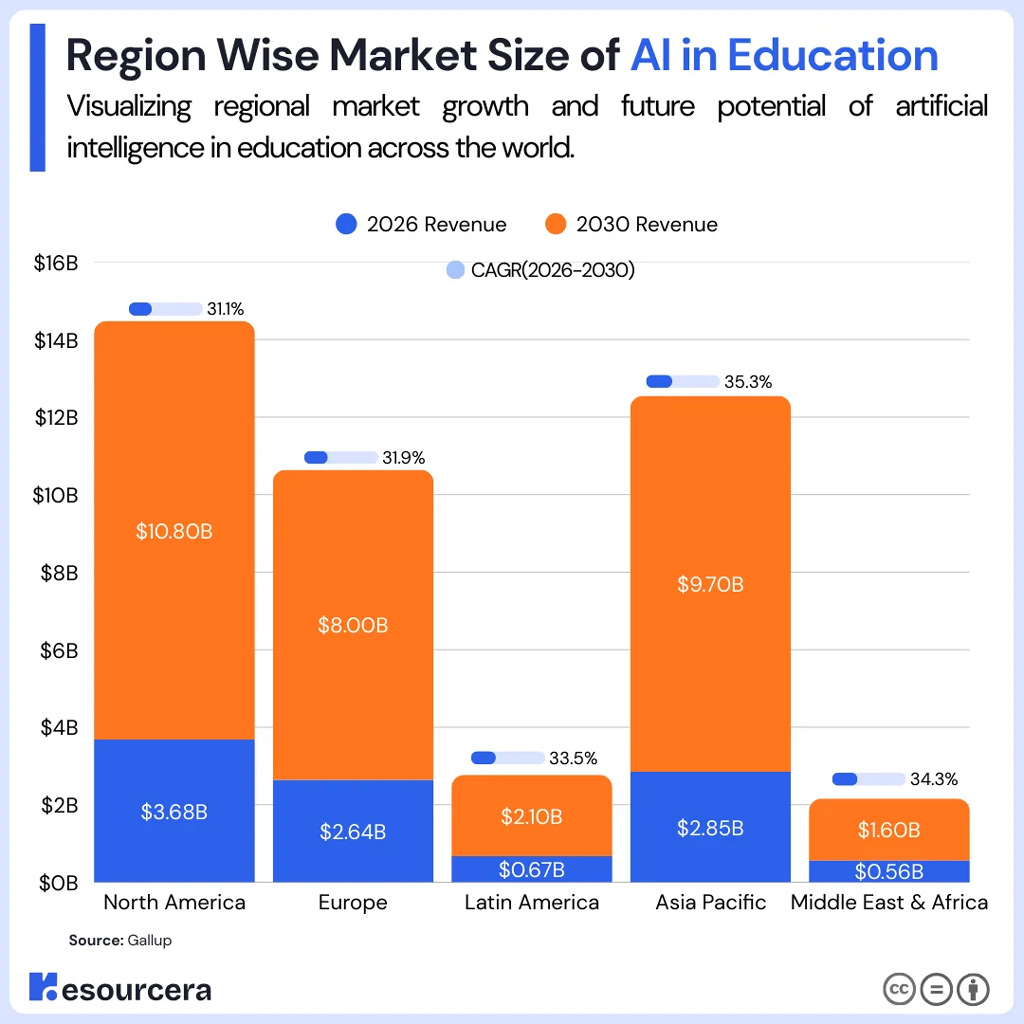
- North America leads the AI in education market with $3.68B in 2026 revenue, projected to reach $10.80B by 2030 at a 31.1% CAGR.
- Asia Pacific is expected to record the fastest growth with a 35.3% CAGR, expanding from $2.85B in 2026 to $9.70B by 2030.
- Europe’s AI in education market is forecast to grow from $2.64B to $8.00B between 2026 and 2030, achieving a 31.9% CAGR.
- Latin America is projected to more than triple its market size, rising from $0.67B in 2026 to $2.10B in 2030.
- The Middle East & Africa is expected to grow from $0.56B to $1.60B by 2030, supported by a strong 34.3% CAGR.
- By 2030, North America, Asia Pacific, and Europe are each projected to generate over $8 billion in AI education revenue.
- Among all regions, the Asia Pacific and Middle East & Africa show the strongest growth momentum with CAGRs above 34%.
- The combined market expansion across regions highlights accelerating global investment in AI-powered education technologies through 2030.
AI in Assessment and Grading Statistics
- 88% of students report using generative AI during assessment activities.
- Automated systems can reduce grading time by 60% to 80% for objective tests.
- AI-assisted tools achieve scoring consistency rates exceeding 90% in standardized environments.
- 86% of educational institutions have formally embraced generative AI tools.
- Students in AI-enhanced environments achieve 54% higher test scores on average.
- 60% of educators actively use AI for administrative tasks and grading.
- AI grading accuracy correlates with human evaluations at a high rate of 0.7 to 0.9.
- Over 60% of educators believe AI improves feedback quality alongside human review.
Administrative and Institutional AI Integration
- UNESCO found that 92.5% of higher education professionals report AI-related activity within their institutions.
- 19% of institutions already maintain formal AI policies.
- An additional 42% of institutions are actively developing AI governance frameworks.
- Approximately 61% of institutions either have AI policies or are creating them.
- AI-powered chatbots now handle admissions, enrollment, and student support inquiries across many universities.
- Institutions deploying AI administrative systems report operational efficiency improvements of 20% to 30%.
- AI scheduling and resource-allocation systems help reduce administrative bottlenecks across campuses.
- Universities increasingly use predictive analytics to forecast enrollment trends and student retention risks.
- Higher education leaders continue ranking AI adoption among their top strategic technology priorities for 2026.
Educational Institution Investment in AI
- The global AI in education market is projected to reach $11.4 billion by 2026.
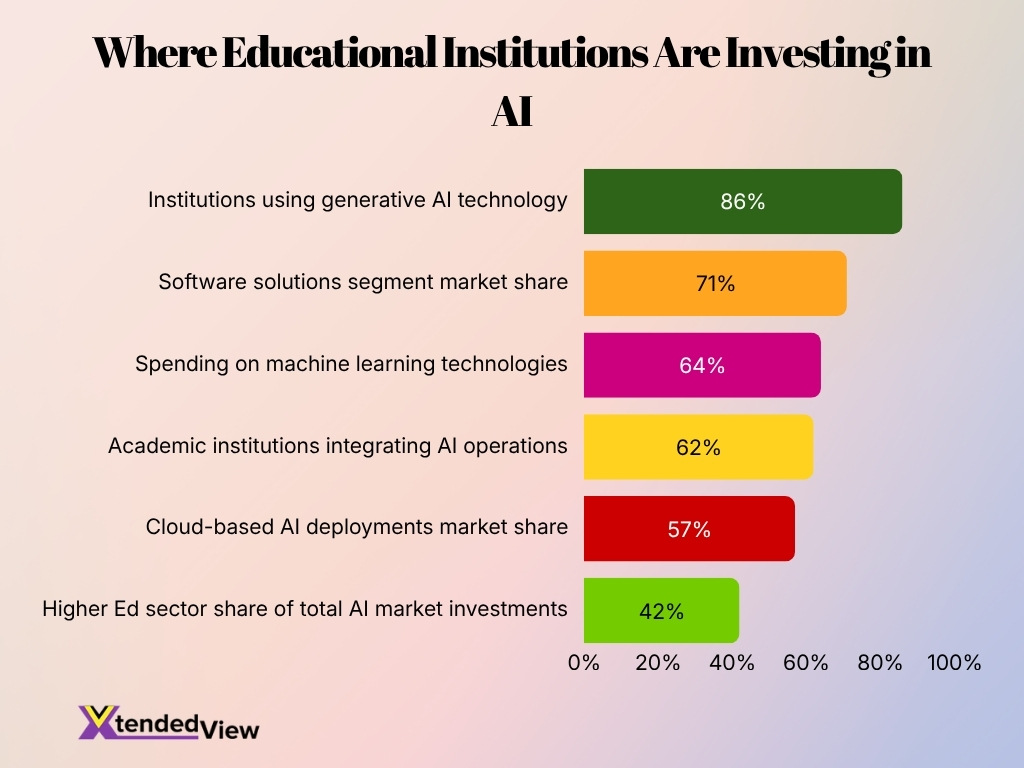
- Approximately 62% of academic institutions are integrating AI tools into their operations.
- The Higher Education sector accounts for over 42% of total AI market investments.
- Currently, 86% of educational institutions use some form of generative AI technology.
- The software solutions segment captures more than 71% of all educational AI spending.
- Cloud-based AI deployments represent the largest investment area with a 57% market share.
- Institutional spending on machine learning technologies makes up 64% of the sector’s budget.
- North American educational institutions dominate global spending with over 40% of market revenue.
- Overall institutional investments in educational AI are expanding at a 35.1% CAGR.
Academic Integrity, Cheating, and AI Detection Statistics
- 88% of students reported using generative AI in assessments during 2025, compared with 53% in 2024, prompting institutions to revise academic integrity policies.
- 92% of university students globally now use AI tools, increasing concerns about unauthorized AI-generated submissions.
- Around 27% of educators reported difficulties distinguishing between student-written and AI-generated content.
- More than 60% of higher education institutions have updated or are updating academic integrity guidelines to address generative AI.
- AI detection tools remain imperfect, with independent studies showing accuracy rates varying significantly across models and content types.
- Approximately 70% of faculty members believe institutions need clearer AI usage policies for coursework and assessments.
- Universities increasingly favor oral assessments, project-based evaluations, and in-class assignments to reduce AI-assisted cheating risks.
- Research indicates that AI detectors may generate false positives, leading institutions to rely on human review before disciplinary action.
- Academic integrity offices report growing demand for AI literacy training alongside traditional plagiarism education.
Student and Educator Perceptions of AI Tools
- 86% of students believe AI will become an essential component of future education.
- About 65% of students view AI as a tool that can improve academic performance and productivity.
- 73% of students say AI helps them understand complex topics more efficiently.
- Nearly 61% of educators believe AI can positively influence student learning outcomes when implemented responsibly.
- Around 58% of teachers express optimism about AI’s ability to reduce repetitive administrative work.
- More than 70% of higher education leaders expect AI to transform teaching methods over the next five years.
- Roughly 48% of educators remain concerned that excessive AI use could weaken critical thinking skills.
- Students consistently rank personalized feedback, tutoring support, and research assistance among AI’s most valuable benefits.
- Surveys show that both students and educators support AI use when transparency, ethics, and human oversight remain in place.
Future Outlook for AI in Education
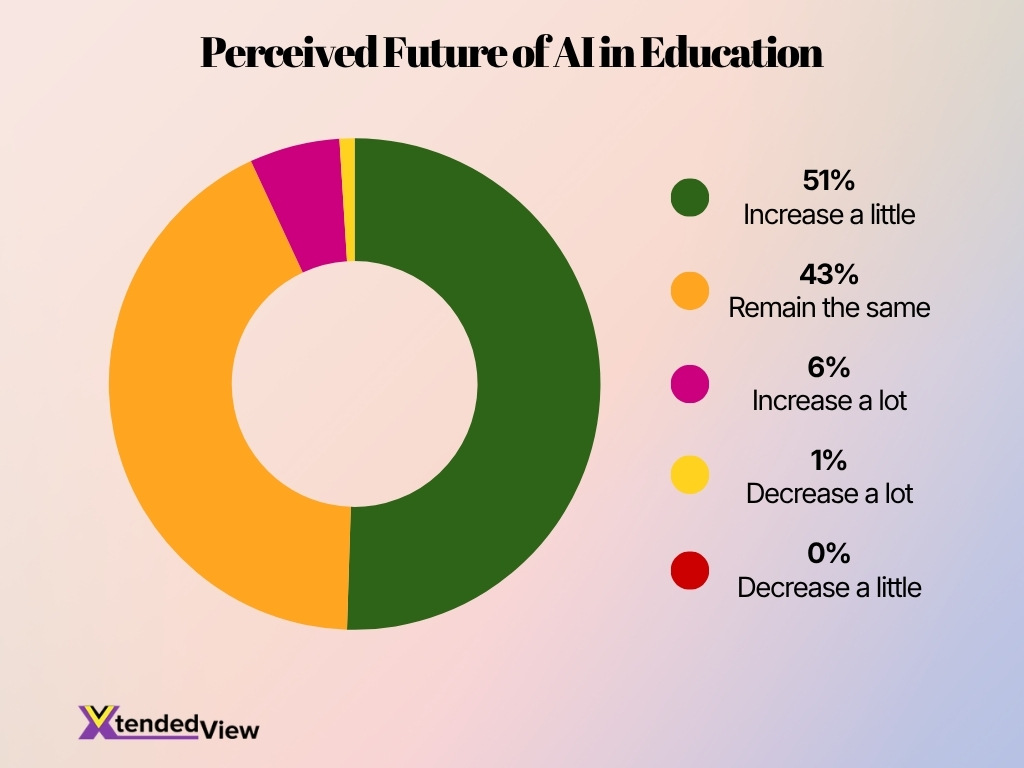
- 51% of respondents believe AI in education will increase a little, making it the most common expectation.
- 43% expect AI’s role in education to remain the same, indicating strong confidence in current adoption levels.
- Only 6% think AI use will increase a lot, suggesting moderate rather than explosive growth expectations.
- Just 1% believe AI in education will decrease a lot, reflecting minimal concern about long-term decline.
- A negligible 0% expect AI use to decrease a little, highlighting overwhelmingly positive sentiment toward AI in education.
Challenges, Bias, and Equity Gap Statistics
- Only 40% of primary schools globally have internet access, dropping to 14% in rural areas of least developed countries.
- AI essay scoring systems consistently rate identical work from African American students 0.3 points lower on average than their white peers.
- Approximately 47% of academic institutions in high-income countries use AI tools, compared to only 8% in low-income countries.
- 73% of educational AI systems display some form of bias, yet only 23% of school administrators assess for this before implementation.
- Black students are 12% more likely to use generative AI for homework help compared to White students.
- Just 7% of schools worldwide have official AI guidance, leaving 58% of students feeling unprepared for an AI-driven workforce.
- Over 60% of institutions in North America and Europe have integrated AI, while Sub-Saharan Africa lags with less than 15% adoption.
- While 77% of teachers find AI useful for lesson prep, only 35% of educational districts actually have a generative AI initiative in place.
- A recent survey shows that 3 in 5 students remain highly concerned about the potential unfairness and bias of AI evaluations.
Future Projections for AI in Schools and Universities
- The global AI in education market is projected to reach $136.79 billion by 2035.
- Industry experts anticipate a remarkable compound annual growth rate of 34.52% from 2026 to 2035.
- The worldwide e-learning sector is poised to hit $480 billion by 2033 due to AI advancements.
- By 2030, the specific AI in education sub-sector is projected to skyrocket to over $35 billion.
- The Asia-Pacific region is estimated to experience the fastest market growth at a 48% annual rate.
- North America is expected to contribute 41.7% to the overall growth of the global AI education market.
- Educational AI is projected to automate grading for nearly 100% of multiple-choice exams.
- The global EdTech market size is expected to reach $380 billion in 2026 and exceed $600 billion by 2032.
Frequently Asked Questions (FAQs)
92% of students reported using AI tools in 2025, up from 66% in 2024.
The global AI in education market is projected to reach $11.4 billion in 2026.
The AI in education market is forecast to grow at a 36.02% CAGR from 2026 to 2035.
North America accounted for 38% of the global AI in education market in 2025, making it the leading region.
53% of K-12 students use AI tools to assist with homework and school assignments.
Conclusion
Artificial intelligence has moved from experimentation to mainstream adoption across education. Data shows rapid growth in student usage, educator adoption, institutional investment, and market expansion. Generative AI, personalized learning systems, intelligent tutoring platforms, and predictive analytics are already influencing how students learn and how educators teach.
At the same time, challenges surrounding academic integrity, bias, privacy, and equitable access remain critical considerations. The most successful institutions are balancing innovation with governance, transparency, and human oversight. Looking ahead, AI will likely become a foundational component of modern education, supporting personalized learning experiences, improving operational efficiency, and expanding educational opportunities for learners worldwide.