



Millionaires play a growing role in shaping global investment, entrepreneurship, and consumer spending. Their wealth influences industries such as real estate, financial services, technology, and private equity while also driving startup funding and philanthropy. As global wealth continues to expand, understanding where millionaires live, how their numbers are changing, and what drives their growth offers valuable insight for investors, businesses, and policymakers. Explore the latest statistics below to see how the global millionaire landscape is evolving.
Editor’s Choice
- Global wealth increased by 10.8% in 2025, marking the fastest annual growth since 2017.
- The world added nearly 1 million new USD millionaires during 2025, representing a 1.5% increase year over year.
- In 2024, the global millionaire population increased by more than 684,000 people, following 4.6% global wealth growth.
- The United States accounted for almost 40% of the world’s millionaires in 2024 and created more than 379,000 new millionaires during the year.
- By 2029, the number of USD millionaires worldwide is projected to rise by 5.34 million, an increase of nearly 9% from 2024 levels.
- More than half of global personal wealth is concentrated in the United States and mainland China combined.
- North America remained the wealthiest region per adult in 2024, with average wealth reaching approximately $593,347.
Recent Developments
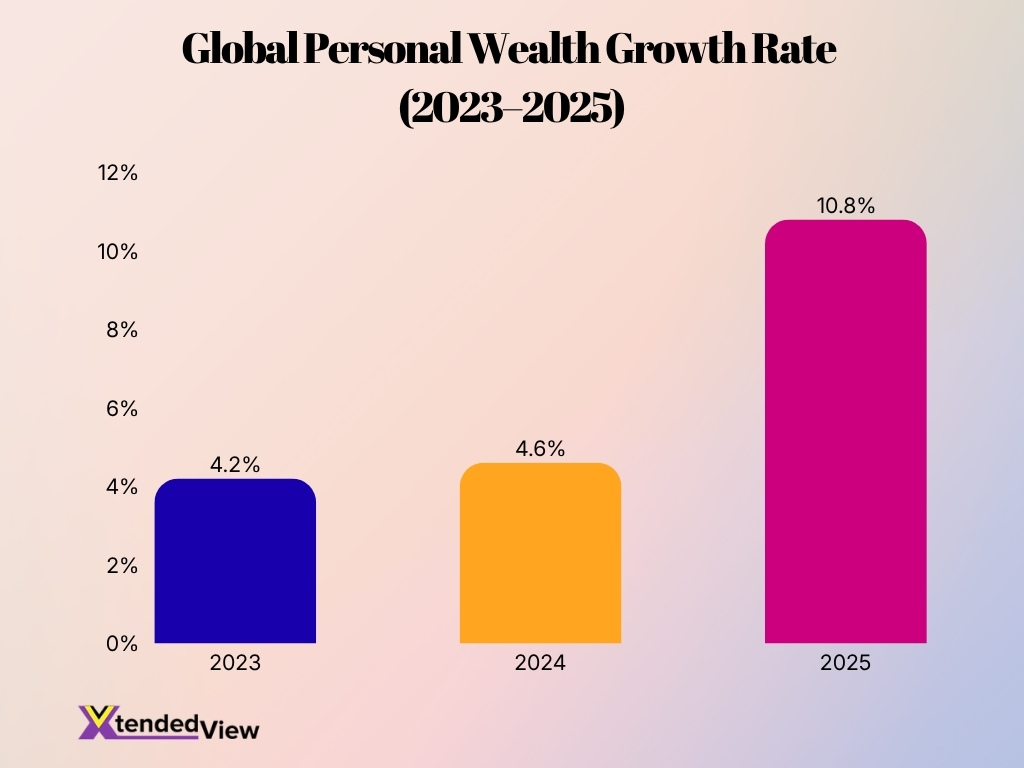
- Global personal wealth recorded its third consecutive year of growth in 2025 after increasing 10.8%, following gains of 4.6% in 2024 and 4.2% in 2023.
- Europe, the Middle East, and Africa posted the strongest regional wealth growth in 2025 at 17.5%, outperforming every other region.
- The Americas recorded 8.5% wealth growth during 2025, supported by resilient financial markets.
- Asia-Pacific wealth expanded 5.9% in 2025, improving on its slower growth in the previous year.
- The global population of high-net-worth individuals increased to 25.3 million in 2025, adding nearly 2 million new millionaires, according to a separate wealth study.
- Wealth held by high-net-worth individuals climbed to $98.3 trillion in 2025, the largest annual increase since 2018.
- The United States added approximately 440,000 new millionaires during 2025, accounting for nearly half of all new millionaires worldwide.
- The share of adults with wealth below $10,000 declined to just over 41% in 2025, down from almost 75% in 2000, highlighting long-term wealth expansion.
- Average wealth continued to outpace median wealth growth, indicating that wealth gains remained uneven across households.
How Many Millionaires Are There Worldwide?
- The world had approximately 60 million USD millionaires at the end of 2024 across the markets tracked in the latest global wealth study.
- More than 684,000 individuals became new millionaires during 2024.
- The global millionaire population expanded another 1.5% in 2025, adding nearly 1 million people.
- The United States alone represented almost 40% of all USD millionaires worldwide in 2024.
- Mainland China ranked second globally for the number of millionaires and added more than 380 new millionaires per day during 2024.
- France ranked among the countries with the largest millionaire populations worldwide in 2024.
- Switzerland maintained the highest density of millionaires per capita among major economies.
- Analysts expect the global millionaire population to increase by more than 5.3 million between 2024 and 2029.
- The number of adults in middle-wealth brackets has continued to expand as lower-wealth segments shrink globally.
Millionaire Growth Over Time
- Since 2000, global personal wealth has expanded steadily despite multiple economic downturns, averaging 3.4% annual growth.
- Global wealth increased 4.2% in 2023 before accelerating to 4.6% in 2024.
- Wealth growth accelerated further to 10.8% during 2025, the strongest annual increase in eight years.
- More than 680,000 new millionaires emerged globally during 2024.
- Nearly 1 million additional millionaires joined the global millionaire population during 2025.
- The proportion of adults with wealth below $10,000 has fallen dramatically from almost 75% in 2000 to just above 41% in 2025.
- Countries with strong equity markets consistently recorded faster millionaire growth than markets driven primarily by real estate.
- Forecasts indicate global millionaire numbers will continue rising through 2029, adding over 5 million more millionaires.
- Long-term wealth accumulation increasingly favors economies with expanding technology sectors, stable financial systems, and sustained capital investment.
Global Millionaire Trends
- Global wealth has increased at a compound annual growth rate of 3.4% since 2000.
- Millionaire growth increasingly reflects gains in financial assets, especially equities, rather than non-financial assets alone.
- The United States remains the primary driver of new millionaire creation, adding more than 1,000 millionaires every day during 2024.
- Emerging technology hubs in China, India, and the UAE continue to attract wealthy entrepreneurs and investors.
- Everyday millionaires with $1 million to $5 million in investable assets have become one of the fastest-growing wealth segments globally.
- International millionaire migration reached a record level in 2025, with 142,000 wealthy individuals expected to relocate across borders.
- The UAE is projected to receive a net inflow of 9,800 millionaires in 2025, making it the world’s leading destination for wealthy migrants.
- Wealth growth has become increasingly concentrated in regions with strong capital markets, favorable tax policies, and expanding technology sectors.
- North America and Greater China are expected to remain the largest contributors to global wealth growth through the end of the decade.
Millionaire Households Across Major Indian Cities
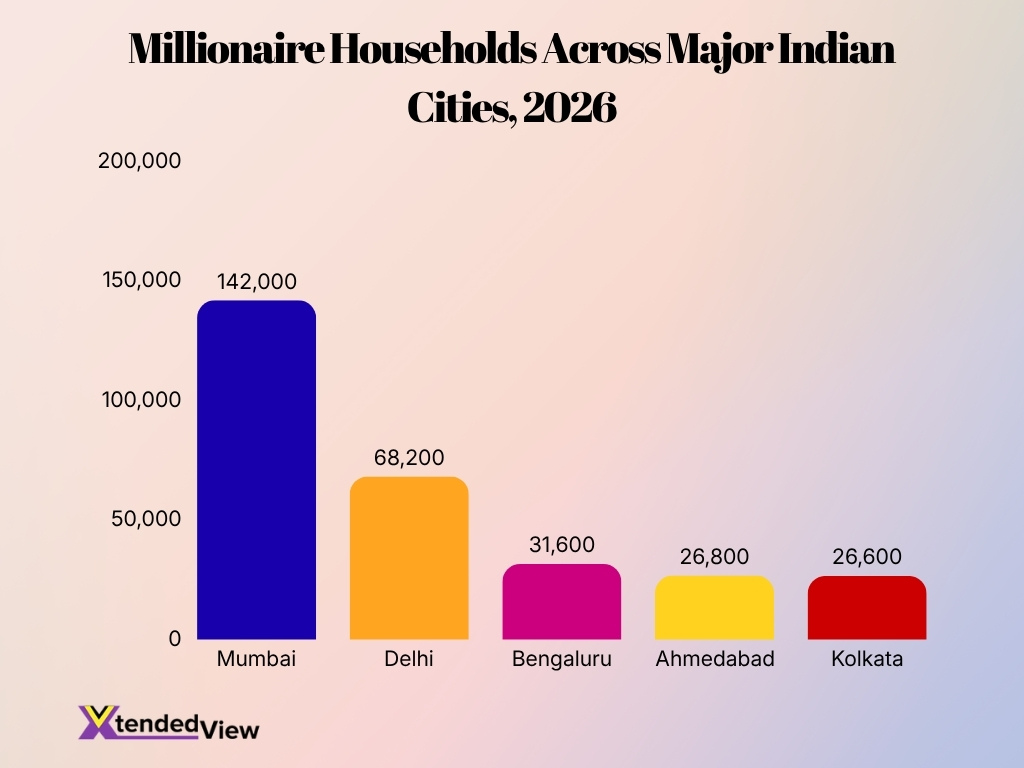
- Mumbai leads the ranking with 142,000 millionaire households, more than double Delhi’s total.
- Delhi ranks second with 68,200 millionaire households, accounting for nearly half of Mumbai’s figure.
- Bengaluru has 31,600 millionaire households, placing it third among the five major cities.
- Ahmedabad records 26,800 millionaire households, slightly ahead of Kolkata.
- Kolkata has 26,600 millionaire households, only 200 fewer than Ahmedabad.
- Mumbai has around 4.5 times more millionaire households than Bengaluru.
- The combined total across the five cities reaches 295,200 millionaire households.
- Mumbai alone represents approximately 48% of the millionaire households shown in the chart.
- Mumbai and Delhi together account for 210,200 households, or about 71% of the five-city total.
- The data highlights a strong concentration of millionaire households in Mumbai and Delhi compared with other major Indian cities.
Millionaire Population by Country
- The United States has the world’s largest millionaire population, representing nearly 40% of all USD millionaires globally.
- Mainland China currently ranks second and continues to produce hundreds of new millionaires every single day.
- France ranks among the world’s leading countries, hosting a millionaire population of 2.8 million.
- Japan successfully remained one of the countries with more than 2 million millionaires in 2025.
- Germany also strongly exceeded 2 million millionaires during the year 2025.
- The United Kingdom continued to maintain a millionaire population above 2 million, despite rising outward migration.
- Switzerland retained the highest average wealth per adult worldwide at more than $910,000 in 2025.
- Luxembourg remained one of the global leaders, featuring a top median wealth of $395,000 per adult.
- South Korea recorded one of the fastest increases in real average wealth, exceeding 50% growth since 2020.
Countries With the Most Millionaires
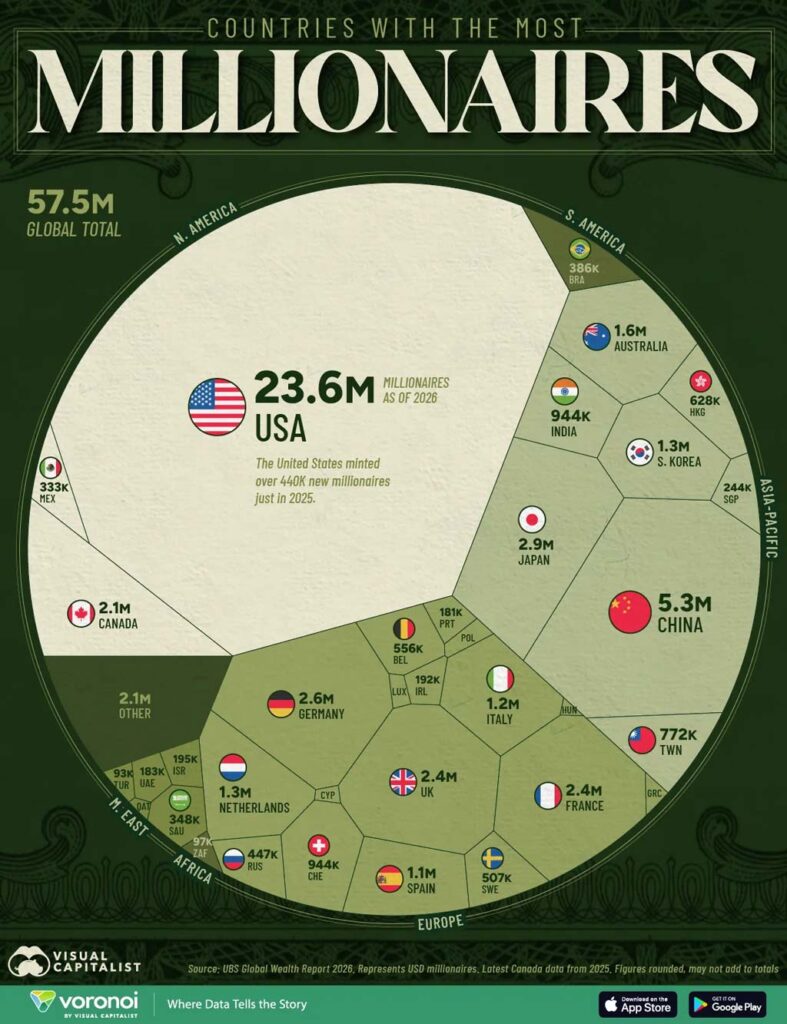
- The global millionaire population reached approximately 57.5 million in 2026, based on the number of adults holding at least $1 million in net wealth.
- The United States dominates the global ranking with 23.6 million millionaires, accounting for roughly 41% of the worldwide total.
- The United States added more than 440,000 new millionaires in 2025, highlighting the continued expansion of wealth in the country.
- China ranks second with 5.3 million millionaires, although its total remains less than one-quarter of the U.S. figure.
- Japan has the third-largest millionaire population at 2.9 million, making it the second-leading millionaire market in the Asia-Pacific region.
- European countries hold several top positions, led by Germany with 2.6 million, followed by the United Kingdom and France with 2.4 million each.
- Canada has approximately 2.1 million millionaires, giving it the second-largest millionaire population in North America.
- Australia records 1.6 million millionaires, significantly exceeding other countries with similarly sized populations.
- South Korea and the Netherlands each have around 1.3 million millionaires, while Italy follows with 1.2 million.
- India and Switzerland each report approximately 944,000 millionaires, despite major differences in their population sizes and economic structures.
- Taiwan has about 772,000 millionaires, while Hong Kong records approximately 628,000.
- Smaller European economies also have substantial millionaire populations, including Belgium with 556,000 and Sweden with 507,000.
- In the Middle East, Saudi Arabia leads with 348,000 millionaires, followed by the United Arab Emirates with 183,000 and Israel with 195,000.
- Brazil leads South America with approximately 386,000 millionaires, while Mexico has about 333,000.
- Countries outside the individually listed markets collectively account for around 2.1 million millionaires, showing that high-net-worth wealth remains geographically widespread.
Millionaires by Region
- Global high-net-worth wealth increased 8.7% to $98.3 trillion in 2025, while the corresponding population grew 7.9% to 25.3 million.
- North America’s high-net-worth population increased 7.3% to approximately 8.4 million in 2024, making it the strongest-performing major region that year.
- North American high-net-worth wealth grew 8.9% to almost $30 trillion in 2024, helped by strong U.S. equity returns.
- Asia-Pacific’s high-net-worth population increased 2.7% in 2024, with Japan and India among the region’s strongest national performers.
- Europe’s high-net-worth population decreased 2.1% in 2024, as subdued growth affected several of its largest wealth markets.
- Latin America recorded an 8.5% decline in its high-net-worth population in 2024, with weakness in Brazil and Mexico contributing to the contraction.
- The Middle East’s high-net-worth population fell 2.1% in 2024, partly reflecting softer oil-related conditions across some markets.
- Asia is projected to deliver the fastest ultra-high-net-worth population growth through 2030, although North America should remain the largest ultra-wealth region.
- The ultra-wealthy represented only 1.1% of high-net-worth individuals in mid-2025 but controlled 32.4% of all wealth held by that broader group.
Cities With the Most Millionaires
- New York City ranked first globally in 2025 with approximately 384,500 resident millionaires, 818 centi-millionaires and 66 billionaires.
- The San Francisco Bay Area ranked second with about 342,400 millionaires, 756 centi-millionaires and 82 billionaires.
- Millionaire numbers in the Bay Area increased 98% between 2014 and 2024, more than double New York City’s 45% growth.
- Tokyo placed among the three largest global millionaire centers in 2025, supported by Japan’s extensive base of household financial wealth and major corporations.
- Singapore remained one of the world’s leading urban wealth centers and had 30 resident billionaires in the 2025 city dataset.
- Los Angeles ranked among the top global millionaire cities and had 45 resident billionaires under the same location-based methodology.
- Hong Kong remained a major Asian wealth hub, with 40 billionaires and a large concentration of millionaires linked to finance, trade and property.
- London continued to rank among the world’s largest millionaire cities despite slower growth and increased departures by some wealthy residents.
- The 2025 city study assessed the 50 wealthiest cities and benchmarked more than 100 locations with significant centi-millionaire populations.
- New York and the Bay Area together housed about 726,900 millionaires, illustrating the scale of wealth concentrated in the two largest U.S. urban hubs.
World’s Richest People in 2026
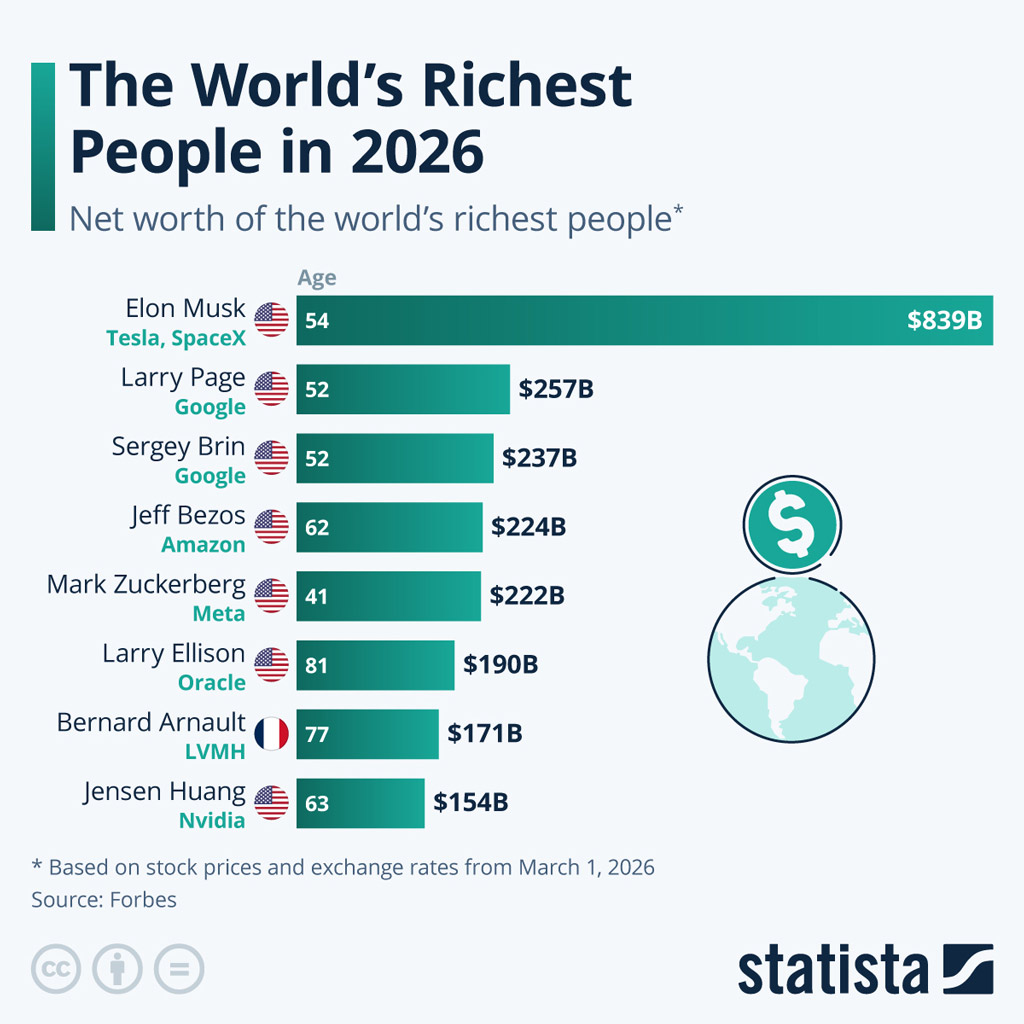
- Elon Musk ranks as the world’s richest person with an estimated net worth of $839 billion.
- Musk’s fortune is more than three times the net worth of second-ranked Larry Page, who holds $257 billion.
- Larry Page and Sergey Brin, the co-founders of Google, have a combined wealth of approximately $494 billion.
- Jeff Bezos ranks fourth with a net worth of $224 billion, closely followed by Mark Zuckerberg at $222 billion.
- Only $2 billion separates Bezos and Zuckerberg, making them the closest pair in the ranking.
- Larry Ellison, aged 81, is the oldest person on the list and has an estimated fortune of $190 billion.
- Mark Zuckerberg, aged 41, is the youngest billionaire featured in the ranking.
- Bernard Arnault is the only person from France and the only non-U.S. billionaire in the top eight, with $171 billion.
- Jensen Huang ranks eighth with a net worth of $154 billion, supported by Nvidia’s position in the semiconductor and AI markets.
- Seven of the eight richest people are from the United States, accounting for 87.5% of the list.
- The combined net worth of all eight individuals is approximately $2.29 trillion.
- Elon Musk alone controls about 36.6% of the total wealth represented in this ranking.
Millionaire Demographics
- The average U.S. millionaire is approximately 61 years old, reflecting the time required to build retirement, property, and investment assets.
- About 95% of U.S. millionaires own a home, with an average home value of approximately $982,938 among the measured households.
- Roughly 47% of millionaires own stocks directly, with an average stock portfolio valued at approximately $949,248.
- About 60% of people worth at least $30 million are self-made, meaning their primary wealth came from entrepreneurship, investing, or employment rather than inheritance alone.
- Only 36% of surveyed U.S. millionaires described themselves as wealthy, showing that the $1 million threshold no longer guarantees a sense of affluence.
- Nearly 49% of American millionaires said their financial planning needed improvement despite having at least $1 million in investable assets.
- About 74% of U.S. millionaires work with a financial adviser, compared with 34% of the general population.
- Approximately 93% of millionaires have received financial advice, versus 78% of U.S. adults overall.
- Only 53% of surveyed millionaires expected to leave an inheritance or charitable gift through their estate plans.
- Among millionaires planning a legacy transfer, just 12% called it their single most important financial objective.
Millionaires by Gender
- Globally, men account for 82% to 86% of all millionaires, while women make up just 14% to 18% of the global millionaire population.
- In the United States, women are much better represented and make up approximately 33% of all millionaires nationwide.
- The global female millionaire population is growing and projected to comfortably reach 18% by 2025 due to business leadership and wealth transitions.
- In developed economies like the U.S., UK, and Canada, the proportion of female millionaires is higher and averages around 18% to 20%.
- Nearly 22% of the male workforce in the U.S. earns over $100,000, compared to just 9% of the female workforce.
- Women currently comprise approximately 20% of Fidelity 401(k) account holders who have successfully saved at least $1 million.
- The average age for women to have $1 million saved for retirement is 58.5 years, slightly younger than men at 59.3 years.
- Historical global data indicates that previously 90% of millionaires were men and only 10% were women, showing a slowly closing gender wealth gap today.
Millionaires by Age Group
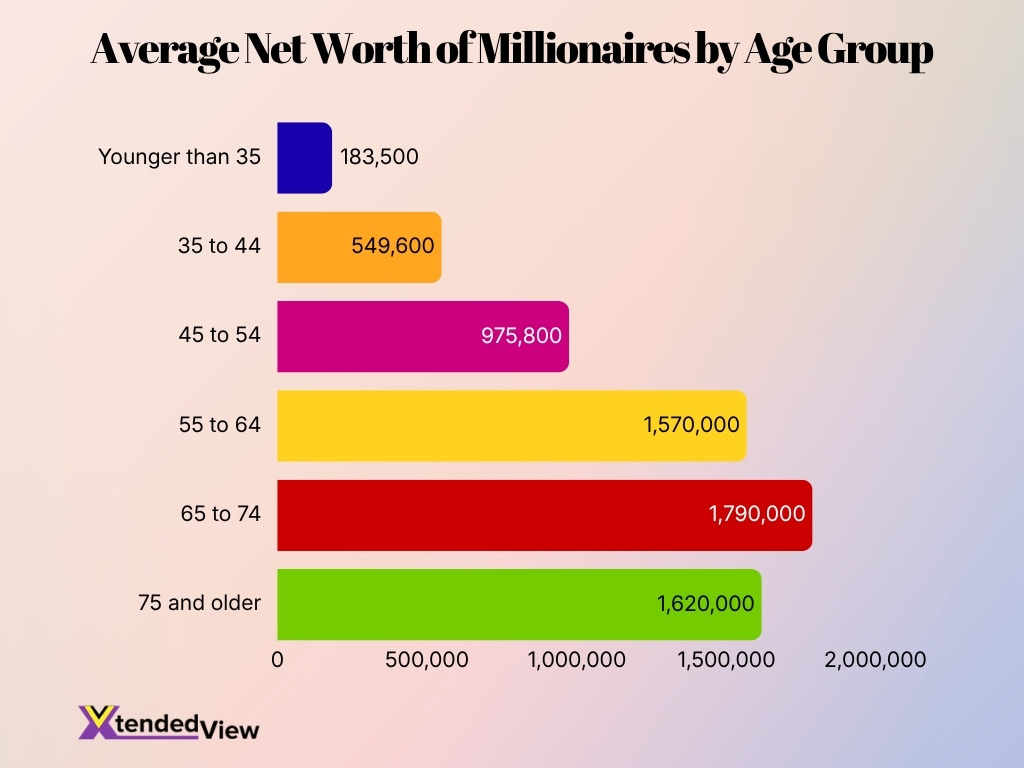
- U.S. households headed by someone younger than 35 had an average net worth of approximately $183,500 in the most recent comprehensive federal survey.
- Average household net worth increased to about $549,600 for the 35-to-44 age group.
- Households ages 45 to 54 averaged approximately $975,800, placing the group just below the millionaire threshold on an average basis.
- Average net worth rose to around $1.57 million among households ages 55 to 64.
- Households ages 65 to 74 recorded the highest average net worth at approximately $1.79 million.
- Average net worth remained above $1 million for households ages 75 and older, reaching approximately $1.62 million.
- Americans in their 50s held an average net worth of roughly $1.3 million in June 2025 within one large financial-dashboard dataset.
- People in their 60s held average retirement savings of approximately $1.1 million in the same 2025 dataset.
- Retirement millionaires held an average of $2.4 million in retirement savings at the end of 2024.
- The number of retirement millionaires increased 29% between 2023 and 2024, highlighting the effect of market gains and sustained contributions.
Millionaires by Education Level
- Households led by someone without a high school diploma had a median net worth of approximately $38,050.
- Households headed by high school graduates recorded a median net worth of roughly $107,000.
- The median net worth reached $137,040 for households that attended college without completing a four-year degree.
- College-graduate households achieved a median net worth of $464,400, over four times higher than high school graduates.
- The average net worth of households with a college graduate approached $2 million.
- Approximately 74% of college-graduate households owned a home, compared to 62% for high school graduates.
- A typical college-graduate household held about $141,700 in retirement accounts.
- College-graduate households held a typical $25,000 in directly owned stocks.
- Education was the strongest socioeconomic predictor of income in a study of 8,984 U.S. participants.
Millionaires by Occupation
- Nearly 40% of U.S. families in the highest income decile own a privately held business.
- Exactly 13% of all U.S. families hold an ownership stake in a private business.
- The finance and investment industry produced 464 billionaires globally in 2025.
- The technology sector accounted for 401 billionaires, representing 13% of the 2025 list.
- Roughly 80% of millionaires are first-generation rich who did not inherit their wealth.
- Approximately one-third of all millionaires never earned a six-figure salary in a single working year.
- Teachers, engineers, and accountants frequently rank in the top five occupations for building millionaire-level wealth.
- Almost 75% of millionaires state that consistent long-term investing was their primary wealth-building tool.
Millionaire Wealth Ranges
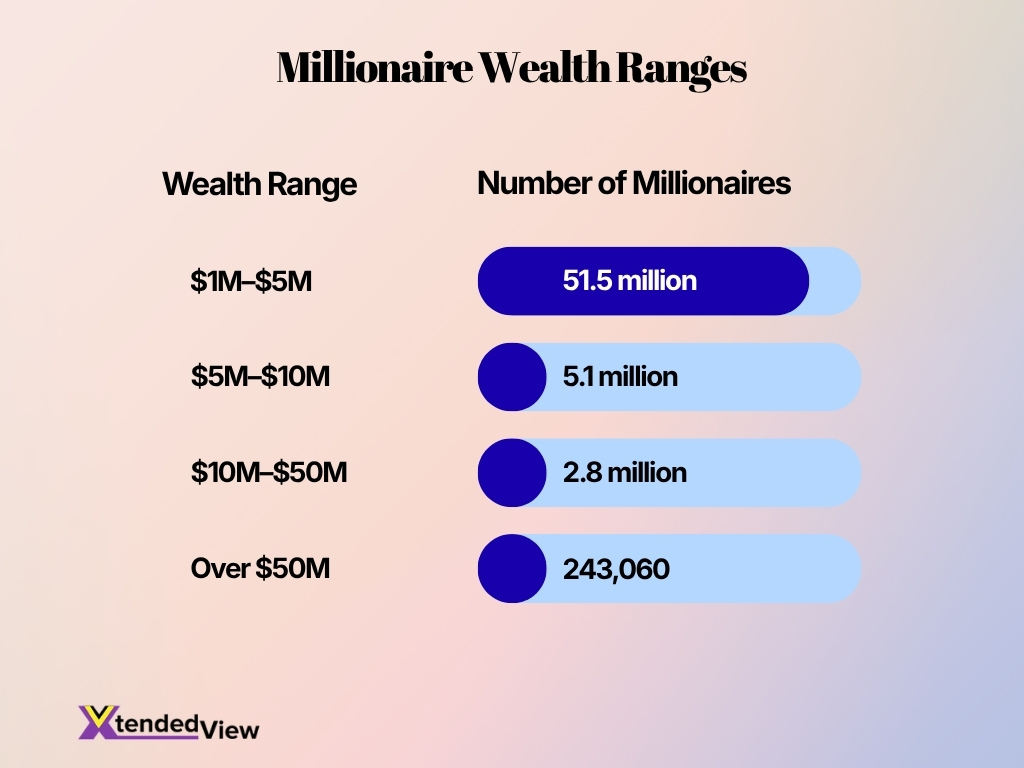
- The $1 million to $5 million segment dominates the distribution, with approximately 51.5 million millionaires worldwide.
- Around 5.1 million individuals hold wealth between $5 million and $10 million.
- The $10 million to $50 million category includes about 2.8 million millionaires.
- Only 243,060 individuals have wealth exceeding $50 million, making this the smallest group.
- The number of millionaires falls sharply as wealth levels rise, showing a high concentration in the lower millionaire range.
- The $1 million to $5 million group is more than 10 times larger than the $5 million to $10 million segment.
- Millionaires worth more than $10 million collectively total just over 3 million people.
- Individuals with over $50 million represent less than 0.5% of the millionaire population shown in the data.
Millionaires by Industry
- Finance and investments led the 2025 rankings by generating exactly 464 billionaires.
- The technology sector followed in second place with 401 billionaires from software and AI.
- Manufacturing ranked third globally by supporting the industrial fortunes of 342 billionaires.
- Technology and finance collectively accounted for nearly 50% of the 400 richest Americans.
- Fashion and retail markets generated 297 billionaires who expanded their global brands.
- Health care industries produced 230 billionaires across pharmaceuticals and medical devices.
- Food and beverage consumer brands accounted for 223 billionaires driven by repeat demand.
- Real estate investments successfully created wealth for 206 billionaires through property appreciation.
- Media and entertainment produced 116 billionaires, representing fewer wealthy individuals than financial sectors.
Sources of Millionaire Wealth
- Global personal wealth rose by more than 10% in 2025.
- The world added nearly 1 million new USD millionaires in 2025.
- Global wealth expansion created more than 2,600 millionaires per day.
- Equities accounted for 57% of the increase in global household wealth.
- Real estate accounted for just 15% of the 2025 wealth increase.
- Asset-price appreciation generated about 60% of global wealth growth.
- New real investment contributed approximately 20% to wealth generation.
Millionaire Wealth Distribution
- Global wealth remains highly concentrated even as the number of millionaires expands. The ultra-wealthy represented only a small fraction of high-net-worth individuals but controlled nearly one-third of the group’s combined wealth in mid-2025.
- In the United States, median family net worth reached $192,900 in 2022, while mean net worth stood at $1.06 million. The large difference shows how wealthy households pull the average upward.
- The median net worth of the top U.S. wealth decile reached $3.79 million, compared with only $3,500 for families in the bottom wealth quartile.
- Mean net worth in the top decile reached approximately $7.81 million, while the bottom quartile recorded negative mean wealth of $5,300.
- U.S. median household wealth increased from $176,500 in 2022 to $191,100 in 2023, an increase of about 8.3%.
- One in 10 U.S. households had no wealth or negative wealth in 2023, while another one in 10 held more than $1.806 million.
- White households represented 65.3% of U.S. households but held 80% of household wealth in 2021.
- Black households represented 13.6% of households but held only 4.7% of U.S. wealth in the same dataset.
- The typical White family held around six times the wealth of the typical Black family and five times the wealth of the typical Hispanic family in 2022.
- In 2024, the highest U.S. income quintile received 52.2% of aggregate household income, while the lowest quintile received 3.1%. Although income differs from wealth, this imbalance affects households’ ability to save and acquire assets.
Frequently Asked Questions (FAQs)
Nearly 1 million new USD millionaires were added globally in 2025, equivalent to more than 2,600 new millionaires per day.
Global personal wealth increased by 10.8% in 2025, the fastest annual growth since 2017.
The global high-net-worth individual (HNWI) population reached 25.3 million in 2025, with their combined wealth rising to $98.3 trillion.
The United States created the most new millionaires in 2025, adding more than 440,000 (UBS estimate), while another study estimated 736,000 new HNWIs under a different methodology.
The United States and mainland China together hold more than 50% of global personal wealth, making them the world’s two largest wealth markets.
Conclusion
The global millionaire population continued to expand, adding nearly 1 million new USD millionaires during the year. The United States remains the largest millionaire market because of its deep equity markets, entrepreneurial economy, retirement system and concentration of valuable private companies. Business ownership, financial assets and property continue to serve as the main routes to millionaire-level wealth, while finance, technology and manufacturing produce many of the world’s largest fortunes. However, most millionaires remain in the lower millionaire tier rather than the ultra-wealth segment, and recent gains still depend heavily on equity prices and other market conditions. Wealth also remains unevenly distributed by income, race, geography, education and asset ownership.
For businesses, these statistics highlight demand for investment management, estate planning, insurance, luxury property and private-market services. For policymakers, they reinforce the importance of homeownership, retirement access, entrepreneurship and broader participation in financial markets. Overall, millionaire wealth continues to grow, but access to the assets that create that wealth remains far from equal.
