

Millennials came of age alongside the expansion of social networks, smartphones, streaming video, and mobile commerce, which makes social media a deeply established part of their digital behavior. Millennials are roughly 30 to 45 years old, placing much of the generation in key working, spending, and family-building years. Their platform habits now influence how brands approach product discovery, social commerce, customer service, creator marketing, and digital advertising. Millennials also use social media for practical needs, from researching products and following news to joining communities and maintaining professional connections.
At the same time, their behavior reflects growing concerns around privacy, low-quality AI content and the credibility of online information. The statistics in this article show where Millennials spend their attention, which platforms matter most and how their social media habits continue to evolve.
Editor’s Choice
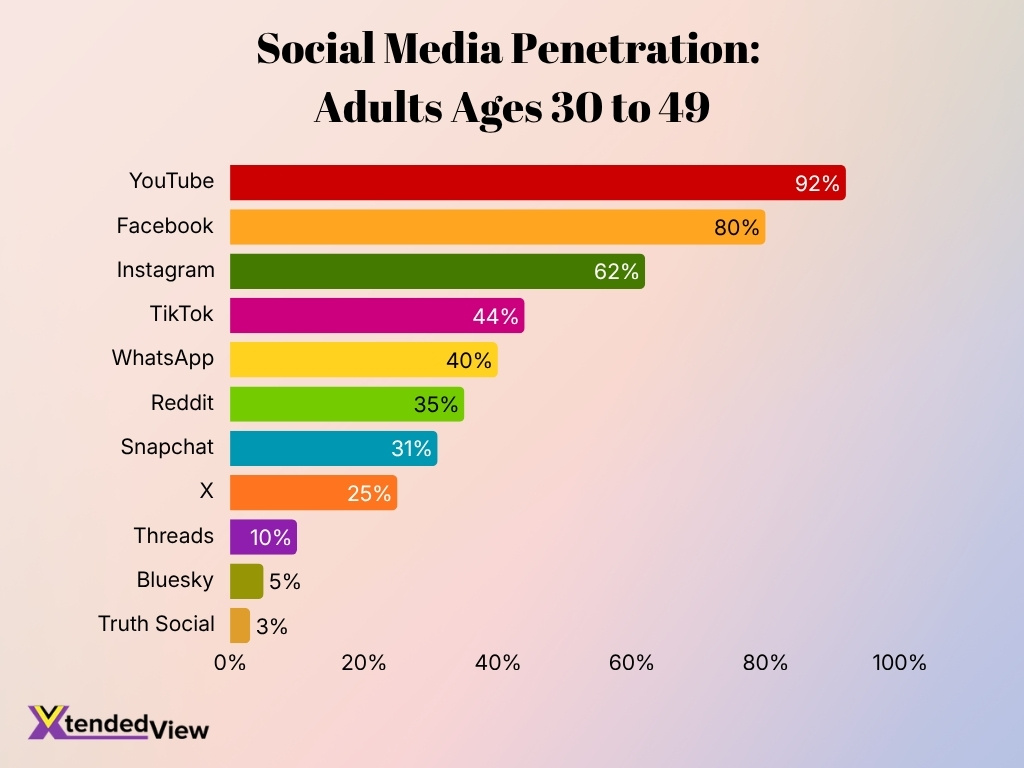
- 92% of adults ages 30 to 49 use YouTube, the highest penetration among the major platforms measured for this age group in the latest 2025 data.
- 80% use Facebook, making it the second-most widely used major platform among 30-to-49-year-olds.
- 62% use Instagram, giving the platform a majority reach within the age band containing most Millennials.
- 44% use TikTok, compared with 63% among adults ages 18 to 29 and 30% among adults ages 50 to 64.
- 58% of adults ages 30 to 49 use Facebook daily, making this middle-age bracket the platform’s most frequent age group in the 2025 frequency survey.
- 40% of adults ages 30 to 49 use WhatsApp, giving messaging-based social interaction substantial reach among Millennial-age consumers.
- 35% use Reddit, compared with 16% of adults ages 50 to 64 and just 6% of those 65 and older.
- In the 2023 benchmark, 53% of adults ages 30 to 49 used at least five of the social platforms included in the survey, illustrating the multi-platform behavior that preceded the latest usage levels.
Recent Developments
- TikTok reached 37% of all U.S. adults in 2025, up from 21% in 2021. That represents a 16-percentage-point increase in four years.
- Instagram reached 50% of U.S. adults in 2025, compared with 40% in 2021.
- WhatsApp reached 32% of American adults in 2025, rising from 23% in 2021.
- Reddit reached 26% of U.S. adults in 2025, compared with 18% four years earlier.
- Meanwhile, YouTube retained mass-market reach, with 84% of U.S. adults saying they used it in the 2025 survey.
- Facebook remained another mature mass-market network, reaching 71% of American adults in 2025.
- The 2025 survey found Instagram usage at 50% overall, making it the only platform other than YouTube and Facebook to reach at least half of U.S. adults.
- TikTok’s growth becomes clearer against the earlier benchmark: 33% of U.S. adults used TikTok in the 2023 survey, compared with 37% in 2025. The survey methodology changed from earlier telephone-based research, so longer-term comparisons require caution.
Who Are Millennials?
- The 1981-to-1996 definition covers a 16-year birth cohort.
- Under this definition, Millennials are approximately 30 to 45 years old during 2026, depending on whether they have reached their birthday.
- The oldest Millennials, born in 1981, turn 45 during 2026.
- The youngest Millennials, born in 1996, turn 30 during 2026.
- The generation immediately preceding Millennials, Gen X, covers 1965 through 1980 under the same analytical framework.
- Gen Z begins with people born in 1997, meaning the oldest members of Gen Z turn 29 in 2026.
- Researchers emphasize that generational cutoff points are not an exact science. The categories work best as analytical groupings rather than hard behavioral boundaries.
- Because Millennials fall mainly inside today’s 30-to-49 age bracket, that bracket provides one of the strongest current public datasets for evaluating U.S. Millennial social media behavior. However, it also includes some younger Gen X adults, so its percentages should not be described as Millennial-only survey results.
Social Media Usage by Generation
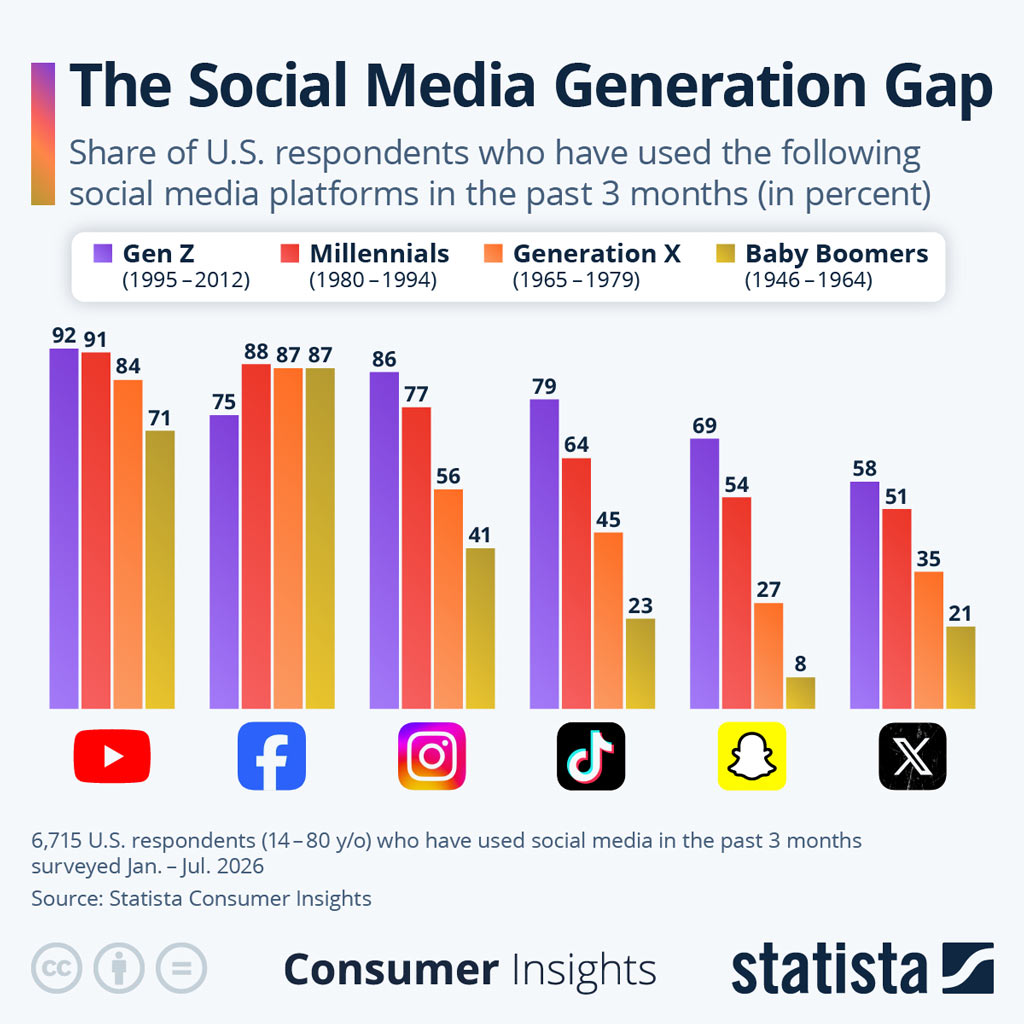
- YouTube dominates across generations, reaching 92% of Gen Z, 91% of Millennials, 84% of Gen X, and 71% of Baby Boomers.
- Facebook is especially strong among Millennials and older users, with adoption at 88% among Millennials and 87% each among Gen X and Baby Boomers.
- Instagram shows a clear generational divide, used by 86% of Gen Z and 77% of Millennials, compared with 56% of Gen X and 41% of Baby Boomers.
- TikTok usage drops sharply with age, from 79% among Gen Z and 64% among Millennials to just 45% of Gen X and 23% of Baby Boomers.
- Snapchat has the widest generation gap, reaching 69% of Gen Z but only 8% of Baby Boomers, a substantial 61-percentage-point difference.
- X is used by 51% of Millennials, placing them below Gen Z at 58% but ahead of Gen X at 35% and Baby Boomers at 21%.
- Among Millennials specifically, YouTube ranks first at 91%, followed by Facebook at 88%, Instagram at 77%, TikTok at 64%, Snapchat at 54%, and X at 51%.
- Overall, the data indicates that Millennials maintain broad cross-platform adoption, combining high usage of established networks like Facebook and YouTube with substantial participation on Instagram, TikTok, and Snapchat.
Millennial Population and Demographics
- The U.S. population reached approximately 340.1 million in 2024, according to the 1-year population estimates used here.
- About 23.9 million Americans were ages 30 to 34 in 2024, representing roughly 7% of the population.
- Another 23.3 million were ages 35 to 39, or about 6.8% of the U.S. population.
- Approximately 22.7 million Americans were ages 40 to 44, accounting for about 6.7% of the population.
- Combined, the 30-to-44 population totaled about 69.8 million people in 2024. This calculation uses the three published five-year age groups and closely approximates the core Millennial-age population entering 2026.
- The 2024 estimates counted about 20.3 million people ages 45 to 49, a group that becomes increasingly relevant to Millennial analysis as the oldest Millennials reach 45 in 2026.
- Americans ages 30 to 34 formed a slightly larger population group than those ages 35 to 39 or 40 to 44, at 23.9 million versus 23.3 million and 22.7 million, respectively.
- Millennials are also more racially and ethnically diverse than older U.S. generations. Earlier generational research found that more than 40% of Millennials were non-White, an important demographic factor when interpreting differences in platform adoption.
Millennial Social Media Adoption
- YouTube reaches 92% of U.S. adults ages 30 to 49, leaving only a small minority outside its audience.
- Facebook reaches 80% of 30-to-49-year-olds, compared with 68% of adults ages 18 to 29.
- Instagram adoption stands at 62% among 30-to-49-year-olds, compared with 80% among adults under 30.
- TikTok reaches 44% of the 30-to-49 bracket. Its reach falls to 30% among ages 50 to 64, illustrating a clear age gradient.
- WhatsApp reaches 40% of 30-to-49-year-olds, making it more common in this age bracket than Reddit, Snapchat or X.
- Reddit reaches 35% of adults ages 30 to 49, versus 48% among adults ages 18 to 29.
- Snapchat still reaches 31% of 30-to-49-year-olds, despite its much stronger 58% penetration among adults under 30.
- X reaches 25% of adults ages 30 to 49, while newer platforms remain considerably smaller: Threads reaches 10%, and Bluesky reaches 5% of this age group.
Daily Social Media Usage Among Millennials
- 58% of U.S. adults ages 30 to 49 use Facebook at least daily, the highest daily Facebook rate among the age groups measured.
- For comparison, 54% of adults ages 50 to 64 use Facebook daily, putting the two middle-age groups ahead of younger and older adults on this measure.
- Across the entire U.S. adult population, roughly half use Facebook daily, demonstrating that the network remains part of routine digital behavior despite its maturity.
- Facebook also generates frequent repeat visits: 37% of all U.S. adults visit it several times per day.
- YouTube similarly reaches about half of U.S. adults every day, supporting its role as both a social platform and a daily video destination.
- 33% of U.S. adults use YouTube several times a day, showing that its 84% overall reach translates into substantial repeat engagement.
- TikTok has become a daily habit for 24% of all U.S. adults, even though its overall adoption rate stands at 37%.
- X has a smaller habitual audience: 10% of U.S. adults use it daily. This gap between X and TikTok illustrates how daily social attention has shifted toward video-led platforms.
- Age remains important for daily TikTok behavior. Roughly half of adults ages 18 to 29 use TikTok daily, compared with just 5% of adults 65 and older; the Millennial-heavy middle age range sits between these extremes.
Number of Social Media Accounts Millennials Have
- The typical online adult actively used 6.75 social media platforms per month in Q2 2025.
- Global multi-platform usage previously peaked at an average of 6.86 platforms in Q4 2024.
- Approximately 53% of adults aged 30 to 49 used at least 5 platforms.
- Around 74% of adults under 30 regularly used 5 or more platforms.
- Exactly 30% of adults aged 50 to 64 maintained accounts across at least 5 platforms.
- Just 8% of seniors aged 65 and older used at least 5 platforms.
- Facebook reached 56.9% of online adults globally, followed by Instagram at 55.1% and WhatsApp at 54.0%.
- YouTube engaged 55.4% of global digital adults monthly, expanding multi-network portfolios.
Millennials’ Weekly Online Content Consumption
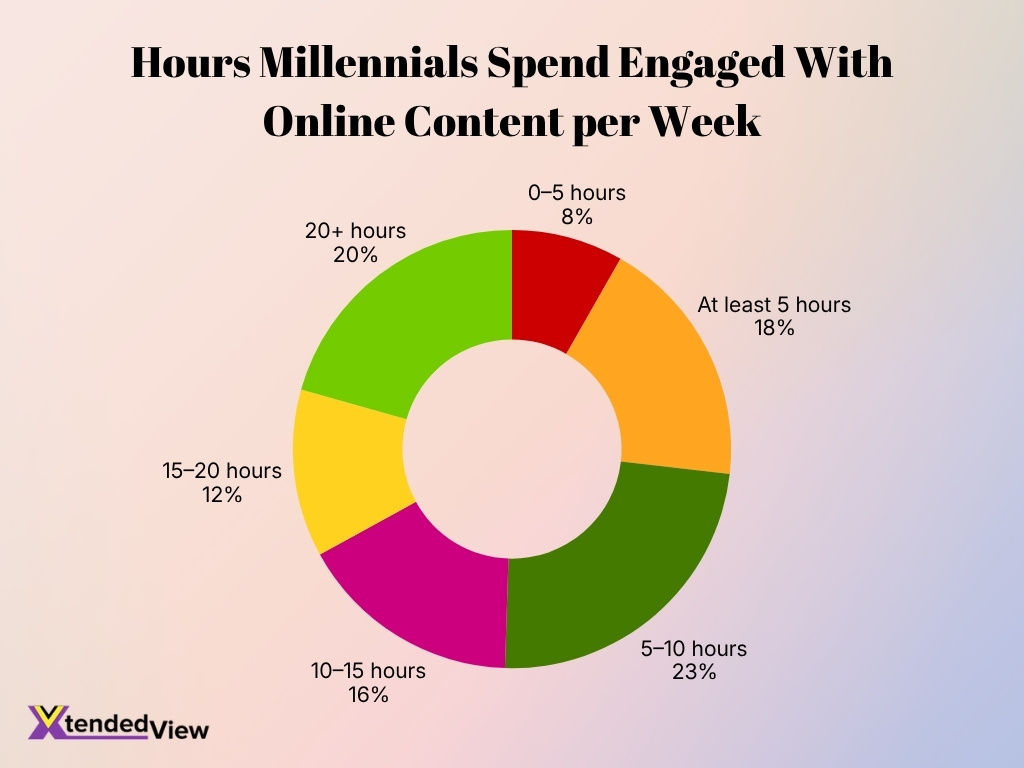
- The largest share of millennials, 23%, spend 5–10 hours per week engaging with online content, making it the most common usage range.
- Around 20% of millennials spend 20+ hours per week consuming online content, highlighting a sizable group of highly engaged digital users.
- Approximately 16% spend 10–15 hours per week with online content, indicating that moderate-to-heavy consumption is widespread.
- Another 12% of millennials report spending 15–20 hours per week engaged with online content.
- Only 8% fall into the 0–5 hours per week category, representing the smallest share shown in the data.
- Overall, the figures suggest that millennials dedicate a significant portion of their week to online content, with substantial shares exceeding 10 or even 20 hours per week.
Most Popular Social Media Platforms Among Millennials
- Among U.S. adults ages 30 to 49, YouTube ranks first, with 92% reporting that they use it in the 2025 survey.
- Facebook follows at 80% penetration among adults ages 30 to 49, giving it unusually strong reach within the age range containing most Millennials.
- Instagram ranks third for this age group at 62%, placing it well ahead of every measured platform other than YouTube and Facebook.
- TikTok reaches 44% of 30-to-49-year-olds, giving the short-form video service access to nearly half of this broad Millennial-heavy age bracket.
- WhatsApp reaches 40% of U.S. adults ages 30 to 49, slightly exceeding Reddit and demonstrating the importance of messaging-based social interaction.
- Reddit attracts 35% of adults ages 30 to 49, making community-driven discussion a significant component of social activity for Millennial-age consumers.
- Snapchat still reaches 31% of adults ages 30 to 49 despite its stronger association with younger consumers.
- X reaches 25% of adults ages 30 to 49, substantially below the audience levels of YouTube, Facebook, Instagram and TikTok.
- Newer networks remain comparatively small among this age group: Threads reaches 10%, Bluesky reaches 5%, and Truth Social reaches 3%.
Facebook, Instagram, and YouTube Usage Among Millennials
- Facebook’s U.S. advertising audience reached approximately 198 million people in late 2025, providing a broad addressable market as 2026 began.
- Facebook’s potential U.S. advertising reach increased by about 4.9 million, or 2.5%, between October 2024 and October 2025.
- Among U.S. adults ages 30 to 49, 58% use Facebook at least once per day, making this age group one of the platform’s most frequent users.
- Instagram’s U.S. advertising audience reached about 182 million users in late 2025, equivalent to 52.3% of the country’s population.
- Instagram’s potential U.S. advertising audience expanded by 16 million, or 9.7%, between October 2024 and October 2025.
- Instagram ads could reach 64.1% of U.S. adults ages 18 and older at the end of 2025, although advertising reach should not be treated as an exact monthly active-user count.
- YouTube’s U.S. advertising audience totaled roughly 254 million users in late 2025, equivalent to 78.4% of the country’s internet user base.
- YouTube’s potential U.S. ad reach increased by 6 million, or 2.4%, between July and October 2025 alone.
- Looking across all U.S. adults, 33% visit YouTube several times per day, showing that its broad reach also produces frequent repeat usage.
TikTok, X, and Snapchat Usage Among Millennials
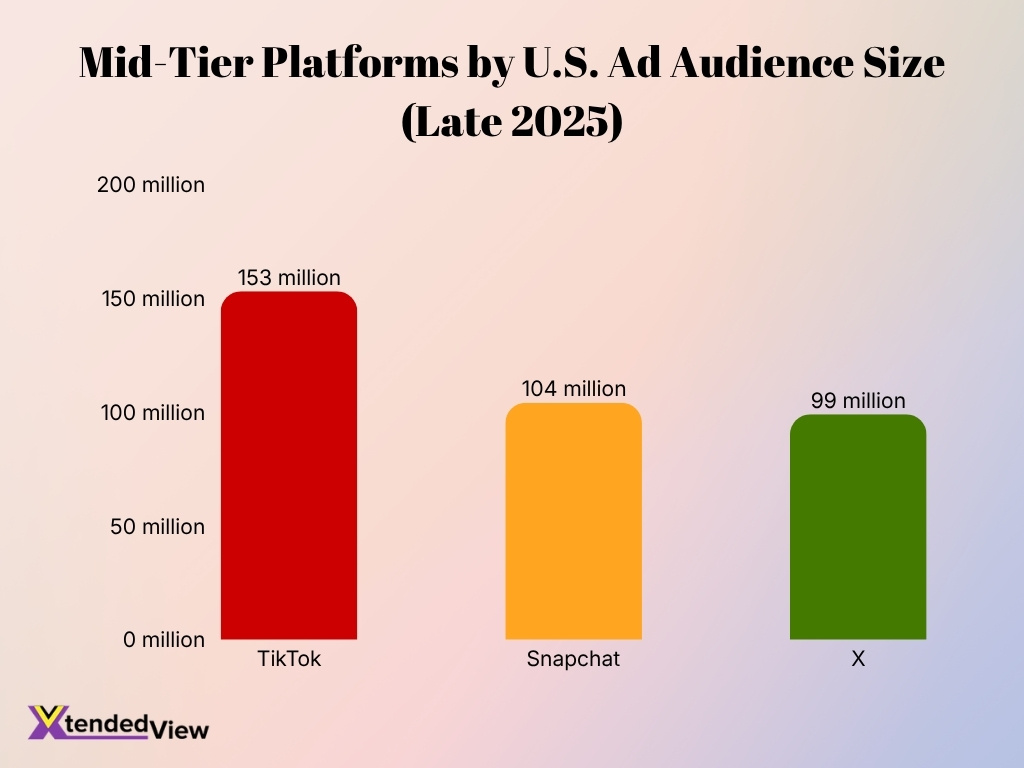
- TikTok’s potential U.S. advertising audience reached 153 million adults in late 2025, considerably larger than the reported advertising audiences for Snapchat or X.
- TikTok’s potential U.S. ad reach increased by 15.2 million users, or 11%, between the end of 2024 and late 2025.
- Between July and October 2025 alone, TikTok’s potential U.S. advertising reach rose by another 7.05 million users, equal to growth of 4.8%.
- Across all U.S. adults, 24% use TikTok daily, showing that the service has developed a substantial habitual audience rather than serving only occasional users.
- Snapchat’s U.S. advertising audience stood at approximately 104 million users in late 2025. Its reported reach equaled 32% of U.S. internet users.
- Snapchat’s potential U.S. advertising reach declined by about 2.78 million, or 2.6%, between the end of 2024 and late 2025.
- X reported an advertising audience of about 99 million U.S. users in late 2025, although its advertising figures should not be treated as a direct measure of monthly active users.
- X’s potential U.S. advertising reach fell by approximately 3.79 million, or 3.7%, between the end of 2024 and late 2025.
- Daily X usage remains limited compared with the largest social platforms: 10% of U.S. adults use X each day, versus roughly one-quarter who use TikTok daily.
LinkedIn, Pinterest, Reddit, and WhatsApp Usage Among Millennials
- The most recent directly comparable age-specific U.S. survey that measured LinkedIn found that 40% of adults ages 30 to 49 used LinkedIn, a higher rate than among both 18-to-29-year-olds and 50-to-64-year-olds in that survey.
- LinkedIn reported approximately 270 million registered U.S. members in late 2025. However, this figure represents registered members rather than monthly active users, so it should not be compared directly with active-audience statistics for other networks.
- LinkedIn’s reported U.S. member-based advertising audience grew by 30 million, or 12.5%, between the end of 2024 and the end of 2025.
- Pinterest’s U.S. advertising audience reached approximately 96.9 million users in late 2025, equivalent to 29.9% of the U.S. internet user base.
- Women represented 71.4% of Pinterest’s U.S. advertising audience at the end of 2025, compared with 19.2% identified as men and 9.4% classified as unspecified.
- Pinterest’s potential U.S. advertising reach increased by about 1.3 million, or 1.4%, between the end of 2024 and late 2025.
- Reddit usage increased nationally from 24% of U.S. adults in 2024 to 26% in 2025, a two-percentage-point increase.
- WhatsApp usage also moved upward nationally, from 30% of U.S. adults in 2024 to 32% in 2025.
- WhatsApp shows particularly strong demographic variation: 56% of Hispanic adults and 54% of English-speaking Asian adults use it, compared with 23% of White adults in the 2025 U.S. survey.
Social Media Usage by Millennial Demographics and Country
- Among U.S. adults overall, Instagram usage rises from 41% in households earning under $30,000 to 60% in households earning at least $100,000, showing a substantial income difference in platform adoption.
- Reddit displays an even larger education gap: 37% of college graduates use it, compared with 15% of adults with a high school education or less.
- TikTok moves in the opposite direction by income. 42% of adults in households earning under $30,000 use TikTok, compared with 30% in households earning $100,000 or more.
- Community type also matters. WhatsApp reaches 44% of urban U.S. adults, compared with 34% of suburban adults and only 17% of rural adults.
- Instagram shows a similar geographic split, reaching 55% of urban adults and 54% of suburban adults, but only 37% of rural adults.
- Heading into 2026, the U.S. had approximately 254 million active social media user identities, equal to 73% of its total population and 78.4% of its internet users.
- Canada recorded 31.7 million social media user identities in early 2025, equivalent to 79.4% of the national population; 86.7% of adults were represented in the adult social media audience estimate.
- Germany recorded 58.7 million adult social media user identities in early 2025, equivalent to 83.4% of the country’s population ages 18 and older.
- India had 444 million adult social media user identities in early 2025, and that figure increased to 500 million total social media user identities by October 2025, illustrating the scale and continued expansion of one of the world’s largest digital markets.
- India also added approximately 29 million social media user identities between early 2024 and early 2025, representing reported growth of 6.3% over the period.
Millennial News Consumption and Social Media Engagement Habits
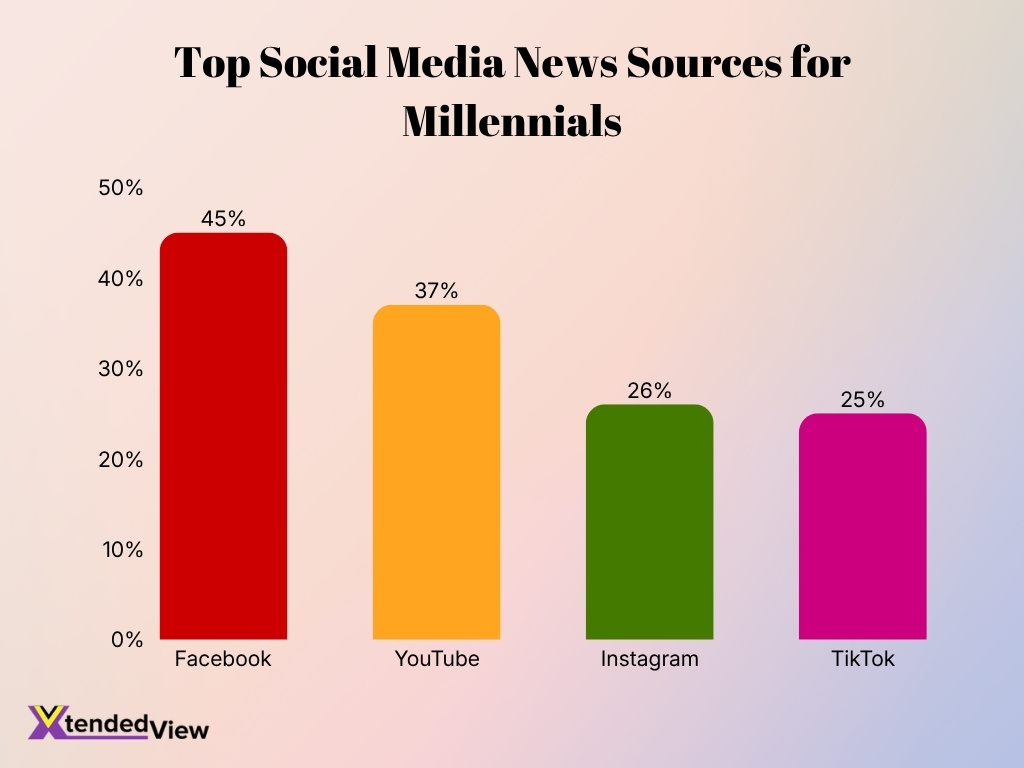
- 45% of adults ages 30 to 49 regularly got news from Facebook in 2025.
- YouTube served as a regular news source for 37% of adults ages 30 to 49.
- 26% of 30-to-49-year-olds regularly consumed news on Instagram, compared to 11% of adults 50 to 64.
- TikTok provided regular news to 25% of adults ages 30 to 49, more than double the 10% of adults 50 to 64.
- 38% of all U.S. adults regularly used Facebook for news, followed closely by YouTube at 35%.
- Instagram and TikTok each supplied regular news to 20% of all U.S. adults.
- X reached 12% of U.S. adults for regular news, while Reddit reached 9%, WhatsApp5%, and Threads reached 3%.
- 55% of TikTok users regularly accessed news on the platform in 2025, surging from 22% in 2020.
Millennials’ Preferred Social Media Content and Video Consumption
- In 2026, 92% of Millennials use social media to keep up with cultural moments, indicating that shared events, entertainment, and conversations remain major reasons to stay connected.
- 40% of Millennials want brands to prioritize educational content about products and services in 2026, making practical information one of the clearest content opportunities for marketers.
- Another 27% want more community-focused brand content, showing that many Millennials value participation and conversation rather than one-way promotion.
- In the Q1 2026 survey, 76% of Millennial social media users used Instagram, while 70% used Facebook and 69% used YouTube. These three platforms therefore provide substantial distribution for visual and video content.
- Millennials show the strongest engagement with short-form videos under 60 seconds on Facebook and Instagram. On YouTube, their engagement becomes more evenly divided between videos shorter and longer than 60 seconds.
- 44% of Millennials have unfollowed, blocked, or muted a brand because its posts appeared to contain low-quality AI-generated content, according to Q1 2026 research.
- Community and creator-led platforms also attract Millennial interest: 63% planned to use Reddit, 57% planned to use Bluesky or Threads, and 53% planned to use Patreon or Substack in the 2025 survey.
- Video consumption extends well beyond short clips. YouTube Shorts serves more than 2 billion monthly users globally, while 73% of surveyed online fans ages 14 to 44 said they turn to YouTube for content, conversation or information related to their fandoms.
- Across social users generally, 50% use social media for cooking and recipe inspiration, 43% for TV and movie recommendations, and 36% for music discovery, illustrating the practical and entertainment-led content environment in which Millennials participate.
Millennials’ Social Media Usage for Brand Discovery and Brand Interaction
- 84% of Millennials said social content influenced a purchase during the previous six months.
- 37% of all consumers prefer social media first when searching for product reviews and recommendations.
- 35% of consumers use social platforms first when searching for local restaurants and activities.
- 2 in 5 Millennials say brands should prioritize educational product and service content.
- 27% of Millennials expect brands to take public positions on political or social issues.
- 23% want brands to serve as resources on issues connected with their industries.
- About one-third of Millennials will stop buying from a company when its values conflict with their own.
- 20% intentionally seek products from brands whose values they support.
- 61% of Millennials reported a positive impact on their social lives from social media engagement.
Key Drivers Behind Millennial Purchasing Decisions
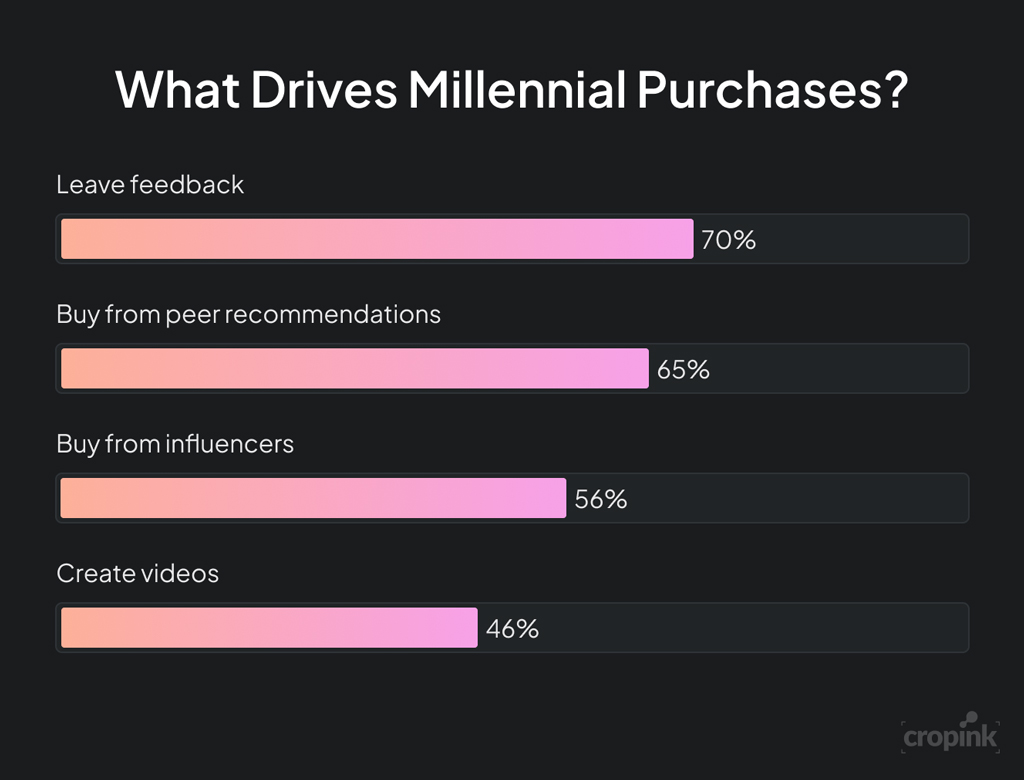
- 70% of millennials leave feedback, highlighting how actively this generation shares opinions and experiences after interacting with products and brands.
- 65% of millennials buy based on peer recommendations, showing that advice from friends, family, and other consumers plays a major role in purchase decisions.
- 56% of millennials purchase products promoted by influencers, indicating the considerable impact of creator recommendations on millennial buying behavior.
- 46% of millennials create videos, suggesting that nearly half actively contribute content rather than simply consuming it on digital and social platforms.
- Overall, the data shows that peer influence, feedback, and user-generated content are important components of the millennial purchase journey.
Millennials’ Social Media Privacy, Security, and Mental Health Concerns
- In recent 2026 research, 55% of Millennials believed their personal data would eventually be breached or exposed, making Millennials one of the generations expressing the greatest concern about data exposure.
- Only 11% of respondents overall in that study thought their data had a low likelihood of being breached, highlighting widespread skepticism about online security.
- The same research found that 58% of internet users had deleted a social or messaging app because of stress or privacy concerns. This figure applies to the overall sample rather than Millennials alone.
- A 2026 meta-analysis combined 79 studies involving 51,085 participants and found that greater privacy concern predicts more targeted privacy-protection behavior on social networks.
- Despite those concerns, 68% of Millennials said social media had a net-positive effect on their mental health during the previous six months in a 2025 survey; 60% of users overall reported the same.
- 53% of Millennials said social media improved their financial decision-making, compared with 47% across the full surveyed population.
- A separate 2025 survey found that 63% of Millennials ages 29 to 44 often find mental health information through platforms such as TikTok, YouTube and Instagram.
- However, 61% of Millennials in that survey said online self-care advice often feels inadequate for serious mental health needs, showing that access to information does not equal confidence in its usefulness.
- A 2025 U.S. study involving 179 adults with an average age of 35.3 found participants reported social media use in almost half of real-time survey prompts and used it for emotion-regulation goals nearly 40% of the time. Greater use also occurred during moments of worse mood and among participants reporting more depressive symptoms, though the study did not establish causation.
- Regulatory research found that major social and video services collected extensive user information, including behavioral and demographic data, while often maintaining indefinite data-retention practices, reinforcing the privacy questions Millennials face when using large platforms.
Frequently Asked Questions (FAQs)
76% of Millennial social media users use Instagram, compared with 70% using Facebook and 69% using YouTube, according to Q1 2026 survey data.
84% of Millennials said social media content influenced at least some of their purchases during the previous six months.
Among U.S. adults ages 30 to 49, 92% use YouTube, making it the most widely used major social platform in that age group.
68% of Millennials reported that social media had a net-positive effect on their mental health during the previous six months.
63% of Millennials said they planned to spend more time on community-based platforms such as Reddit, while 53% were leading adoption of creator-driven platforms such as Patreon and Substack.
Conclusion
Millennials remain one of the most commercially important and digitally active generations on social media. Their behavior shows that social platforms now serve several roles at once, including entertainment, news, product research, customer support, professional networking, community participation and shopping. Established platforms such as Facebook, Instagram and YouTube still hold strong reach, while TikTok, Reddit, WhatsApp and other services continue to shape discovery and engagement in different ways.
At the same time, Millennials are becoming more selective about what earns their attention and trust. They respond to useful information, credible creators, responsive customer care and clear human communication, while privacy concerns, data security risks and low-quality automated content can weaken brand relationships. For marketers, publishers and businesses, the key takeaway is clear: reaching Millennials requires more than maintaining a presence on major platforms. Success depends on understanding how this generation moves across channels, evaluates content and connects social activity with real purchase and lifestyle decisions.