


Microsoft Windows remains the leading desktop operating system, but the market around it is changing faster than at any point in recent years. Windows 11 has become the dominant Windows version as consumers, businesses, schools, government agencies, and other organizations move away from Windows 10 following the end of standard support in October 2025. This transition influences enterprise IT budgets, PC replacement cycles, application compatibility decisions, cybersecurity planning, and hardware demand across the global technology industry.
Windows also continues to play a central role in PC gaming, workplace computing, software development, and the broader personal computer ecosystem. At the same time, rising hardware costs, increasing Linux usage, Apple’s desktop presence, AI-capable PCs, and extended support options for older devices are reshaping how quickly users upgrade. The following statistics examine Windows market share, version adoption, regional differences, enterprise use, security, gaming, devices, business performance, and the factors likely to shape Windows through the rest.
Editor’s Choice
- Windows held 62.67% of the global desktop operating system market in August 2026.
- Windows 11 reached 68.6% of worldwide Windows desktop usage in August 2026, making it the dominant Windows release.
- Windows 10 retained 30.14% of Windows desktop usage worldwide more than 10 months after its standard support deadline.
- Windows 11 adoption in the United States reached 75.37% of Windows desktops in August 2026.
- The United Kingdom had an even higher Windows 11 share of 82.7% among Windows desktops in August 2026.
- India remained significantly more dependent on Windows 10: Windows 11 held 58.63%, while Windows 10 still accounted for 41.08% of Windows desktops in August 2026.
- Windows 11 first moved ahead of Windows 10 during 2025; early July figures placed Windows 11 at 50.24% versus 46.84% for Windows 10.
Recent Developments
- Windows 10 reached its standard end-of-support date on Oct. 14, 2025. Regular technical support, feature updates, and security fixes ended for standard installations.
- Windows 10 PCs did not stop functioning after the support deadline. However, users who remain on the operating system need an eligible Extended Security Updates option or another supported configuration to continue receiving qualifying security protection.
- Windows 11 version 25H2 became generally available Sept. 30, 2025, with Home and Pro servicing scheduled through October 2027.
- Windows 11 version 26H1 became available Feb. 10, 2026, introducing build 28000 as a hardware-optimized Windows release for newer silicon platforms.
- Version 26H1 Home and Pro editions are scheduled to receive updates until March 14, 2028, while Enterprise and Education servicing extends into March 2029.
- Windows 11 version 24H2 Home and Pro reaches the end of updates in October 2026, adding another migration requirement for users running older Windows 11 builds.
- Windows 11 version 23H2 already reached its Home and Pro end-of-support window in November 2025, although eligible Enterprise and Education editions continue receiving updates into November 2026.
- Windows 11’s worldwide Windows-version share increased from roughly 49% in August 2025 to 68.6% in August 2026, a gain of about 19.6 percentage points in one year.
Global Desktop Operating System Market Share
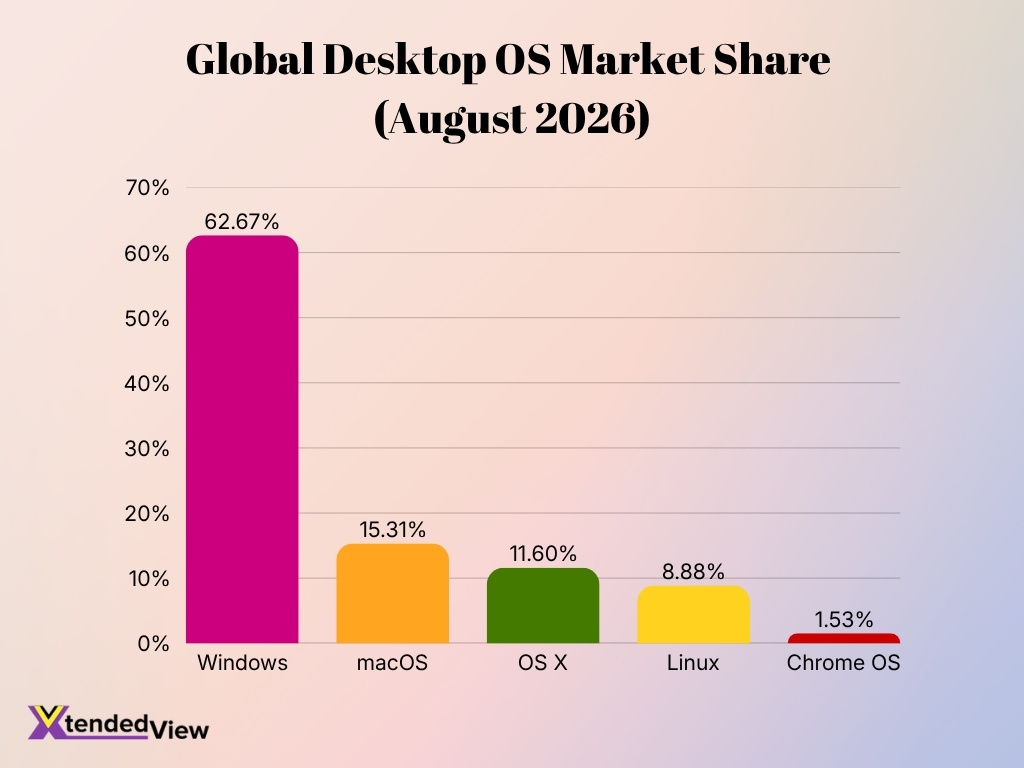
- Windows controlled 62.67% of worldwide desktop operating system usage in August 2026.
- macOS accounted for 15.31% of global desktop usage, making it the largest individually reported alternative to Windows in the August 2026 data.
- OS X represented another 11.6% of measured worldwide desktop usage.
- Linux reached 8.88% of global desktop usage in August 2026.
- Chrome OS accounted for 1.53% of worldwide desktop operating system usage.
- Windows’ 62.67% share was about 7.1 times Linux’s 8.88% share, showing the scale gap between the two platforms in general desktop web usage.
- The combined macOS and OS X categories represented 26.91% of worldwide desktop usage in August 2026, still less than half the Windows share.
- In August 2025, Windows represented 69.75% of worldwide desktop usage. The corresponding August 2026 figure was 62.67%, a difference of about 7.1 percentage points; changes in measured traffic and category attribution should be considered when interpreting the year-over-year comparison.
Microsoft Windows Market Share Statistics
- Windows represented 62.67% of global desktop usage in August 2026, retaining a majority share of the worldwide desktop market.
- On an all-device basis, which includes mobile platforms, Windows had a much smaller 26.49% worldwide share because Android and iOS account for large portions of smartphone traffic.
- Android held 38.66% of all-device operating system usage globally in August 2026, putting Windows 12.17 percentage points behind Android when desktop and mobile devices are combined.
- Windows remained substantially stronger on conventional PCs: its 62.67% desktop share was 36.18 percentage points higher than its 26.49% cross-device share.
- In the United States, Windows accounted for 53.25% of desktop operating system usage in August 2026.
- Windows performed more strongly in Europe, reaching 68.52% of desktop operating system usage in August 2026.
- North America recorded a 53.68% Windows desktop share in August 2026, significantly below the 68.52% measured in Europe.
- Japan remained a strong Windows desktop market, with Windows accounting for 75.04% of desktop operating system usage in August 2026.
Windows Version Market Share
- Windows 11 controlled 68.6% of the worldwide Windows desktop market in August 2026.
- Windows 10 remained in second place with 30.14%, meaning almost three in 10 measured Windows desktop sessions still came from Windows 10.
- Windows 7 accounted for 0.96% of worldwide Windows desktop usage in August 2026.
- Windows XP, first released more than two decades ago, still registered a measurable 0.14% share of Windows desktop usage.
- Windows 8.1 represented 0.11% of worldwide Windows desktops, while Windows 8 accounted for 0.03%.
- Windows 11’s 68.6% share was approximately 2.3 times Windows 10’s 30.14% share in August 2026.
- In June 2026, Windows 11 had reached 69.92%, while Windows 10 stood at 28.1%. By August, Windows 11 had eased to 68.6% and Windows 10 had recovered to 30.14%, showing that migration does not move in a straight line month to month.
- In August 2025, Windows 11 held about 49.02% and Windows 10 about 45.65%. One year later, their shares had moved to 68.6% and 30.14%, respectively.
Windows Market Share by Region and Country
- Windows held 53.25% of the U.S. desktop operating system market in August 2026. Linux stood at 18.19%, while OS X accounted for 17.6%.
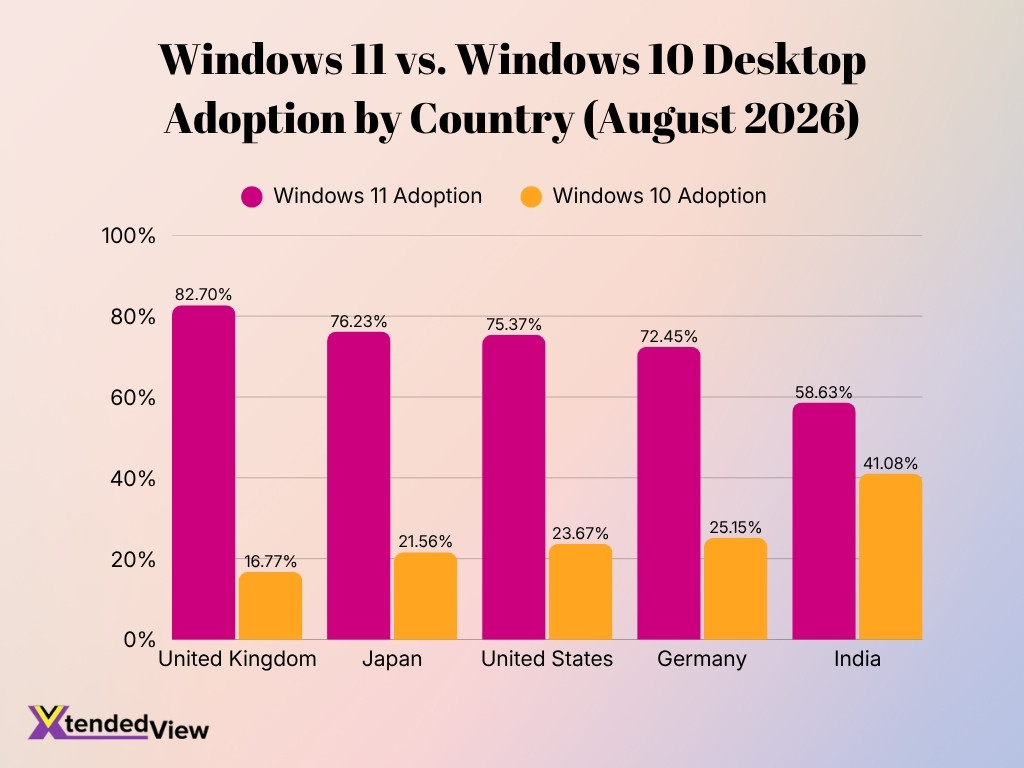
- Within the U.S. Windows installed-use mix, Windows 11 reached 75.37%, compared with 23.67% for Windows 10 in August 2026.
- Europe recorded a 68.52% Windows desktop share in August 2026, about 15.3 percentage points above the U.S. figure.
- North America as a whole recorded a 53.68% Windows desktop share, closely tracking the U.S. market.
- Japan recorded one of the stronger Windows positions among major developed PC markets, with 75.04% of desktop operating system usage coming from Windows.
- Windows 11 accounted for 76.23% of Windows desktops in Japan, while Windows 10 retained 21.56% in August 2026.
- The United Kingdom showed particularly fast version migration: 82.7% of Windows desktop usage came from Windows 11, while only 16.77% came from Windows 10.
- Germany’s Windows desktop mix was also heavily tilted toward Windows 11, which reached 72.45%, compared with 25.15% for Windows 10.
- India showed a slower Windows 11 transition. Windows 11 accounted for 58.63% of Windows desktop usage, while Windows 10 still represented 41.08% in August 2026.
- The gap between Windows 11 adoption in the United Kingdom and India reached roughly 24.1 percentage points in August 2026, 82.7% versus 58.63%, showing how hardware age, replacement cycles and migration timing can produce large country-level differences.
Windows Adoption Trends Over Time
- Windows 11 held just 36.6% of the worldwide Windows desktop market in January 2025, while Windows 10 still controlled 60.37%. This showed how much migration work remained less than nine months before Windows 10 support ended.
- By February 2025, Windows 11 had risen to 38.13%, while Windows 10 declined to 58.7%. The month-to-month movement marked the beginning of a faster migration cycle.
- Windows 11 finally overtook Windows 10 during July 2025, almost four years after its October 2021 launch. The crossover represented a major change in the Windows installed-use landscape.
- By September 2025, enterprise-focused asset data covering more than 8 million Windows devices showed Windows 11 running on 60.1% of corporate deployments. That figure had increased 26.3% from the beginning of 2025.
- Windows 11 represented 53.7% of worldwide Windows desktop usage in November 2025, compared with 42.7% for Windows 10. Migration continued after the Windows 10 support deadline, although Windows 10 remained widely used.
- Windows 11’s share temporarily dropped to 50.73% in December 2025, while Windows 10 increased to 44.68%. The reversal illustrates why individual monthly measurements should not automatically be treated as permanent adoption trends.
- By July 2026, a large asset-intelligence dataset placed Windows 11 at 78.8% of observed Windows devices, while Windows 10 had fallen to 16.9%. The remaining Windows 10 population increasingly consisted of difficult-to-migrate systems.
- Windows 10 had represented about half of Windows systems in that dataset in mid-2025, but its share fell to approximately 18.6% by June 2026. End-of-support pressure clearly accelerated migration over the 12-month period.
Windows 11 Adoption Statistics
- Windows 11 accounted for 68.6% of worldwide Windows desktop usage in August 2026, establishing a clear lead over Windows 10. This compares with a much smaller share at the beginning of 2025.
- Enterprise deployment data from September 2025 showed Windows 11 running on 60.1% of corporate Windows devices, up 9.5 percentage points from July 2025.
- In June 2025, only about 50% of enterprise Windows endpoints in a study of more than 1 million devices had completed their Windows 11 migration. A year earlier, only 18% had moved to Windows 11.
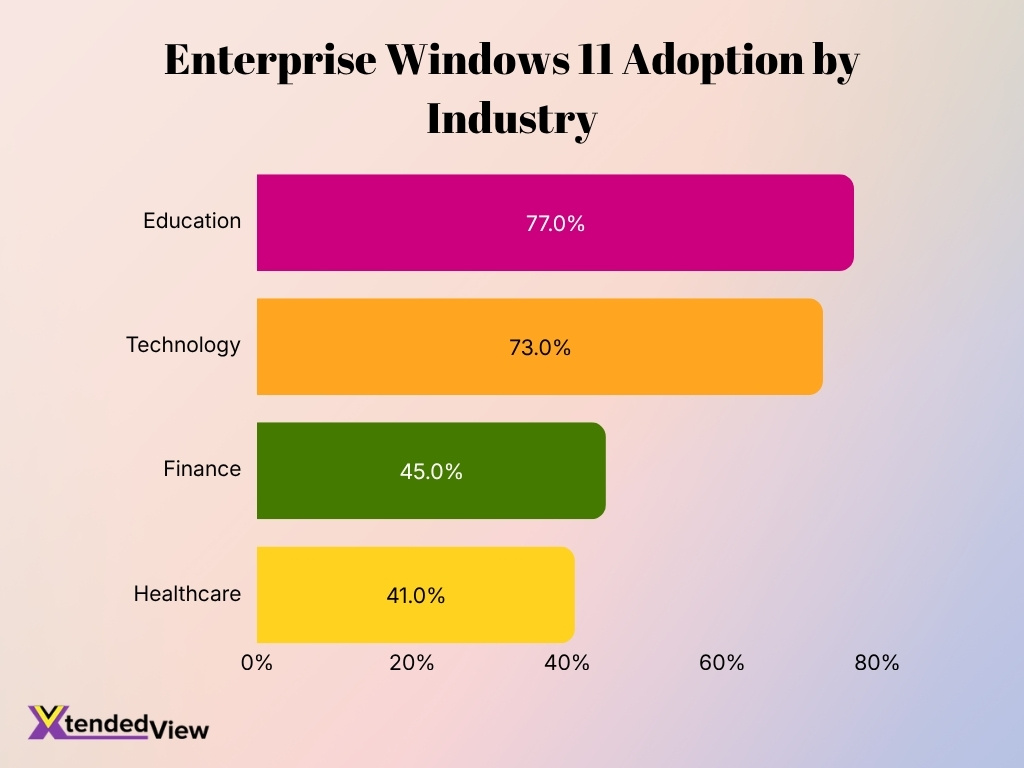
- Education organizations led the June 2025 enterprise sample, with 77% of devices already running Windows 11. Technology organizations followed at 73%.
- Healthcare lagged substantially in the same enterprise sample, with only 41% of endpoints migrated to Windows 11. Finance performed slightly better at 45%.
- Europe had completed Windows 11 migration on 70% of measured enterprise endpoints by June 2025, compared with only 43% in the Americas. Other regions averaged 66%.
- Very large organizations with more than 10,000 Windows devices had completed only 42% of their migrations by June 2025. Their scale made application testing, hardware replacement and deployment coordination more complex.
- By July 2026, Windows 11 represented 78.8% of Windows devices in a dataset drawn from millions of assets across tens of thousands of active customer environments, indicating substantial post-support-deadline migration.
Windows Usage in Enterprise and Business Environments
- A June 2025 enterprise study examined more than 1 million Windows endpoints, providing a large snapshot of business migration behavior ahead of Windows 10 end of support.
- At that point, roughly 50% of enterprise endpoints had completed their Windows 11 migration, up dramatically from only 18% in the comparable 2024 study.
- Windows Enterprise editions dominate managed corporate fleets. One 2025 endpoint dataset found that 90% of Windows 11 systems in measured enterprise environments used an Enterprise SKU, compared with 9% running Pro.
- Windows 10 showed a similar business-edition pattern: 87.7% of measured Windows 10 machines used Enterprise, while 10.7% ran Pro and about 1% used IoT editions.
- Education organizations were among the quickest business-sector adopters in June 2025, with 77% of endpoints on Windows 11. Technology organizations reached 73%.
- Healthcare organizations lagged at 41% Windows 11 adoption, and 19% of healthcare endpoints in the study required complete replacement before they could support Windows 11.
- Finance organizations reached 45% Windows 11 adoption in the same study, but only about 3% of their devices required replacement, indicating that migration timing rather than hardware represented the larger barrier.
- In July 2026, 21.4% of small and midsize business Windows machines in another dataset still ran Windows 10, compared with 16.6% among enterprise-scale organizations.
- Industry differences remained substantial in 2026. Windows 10 still ran on 23% of healthcare and pharmaceutical devices, 22.7% of retail devices, and 18% of manufacturing devices in the measured environment.
- Windows 11 Enterprise and Education version 25H2 remains supported until October 2028, while version 26H1 receives Enterprise and Education updates through March 2029, giving IT teams longer servicing windows than Home and Pro users receive.
Impact of Windows 10 End of Support on Adoption
- Standard support for Windows 10 Home, Pro, Enterprise and Education ended on Oct. 14, 2025, eliminating regular security updates for conventional installations outside qualifying extended-support arrangements.
- In September 2025, one month before the deadline, 39.9% of measured corporate Windows devices still used an operating system approaching end of support. That translated into millions of devices requiring migration, replacement or extended servicing.
- Windows 11 enterprise adoption increased 26.3% between the start of 2025 and September 2025 in one dataset, demonstrating how the support deadline accelerated upgrade activity.
- Enterprise Windows 11 adoption rose from roughly 50% in Q2 2025 to about 80% in Q3 2025 in another large endpoint dataset as the October deadline approached.
- Virtual desktop environments moved more slowly. Windows 11 accounted for only 40% of measured VDI deployments around the support deadline, although that was up from approximately 25% in June 2025.
- By July 2026, Windows 10’s share had fallen to 16.9% of Windows clients in a large enterprise-oriented asset dataset, down from roughly half of Windows machines around mid-2025.
- Hardware remains a barrier for some holdouts. About 2.8% of remaining Windows 10 devices in the July 2026 dataset could not meet Windows 11 hardware requirements and therefore required physical replacement.
- The hardware constraint varies sharply by sector: 7.8% of remaining retail Windows 10 devices, 6.1% in transportation and logistics, and 3% in manufacturing could not migrate because of hardware limitations.
- Although most mainstream Windows 10 editions have passed end of support, specialized versions follow different schedules. Windows 10 Enterprise LTSC 2021 remains supported until Jan. 12, 2027, while Windows 10 IoT Enterprise LTSC 2021 extends to January 2032.
Windows vs. macOS vs. Linux: Desktop OS Comparison
- Windows remained the largest worldwide desktop operating system in August 2026, accounting for 62.67% of measured desktop usage.
- macOS represented 15.31% of desktop usage in August 2026, while the separately categorized OS X segment accounted for another 11.6%.
- Linux held 8.88% of worldwide desktop usage in August 2026. Although still far below Windows, Linux’s share was materially higher than its 3.39% measured share in August 2025.
- Chrome OS accounted for 1.53% of worldwide desktop usage in August 2026, making its measured footprint significantly smaller than Windows, macOS or Linux.
- Windows’ 62.67% share was about 7.1 times Linux’s 8.88% share in August 2026, demonstrating Windows’ continued lead in general-purpose desktop usage.
- Combining the macOS and OS X categories produces 26.91% of measured desktop usage, meaning Windows’ share remained more than twice as large as Apple’s combined desktop categories.
- In August 2025, Windows held 69.75% of worldwide desktop usage, compared with 8.69% for OS X, 4.79% for macOS and 3.39% for Linux.
- Between August 2025 and August 2026, Windows’ measured desktop share moved from 69.75% to 62.67%, while Linux moved from 3.39% to 8.88%. Changes in traffic measurement and operating-system classification mean these figures describe observed web usage rather than the exact installed PC population.
Windows Security and Vulnerability Statistics
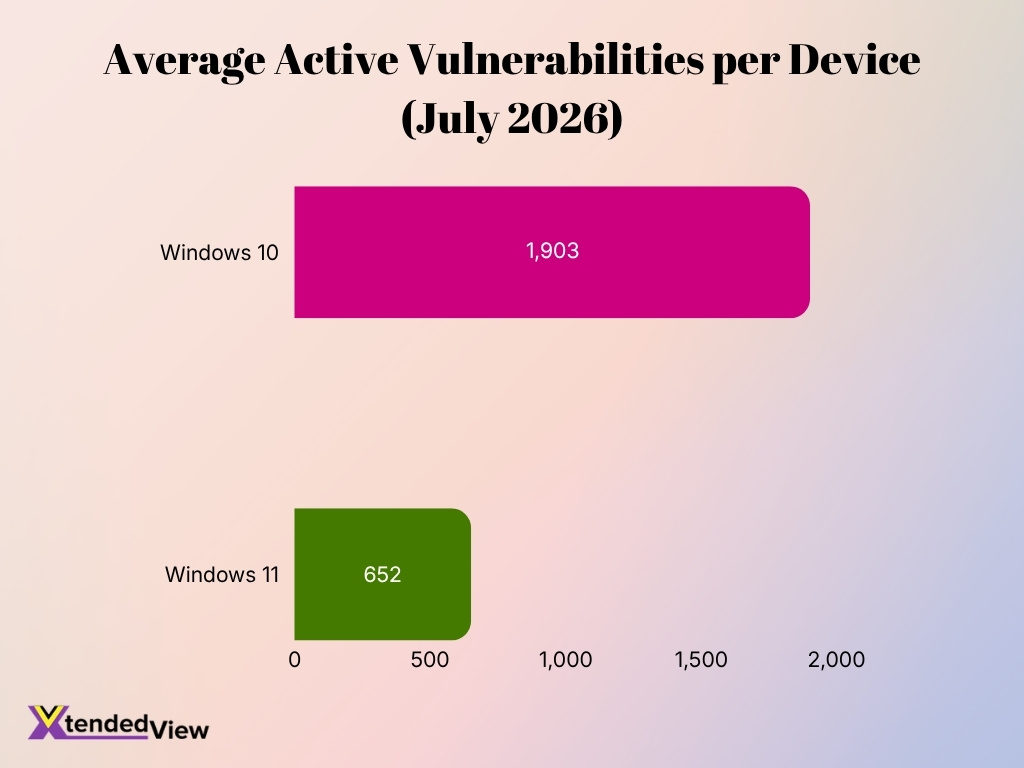
- By July 2026, an average measured Windows 10 device carried 1,903 active CVEs, compared with 652 on Windows 11. That equates to about 2.9 times as many active vulnerabilities per device.
- About 66.6% of active CVEs on Windows 10 devices in that dataset carried high or critical severity ratings. The concentration raises the risk for organizations maintaining unsupported Windows 10 systems.
- Approximately 2.4% of active Windows 10 CVEs in the dataset were already known to face exploitation in the wild, roughly 1.7 times the corresponding rate measured on Windows 11.
- Unsupported Windows versions extended beyond Windows 10. Counting Windows 7, Windows 8.1, and Windows XP alongside unsupported Windows 10 configurations put 18.7% of observed Windows devices on an end-of-life operating system in July 2026.
- When systems scheduled to lose support within six months were added, the affected proportion rose to 40.9% of measured Windows devices, illustrating how lifecycle management can quickly expand security exposure.
- Among known cyberattack motivations measured in the 2025 threat landscape, more than 52% involved extortion or ransomware, while espionage accounted for just 4%.
- Attackers attempted to steal data in 80% of investigated security incidents, showing why endpoint operating-system security remains tied closely to broader identity and data-protection controls.
- 97% of observed identity attacks involved password spraying. Despite the growth of more advanced techniques, large-scale credential attacks continued to exploit weak or reused passwords.
- Security systems processed more than 100 trillion signals per day, including roughly 38 million identity-risk detections and 5 billion email scans for phishing and malware threats.
- During a 2025 disruption targeting a major information-stealing malware operation, authorities and security teams seized or blocked more than 2,300 malicious domains, cutting infected machines off from key criminal infrastructure.
Windows Mobile and Tablet Market Share
- Windows has almost disappeared from the mobile operating system market. It accounted for just 0.01% of worldwide mobile usage in August 2026.
- Android dominated worldwide mobile usage with 67.45% in August 2026, while iOS accounted for 32.52%. Windows therefore represented only a tiny fraction of modern smartphone traffic.
- When smartphones and tablets are combined, Windows again represented approximately 0.01% of worldwide operating-system usage in August 2026.
- Android accounted for 67% of combined mobile and tablet operating-system activity in August 2026, compared with 32.96% for iOS.
- In July 2026, Windows also held only 0.01% of combined mobile and tablet usage, suggesting that its residual share remained essentially unchanged month to month.
- Windows becomes much more significant once desktop devices enter the calculation. Across desktop, mobile and tablet devices combined, Windows represented 26.5% of worldwide operating-system usage in August 2026.
- In the desktop-and-tablet category, Windows reached 60.19% in August 2026, compared with 14.71% for macOS, 11.14% for OS X, 8.53% for Linux, 2.07% for iOS and 1.88% for Android.
- The contrast between Windows’ 60.19% desktop-and-tablet share and its roughly 0.01% mobile-and-tablet share highlights how strongly Windows usage remains concentrated in traditional PCs and PC-class devices rather than smartphones.
- Across all major device classes, Windows held 26.49% of worldwide operating-system usage in August 2026. Android led with 38.66%, followed by Windows and then iOS at 19.02%.
Windows PC and Device Statistics
- Worldwide PC shipments reached more than 270 million units in 2025, up 9.1% from 2024. Windows 11 upgrades contributed to the rebound as consumers and businesses replaced aging systems before and after Windows 10’s support deadline.
- Global PC shipments totaled 62.8 million units in Q1 2026, a 4% year-over-year increase. Inventory building ahead of expected memory-related price increases contributed to that growth rather than pure end-user demand.
- The largest PC vendor shipped approximately 16.6 million units in Q1 2026, capturing 26.5% of the worldwide market. The second-largest vendor shipped about 12.1 million units for a 19.3% share.
- The third-largest PC supplier shipped 10.3 million systems during Q1 2026, up 7.6% from the same quarter of 2025. Its worldwide market share reached 16.5%.
- Worldwide desktop, notebook and workstation shipments fell 3.6% year over year to 65.7 million units in Q2 2026, reflecting higher memory and storage costs.
- Notebook and mobile workstation shipments totaled 51.7 million units in Q2 2026, down 4.2% year over year. Desktop and desktop workstation shipments reached 13.9 million units, down 1.3%.
- Another major industry estimate placed Q2 2026 worldwide PC shipments at 68.2 million units, a 4.9% year-over-year decline. Differences between tracking methodologies explain why industry shipment estimates do not always match exactly.
- Rising component costs are expected to reshape the Windows PC replacement cycle. One 2026 forecast projects PC prices rising 17% compared with 2025, while business buyers extend average device lifetimes by 15% and consumers by 20%.
- Memory and solid-state storage prices combined are projected to increase by 130% by the end of 2026 compared with prior cost levels used in the forecast, putting particular pressure on low-priced Windows PCs.
Windows Revenue and Microsoft Business Statistics
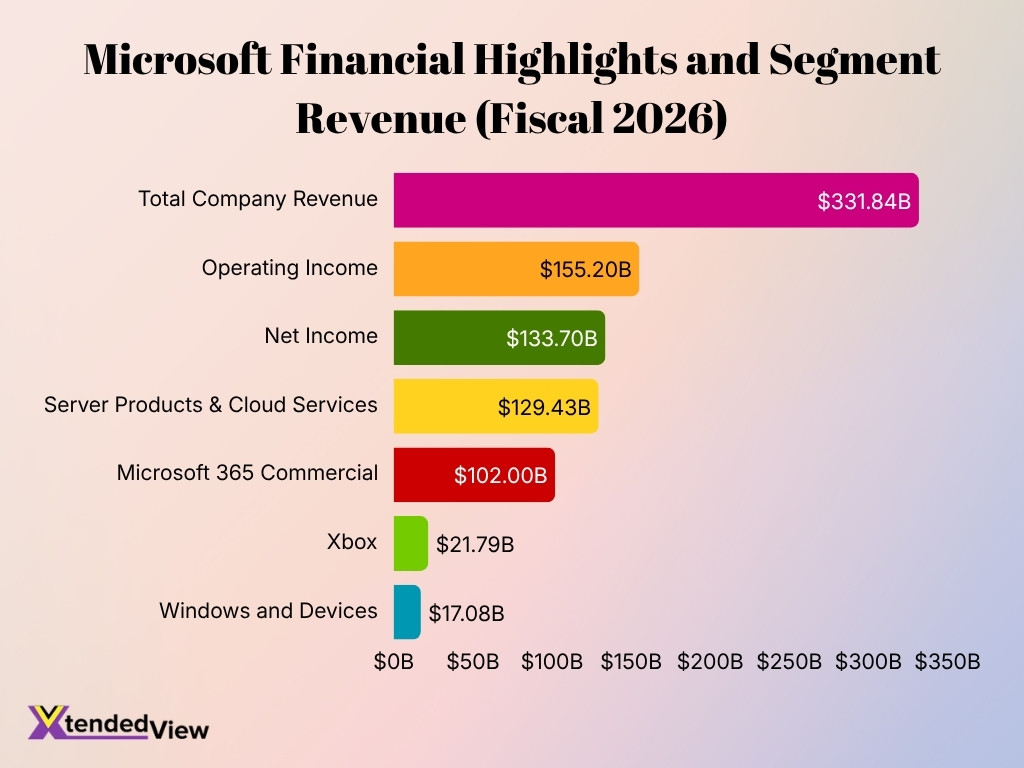
- Total fiscal 2026 company revenue reached $331.84 billion, up 18% from $281.72 billion in fiscal 2025. The fiscal year ended June 30, 2026.
- Fiscal 2026 operating income increased 21% to $155.2 billion, demonstrating that the broader business continued expanding even as the Windows hardware-related segment faced a more difficult PC market.
- Fiscal 2026 net income reached $133.7 billion, up 31% on a GAAP basis from the previous fiscal year.
- Windows and Devices generated $17.08 billion in fiscal 2026 revenue, compared with $17.31 billion in fiscal 2025 and $17.03 billion in fiscal 2024.
- Windows and Devices revenue therefore declined by approximately 1.3% year over year in fiscal 2026 despite the Windows 11 PC replacement cycle.
- Revenue from the More Personal Computing segment totaled $12.9 billion in fiscal Q4 2026, declining 4% year over year and 5% in constant currency.
- Windows OEM and Devices revenue fell 7% year over year in fiscal Q4 2026, reflecting weaker PC market conditions and pressure on device sales.
- Xbox generated $21.79 billion in fiscal 2026 revenue, down from $23.46 billion in fiscal 2025. That represents a decline of roughly 7.1%.
- Server products and cloud services generated $129.43 billion in fiscal 2026, while Microsoft 365 Commercial products and cloud services contributed another $102 billion. These businesses are now substantially larger than Windows and Devices in direct reported revenue.
- The company returned $10.2 billion to shareholders through dividends and share repurchases during fiscal Q4 2026.
Windows in the Gaming Market
- Windows accounted for 93.95% of surveyed gaming systems in August 2026, keeping the operating system overwhelmingly dominant among PC gamers participating in the monthly hardware survey.
- Windows 11 64-bit represented 70.97% of all surveyed gaming systems in August 2026, rising 0.71 percentage points from July.
- When the survey is limited specifically to Windows PCs, Windows 11 reached 75.53% in August 2026, up from 75.01% in July.
- Windows 10 retained 24.37% of Windows gaming PCs in August 2026, down 0.51 percentage points month over month. Windows 7 accounted for only 0.07%.
- Windows 11’s share among Windows gaming PCs climbed from 71.80% in April 2026 to 75.53% in August, a gain of 3.73 percentage points in four months.
- Windows 10 moved in the opposite direction, declining from 27.16% in April to 24.37% in August 2026 among surveyed Windows gaming systems.
- 16 GB of system memory remained the most common Windows gaming configuration, appearing in approximately 41% of surveyed Windows PCs in August 2026.
- Windows’ 93.95% overall gaming-platform share compared with 3.90% for Linux and 2.14% for macOS in August 2026. The figures show why Windows remains the primary desktop target for most mainstream PC game releases.
- Eight-core processors represented about 28% of surveyed gaming PCs in August 2026, narrowly ahead of six-core systems at roughly 27%, reflecting the gradual move toward higher core counts in Windows gaming hardware.
Windows App and Microsoft Store Statistics
- The Windows app marketplace served more than 250 million monthly active users during 2025, giving application developers access to one of the largest PC-focused software distribution audiences.
- Individual developer registration became free in 2025 across nearly 200 markets worldwide, eliminating the previous onboarding fee and credit-card requirement for eligible individual publishers.
- Hundreds of new AI-capable applications entered the Windows marketplace during the two years leading into 2025, reflecting growing developer interest in generative AI and on-device AI software.
- One featured AI application reported a 245% increase in product-page views after participating in the platform’s AI discovery program. Its installs increased 13%, while new active users grew 24%.
- Store performance work completed by late 2024 reduced application launch time by 25% and cut reported download-hanging problems by 50%. Those improvements formed the performance baseline for further updates during 2025 and 2026.
- Personalized Store recommendations expanded during 2025 from the home page into dedicated apps and games sections, while AI-related product badges began appearing on product pages in June.
- The refreshed AI discovery section was available in 10 major markets during 2025, including the United States, Canada, the United Kingdom, Germany, France, Italy, Japan, China, Australia and New Zealand.
- A new special-events discovery feature began rolling out across five initial markets, the United States, United Kingdom, Canada, Australia and New Zealand, to highlight in-app events, game events and feature releases.
- Regulatory changes in Europe expanded user choice during 2025, including the ability to uninstall the Windows app marketplace on Windows 10 and Windows 11 retail PCs in the European Economic Area.
Future Outlook for Windows Market Share
- Worldwide PC shipments are forecast to decline 10.4% in 2026 as rapidly rising memory prices increase device costs and encourage buyers to extend replacement cycles.
- The forecast assumes combined DRAM and SSD prices increase 130% by the end of 2026, contributing to an estimated 17% increase in PC prices versus 2025.
- Higher hardware prices could extend PC lifetimes by 15% for business buyers and 20% for consumers by the end of 2026. Longer replacement cycles may slow the natural migration of older Windows devices.
- Earlier forecasts expected AI-capable PCs to reach approximately 143 million shipments in 2026, representing about 55% of the PC market. Subsequent memory-cost pressure has made the timing of that adoption more uncertain.
- AI PCs represented an estimated 31% of the worldwide PC market in 2025, up from 15.6% in 2024. The long-term trajectory still points toward AI hardware becoming standard even if 2026 shortages slow the transition.
- By the end of 2026, approximately 40% of software vendors were previously forecast to prioritize investment in AI functionality running directly on PCs, up from only 2% in 2024.
- Windows 11 version 24H2 Home and Pro reaches end of servicing on Oct. 13, 2026, while version 25H2 remains supported until Oct. 12, 2027, creating another scheduled wave of Windows version upgrades.
- Windows 11 version 26H1 receives Home and Pro updates through March 14, 2028, while Enterprise and Education editions are supported through March 13, 2029.
- Commercial Windows 10 Extended Security Updates can continue through as many as three ESU years, with the third commercial year ending Oct. 10, 2028. This gives organizations more time to migrate specialized devices that cannot immediately move to Windows 11.
- For consumers, an important 2026 change extended Windows 10 Extended Security Updates for personal-use devices through Oct. 12, 2027. That additional year may slow the final disappearance of Windows 10 while giving households more time to replace incompatible PCs.
Frequently Asked Questions (FAQs)
Windows held 62.67% of worldwide desktop operating system usage in August 2026.
Windows 11 accounted for 68.6% of worldwide Windows desktop usage in August 2026, compared with 30.14% for Windows 10.
Windows represented 93.95% of surveyed gaming systems in August 2026, while Windows 11 alone accounted for 70.97% of all surveyed systems.
Windows and Devices generated $17.08 billion in fiscal 2026, down from $17.31 billion in fiscal 2025.
Worldwide desktop, notebook, and workstation shipments totaled 65.7 million units in Q2 2026, down 3.6% year over year.
Conclusion
Windows remains the dominant desktop operating system, but its position is increasingly defined by transition rather than simple market leadership. Windows 11 now leads the Windows installed base, while the decline of Windows 10 is being shaped by end-of-support deadlines, hardware compatibility requirements, enterprise migration schedules, and extended security options. The shift is especially important for businesses that must balance security, application compatibility, device replacement costs, and long-term support planning.
At the same time, Windows continues to hold an exceptionally strong position in PC gaming and remains deeply embedded in workplace computing and the global PC hardware ecosystem. AI-capable PCs could create another upgrade cycle, although higher memory and storage costs may slow replacement activity in the near term. Windows therefore enters its next phase with a large installed base and strong ecosystem advantages, but future market share will depend on how quickly users adopt supported Windows 11 releases, how affordable new PCs remain, and how effectively the platform competes across productivity, gaming, security, and AI-driven computing.
