



The media and entertainment industry continues to reshape how people consume information, watch content, play games, and engage with brands. Streaming platforms, digital advertising, AI-powered content creation, and live events are driving new business models across the United States and worldwide. Businesses use these insights to plan advertising budgets, while investors, creators, and media companies rely on industry data to identify growth opportunities. Explore the latest statistics below to understand where the industry stands and where it is headed next.
Editor’s Choice
- The global entertainment and media industry is projected to reach $4.2 trillion by 2030, supported by AI-powered advertising, streaming, and live experiences.
- Global entertainment and media revenue moved toward $3 trillion in 2024, with forecasts indicating approximately $3.5 trillion by 2029.
- The United States remains the world’s largest entertainment and media market, with the OTT video segment expected to grow from $61.9 billion in 2024 to $112.7 billion by 2029.
- Global advertising revenue within the media and entertainment sector surpassed $1 trillion in 2025 and is forecast to reach $1.4 trillion by 2030.
- The U.S. internet advertising market reached $258.6 billion in 2024 after growing 14.9% year over year.
- Global video game revenue totaled approximately $224 billion in 2024, exceeding the combined revenue of the movie and recorded music industries.
- Non-digital entertainment, including live music, cinema, and events, still represented 61% of consumer entertainment spending in 2024, highlighting continued demand for in-person experiences.
Recent Developments
- Media companies increasingly adopted AI-assisted production, localization, and personalization throughout 2025 and 2026 to improve efficiency and audience engagement.
- Global advertising revenue crossed the $1 trillion milestone in 2025, with AI becoming a major driver of campaign optimization.
- Connected TV advertising continues to expand rapidly as advertisers shift budgets away from traditional television.
- Streaming platforms increasingly rely on ad-supported subscription plans, bundled offerings, and password-sharing restrictions to improve profitability.
- Live entertainment, including concerts and sporting events, remains one of the fastest-growing consumer spending categories following strong attendance in 2025.
- Global cinema revenue is expected to recover steadily, rising from $33 billion in 2024 toward approximately $42 billion by 2029.
- Regional and locally produced content continues gaining market share, reducing the dominance of major Hollywood studios in several international markets.
- Generative AI investment exceeded $56 billion in 2024, accelerating innovation across media production, advertising, and content management.
- Streaming platforms increasingly compete through exclusive live sports rights, premium content, and bundled subscriptions rather than subscriber growth alone.
Media and Entertainment Industry Overview
- The media and entertainment industry spans television, film, streaming, gaming, publishing, music, advertising, podcasts, radio, and live events.
- The industry generated nearly $3 trillion in worldwide revenue during 2024 and continues growing steadily.
- Advertising has become the industry’s fastest-growing major revenue stream, outpacing consumer spending.
- Digital platforms continue capturing a larger share of audience attention than traditional broadcast channels.
- Video gaming remains among the largest entertainment categories globally by annual revenue.
- Streaming services continue expanding through subscription, advertising, and hybrid business models.
- AI is transforming content discovery, production workflows, recommendation systems, and digital advertising across the sector.
- The U.S. remains the largest entertainment and media market globally, while countries such as India and Indonesia are growing at faster rates.
- Consumer demand increasingly favors personalized, on-demand, and mobile-first entertainment experiences.
Entertainment and Media Market Size
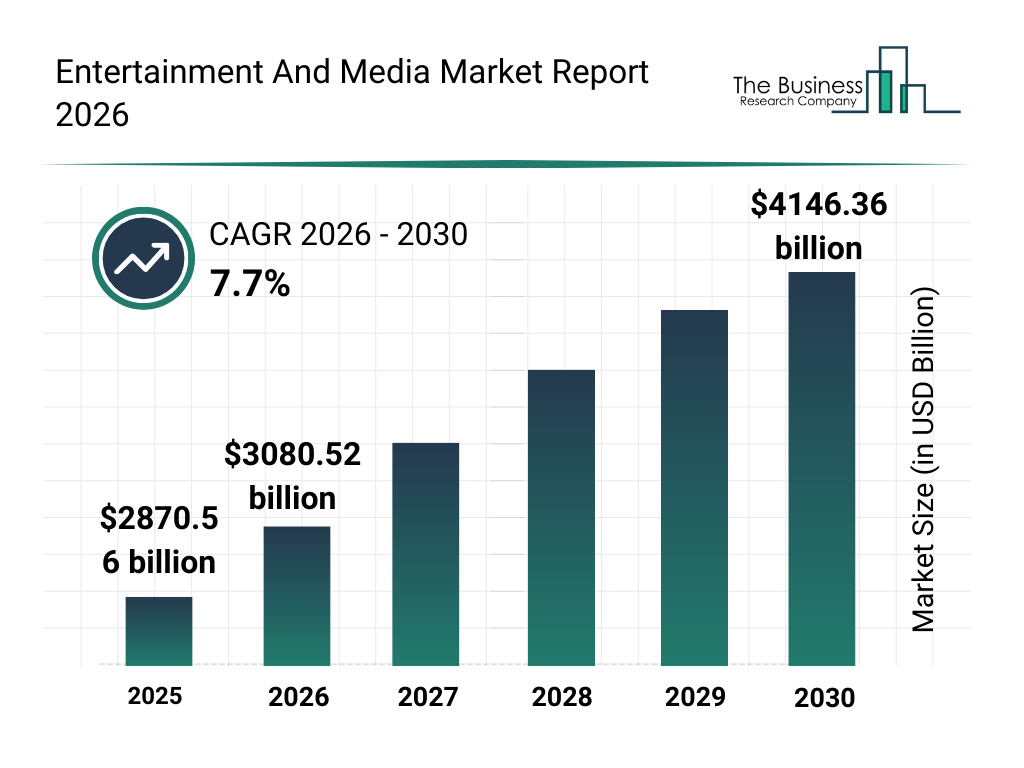
- The global entertainment and media market was valued at $2,870.56 billion in 2025.
- The market is projected to reach $3,080.52 billion in 2026, reflecting strong annual expansion.
- Industry revenue is expected to rise to approximately $3,317.72 billion in 2027.
- The market could grow further to nearly $3,573.18 billion by 2028.
- By 2029, the entertainment and media sector is estimated to generate around $3,848.32 billion.
- The global market is forecast to reach $4,146.36 billion by 2030.
- From 2026 to 2030, the industry is expected to grow at a 7.7% CAGR.
- Overall, the market is projected to add more than $1.27 trillion in value between 2025 and 2030.
Media and Entertainment Market Growth
- The global entertainment and media industry is expected to grow at approximately 3% to 4% annually through the end of the decade.
- Advertising spending is projected to grow roughly three times faster than direct consumer spending.
- The U.S. internet advertising market is forecast to reach $389.1 billion by 2029.
- U.S. OTT revenue is projected to grow at a 5.9% CAGR between 2024 and 2029.
- Global gaming revenue is forecast to approach $300 billion by 2029.
- Connected TV advertising continues to record double-digit growth as marketers increase digital video spending.
- AI-powered personalization is expected to become a primary driver of advertising efficiency and media monetization during the forecast period.
- Developing markets continue posting faster entertainment and media growth than mature economies, supported by rising internet access and smartphone adoption.
- Live events, concerts, and experiential entertainment remain among the fastest-growing consumer spending categories entering 2026.
Media and Entertainment Industry Revenue
- Global entertainment and media revenue approached $3 trillion during 2024.
- Industry revenue is projected to increase to $3.5 trillion by 2029.
- Updated forecasts indicate revenue could reach approximately $4.2 trillion by 2030.
- The U.S. internet advertising market generated $258.6 billion during 2024.
- Global video game revenue totaled approximately $224 billion in 2024.
- Global cinema revenue is forecast to grow from $33 billion in 2024 to approximately $42 billion by 2029.
- Connected TV advertising revenue continues expanding rapidly as streaming platforms increase ad inventory.
- Advertising now contributes a growing share of total media revenue as subscription growth moderates across mature streaming markets.
- Live entertainment revenues continue strengthening through concerts, festivals, sporting events, and experiential entertainment offerings.
Employment Trends in the Media and Entertainment Industry
- The U.S. performing arts, spectator sports, and related industries employed approximately 608,800 people in May 2026, reflecting continued recovery in entertainment hiring.
- Industry employment remained above 600,000 workers throughout much of 2025 and 2026 despite seasonal fluctuations.
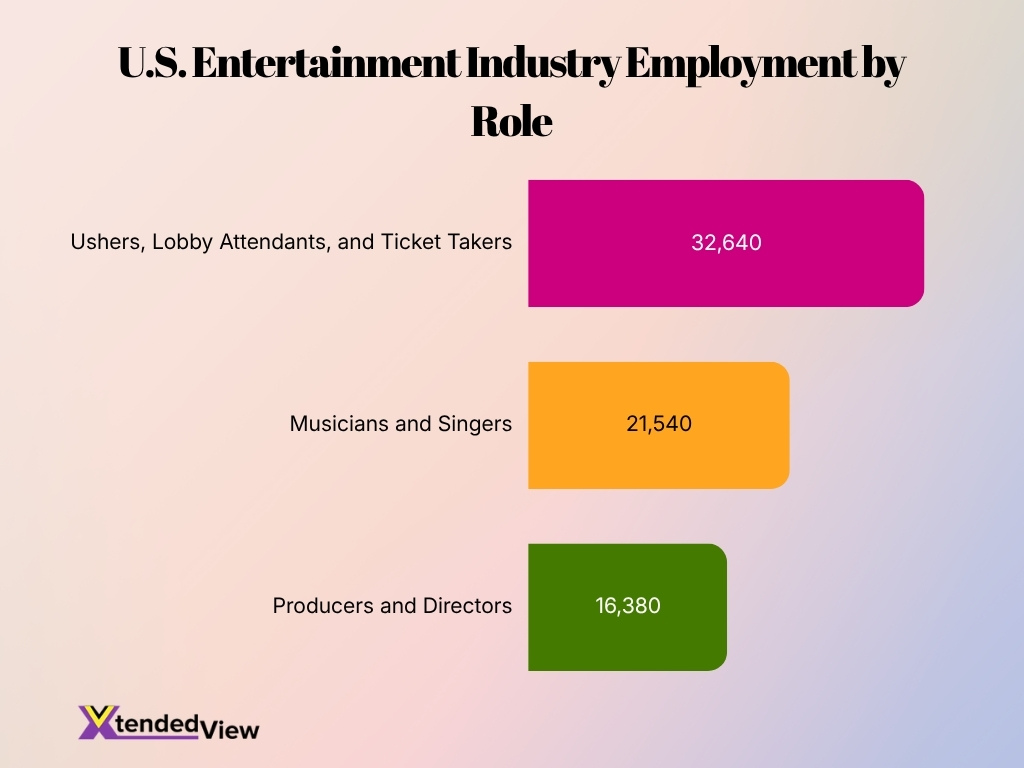
- There were 21,540 musicians and singers employed in the U.S. during 2025.
- The industry employed 16,380 producers and directors in 2025, highlighting sustained demand for film, television, and streaming content.
- About 32,640 ushers, lobby attendants, and ticket takers worked across entertainment venues in 2025.
- The median annual wage for entertainment and sports occupations reached $54,870 in 2024, exceeding the median for all occupations.
- The U.S. labor market is expected to generate around 99,700 entertainment and sports job openings annually between 2024 and 2034 through growth and workforce replacement.
- Private establishments in performing arts and spectator sports increased to 85,891 locations by the fourth quarter of 2025.
- Producers and directors earned a median annual salary of $74,240 in 2025, reflecting the growing value of premium content creation.
Media and Entertainment Industry Contribution to GDP
- The global media and entertainment industry generated nearly $3 trillion in economic activity during 2024.
- Industry revenue is forecast to reach $3.5 trillion by 2029, increasing its contribution to global economic output.
- Advertising is projected to expand at an annual rate of 6.1%, roughly three times faster than consumer entertainment spending.
- Non-digital entertainment, including live events, cinema, and music, represented 61% of total consumer entertainment spending in 2024.
- The global video game industry produced $224 billion in revenue during 2024, making it one of the largest contributors within the sector.
- Global cinema revenue is expected to increase from $33 billion in 2024 to approximately $42 billion by 2029.
- Digital advertising continues to account for a growing share of GDP generated by media businesses as brands shift budgets toward online platforms.
- The United States remains the world’s largest entertainment and media economy, contributing a substantial share of global industry output.
- Fast-growing digital markets in Asia are expanding the industry’s contribution to regional GDP through streaming, gaming, and internet advertising.
Streaming Industry Statistics
- The global video streaming market is projected to surge from $159.98 billion in 2025 to $873.21 billion by 2035.
- U.S. OTT video revenue is projected to increase from $61.9 billion in 2024 to $112.7 billion by 2029.
- Ad-supported subscription tiers accounted for over 60% of new signups in available global markets during early 2026.
- The global sports streaming market reached $33.9 billion in 2026 and is growing at a 12.6% CAGR.
- Connected TV (CTV) ad spend in the U.S. is projected to reach $38 billion by the end of 2026.
- OTT revenue in India is projected to reach $3.5 billion by 2029, heavily driven by regional-language content.
- Advertising-based Video on Demand (AVOD) revenues are expected to more than double from $30 billion in 2023 to $69 billion by 2029.
- Subscription Video on Demand (SVOD) platforms maintained their dominance by holding 69.2% of all video streaming revenue in 2025.
Media and Entertainment Revenue by Segment
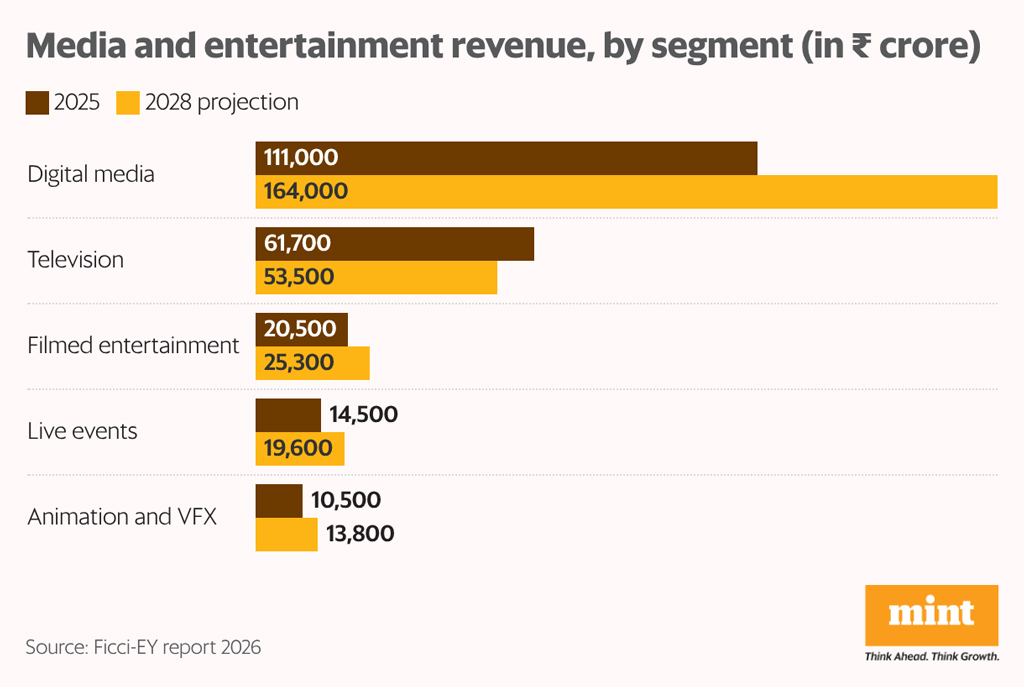
- Digital media is the largest segment, with revenue projected to rise from ₹111,000 crore in 2025 to ₹164,000 crore by 2028.
- Digital media is expected to add ₹53,000 crore in revenue, representing growth of approximately 47.7% over the period.
- Television is the only segment forecast to decline, falling from ₹61,700 crore to ₹53,500 crore by 2028.
- Television revenue is projected to decrease by ₹8,200 crore, equivalent to a decline of about 13.3%.
- Filmed entertainment is expected to grow from ₹20,500 crore in 2025 to ₹25,300 crore in 2028.
- Live events revenue is projected to increase by ₹5,100 crore, reaching ₹19,600 crore by 2028.
- Live events may record the fastest percentage growth at approximately 35.2% between 2025 and 2028.
- Animation and VFX revenue is forecast to rise from ₹10,500 crore to ₹13,800 crore, reflecting growth of about 31.4%.
- The combined revenue of these five segments is projected to increase from ₹218,200 crore in 2025 to ₹276,200 crore in 2028.
- Overall, the data highlights a strong industry shift toward digital-first entertainment, while traditional television faces revenue pressure.
Cable TV and Cord-Cutting Statistics
- By 2026, an estimated 80 million US households will be cord-cutters, compounding the 20 million lost subscribers that pay-TV providers have suffered since 2014.
- Connected TV (CTV) ad spending is projected to climb by 14.5% to reach $37.95 billion in 2026 as marketing budgets rapidly abandon linear television.
- Approximately 28% of Americans operate as hybrid viewers, maintaining a traditional cable subscription while simultaneously using digital streaming services.
- Live sports remains the primary anchor for linear television, driving 18.4% of former cord-cutters to eventually return to traditional cable packages.
- Media network licensing strategies continue to shift as streaming services captured a record-breaking 47.5% of all total TV viewing time by late 2025.
- Traditional television is losing younger demographics completely, with 45% of adults aged 18 to 29 reporting they have never subscribed to cable or satellite services.
- The global streaming service industry revenue is aggressively expanding and is projected to hit $300 billion by 2030 as media companies diversify.
- Connected TV platforms will be actively used by nearly 120 million US households in 2026, establishing it as the most dominant medium for digital audiences.
Movie and Box Office Statistics
- Global cinema revenue is projected to grow from $33 billion in 2024 to around $42 billion by 2029.
- Worldwide box office revenue reached approximately $27.5 billion in 2025, improving from $24.9 billion in 2024.
- Inside Out 2 became the highest-grossing film of 2024 with nearly $1.70 billion in worldwide ticket sales.
- More than 9,600 feature films were produced globally in 2024, marking a record high.
- The combined market share of the five largest U.S. film studios declined to 51% in 2024, reflecting stronger local-language productions.
- International audiences increasingly favor locally produced films over imported Hollywood releases.
- Premium large-format theaters continue generating higher average ticket revenue than standard cinema screens.
- The global theatrical market continues recovering but remains below its 2019 revenue peak.
- Film studios increasingly release content across theaters and streaming platforms as part of hybrid distribution strategies.
Global Media and Entertainment Revenue Share by Region
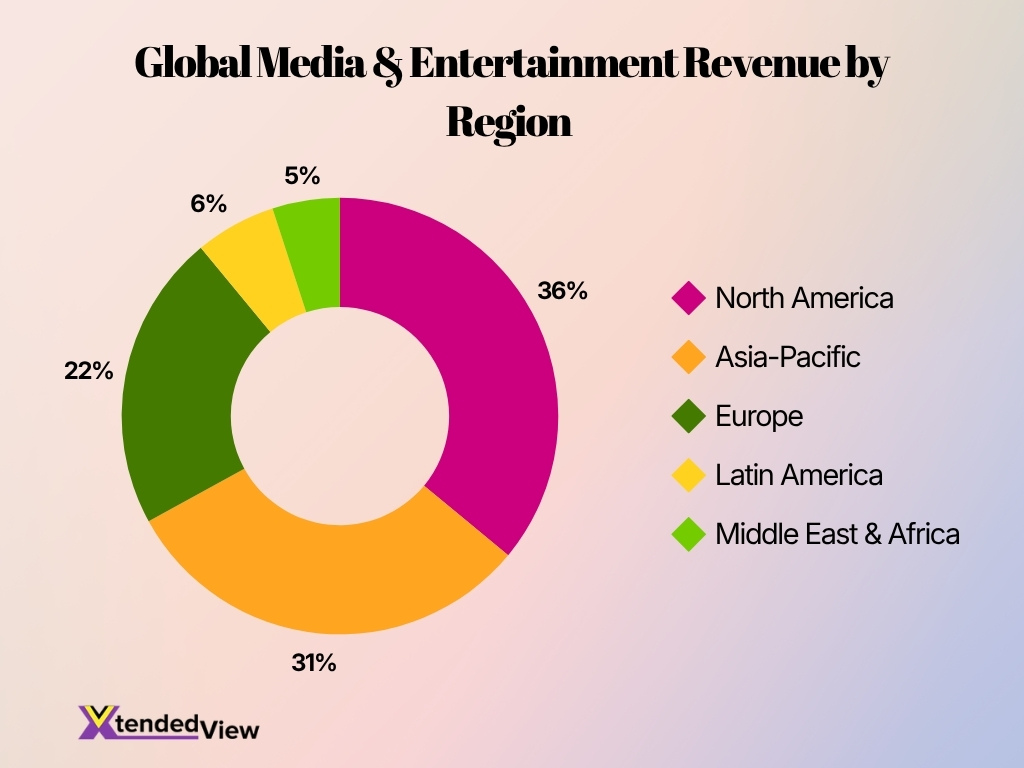
- North America leads the global media and entertainment market with a 36% revenue share in 2026.
- Asia-Pacific ranks second, accounting for 31% of total global industry revenue.
- Together, North America and Asia-Pacific generate 67% of worldwide media and entertainment revenue.
- Europe holds a significant 22% market share, making it the third-largest regional market.
- Latin America contributes 6% of global revenue, indicating a smaller but developing entertainment market.
- The Middle East and Africa account for the remaining 5%, the lowest regional share in the dataset.
- The top three regions, North America, Asia-Pacific, and Europe, collectively represent 89% of global market revenue.
Music Industry Statistics
- Worldwide recorded music revenues reached $31.7 billion in 2025, marking the 11th consecutive year of growth.
- Global live music ticket sales revenue surpassed $40 billion in 2025 and is projected to hit $50 billion by 2030.
- Paid subscription streaming revenues rose by 8.8%, pushing total streaming revenue past $22 billion for the first time.
- The number of users with paid subscription accounts worldwide increased to 837 million in 2025.
- Latin America was the fastest-growing region, posting a 17.1% increase in recorded music revenues.
- Global revenue from physical music formats increased by 8.0%, showing a continued demand for tangible music experiences.
- China became the fourth-largest recorded music market globally, showing a strong revenue growth of 20.1%.
- The global music streaming market is projected to grow from $62.5 billion in 2026 to $158.1 billion by 2033.
- Over 500 million people are expected to attend paid live music events by 2027 due to rising consumer demand.
Digital Advertising in Media and Entertainment
- U.S. digital advertising revenue reached a record $294.6 billion in 2025, representing 13.9% year-over-year growth.
- Global advertising revenue surpassed $1 trillion in 2025 and is projected to reach $1.4 trillion by 2030.
- The global internet advertising market grew 12.2% in 2025 to $755.6 billion.
- Social media advertising generated $117.7 billion in 2025, accounting for 40% of total U.S. digital advertising revenue.
- Digital video advertising climbed to $78 billion in 2025 after growing 25.4% year over year.
- Programmatic advertising reached $162.4 billion in 2025, increasing 20.5% from the previous year.
- Creator advertising became a mainstream channel, with spending totaling $37 billion during 2025.
- Connected TV advertising continues to post double-digit growth as brands shift budgets from traditional television to streaming platforms.
- AI-powered audience targeting and real-time personalization remain key drivers behind advertising growth across media platforms.
Social Media Discovery and Conversion Trends by Generation
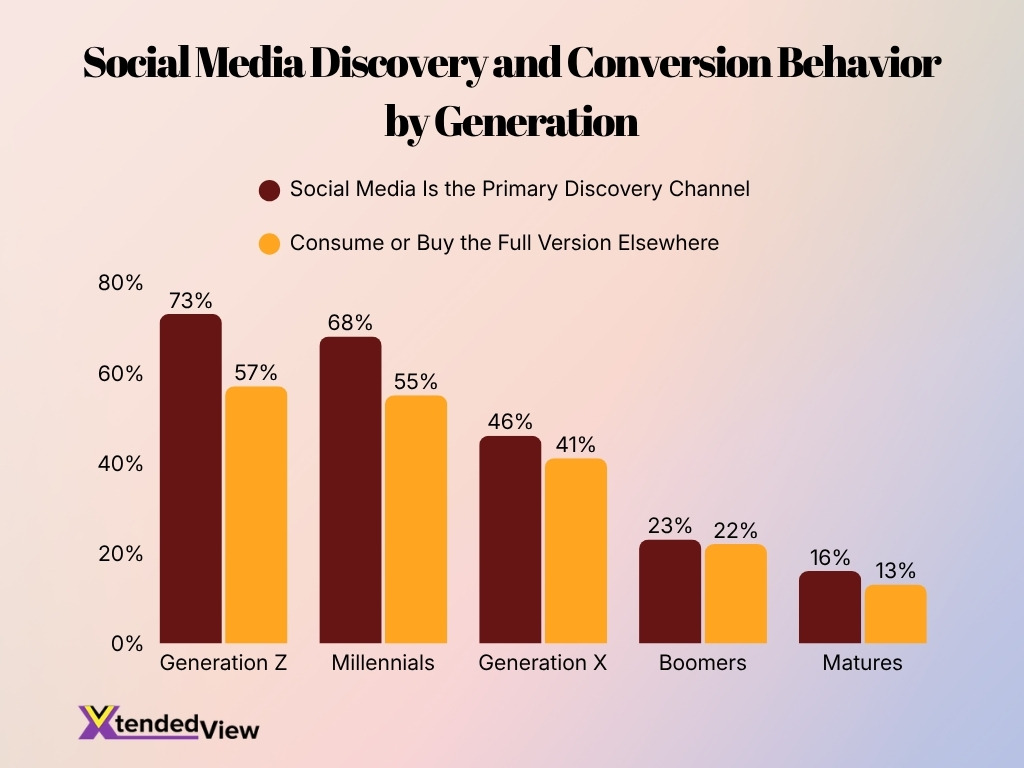
- Generation Z leads social media discovery, with 73% using social platforms as their primary source for new entertainment.
- Around 57% of Gen Z fans discover content on social media but watch, listen to, or purchase the full version elsewhere.
- Millennials closely follow, with 68% relying on social media to learn about new shows, movies, music, games, and events.
- About 55% of millennials convert their social media discoveries through other platforms or purchasing channels.
- Generation X shows moderate social media influence, with 46% using it for discovery and 41% consuming the full content elsewhere.
- Social media has less influence among boomers, as only 23% use it for discovery and 22% convert elsewhere.
- Matures report the lowest engagement, with just 16% discovering entertainment through social media and 13% converting elsewhere.
- Overall, 52% of fans use social media as a primary discovery channel, while 44% complete consumption or purchases on another platform.
- The findings show that social media is mainly a discovery tool, while actual viewing, listening, gaming, and purchasing often happen elsewhere.
Consumer Entertainment Spending
- Global entertainment and media revenue reached approximately $3.5 trillion in 2025.
- Consumer entertainment spending is projected to grow at approximately 2.5% CAGR through 2030.
- Non-digital entertainment represented 61% of overall consumer entertainment spending in 2024.
- The global live music market is projected to grow to $41.5 billion by 2030.
- Roughly 39% of consumers canceled a streaming service recently due to subscription fatigue.
- Advertising-supported streaming models are expanding rapidly at a 14.7% CAGR.
- Immersive premium experiences like the Sphere venue reported $781 million in revenue in 2025.
- The global mobile gaming market reached an impressive $165.37 billion in 2025.
- Consumers spent an average of 21 hours per week on on-demand video streaming in 2025.
Global Media and Entertainment Market
- The global media and entertainment industry generated $3.5 trillion in revenue during 2025.
- Total industry revenue is forecast to reach $4.2 trillion by 2030 at a 3.4% CAGR.
- The industry is expected to expand by 4.6% during 2026, following 5.3% growth in 2025.
- Global advertising remains the fastest-growing major revenue segment, with projected 5.6% CAGR through 2030.
- The global video game market generated $224 billion in 2024 and is projected to approach $300 billion by 2029.
- Global box office revenue is forecast to reach approximately $39.5 billion by 2030 as theatrical attendance continues to recover.
- Developing markets such as India and Indonesia continue to record some of the fastest entertainment industry growth rates globally.
- AI, streaming, mobile connectivity, and immersive experiences remain the primary long-term drivers of industry expansion.
- Digital ecosystems continue generating most new industry revenue across advertising, streaming, gaming, and creator content.
Leading Companies in Media and Entertainment
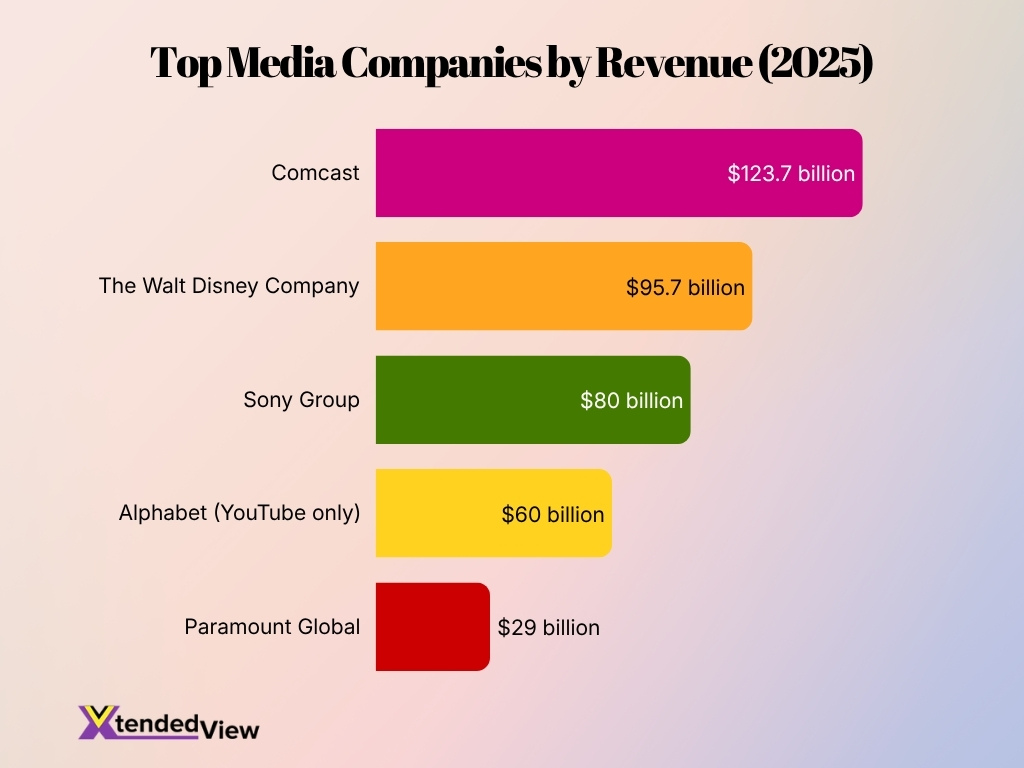
- The Walt Disney Company generated $95.7 billion in total revenue during the 2025 fiscal year.
- Netflix reached a record 325 million global paid subscribers by the end of 2025.
- Comcast reported a massive $123.7 billion in total consolidated revenue for the 2025 fiscal year.
- Warner Bros. Discovery successfully expanded its streaming base to over 131 million global subscribers in 2025.
- Paramount Global recorded a substantial annual revenue exceeding $29 billion throughout the 2025 fiscal year.
- Sony Group continues growing its media presence with annual revenues consistently surpassing $80 billion.
- Alphabet achieved over $60 billion in YouTube revenue across advertisements and subscriptions in 2025.
- Meta Platforms experienced a surge in full-year advertising revenue, reaching approximately $196 billion in 2025.
- Amazon Prime Video contributed an estimated $17.5 billion to Amazon’s overall entertainment revenue in 2025.
Frequently Asked Questions (FAQs)
The global media and entertainment industry is projected to reach US$4.2 trillion by 2030, growing at a 3.4% CAGR from 2025 to 2030.
Global advertising revenue surpassed US$1 trillion in 2025 and is forecast to reach US$1.4 trillion by 2030.
The U.S. digital advertising market generated a record US$294.6 billion in revenue during 2025, representing 13.9% year-over-year growth.
Global OTT streaming revenue is projected to grow at a 6.1% CAGR through 2030, supported by ad-supported subscriptions and bundled services.
Global on-demand audio music streaming reached a record 2.8 trillion streams during the first half of 2026, while the U.S. recorded 732.7 billion streams.
Conclusion
The media and entertainment industry continues to evolve as streaming, digital advertising, AI, gaming, and live experiences reshape consumer behavior worldwide. Although traditional media faces ongoing challenges, advertising-supported streaming, creator-driven content, connected TV, and immersive entertainment continue to open new growth opportunities. The United States remains the industry’s largest market, while rapidly developing economies are accelerating global expansion through mobile-first consumption and digital innovation.
As companies invest in AI, personalized content, and diversified revenue models, the industry is expected to maintain steady growth through the remainder of the decade.
