


Huawei remains one of the world’s largest technology companies, with operations spanning telecommunications infrastructure, cloud computing, consumer electronics, artificial intelligence, digital power, and automotive technology. Its investments continue to influence industries ranging from 5G network deployment to enterprise AI infrastructure, while its ecosystem powers millions of connected devices worldwide. This article explores the latest Huawei statistics, covering financial performance, innovation, market trends, and business growth across its major segments.
Huawei Company Overview
- Huawei was founded in 1987 and is headquartered in Shenzhen, China, growing from a telecommunications equipment supplier into a global ICT and consumer technology company.
- As of the end of 2025, Huawei employed approximately 212,000 people worldwide across research, manufacturing, sales, and support functions.
- Huawei reported CNY 880.9 billion (about US$126 billion) in revenue during 2025, making it one of the world’s largest privately held technology companies.
- The company operates across six major business groups, including ICT Infrastructure, Consumer, Cloud Computing, Digital Power, Intelligent Automotive Solutions, and other emerging businesses.
- Huawei conducts business in more than 170 countries and regions, serving governments, enterprises, telecom operators, and consumers worldwide.
- More than 53% of Huawei’s workforce worked in research and development at the end of 2025, demonstrating its long-term innovation strategy.
- Huawei has invested over CNY 1.382 trillion in research and development during the past decade.
- The company held approximately 165,000 active granted patents globally by the end of 2025.
- Huawei continues expanding beyond telecom equipment by investing heavily in AI computing, cloud infrastructure, intelligent vehicles, renewable energy, and HarmonyOS.
Editor’s Choice
- Huawei generated CNY 880.9 billion in revenue during 2025, representing 2.2% year-over-year growth.
- Net profit reached CNY 68.0 billion in 2025, increasing from CNY 62.6 billion in 2024.
- Huawei invested a record CNY 192.3 billion in R&D during 2025, equal to 21.8% of annual revenue.
- The ICT Infrastructure business remained Huawei’s largest segment, generating CNY 375.0 billion in 2025 revenue.
- Intelligent Automotive Solutions recorded the fastest growth in 2025, with revenue increasing 72.1% year over year.
- Huawei ended 2025 with 165,000 active granted patents, strengthening its position among the world’s leading patent holders.
- Huawei’s HarmonyOS ecosystem surpassed 10 million registered developers and more than 350,000 apps and services by the end of 2025.
- During the first half of 2026, Huawei recorded 9.6% revenue growth despite higher operating costs and increased R&D investment.
- Huawei allocated 25.9% of first-half 2026 revenue to R&D, reflecting continued investment in AI, semiconductors, and advanced computing.
Recent Developments
- Huawei released its 2025 Annual Report in March 2026, confirming revenue of CNY 880.9 billion and net profit of CNY 68 billion.
- The company continued expanding its AI strategy through investments in Ascend AI processors, Kunpeng computing platforms, and enterprise AI infrastructure.
- Huawei introduced new flagship smartphones and foldable devices powered by HarmonyOS, expanding its premium product portfolio during 2025.
- HarmonyOS devices exceeded 36 million running HarmonyOS 5 and HarmonyOS 6 by the end of 2025.
- Huawei expanded its retail presence to 16 flagship stores and approximately 480 Smart Life Stores globally by the end of 2025.
- Huawei’s authorized service network surpassed 3,100 service centers across 70 countries and regions.
- During the first half of 2026, Huawei reported revenue growth across all business segments, even as profit declined because of rising investment and operating costs.
- Huawei continued strengthening domestic semiconductor capabilities to reduce reliance on foreign technology amid ongoing export restrictions.
- The company accelerated AI-driven cloud, intelligent driving, and computing initiatives as major strategic priorities entering 2026.
Huawei Financial Performance by Year
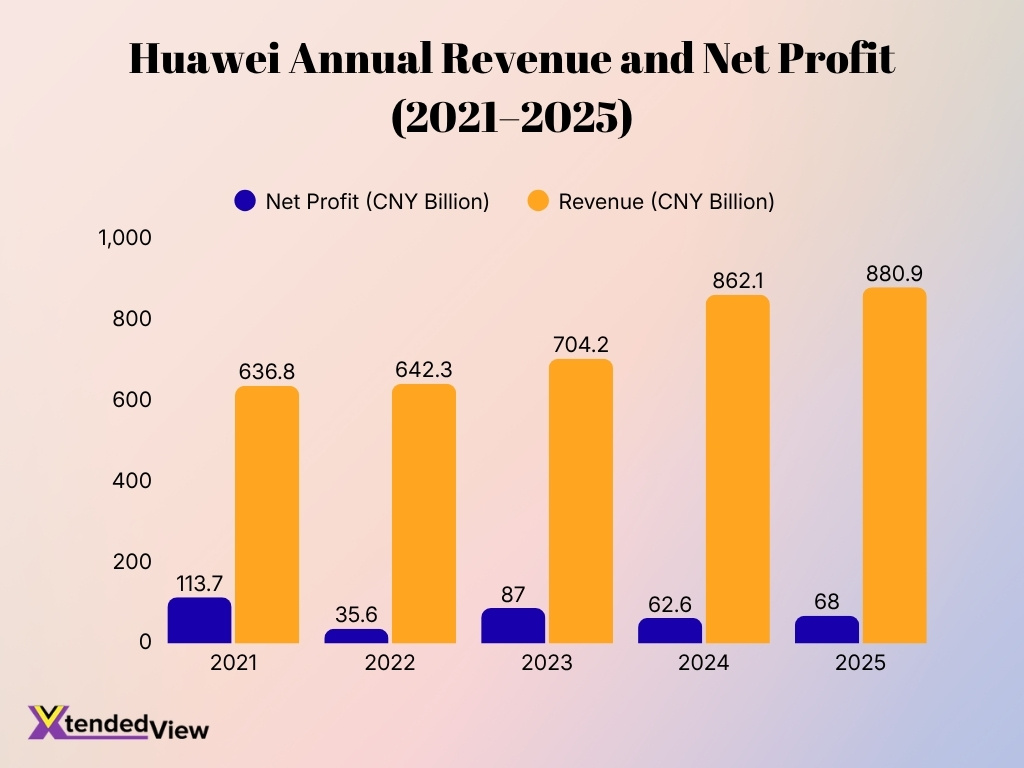
- Huawei reported CNY 636.8 billion in revenue during 2021.
- Revenue increased to CNY 642.3 billion in 2022 despite continued global market challenges.
- Huawei’s revenue climbed to CNY 704.2 billion in 2023 as consumer products recovered.
- Revenue reached CNY 862.1 billion in 2024, representing one of Huawei’s strongest annual recoveries.
- The company achieved CNY 880.9 billion in revenue during 2025, its second-highest annual revenue on record.
- Net profit measured CNY 113.7 billion in 2021 before declining to CNY 35.6 billion in 2022 because of industry and market adjustments.
- Net profit recovered to CNY 87.0 billion in 2023 before settling at CNY 62.6 billion in 2024 as Huawei increased strategic investments.
- Net profit improved again to CNY 68.0 billion in 2025 while Huawei maintained record investment in research and innovation.
- Huawei’s total assets increased from CNY 1.29 trillion in 2024 to CNY 1.33 trillion in 2025.
Huawei Revenue and Net Profit Statistics
- Huawei generated CNY 880.9 billion (approximately US$126.0 billion) in revenue during 2025.
- Revenue increased from CNY 862.1 billion in 2024 to CNY 880.9 billion in 2025.
- Huawei’s 2025 net profit reached CNY 68.0 billion, up from CNY 62.6 billion a year earlier.
- Operating profit totaled CNY 96.9 billion in 2025, compared with CNY 79.4 billion in 2024.
- Huawei maintained an 11.0% operating margin during 2025, improving from 9.2% in 2024.
- Cash flow from operating activities increased to CNY 127.4 billion in 2025, compared with CNY 88.4 billion in 2024.
- During the first half of 2026, Huawei reported CNY 467.8 billion in revenue, representing 9.6% year-over-year growth.
- First-half 2026 net profit declined about 36% year-over-year to CNY 23.8 billion, primarily because of higher R&D spending and manufacturing costs.
- Huawei stated that stronger investment in AI, chips, cloud infrastructure, and intelligent vehicles contributed to higher costs while supporting long-term growth.
Huawei Employee and Global Presence Statistics
- Huawei employed approximately 212,000 people worldwide as of the end of 2025, up from around 208,000 employees in 2024.
- Around 114,000 employees, or 53.7% of Huawei’s global workforce, worked in research and development at the end of 2025.
- Huawei conducts business in more than 170 countries and regions, serving telecom operators, enterprises, governments, and consumers.
- Huawei Cloud operates across 34 geographic Regions and 101 availability zones (AZs), supporting customers around the world.
- Huawei Cloud serves customers in 170+ countries and regions, making it one of the company’s fastest-growing global platforms.
- By the end of 2025, Huawei Cloud had attracted more than 10 million developers and 59,000 partners globally.
- Huawei Cloud’s AI Cluster Service exceeded 1,800 enterprise customers worldwide by the end of 2025.
- Huawei maintains an extensive international partner ecosystem spanning telecommunications, cloud computing, AI infrastructure, and enterprise digital transformation.
- Huawei continues expanding its overseas enterprise business despite ongoing geopolitical restrictions, while maintaining growth across all major business units in 2026.
Huawei Revenue by Business Segment Statistics
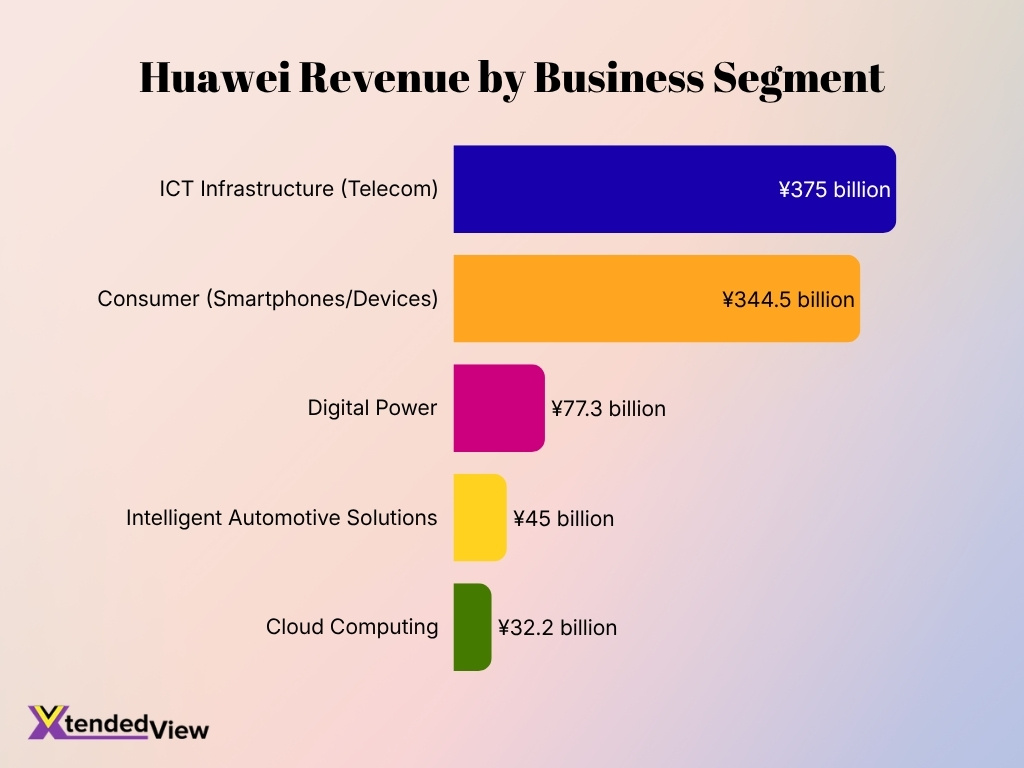
- ICT Infrastructure was Huawei’s largest business segment in 2025, generating CNY 375.0 billion in revenue with 2.6% year-over-year growth.
- The Consumer segment ranked second with CNY 344.5 billion in revenue, increasing by 1.6% year-over-year.
- Digital Power generated CNY 77.3 billion, recording a stronger 12.7% annual growth rate.
- Intelligent Automotive Solutions reached CNY 45.0 billion in revenue and posted the fastest growth among the listed segments at 72.1% year over year.
- Cloud Computing recorded CNY 32.2 billion in revenue, declining by 3.5% year over year, making it the only listed segment with negative growth.
Huawei Research and Development Spending and Employee Statistics
- Huawei invested CNY 192.3 billion in research and development during 2025, representing 21.8% of annual revenue.
- Huawei’s cumulative R&D investment over the last decade exceeded CNY 1.382 trillion by the end of 2025.
- Approximately 114,000 employees worked in R&D at the end of 2025, accounting for 53.7% of the company’s workforce.
- Huawei has consistently invested more than 10% of annual sales revenue in research and development every year.
- Huawei ranked 6th globally in the 2025 EU Industrial R&D Investment Scoreboard.
- During the first half of 2026, Huawei increased R&D spending by 25.2% year over year, with R&D accounting for 25.9% of revenue.
- Huawei’s R&D priorities include connectivity, AI computing, cloud infrastructure, semiconductors, HarmonyOS, digital power, and intelligent vehicles.
- Since 2024, Huawei has accelerated investment in Ascend AI processors and Kunpeng computing platforms to strengthen domestic AI infrastructure.
- The company continues using sustained R&D investment as a long-term strategy to offset external technology restrictions and expand into emerging industries.
Huawei Patent and Innovation Statistics
- Huawei held approximately 165,000 active granted patents worldwide at the end of 2025.
- The company increased its active patent portfolio from 150,000+ patents in 2024 to 165,000 in 2025.
- Huawei has signed more than 260 patent licensing and cross-licensing agreements with major global technology companies.
- Huawei remains one of the world’s largest holders of standard-essential patents covering cellular communications technologies.
- The company’s patent portfolio includes leadership across 5G, Wi-Fi, optical networking, audio, and video codec technologies.
- Huawei continues licensing intellectual property through bilateral agreements and global patent pools, generating recurring licensing revenue.
- Huawei invests heavily in foundational research to strengthen innovation in AI, cloud computing, chip design, digital energy, and intelligent transportation.
- The company continues expanding its patent portfolio despite export controls, reinforcing its long-term technology strategy.
- Huawei’s innovation strategy focuses on converting long-term R&D investment into commercially deployable technologies across multiple industries.
China Smartphone Shipments and Market Share
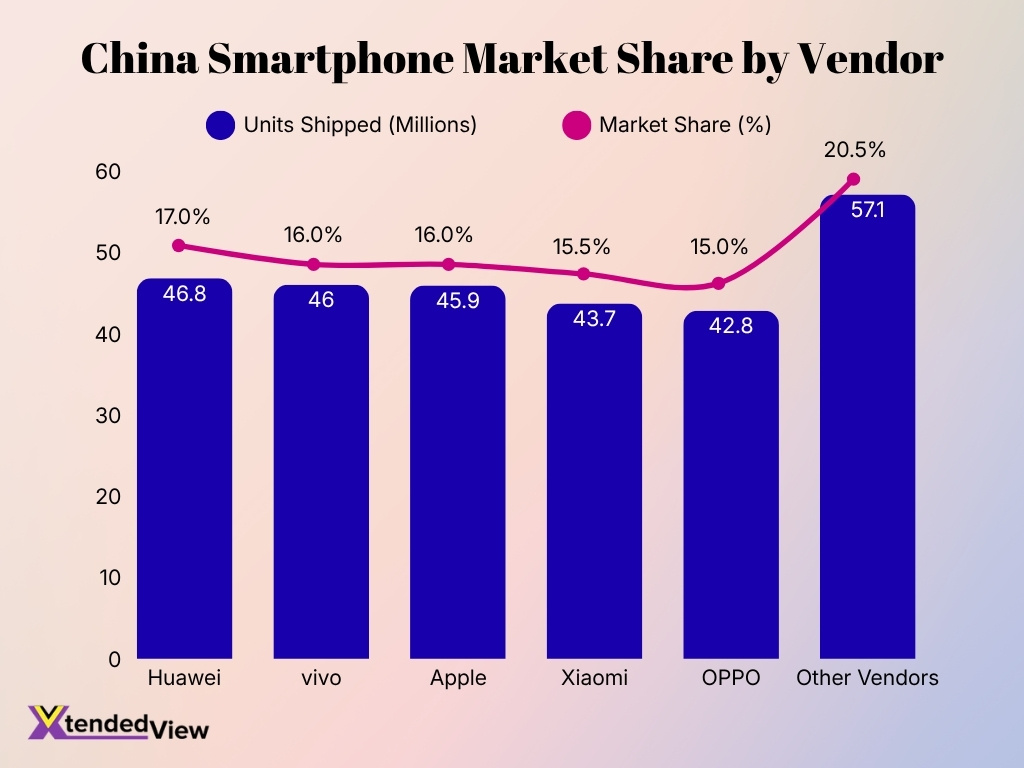
- Huawei led China’s smartphone market in 2025 with 46.8 million units shipped and a 17.0% market share.
- vivo ranked second with 46.0 million shipments, accounting for 16.0% of the market.
- Apple closely followed vivo with 45.9 million units shipped and an equal 16.0% market share.
- Xiaomi captured a 15.5% market share, supported by shipments of 43.7 million smartphones during the year.
- OPPO shipped 42.8 million units in China, giving it a 15.0% share of the smartphone market.
- Other vendors collectively accounted for the largest combined portion at 20.5%, representing 57.1 million units shipped.
- The five named vendors together controlled 79.5% of China’s smartphone market, highlighting the market’s concentration among major brands.
- Only 2 percentage points separated Huawei’s 17.0% share from OPPO’s 15.0%, indicating intense competition among China’s five leading smartphone vendors.
Huawei Telecommunications Equipment and 5G Market Share
- Huawei reached a 41% revenue share in the global telecom equipment market outside North America during 2025.
- During the first half of 2025, Huawei led the overall global telecom equipment market with a 31% revenue share.
- Huawei’s ICT infrastructure business generated CNY 375.0 billion in revenue in 2025, marking a 2.6% year-on-year increase.
- In the global 5G core network sector, Huawei commands the top position with a market share exceeding 42%.
- The company achieved a total global sales revenue of 880.9 billion yuan in 2025, representing a 2.2% year-on-year increase.
- Huawei currently ranks as the top supplier by revenue across all six major telecom infrastructure segments globally.
- The company’s annual R&D investment reached a record 192.3 billion yuan in 2025, accounting for 21.8% of total revenue.
- By late 2025, Huawei employed approximately 114,000 R&D professionals, making up 53.7% of its entire workforce.
Huawei Enterprise, Cloud, and ICT Infrastructure Statistics
- Huawei Cloud covered 34 geographic Regions and 101 availability zones by the end of 2025.
- Huawei Cloud provides services to customers in more than 170 countries and regions worldwide.
- Huawei Cloud attracted over 10 million developers and 59,000 partners globally by the end of 2025.
- The AI Cluster Service supported more than 1,800 enterprise customers worldwide by the end of 2025.
- External Cloud Computing revenue reached CNY 32.2 billion in 2025, while total cloud-related revenue, including internal business, amounted to CNY 72.1 billion.
- Huawei continued investing in AI cloud infrastructure through CloudMatrix AI Infra and Ascend-based computing services.
- ICT Infrastructure remained Huawei’s largest revenue contributor with CNY 375.0 billion in 2025 revenue.
- Huawei’s enterprise strategy focuses on cloud computing, AI infrastructure, cybersecurity, industrial digital transformation, and intelligent computing platforms.
- During the first half of 2026, Huawei reported revenue growth across all enterprise and infrastructure businesses while continuing to increase investment in AI capabilities.
Huawei Consumer Devices, Tablet, and Wearables Market Share
- Huawei’s consumer business revenue reached CNY 344.5 billion during the 2025 fiscal year.
- The company shipped 46.7 million smartphones, capturing a 16.4% market share in China during 2025.
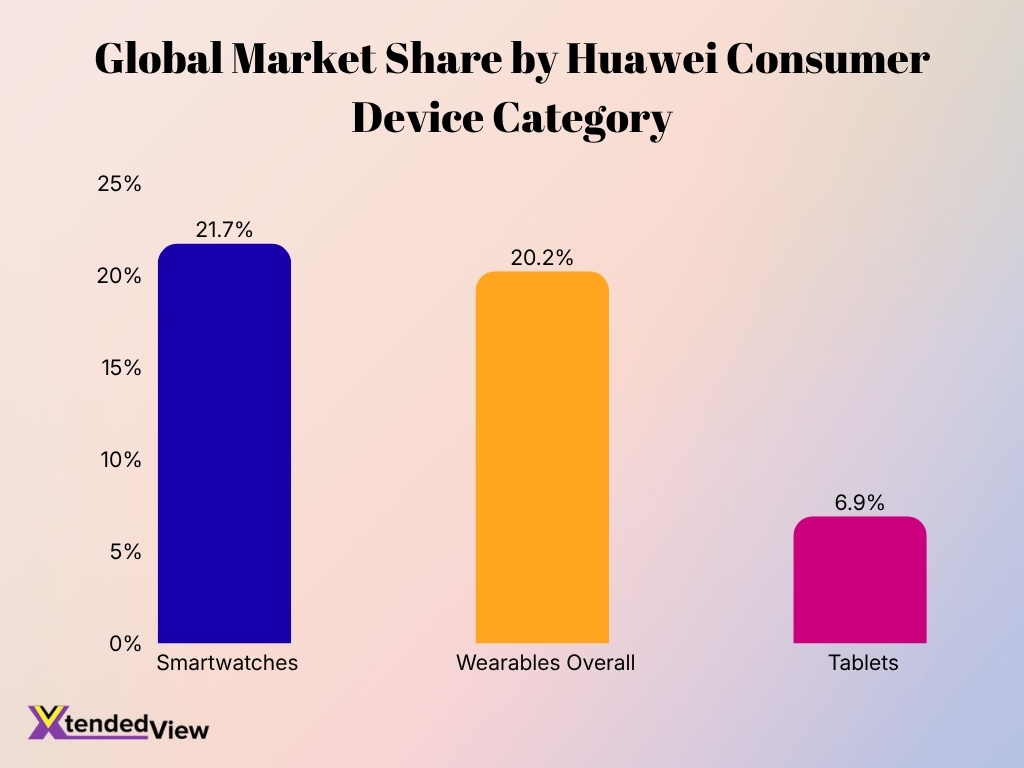
- Huawei achieved a 20.2% market share to lead the global wearable market in Q2 2025.
- The tech giant sold 10 million smartwatches globally in Q1 2025, securing a 21.7% market share.
- Huawei impressively dominated the Chinese foldable smartphone market with a 69% share in early 2025.
- The company maintained a 6.9% global market share in the highly competitive tablet industry throughout 2025.
- The HarmonyOS ecosystem rapidly expanded to power over 36 million terminal devices by late 2025.
- The connected software platform grew significantly to support more than 10 million HarmonyOS developers worldwide.
Huawei HarmonyOS, AppGallery, and User Statistics
- The HarmonyOS ecosystem expanded to over 1.3 billion active connected devices by June 2026.
- HarmonyOS officially captured a 19% share of the Chinese smartphone market in Q1 2026.
- The global market share for HarmonyOS successfully reached 5% during the first quarter of 2026.
- Shipments of HarmonyOS PCs are forecasted to surge to 1.4 million units in 2026.
- Huawei AppGallery maintained a massive user base with 400 million monthly active users globally in 2026.
- The total number of devices operating on HarmonyOS 6 surpassed 60 million in early 2026.
- Huawei dominated the mainland China market with a 20% smartphone shipment share in Q1 2026.
- Deliveries for Huawei’s HIMA smart vehicles reached 190,000 units during the first quarter of 2026.
Huawei Digital Power and Green Energy Statistics
- Digital Power generated CNY 77.3 billion in revenue during 2025, reflecting a 12.7% increase.
- The solutions helped customers generate over 2 trillion kWh of green electricity globally.
- Customers saved 154.4 billion kWh of electricity worldwide using clean energy technologies.
- The average energy efficiency of major products was 3.4 times higher in 2025 than in 2019.
- These green power solutions successfully reduced carbon dioxide emissions by 1.06 billion tonnes.
- Packaging plastic usage was reduced by more than 1,500 metric tons during 2025.
- The company consumed more than 3 billion kWh of clean energy in its own operations.
- A corporate target is set to achieve a 47% reduction in overall carbon footprint by 2030.
- Operations are committed to reaching net-zero emissions across the full value chain by 2040.
Huawei HIMA Vehicle Delivery Trends
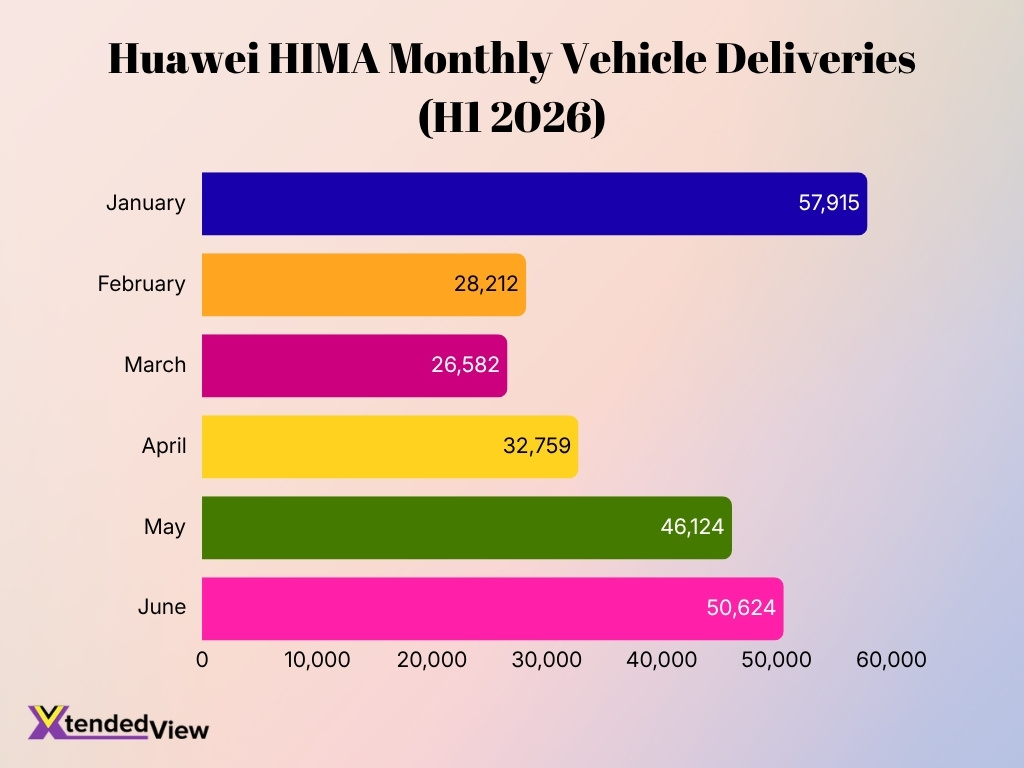
- Huawei HIMA recorded its highest monthly deliveries in January 2026, reaching 57,915 vehicles, supported by strong year-end momentum carried over from Q4.
- Deliveries fell sharply to 28,212 vehicles in February, representing a 51.3% month-over-month decline, partly reflecting the Lunar New Year slowdown.
- HIMA deliveries declined another 5.7% in March to 26,582 vehicles, the lowest monthly total during the first half of 2026.
- The delivery trend reversed in April, when volumes increased 23.2% month over month to 32,759 vehicles.
- HIMA accelerated its recovery in May, delivering 46,124 vehicles, a strong 40.8% monthly increase and the largest positive growth rate of H1.
- Deliveries climbed further to 50,624 vehicles in June, up 9.8% month-over-month and approaching January’s H1 peak.
- Across the first six months of 2026, HIMA delivered a combined 242,216 vehicles, averaging approximately 40,369 vehicles per month.
- From the March low to June, monthly deliveries increased by roughly 90.4%, highlighting a substantial second-quarter recovery in HIMA’s vehicle volumes.
Huawei Sustainability and Rural Connectivity Statistics
- Since launching its digital inclusion initiative in 2019, Huawei’s education programs have benefited more than 700,000 people across 1,790 schools.
- Huawei’s environmental technologies support biodiversity conservation across 65 protected natural areas worldwide.
- Accessibility features built into Huawei devices now serve more than 8 million users every month.
- Huawei provided emergency communications support for over 300 natural disasters and major events worldwide during 2025.
- Huawei’s Rural Series network solutions continued expanding mobile connectivity across underserved communities in countries including Nigeria and Ghana.
- By the end of 2025, the number of global gigabit broadband users exceeded 450 million, supported in part by Huawei networking technologies.
- Huawei continues promoting digital inclusion through projects focused on education, healthcare, environmental protection, and community development.
- Sustainability initiatives include improving product energy efficiency, reducing packaging waste, and enabling renewable energy adoption worldwide.
- Huawei continues aligning its sustainability strategy with long-term digital transformation and low-carbon economic development.
Huawei Business Challenges, Supply Chain, and Sanctions
- U.S. export sanctions introduced in 2019 continue limiting Huawei’s access to advanced semiconductors.
- Huawei generated CNY 880.9 billion in revenue during 2025, marking its second-highest on record.
- First-half 2026 revenue increased by 9.6% as the company expanded into new technology sectors.
- Net profit sharply declined by 36% in early 2026 due to high manufacturing and R&D costs.
- Huawei increased its first-half 2026 R&D spending by a significant 25.2% year over year.
- Research and development investments accounted for 25.9% of Huawei’s total revenue in early 2026.
- Component inventories increased by 42% in early 2026 to aggressively strengthen domestic supply chains.
- Huawei holds over 165,000 active patents globally to counter severe supply chain sanctions.
- Over 113,000 employees, representing 54.1% of the workforce, are actively dedicated to R&D.
Frequently Asked Questions (FAQs)
Huawei generated CNY 880.9 billion (approximately US$127.5 billion) in revenue during 2025, representing 2.2% year-over-year growth.
Huawei invested CNY 192.3 billion in R&D in 2025, equal to 21.8% of its annual revenue.
Huawei held approximately 165,000 active granted patents globally as of the end of 2025.
More than 36 million devices were running HarmonyOS 5 and HarmonyOS 6 by the end of 2025.
Huawei reported CNY 467.82 billion in first-half 2026 revenue, reflecting 9.6% year-over-year growth.
Conclusion
Huawei continues to strengthen its position as a global technology leader through sustained investment in research, AI, cloud computing, digital power, telecommunications, and intelligent vehicles. Although geopolitical restrictions and supply chain challenges remain, the company’s expanding ecosystem and diversified business portfolio support long-term growth. As Huawei advances next-generation connectivity, enterprise infrastructure, and consumer technologies, it is expected to remain an influential force in the global technology industry.