


5G continues to reshape how people connect, work, and consume digital services. From supporting real-time automation in manufacturing facilities to enabling high-definition cloud gaming and telehealth services, the technology now plays a central role in modern economies. As operators expand coverage and enterprises deploy new use cases, 5G adoption is accelerating across both developed and emerging markets. The statistics below highlight the latest trends, performance benchmarks, and adoption patterns shaping the global 5G landscape.
Editor’s Choice
- Global 5G subscriptions reached approximately 2.9 billion by the end of 2025, representing about one-third of all mobile subscriptions worldwide.
- Around 151 million new 5G subscriptions were added during Q4 2025 alone.
- Global 5G connections surpassed 2.7 billion by the end of 2025, making 5G the fastest-growing mobile technology in history.
- Mobile network traffic increased by approximately 20% year over year between Q3 2024 and Q3 2025, driven largely by growth in 5G usage.
- India exceeded 360 million 5G subscribers in 2025, becoming one of the world’s fastest-growing 5G markets.
- More than 80% of India’s population had access to 5G coverage by late 2025.
- 5G is projected to contribute nearly $1 trillion to the global economy by 2030 through new consumer and enterprise services.
- Two-thirds of all mobile subscriptions are forecast to use 5G by 2031.
- Europe recorded approximately 200 million 5G connections by the end of 2024, accounting for around 30% of mobile connections in the region.
Recent Developments
- During Q1 2025, global operators added 145 million new 5G subscriptions, pushing the total beyond 2.4 billion.
- By late 2025, global 5G subscriptions approached 2.9 billion, significantly ahead of earlier industry forecasts.
- 5G now accounts for roughly one-third of all mobile subscriptions worldwide.
- India’s telecom review for 2025 reported that 5G services reached approximately 85% of the population.
- Standalone 5G deployments accelerated during 2025 as operators focused on enterprise applications and network slicing.
- Operators increasingly use 5G to support differentiated connectivity services and enterprise IT modernization initiatives.
- The number of commercial 5G launches continued to expand throughout 2025 across emerging markets in Asia, Africa, and Latin America.
- Global mobile data traffic growth remained strong at 20% annually, reflecting higher video streaming and cloud application usage on 5G networks.
- Industry forecasts released in late 2025 estimate that global 5G subscriptions will exceed 6.4 billion by 2031.
General 5G Statistics
- Global 5G subscriptions reached approximately 2.9 billion at the end of 2025.
- 5G subscriptions represented about 33% of all mobile subscriptions worldwide in 2025.
- Global 5G connections exceeded 2.7 billion by the close of 2025.
- The technology added more than 296 million subscriptions during just the first and fourth quarters of 2025 combined.
- India recorded 290 million 5G subscriptions by the end of 2024 before crossing 360 million during 2025.
- India’s average monthly mobile data usage reached 32 GB per user, the highest globally, supported by widespread 5G adoption.
- Europe’s 5G connections accounted for roughly 30% of all mobile connections by the end of 2024.
- The mobile industry expects 5G to become the dominant mobile access technology globally before the end of this decade.
- Commercial momentum continues to shift investment away from 4G as operators prioritize 5G spectrum and infrastructure.
5G Technologies Market Growth Statistics
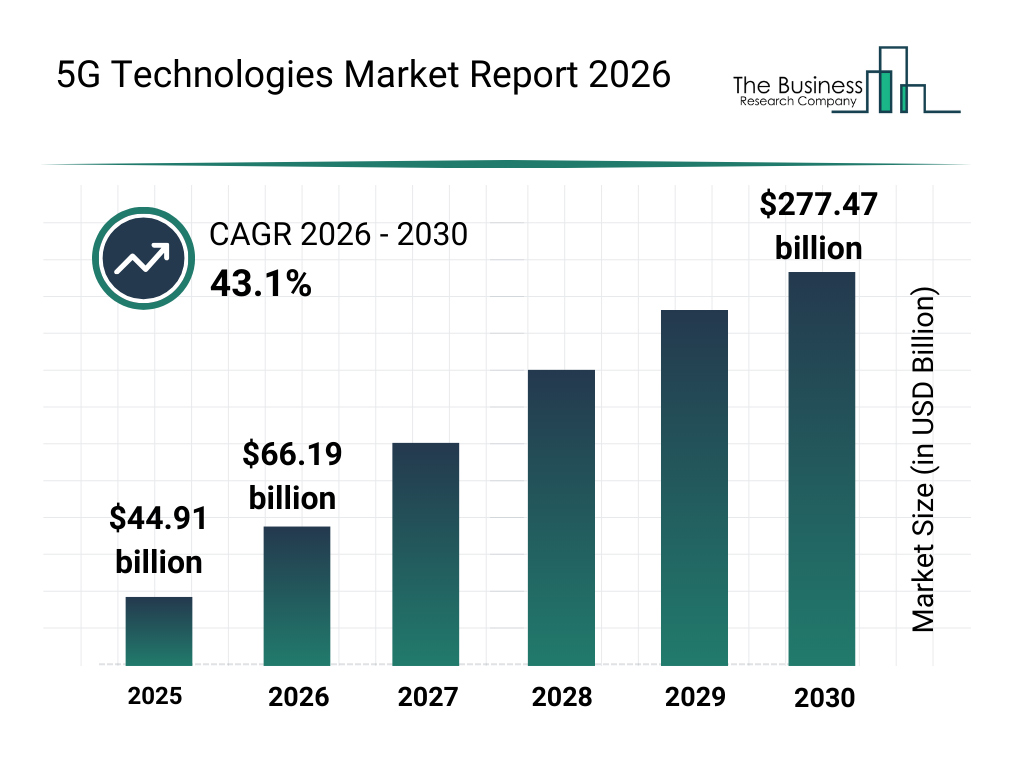
- The global 5G technologies market is projected to grow from $44.91 billion in 2025 to $277.47 billion by 2030, representing a more than 6x increase in market value.
- The market is expected to reach $66.19 billion in 2026, adding over $21 billion in value compared to 2025.
- The industry is forecast to expand at a rapid 43.1% CAGR between 2026 and 2030, highlighting strong long-term growth momentum.
- By 2030, the 5G technologies market is anticipated to surpass $277 billion, making it one of the fastest-growing segments in the telecom industry.
- Market value is expected to climb from $66.19 billion in 2026 to approximately $277.47 billion in 2030, gaining over $211 billion within four years.
- The market is projected to cross the $100 billion threshold before the end of the forecast period, driven by accelerating 5G adoption worldwide.
- Strong year-over-year growth between 2025 and 2030 reflects increasing investments in 5G infrastructure, devices, and enterprise applications.
- The forecast indicates that the 5G technologies market could grow by roughly 518% from 2025 to 2030, underscoring its transformative economic impact.
Global 5G Adoption and Subscription Statistics
- Global 5G subscriptions surpassed 2.4 billion during Q1 2025.
- By year-end 2025, subscriptions climbed to approximately 2.9 billion, an increase of about 500 million within the same year.
- More than one-third of global mobile users now subscribe to 5G services.
- Global 5G connections exceeded 2.7 billion by the end of 2025.
- Europe recorded approximately 200 million 5G connections by late 2024.
- India expanded from 290 million 5G subscriptions in 2024 to more than 360 million in 2025.
- Many Gulf countries rank among the world’s leaders in 5G adoption readiness and deployment maturity.
- Industry forecasts indicate global 5G subscriptions will exceed 6.4 billion by 2031.
- By 2031, approximately two-thirds of mobile subscriptions are expected to run on 5G networks.
5G Coverage and Availability Statistics
- Global population coverage of 5G reached approximately 55% by the end of 2025, up from around 45% in 2024.
- Around 85% of the world’s population is expected to have 5G coverage by 2030, reflecting aggressive network expansion plans.
- North America maintains one of the highest 5G coverage rates globally, with population coverage exceeding 95% in many metropolitan areas.
- India’s 5G rollout reached roughly 85% of the population during 2025, making it one of the fastest deployments worldwide.
- More than 300 cities and towns across India had active 5G services by late 2025.
- Several Gulf countries achieved population coverage levels exceeding 95%, supported by extensive standalone 5G deployments.
- In the United States, 5G now covers the vast majority of urban residents, with nationwide providers reaching over 300 million people.
- Europe continues to close the coverage gap, with many countries surpassing 80% population coverage in 2025.
- Fixed Wireless Access (FWA) powered by 5G expanded rapidly, providing broadband alternatives in underserved regions.
5G Network Speed and Performance Benchmarks
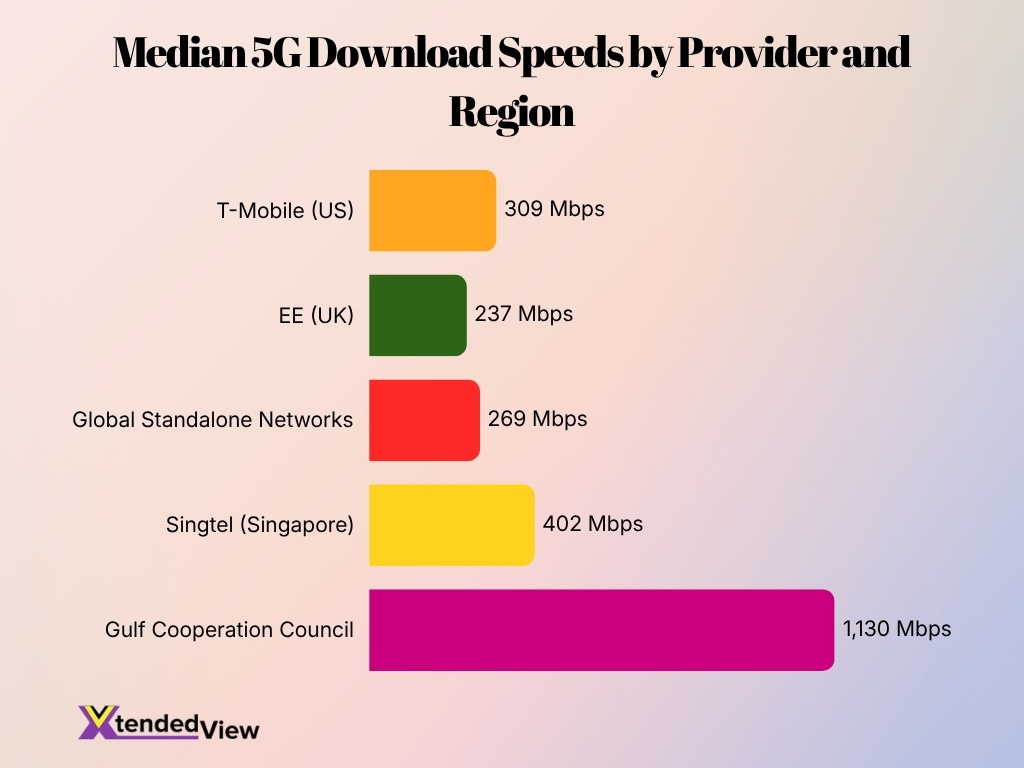
- T-Mobile recorded a median 5G download speed of approximately 309 Mbps in 2025.
- EE delivered median 5G download speeds of roughly 237 Mbps in the United Kingdom during 2025.
- Three UK achieved a 5G Speed Score of 55.17 in the first half of 2025.
- Global 5G standalone networks achieved a median download speed of 269 Mbps, representing a 52% premium over older networks.
- 5G networks currently deliver real-world speeds that are 3 to 6 times faster than typical 4G LTE performance.
- Modern 5G Standalone networks can deliver latency as low as 10 to 15 ms in ideal conditions.
- Singtel in Singapore achieved a massive median 5G download speed of 402 Mbps in the second half of 2025.
- Gulf Cooperation Council countries delivered the world’s fastest 5G median download speeds at 1.13 Gbps.
- Pan-India monthly 5G data traffic grew by 70% to reach 12.9 exabytes in 2025.
- Urban users experience higher speeds, with performance gaps exceeding 150 Mbps compared to rural areas.
5G Connection Growth and Future Projections
- Global 5G subscriptions increased from roughly 2.3 billion in 2024 to 2.9 billion in 2025.
- The industry expects 5G subscriptions to exceed 6.4 billion by 2031.
- Approximately two-thirds of all mobile subscriptions will run on 5G networks by 2031.
- Global 5G connections are projected to surpass 8 billion before the end of the decade.
- Asia-Pacific is expected to account for the largest share of future 5G subscriber growth through 2030.
- Mobile network traffic is forecast to nearly triple between 2025 and 2031, driven largely by 5G usage.
- Standalone 5G adoption is expected to accelerate as operators monetize network slicing and enterprise services.
- Fixed Wireless Access subscriptions are forecast to exceed 350 million globally by 2030.
- Emerging markets in Africa and Latin America are projected to record the fastest percentage growth in 5G adoption through the decade.
5G Smartphone and Device Market Statistics
- Global 5G smartphone shipments represented more than 70% of the 1.25 billion total smartphones shipped during 2025.
- More than 800 million 5G-enabled smartphones were shipped globally across all markets during 2025.
- Android devices account for the vast majority of global 5G shipments with an estimated 70% to 80% market share.
- Premium smartphones achieved impressive 5G penetration rates exceeding 95% across all major consumer markets.
- China remains the largest market globally, contributing heavily to the 43.6% Asia-Pacific smartphone market share in 2025.
- Active global 5G subscriptions officially reached a massive 2.9 billion connected users by the end of 2025.
- The global 5G IoT market reached a valuation of $11.83 billion in 2025 as industrial device adoption accelerated.
- The overall 5G services market was estimated at $196.42 billion in 2025 due to rising demand for low-latency connectivity.
- Enterprise-grade 5G modules experienced significant double-digit shipment growth throughout 2025 to support industrial automation.
5G Patent Ownership Statistics
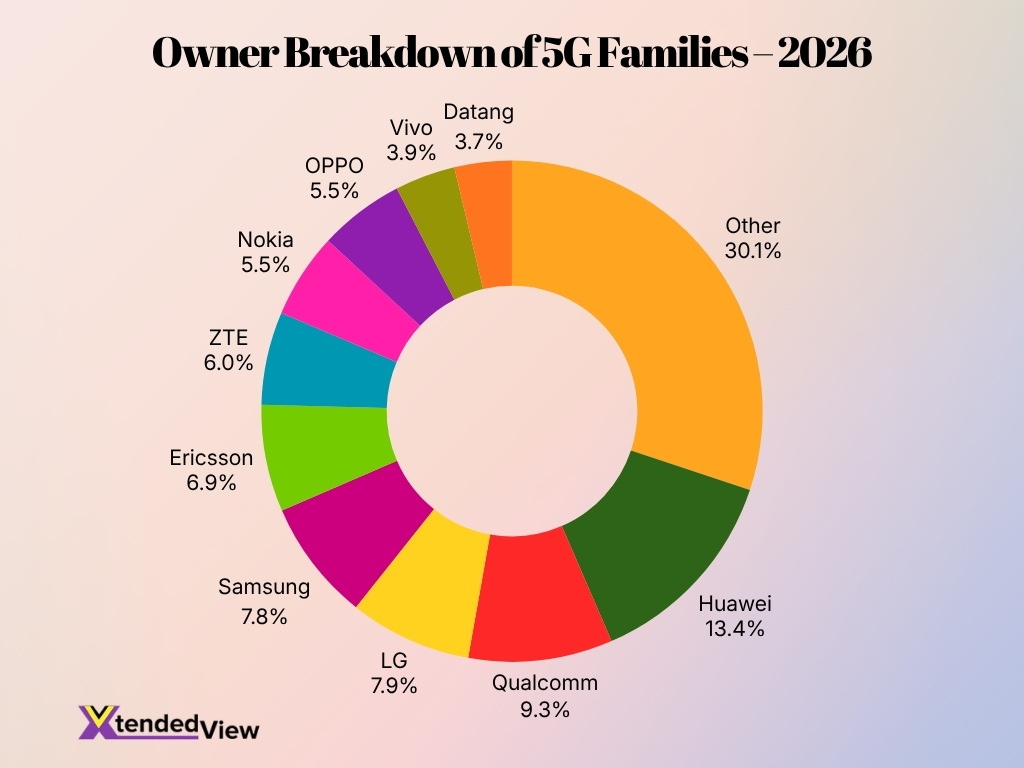
- Huawei leads individual 5G patent family ownership with 13.4%, making it the largest single holder among named companies.
- Other companies collectively control 30.1% of all 5G patent families, representing the largest overall ownership segment.
- Qualcomm holds 9.3% of global 5G patent families, securing the second-highest share among major firms.
- LG accounts for 7.9% of 5G patent families, narrowly ahead of Samsung in the patent race.
- Samsung owns 7.8% of 5G patent families, placing it among the top five patent holders worldwide.
- Ericsson captures 6.9% of global 5G patent families, reinforcing its strong position in telecom infrastructure.
- ZTE controls 6.0% of 5G patent families, maintaining a significant share of essential 5G intellectual property.
- Nokia and OPPO each hold 5.5%, giving both companies an equal stake in the 5G patent landscape.
- Vivo represents 3.9% of 5G patent families, highlighting its growing contribution to wireless innovation.
- Datang owns 3.7% of 5G patent families, making it one of the smaller but notable patent holders.
- The top five named companies account for 45.3% of all 5G patent families combined.
- Chinese firms (Huawei, ZTE, OPPO, Vivo, and Datang) collectively hold 32.5% of global 5G patent families.
Enterprise and Business 5G Statistics
- The global 5G enterprise market is valued at $6.52 billion in 2025 and projected to hit $99.66 billion by 2035.
- North America dominated the private 5G network industry, accounting for a 32.0% market share in 2025.
- Manufacturing remains the largest demand driver for private 5G, representing 32% to 37% of total industry revenue.
- Large enterprises controlled 53.10% of the global 5G private network market in 2025.
- The healthcare sector is the fastest-growing vertical for private 5G, with a projected CAGR of 42.8% by 2031.
- By 2030, 5G technology is expected to account for 38% of the private cellular market globally.
- The sub-6 GHz spectrum captured 61.10% of the 5G private network market in 2025 due to its wide area coverage.
- Approximately 69% of enterprises believe that 5G network slicing will significantly improve their operational efficiency.
- The Asia Pacific region held the largest global share of the 5G services market at 42.7% in 2025.
5G Economic Impact and Job Creation
- By 2035, the global 5G value chain alone is projected to create 22.3 million jobs.
- 5G technologies are expected to enable $13.2 trillion in global economic value by 2035.
- The widespread adoption of 5G will add $1.3 trillion to global GDP by the year 2030.
- Deployment of 5G networks in the US is estimated to contribute $1.4 trillion to $1.7 trillion to the national GDP over a decade.
- 5G expansion will create between 3.8 million and 4.6 million jobs across the United States in the coming decade.
- 5G-powered healthcare applications are projected to contribute $530 billion to global GDP by 2030.
- Direct spending on capital and labor for 5G infrastructure will contribute $400 billion to $500 billion directly to the economy.
- 5G-enabled smart utilities and infrastructure will add approximately $330 billion to the global economy by 2030.
5G Core Investment Accelerates Across Regions
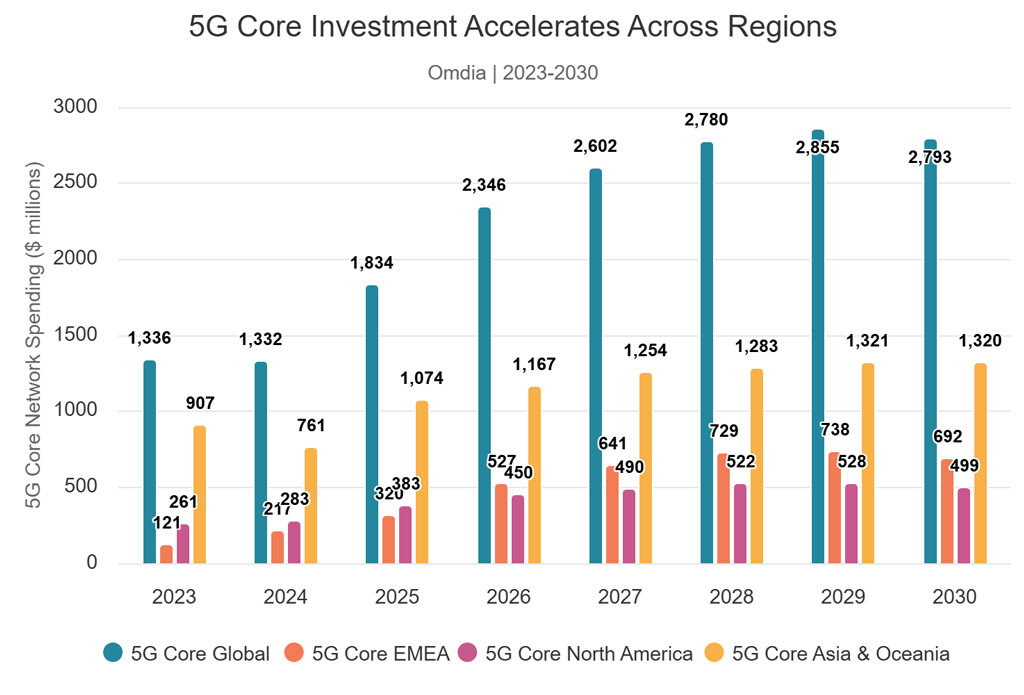
- Global 5G core spending is projected to more than double from $1.34 billion in 2023 to $2.79 billion in 2030, highlighting sustained infrastructure investment.
- Asia & Oceania remains the largest regional market, with spending rising from $907 million in 2023 to $1.32 billion in 2030.
- EMEA investment is expected to surge nearly sixfold, growing from $121 million in 2023 to $692 million by 2030.
- North America spending increases from $261 million in 2023 to a peak of $528 million in 2029 before easing slightly in 2030.
- Global 5G core investment jumps by 37.7% year over year between 2024 and 2025, reaching $1.83 billion.
- Asia & Oceania surpasses the $1 billion mark in 2025, with spending reaching $1.07 billion.
- EMEA records its strongest annual growth between 2025 and 2026, climbing from $320 million to $527 million.
- Global spending peaks at $2.86 billion in 2029, marking the highest investment level during the forecast period.
- North America’s share grows from $261 million in 2023 to over $520 million annually between 2028 and 2029.
- Regional 5G core investments collectively exceed $2.6 billion globally by 2027, reflecting accelerating network modernization efforts.
Regional and Country-Specific 5G Statistics
- China surpassed 1 billion 5G subscribers in 2025, maintaining the world’s largest 5G user base.
- China deployed more than 4.7 million 5G base stations by the end of 2025.
- The United States reached approximately 350 million 5G users by early 2026, maintaining strong nationwide availability.
- India rapidly exceeded 400 million 5G subscribers in 2026, becoming the world’s second-largest market.
- South Korea maintains high maturity, with 5G adoption rates significantly exceeding 50% of all mobile subscriptions.
- Major Gulf countries successfully achieved 5G population coverage rates well above 95% across primary urban areas.
- The European Union reached around 200 million 5G connections as countries like Germany and France expanded networks.
- Japan continued rapid enterprise expansion, reaching approximately 190 million 5G users nationwide.
- Brazil leads the Latin American region in subscriber growth, surpassing 20 million active 5G connections.
5G Internet of Things (IoT) and Smart City Statistics
- The global 5G IoT market is projected to grow from $11.83 billion in 2025 to $479.47 billion by 2034.
- 5G networks can support up to 1 million IoT devices per square kilometer to reduce urban congestion.
- The global smart cities market is forecast to expand to $1,445.6 billion by 2030 with a 15.6% CAGR.
- Over 50% of all IoT device connections within smart cities are expected to be powered by 5G by 2025.
- Smart transportation currently leads the IoT in the Smart Cities market with approximately a 33% market share.
- North America captures 42% of the global IoT market for smart cities due to early technology adoption.
- IoT cloud infrastructure spending is forecast to reach $37 billion by 2026 with a 37% annual growth rate.
- Global 5G IoT hardware components are estimated to account for a 41.7% market share by 2026.
- 87% of smart building projects successfully generate a positive return on investment to drive further adoption.
Urban vs. Rural 5G Adoption Rates
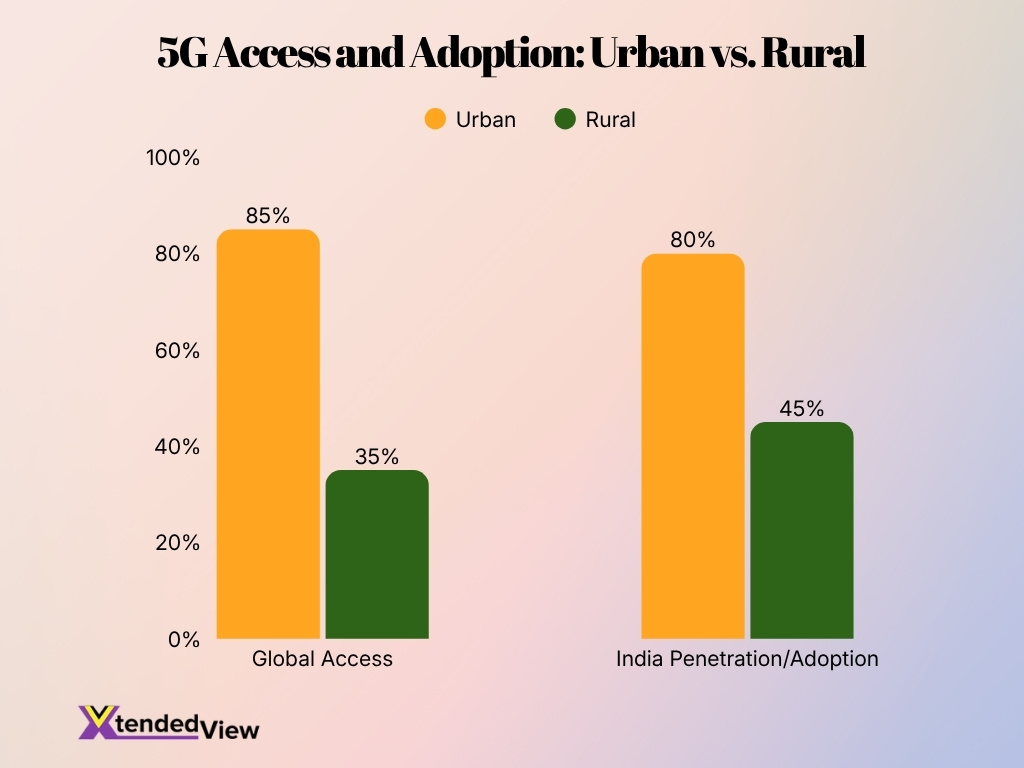
- Approximately 85% of urban populations have access to 5G compared to only 35% of rural residents.
- Urban 5G download speeds average around 250 Mbps, which is nearly 100% faster than typical rural speeds.
- Global telecommunication providers directed over 75% of their 5G infrastructure investments toward high-density urban centers.
- Rural Fixed Wireless Access (FWA) adoption surged by 120% as a cost-effective alternative to laying fiber-optic cables.
- India’s urban 5G penetration reached 80% during early deployments, while rural adoption stood at roughly 45%.
- Global government initiatives allocated more than $15 billion in subsidies specifically to accelerate rural 5G connectivity.
- The deployment of private 5G networks in rural agriculture and mining experienced a 40% year-over-year growth.
- The overall adoption gap between urban and rural 5G users globally is estimated at 42 percentage points.
5G Industry Adoption Statistics
- Manufacturing led the global private 5G network market by capturing a dominant 32.35% revenue share in 2025.
- Approximately 39% of industrial organizations are actively incorporating private 5G networks into their core operational infrastructures.
- Mining companies and heavy industries report an operational efficiency increase of 1%, translating to $15 million in annual savings.
- The healthcare sector is rapidly expanding its private 5G deployments with an expected 42.78% CAGR through 2031.
- Logistics providers utilizing private 5G architectures have successfully reduced their overall manual delivery costs by 50%.
- Energy companies are replacing up to 80 legacy Wi-Fi access points with just four 5G small cells to monitor infrastructure.
- The global private 5G market covering retail and enterprise operations is projected to reach an astounding $25.25 Billion by 2031.
- Smart transportation networks adopting private 5G infrastructure are projected to grow at a massive 58.9% CAGR from 2026 to 2033.
- Airports and seaports leveraging private 5G networks to control automated robotics have successfully increased operational efficiency by 50%.
5G Market Size and Revenue Projections
- The global 5G services market is projected to reach $1,022.49 billion by 2030.
- The global 5G infrastructure market is anticipated to expand at a CAGR of 33.82% through 2030.
- Enterprise 5G applications dominate the sector by holding a 62.7% market share of overall adoption.
- The private 5G network market is forecast to surge to $17.55 billion by the year 2030.
- Fixed Wireless Access (FWA) is the fastest-growing segment, boasting a global CAGR of 46.2%.
- The Asia-Pacific region held the largest global share of 42.7% in the 5G services market.
- Industrial and enterprise applications currently lead the industry with a 34.5% market share.
- Standalone 5G architectures, essential for network slicing, are expanding rapidly at a 33.80% CAGR.
- The consumer 5G segment is experiencing robust growth at a 38.4% CAGR driven by immersive media applications.
Key Challenges in 5G Adoption Among European Tech Firms
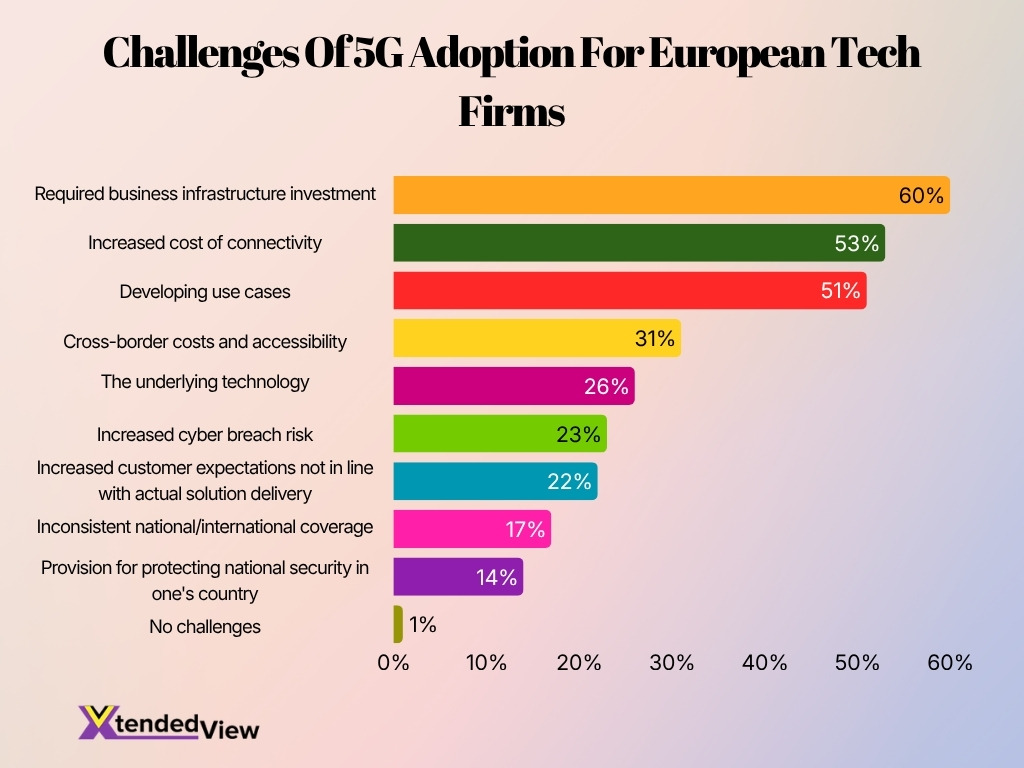
- Infrastructure investment is the biggest hurdle, with 60% of European tech firms citing the need for significant business infrastructure upgrades.
- 53% of companies report that the increased cost of connectivity is a major barrier to wider 5G adoption.
- Developing practical 5G use cases remains challenging for 51% of firms, highlighting uncertainty around ROI and implementation.
- 31% of respondents identify cross-border costs and accessibility issues as obstacles to deploying 5G solutions across Europe.
- 26% of firms struggle with the underlying technology, reflecting the complexity of integrating 5G into existing systems.
- Cybersecurity concerns are rising, with 23% of companies worried about an increased risk of cyber breaches.
- 22% of businesses say customer expectations exceed actual 5G solution delivery capabilities, creating adoption challenges.
- 17% of firms face issues due to inconsistent national and international 5G coverage, limiting service reliability.
- 14% of respondents cite national security protection requirements as a challenge when implementing 5G technologies.
- Only 1% of European tech firms report no challenges, indicating that 5G adoption remains a complex undertaking.
Consumer Expectations and Usage Trends
- Video streaming now accounts for 76% of all global mobile data traffic as of 2025.
- Short-form videos dominate consumer consumption, generating over 70% of the total smartphone video data traffic.
- India’s average monthly mobile data consumption crossed 31 GB per user in 2025, following a 70% year-on-year 5G traffic surge.
- Cloud gaming platforms demand up to 25 Mbps throughput and 20–30ms end-to-end network latency to deliver a lag-free experience.
- Remote work adoption is supported by 5G networks delivering speeds up to 20 Gbps and 1 millisecond latency for seamless video collaboration.
- Access to faster download speeds and a 100x increase in network capacity remain the primary drivers for consumers upgrading to 5G devices.
- High-definition and 4K video streaming drive massive consumption, contributing to the 200 exabytes of monthly global mobile network traffic recorded in 2025.
- Consumers utilizing AR and VR applications require ultra-responsive connectivity with sub-5 millisecond latency to ensure an immersive experience.
- Recent consumer surveys indicate that network reliability is prioritized by 19% of users, heavily outranking raw network speed at just 7%.
5G Security and Privacy Statistics
- The global zero-trust security market is projected to grow to $54.31 billion in 2026.
- The overarching 5G security market is anticipated to expand rapidly to $5.62 billion in 2026.
- The global private 5G network market is forecast to reach $7.57 billion in 2026 with a 48.9% growth rate.
- Active connected IoT devices are projected to hit 21.1 billion globally by the end of 2025.
- The worldwide 5G IoT market is projected to grow heavily from $11.83 billion to $17.85 billion in 2026.
- At least 75% of federal agencies face challenges in fully implementing mandatory zero-trust regulations by 2026.
- Deploying AI-led detection tools successfully reduced the global mean time to contain a data breach to 241 days.
- The security solution segment holds a dominant 70.9% revenue share as operators heavily invest in infrastructure protection.
- North America will dominate the private 5G market with an estimated 32% share, driven by strong enterprise security demands.
Frequently Asked Questions (FAQs)
Global 5G subscriptions reached approximately 2.9 billion by the end of 2025, accounting for about 33% of all mobile subscriptions worldwide.
5G represented roughly one-third (33%) of global mobile subscriptions at the end of 2025.
India surpassed 400 million 5G subscribers in early 2026, making it the world’s second-largest 5G market after China.
The global 5G services market was valued at $196.4 billion in 2025 and is projected to reach $1.87 trillion by 2033, growing at a 29.0% CAGR.
Global 5G subscriptions are forecast to reach 6.4 billion by 2031, representing approximately two-thirds of all mobile subscriptions.
Conclusion
5G entered a new phase of maturity as global subscriptions approached 3 billion, coverage expanded across major regions, and enterprise deployments accelerated. The technology now supports everything from industrial automation and smart cities to cloud gaming and advanced healthcare applications. Looking ahead, continued investment in standalone networks, private wireless infrastructure, and IoT ecosystems will drive further growth. With forecasts pointing toward more than 6.4 billion subscriptions by 2031, 5G is positioned to become the foundation for the next generation of digital services, connected industries, and economic innovation worldwide.