



Cloud computing continues to reshape how organizations build applications, store data, and scale digital operations. From AI model training and real-time analytics to remote collaboration and e-commerce infrastructure, cloud platforms now support many of the services people use every day. As enterprises accelerate digital transformation and invest in AI-powered workloads, cloud adoption and spending continue to reach new highs. The statistics in this report highlight the latest market trends, spending patterns, and adoption rates shaping the cloud computing industry.
Editor’s Choice
- Global public cloud end-user spending is projected to reach $723.4 billion in 2025, up from $595.7 billion in 2024, representing annual growth of 21.4%.
- The global cloud computing market was valued at $781.27 billion in 2025 and is expected to reach $905.33 billion in 2026.
- North America accounted for 52% of the global cloud computing market in 2025.
- Around 90% of organizations are expected to adopt hybrid cloud environments by 2027.
- Global cloud infrastructure spending reached $399.6 billion in 2025, a 24% year-over-year increase.
- AWS, Microsoft Azure, and Google Cloud collectively controlled 66% to 71% of the cloud infrastructure market in 2025.
- Sovereign cloud IaaS spending is forecast to reach $80 billion in 2026, growing 35.6% year over year.
Recent Developments
- Public cloud spending is forecast to increase from $595.7 billion in 2024 to $723.4 billion in 2025.
- Gartner forecasts public cloud services growth of 21.3% in 2026 as AI adoption accelerates.
- Global cloud infrastructure spending exceeded $110.9 billion in Q4 2025, up 29% year over year.
- Cloud infrastructure spending reached $102.6 billion during Q3 2025, marking the fifth consecutive quarter of growth above 20%.
- Google Cloud expanded its market share from approximately 7% to 13% by 2025, fueled by AI demand.
- Oracle reported a 47% increase in cloud revenue during its latest fiscal quarter.
- Global IT spending is expected to surpass $5.43 trillion in 2025, with AI initiatives acting as a major catalyst.
- Sovereign cloud infrastructure spending is expected to grow 35.6% in 2026, reflecting rising compliance and data residency requirements.
- Omdia forecasts cloud infrastructure spending growth of 27% in 2026, potentially exceeding $500 billion annually.
Cloud Computing Market Growth Statistics
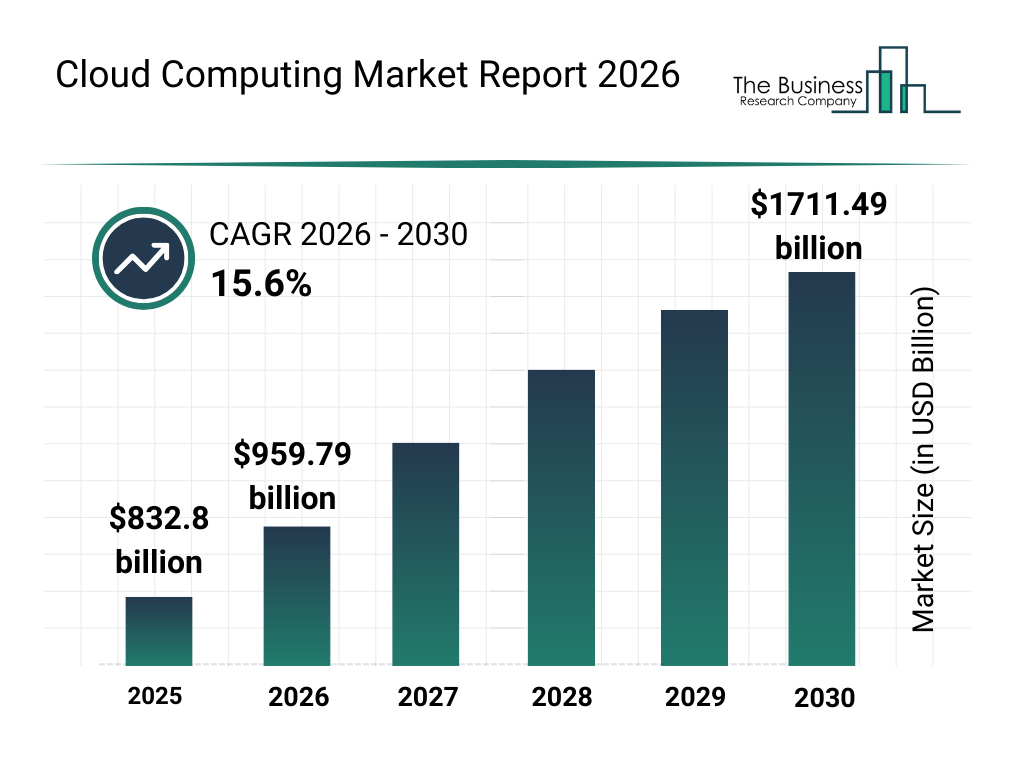
- The global cloud computing market is projected to grow from $832.8 billion in 2025 to $1.71 trillion by 2030, more than doubling in size.
- The market is expected to reach $959.79 billion in 2026, crossing the $900 billion milestone.
- Cloud computing is forecast to expand at a strong 15.6% CAGR between 2026 and 2030.
- The industry is projected to surpass $1 trillion in market value by 2027, highlighting accelerating enterprise adoption.
- By 2028, the cloud computing market is estimated to reach approximately $1.3 trillion, reflecting sustained double-digit growth.
- The market is expected to climb to around $1.55 trillion in 2029, adding hundreds of billions in annual value.
- Between 2025 and 2030, the cloud computing industry is projected to add nearly $879 billion in market value.
- The market is expected to grow by approximately 105.5% from 2025 to 2030, underscoring strong long-term demand.
- Rising adoption of AI, big data, hybrid cloud, and digital transformation initiatives is driving continued cloud market expansion.
- The forecast indicates cloud computing will remain one of the fastest-growing technology sectors through 2030.
Cloud Computing Adoption Statistics
- By 2027, 90% of organizations are expected to adopt hybrid cloud architectures.
- Over 50% of enterprise workloads are currently hosted within public cloud environments.
- 73% of organizations are currently utilizing the cloud for analytics and AI workloads.
- Worldwide public cloud spending is projected to reach $1.13 trillion by the year 2026.
- 70% of enterprises are expected to operate across multiple clouds by 2025.
- Worldwide sovereign cloud IaaS spending is officially forecast to total $80 billion in 2026.
- 55% of modern enterprises are planning to adopt cloud-native application development.
- By 2026, 75% of data and analytics workloads will be actively processed in the cloud.
- 91% of active organizations have successfully migrated at least one workload to the cloud.
Cloud Spending and Budget Statistics
- Worldwide public cloud spending is expected to hit $723.4 billion in 2025, compared with $595.7 billion in 2024.
- Global cloud infrastructure spending totaled $399.6 billion in 2025.
- Omdia expects cloud infrastructure spending to exceed $500 billion in 2026.
- Global IT spending is forecast to reach $5.43 trillion in 2025, with cloud services receiving a significant share of new investment.
- Data center systems spending is projected to grow 42.4% in 2025, largely due to AI-driven cloud demand.
- Sovereign cloud IaaS spending will total approximately $80 billion in 2026.
- End-user spending on public cloud services in India is expected to reach $17.5 billion in 2026, up from $13.7 billion in 2025.
- Oracle plans roughly $70 billion in capital expenditures for fiscal 2027 to expand cloud and AI infrastructure capacity.
- Cloud optimization has become a budget priority, with 72% of IT leaders focusing on optimization to reduce costs and improve efficiency.
Cloud Provider Market Share Statistics
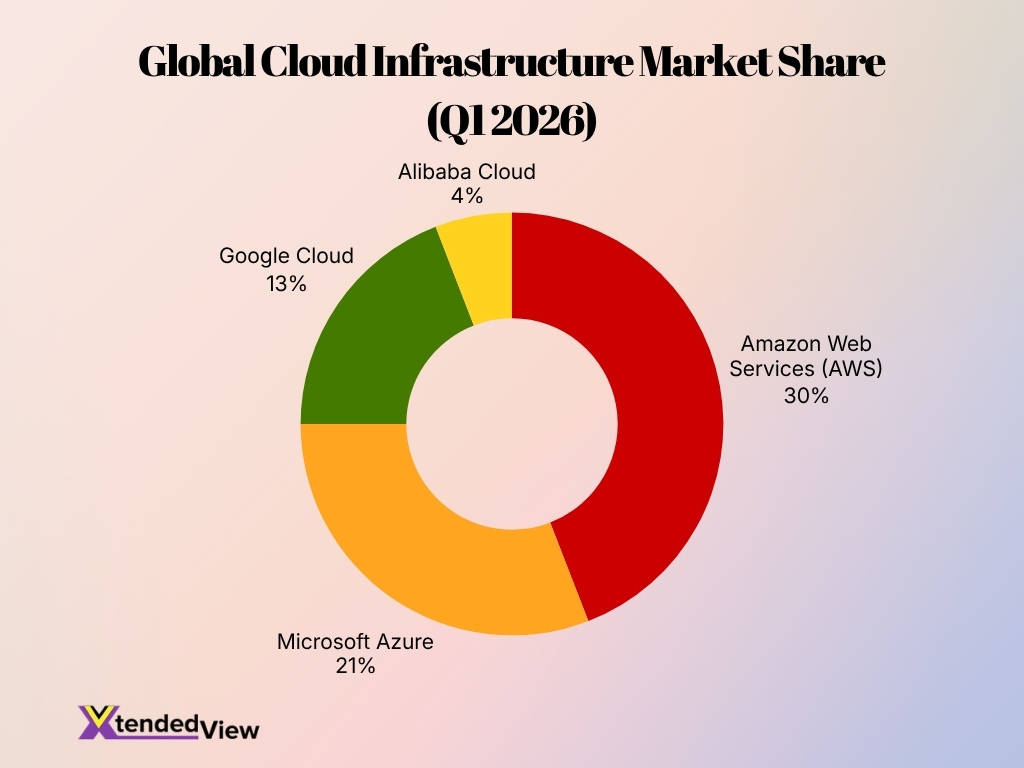
- Amazon Web Services (AWS) held approximately 30% of the global cloud infrastructure services market in Q1 2026, maintaining its position as the largest provider.
- Microsoft Azure accounted for roughly 21% of global cloud infrastructure spending in early 2026, narrowing the gap with AWS.
- Google Cloud captured about 13% market share in 2026, nearly doubling its share compared with five years earlier.
- AWS, Microsoft Azure, and Google Cloud together controlled approximately 64% of the global cloud infrastructure market in Q1 2026.
- Cloud infrastructure services spending reached $90.9 billion during Q1 2026, representing annual growth of around 21%.
- Google Cloud recorded growth of approximately 28% year over year during the first quarter of 2026, outperforming the broader market.
- Microsoft Azure reported cloud revenue growth exceeding 30% year over year during several quarters of 2025 and 2026 due to AI demand.
- Oracle Cloud Infrastructure continued expanding rapidly, posting cloud infrastructure growth rates above 40% during recent reporting periods.
- Alibaba Cloud remained the largest cloud provider in Asia-Pacific, with an estimated 4% global market share in 2026.
Public, Private, and Hybrid Cloud Statistics
- Around 90% of organizations are expected to adopt hybrid cloud environments by 2027, making hybrid the dominant deployment model.
- More than 70% of enterprises operate workloads across multiple cloud environments, including public and private infrastructure.
- Hybrid cloud adoption among large enterprises exceeded 80% in 2025, driven by compliance and workload flexibility requirements.
- Approximately 73% of organizations use hybrid cloud strategies as part of their digital transformation efforts.
- Nearly 89% of enterprises report using multiple public cloud providers alongside private cloud resources.
- Public cloud remains the preferred environment for AI and machine learning workloads because of scalable compute resources.
- Private cloud usage remains strong in regulated sectors such as healthcare, government, and financial services.
- About 47% of enterprise workloads now run in public cloud environments, while the remainder stay on-premises or in private clouds.
- Data sovereignty regulations are accelerating investment in hybrid and sovereign cloud deployments across Europe and Asia.
Cloud Service Models Statistics (SaaS, PaaS, IaaS)
- Software as a Service (SaaS) remains the largest cloud segment, with spending expected to exceed $300 billion in 2026.
- Infrastructure as a Service (IaaS) spending is projected to reach approximately $212 billion in 2026.
- Platform as a Service (PaaS) continues to be one of the fastest-growing cloud segments due to AI application development.
- SaaS accounts for roughly 40% of total public cloud spending worldwide.
- More than 99% of organizations use at least one SaaS application in daily operations.
- The average enterprise uses over 110 SaaS applications, highlighting the widespread adoption of cloud software.
- AI-related platform services are expected to drive double-digit PaaS growth through 2030.
- IaaS growth accelerated during 2025 as enterprises expanded cloud infrastructure to support generative AI workloads.
- Database-as-a-Service and AI-as-a-Service offerings are becoming major contributors to next-generation PaaS revenue growth.
Key Benefits Driving Private Cloud Adoption
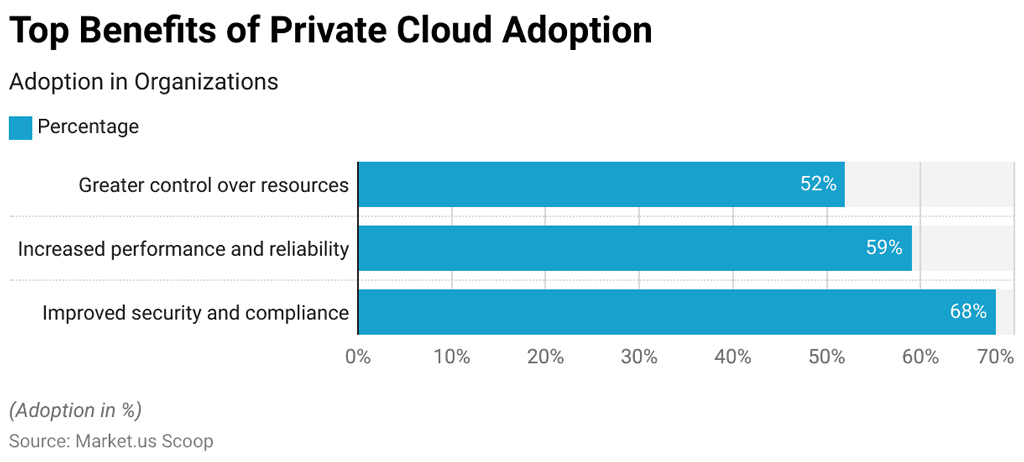
- 68% of organizations adopt private clouds for improved security and compliance, making it the leading benefit.
- 59% of organizations cite increased performance and reliability as a key reason for private cloud adoption.
- 52% of organizations value greater control over resources, highlighting the importance of infrastructure management.
- Security and compliance lead all benefits, outperforming performance gains by 9 percentage points.
- More than half of organizations (52%+) report operational and governance advantages from private cloud environments.
- The data shows that security, reliability, and control remain the top priorities in private cloud adoption decisions.
Cloud Storage and Data Volume Statistics
- By 2025, global data creation is projected to reach 181 zettabytes, up from 120 zettabytes in 2023.
- It is estimated that 100 zettabytes of data will be stored in the cloud, accounting for 50% of the world’s total data.
- The global cloud storage market was valued at $161.28 billion in 2025 and is projected to reach $809.99 billion by 2034.
- Approximately 402.74 million terabytes of data are generated daily worldwide.
- The block storage segment is expected to dominate the market with a 68.00% share globally in 2026.
- The public cloud segment is projected to contribute a major market share of 63.71% globally in 2026.
- Unstructured data is expected to account for nearly 80% of all stored enterprise data by the end of 2025.
- More than 85% of organizations are projected to significantly increase their spending on data storage and backups in 2026.
- The top three hyperscalers combined hold more than a 60% share of the global cloud infrastructure market in 2026.
Cloud Security and Data Breach Statistics
- Approximately 82% of data breaches involved information stored in cloud environments during recent investigations.
- The global average cost of a data breach reached $4.88 million in 2024, the highest level recorded to date.
- Organizations using extensive security AI and automation reduced breach costs by an average of $2.22 million.
- Misconfigured cloud storage accounts for roughly 23% of all cloud security incidents.
- More than 45% of organizations identified cloud security as their top cybersecurity challenge.
- Human error continues to be responsible for up to 95% of all cloud security failures.
- Implementing multi-factor authentication (MFA) reduces the risk of cloud account compromise by more than 99%.
- Spending on cloud security tools is expected to grow at double-digit rates through 2028.
- Over 80% of organizations experienced at least one cloud security breach in the past year alone.
Cloud Computing Usage by Industry Statistics
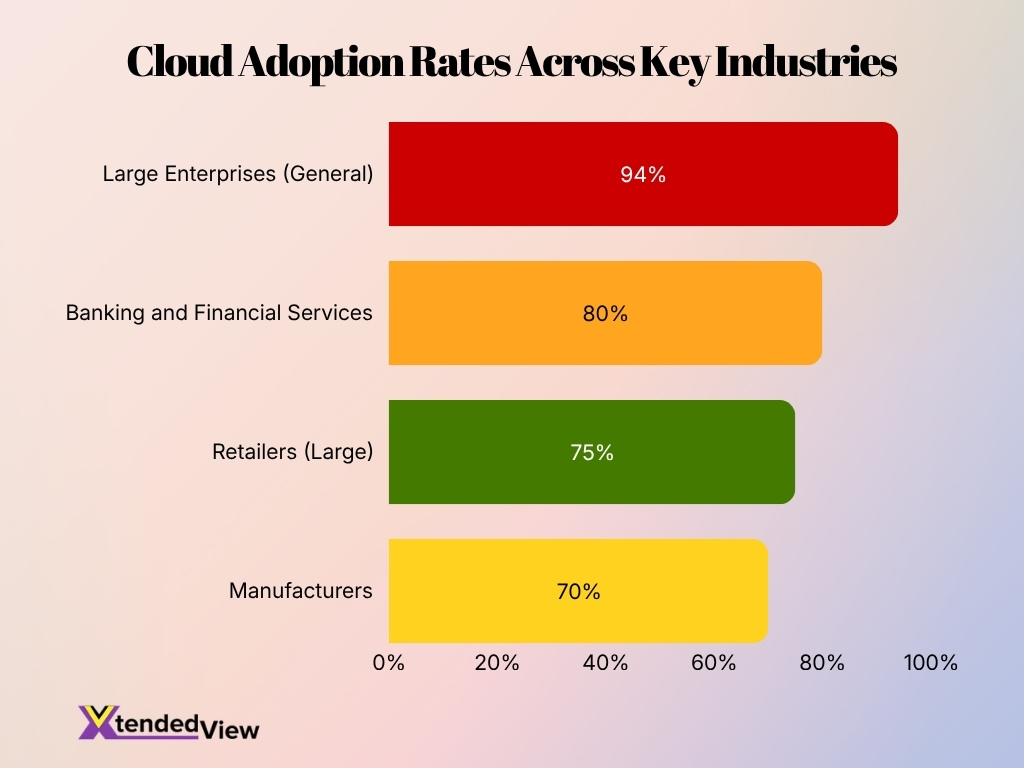
- Approximately 94% of large enterprises use cloud services in some capacity across business operations.
- The banking and financial services sector remains one of the largest cloud adopters, with more than 80% of institutions using cloud platforms for digital banking and analytics.
- Healthcare organizations continue increasing cloud investments, with cloud-based healthcare IT spending expected to exceed $120 billion by 2030.
- Around 70% of manufacturers have adopted cloud technologies to support Industry 4.0 initiatives and smart factories.
- Retailers increasingly rely on cloud infrastructure for e-commerce, inventory management, and customer analytics, with cloud adoption exceeding 75% among large retailers.
- Government agencies worldwide continue cloud modernization programs, contributing to sovereign cloud spending growth of 35.6% in 2026.
- The media and entertainment industry uses cloud platforms extensively for content delivery, streaming, and rendering workloads.
- Educational institutions accelerated cloud adoption after remote learning initiatives, with cloud-based learning platforms becoming standard across universities.
- Telecommunications providers are expanding cloud-native network deployments to support 5G infrastructure and edge computing.
Cloud Migration Statistics
- By 2026, over 94% of organizations will have migrated workloads to cloud infrastructure.
- Roughly 80% of enterprise workloads have successfully migrated to cloud environments.
- The cloud migration services market is expected to exceed $330 billion by 2026.
- Over 83% of enterprises are considering repatriating workloads to private clouds for cost predictability.
- Approximately 87% of companies utilize a multi-cloud migration strategy to ensure vendor flexibility.
- Cloud migration initiatives are forecast to consume 45% of enterprise IT budgets in 2026.
- Nearly 56% of enterprises are migrating AI inferencing workloads to dedicated private clouds.
- Around 52% of IT leaders estimate that over 25% of their public cloud spend is wasted.
Cloud Downtime and Performance Statistics
- The average cost of IT downtime now reaches $15,000 per minute for large enterprises.
- Over 90% of organizations experienced at least one cloud-related outage during the past year.
- Major cloud providers typically offer service-level agreements ranging from 99.9% to 99.99% uptime.
- Downtime costs for Global 2000 companies recently surged to $600 billion annually.
- Approximately 41% of enterprises report per-hour downtime costs between $1 million and $5 million.
- Midsize businesses face cloud outage costs that can easily exceed $300,000 per hour.
- Unplanned outages cost the average large organization approximately $300 million per year.
- AI-powered monitoring tools can reduce incident detection times by more than 50%.
- Publicly traded companies suffer a 3.4% average stock price drop following a single downtime incident.
Cloud Computing Challenges and Waste Statistics
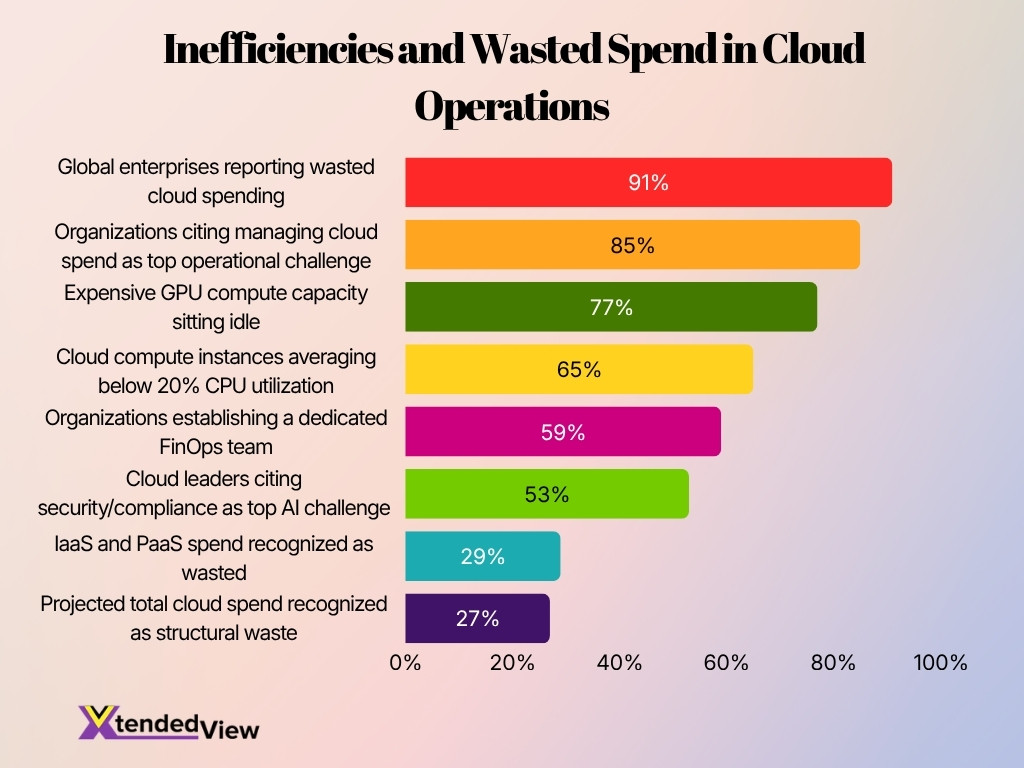
- 29% of IaaS and PaaS spend is now wasted due to dynamic AI workloads.
- 85% of organizations cite managing cloud spend as their top operational challenge.
- 27% of the projected $723 billion cloud spend is recognized as structural waste.
- 65% of cloud compute instances average below 20% CPU utilization across environments.
- 77% of expensive GPU compute capacity in modern cloud infrastructure sits idle.
- 91% of global enterprises actively report experiencing wasted cloud spending.
- 76% of large enterprises now spend over $5 million monthly on public cloud services.
- 53% of cloud leaders cite security and compliance as the top challenge for AI initiatives.
- 59% of organizations have established a dedicated FinOps team to optimize costs.
Cloud Infrastructure Spending Statistics
- Global cloud infrastructure spending reached $399.6 billion in 2025, increasing 24% year over year.
- Worldwide cloud infrastructure spending is expected to surpass $500 billion in 2026.
- Spending on cloud infrastructure services reached $90.9 billion in Q1 2026 alone.
- Data center systems spending is forecast to grow 42.4% in 2025, largely driven by AI infrastructure demand.
- Hyperscale providers continue investing heavily in AI-ready data centers and specialized computing infrastructure.
- Oracle announced plans for approximately $70 billion in future capital expenditures to expand cloud infrastructure capacity.
- Microsoft, Amazon, and Google collectively invested tens of billions of dollars in data center expansion throughout 2025.
- AI workloads have become one of the fastest-growing drivers of infrastructure spending across public cloud providers.
- Global demand for GPU-enabled cloud infrastructure continues to exceed supply in several regions.
Regional Cloud Computing Statistics
- North America accounted for approximately 52% of the global cloud computing market share in 2025.
- Europe’s cloud computing market size is expected to grow from $220.90 billion in 2025 to $256.07 billion in 2026.
- Asia-Pacific is projected to record the fastest regional growth and reach a market value of $554.85 billion by 2030.
- Public cloud spending in India is officially forecast to reach $17.5 billion in 2026, up from $13.7 billion in 2025.
- The Latin America cloud market was valued at $53.85 billion in 2025 and is expanding at a 16.4% annual growth rate.
- The Middle East and Africa cloud market size is projected to surge from $104.24 billion in 2025 to $179.51 billion by 2032.
- Approximately 52.7% of all enterprises across the European Union reported using paid cloud computing services in 2025.
- Brazil dominated the Latin American region by holding a massive 38% share of the total cloud infrastructure investment in 2025.
Public Cloud Usage Trends Among Businesses
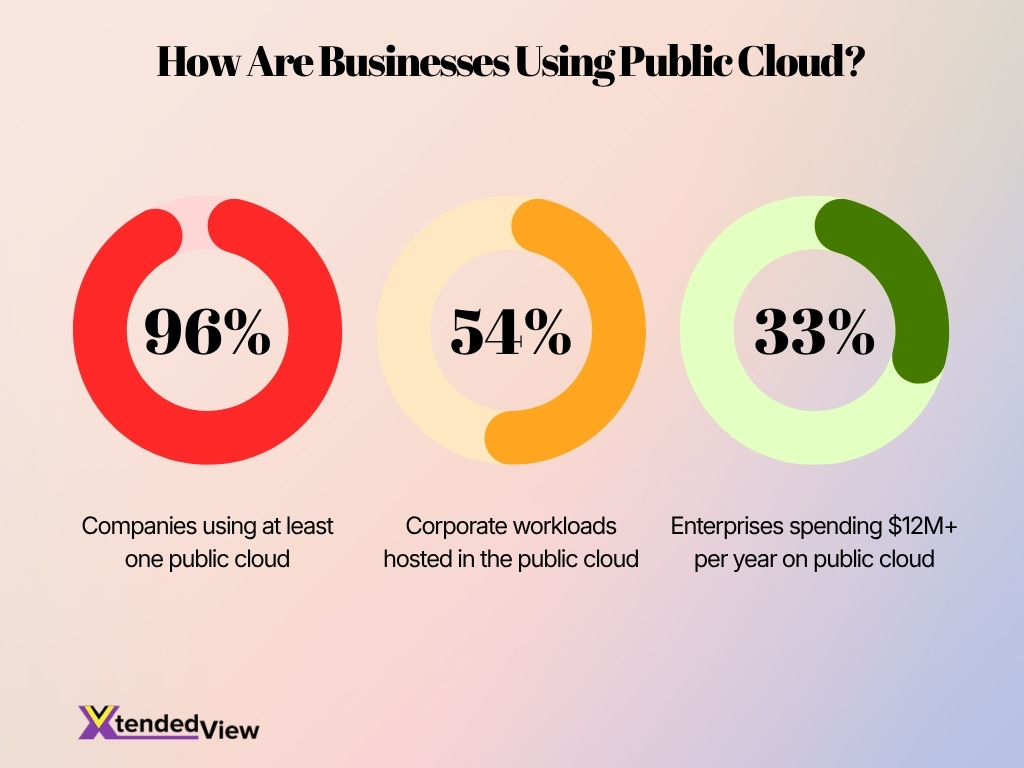
- 96% of companies now use at least one public cloud, highlighting near-universal cloud adoption across businesses.
- 54% of corporate workloads are running in the public cloud, showing that cloud platforms have become a primary IT environment.
- 33% of enterprises spend more than $12 million annually on public cloud services, reflecting significant cloud investment.
- Nearly all organizations (96%) rely on public cloud solutions to support business operations and digital transformation.
- More than half of enterprise workloads (54%) have already migrated to the public cloud, accelerating modernization efforts.
- One in three enterprises (33%) commits $12M+ per year to public cloud infrastructure and services.
Cloud Environmental Impact and Sustainability Statistics
- Global data center electricity usage currently accounts for roughly 1.5% of worldwide power consumption.
- Over 50% of cloud organizations plan to offset 100% of their energy with renewable sources.
- Shifting workloads to the cloud can slash IT-related carbon emissions by up to 80%.
- AI-optimized servers will consume 31% of all data center power globally in 2026.
- An average hyperscale data center requires up to 450,000 gallons of water daily for cooling.
- Implementing liquid cooling technologies can decrease a facility’s energy consumption by 50%.
- Total data center emissions are projected to reach 8% of global greenhouse gases by 2030.
- A single generative AI prompt uses 10 times more electricity than a standard web search.
- Cooling systems traditionally account for more than 40% of a data center’s total energy expenditure.
Future Trends and AI in Cloud Computing Statistics
- The global cloud computing market is projected to reach $1.6 trillion by 2030 due to rapid AI integration.
- AI-related cloud workloads were a primary factor in the 24% increase in overall cloud infrastructure spending during 2025.
- The worldwide AI cloud infrastructure market is expected to experience a massive CAGR of over 30% through 2030.
- More than 70% of modern enterprises are currently exploring or running generative AI initiatives on cloud servers.
- Global power consumption by AI-driven data centers is anticipated to triple by 2030 as computational demands surge.
- By the end of 2026, nearly 50% of corporate data globally will be stored and managed in cloud-based systems.
- Enterprise AI adoption within cloud environments surged by 48% as organizations heavily automated cloud security.
- Worldwide end-user spending on public cloud services is forecast to reach a staggering $1.6 trillion by 2028.
- The AI infrastructure hardware segment alone held a massive 63% market revenue share due to specialized chip demand.
Frequently Asked Questions (FAQs)
Worldwide end-user spending on public cloud services is forecast to reach $723.4 billion in 2025, up from $595.7 billion in 2024.
Approximately 90% of organizations are expected to adopt hybrid cloud environments by 2027.
The global cloud computing market is projected to reach $905.33 billion in 2026.
AWS, Microsoft Azure, and Google Cloud collectively account for approximately 66% of global cloud infrastructure spending.
Global cloud infrastructure spending totaled $399.6 billion in 2025, representing a 24% year-over-year increase.
Conclusion
Cloud computing continues to evolve from a cost-saving technology into the foundation of modern digital business. The latest statistics show strong growth across cloud spending, infrastructure investments, AI-driven workloads, and hybrid cloud adoption. Organizations are increasingly relying on cloud platforms to power analytics, cybersecurity, application development, and artificial intelligence initiatives.
At the same time, challenges such as cloud cost optimization, security management, and sustainability remain critical priorities. Looking ahead, AI, sovereign cloud services, edge computing, and next-generation infrastructure investments are expected to shape the future of the industry. Businesses that align their cloud strategies with these emerging trends will be better positioned to scale operations, improve efficiency, and remain competitive in an increasingly digital economy.
