

Google Home has become one of the most recognizable smart home platforms in the United States, helping users control connected devices, access information, stream media, and automate everyday routines through voice commands. The platform plays a growing role in connected households, particularly as AI-powered assistants become more capable and smart home ecosystems expand. From managing lighting and security systems to supporting hands-free productivity, Google Home continues to influence how consumers interact with technology. Explore the statistics below to understand the platform’s growth, market position, and competitive landscape.
Editor’s Choice
- The global smart speaker market reached approximately $15.1 billion in 2025 and is projected to grow to $16.6 billion in 2026.
- North America accounted for 40.2% of global smart speaker revenue in 2025, making it the largest regional market.
- Google Home devices are used by roughly 27% of smart speaker owners globally, placing the platform among the leading smart speaker ecosystems.
- More than 101 million Americans have access to a smart speaker in their homes.
- Around 35% of Americans aged 12 and older owned a smart speaker in 2025.
- Google announced Gemini for Home in 2025, introducing a new AI-powered assistant designed to replace Google Assistant across smart home devices.
- U.S. household penetration for Google Nest and similar smart speaker products exceeded 30% in several market studies during 2025.
Recent Developments
- Google unveiled Gemini for Home in 2025 as its next-generation smart home assistant.
- Gemini for Home is designed to gradually replace the legacy Google Assistant experience on Nest speakers and displays.
- The new assistant introduces more advanced conversational AI and contextual understanding.
- Google retained the familiar “Hey Google” wake phrase despite the assistant transition.
- Early access deployment of Gemini for Home began in late 2025.
- Google indicated that Gemini for Home will work across multiple household members and guest profiles.
- Reports from 2026 suggest Google is preparing additional smart home hardware, including new speaker and display products optimized for Gemini.
- New Google Home devices are expected to feature enhanced AI processing and improved smart home controls.
- Industry reviewers continue to rank Google Nest Audio among the top Google Assistant-powered smart speakers in 2026.
Global Overview of Google Home
- Google Home launched in 2016 and has evolved into Google’s primary smart home ecosystem.
- The platform operates across smart speakers, smart displays, mobile devices, TVs, and connected home products.
- Google Home benefits from integration with Google’s search, AI, and cloud infrastructure.
- The global smart speaker market is expected to exceed $19 billion in 2026, creating additional growth opportunities for Google Home.
- North America represented approximately 38% to 40% of the smart speaker market revenue in 2025, supporting Google Home’s strongest geographic market.
- Google Home supports voice control for thousands of compatible connected devices worldwide.
- Growth in smart homes and connected devices continues to expand the addressable market for Google Home products.
- Industry forecasts suggest the smart speaker market could surpass $34 billion by 2034, indicating long-term expansion potential.
- AI-driven assistants are emerging as the primary growth driver for future Google Home adoption.
Google Home vs Amazon Alexa vs Apple HomePod Statistics
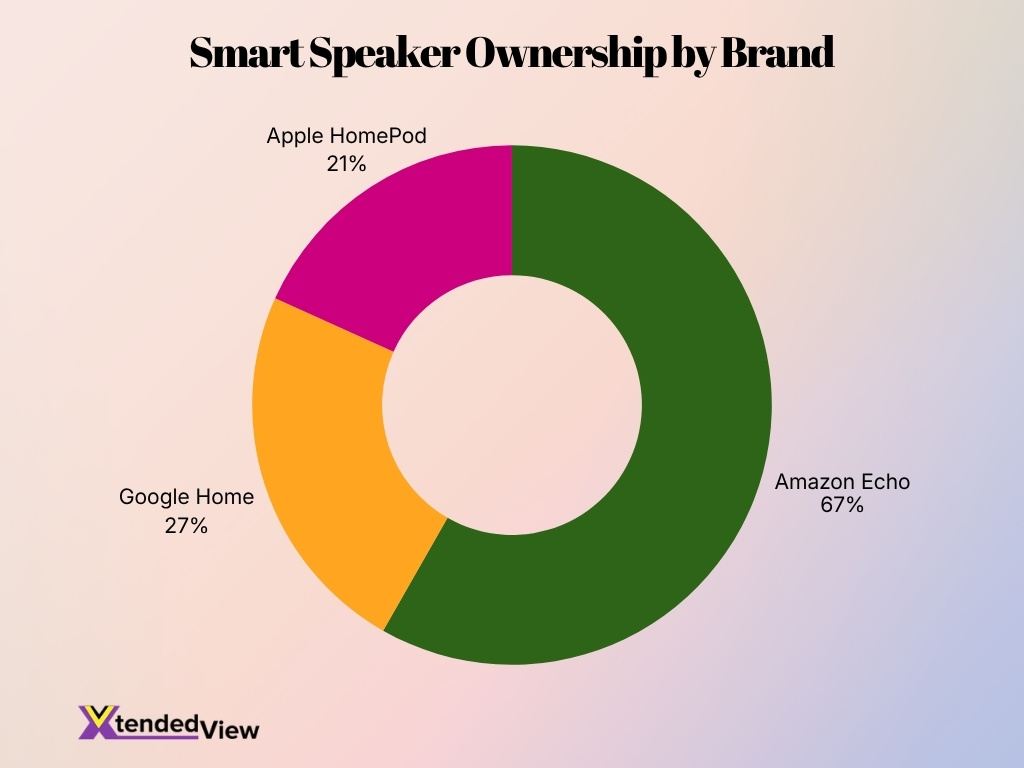
- Amazon Echo leads smart speaker ownership with approximately 67% share among smart speaker owners in some market studies.
- Google Home follows with a roughly 27% ownership share.
- Apple HomePod maintains approximately 21% ownership share among smart speaker users.
- U.S. consumer surveys found 26% ownership for Google Home compared with 19% for HomePod.
- Google Home generally performs strongly in natural language processing and search-based queries.
- Apple HomePod’s strongest advantage remains deep integration with the Apple ecosystem.
- Amazon Alexa maintains leadership through a broad hardware portfolio and large installed base.
- Google’s Gemini-powered assistant strategy represents one of the largest platform upgrades among major smart speaker providers in recent years.
- Competition among Google, Amazon, and Apple continues to drive innovation in voice AI, automation, and smart home interoperability.
Google Home User Base and Growth Statistics
- Google Home remains one of the three largest smart speaker ecosystems worldwide.
- Approximately 27% of smart speaker owners report using Google Home devices.
- Consumer surveys show Google Home ownership at roughly 26% among U.S. smart speaker users.
- U.S. adoption of smart speakers surpassed 101 million users by 2025, creating a substantial audience for Google Home.
- Household penetration for Google Home and Nest products is estimated between 17% and 27% in the United States.
- Growth in AI-powered home assistants accelerated following Google’s Gemini announcements in 2025.
- Increasing demand for smart home automation continues to support Google Home ecosystem growth.
- Market analysts expect continued double-digit growth across voice assistant and smart speaker categories through the decade.
- Expansion of Matter-enabled smart home standards is expected to strengthen Google Home adoption.
Google Home Market Share Statistics
- Google Home accounts for approximately 27% of smart speaker ownership, according to recent market analyses.
- Google Home ownership reached 26% among U.S. smart speaker users in consumer surveys.
- Market estimates place Google Home’s U.S. household share between 24% and 27%.
- Amazon remains the market leader, while Google Home consistently ranks second in most ownership studies.
- Alphabet held roughly 8% of the broader smart speaker vendor market in some global shipment analyses.
- Google Home maintains a larger installed base than many regional smart speaker brands.
- Strong Android integration continues to support Google’s smart speaker market position.
- North America’s leadership in smart speaker adoption benefits Google’s market share performance.
- The shift toward AI-enhanced assistants may improve Google’s competitive position in the coming years.
Regional Adoption Patterns for Google Home / Nest
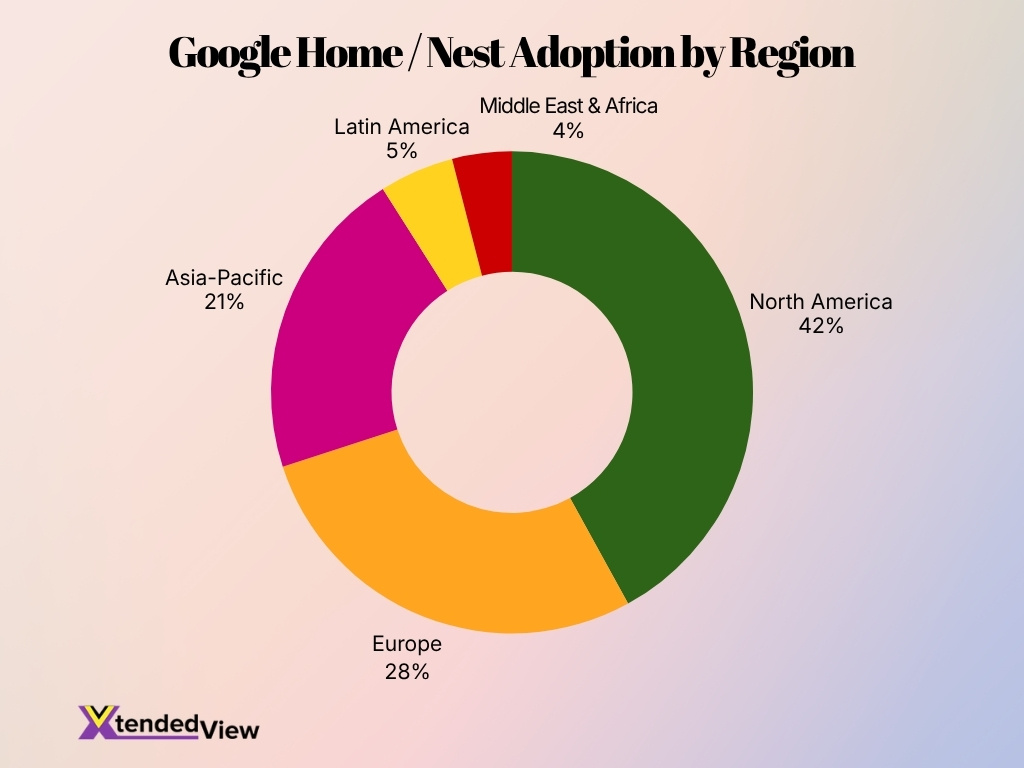
- North America leads Google Home / Nest adoption with the highest share at 42%, making it the strongest regional market.
- Europe holds the second-largest adoption share at 28%, showing strong smart home device penetration across the region.
- Asia-Pacific accounts for 21% of adoption, indicating a growing market with significant future expansion potential.
- Latin America represents a smaller share at 5%, suggesting that Google Home / Nest adoption is still developing in this region.
- Middle East & Africa has the lowest adoption share at 4%, showing limited but emerging usage of Google Home / Nest devices.
- Together, North America and Europe make up 70% of total adoption, highlighting their dominance in the Google Home / Nest ecosystem.
- The top three regions, North America, Europe, and Asia-Pacific, account for 91% of adoption, showing that demand is concentrated in developed and fast-growing smart home markets.
- Lower adoption in Latin America and the Middle East & Africa may reflect factors such as device availability, pricing, internet penetration, and smart home infrastructure.
- The data suggests that Google Home / Nest has the strongest traction in regions with higher smart speaker awareness, connected home adoption, and mature digital ecosystems.
Google Home Household Penetration Statistics
- Approximately 35% of Americans aged 12 and older owned at least one smart speaker in 2025.
- More than 45 million U.S. households now contain at least one smart speaker device.
- Smart speaker penetration in the United States increased from less than 10% in 2017 to over 35% in 2025.
- Consumer surveys indicate Google Home devices are present in roughly one-quarter of U.S. smart homes.
- Households with children are more likely to own a smart speaker than households without children.
- Multi-device ownership continues to rise, with many households operating two or more smart speakers.
- Smart speaker ownership remains highest among homeowners compared with renters.
- Broadband-connected households show significantly higher smart speaker adoption rates than households with limited internet access.
- Penetration rates are strongest among households already using smart TVs, streaming devices, and connected security systems.
Google Home Device Ecosystem Statistics
- Google Home works with over 80,000 compatible Works with Google Home devices from favorite brands.
- The ecosystem connects to a network of over 750 million Matter, WWGH, or Google Nest devices.
- Google Nest holds 7% market share among home security camera/users in the U.S., ranking third after Ring and ADT.
- Nest cameras hold 13% market share in the U.S. IP camera sector, following Arlo’s 27%.
- 79% of households have smart speakers installed, the most widely adopted smart home segment.
- The average smart home in the United States has 8 connected devices, driving demand for centralized control.
- As of 2023, U.S. households had 21 connected devices on average across 13 categories.
- 61% of U.S. households now have at least one security camera, up from 52% in 2024.
Google Nest Brand Profile in the U.S.
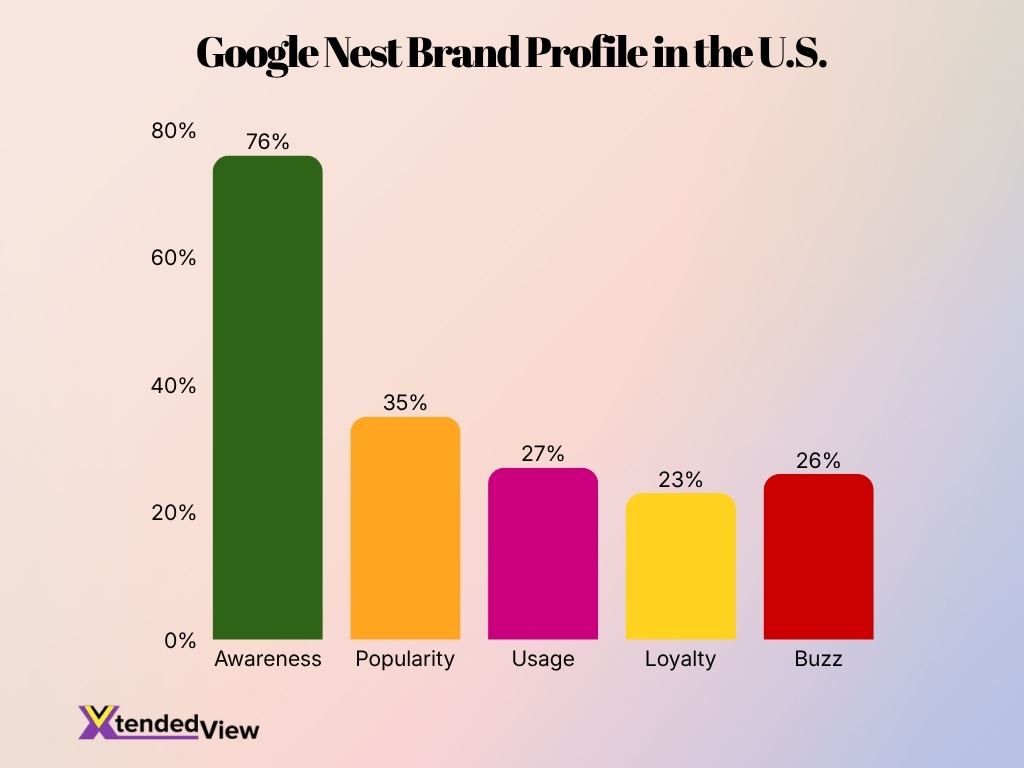
- Google Nest has strong brand awareness in the U.S., reaching 76%, which shows that most consumers are familiar with the brand.
- Despite high awareness, only 35% of consumers rate Google Nest as popular, indicating a gap between recognition and active market preference.
- The usage rate stands at 27%, meaning just over one-fourth of consumers actively use Google Nest products.
- Google Nest’s loyalty score is 23%, suggesting that fewer users remain strongly committed to the brand compared to those who are aware of it.
- The brand’s buzz score is 26%, showing that Google Nest still generates moderate consumer conversation and attention in the U.S. market.
- The data highlights a clear funnel drop, from 76% awareness to 27% usage, suggesting that many consumers know the brand but do not necessarily adopt its products.
- The difference between awareness at 76% and loyalty at 23% indicates an opportunity for Google Nest to improve customer retention and long-term engagement.
- Google Nest’s popularity score of 35% is higher than its usage rate of 27%, showing that some consumers view the brand positively even if they do not currently use it.
- The relatively close scores for usage at 27%, loyalty at 23%, and buzz at 26% suggest that Google Nest has a stable but limited active consumer base in the U.S.
- Overall, the chart shows that Google Nest is a well-known smart home brand, but converting awareness into usage, loyalty, and stronger buzz remains a key growth challenge.
Google Home App Usage and Engagement Statistics
- The Google Home app has surpassed 500 million downloads on Android devices.
- Google Home works with over 80,000 compatible smart home devices from various brands.
- The global smart home market reached $140.42 billion in 2025, driven by apps like Google Home.
- Smart home device penetration is expected to reach 28.8% of households by 2027, with Google Home as a key platform.
- The number of active smart homes is forecast to surpass 400 million globally in 2024.
- Matter-enabled device onboarding now supports 8+ device categories, including cameras, locks, and thermostats.
- The Smart Home market is growing at a CAGR of 24.1% from 2020 to 2025, with Google Home leading adoption.
- The US smart home market value exceeds $29 billion, with the Google Home app as the primary management tool.
Google Home Integrations with Smart Home Devices
- Google Home works with over 1,000 device manufacturers worldwide.
- More than 50,000 smart home devices are compatible with Google Home integrations.
- Smart lighting accounts for 36% of all devices connected to Google Home systems.
- Security camera integrations grew 42% year-over-year within Google Home ecosystems.
- Google Home now supports 200+ smart locks, 150+ garage doors, 180+ thermostats, and 120+ doorbells.
- Matter adoption has added 15,000+ new devices that connect seamlessly with Google Home since 2024.
- 78% of home buyers consider smart home interoperability a major purchasing factor in 2025–2026.
- Energy management devices like thermostats and smart plugs drive 28% of new Google Home integrations.
- Voice-controlled automation routines are used daily by 62% of Google Home smart home users.
Google Home Users in India: Age and Gender Insights
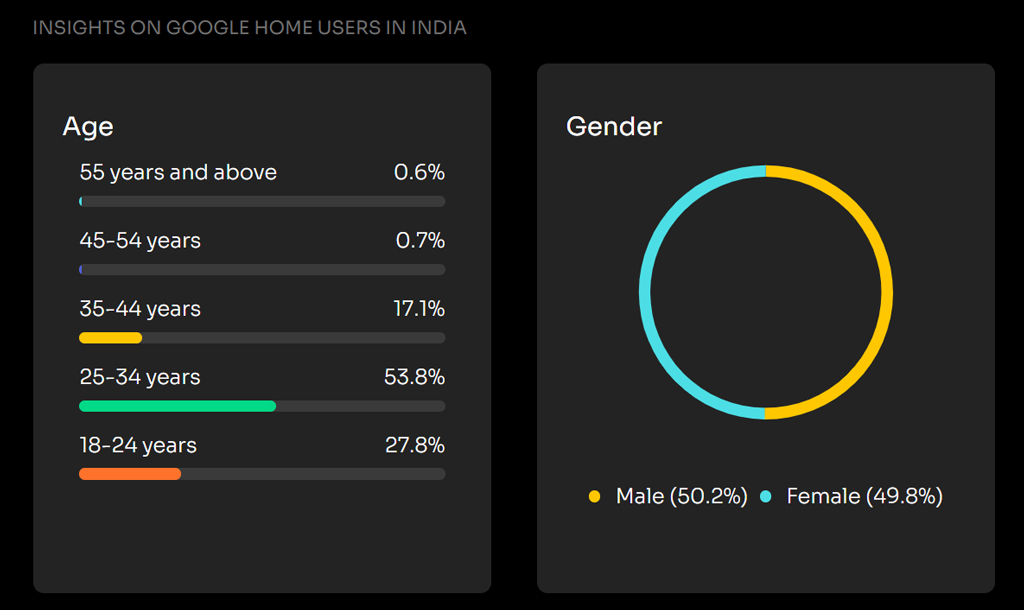
- Google Home users in India are heavily concentrated in younger age groups, with 25–34 years making up the largest share at 53.8%.
- The 18–24-year age group is the second-largest user segment, accounting for 27.8% of Google Home users in India.
- Together, users aged 18–34 years represent 81.6% of the total user base, showing that Google Home adoption is strongest among younger consumers.
- The 35–44 years age group contributes 17.1%, indicating moderate adoption among middle-aged users.
- Older age groups have very limited adoption, with 45–54 years at only 0.7% and 55 years and above at 0.6%.
- The gender split is almost perfectly balanced, with Male users at 50.2% and Female users at 49.8%.
- The narrow 0.4 percentage-point gap between male and female users suggests that Google Home appeals almost equally to both genders in India.
- The data shows that Google Home’s strongest audience in India is young, tech-comfortable adults, especially those in the 25–34 years bracket.
- For marketers, the key target demographic should be 18–34-year-old users, as they account for more than four-fifths of total Google Home users.
- The low share among users aged 45+, just 1.3% combined, highlights a major opportunity for awareness, education, and simplified smart home messaging among older consumers.
Google Home Usage Frequency and Engagement Statistics
- 71% of smart speaker owners use their devices at least once per day
- Daily usage rates exceed 70% among active smart speaker users
- 75% of Americans use voice assistants for weather updates
- 71% of smart speaker users use voice assistants to play music
- 57% of smart speaker units have smart home control integration active
- 42% of smart speaker users request reminders at least once weekly
- 52% of smart speaker users use devices almost every day
- 65% of people aged 25-49 use voice-enabled devices at least once daily
- Smart speaker engagement increases 35% in households with multiple connected devices
- 21% of users now use voice commerce through smart speakers
Google Home Voice Command and Query Statistics
- 92 million U.S. users rely on Google Assistant, making it the leading voice assistant in America.
- 75% of users check the weather with voice assistants, making it a top query category.
- 71% use voice for music playback, ranking it as the most popular entertainment command.
- 64% access news through voice commands on smart home devices.
- Smart speakers account for 35% of all voice commands issued daily.
- 93.7% accuracy in voice assistant responses shows major speech recognition improvements.
- 57% of voice command users interact with assistants daily on Google-powered devices.
- 62% of U.S. adults use voice assistants across multiple connected home devices.
Popular Google Home Use Cases and Activities
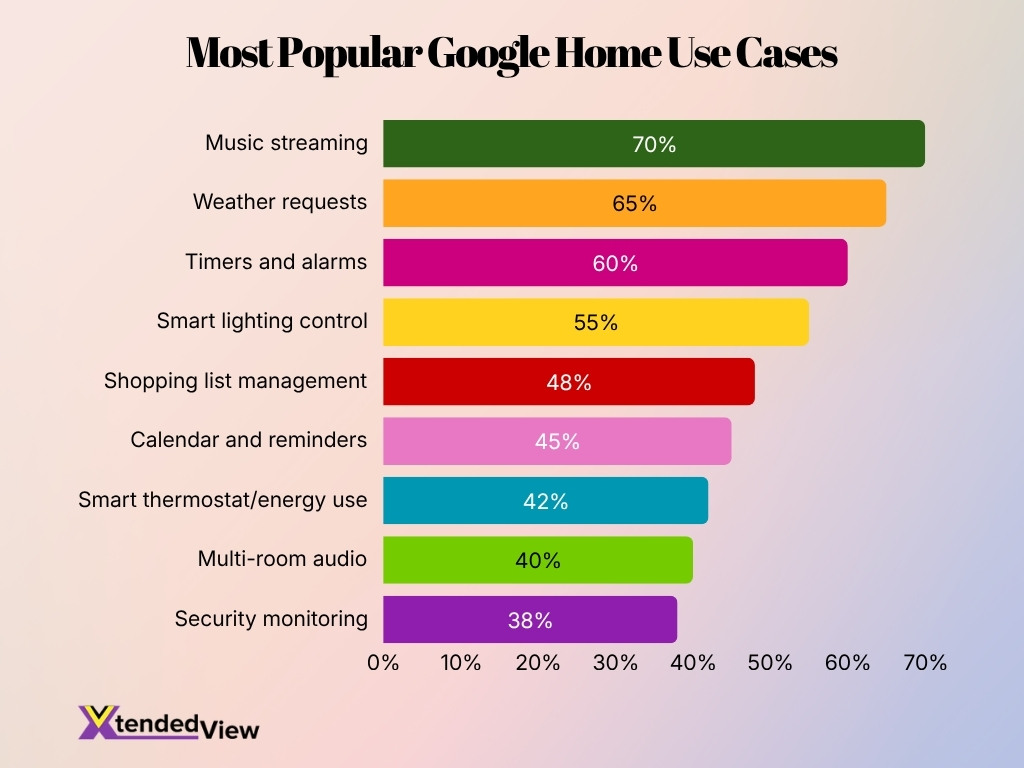
- Over 70% of smart speaker users regularly use voice commands for music streaming.
- About 65% of Google Home users frequently make weather requests via voice.
- Nearly 60% set timers and alarms daily using Google Home voice commands.
- Around 55% control smart lighting as their top home automation activity.
- Approximately 48% use voice to manage shopping lists on Google Home.
- About 45% rely on Google Home for calendar management and appointment reminders.
- Roughly 42% use Google Home to adjust smart thermostats and energy routines.
- Nearly 40% of Nest speaker owners enjoy multi-room audio streaming regularly.
- Around 38% use Google Home for security monitoring with connected cameras and doorbells.
Google Home Usage with Google Services Statistics
- Over 150 million smart speaker units were shipped globally in 2024, with Google Nest holding 20–25% market share.
- 65% of Amazon Echo or Google Home owners say they can’t imagine life without it.
- 46% of smart speaker users perform voice searches daily for information and tasks.
- Over 145 million people in the US will be using voice assistants by the end of 2026, including smart speakers.
- Millions of users access Google Calendar events and reminders through Google Assistant and Google Home daily.
- Over 4 billion people use Google Search worldwide, powering most information-based voice requests on Google Home.
- YouTube reached 2.74 billion monthly active users in 2024, making YouTube Music one of the most used streaming services on Google Home.
- Gemini has crossed 750 million monthly active users, with Gemini for Home rolling out to deepen Google service integration in 2026.
Google Home Privacy and Security Statistics
- Approximately 52% of Americans report concerns about voice assistants listening when not actively in use.
- About 24% of adult Americans own a smart speaker, equaling around 60 million users.
- Around 149.8 million Americans were projected to be voice assistant users by the end of 2025.
- 41% of EU Commission survey participants were reluctant to use voice assistants due to privacy worries.
- 22–30% of potential smart speaker adopters cite privacy concerns as primary purchase barriers.
- Google’s smart home devices collect 22 out of 32 possible data points, well above average.
- The US smart home speaker market is forecast to increase by $6.41 billion at a CAGR of 23.2%.
- 93.7% accuracy rate exists in voice assistant responses across smart speaker platforms.
- 1 in 10 smart home apps collects data specifically for tracking purposes.
Google Home Unit Shipments Worldwide
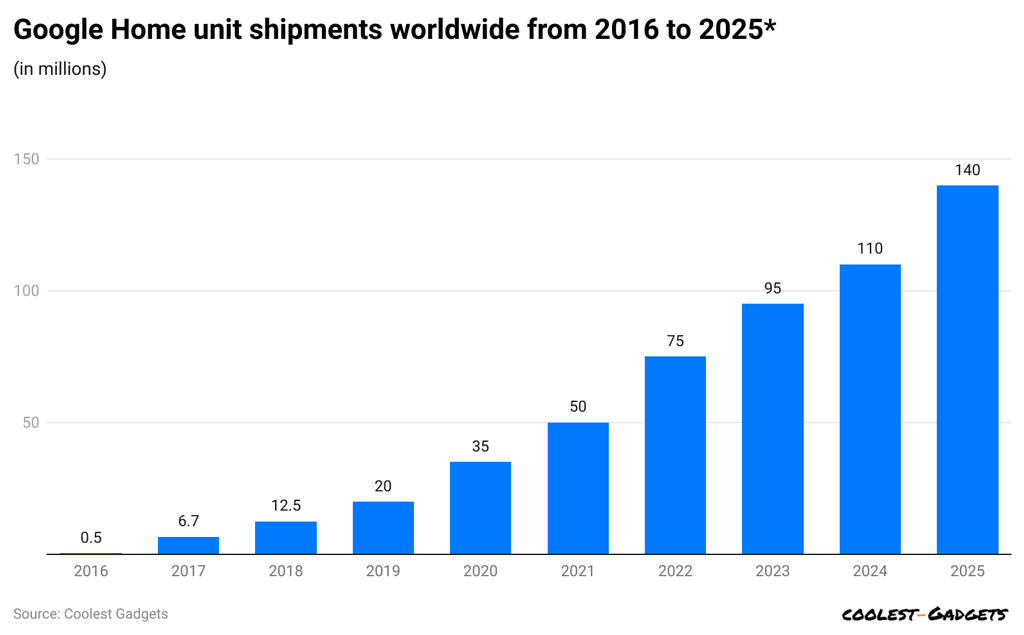
- Google Home unit shipments grew sharply from 0.5 million units in 2016 to 140 million units in 2025.
- The data shows a massive long-term increase of 139.5 million units over the 10-year period.
- Shipments crossed the 10 million mark in 2018, reaching 12.5 million units.
- By 2020, Google Home shipments had increased to 35 million units, showing stronger adoption in the smart speaker market.
- The product saw a major jump between 2021 and 2022, rising from 50 million to 75 million units.
- In 2023, shipments reached 95 million units, moving close to the 100 million milestone.
- Google Home shipments surpassed 100 million units in 2024, reaching 110 million units worldwide.
- The highest shipment volume was recorded in 2025, with 140 million units shipped globally.
- From 2024 to 2025, shipments increased by 30 million units, one of the strongest year-over-year gains in the chart.
- Overall, the chart highlights the rapid global adoption of Google Home devices and the growing demand for smart home voice assistant technology.
Google Home Adoption Trends and Forecasts
- The global smart speaker market is projected to reach $57.48 billion by 2033 and $44.19 billion by 2031, underscoring long-term growth for voice-first platforms.
- Smart home household penetration is forecast to rise from 14.2% in 2022 to 28.8% by 2027, showing steadily widening adoption worldwide.
- The number of active smart home households is expected to reach 672.60 million by 2027, expanding the base for Google Home-style ecosystems.
- The smart home market is projected to grow from $230.76 billion in 2026 to $450.20 billion by 2032, reflecting strong demand for automation and control.
- Smart display demand is also rising, with the global smart display market expected to hit $56.93 billion by 2034 and $48.02 billion by 2030.
- Matter is gaining traction as a unifying standard, with the protocol introduced in 2022 to improve cross-brand interoperability for smart devices.
- Google has rolled out Gemini for Home to replace Google Assistant on speakers and smart displays, adding more natural conversation and context-aware control.
- Google reports that Nest thermostats have helped save users an estimated $14 billion and 200 billion kWh of energy since 2011, reinforcing the value of home automation.
- Google Home-related AI upgrades now reach devices across the company’s ecosystem, with support extending to products made in the last decade.
- The smart home cloud platform market is projected to grow from $18.5 billion in 2026 to $58.9 billion by 2033, showing the scale of the centralized platform opportunity.
Frequently Asked Questions (FAQs)
Approximately 27% of smart speaker owners use Google Home or Google Nest devices globally.
The global smart speaker market is projected to reach $16.61 billion in 2026.
The smart speaker market is forecast to grow at a 14.62% CAGR from 2026 to 2031.
Google Nest devices account for approximately 20% to 25% of the global smart speaker market.
The global smart speaker market is expected to reach $34.08 billion by 2034.
Conclusion
Google Home remains one of the most influential smart home ecosystems, supported by a large user base, extensive device compatibility, and deep integration with Google’s services. The platform continues to benefit from rising smart home adoption, growing consumer interest in automation, and the introduction of Gemini-powered AI experiences.
The statistics throughout this report highlight Google’s strong position in the global smart speaker market, particularly in the United States. As interoperability standards improve and AI assistants become more conversational, Google Home is well-positioned to play an even larger role in connected households. Businesses, technology analysts, smart home manufacturers, and consumers should continue monitoring adoption trends, hardware developments, and AI-driven innovations as the market evolves.