


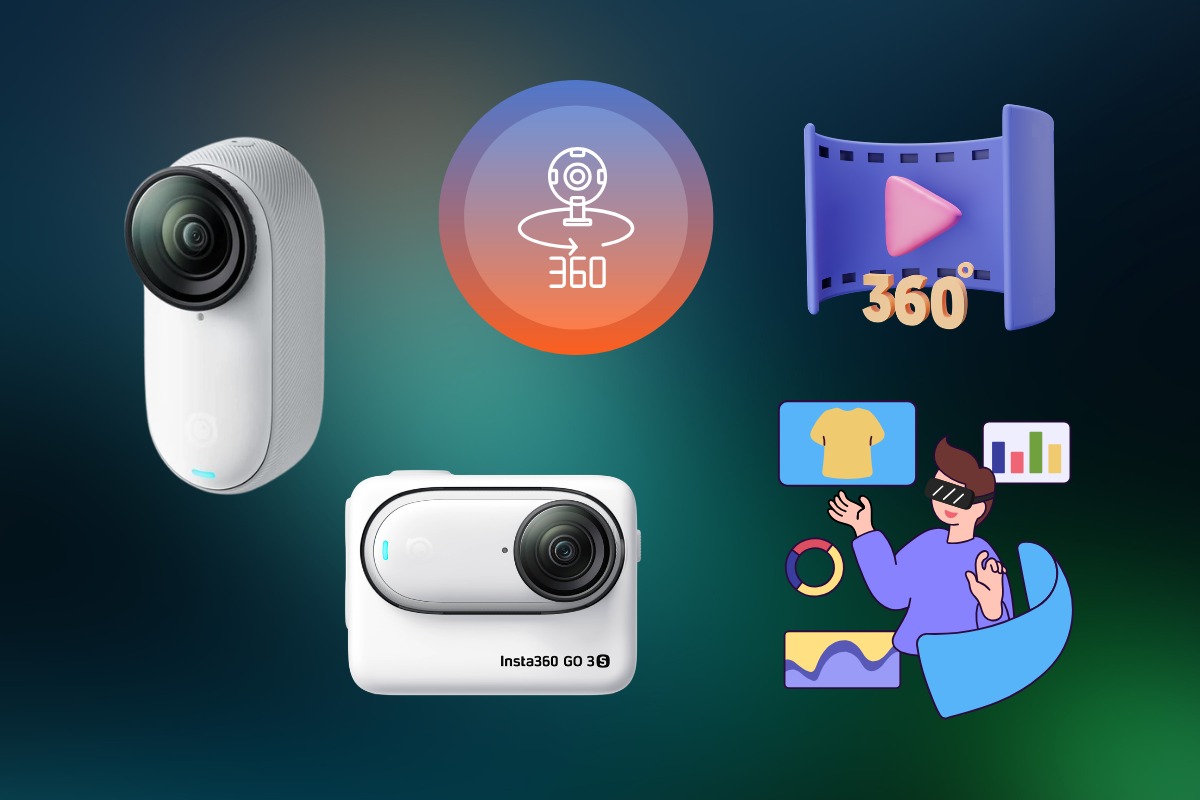
360 cameras have moved beyond niche creator tools and now play a growing role in content production, virtual tourism, remote inspections, security monitoring, and immersive commerce. Businesses use them to create virtual property walkthroughs, while media companies rely on 360-degree footage to deliver interactive experiences across streaming and social platforms. As hardware improves and AI-powered editing becomes easier, adoption continues to expand across consumer and enterprise markets. Explore the latest market figures, growth trends, regional insights, and competitive developments shaping the 360 camera industry.
Editor’s Choice
- The global 360-degree camera market was valued at approximately $2.1 billion in 2025 and is projected to reach $12.91 billion by 2034, growing at a CAGR of 22.37%.
- Another industry estimate places the market at $2.43 billion in 2025, with projections reaching $16.79 billion by 2033 at a CAGR of 27.32%.
- Insta360 controlled approximately 67.2% of the global consumer panoramic camera market in early 2026.
- North America accounts for roughly 40% to 45% of global 360 camera revenue, making it the largest regional market.
- The market generated an estimated $1.86 billion in revenue during 2024, up from $1.38 billion in 2023.
- Forecasts indicate the industry could surpass $19 billion by 2033, driven by VR, AR, immersive media, and enterprise applications.
- Consumer demand for 8K 360 video recording accelerated in 2025 and 2026 as leading products from Insta360, DJI, and GoPro expanded high-resolution offerings.
- Compact camera shipments are expected to increase 13.6% in 2026, benefiting action and immersive camera categories.
Recent Developments
- Insta360 completed a public listing in 2025, raising additional capital to accelerate camera and software research.
- DJI entered the dedicated 360-camera segment with the launch of the Osmo 360, intensifying competition among premium manufacturers.
- DJI’s Osmo 360 introduced an industry-first square HDR sensor that improves sensor utilization by approximately 25%.
- The Osmo 360 supports 8K/50fps panoramic recording, among the highest resolutions currently available in consumer devices.
- Insta360’s flagship X5 camera added replaceable lenses, reducing maintenance costs and extending product lifespan.
- New AI-assisted editing features now automate reframing, object tracking, and highlight generation for creators.
- Insta360 expanded beyond panoramic cameras by developing premium vlogging cameras under the Luna lineup.
- Industry analysts reported growing adoption of 360 cameras in tourism, training simulations, and industrial inspection environments throughout 2025.
- Manufacturers increasingly integrate AI stabilization and low-light enhancement to improve usability across social media platforms.
Global 360 Camera Market Size Statistics
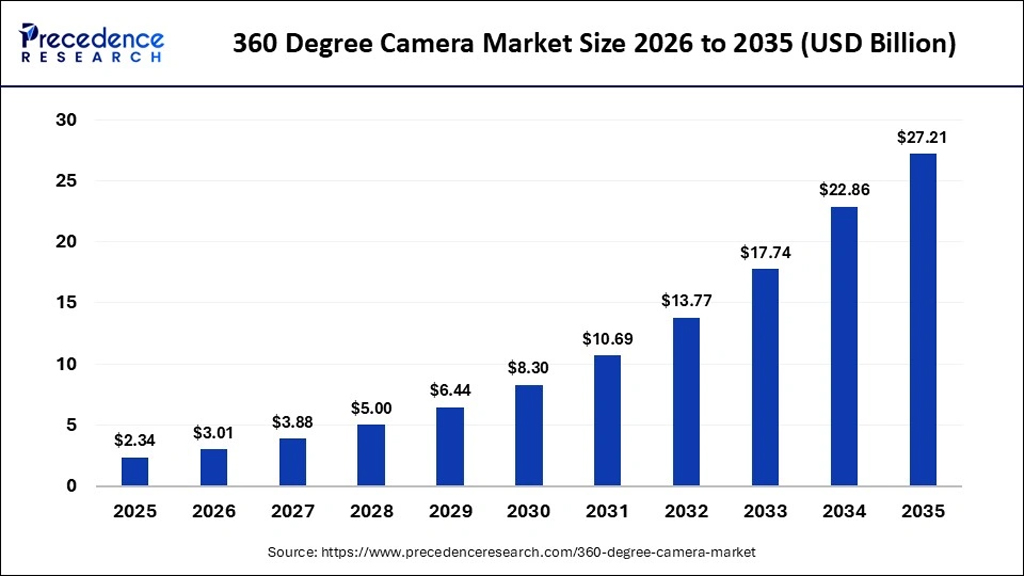
- The global 360-degree camera market is projected to grow from $2.34 billion in 2025 to $27.21 billion by 2035.
- The market is expected to cross $3.01 billion in 2026, showing strong early-stage growth momentum.
- By 2030, the 360-degree camera market is forecast to reach $8.30 billion, more than 3.5 times its 2025 value.
- The market is projected to surpass the $10 billion mark in 2031, reaching $10.69 billion.
- Between 2032 and 2035, the market is expected to expand sharply from $13.77 billion to $27.21 billion.
- The highest annual market value shown in the forecast is $27.21 billion in 2035.
- The data suggests rising adoption of 360-degree cameras across areas such as virtual tours, content creation, automotive applications, surveillance, immersive video, and VR experiences.
- From 2025 to 2035, the market is forecast to increase by $24.87 billion, highlighting a major long-term growth opportunity.
- The market nearly doubles between 2032 and 2035, rising from $13.77 billion to $27.21 billion.
- Overall, the forecast indicates that 360-degree cameras are moving from a niche imaging product toward a broader technology category with expanding commercial and consumer demand.
360 Camera Market Growth Rate and Forecast Statistics
- The global 360 camera market is projected to grow at a compound annual growth rate (CAGR) of 27.8% between 2024 and 2030.
- Industry forecasts indicate an annual growth rate of approximately 27.3% from 2026 to 2033.
- Market analyses estimate the sector will expand at a 25.3% CAGR between 2026 and 2033.
- Long-term projections suggest the market could achieve a 22.4% CAGR through 2034.
- Additional forecasts indicate annual growth of around 20.1% from 2026 to 2034.
- Some market outlooks predict a 20.5% CAGR between 2025 and 2034.
- Industry research also points to a 27.4% CAGR through 2031, reflecting strong momentum across multiple end-use sectors.
- The market is expected to grow significantly from its 2025 valuation of approximately $2.32 billion, supported by increasing adoption across consumer and enterprise applications.
- Rising demand for virtual reality (VR) experiences, immersive gaming, and virtual collaboration platforms continues to drive market expansion.
- Growing use of 360 cameras in security, surveillance, automotive systems, real estate, tourism, and industrial inspections is creating new growth opportunities beyond consumer content creation.
Market Share of 360-Degree Camera Companies
- Insta360 held approximately 67.2% of the consumer panoramic camera market in 2026.
- Frost & Sullivan data previously showed Insta360 controlling around 67% of the global 360-camera market.
- Industry reports indicate Insta360 accounts for roughly 66% of global panoramic camera sales.
- GoPro remains one of the most recognized brands in immersive imaging despite losing share to newer competitors.
- DJI has emerged as a major challenger following the release of its Osmo 360 product line.
- Major companies operating in the sector include GoPro, Insta360, Ricoh, Samsung Electronics, Nikon, LG Electronics, and Garmin.
- GoPro, Ricoh, LG Electronics, and Samsung collectively account for roughly 30% of industry share in some market assessments.
- In Japan’s action camera market, DJI reached approximately 45.2% share in late 2025 while Insta360 held 43.3%.
- GoPro’s position in the action-camera segment declined as DJI and Insta360 expanded their product portfolios.
- Competition increasingly centers on AI editing software, stabilization quality, battery performance, and 8K video capabilities rather than price alone.
360 Camera Market Revenue by Region Statistics
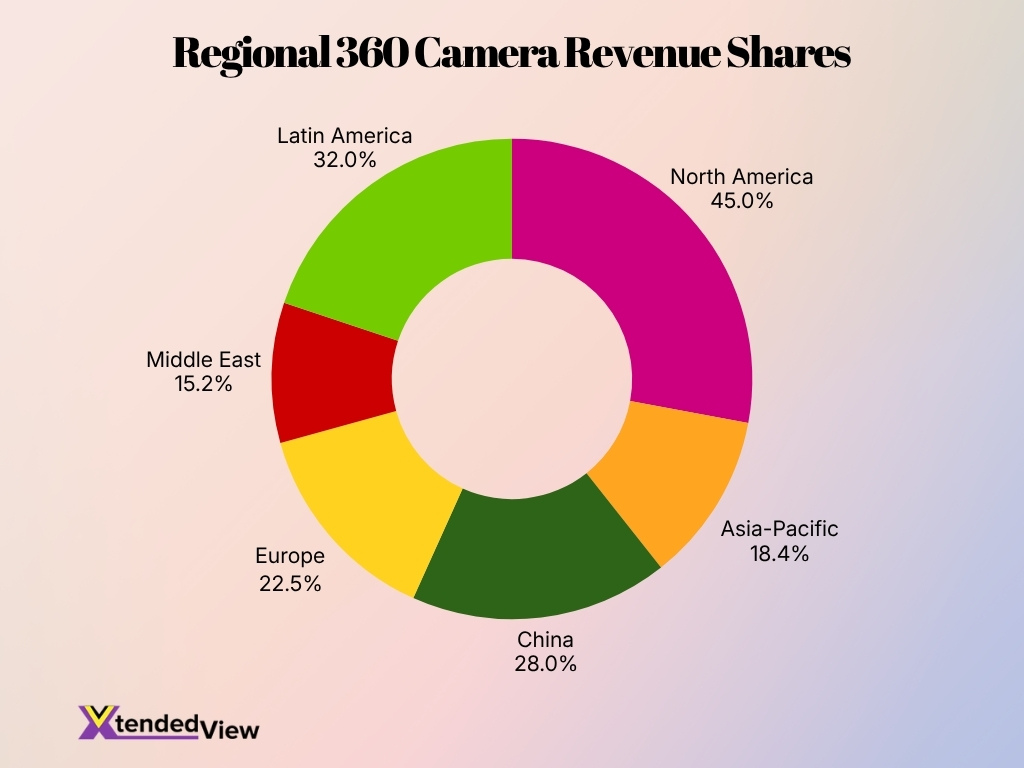
- North America holds approximately 40.1% of global 360 camera revenue, the highest share worldwide.
- Another industry estimate places North America’s market share near 45%.
- The United States is the largest single-country market with over $120 million in 2024 360 camera sales.
- Asia-Pacific is growing at a CAGR of 18.4% from 2024 to 2030, the fastest growth rate globally.
- China accounts for roughly 28% of global 360 camera production revenue, led by Insta360 and DJI.
- Europe represents about 22.5% of the global 360 camera market revenue, driven by tourism and industrial use.
- The Middle East 360 camera market is projected to grow at a CAGR of 15.2% through 2030 from smart city projects.
- Latin America’s 360 camera revenue is expected to reach $45 million by 2026, up 32% from 2023.
- 5G deployment correlates with a 23% increase in immersive content consumption, boosting regional 360 camera revenue.
- Enterprise AR/VR investments added $210 million to the 360 camera market revenue across North America, Europe, and Asia-Pacific in 2024.
Consumer vs Professional 360 Camera Market Statistics
- Consumer-grade 360 cameras accounted for approximately 62% of total unit sales in 2025, driven by travel creators, vloggers, and social media users.
- Professional and enterprise-grade devices generated nearly 55% of total market revenue, despite lower shipment volumes, because of higher average selling prices.
- Cameras priced below $600 represented the largest consumer segment in 2025.
- Enterprise deployments in training, inspections, and virtual collaboration grew by more than 20% year-over-year during 2025.
- Professional users increasingly favor cameras capable of 8K and 11K capture, particularly in media production and immersive experiences.
- More than 70% of creator-focused purchases originate from content creation, travel documentation, and action sports applications.
- Corporate demand for immersive training solutions expanded significantly as organizations increased spending on VR-based learning programs.
- Enterprise customers typically spend 3 to 10 times more per device than consumer buyers because of software, accessories, and service requirements.
- Professional-grade systems increasingly include cloud collaboration tools, AI editing, and live-production integrations.
- The consumer segment continues to dominate shipment volume, while professional deployments contribute a disproportionate share of market value.
360 Camera Pricing and Average Selling Price Statistics
- Entry-level 360 cameras in 2026 generally retail between $250 and $450.
- Premium consumer models featuring 8K recording typically sell between $500 and $900.
- Professional immersive cameras often cost between $3,000 and $15,000, depending on specifications.
- Enterprise virtual production systems can exceed $20,000 per unit when bundled with specialized lenses and software.
- The average selling price of consumer 360 cameras increased during 2025 due to rising demand for higher-resolution devices.
- AI-powered editing features have become a major factor supporting premium pricing across leading products.
- Devices with 8K video capability command premiums of 25% to 40% compared with standard 5.7K models.
- Subscription-based editing and cloud-storage services have created recurring revenue streams beyond hardware sales.
- Professional buyers increasingly prioritize workflow efficiency over upfront camera costs.
- Manufacturers continue to balance pricing pressure with investments in AI, stabilization, and sensor technology.
360 Degree Camera Market Share by Camera Type
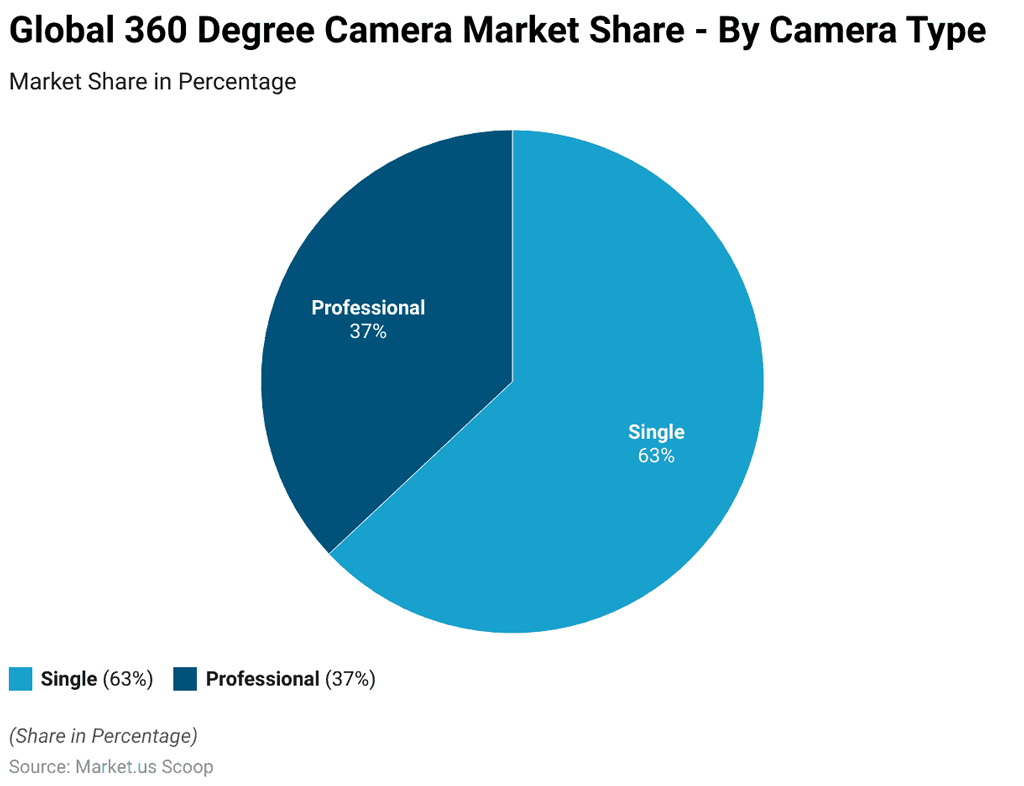
- Single 360-degree cameras dominate the global market, accounting for 63% of the total market share.
- Professional 360-degree cameras hold 37% of the market, showing a smaller but still significant demand among advanced users and businesses.
- The data shows that single-camera models are the preferred choice, likely because they are more affordable, easier to use, and suitable for consumer-level photography and video.
- The 26 percentage point gap between single and professional cameras highlights the stronger adoption of compact and user-friendly 360 camera formats.
- Professional cameras continue to serve a niche market, especially in areas such as media production, virtual tours, enterprise training, and high-quality immersive content creation.
- The larger share of single cameras at 63% suggests that consumer adoption is a key growth driver in the 360-degree camera market.
- Despite having a lower share, professional cameras at 37% indicate steady demand from commercial users who need higher resolution, better stabilization, and advanced production features.
- Overall, the market is led by single 360-degree cameras, while professional models remain important for specialized and premium applications.
360 Camera Unit Shipments and Installed Base Statistics
- Global 360 camera shipments surpassed 2 million units annually in the mid-2020s.
- The 360-degree camera market reached $2.34 billion in 2025.
- An active installed base exceeds 10 million devices worldwide.
- Asia-Pacific holds 41.50% of the global 360 camera revenue in 2025.
- Creator-focused models made up 62% of new 360 camera shipments in 2025.
- Enterprise deployments grew 31% year-over-year as organizations adopted immersive workflows.
- 8K-capable devices drove 24% of replacement purchases in early 2026.
- Real estate professionals account for 28% of 360-degree camera adoption among creators.
- North America and Asia-Pacific together hold 68% of global 360 camera installations.
- Unit growth outpaced legacy compact cameras by 3.2× as immersive content expanded.
Adoption of 360-Degree Cameras in Media and Entertainment
- Media and entertainment generated the largest share of 360 camera revenue in 2025.
- The global 360-degree camera market is estimated at $2.43 billion in 2025 and projected to reach $16.79 billion by 2033.
- Nearly 70% of Gen Z and Millennial fans are interested in sports-related virtual experiences using 360/VR tech.
- Interactive video content can boost viewer engagement by up to 300% compared with passive traditional video.
- AI automation in video editing reduced post-production time by 50% for film studio panoramic projects.
- More than 60% of consumers surveyed have prior experience with a VR headset, driving immersive content demand.
- The media and entertainment segment is expected to grow at a significant CAGR from 2026 to 2035 in the 360 camera market.
- Virtual tours using 360° cameras increase property sales by up to 30%, showing strong immersive content ROI.
360 Camera Usage by Application
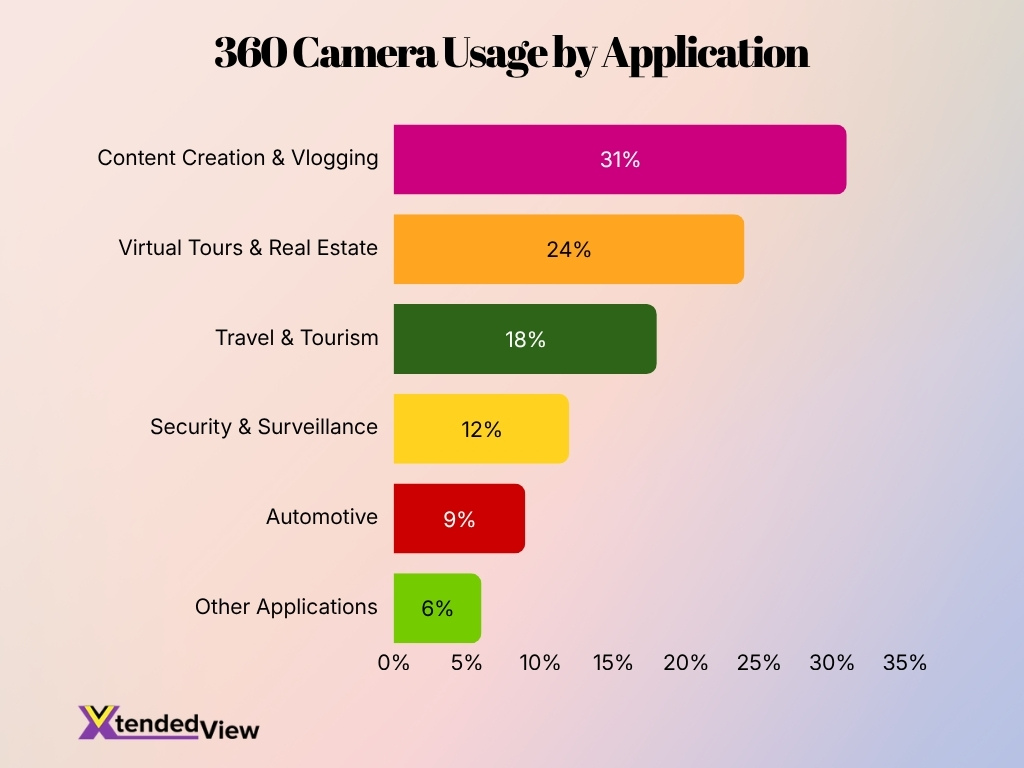
- Content creation and vlogging are the leading applications for 360 cameras, accounting for 31% of total usage.
- Virtual Tours & Real Estate holds the second-largest share at 24%, showing strong demand for immersive property viewing experiences.
- Travel & Tourism represents 18% of 360 camera usage, as travelers and tourism brands use immersive visuals to showcase destinations.
- Security & Surveillance accounts for 12%, highlighting the role of 360 cameras in wide-area monitoring and safety applications.
- Automotive usage stands at 9%, mainly driven by applications such as surround-view systems, parking assistance, and vehicle safety monitoring.
- Other Applications make up the remaining 6%, indicating smaller but diverse use cases across education, events, training, and industrial environments.
- The top two categories, Content Creation & Vlogging and Virtual Tours & Real Estate, together represent 55% of total 360 camera usage.
- Consumer-facing and visual-experience applications dominate the market, with Content Creation, Real Estate, and Travel combining for 73% of total usage.
- The data shows that 360 cameras are used most heavily in applications where immersive visual storytelling and interactive viewing provide clear value.
360 Camera Usage in Live Streaming and Social Media Statistics
- Global social media users reached 5.79 billion in April 2026, creating a massive audience for immersive 360 content.
- 99% of social media users worldwide access platforms via mobile devices, making mobile the dominant method for viewing 360 content.
- The 360-degree camera market is projected to reach $8.0 billion by 2032, reflecting 22.50% CAGR growth.
- 26.8% of global internet users watch live streams every week, with 360 cameras being a key use case for immersive streaming.
- The live streaming video and camera market will grow from $1.92 billion in 2024 to $3.71 billion by 2030 at 11.60% CAGR.
- YouTube and Facebook continue supporting 360-degree video uploads with metadata injection for spherical playback.
- Interactive video ads delivered +1.3x more positive brand lift than standard video campaigns, driving brand interaction.
- 5G networks provide 10 Gb/s peak rates supporting 4K/8K panoramic VR live streams with ultra-low latency.
- 85% of participants are more likely to purchase after attending immersive video campaigns, improving product discovery.
- Live streaming accounts for 17% of all internet traffic and 23% of total viewing time worldwide for 360-degree event coverage.
Adoption of 360-Degree Cameras in Real Estate and Virtual Tours
- More than 90% of homebuyers begin their property search online, driving demand for immersive virtual tours.
- Listings with 3D tours receive 87% more views than listings with standard photos alone.
- Properties featuring 3D or virtual tours generate up to 49% more qualified leads than traditional listings.
- Approximately 74% of agents report that virtual tours help buyers better understand a property’s layout before visits.
- Virtual tours increase buyer confidence by 28%, resulting in more informed and serious inquiries.
- Properties with 3D virtual tours sell up to 31% faster than those without immersive walkthroughs.
- The global virtual-tour market is projected to grow at a CAGR of 27.32% through 2033, boosting 360 camera adoption.
- Buyers spend 31% more time viewing listings that include 3D virtual tours compared to standard photo listings.
Key Reasons Creators Prefer 360 Cameras
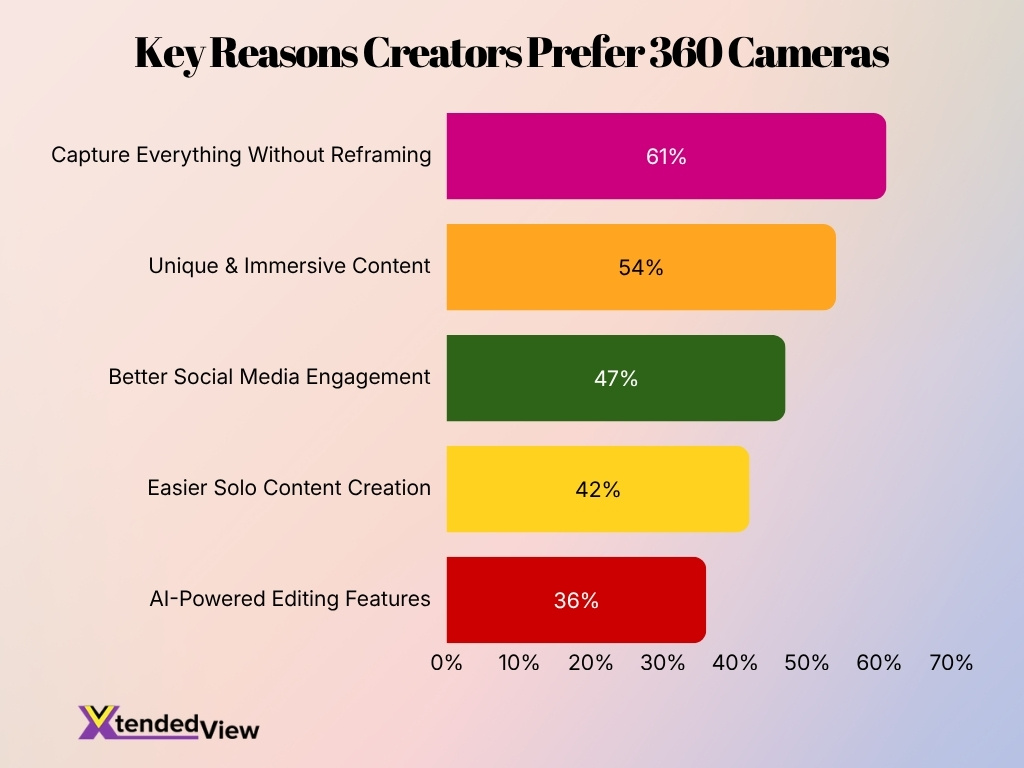
- 61% of creators use 360 cameras because they can capture everything without reframing, making it the top reason in the chart.
- Unique and immersive content is the second-biggest driver, with 54% of creators choosing 360 cameras for more engaging visual storytelling.
- 47% of creators say 360 cameras help improve social media engagement, showing their value for platforms that reward interactive and eye-catching content.
- 42% of creators prefer 360 cameras because they make solo content creation easier, reducing the need for extra camera operators or complex setups.
- AI-powered editing features attract 36% of creators, highlighting the growing role of automation in simplifying video production.
- The data shows that creators mainly value 360 cameras for creative flexibility, immersive output, and easier production workflows.
- Since the top two reasons both exceed 50%, creators are clearly using 360 cameras to produce content that feels more complete, dynamic, and visually distinctive.
- Even the lowest-ranked reason, AI-powered editing features at 36%, shows that more than one-third of creators see editing automation as an important advantage.
360 Camera Adoption in Automotive and Transportation Statistics
- The global automotive 360-degree camera market reached $2.42 billion in 2025 and is projected to grow at 28.29% CAGR through 2034.
- ADAS adoption in India hit 8.3% in H1 2025, with Level 2 ADAS capturing 5.6% market share and EVs leading at 36.4% penetration.
- Fleet camera systems reduce collisions by 40–60% when alerts and coaching are used consistently, with claims dropping by up to 50%.
- Blind spots cause nearly 400,000 accidents annually in truck fleets, driving 360° camera adoption for complete visibility.
- AI vehicle inspection systems achieve 30% faster inspections versus traditional methods, with 20% growth expected in AI adoption over 5 years.
- The US automotive panoramic image monitoring market is valued at $5.93 billion in 2025, growing at 16.68% CAGR to $14.96 billion by 2033.
- Forward Collision Warning and Automatic Emergency Braking now reach 94% penetration in new 2023 vehicles, making 360 cameras nearly universal in premium segments.
- The autonomous vehicles market, valued at $147.6 billion in 2023, will reach $2,398.2 billion by 2033 at 33.1% CAGR, fueling panoramic imaging demand.
360 Camera Adoption in Security and Surveillance Statistics
- The global 360-degree security cameras market reached $1.87 billion in 2024 with robust expansion driven by surveillance demand.
- The AI in the video surveillance market is projected to reach $28.76 billion by 2030, growing at a CAGR of 26.2%.
- A single 360° panoramic camera can provide 100% coverage with no blind spots, replacing multiple traditional fixed-lens cameras.
- Shoplifting incidents surged 93% in 2023 vs. 2019, driving retailers to adopt 360° cameras for loss-prevention strategies.
- The Indian AI CCTV market will reach $3.67 billion by 2030, growing at a CAGR of 21.79% from smart-city initiatives.
- The panoramic security camera market in the US is projected to expand at a CAGR of 11.4% from 2026 to 2033 across commercial and governmental sectors.
- There are 770 million CCTV cameras worldwide, with 360-degree cameras increasingly deployed to eliminate blind spots in airports and retail stores.
- AI-powered analytics now enable real-time object detection and crowd monitoring from 360 video feeds, driving integrated surveillance adoption through 2030.
Most Popular 360 Camera Features by Adoption
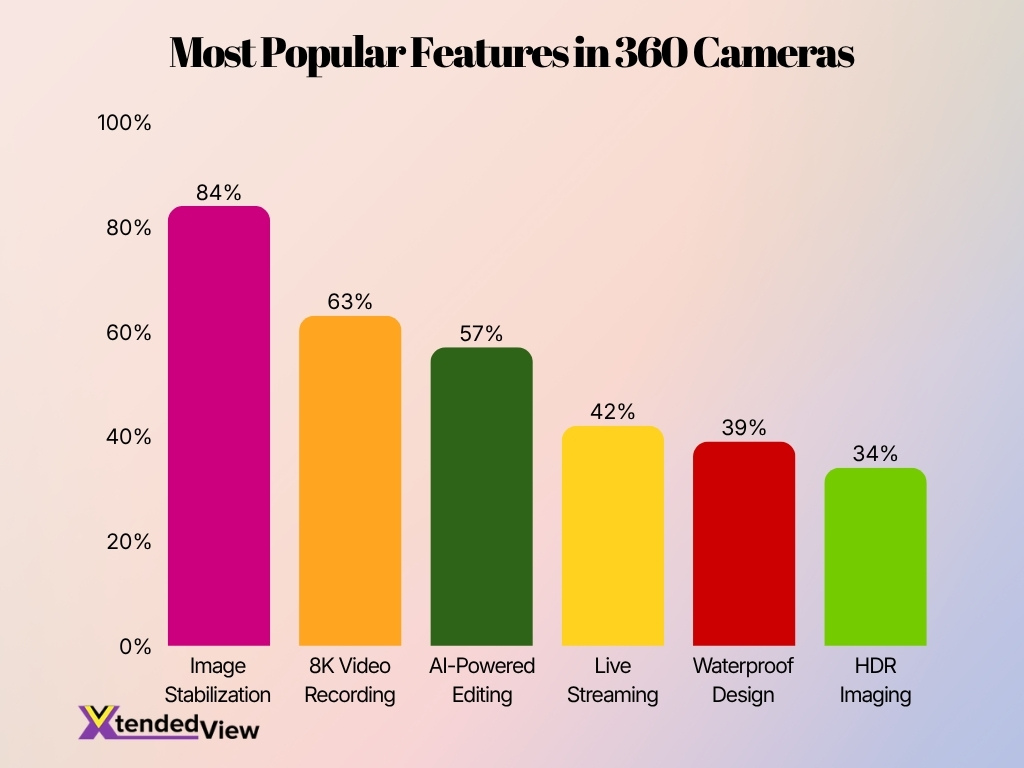
- Image stabilization is the most widely adopted 360 camera feature, used in 84% of cameras or users surveyed.
- 8K video recording ranks second with 63% adoption, showing strong demand for ultra-high-resolution immersive content.
- AI-powered editing is also a major feature, with 57% adoption, highlighting the growing role of automation in 360 video production.
- Live streaming is adopted by 42%, indicating that real-time 360-degree content is becoming increasingly useful for creators, events, and virtual experiences.
- Waterproof design accounts for 39% adoption, making it an important feature for travel, outdoor, and adventure-based 360 camera users.
- HDR imaging has the lowest adoption among the listed features at 34%, but it still plays a key role in improving image quality and dynamic range.
- The data shows that users prioritize stability, video quality, and editing convenience, with image stabilization, 8K recording, and AI-powered editing leading the feature adoption list.
- Features linked to professional content creation, such as 8K video recording at 63% and AI-powered editing at 57%, suggest that 360 cameras are increasingly being used for high-quality digital content production.
360 Video Viewership and Engagement Statistics
- 360-degree videos achieved a combined 4.5 billion views on Facebook and YouTube in the first 10 months.
- 360 video has a 28.81% higher view rate than fixed-frame video on YouTube.
- VR click-through rate reaches 4.51% compared to just 0.56% for traditional fixed video.
- 360 video ads drove 41% more earned actions, including shares, subscriptions, and additional views.
- Full-length 360-degree videos earned 46% higher view count than standard full-length videos.
- Viewers spend 75% of their time focused on just the front 90 degrees of immersive 360 video.
- 360-degree videos increase viewer retention by up to 46% compared to traditional video formats.
- Coca-Cola’s 360 video had 36% more people watch to the end versus standard in-stream ads.
- Global VR headset shipments will reach 6.73 million units in 2025, growing to 9.5 million by 2028.
360 Camera Patents and Innovation Trends Statistics
- The 360-degree camera market is valued at $2.64 billion in 2026 and growing at a CAGR of 17.78% to reach $5.98 billion by 2031.
- Ultra-HD 8K+ is the fastest-growing resolution band in 360° cameras at a CAGR of 18.41%, while 4K accounted for 57.12% market share in 2025.
- Insta360 countersued DJI for alleged infringement of 28 patents in the panoramic camera patent war.
- Insta360 maintained its global lead in panoramic cameras with shipments rising nearly 60% year-on-year in 2026.
- The Insta360 X5 sets a new industry record with 180 minutes of continuous 8K recording battery life, up from 135 minutes in X4 and 81 minutes in X3.
- Virtual tours using 360° cameras increase property sales by up to 30% in real estate applications.
- The U.S. 360-degree camera market is worth $0.73 billion in 2025 and projected to reach $5.04 billion by 2033.
- AI and LiDAR integration is expanding professional use cases with enhanced image stabilization, object tracking, and depth mapping.
- The global market is expected to reach $16.79 billion by 2033, growing at a CAGR of 27.32% during 2026 to 2033.
Frequently Asked Questions (FAQs)
The global 360-degree camera market is estimated at $2.64 billion in 2026, up from $2.24 billion in 2025.
The global 360-degree camera market is projected to grow at a 17.78% CAGR from 2026 to 2031.
Industry forecasts suggest the market could reach $27.21 billion by 2035, growing from $2.34 billion in 2025.
Insta360 controls approximately 67.2% of the global consumer panoramic camera market.
The U.S. 360-degree camera market is expected to grow from $610 million in 2025 to about $7.2 billion by 2035.
Conclusion
The 360 camera industry entered the year with strong momentum across consumer, creator, and enterprise segments. Market forecasts consistently point to double-digit growth rates as demand expands beyond action cameras into virtual tours, immersive media, automotive applications, surveillance systems, and industrial workflows.
Several trends stand out. First, Insta360 remains the dominant market leader, although DJI’s entry has intensified competition in premium hardware. Second, AI-powered editing, stabilization, and automated reframing have lowered the barrier to creating immersive content. Third, enterprise adoption continues to accelerate as organizations deploy 360 cameras for training, inspections, property visualization, transportation safety, and security monitoring.
Looking ahead, improvements in sensor technology, cloud collaboration, 8K video capture, and AI-assisted production are expected to drive the next phase of industry expansion. As immersive experiences become more common across digital platforms, 360 cameras are likely to play an increasingly important role in how people create, share, and consume visual content.