

Sales follow-up plays a central role in turning initial interest into qualified opportunities, meetings, and closed revenue. In B2B sales, SaaS, financial services, real estate, professional services, and other relationship-driven industries, the timing, frequency, and relevance of follow-up can directly affect whether a prospect continues the conversation or moves to another provider.
Follow-up is becoming more complex as buyers use more digital research channels, self-service tools, and AI-generated information before speaking with a salesperson. Sales teams are responding with automated email sequences, AI-assisted prospecting, faster lead routing, phone outreach, social messaging, and multi-channel cadences designed to reduce missed opportunities. The statistics in this article show how follow-up performance varies by channel, timing, buyer type, industry, and level of automation.
Editor’s Choice
- 58.6% of replies in a 7.53-million-email analysis came from emails sent after the first step, showing that the majority of eventual responses required continued outreach.
- The third email alone produced 35.6% of email-sourced meetings, making it the strongest individual step for appointment generation in the sequence analyzed.
- Across more than 46,000 outbound calls, 18.6% connected with prospects, compared with 5.04% engagement through professional-network outreach and 0.45% through cold email.
- Calls generated 33.6% of all booked appointments in the 2025 omnichannel dataset despite operating at far lower volume than email.
- 92% of U.S. B2B managers surveyed in 2026 said qualified leads fall through their follow-up processes every month.
- Morning B2B emails sent from 8 a.m. to noon achieved a 0.54% reply rate and 0.4% meeting rate, the strongest time window in an analysis of more than 7.5 million 2025 emails.
- A 2025 sales survey found that 51% of regular cold callers considered 10 a.m. to noon their most productive calling window.
- Responding to a web lead within five minutes historically produced 21 times greater odds of qualification than waiting 30 minutes, according to a large lead-response study that remains one of the most rigorous benchmarks available on speed-to-lead.
Recent Developments
- In 2026, 80% of surveyed sales professionals said they already use AI somewhere in their sales workflow.
- The share of sellers naming AI workflow automation as an exciting development increased from 10% in 2025 to 46% in 2026, a 4.6-fold increase in one year.
- Meanwhile, 46% of sales professionals in 2026 said following up with leads ranks among their most time-consuming tasks.
- Prospecting remained the largest AI use case, although adoption shifted from 65% in 2025 to 57% in 2026 among respondents.
- AI use for creating sales outreach messages increased from 41.3% in 2025 to 50% in 2026, suggesting that message preparation is becoming increasingly automated.
- AI-assisted data enrichment increased from 23% to 35% between the 2025 and 2026 surveys, helping sellers gather more information before follow-up.
- Willingness to trust AI when it could predict buying likelihood with 90% accuracy increased from 37% in 2025 to 77% in 2026.
- Separately, a 2026 survey of more than 4,000 sales professionals found that high-performing sellers were 1.7 times more likely than underperformers to use AI agents for prospecting.
- A U.S. B2B follow-up study found that 91% of sales managers had begun integrating AI into regular workflows, while 55% reported full AI integration into lead workflows such as routing, personalization, and record updates.
- Even with that technology, 37% of managers reported losing leads between disconnected marketing and CRM systems or during marketing-to-sales handoffs.
How Many Follow-Ups Does It Take to Close a Sale?
- In an analysis of 7,530,489 B2B emails, the initial message generated 41.4% of replies, while sequence steps two through six produced the remaining 58.6%.
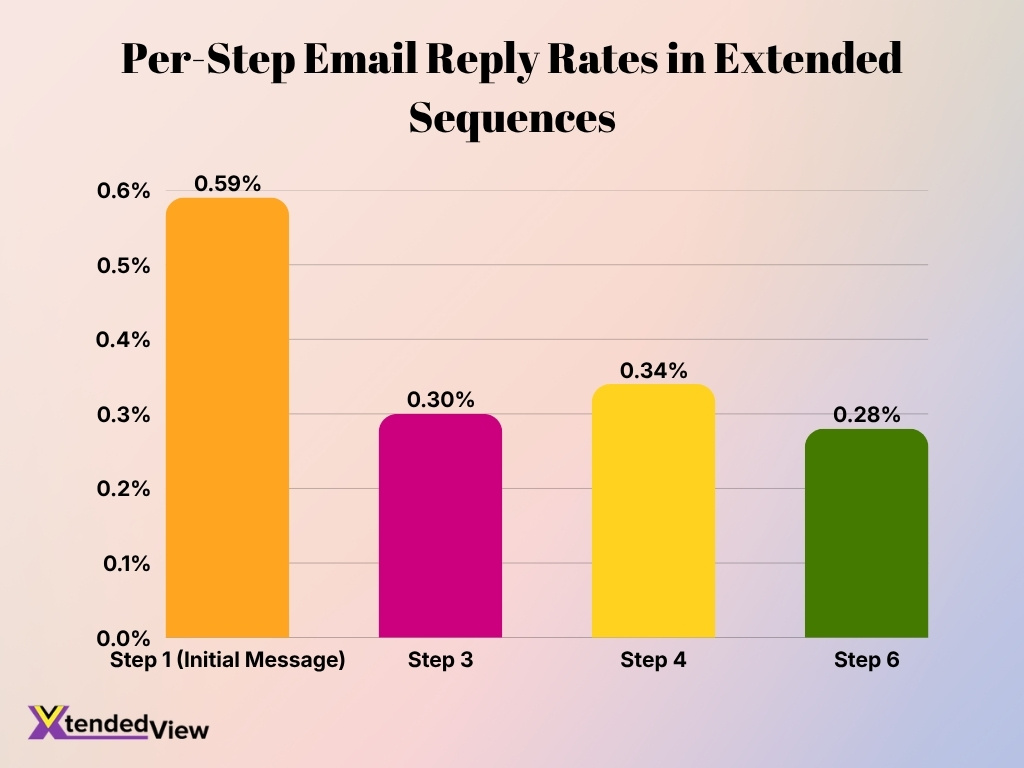
- The first email delivered a 0.59% reply rate, making it the strongest individual step, but cumulative follow-ups produced more total replies than the opening message.
- The reply rate measured 0.30% at step three before increasing slightly to 0.34% at step four, showing that a later touch can outperform an earlier follow-up when the message changes.
- By the sixth email, the per-step reply rate had fallen to 0.28%, indicating diminishing returns in extended email-only sequences.
- Based on that dataset, three to five email steps represented the practical range before incremental email returns declined sharply.
- The third email generated more booked meetings than steps one and two combined. Steps one and two together produced 46.4% of meetings, while steps three through five generated 53.5%.
- Appointment rates reached approximately 0.2% from step three onward, twice the roughly 0.1% rate associated with the first two steps in the analyzed sequences.
- Modern calling behavior shows a similar pattern of limited persistence: 55% of surveyed cold callers stop after three to five attempts, while only 17% continue to six or more attempts.
- Older lead-response research involving more than 14,000 companies also tracked persistence alongside response speed, reinforcing that sales organizations need to measure both how quickly and how repeatedly they attempt contact.
- Therefore, businesses should treat the familiar claim that every sale requires five, eight, or 12 follow-ups cautiously. Contemporary evidence supports persistence, but no modern study establishes one universal closing threshold across all sales environments.
What Percentage of Salespeople Give Up After One Follow-Up?
- The popular 44% figure traces back to a 1987 business book that did not provide a survey, sample size, or citation supporting the percentage.
- A separate 2026 provenance review also found no verifiable primary study behind the related claim that 44% of sellers stop after one refusal.
- Modern 2025 survey data found that 26% of cold callers make only one or two contact attempts before abandoning a prospect.
- The largest group, 55%, reported making three to five attempts before moving on.
- Only 13% reported reaching six to eight attempts.
- Just 4% persisted for nine to 12 attempts, making extended follow-up relatively uncommon.
- In a separate 2026 survey of more than 400 U.S. B2B managers, 42% said their teams sometimes fail to make a second or third attempt after an initial contact.
- That research also found that 47% of managers identify volume overload as their primary follow-up challenge, which helps explain why leads receive fewer touches than intended.
- Current evidence therefore supports a more defensible conclusion: roughly one-quarter of cold callers stop within one or two attempts, while a much larger share exits before reaching six attempts.
Response Time and Speed-to-Lead Statistics
- A major lead-response study found that contacting an inbound web lead within five minutes produced 100 times greater odds of making contact than waiting 30 minutes.
- The same research found that leads contacted within five minutes had 21 times greater odds of becoming qualified than leads contacted after 30 minutes.
- A later response audit covering more than 14,000 companies continued to identify response speed and follow-up persistence as major lead-management benchmarks.
- Historical benchmarking found an average Internet-lead response time of about 39 hours and 22 minutes, illustrating how far typical business practices could fall behind the five-minute performance window.
- That research also found that only 27% of Internet leads received contact, meaning lead leakage involved both slow replies and complete nonresponse.
- More recent testing of 1,000 B2B websites found that only 203 companies responded to an inbound inquiry within one hour.
- In the same test, 63.5% did not respond at all, while another 162 businesses took at least one day to follow up.
- A 2026 U.S. survey found that 92% of sales managers still experience dropped qualified leads every month, showing that the operational response problem remains current despite widespread CRM adoption.
- Among surveyed managers, 38% said qualified leads go without follow-up several times each week, while 42% experience lead drops a few times each month.
- These findings make speed-to-lead most relevant for high-intent inbound prospects; businesses should not assume that a five-minute response rule produces the same effect for cold outbound lists where no buyer intent has occurred.
Best Days and Times for Sales Follow-Up
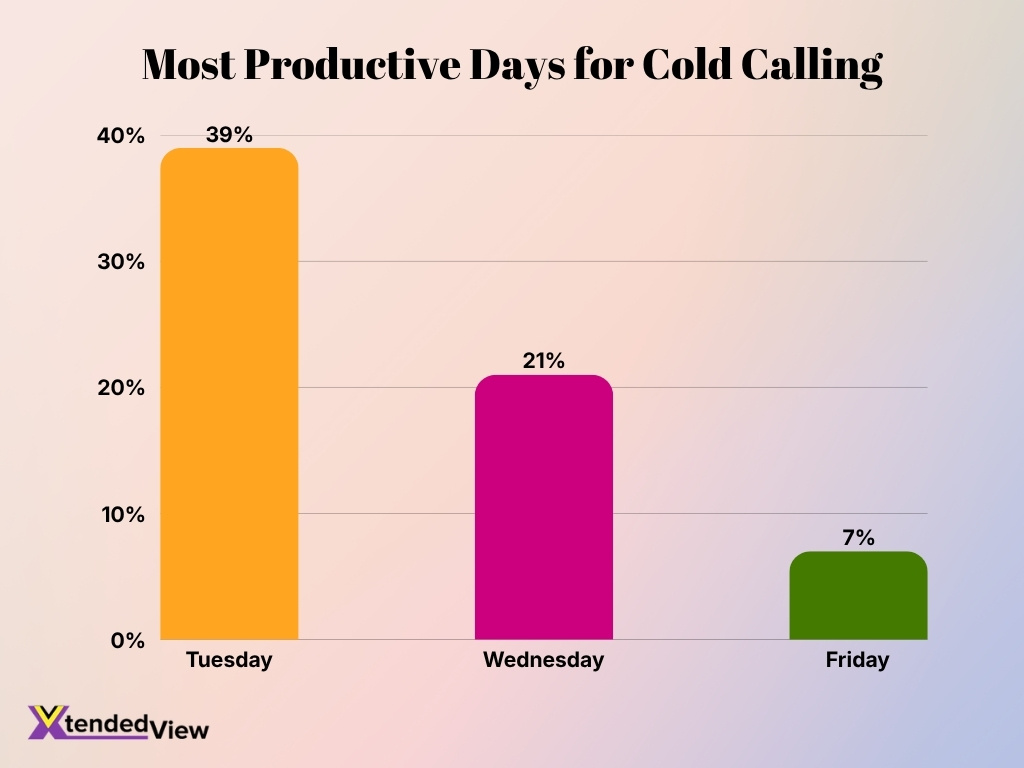
- In a 2025 survey of 379 sales professionals, 39% of regular cold callers ranked Tuesday as their best-performing day.
- Among sellers who cold call every day, 30% also selected Tuesday as their strongest day.
- Wednesday ranked second, chosen by 27% of daily cold callers and 21% of regular cold callers.
- Friday produced the weakest calling sentiment: only 7% to 12% of surveyed sellers considered it an effective day for cold calls.
- Late morning, from 10 a.m. to noon, ranked as the best calling period for 51% of regular cold callers and 38% of daily cold callers.
- Early afternoon, from noon to 3 p.m., ranked second, with 25% to 26% of respondents identifying it as productive.
- Only 6% to 11% considered 3 p.m. to 5 p.m. productive for calling, while just 2% to 6% favored after-hours outreach.
- For email, analysis of more than 7.5 million 2025 sends found that Wednesday and Thursday each delivered a 0.48% reply rate, the highest among standard weekdays.
- Emails sent from 8 a.m. to noon achieved a 0.54% reply rate, while 5 a.m. to 8 a.m. sends followed closely at 0.52%.
- More importantly, both morning windows generated a 0.4% meeting rate, compared with 0.1% for the other measured time periods. This suggests that time of day can matter more than day of week when the objective is booked meetings rather than replies.
Sales Follow-Up Email Statistics
- A 2026 analysis of 7,530,489 B2B emails found that follow-up emails generated 58.6% of all replies, while initial emails produced 41.4%.
- The initial email recorded the highest individual reply rate at 0.59%, even though subsequent steps collectively produced more responses.
- Email sequence step three generated 35.6% of all email-sourced meetings, making it the strongest individual step for booked appointments in the dataset.
- Steps one and two combined accounted for 46.4% of booked meetings, meaning later emails produced the majority of appointments.
- Steps three through five produced 53.5% of email-sourced meetings, showing that prospects who remain in a sequence can still hold meaningful buying potential.
- The appointment rate stabilized at about 0.2% from the third email onward, roughly twice the rate associated with the first two steps.
- A separate 2025–2026 analysis of 1,857 cold-email replies found that 61.7% came from the first email, while 38.3% arrived after one or more follow-ups.
- In that dataset, the first follow-up generated 20.9% of total replies, while the second follow-up generated another 12.5%.
- Another 4.9% of replies arrived after the third follow-up or later, confirming that extended sequences still generate incremental responses, although at sharply lower volume.
- Among replies classified as interested, 47.2% came after the initial email, suggesting that prospects with positive intent may still need additional context or time before responding.
Phone and Voicemail Follow-Up Statistics
- An analysis of more than 46,000 outbound calls recorded an 18.6% connection rate across the campaigns studied.
- Calls accounted for 33.6% of all appointments booked in the same 2025 omnichannel dataset, despite call volume being far smaller than email volume.
- Broader 2025 calling benchmarks put the average dial-to-meeting success rate at 2.3%, down from 4.82% in 2024.
- Early 2026 data covering more than 200,000 calls showed the average dial-to-meeting rate recovering modestly to approximately 2.7%.
- The top 5% of callers in that 2026 dataset achieved meeting rates of roughly 10% to 15%, highlighting the gap between average and high-performing phone outreach.
- Analysis drawing on more than 300 million sales calls places the average cold-call connection rate near 5.4%, while top-quartile teams reach approximately 13.3%.
- The most successful validated cold-call opener in a large-scale analysis produced an 11.24% success rate, compared with 2.15% for one of the weakest commonly used openers.
- A permission-based opening performed almost identically, recording an 11.18% success rate, suggesting that how a seller starts a follow-up call can materially affect the outcome.
- Stating a clear reason for calling early in the conversation was associated with roughly a 2.1x increase in success, making relevance more important than generic conversation starters.
- Current calling research also indicates that 93% of phone conversations occur within the first three dial attempts, which supports changing channels rather than repeatedly dialing indefinitely.
Call Connect Rates by Attempt Number (2026)
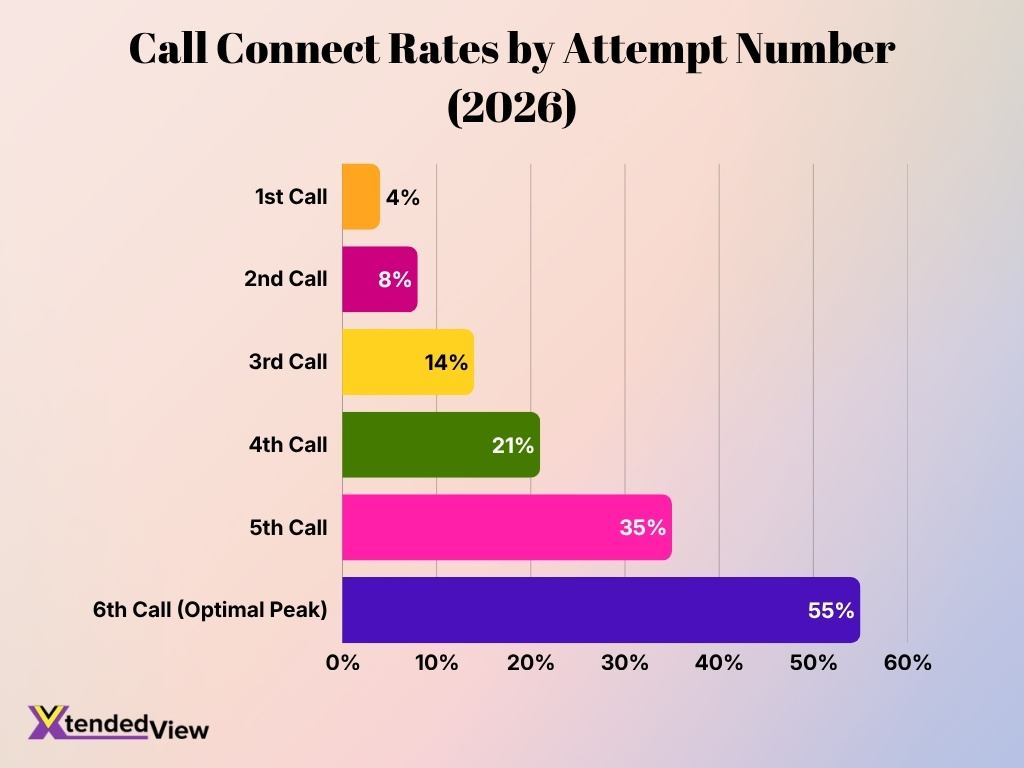
- The first call attempt reaches a decision maker just 4% of the time, indicating relatively low initial connect rates.
- The connect rate doubles to 8% on the second call, showing the value of making at least one follow-up attempt.
- By the third call, the connect rate rises to 14%, more than 3 times the first-attempt rate.
- The fourth call achieves a 21% connect rate, meaning roughly 1 in 5 attempts reaches a decision maker.
- The connect rate jumps substantially to 35% on the fifth call, an increase of 14 percentage points from the fourth attempt.
- The sixth call records the highest connect rate at 55%, making it the optimal peak in the dataset.
- Overall, the connect rate increases from 4% on the first call to 55% on the sixth, a 51-percentage-point increase across the sequence.
- The data suggests that persistent sales follow-up can substantially improve the likelihood of reaching a decision maker compared with relying on the initial call alone.
SMS and Social Media Follow-Up Statistics
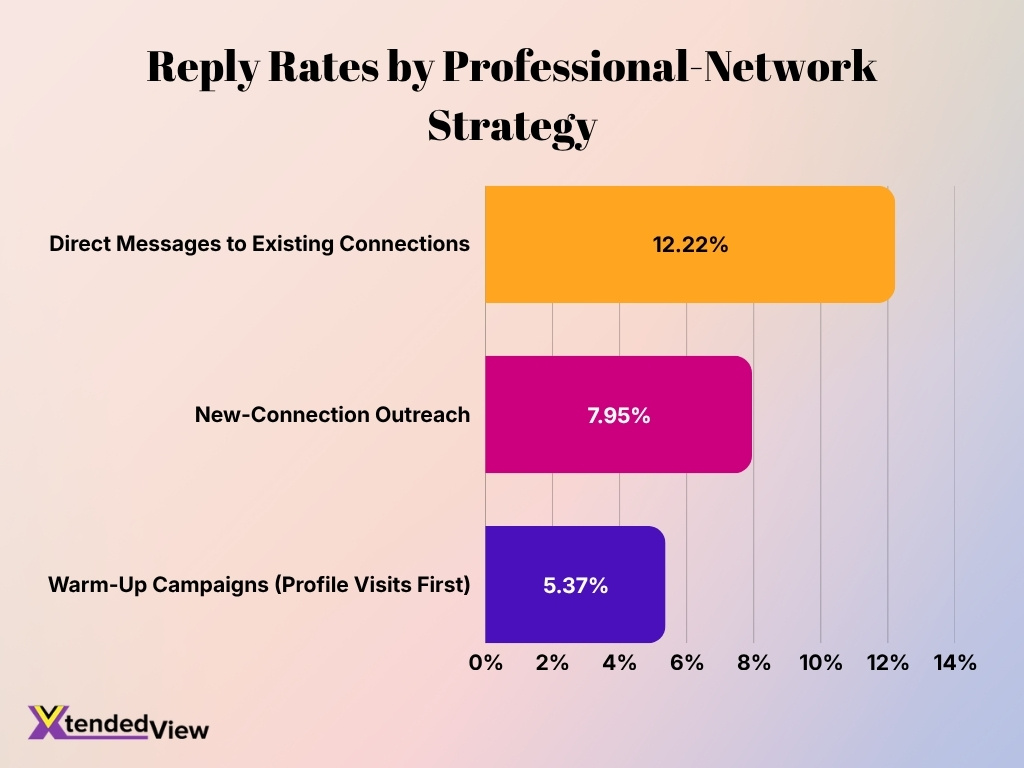
- Professional-network messenger campaigns targeting existing connections produced a 12.22% reply rate across a dataset involving about 15 million contacts.
- Connection-request campaigns targeting new prospects recorded a 7.95% reply rate, making social outreach a viable re-engagement channel after unanswered email.
- Engagement-first campaigns, which warm prospects before direct outreach, generated a lower but still measurable 5.37% reply rate.
- Across the entire year of 2025, professional-network follow-up maintained reply rates above 7% each month, without a major seasonal collapse.
- Connection requests without an accompanying note achieved a 27.56% acceptance rate, compared with 25.31% when a message was included.
- Despite the slightly lower acceptance rate, adding context increased subsequent replies from 5.28% to 8.18% among accepted connections.
- The resulting 55% lift in reply rate shows why sales teams should track conversations and meetings rather than optimizing solely for connection acceptance.
- Current B2B buying research shows that buyers use an average of seven information sources during a purchase, supporting follow-up strategies that create visibility across more than one digital environment.
- About 45% of surveyed B2B buyers said they used generative AI during a recent purchase, mainly to collect information about vendors and products, which means seller follow-up now competes with additional digital research channels.
- Meanwhile, 69% of B2B buyers said they prefer to validate AI-generated information with a sales representative, suggesting that human social or direct-message follow-up still has value when prospects need confirmation or context.
Follow-Up Cadence and Timing Statistics
- Follow-up emails collectively produced 58.6% of replies in a 7.53-million-email B2B dataset, confirming that a one-touch cadence misses a large share of potential engagement.
- The third email generated 35.6% of all email-sourced meetings, more than either of the opening steps individually.
- More than 53% of email-generated meetings occurred at sequence step three or later.
- Steps three through five collectively accounted for 53.5% of meetings, compared with 46.4% from the first two steps.
- Per-step appointment rates settled near 0.2% from the third email onward, approximately double the early-sequence rate.
- A separate 2025–2026 cold-email dataset found that the first follow-up generated 20.9% of all replies.
- The second follow-up contributed another 12.5%, while the third follow-up or later accounted for 4.9%, showing clear diminishing returns.
- For phone outreach, 93% of conversations in a 2025 benchmark occurred within three call attempts, supporting a channel change when repeated calls fail.
- Broader prospecting research places the average requirement for securing an initial meeting near eight touches across channels, while high-performing sellers can achieve the outcome in closer to five.
- In practice, the data supports a cadence that combines several touches but changes the message or channel rather than sending repeated copies of the same follow-up. The strongest public datasets show measurable returns through at least three to five email steps plus calls or social outreach.
Multi-Channel Follow-Up Statistics
- In 2025 outreach data, email, professional-network messaging, and calling produced meaningfully different engagement rates, reinforcing the value of channel diversification instead of email-only follow-up.
- Across more than 46,000 outbound calls, phone outreach reached an 18.6% connection rate, substantially above the engagement rates recorded for high-volume cold email.
- Professional-network follow-up generated reply rates above 7% throughout all 12 months of 2025, showing relatively stable performance across the year.
- Direct messages sent to existing professional connections achieved a 12.22% reply rate in an analysis drawing on roughly 15 million contacts.
- New-connection outreach produced a 7.95% reply rate, offering a second path to reach prospects who ignored email.
- Warm-up campaigns using profile visits and engagement before a message recorded a 5.37% reply rate.
- Adding a note to a connection request reduced acceptance from 27.56% to 25.31%, suggesting that overt outreach can slightly reduce raw connection volume.
- However, prospects who received an introductory message and accepted the request generated an 8.18% reply rate, compared with 5.28% when no message accompanied the request.
- That represents an improvement of roughly 55% in reply rate among accepted connections, showing that context can trade some reach for stronger engagement.
- Calls generated 33.6% of booked appointments in the omnichannel dataset, indicating that switching from digital follow-up to a live conversation can recover opportunities after email engagement stalls.
B2B vs. B2C Sales Follow-Up Statistics
- In 2026 research involving 645 B2B buyers, participants reported using an average of seven information sources during their most recent purchase.
- About 45% of B2B buyers surveyed said they used generative AI as part of the buying process, primarily to research products and vendors.
- Even with increased digital research, 69% of B2B buyers said they prefer to validate AI-generated information with a sales representative.
- A 2025 survey of 632 B2B buyers found that 61% preferred an overall rep-free buying experience, underscoring the importance of contacting prospects when a seller can add context instead of repeating publicly available information.
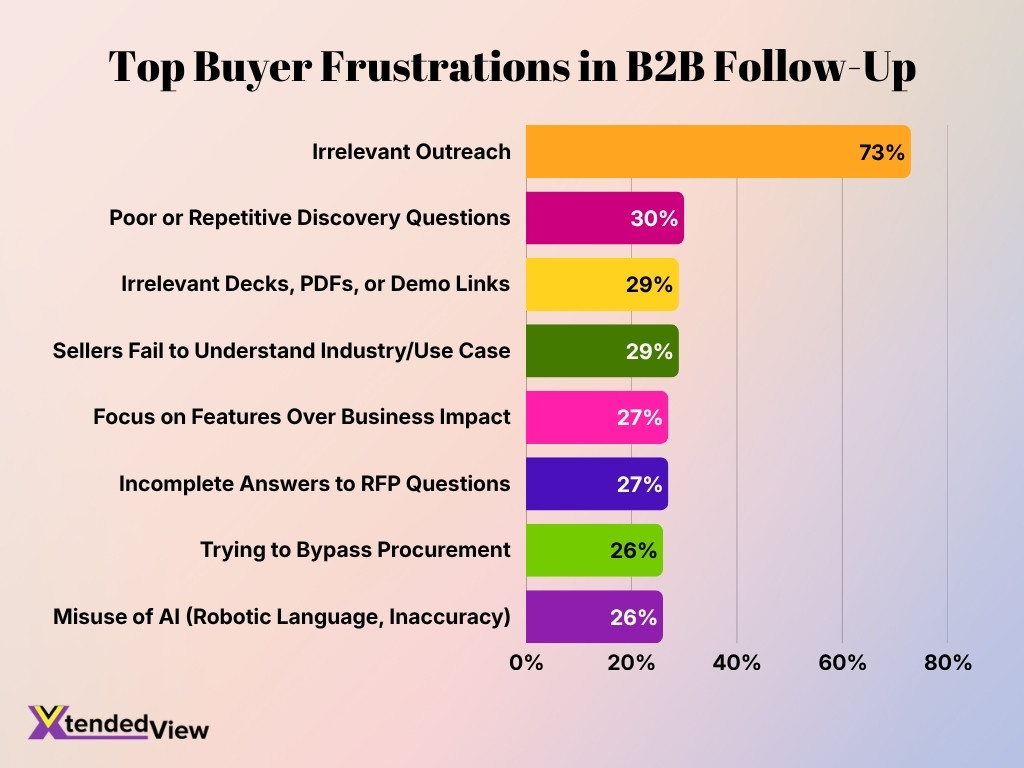
- Another 73% of B2B buyers said they actively avoid suppliers that send irrelevant outreach, making personalization especially important in longer B2B follow-up sequences.
- B2B buyers reported completing an average of 3.0 purchasing activities using both digital channels and supplier representatives, illustrating that buying journeys commonly move between self-service and human interaction.
- Buyers completed an average of 2.3 activities directly with supplier representatives, compared with 1.8 solely through digital self-service tools.
- Broader B2B sales research indicates that as many as 60% of deals stall before a decision, making persistent but relevant follow-up especially important in organizational purchases.
- Fewer than half of B2B sellers consistently hit quota, which reflects the difficulty of converting complex pipelines rather than merely generating initial interest.
- Reliable 2025–2026 research does not establish one universal B2C-versus-B2B follow-up count. Businesses should therefore avoid unsupported claims that every B2B sale requires a fixed number of contacts while every B2C sale requires another fixed number; cadence should reflect purchase complexity, intent, channel, and customer value.
Why Salespeople Fail to Follow Up
- The average salesperson spends only 40% of working time actively selling, meaning most of the week goes to prospecting, administration, research, internal work, and other tasks.
- 48% of sales representatives say they lack enough bandwidth to perform adequate cold outreach.
- Sales representatives spend nearly one full working day each week on prospecting, reducing the time available for later-stage conversations and follow-up.
- 47% of sellers identify cold calling as one of the worst parts of their job, which can contribute to channel avoidance when calls form part of a follow-up cadence.
- Among younger sales professionals, only 35% of working time goes toward selling, below the 40% average across sellers.
- 46% of younger sellers report that they rarely receive feedback on their sales conversations, limiting their opportunity to improve ineffective follow-up techniques.
- Another 47% say they do not receive enough role-playing practice before speaking with customers, which can weaken confidence in follow-up calls.
- 51% of sales leaders using AI say disconnected systems slow their AI initiatives, showing that technology does not solve follow-up gaps when CRM, prospecting, and communication data remain fragmented.
- Data quality also separates stronger teams: 79% of high-performing sales professionals prioritize data hygiene, compared with 54% of underperformers.
- Finally, follow-up quality matters as much as consistency. 73% of B2B buyers actively avoid suppliers that send irrelevant outreach, meaning more activity can hurt pipeline performance when salespeople fail to tailor the message to the buyer.
Follow-Up Statistics by Industry
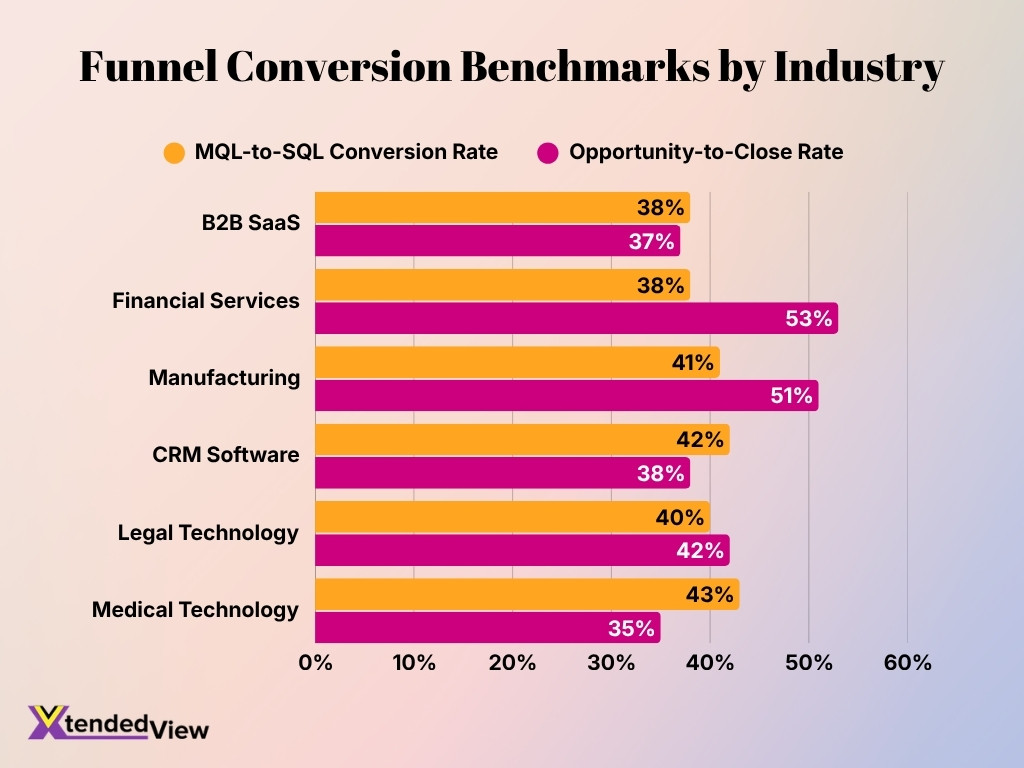
- In 2026 funnel benchmarks, B2B SaaS recorded an MQL-to-SQL conversion rate of approximately 38%, while SQL-to-opportunity conversion reached about 42%.
- B2B SaaS opportunities converted to closed business at approximately 37%, illustrating how much value remains dependent on effective mid- and late-stage follow-up after qualification.
- Financial services recorded a 38% MQL-to-SQL conversion benchmark, followed by a 49% SQL-to-opportunity rate.
- Financial-services opportunities reached an estimated 53% closed-won rate, higher than the comparable B2B SaaS benchmark.
- Manufacturing recorded a 41% MQL-to-SQL rate, a 46% SQL-to-opportunity rate, and roughly 51% conversion from opportunity to closed business.
- Healthcare benchmarks placed lead-to-qualified-opportunity conversion at approximately 8% to 18%, reflecting longer evaluation processes involving compliance, security, clinical, and IT requirements.
- Once healthcare opportunities reach proposal stages, estimated proposal-to-close performance rises to 25% to 40%, showing why follow-up after qualification carries substantial value.
- Manufacturing proposal-to-close rates range from approximately 30% to 50%, partly because buyers often conduct extensive internal vetting before formally requesting proposals.
- Across 2025 SaaS funnel benchmarks, CRM software recorded a 42% MQL-to-SQL rate and 38% opportunity-to-close rate.
- The same dataset placed legal technology at a 40% MQL-to-SQL rate and 42% opportunity-to-close rate, while medical technology recorded 43% MQL-to-SQL and 35% opportunity-to-close.
The Cost of Poor Follow-Up on Revenue
- In a 2026 survey of more than 400 U.S. B2B sales and marketing managers, 92% said their organizations lose qualified leads every month because follow-ups arrive late, happen inconsistently, or never happen.
- 38% of managers said qualified prospects receive no follow-up several times per week, creating recurring revenue leakage rather than an occasional process failure.
- Another 12% said significant numbers of qualified leads go untouched almost every day, putting already-generated pipeline at risk before meaningful sales conversations begin.
- 42% of managers reported that their teams sometimes fail to complete even the second or third outreach attempt, which means opportunities can disappear early in the follow-up cycle.
- Volume contributes directly to the problem: 47% identified having too many leads to manage effectively as their leading follow-up challenge.
- Disconnected systems also carry a commercial cost. 37% reported losing leads during marketing-to-sales handoffs or between marketing platforms and CRM systems.
- Buyer tolerance for poor outreach is low: 73% of B2B buyers said they actively avoid suppliers that send irrelevant outreach, meaning weak follow-up can remove a seller from consideration instead of simply producing no response.
- 61% of B2B buyers surveyed in 2025 preferred an overall rep-free buying experience, increasing the cost of sales interactions that provide little information beyond what buyers can find themselves.
- In 2026, that rep-free preference increased to 67%, based on a survey of 646 B2B buyers, reinforcing the need for follow-up messages to provide clear decision value rather than simply ask prospects to “check in.”
- Follow-up gaps also matter because buyers still need human validation: 69% said they prefer to verify AI-generated purchasing information with a sales representative. Sellers who miss that moment risk losing one of the stages where human involvement remains valuable.
How Automation Improves Follow-Up Performance
- AI currently saves salespeople an average of 4.8 hours per week, creating additional capacity that teams can redirect toward prospect conversations and follow-up.
- However, 72% of sales organizations report low reinvestment of those saved hours into high-value sales activities, showing that automation alone does not guarantee stronger commercial performance.
- 87% of sales organizations now use some form of AI for activities such as prospecting, lead scoring, forecasting, or email creation.
- 54% of sellers said they had already used AI agents in 2026, while nearly nine in 10 expected to use them by 2027.
- Sellers expect fully implemented AI agents to reduce prospect research time by 34%, giving representatives more capacity for direct engagement.
- They also expect agents to reduce email-drafting time by 36%, which can make personalized follow-up easier to scale across larger pipelines.
- Top-performing sellers are 1.7 times more likely than underperformers to use prospecting AI agents for outreach, showing a strong association between agent adoption and higher-performing teams.
- Among sellers using AI, 89% said the technology improves their understanding of customers, which can support more relevant follow-up when teams use that intelligence appropriately.
- Another 87% said AI makes their jobs less stressful, suggesting that automation can reduce the workload pressure behind missed or inconsistent follow-ups.
- Adoption does not remove infrastructure problems. 51% of sales leaders using AI report that disconnected systems slow their AI initiatives, making CRM integration and clean data essential for automated follow-up.
Common Follow-Up Mistakes and Their Impact
- 73% of B2B buyers actively avoid suppliers that send irrelevant outreach, making poor targeting one of the clearest measurable risks in sales follow-up.
- A 2026 study of 350 B2B buyers found that 30% become frustrated when vendors ask poor or repetitive discovery questions.
- 29% cited irrelevant decks, PDFs, or demo links as a major sales-process frustration, showing that sending more collateral does not help when it fails to answer the buyer’s immediate question.
- Another 29% said sellers fail to understand their industry or use case, highlighting the commercial risk of generic follow-up templates.
- 27% of buyers objected to sellers focusing on features rather than business impact, suggesting follow-ups should connect the offering with a specific operational or financial outcome.
- 27% also cited incomplete answers to RFP questions as a frustration, which can weaken trust during more advanced sales stages.
- 26% of buyers objected to suppliers trying to bypass procurement, demonstrating that aggressive follow-up can create friction when it ignores a buyer’s established purchasing process.
- Another 26% identified misuse of AI, including robotic language, obvious automated insertion, or inaccurate information, as a sales frustration.
- 67% of B2B buyers now prefer a rep-free experience, so low-value follow-up competes against increasingly capable self-service buying journeys.
- Yet 69% of buyers still want salespeople to validate information generated by AI. The contrast shows that the problem is not human contact itself; it is contact that fails to add useful expertise or certainty.
Future Trends in Sales Follow-Up
- 94% of sales leaders surveyed in 2026 said their teams use AI, making AI-assisted selling a mainstream operating model rather than an experimental one.
- Across another survey of more than 4,000 sales professionals, 87% of sales organizations reported using AI for activities such as prospecting, forecasting, scoring leads, and creating outreach.
- 54% of sellers had already used AI agents in 2026, while almost 90% expected to use agents by 2027.
- 94% of sales leaders with agents said those agents are critical for meeting business demands, indicating that agent-based workflows are moving into core sales operations.
- Top performers remain ahead of the adoption curve: they are 1.7x more likely to use prospecting AI agents than struggling sellers.
- Buyer behavior is changing simultaneously. 45% of B2B buyers said they used generative AI during a recent purchase, primarily to gather information about products and vendors.
- B2B buyers used an average of seven information sources during recent purchasing decisions, meaning follow-up increasingly occurs inside a wider network of digital research rather than a seller-controlled funnel.
- The share of buyers preferring a rep-free B2B experience reached 67% in 2026, up from 61% in the prior published survey.
- Despite that shift toward self-service, 69% prefer human sales representatives when they need to validate AI-generated insights, pointing toward a future where sellers spend less time distributing basic information and more time interpreting it.
- Research involving nearly 4,000 B2B buyers and sellers across 13 countries in 2026 found that leading organizations are increasingly redesigning commercial processes around agentic AI rather than simply adding isolated AI tools to existing workflows.
Frequently Asked Questions (FAQs)
58.6% of replies came from follow-up emails in a 2026 study based on 7.5 million B2B emails.
92% of surveyed U.S. B2B sales leaders said their teams lose qualified leads every month because follow-ups are delayed, inconsistent, or forgotten.
AI saves sellers an average of 4.8 hours per week, although 72% of sales organizations report low reinvestment of that saved time into high-value activities.
87% of sales organizations currently use AI, while 54% have already used AI agents.
Sales organizations providing AI-enabled next-best actions are 2.6x more likely to achieve commercial growth, while those prioritizing seller AI upskilling are 2.4x more likely to achieve strong revenue growth.
Conclusion
Sales follow-up is no longer about sending the highest possible number of messages. The strongest results come from combining persistence with relevance, responding at the right time, using the right channel, and giving prospects information that helps them make a decision.
Buyers increasingly rely on self-service resources, AI-generated research, and multiple digital touchpoints, but human sellers still matter when prospects need validation, context, expertise, or help evaluating complex options. At the same time, automation can reduce administrative work, improve routing, and support more consistent outreach when sales teams maintain clean data and connected systems.
Overall, the most effective follow-up strategies balance speed, persistence, channel variety, buyer context, personalization, clean data, and timely human input. Rather than relying on a universal number of touches, sales teams should use performance data to adjust cadence, timing, and messaging based on the buyer, sales stage, and channel.