



Online video continues to shape entertainment, education, marketing, and enterprise communication. While YouTube dominates consumer video streaming and creator monetization, Vimeo has built a strong position among filmmakers, businesses, agencies, and enterprise users who need ad-free hosting and advanced collaboration tools. Brands now use these platforms for everything from product launches and live shopping to internal training and virtual events.
The gap between YouTube and Vimeo keeps widening in audience scale, yet both platforms serve very different business goals. This article explores the latest YouTube vs Vimeo statistics, including user growth, revenue, engagement, streaming trends, and monetization performance.
Editor’s Choice
- YouTube surpassed 2.7 billion monthly active users in 2026, making it one of the largest digital platforms globally.
- Vimeo maintained an estimated 260 million to 300 million users worldwide across professional and business-focused audiences in 2025 and 2026.
- YouTube users collectively watch more than 1 billion hours of video daily.
- More than 500 hours of content are uploaded to YouTube every minute in 2026.
- YouTube generated over $60 billion in revenue during 2025, including advertising and subscriptions.
- Vimeo continues positioning itself as a premium business video platform with ad-free hosting, OTT services, and enterprise streaming tools.
- YouTube Shorts now delivers up to 200 billion daily views, reflecting massive short-form video adoption.
- Vimeo’s professional ecosystem includes creators, agencies, SaaS firms, educators, and enterprise video teams that prioritize customization and privacy over reach.
Recent Developments
- In 2026, YouTube expanded AI-powered tools for creators, including multilingual dubbing, auto-editing, and enhanced recommendation systems.
- Alphabet confirmed that YouTube’s combined ad and subscription business crossed $60 billion in annual revenue during 2025.
- Vimeo completed its acquisition transition under Bending Spoons in late 2025 and entered 2026 with a renewed focus on operational efficiency and creator tools.
- YouTube remained the #1 streaming platform by watch time in the US for nearly three consecutive years, according to Nielsen data referenced in 2026 reporting.
- Vimeo continued expanding OTT and monetization services that allow businesses to launch subscription-based streaming channels without third-party ad networks.
- YouTube Shorts crossed an estimated 200 billion daily views in 2025, strengthening YouTube’s competition against TikTok and Instagram Reels.
- Vimeo increased its emphasis on enterprise collaboration, video analytics, and secure hosting for businesses and creative agencies.
- Mobile devices now account for more than 70% of YouTube watch time, reinforcing mobile-first consumption trends.
- Vimeo maintained a competitive edge in ad-free viewing and player customization, especially among professional video publishers.
Overview of YouTube and Vimeo Statistics
- YouTube launched in 2005 and has evolved into the world’s largest video-sharing ecosystem with billions of users globally.
- Vimeo launched in 2004 and built its reputation around professional-grade hosting, filmmaker communities, and enterprise video services.
- YouTube operates primarily through advertising, creator monetization, subscriptions, and streaming commerce.
- Vimeo follows a subscription-based business model centered on SaaS video hosting and enterprise tools.
- YouTube supports free, unlimited uploads for creators within the platform’s rules and technical restrictions.
- Vimeo’s premium plans offer advanced branding controls, private hosting, and customizable players for businesses.
- YouTube ranks among the top global websites by traffic, receiving more than 54 billion monthly visits in March 2026.
- Vimeo maintains a significantly smaller audience but attracts high-value professional users and enterprise clients.
- Both platforms now support 4K and 8K video streaming, though Vimeo emphasizes visual quality and compression efficiency more heavily.
Monthly Active Users on YouTube and Vimeo
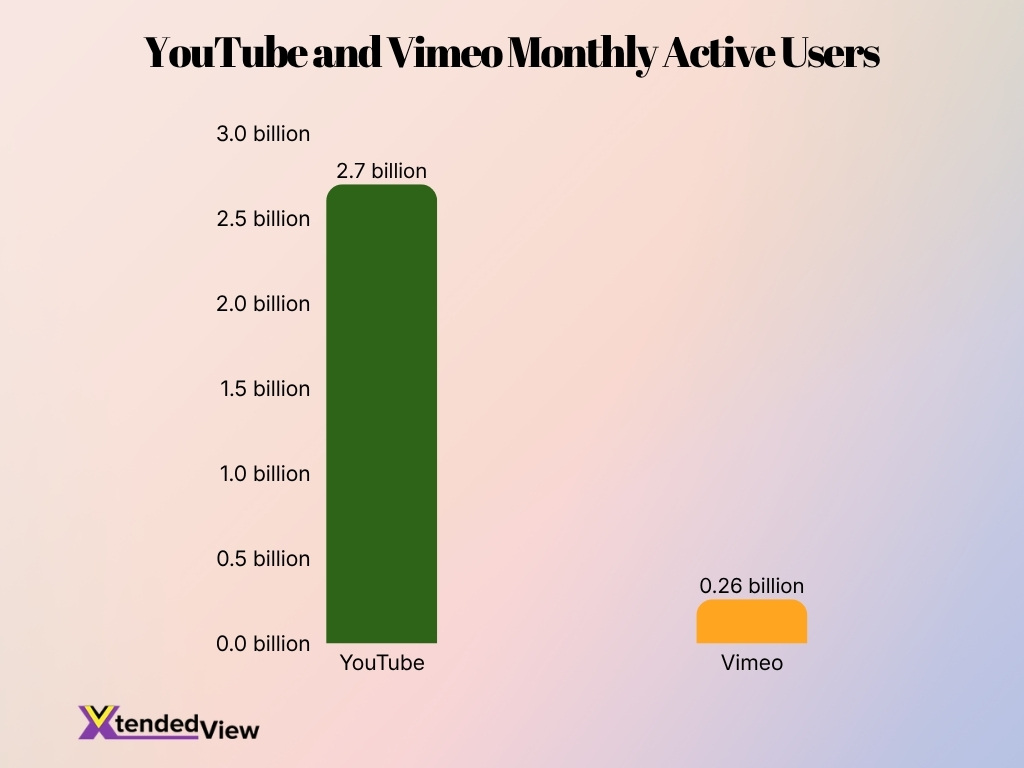
- YouTube recorded approximately 2.7 billion monthly active users globally in 2026.
- Exploding Topics estimated YouTube’s user base at 2.58 billion monthly active users in early 2026.
- Vimeo’s active audience stood at roughly 260 million users according to multiple industry estimates in 2025 and 2026.
- Vimeo’s audience reportedly grew from 260 million to around 300 million users between 2022 and 2023.
- YouTube attracts more than 122 million daily active users globally.
- More than 70% of YouTube watch activity comes from mobile devices.
- YouTube users watch content across smartphones, connected TVs, desktops, gaming consoles, and smart displays.
- Vimeo maintains stronger penetration among business users who require secure hosting, password protection, and collaboration features.
- YouTube’s massive scale helped it remain one of the top two most visited websites globally in 2026.
Audience Demographics Across YouTube and Vimeo
- Adults aged 18 to 34 remain YouTube’s largest audience segment in 2026, accounting for a major share of total viewing activity.
- Roughly 54% of YouTube’s global audience is male, while female users represent about 46%.
- In the US, nearly 95% of adults aged 18 to 29 use YouTube regularly, making it the country’s most-used social video platform.
- Vimeo attracts a more professional audience that includes filmmakers, agencies, SaaS companies, educators, and enterprise communication teams.
- YouTube reaches a broader consumer demographic across entertainment, gaming, education, music, sports, and creator content.
- Vimeo users typically show higher engagement with long-form creative and branded video content compared to mass-market entertainment clips.
- More than 80% of US parents report that children under 11 watch YouTube content regularly.
- Vimeo’s audience skews toward higher-income business users willing to pay for premium hosting and collaboration tools.
- YouTube’s connected TV audience expanded significantly in 2025 and 2026, especially among viewers over age 35.
Country Distribution of YouTube and Vimeo Users
- India remained YouTube’s largest market in 2026 with approximately 491 million users.
- The United States ranked second with roughly 253 million YouTube users in 2026.
- Brazil continued as one of YouTube’s strongest engagement markets with over 144 million users.
- Indonesia contributed more than 139 million YouTube users, driven by strong mobile adoption.
- Vimeo’s professional user base remains heavily concentrated in North America and Western Europe.
- The US accounted for a significant portion of Vimeo’s enterprise and creative agency customers in 2026.
- YouTube is available in more than 100 countries and supports over 80 languages globally.
- Vimeo maintains stronger adoption in industries such as media production, higher education, healthcare, and corporate communications.
- Emerging markets across Southeast Asia, Africa, and Latin America continue fueling YouTube’s annual audience growth.
Regional Distribution of YouTube and Vimeo User
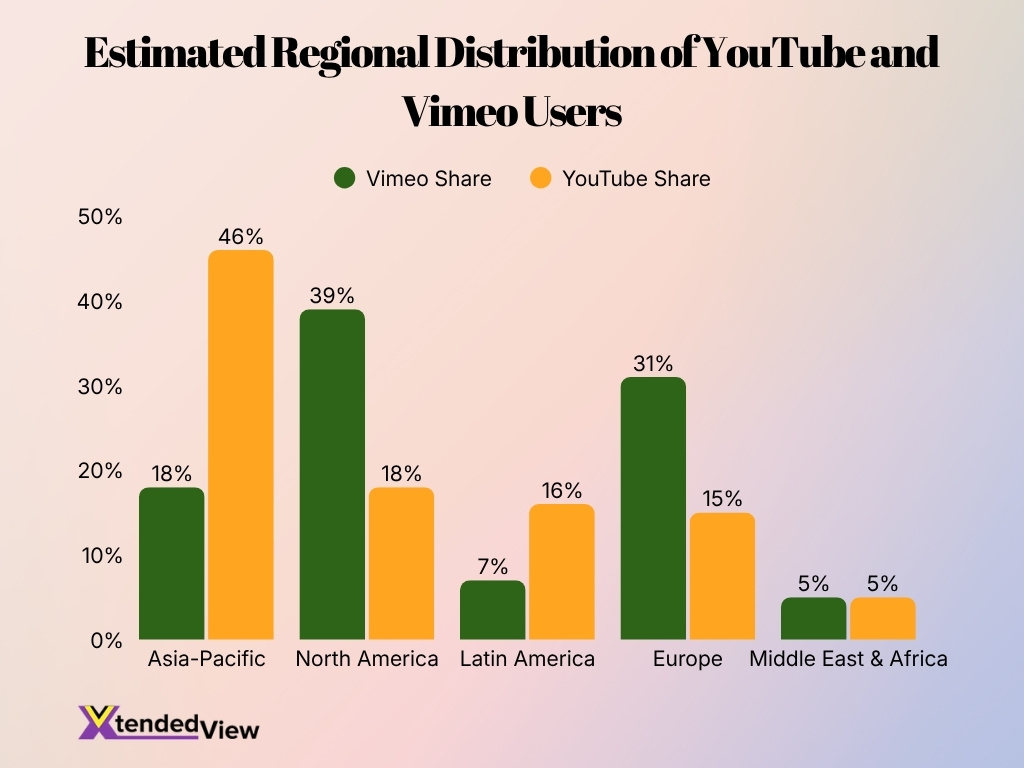
- Asia-Pacific dominates YouTube’s user base, accounting for the largest share at 46%, showing YouTube’s strong reach in high-population digital markets.
- North America is Vimeo’s biggest region, representing 39% of its estimated user distribution, compared with only 18% for YouTube.
- Europe is also a major Vimeo market, contributing 31% of Vimeo users, which is more than double YouTube’s European share of 15%.
- YouTube has stronger adoption in Latin America, with 16% of its user base coming from the region, compared with 7% for Vimeo.
- Vimeo appears more concentrated in Western markets, as North America and Europe together account for 70% of its estimated user distribution.
- YouTube has a broader global spread, with Asia-Pacific and Latin America together making up 62% of its estimated users.
- The Middle East & Africa have the smallest share for both platforms, with each platform recording 5% in the region.
- The data suggests that YouTube is more mass-market and globally distributed, while Vimeo has a stronger professional and business-oriented presence in North America and Europe.
Revenue Comparison of YouTube and Vimeo
- YouTube generated more than $60 billion in total revenue in 2025, making it one of Alphabet’s biggest growth engines.
- YouTube’s advertising revenue alone reached about $36.1 billion in 2024 and stayed above $36 billion in 2025-era estimates.
- YouTube’s revenue mix includes ads, Premium, TV, Super Chats, memberships, and shopping, which gives it multiple monetization streams.
- YouTube Premium and subscription products contributed roughly $19.6 billion in 2025 in a 2026 revenue breakdown.
- Google disclosed that YouTube’s paid subscriptions surpassed 325 million in 2025, showing strong recurring revenue growth.
- Vimeo’s annual revenue was about $417 million in 2024, with trailing revenue near $415 million in 2025.
- Vimeo reported around $103 million in Q1 2025 revenue, reflecting its much smaller scale than YouTube.
- Vimeo’s business model is subscription-led, with four premium plans and pricing ranging from $7 to $75 per month.
- Vimeo’s enterprise segment reached nearly 3,800 subscribers by Q3 2024, showing steady growth in its SaaS customer base.
- YouTube had about 2.7 billion monthly active users, while Vimeo had about 170 million to 260 million, depending on the source and timeframe.
Engagement Statistics on YouTube and Vimeo
- YouTube users watch over 1 billion hours of video content daily worldwide.
- YouTube Shorts generate more than 200 billion views every day globally.
- Average YouTube viewing session lasts about 19 minutes, with users watching 8-9 videos per visit.
- YouTube on connected TVs reaches over 200 million monthly viewers in the US, accounting for 60% of watch time.
- Vimeo attracts 715 million video views monthly, with 58% of traffic from mobile devices.
- Vimeo’s business plans have 240,000 subscribers, focusing on professional collaboration tools.
- YouTube holds 9.7% of all US television viewership, surpassing Netflix’s 7.6%.
- YouTube Shorts boasts a 5.91% engagement rate, the highest among short-form platforms.
- Vimeo enterprise subscribers grew to 3,800 by Q3 2024, emphasizing team review systems.
Paid Subscriber Statistics for YouTube and Vimeo
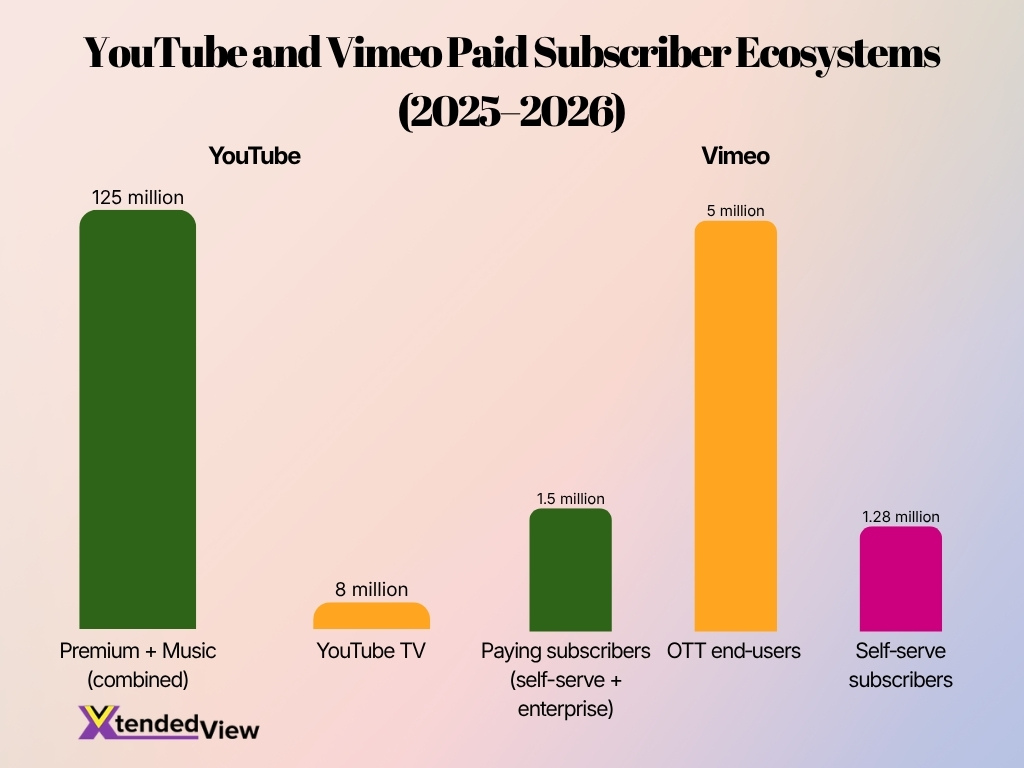
- YouTube Premium and YouTube Music reached 125 million combined subscribers worldwide by early 2026.
- YouTube TV exceeded 8 million subscribers in the US as of late 2025.
- Vimeo reported approximately 1.5 million paying subscribers across self-serve and enterprise plans.
- Vimeo’s OTT platform serves about 5 million end-users for creators and streamers.
- YouTube added 25 million net subscribers to Premium and Music in the past year through Q1 2026.
- Vimeo Enterprise grew to nearly 3,800 subscribers by Q3 2024, targeting large organizations.
- YouTube TV is projected to hit 12.4 million US subscribers by the end of 2026.
- Vimeo self-serve subscribers stood at 1.28 million in recent quarters.
- YouTube subscriptions contributed to Google’s total of 350 million paid users across services in Q1 2026.
Traffic and Reach Analysis of YouTube and Vimeo
- YouTube attracted 2.72 billion monthly logged-in users globally in 2026.
- Vimeo records approximately 69 million monthly visits as of late 2025.
- YouTube commands 60% of US watch time on connected TVs, surpassing mobile.
- Over 70% of global YouTube visits originate from mobile devices.
- YouTube operates in 100+ countries with localized versions worldwide.
- Vimeo derives 65% of desktop traffic from direct sources.
- 95% of US adults aged 18-44 use YouTube monthly.
- Vimeo sees 58% of traffic from mobile devices.
- YouTube generated $36.1 billion in ad revenue in 2025.
- YouTube holds 97-99% market share in Google video search results.
Enterprise Growth Trends on YouTube and Vimeo
- Over 1.66 million verified companies now use Vimeo for enterprise‑grade video hosting and workflows in 2026.
- Vimeo’s enterprise segment grew from about 1,000 subscribers in early 2021 to nearly 3,800 subscribers by Q3 2024, reflecting strong B2B demand.
- Roughly 72% of organizations report using video more than 25 times per year for internal events, training, and townhalls.
- Around 60% of hybrid‑work employees now spend more than one hour per week consuming business‑related video content.
- More than 42% of global internet users access YouTube monthly, giving enterprises access to a massive audience for branded and educational content.
- YouTube is projected to reach 2.85 billion monthly active users by the end of 2026, reinforcing its role in large‑scale corporate webinars and customer‑acquisition campaigns.
- Enterprise‑focused video workflows now generate over 100 billion video plays on Vimeo, highlighting the platform’s scale in secure, internal deployments.
- Approximately 71% of enterprise respondents say on‑demand video archives are a “valuable storehouse” of institutional knowledge for onboarding and training.
- YouTube’s enterprise‑style ad‑based video services contribute roughly 10% of Alphabet’s total revenue in the first half of 2025, underscoring its commercial weight.
- Over one‑fifth of surveyed organizations expect hybrid work models to remain permanent, driving continued growth in internal training and corporate video usage on both YouTube and Vimeo.
Creator and Business Video Platform Usage
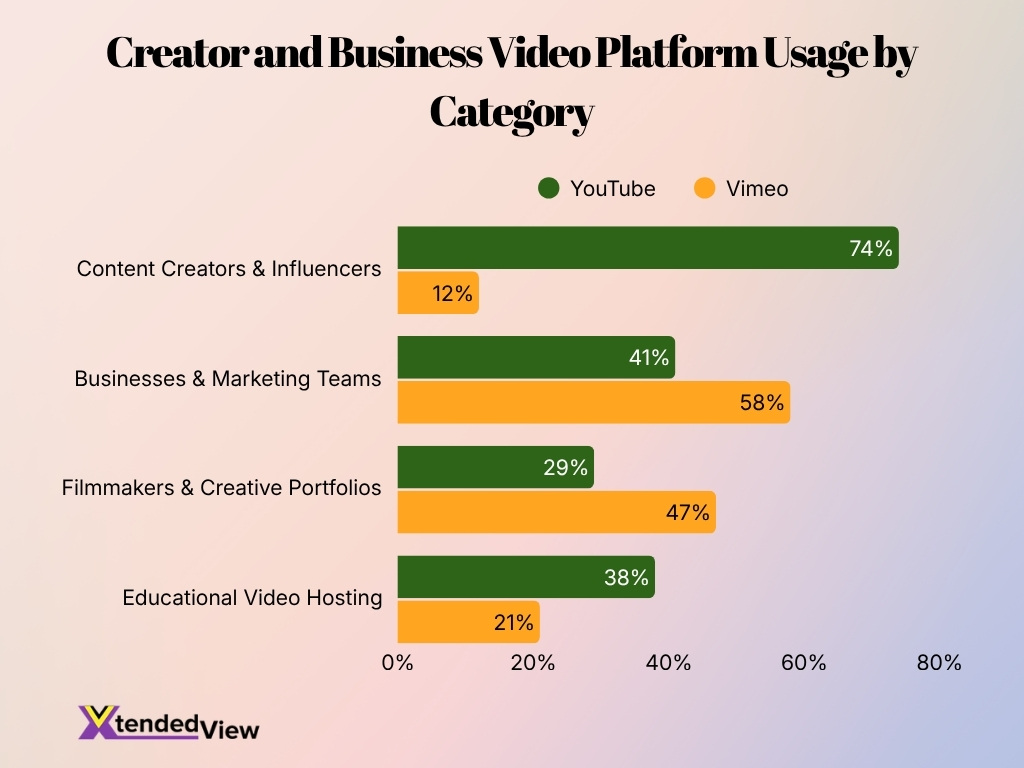
- YouTube dominates among content creators and influencers, with 74% usage, compared to only 12% for Vimeo.
- Vimeo performs strongest with businesses and marketing teams, reaching 58% usage, while YouTube stands at 41% in this category.
- Filmmakers and creative portfolio users prefer Vimeo more often, with 47% usage, compared to 29% for YouTube.
- Educational video hosting is stronger on YouTube, where usage reaches 38%, while Vimeo accounts for 21%.
- The biggest gap appears in content creator and influencer usage, where YouTube leads Vimeo by 62 percentage points.
- Vimeo’s advantage is most visible in business and creative use cases, especially among marketing teams and filmmakers.
- YouTube is better positioned for mass audience reach, while Vimeo appears more focused on professional, branded, and portfolio-based video hosting.
- Overall, the data shows that YouTube is more creator-led, while Vimeo is more business- and portfolio-oriented.
SEO Performance of YouTube and Vimeo Videos
- YouTube videos appear in roughly 26% of Google search results, making them far more visible than most other video platforms.
- Videos optimized for both YouTube and Google SEO are up to 53 times more likely to rank on the first page of Google than text‑only pages.
- Nearly 68.2% of videos on Google’s first page are in HD quality, reinforcing YouTube’s dominance in high‑quality indexed results.
- YouTube channels report that 28% of their views now come from search, up from 23% in 2024, highlighting stronger SEO‑driven discovery.
- YouTube Shorts reach about 2 billion monthly users, and Shorts views have overtaken many long‑form formats on mobile‑first search.
- Vimeo‑hosted videos appear in Google search far less frequently, with studies indicating that fewer Vimeo videos surface in SERPs compared with YouTube.
- Brands embedding YouTube videos report up to 157% more organic traffic on pages containing well‑optimized YouTube content.
- YouTube thumbnails in Google video carousels achieve an average 4% CTR, and strong thumbnails can lift CTR by up to 41% over plain text links.
- Vimeo’s cleaner embeds improve the on-site experience, but only about 3% of global video search traffic flows through Vimeo versus YouTube.
- Vimeo videos embedded with structured data appear in Google for about 10–15% of eligible video queries, mostly when hosted on brand‑owned domains.
Watch Time Comparison Between YouTube and Vimeo
- YouTube users watch over 1 billion hours of content daily worldwide.
- Global YouTube users average 48.7 minutes daily watch time in 2026.
- Vimeo users average 3 minutes 22 seconds per video session.
- YouTube connected TVs reach 1 billion hours watched daily.
- YouTube Shorts sessions average 14-15 minutes with 12-18 videos.
- Vimeo.com’s average visit duration stands at 3:33 minutes.
- U.S. YouTube users average 48.6 minutes daily watch time.
- YouTube mobile sessions average 25 minutes, desktop 14 minutes.
- Vimeo sees 715 million monthly video views across users.
Device-Based Watch Time for YouTube and Vimeo
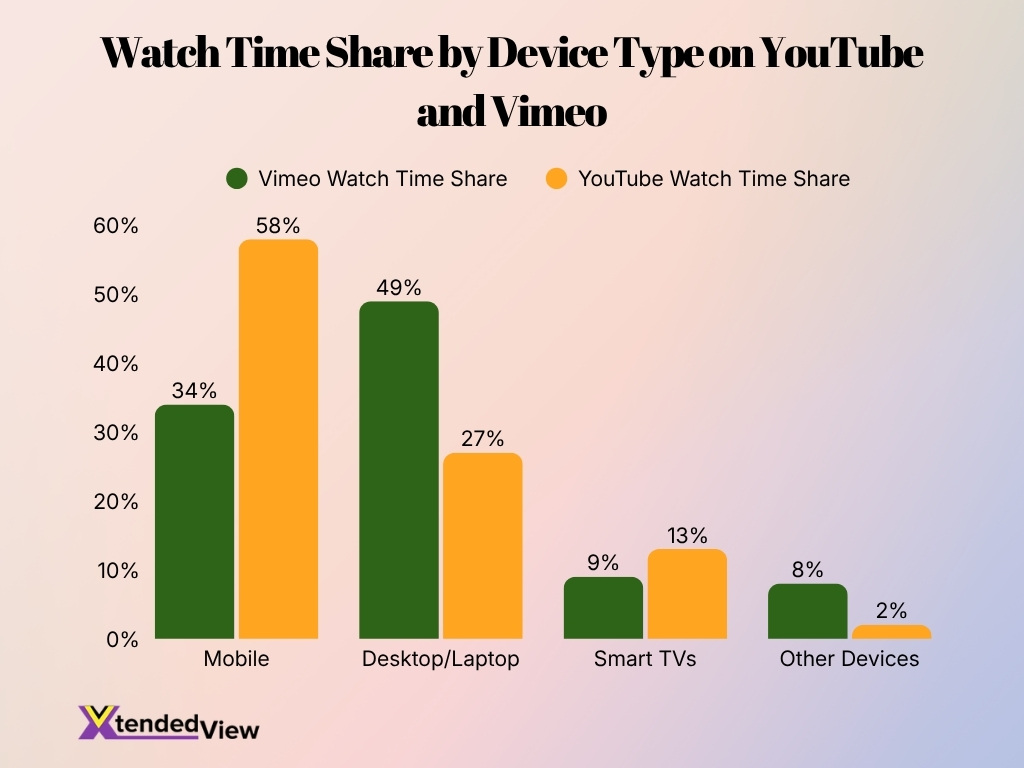
- Mobile dominates YouTube watch time, accounting for 58% of total viewing, showing that YouTube is strongly driven by smartphone-based consumption.
- Desktop/Laptop is the leading device for Vimeo, contributing 49% of watch time, which suggests Vimeo is more commonly used in professional, work, or portfolio-viewing environments.
- YouTube has a much higher mobile watch time share than Vimeo, with 58% vs 34%, highlighting YouTube’s stronger appeal for on-the-go video viewing.
- Vimeo users spend more time watching on Desktop/Laptop, with 49% of watch time compared to YouTube’s 27%.
- Smart TVs account for 13% of YouTube watch time, slightly higher than Vimeo’s 9%, indicating YouTube has broader adoption for living-room entertainment.
- Other Devices represent only 2% of YouTube watch time, but 8% for Vimeo, suggesting Vimeo has a more varied device usage pattern outside the main categories.
- Overall, the data shows that YouTube is mobile-first, while Vimeo is more desktop-oriented, reflecting different audience behavior and platform use cases.
Video Quality Comparison on YouTube and Vimeo
- Vimeo retains 12-18% more visual detail than YouTube at equivalent resolutions.
- Vimeo encoding preserves superior color depth and detail for professional footage.
- YouTube recommended a 4K bitrate of 35–45 Mbps for standard frame rates.
- Vimeo recommends a 40-50 Mbps bitrate for 4K uploads.
- Vimeo audio quality reaches 320 Kbps, the highest MP3 bitrate.
- YouTube standard audio streams at 128 Kbps, premium at 256 Kbps.
- Vimeo supports 10-bit HDR with over 1 billion colors in 4K and 8K.
- Both platforms support up to 8K resolution and HDR playback.
- Vimeo free tier limits to 1GB storage, paid up to 7TB.
- Professional creators favor Vimeo for minimal compression artifacts.
Vimeo vs YouTube Live Streaming Comparison
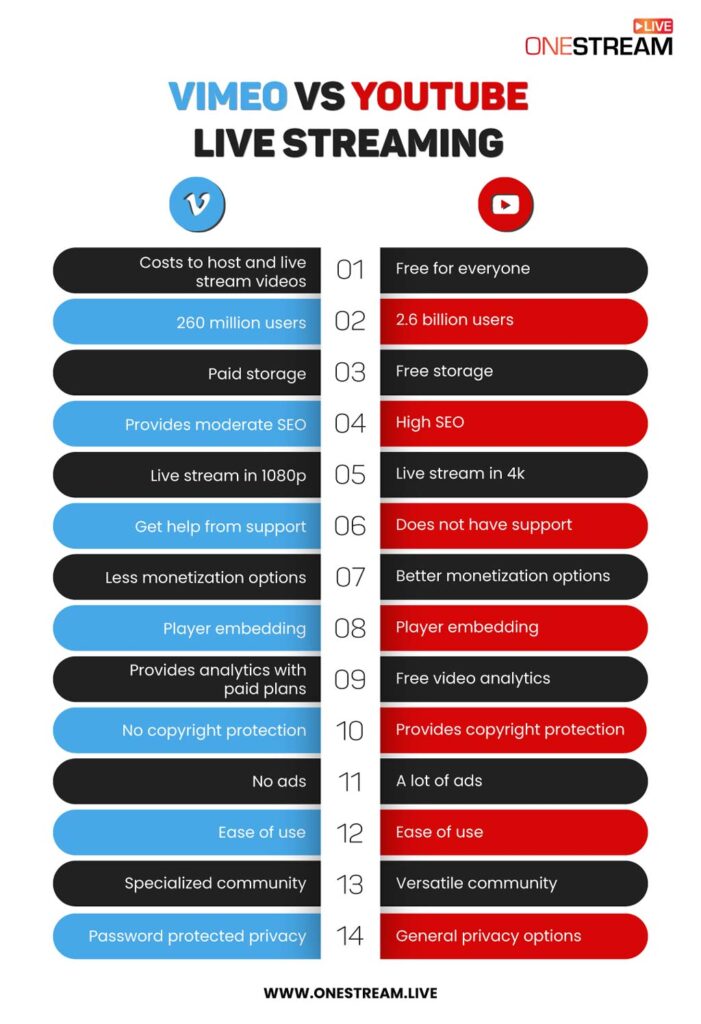
- YouTube has a much larger user base, with 2.6 billion users, compared to Vimeo’s 260 million users, making YouTube stronger for mass audience reach.
- Vimeo is more suitable for professional and controlled video hosting, as it offers password-protected privacy, no ads, and direct support access.
- YouTube is more cost-friendly for beginners, because it is free for everyone and includes free storage, while Vimeo requires users to pay for hosting and storage.
- YouTube performs better for visibility and discovery, offering high SEO, whereas Vimeo provides only moderate SEO.
- YouTube supports higher live streaming quality, with live streams available in 4K, while Vimeo supports live streaming in 1080p.
- Vimeo offers a cleaner viewing experience because it has no ads, while YouTube shows a lot of ads, which may affect the viewer experience.
- YouTube provides stronger monetization opportunities, offering better monetization options compared to Vimeo’s limited monetization options.
- Both platforms support player embedding, making it easy to add videos to websites, landing pages, and blogs.
- YouTube offers free video analytics, while Vimeo provides analytics mainly through paid plans.
- YouTube provides copyright protection, while Vimeo is shown as having no copyright protection in the comparison.
- Vimeo is better for niche creators and professional communities, thanks to its specialized community, while YouTube serves a broader and more versatile community.
- Both platforms are easy to use, making them accessible for creators, businesses, educators, and marketers.
Monetization Statistics for YouTube and Vimeo
- YouTube paid creators, artists, and media partners more than $70 billion over the last three years.
- YouTube advertising revenue reached $36.1 billion in 2024, reflecting a 14.6% year-over-year growth.
- Shorts accounted for 22% of YouTube’s total ad revenue in 2025, up from 15% in 2024.
- Eligible creators receive a 45% share of the ad revenue generated from the YouTube Shorts creator pool.
- Only about 4% of active YouTube channels are currently enrolled in the YouTube Partner Program.
- Most YouTube creators earn between $1 and $10 per 1,000 views based on their specific content RPM.
- Vimeo subscribers increased to over 7.09 million by the end of 2023, up from 6.4 million in 2022.
- Subscription video-on-demand accounted for 47.23% of the total video-on-demand market revenue in 2025.
- Over-the-top streaming services held a 59.42% share of the total video-on-demand market in 2025.
Pricing Comparison of YouTube and Vimeo
- YouTube remains free for viewing and uploading, with creators earning ad revenue from a platform that reaches over 2.7 billion logged‑in monthly users.
- The YouTube Premium Individual plan in the US costs $13.99 per month in 2026, up from previous lower tiers.
- YouTube TV’s Base Plan in the US hit $82.99 per month in 2026, with specialized plans starting around $54.99 per month.
- Vimeo’s Starter paid plan begins at $20 per month for creators and small businesses, offering limited storage and user seats.
- Vimeo’s Standard plan runs about $41 per month when billed monthly, providing higher upload quotas and more storage.
- Vimeo’s Advanced tier can cost $125 per month, aimed at teams needing expanded video limits and workflow tools.
- YouTube’s free model supports over 2 billion active users with no direct hosting fees, while Vimeo charges for extra storage starting around $20–$125 per month.
- Vimeo’s Enterprise pricing is custom‑quoted, often ranging from hundreds to thousands of dollars per month depending on storage, security, and analytics.
- YouTube TV subscribers in the US pay a median of around $72–$83 per month in 2026, making it significantly more expensive than basic YouTube Premium.
- Vimeo’s OTT subscriber monetization adds $1 per subscriber per month plus 2.5% + 30¢ payment fees, while YouTube typically relies on ad‑share revenue.
Frequently Asked Questions (FAQs)
YouTube has approximately 2.7 billion monthly active users worldwide in 2026.
Vimeo has an estimated 260 million to 300 million active users globally in 2026.
YouTube generated more than $60 billion in revenue from ads and subscriptions in 2025.
YouTube Shorts averages over 200 billion daily views globally.
Vimeo Streaming supports more than 13 million active subscribers across its creator and OTT ecosystem.
Conclusion
YouTube and Vimeo continue serving different corners of the online video economy. YouTube dominates in audience size, creator monetization, advertising revenue, and global reach. Its ecosystem supports entertainment creators, brands, educators, livestreamers, and ecommerce businesses on a massive scale.
Meanwhile, Vimeo maintains a strong position among professional creators, enterprises, agencies, and organizations that prioritize video quality, branding control, privacy, and ad-free experiences. While Vimeo cannot compete with YouTube’s reach, it remains highly valuable for premium hosting and enterprise communication.
As video consumption keeps expanding across mobile devices, connected TVs, ecommerce, and hybrid workplaces, both platforms will continue evolving in distinct ways. Businesses and creators choosing between YouTube and Vimeo increasingly base their decisions on audience goals, monetization strategy, discoverability needs, and content ownership requirements.
